113
Factors affecting the adoption and implementation of ISO 14001/EMS in Oman: a
study of SME sectors
Gopalakrishnan Chinnasamya*, Preeti Srivastavab, Gopalakrishnan Soundararajanc Fahad Nasser Humaid AL-Saidyd
a* Muscat College, Muscat, Oman. [email protected] (Corresponding author).
b Muscat College, Muscat, Oman. [email protected] c Muscat College, Muscat, Oman. [email protected]
d Muscat College, Muscat, Oman. Corresponding author
ARTICLE HISTORY:
Received: 14-Apr-2017 Accepted: 24-May-2017 Online available: 07-Jun-2017
Keywords:
Small and medium sized enterprises,
ISO14001,
Environmental management System,
Quality,
Environmental issues, Implementation
ABSTRACT
This study intends to observe and examine the various external and internal influences, which are affecting the small to medium-sized enterprises (SMEs) in Oman to accept ISO14001 or reject Environment Management System (EMS). The concept of implementing quality accreditation by small firms is relatively small as compared to bigger firms. Market in general is cynical about the long-term benefits of this quality certification in relation with the costs incurred by the SMEs. The SMEs in Oman are typically focused on a few sectors namely transportation, chemicals, construction, automobile, manufacturing, storage, textiles and food & beverage. This research is an effort to identify and provide solutions and recommendations for successful implementation of ISO 14001 for Omani SMEs.
Contribution/ Originality
The present study identified the gaps in literature in terms of stakeholders’ contribution and involvement towards the implementation of EMS in SME’s Oman and examined SME’s inventiveness in Oman associated with environment to assess the various factors which have influenced/are influencing the stakeholders’ regarding the implementation of ISO14001/ Environmental Management System (EMS) in Oman SME’s.
DOI: 10.18488/journal.1007/2017.7.5/1007.5.113.123 ISSN (P): 2306-983X, ISSN (E): 2224-4425
Citation: Gopalakrishnan Chinnasamy, Preeti Srivastava, Gopalakrishnan Soundararajan and Fahad Nasser Humaid AL-Saidy(2017). Factors affecting the adoption and implementation of ISO
14001/EMS in Oman: a study of SME sectors. Asian Journal of Empirical Research, 7(5),
113-123.© 2017 Asian Economic and Social Society.All rights reserved
Asian Journal of Empirical Research
Volume 7, Issue 5(2017): 113-123114
1. INTRODUCTION
According to Christmann (2000), recognition of Small and Medium Enterprises (SMEs) as one of the propellers of country’s backbone is agreed and accepted by several governments. Generally SMEs are considered as a prime driver of economic growth and employment. Subsequently contributing in regional development and improving standards. Similarly Bansal and Roth (2000)
mentioned that the contribution of SMEs in developed or developing nations is to push economic and social development while significantly affecting a political environment. Same is the case for countries evaluating from expertise to marketing base economy. According to Gerstenfeld and Roberts (2000), there is no immediate or long term benefits in picture, present managers ever so often believe that these environmental issues and concerns are building undue burden on them. In similar lines Anglada (2000) stated that large firm’ also feels that to implement these guidelines, the amount of investment and reputation is too overpriced. The SMEs felt that the implementation as part of their “corporate social responsibility” is not a way of guaranteeing success or further enhancement of customer loyalty (Yu, 2001).
Several researchers contradicted it and the ISO 14001 have seen to improve not only environment but also a tool to monitor performance of organizations (Petts et al., 1999). Preliminary assessment of all existing practices for protecting the environment is mandatory first step of all SMEs. According to Worthington et al. (2006), one major factor, which will force SMEs to accept EMS / ISO 14001 shall be pushing from government or other, related establishments. It’s compulsory for firms to appear authentic and accountable towards stakeholders, thus adopting ISO 14001 showcases the external stakeholders of firms environment obligations. It’s a known fact that small firms assumed the relation between business and waste materials generated as proportional and thus do not make concrete efforts to resolve. SMEs will not react if the impact/effect is high in ratio but will swiftly respond if the influence is small (Hillman andKeim, 2001).
It’s high time to adapt and embrace new global development regarding this topic. Business policies nowadays have a dedicated section for environment management practices. The approach from purely looking for the economic profit is shifting towards profound management strategies (King et al., 2001). Tilley (2000) observed that instead of sector specific procedures and guidelines, the SMEs only have general information on the environment subject. This is because they take environment compliance as additional work or liability. It’s challenging for them to understand & comprehend the government regulations. Without proper instructions in environment management, the SMEs poorly handle environmental topics and concerns (Hitchens et al., 2003).
2. LITERATURE REVIEW
It was noted by Hillary (2004) that SMEs mostly consider environment issues as external to business and an encumbrance. Also business managers have this feeling that in the long term these environmental topics and concerns are baseless with no immediate or further benefits (Simpson et
al., 2004). Similarly large organizations believe that it’s expensive to implement these
environmental guidelines when compared with the magnitude of investment. According to (Anglada, 2000), these regulations can become part of “corporate social responsibility” of large organizations but for sure it cannot assure business accomplishments.
115
2.1. Implementation of ISO14001 environmental management system (EMS)
ISO 14001 is documented to improve environment engagement of organizations (Willard, 2005). According to ISO 14001, primary task for SMEs is to undergo assessment of all existing environment safety procedures by recognizing government responsibilities/duties and identifying/correcting all internal procedures concerning to environment. Secondary task consists of involving external auditors to do audits. This really helps in understanding firm’s present standing and drafting future roadmaps. Further improving organization’s market standards and industry levels
(Potoski and Prakash, 2005).
2.1.1. Reasons for adopting ISO14001/EMS
Prime reason to adopt ISO1 4001 is to avoid penalties and decreased market standing. These are consequences of not following environmental guidelines and regulations. By following ISO 14001 the excess budgets due to fines/penalties are cut and profits looks like increasing. Once a firm is accredited with ISO 14001, encouraging market image is created and the firm is considered as accountable and responsible. This surely provides a competitive edge over competitors. Most SMEs are accepting ISO 14001 because of its reputation & high market value. They market / highlight ISO 14001 accreditation and even post on their firm’s website to make sure that customers and government know about their achievements. As per Weerasiri and Zhengang (2012), it was stated that government pressure and different external bodies push or force SMEs to change and adopt ISO 14001 (Potoski and Prakash, 2005). Thus adopting ISO 14001 cannot be avoided and is a symbol of environmental responsibility and commitment.
2.2. SMEs attitudes towards Environmental issues and their awareness levels
Believing that environmental impression is directly proportional to magnitude of their operations and generated industry waste, many SMEs do not make constructive efforts to adopt ISO 14001. They respond swiftly if they feel it is not going to affect too much of their budget and profits but the reaction is slow and unsteady if the equation is high (Hillman and Keim, 2001). In light of beginning of technology era, it becomes important for stakeholders to be conscious and responsible for their environment conventions. It’s also known that most of managers have sense of environmental benefits but they are apprehensive only about financial gains for which they are hired (Petts et al.,
1999). On the other hand, SMEs have understanding of environmental impacts but are limited due to their financial restrictions. Apart from financial area, there have also restricted manpower, resources, time and technical skills, etc. They also get few opportunities and practices to measure and showcase the actual impact of the environment on businesses. Thus the factors of low motivational levels and unwillingness to change their current situation make it challenging for SMEs to approve new systems (Tilley, 2000).
Similarly, Jenkins (2009) mentioned that various concerns linked with environment regulations and guidelines in different countries have made it extremely difficult for SMEs to adopt new systems. In contrast, according to (Hillary, 2000), it is particularly important and vital that SMEs understand the apparent benefits and approve these changes. Thus it is important to examine SME’s inventiveness in Oman associated with environment topics so that the shortcomings can be studied and suitable suggestions are provided to stakeholders.
2.3. Stakeholders and their impact on business
116
2.4. SMEs and environment complianceUnlike health and safety legislations, the environment departments in Oman have very less direct contact with the smaller firms. The insignificant pressure from government agencies results in SMEs shying away from ISO14001 certification. Majority of firm’s managers are uninformed of environmental guidelines and regulations and without persistent concern they tend not to take volunteer action to understand environmental issues with negligible contribute in environmental matters.
In following are the general four strategies which are followed by SMEs so as to be environment compliant:
Resistant strategy – In this strategy, the SMEs have very less knowledge and awareness of environment topics because of minimal pressure to assume change the SME take no action to improve leading to ignorance towards environmental management.
Proactive strategy – Contrasting above, in this case the SMEs put up intended effort to accept change leading to enhanced environmental management. They are inclined towards law, society and environment and the initiatives are often perpetual.
Reactive strategy – This case is a patch up or a quick fix solution. Reacting to increasing pressure to adopt change and improve environmental performance, the firm put in place provisional solution which is short lived.
Sustainable strategy – As part of this strategy the SME prepares and organizes full integration of environmental compliances with business management as his planned vision.
Further, Ajzen and Fishbein (1980) highlighted that SMEs use these compliances as a tactical tool to cut ahead of their competitors and capture market share. They exhibit their environmental compliance to gain customer loyalty. International firm’s SME who deals in high degree of exports were noted to be more exposed and positive towards environmental compliance, which in turns provides increased confidence and huge benefit while doing business in other countries which demands acceptance of regulations, guidelines and compliance. Thus this international pressure guarantees that the SMEs should have all the certifications, accreditations and working practices which are in line with international standards and environmental protocols. The SMEs need to realize that the benefits are immense and it can improvise their public loyalty, increase organizational proficiency and to improve public image (Ajzen and Fishbein, 1980). Generally if the implementation is done by systematic assessment, the results are positive and even economically beneficial because the decreased wastes indirectly help in reduction of complete cost.
3. RESEARCH METHODOLOGY
3.1. Research problem and research objectives
In Oman SMEs are propellers for jobs and also contribute towards economic performance. They are affected by the any changes in the global market and economic depression. With the importance to Oman’s economy SMEs need to respond to the environmental issues and also should be able to handle different challenges and required legal norms. Present research is an effort to understand and gauge the factors positive or negative affecting implementation of ISO14001/ Environmental Management System (EMS) in Oman. Select SME sectors in and around Muscat region have been taken for the present study due to time and other resource constraints. In the light of the research problem, the following research objectives has been framed.
To find out the various processes of environmental practices and how they influence implementation at the different level at various levels in the select SME sectors in Oman. To understand the challenges, barriers and various environmental issues of SMEs in Oman
in adopting ISO 14001.
117
3.2. Research designTo understand environmental problems, issues and challenges faced by SMEs a structured questionnaire is prepared which is both quantifiable and qualitative in nature. This questionnaire is distributed among selected group of SMEs.
3.3 Target population and sample size
Most of the Oman’s SMEs are focused in seven sector namely manufacturing, trade and services etc. From given complete list from the Ministry of commerce and above mentioned seven sectors, this study has shortlisted and will use 60 registered companies which will comprise as study unit. 3.4 Conceptual model
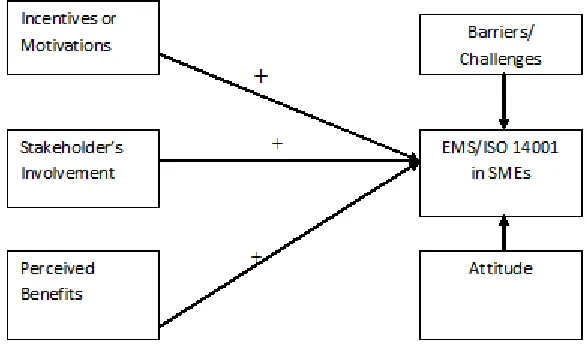
For SME to adopt EMS and procure ISO 14001, researchers have listed influences which acts as obstacles/hindrances and/or instigators. The following model comprises of all these factors influencing EMS implementation.
Figure 1: Research model for the study
3.5. Questionnaire design
The questionnaire is qualitative and quantitative in nature. The questionnaire purposefully contains organized questions enabling us to understand management issues, concerns and obstacles in implementing EMS standards. In three sections, set of questions will determine motivations, attitude, and apparent benefits with obstacles. The questionnaire is distributed to study unit as mentioned above which are 60 registered companies.
3.6 Data analysis
A statistical program named SPSS 16.0 is used to analyze data. The numerically coded collected data is enables the use of this program. The uncompromising data is divided into two parts independent and dependent variables. The independent variables comprises of ownership type, size of industry and market whereas dependent variables consists of obstacles, drivers etc. Further to analyze and draw interpretation, the study uses one way ANOVA and Garret Ranking Method.
4. ANALYSIS AND INTERPRETATION
4.1. One way analysis of variance analysis
118
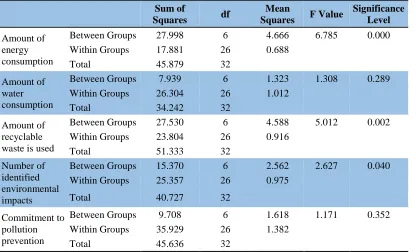
Table 1: Environmental performance and nature of industry
Sum of
Squares df
Mean
Squares F Value
Significance Level
Amount of energy consumption
Between Groups 27.998 6 4.666 6.785 0.000
Within Groups 17.881 26 0.688
Total 45.879 32
Amount of water consumption
Between Groups 7.939 6 1.323 1.308 0.289
Within Groups 26.304 26 1.012
Total 34.242 32
Amount of recyclable waste is used
Between Groups 27.530 6 4.588 5.012 0.002
Within Groups 23.804 26 0.916
Total 51.333 32
Number of identified environmental impacts
Between Groups 15.370 6 2.562 2.627 0.040
Within Groups 25.357 26 0.975
Total 40.727 32
Commitment to pollution prevention
Between Groups 9.708 6 1.618 1.171 0.352
Within Groups 35.929 26 1.382
Total 45.636 32
Sources: Survey data, 2016
The SPSS used to analyse the probability value (p) from the analysis of performance (ANOVA) was used from the collected primary data from the lower level of significance (0.05) in the identified factors regarding recyclable wastage used, amount of energy consumption and environmental facts. The study depict that the Null hypothesis is rejected at 95% level of confidence and the alternative hypothesis may be accepted.
In further, the study shows that the probability value from the above table (ANOVA) p value is > 0.05 at the 5% level of significance. Hence, it can be concluded that there is no identified significant difference regarding the pollution prevention commitment and water consumption. Therefore, the test is not significant at the 5% level of confidence.
Table 2: Regulatory performance and nature of industry
Sum of
Squares df
Mean
Squares F Value
Significanc e Level
Total cost of regulatory fines
Between Groups 26.212 6 4.369 3.217 0.017
Within Groups 35.304 26 1.358
Total 61.515 32
Total cost of regulatory compliance
Between Groups 64.170 6 10.695 162.774 0.000
Within Groups 1.708 26 0.066
Total 65.879 32
Number of regulatory agency inspections
Between Groups 22.589 6 3.765 6.505 0.000
Within Groups 15.048 26 0.579
Total 37.636 32
Management's commitment
Between Groups 11.422 6 1.904 2.102 0.088
119
Total 34.970 32
Sources: Survey data, 2016
The SPSS used to analyse the probability value (p) from the analysis of performance (ANOVA) was used from the collected primary data from the lower level of significance (0.05) in the identified factors regarding cost of regularity compliances, cost of regularity of fines and the number of regulatory agency inspection. The study depict that the Null hypothesis is rejected at 95% level of confidence and the alternative hypothesis may be accepted.
In further, the study shows that the probability value from the above table (ANOVA) p value is > 0.05 at the 5% level of significance. Hence, it can be concluded that there is no identified significant difference regarding the management commitment towards environmental management system and the test is not significant at the 5% level of confidence.
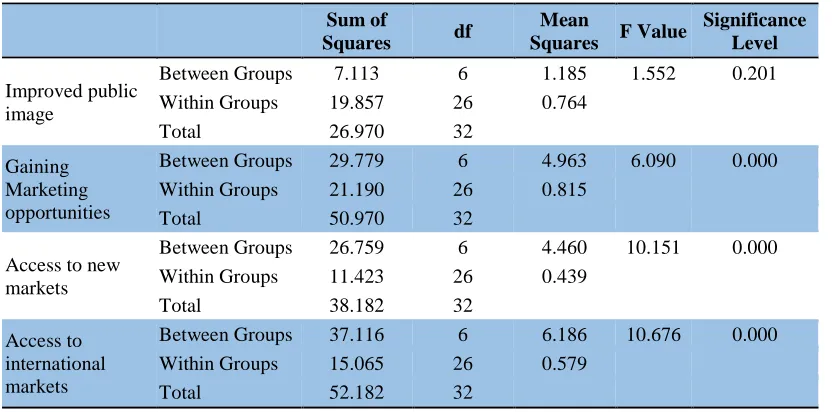
Table 3: Competitive advantage and nature of industry
Sum of
Squares df
Mean
Squares F Value
Significance Level
Improved public image
Between Groups 7.113 6 1.185 1.552 0.201
Within Groups 19.857 26 0.764
Total 26.970 32
Gaining Marketing opportunities
Between Groups 29.779 6 4.963 6.090 0.000
Within Groups 21.190 26 0.815
Total 50.970 32
Access to new markets
Between Groups 26.759 6 4.460 10.151 0.000
Within Groups 11.423 26 0.439
Total 38.182 32
Access to international markets
Between Groups 37.116 6 6.186 10.676 0.000
Within Groups 15.065 26 0.579
Total 52.182 32
Sources: Survey data, 2016
The SPSS used to analyse the probability value (p) from the analysis of performance (ANOVA) was used from the collected primary data from the lower level of significance (0.05) in the identified factors like gaining marketing opportunities, access to new markets and access to international markets. The study depict that the Null hypothesis is rejected at 95% level of confidence and the alternative hypothesis may be accepted.
120
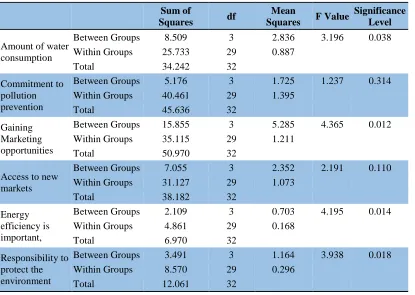
Table 4: Environmental performance and number of years
Sum of
Squares df
Mean
Squares F Value
Significance Level
Amount of water consumption
Between Groups 8.509 3 2.836 3.196 0.038
Within Groups 25.733 29 0.887
Total 34.242 32
Commitment to pollution prevention
Between Groups 5.176 3 1.725 1.237 0.314
Within Groups 40.461 29 1.395
Total 45.636 32
Gaining Marketing opportunities
Between Groups 15.855 3 5.285 4.365 0.012
Within Groups 35.115 29 1.211
Total 50.970 32
Access to new markets
Between Groups 7.055 3 2.352 2.191 0.110
Within Groups 31.127 29 1.073
Total 38.182 32
Energy efficiency is important,
Between Groups 2.109 3 0.703 4.195 0.014
Within Groups 4.861 29 0.168
Total 6.970 32
Responsibility to protect the environment
Between Groups 3.491 3 1.164 3.938 0.018
Within Groups 8.570 29 0.296
Total 12.061 32
Sources: Survey data, 2016
The SPSS used to analyse the probability value (p) from the analysis of performance (ANOVA) was used from the collected primary data from the lower level of significance (0.05) in the identified factors like gaining marketing opportunities, good environment management essentiality and waste minimization. The study depict that the Null hypothesis is rejected at 95% level of confidence and the alternative hypothesis may be accepted.
In further, the study shows that the probability value from the above table (ANOVA) p value is > 0.05 at the 5% level of significance. Hence, it can be concluded that there is no identified significant difference among respondents for the amount of waste consumption, access to new markets and commitment to pollution prevention and the test is not significant at the 5% level of confidence. 4.2. Rank analysis (Garret Ranking Method)
The scores earned by the selected factors are added together and it is divided by total value calculated for which the scores are added. This ranking method is converted scores from the ranks obtained.
Table 5: Implementation of ISO 14001 and environmental management system and stakeholder’s engagement
Factors Garret value Mean score Rank
Communication on Community engagement 3600 36.00 1
Implementation and customer requirement 3598 35.98 2
Support from top and middle management 3581 35.81 3
Demand/ need from the customers 3573 35.73 4
Environmental stewardship demonstration among public 3474 34.74 5
Demand from the company employees 3257 32.57 6
121
From the above analysis using Garret ranking method the Communication on Community engagement is attained the top rank with value of 3600 and the next position occupied by the factor Implementation and customer requirement with 3598. There is no much difference identified between these two factors. The Support from top and middle management holds the third position with the garret value of 3581. The fourth position holds by customer demand with a garret value of 3573. The 5th and 6th ranks are obtained by the last two positions such as 5th and 6th rank holds by Environmental stewardship demonstration among public with the garret value of 3474 and Demand from the company employees with the garret value of 3257. So it inferred that the stakeholders are paying attention in communicating their corporate social responsibility to the society and the needs and wants of fulfilling the customer requirements.
5. FINDINGS AND CONCLUSION
5.1 Implication of the research
After interpreting the findings, various inferences can be derived from this research. The prime discussion is about factors and influencers of Oman market which impacts the implementation of ISO 14001/EMS. The study brought forward the real challenges and obstacles faced by SMEs while implementing ISO 14001/EMS. SMEs have special place in Oman economy and they contribute significantly toward growth of economy. Thus it is desirable to understand the benefits of adopting ISO 14001.
By saving energy and reducing water wastages the SME will save money and apparently increase profits. Also the reduce waste disposals will help and cut cost. To achieve these benefits SME should be far sighted and focus on longer forecasts in contrast to shorter gains. SMEs are the ones who can push their employees to go for workshops and trainings keeping them up-to-date with the latest developments in environmental management. Customer pressure to accept ISO 14001 on SMEs is also significant. The factors SMEs should consider before adopting ISO 14001 includes resource management, change management, manpower and cost.
Among other factors which can influence & motivate SME to adopt ISO 14001, pressure from supply chain shall be the front runner together with pressure from large corporations to smaller companies to shown their environment certificate before taking up their projects. Public pressure can also be effective, reputation damage if public know that a firm is doing business without proper accreditations can be major driving factor which can eventually leads to financial loss.
This study showcased strong need of support mechanism for SMEs like the directives from ministry should be crystal clear. Other examples can be technical know how, better marketing etc. SMEs perception should match with market scenarios. Whether trade associations or Oman government will take initiative to encourage SME adopt & implement environment management systems, will remain a question.
5.2. Suggestions
For effective adoption and implementation of ISO 14001/EMS, following suggestions for the stakeholders should be ensured.
General awareness campaigns and workshops should be organized in Oman so that even a common man together with SMEs understands the significance of environmental issues and impacts. This should be organized by chamber of commerce.
School & college text books should include chapters including environmental management and compliance. Even some professional course should be lined up by Ministry of higher education.
122
The SMEs should be self-motivated and self-directed to protect environment and adopt green & clean environment.
Survey showed that most of the SMEs were unaware of informative programs launched by government (Ministry in Oman) thus miscommunication should be avoided.
5.3. Conclusion
The current study addressed and answered the key and basic research question “what factors enable or obstacle adoption & implementation of ISO 140001/EMS in Oman linking to SME sector”. Further we discussed factors & parameters which forces SMEs to implement ISO 14001, some of them are customer/public requirements, stakeholder pressure etc. However, no such evidence was found about regulatory compliance being driving factor of SMEs adopting ISO14001/EMS.
5.4 Limitations of the Study Following listed are the limitations:
The sample size is fixed and hence the results cannot be generalized to the larger sample size or population of the SMEs. The study is geographically restricted / limited to Oman. Only few key parameters are concentrated namely Environmental Issues, Challenges &
Management Practices, Resource Conservation, Competitiveness, Pollution Prevention and Economic Performance only
Not all participated; some participants were hesitant to answer.
To cover all selected SME and personally approaching them requires lots of time and money. Thus these were also important constraints.
Funding: This study received no specific financial support.
Competing Interests: The authors declared that they have no conflict of interests.
Contributors/Acknowledgement: All authors participated equally in designing and estimation of current research.
Views and opinions expressed in this study are the views and opinions of the authors, Asian Journal of Empirical Research shall not be responsible or answerable for any loss, damage or liability etc. caused in relation to/arising out of the use of the content.
References
Ajzen, I., & Fishbein, M. (1980). Understanding attitudes and predicting social behavior. Prentice-Hall, Englewood Cliffs, NJ. view at Google scholar
Anglada, M. L. (2000). Small and medium-sized enterprises perceptions of the environment: a study from Spain, in R. Hillary (ed), small and medium-sized enterprises and the environment. Sheffield: Greenleaf Publishing, pp.62-74. view at Google scholar/ view at publisher
Bansal, P., & Roth, K. (2000). Why companies go green: a model of ecological responsiveness. Academy of Management Journal, 43(4), 717-736. view at Google scholar / view at publisher
Christmann, P. (2000). Effects of best practices of environmental management on cost advantage: the role of complementary assets. Academy of Management Journal, 43(4), 663- 680. view
at Google scholar/ view at publisher
Gerstenfeld, A., & Roberts, H. (2000). Size matters: Barriers and prospects for environmental management in small and medium-sized enterprises. in R. Hillary (ed), Small and Medium-Sized Enterprises and the Environment. Sheffield: Greenleaf Publishing, pp.106-118. view
at Google scholar/ view at publisher
Hillary, R. (2000). Small and medium-sized enterprises and the environment. Greenleaf Publishing Sheffield, pp. 121-130. view at Google scholar
123
Hillman, A. J., & Keim, G. D. (2001). Shareholder value, stakeholder management, and social issues: what’s the bottom line?. Strategic Management Journal, 22(2), 125-139. view at
Google scholar/ view at publisher
Hitchens, D., Clausen, J., Trainor, M., Keil, M., & Thankappan, S. (2003). Competitiveness, environmental performance and management of SMEs. Greener Management International,44, 45-57. view at Google scholar/ view at publisher
Jenkins, H. (2009). A business opportunity model of corporate social responsibility for small-and medium-sized enterprises business ethics. A European Review, 18(1), 21- 36. view at
Google scholar
King, A., & Lenox, M. (2001). Does it really pay to be green? an empirical study of firm environmental and financial performance. Journal of Industrial Ecology, 5(1), 105-116.
view at Google scholar/ view at publisher
Petts, J., Herd, A., Gerrard, S., & Horne, C. (1999). The climate and culture of environmental compliance within SMEs. Business Strategy and the Environment, 8, 14-30. view at Google
scholar/ view at publisher
Potoski, M., & Prakash, A. (2005). Green clubs and voluntary governance: ISO 14001 and firms’ regulatory compliance. American Journal of Political Science, 49(2), 235–48. view at
Google scholar/ view at publisher
Simpson, M., Taylor, N., & Barker, K. (2004). Environmental responsibility in SMEs: does it deliver competitive advantage?. Business Strategy and the Environment, 13, 156-171. view at
Google scholar/ view at publisher
Tilley, F. (2000). Small firm environmental ethics: how deed do they go?’ business ethics. A European Review, 9(1), pp. 31-41. view at Google scholar/ view at publisher
Weerasiri, S., & Zhengang, Z. (2012). Attitudes and awareness towards environmental management and its impact on environmental management practices (EMPs) of SMEs in Sri Lanka. Journal of Social and Development Sciences, 3(1), 16-23. view at Google scholar
Willard, B. (2005). The next sustainability wave: building boardroom buy-in. Gabriola Island: New Society Publishers. view at Google scholar
Worthington, I., Ram, M., & Jones, T. (2006). Exploring corporate social responsibility in the U.K. Asian small business community. Journal of Business Ethics 67(2), 201-217. view at
Google scholar/ view at publisher
Yu, T. F. (2001). Towards a capabilities perspective of small firm. International Journal of Management Reviews, 3(3), 185-197. view at Google scholar/ view at publisher
Appendix
Hypotheses
H1: There is positive impact on EMS/ISO14001 implementation and environmental performance and practices.
H2: There is positive impact on EMS/ISO14001 implementation and Stakeholders involvement. H3: Barriers and challenges have negative impact on EMS/ISO14001 implementation.