Article 1
An Exploration of the Sub-Register of Chemical Engineering Research
2Papers Published in English
34
Myrto-Panagiota Zacharof*
aand Anna Charalambidou
b 5a Centre for Cytochrome P450 Biodiversity, Institute of Life Science, Swansea University Medical 6
School, Swansea, Wales SA2 8PP, UK 7
b Media Department, Faculty of Arts and Creative Industries Middlesex University London, The 8
Burroughs, Hendon, London, NW4 4BT, UK 9
10
*Corresponding author : a Centre for Cytochrome P450 Biodiversity, Institute of Life Science, Swansea 11
University Medical School, Swansea, Wales SA2 8PP, UK [email protected], 12
[email protected] Tel: +44(0) 7455858883 13
bMedia Department, Faculty of Arts and Creative Industries, Middlesex University London, The Burroughs, 14
Hendon, London, NW4 4BT, UK , [email protected] Tel: +44(0) 7904365654 15
16
17
Abstract: The combination of increased pressures for high-volume, high-impact 18
publications in English language with the high rejection rates of submitted manuscripts for 19
publications presents an often unsurpassable obstacle for (early career) researchers. At the 20
same, the register requirements of peer-reviewed journals -that can contribute to whether a 21
paper is accepted for publication- has received little attention. This paper redresses this gap, 22
by investigating the linguistic choices in 60 published manuscripts in four journals, with 23
impact factor (IF) above 2; all 4 journals, publish original research papers in the field of 24
chemical engineering science and specifically focus on wastewater treatment. Our survey 25
shows that chemical engineering research publications tend to comply to a set of unwritten 26
requirements: multidisciplinarity, brevity, co-authorship, focus on the description of 27
practical results (rather than methods), and awareness of non-specialised audiences. It is 28
found that less discipline-specific vocabulary was used in higher IF journals and this is 29
interpreted within the current context of manuscript publication and consumption. Also, a 30
complex relationship between the advertised scope of each journal and the actual published 31
papers exists, indicating that guide for authors and aims and objective published by the 32
journal's editorial office should be critically evaluated. 33
© 2018 by the author(s). Distributed under a Creative Commons CC BY license.
Keywords: chemical engineering; journal publications; lexical choices; collocations; impact factor; training
34
35
1. Introduction
36
Chemical engineering science is a versatile, multifaceted scientific field integrating physics, 37
mathematics, biology and chemistry. Chemical engineers employed both in the academic 38
world and in industry are called to act upon a wide variety of subjects, from pharmaceutical 39
and cosmetics fabrications, to hydrocarbons, food production and processing and 40
environmental pollution. In academia, in particular, the research activity occurring has 41
factual outputs, such as communications of various character and nature, that are 42
quantifiable; for instance patents, presentations databases, protocols and publications [1]. 43
Researchers, often non native speakers, are expected to gather information, process and 44
evaluate them, take practical steps and make comments and finally communicate these 45
findings in a concise form [2,3]. The prevailing form of communication of research -and 46
therefore its certification- is scientific journal publication, while publishing in co-authorising 47
teams is now the dominant modus operandi [1,4]. Researchers and scientists are under 48
constant pressure to publish their results [5], as this would enhance their employment 49
prospects and career development, their funding and consultancy prospects and, on the 50
whole, their professional reputation [6,7]. Chemical engineering researchers are further 51
challenged by the multifaceted nature of their discipline, since they are called to 52
communicate their findings to a wider audience of fellow scientists, both during the 53
manuscripts' writing process and its peer review. Moreover, high rejection rates of submitted 54
rejected at least once [8]. Numerous reasons influence rejection, including technicalities, 56
such as limits in pages of publications per year (printed pages per issue, volume), limited 57
time between submission and publication [9], but mainly lack of clear, succinct explanation 58
of the findings and their significance to their scientific field [8] which is often attributed to 59
the use of English language. 60
Although the acceptance of a manuscript for publication is an achievement, only high-quality 61
publications in high-ranking scientific journals are widely accepted by the scientific 62
community, authors’ affiliations, employment and funding bodies [39,40]. For instance, the 63
European Commission has formally recognised the importance of bibliometric indicators for 64
policy purposes and is deeply engaged in and strongly encourages scientometric analysis [7]. 65
The great number of predatory publishers [10,11], the increasing rate of generation of 66
scientific findings, the globalisation of scientific communication through electronic media, 67
the different sets of regulations regarding manuscript length, peer review and evaluation have 68
contributed to the widening importance of assessing the value of a publication by (a) the 69
quality of the journal described by the journal's impact factor and (b) the individual citations 70
the publication receives [6]. A journal's impact factor, despite being continuously and 71
increasingly scrutinised [12], is the most popular numerical measure for the evaluation of a 72
scientific publication. 73
The impact factor has been originally designed as an aid to librarians all over the world, to 74
select journals that were most relevant to the public the library addresses or aims to address 75
[13, 14]. It is a ratio calculated by the total number of citations a journal receives over the 76
preceding two years divided by the total number of citations of articles published during that 77
time [15,16,38]. Nowadays, impact factors have been converted to a vital part in decision 78
making regarding scientific impact [14] influencing decisions regarding career prospects, 79
recruitment and appointments [1,16, 17]. Therefore, mastering the art of scientific writing is 80
of utmost importance for every researcher [5] since, research scientists are requested to 81
produce publications of exceptionally high standards, not only related to the novelty and 82
validity of the results presented, but also in a style that would make the manuscript a good 83
read, hence enhancing the potential of publication (by reducing editor’s time) and increasing 84
its citability potential [18]. 85
Despite its importance and even though some writing-related training across the curriculum 86
at student level exists [4,19,20], training scientists in publishing their research findings is not 87
an elemental part of chemical engineering education [18]. Post-doctoral researchers are 88
expected to have already obtained the skills required for formulating high quality 89
publications, presentations or talks during their postgraduate education or to have learnt by 90
osmosis, ergo reading published manuscripts from fellow researchers, a tactic that might be 91
highly ineffective, time consuming and lead to failed attempts to publish [21]. Several 92
books have been published offering guidelines for writing papers [22] in science, chemistry 93
and engineering however these give general advice on the structure the papers need to have 94
related to the analysis of experimental data of quantative and qualitative nature without 95
focusing on the use of language [23]. In addition, there is concrete evidence of lexical 96
variation of texts within the same academic discipline, depending on the type of publication 97
(i.e. journal article, research proposal, scientific poster, textbook, popular science article) 98
[20,24-26]. However, the issue of content and register variation among articles published at 100
different types of peer-reviewed periodicals has received little attention and is a much needed 101
addition to chemical engineering education at university level and researcher development, 102
in general. 103
Hence, this paper aims to identify and investigate the linguistic choices in 60 published 104
manuscripts in four different journals of impact factor above 2. All four journals publish 105
original research papers in the field of chemical engineering science, and specifically in one 106
of its most prominent and complex subject areas, environment conservation and 107
sustainability, focusing on wastewater treatment (Fig. 1). This study explores possible links 108
(or lack thereof) between the impact factor and scope of each journal on the one hand and 109
register of the manuscripts (with a focus on lexical choices and discourse moves) , on the 110
other.. To the authors’ best knowledge, register variation between different types of 111
published,professionaloriginal research articles has not been researched. This paper, thus, 112
aims to investigate how lexical choices and content of scientific manuscripts relate to the 113
advertised scope and impact factor of the journal, in which they are published. This can 114
contribute in helping chemical engineering researchers better adapt their papers to suit the 115
specific register of their chosen journal, so as to positively influence their publication record, 116
career prospects and attract citations and possible collaborations. 117
118
Fig. 1: Schematic representation of the methodology developed and followed in this case 119
study. 120
2. Materials and Methods
121
2.1.Materials 122
Four journals related to chemical engineering, with impact factor above two have been 123
selected, namely Water Research (WR), Waste Management (WM), Chemical Engineering
124
Chemical Engineering Science
Enviromental Chemical Engineering:
Energy, Water, Enviroment, Sustainability
Selection of 60 original research articles published
in four high impact factor journals (IF 2-7), of wide
and narrow scope, in 2012 (15 papers per journal)
Qualitative/Quantitative Analysis:
1. Quantitative analysis of the format and length;
2. Qualitative analysis of the scientific concepts of each paper and addressed audience; 3. Analysis of lexical choices (aided by ManyEyes software): (a) word frequencies of the
entire corpus and (b) collocations of selected lemmas
Selection of lemmas for collocation analysis:
1. General; related to environmental chemical engineering:
'Water' and 'Waste'
2. Specific; descriptive of waste:
'Sludge' and 'Effluent'
3.Specific; related methods
of
treatments/results/effectiv eness:
Science (CES) and Chemical Engineering Journal (CEJ). The selection of the four journals 125
was based on the following criteria: 126
1. The topics the journal addresses, as advertised in the website of each journal, needed to 127
include environmental chemical engineering wastewater treatment and management; 128
2. The intended scientific audience, as advertised in the journal’s website, needed to include 129
chemical engineering professionals; 130
3. The journal needed to have at least 15 original research articles published in 2012 focusing 131
primarily on various aspects of wastewater treatment and management, for example 132
industrial and agricultural wastewater, separation science etc.; 133
4. Journal’s impact factor above 2, considered 2- and 3star, the quality is recognised 134
internationally in terms of originality, significance and rigour [42] 135
CES and CEJ were considered journals of wider scope; due to the great variety of scientific 136
categories within chemical engineering from which they accommodate publications (Table 137
1), while WR and WM were regarded as specialised scope due to their more concentrated 138
focus on areas relevant to environmental chemical engineering. Each journal publishes 139
various types of papers related to environmental chemical engineering and its major areas of 140
energy, water, environmental impact and sustainability (Table 1). 141
142
Fig. 2: Volumetric characteristics of the analysed published papers. 143
0 2000 4000 6000 8000 10000 12000
0 10 20 30 40 50 60
Water Research
Waste Management
Chemical Engineering
Science
Chemical Engineering
Journal
Authors Pages Tables References Figures
Nu
m
b
er
Nu
m
b
e
r
144
15 original papers, i.e. research-related scientific manuscripts describing, analysing and 145
discussing experimental trials and case studies were selected, of every journal totalling in 60 146
papers, all of them published in 2012. We chose to focus on volumes published 2012, as that 147
would give us a period of five years to track accumulate citations. Restraints in the type of 148
papers selected were placed to ensure a homogenous, consistent sample, in order to extract 149
meaningful results and draw useful conclusions, since the vast majority of published papers 150
in sciences, including chemical engineering, correspond to the type of factual research 151
related manuscripts. 152
2.2. Methods 153
A multi-layered analysis of the collected papers was devised, employing a mixture of 154
qualitative and quantitative methods as well as lexical analysis methods (Fig. 1). Quantitative 155
analysis related to the length of the papers (word counts, number of authors, references, 156
pages, tables, and figures) and was conducted in order to identify similarities and common 157
trends, using Portable Document Format (.pdf) to MS Office Word 2007 converter software 158
by freepdf solutions (www.freepdfsolutions.com). Further analysis was done using MS 159
Office Excel 2007, using linear regression analysis to obtain the average data and estimate 160
standard error and standard deviation (below< 5%). 161
Qualitative analysis of the corpus followed previously published methodologies [27,28] 162
focusing on the main scientific concepts each published manuscript was addressing. Each 163
paper was broken into clusters according to the classic practical sciences report writing style, 164
which is introduction, materials and methods, results, discussion and conclusion. Each 165
paragraph contained in the clusters was then conceptually analysed aiming at a literal 166
description, analysis and understanding of the stated research including its methodology, 167
findings, conclusions and addressed audience. Two independent examinations were carried 168
out by each of the authors to minimise each reader’s subjectivity and bias regarding the 169
manuscript content. Any disagreements that arose were resolved after thorough discussion 170
among the reviewers, until a unanimous consensus was reached. Lexical variation was 171
examined through computational analysis of word association and frequencies, facilitated by 172
ManyEyes software (www-958.ibm.com). This software allows for the creation of visualisation 173
from large datasets. The following three visualisations were chosen, as they were the most 174
pertinent to the type of data (text) and research objectives (see supplementary material): 175
- Tag clouds: visualizations of word frequencies, which enable the researcher to see how 176
frequently a given word appears in the corpus. 177
- Phrase nets: This visualisation shows patterns of frequent pairs of words. Words are 178
connected when they are separated by ‘and’; ‘of the’; ‘is’, space, ‘at’, ‘a’, ‘is’, and ‘the’ in 179
the source text. 180
- Word trees: This visualisation enables the analyst to pick a word or phrase and shows all 181
the different contexts (i.e. immediately prior or upcoming text) in which the word or phrase 182
appears. 183
Many Eyes software can account for large amounts of text and provide accurate and fast 184
about word use and actual patterns in authentic language. An additional benefit is that it has 186
the potential of finding exceptional cases. For the analysis and interpretation of word 187
frequencies and collocations in the various journals analytical tools from corpus linguistics 188
were employed [29,30]. 189
3. Results
190In order to better contextualize the findings of the fine-grained analysis of the lexical choices 191
in the different journals, an overview of the format and length of the papers is provided, 192
followed by qualitative analysis of their targeted audience. 193
3.1. Format of the collected papers 194
In practical sciences, including chemistry, physics or engineering, manuscripts are generally 195
considered shorter in length compared to liberal sciences and arts [31]. Commonly within a 196
breadth of 6 to 12 printed two-column pages, including tables, figures and references [32] the 197
authors are expected to satisfactory demonstrate and explain their reason for research and 198
findings. Reduction in volume and size of research papers have been implemented 199
unanimously to physical sciences journals due to the constantly increasing rate of 200
submission, leading to the need to accommodate a higher number of published papers within 201
journals printed issues or volumes [33]. Shorter length of such papers is also supported by the 202
ability of the authors to visualize their findings into meaningful figures that need little or no 203
explanation as well as reducing the amount of words and development of long, articulate 204
arguments by tabulating their core finding [34]. 205
These findings are also supported in this case study. The papers’ length was between 8 to 13 206
printed pages, including figures and tables, with a word count between 6800 to 9700 words 207
including references, highlights, abstracts and tables and figures legends (Fig. 2). As regards 208
to the length of the papers, similarities were found between CES and WR (average 11 pages, 209
8.300 words) and CEJ and WM (average 8 pages, 6.700 words). Cited literature serves in 210
supporting the findings and explaining the reasoning behind the trials, but also saving space, 211
as the authors are not forced to refer extensively to previously developed knowledge. 212
References in all papers ranged between 36 to 48, with similar trends found among the wider 213
scope journals CES and CEJ (on average 37 references) and the specialized scope WM and 214
WR (on average 41 references) (Fig. 2). 215
Figures and tables are the core part of the published manuscripts, varying in numbers, 4 to 10 216
figures and 3 to 5 tables, proving essential for the understanding and scientific evaluation of 217
the papers. Within that context, the text serves for analyzing, explaining and discussing these 218
visual aids to the audience. Papers in CEJ and WM were small in size, quite densely written, 219
and comprising mainly graphs and figures without analytically describing numerical results. 220
CES and WR publish longer papers with numerous figures and analytical numerical data, 221
encouraging elaboration and explanation of findings while WR has a balance between 222
figures, tables and discursive sections. 223
The quantitative analysis suggests that the selected papers from each of the four journals 224
share similar quantitative characteristics, thus rendering the four datasets comparable. 225
3.2.Multidisciplinary nature of the analyzed papers 226
Despite their moderate size, all published manuscripts were the outcome of collaborative 227
chemical engineering calls for extensive cooperation, since specialists from many disciplines 229
are required to perform the integral experimental trials to prove the scientific concept and 230
reasoning developed in the manuscripts (Ware and Mabe, 2009; White, 2006). The 231
multifaceted nature of the published papers in chemical engineering was clearly reflected in 232
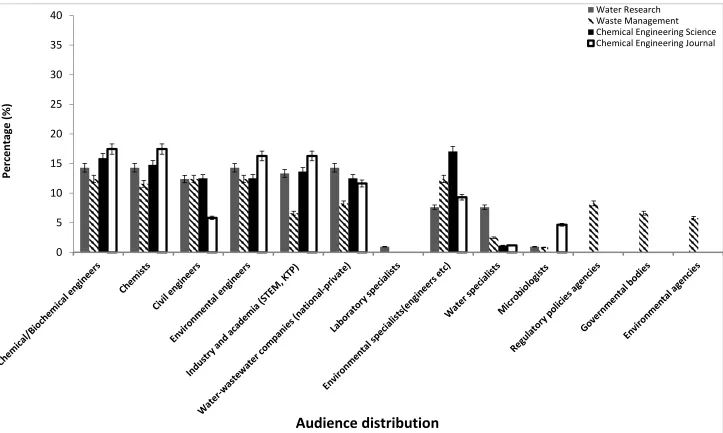
this study, by the subject category (Fig. 3) and audience distribution (Fig. 4). 233
Out of the 60 papers investigated, the array of subjects of interests relevant to environmental 234
chemical engineering and specifically to waste treatment and management is wide (Fig. 3), 235
covering numerous scientific areas from biochemical engineering to environmental 236
chemistry, to other engineering disciplines such as mechanical, electrical or civil 237
engineering. The two most often-encountered areas were environmental engineering (up to 238
35%) and wastewater treatment (up to 30%) making these two (Fig. 3), while a more general 239
approach to biochemical and chemical engineering related paper was the next prevalent 240
subject area (up to 23%). Solid waste treatment (up to 26.7%) and chemistry (up to 20.93%) 241
are also covered in the journals. When compared to the advertised scientific subject of 242
interest for publication of each journal, a differentiation is found since the advertised subject 243
areas are broader to the categories that emerged from this research. The fact that journal 244
guidelines are not foolproof representations of a journal's actual remit of publications is not a 245
novel finding. What our research shows is that lexical visualisation can provide a quick way 246
for researchers to assess the specific areas that are most likely to be published in the journal. 247
248
249
250
Fig.3. Scientific theme distribution of the analysed published manuscripts. 251
0 5 10 15 20 25 30 35 40
Enviromental engineering
Wastewater treatment
Water treatment
Water quality Microbiology Enviromental chemistry
Bioremediation Chemical and biochemical engineering
Solid waste treatment
Energy policy professionals
Local and nationa council
policy regulators
Other Engineering
Disciplines
Chemistry Water Research
Scientific theme
Pe
rcent
ag
e
Fig. 4: Distribution of potential audience of the analysed published manuscripts 0
5 10 15 20 25 30 35
40 Water ResearchWaste Management
Chemical Engineering Science Chemical Engineering Journal
Audience distribution
Pe
rcent
ag
e
(%)
1
The topics covered in the papers in our sample was found to be of potential relevance to a 2
broad audience, not restricted to academia, but also to other bodies such as policy regulators, 3
small and medium size companies and enterprises, or environmental agencies. In fact, the 4
collected papers addressed an audience of 13 categories varying from water and environment 5
specialists to microbiologists and chemists, as well as governmental bodies, water and 6
wastewater companies (national, private) or regulatory policies agencies and law developing 7
and forming bodies (Fig. 4). In particular, 8 of these categories are represented in all the 8
selected journals into varying percentages (5.81% to 17.5%). This is a divergence from the 9
advertised audience in the website of each journal, where the focus is on specialist in 10
chemical engineering audience within the field. 11
The content analysis of the papers has shown that in CEJ and CES there is a stronger 12
tendency, compared to WR and WM, to appeal to the industry. That could be attributed to 13
the nature of studies, i.e. dealing with trials in pilot plant scale (large volumes of materials), 14
which are more attractive to the industry, since the authors have not only proven their 15
concept but have also implement it to a large scale. In contrast, WR and WM are primarily 16
addressing an academic audience, with WM publishing also on topics that are of interest to 17
the regulatory authorities of each country and globally, regarding waste; since a more holistic 18
approach is taken that accounts for financial and social parameters. Thus patterns have 19
emerged about the nuances of the addressed audience in the published manuscripts of each 20
The wide range of potential audience of the published papers emphasises the need for clear, 22
concise and easily understood language, as readers coming from different academic 23
disciplines, even in close proximity, might fail to comprehend the concepts and rationale 24
expressed in the manuscripts. Figures and tables might, to a certain extent, describe the core 25
essence of the paper but the text, especially in the discussion and conclusions part are vital for 26
the overall understanding of the ideas. This is found also in this case study, where the words 27
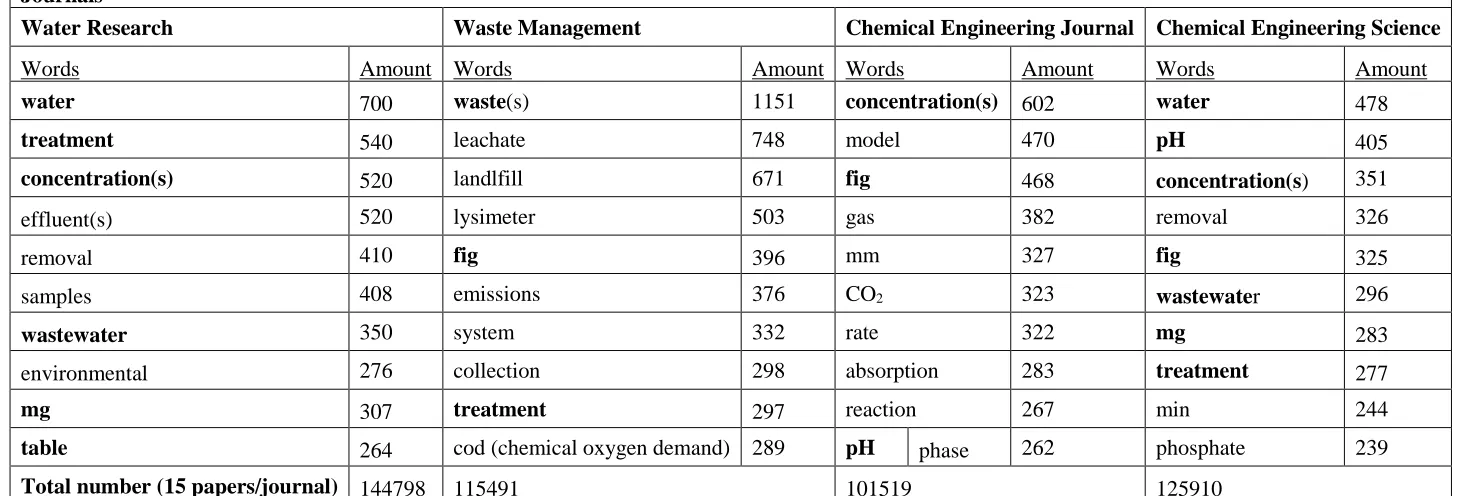
“table” and “figures” are among the top ten words mostly used among all the journals (Table 28
2), implying that the text’s primary function, especially in the results sections, is to comment 29
upon the visual parts of the papers. 30
3.3. Analysis of lexical choices 31
As suggested in the introduction, linguistic and in particular lexical choices, are intimately 32
linked to the text type and intended audience. In order to investigate lexical variation among 33
different types of journal articles on wastewater treatment and management, the most 34
frequently used words in the corpus were analysed, as well as collocations of certain key 35
words, and correlations were explored between the results and the type of journal (wider or 36
specialized scope) and the journal’s IF. Six lemmas were chosen, to explore collocations and 37
consequently the context in which certain key terms are employed and variation in the 38
specific meaning that is ascribed to them (Fig. 1). These terms comprise water and waste, 39
which are generally used when referring to the environment and would be expectably 40
mentioned mostly in the introduction and discussion or conclusions parts of the papers, two 41
lemmas specifically related and descriptive of waste, sludge and effluent, that could be found 42
throughout the manuscript and especially in the results section and, finally, two lemmas 43
related to the experimental methodology used and the achieved results and relevant 44
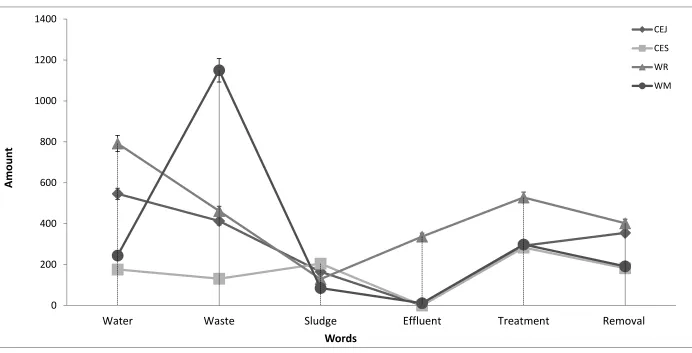
conclusions, treatment and removal (see Fig. 5, for the frequency of occurrence of these six 45
lemmas in each journal). The collocations of the lemmas and consequently the specific 46
meaning they accrue because of their context of use (context is taken here as immediately 47
prior and upcoming text, see [41]) were analysed based on ‘word trees’ and ‘phrase net’ 48
visualizations (see supplementary material). Below the key findings of the analysis of the 49
ManyEyes visualisations of the six lemmas are outlined. 50
In CEJ the lemma “water” was found 546 times in a total of 15 papers, and, as the analysis of 51
the visualization showed, was mainly conceptualised as a resource (ground water, surface 52
water, wastewater) either potable or as liquid waste. Focus was placed on reuse (removal of 53
harmful elements and use as washing water), recycling (water reclamation in the scope of 54
cost reduction, environmental load) and treatment (removal of toxic metals such as lead, 55
copper, harmful substances i.e. pesticides, hormones, pharmaceuticals) of water focusing on 56
wastewater treatment. 57
In the 15 CES collected papers, “water” occurred 176 times and was mainly understood as a 58
tool within the context of a chemical reaction, water as an aid in a chemical process for 59
example in the form of steam during sterilization, as solvent, as treatment method for other 60
elements or as a component to other substances. 61
As regards to the 15 WR and 15 WM papers, “water”, was found 792 and 244 times 62
respectively, and, as its collocations suggest, it was conceptualized as a matter worthy of 63
treatment i.e. softening, salts and metals removal) wastewater (liquid waste of industrial, 65
municipal, domestic, agricultural, slaughterhouse, food, tanning industry origin), a resource 66
and water cycle (water as an environmental resource, ponds, rivers, lakes). 67
The word “waste”, found 413 times, in CEJ was used to indicate a problematic material that 68
has to be treated, managed and disposed. It was commonly found immediately preceding the 69
term ‘water’, forming the compound “wastewater” referring to the liquid or semi-liquid, 70
semi-solid nature of waste. 71
Similarly to the use of the lemma “water”, “waste”, occurring 131 times, in CES, was mainly 72
conceptualized as part or a tool of a chemical reaction, a part a chemical process, the 73
substrate or sample where the chemical process is applied on, as a component to other 74
substances. 75
In WR and WM “waste” was found 462 and 1150 times, respectively, and, similarly to the 76
word “water”, it was used in the context of a research subject deriving of numerous sources, a 77
subject of analysis regarding quality and treatment, but as well as a component or a resource 78
for the production of other materials. 79
Both lemmas “water” and “waste” were routinely found in the manuscripts of each journal, 80
and they were among the top 10 words most often-encountered words in the manuscripts, and 81
used in high frequency either combined, i.e. wastewater, or separately (Table 2). However, as 82
the analysis above indicates, in CEJ and CES the terms were recurrently employed in 83
different contexts than WR and WM. In CEJ and CES the words are used in a rather 84
specialized context compared to WR and WM, an interesting observation that did not 85
confirm the authors’ expectations, since both journals are of wider scope (Table 1), and it was 86
anticipated that a less restrictive use of the term would have been encountered. In CEJ and 87
WR, the words are found in analogous amounts; while in CES the amount of use is very 88
limited, suggesting the use of a scientific specialized vocabulary (e.g. the terms “liquid” or 89
“fluid” or “solvent”, were preferred over “water”). On the other hand, WM is standing out 90
since the lemma “waste” is used very frequently, suggesting a broader approach to the 91
subject (.i.e., industrial, agricultural, slaughterhouse, domestic, municipal waste). 92
Further investigation of the observed trends, was achieved by examining the use of the words 93
“sludge”, “effluent”, “treatment” and “removal” (Fig. 1), as can be deduced from the 94
visualisations. 95
In CEJ the word “sludge” was found 165 times and was referred to as a problematic, 96
potentially harmful and hazardous material coming of waste. On the other hand, in CES 97
“sludge”, found 205 times, was used to describe a muddy, murky, highly viscous thick 98
material in the need of processing or treatment not necessarily harmful or indicative of a 99
problem. In WR and WM “sludge” occurred 129 and 85 times respectively and had a far 100
more complex meaning, as it was used in the context of harmful material coming out of 101
waste, physically looking as murky, muddy, soil based material, liquor or concentrated liquid 102
of a semisolid nature coming out of process treating sludge. 103
In CEJ and CES the word “effluent” is not found, implying the absence of mention of any 104
mechanical treatment process that would separate the solid from the liquid phase of sludge, 105
such as filtration, and the absence of any treatment involving large scale processes, a finding 106
that relates with the subject and audience distribution of the journal as defined by the 107
explain any liquid coming out, discharged of a waste treatment or of waste producing 109
process, while in WM it occurred only 11 times, and was used when referring to any liquid 110
discharged of a leaching related process. 111
In CES the word “treatment”, occurring 283 times, referred to any method and/or process 112
used to uncouple sludge or wastewater of its harmful, dangerous, hazardous, toxic elements. 113
In CEJ and WM “treatment”, found 292 and 298 times correspondingly, was used to 114
describe any process used, developed or applied to water, wastewater and sludge, without 115
specifically explaining whether it is done to remove hazardous substances or simply for 116
treatment. In WR “treatment” occurred 528 times and had a more generic meaning, referring 117
to any process in which waste is involved, for example anaerobic digestion for combined heat 118
and electricity production, to technologies or systems used to remove the harmful 119
components. 120
Finally, the word “removal”, found 325 and 182 times in CEJ and CES respectively, was 121
employed to refer to any method and or process used to recover nutrients from the waste or 122
remove all the components that are harmful and /or toxic, and its effectiveness and efficiency. 123
In CES “removal” also represented the main scope of the project developed in the 124
manuscript. In WR and WM, “removal”, occurring 402 and 191 times, was used in the 125
context of referring to any process or method applied to the removal of harmful elements 126
from the discharged effluents, wastes, sludge or wastewater. 127
128
129
130
131
Fig. 5: Distribution of the selected keywords among the analysed manuscripts 132
0 200 400 600 800 1000 1200 1400
Water Waste Sludge Effluent Treatment Removal
A
m
ou
n
t
Words
CEJ
CES
WR
4. Discussion
133The analysis of visualisations and word frequencies (see supplementary material) has shown 134
emerging trends in lexical choices that also have implications about the specific subject-area 135
and approach preferred in each journal and which -interestingly- do not necessarily 136
correspond with the advertised scope of each journal or with the authors’ expectations. 137
Among the four journals selected, WR and WM were considered of specialized scope (based 138
on their advertised scope), thus expected to accommodate a highly specialized and technical 139
lexis, whereas CEJ and CES were expected to use less discipline-specific lexis, due to their 140
wider range of scientific areas and potential audiences, as described on the journals’ websites 141
(Table 1). 142
However, these expectations were not completely supported by the findings. WM and CES 143
were found to be the journals where a more specialized vocabulary is used, especially in WM. 144
The high occurrence of discipline-specific vocabulary is not only associated with the scale of 145
the experiments, but also with the methodology and experimental phase meaning the size, the 146
accommodating volume of the equipment and the size of volume eligible to be processed by 147
the proposed methodology, rather than the results and their impact and applicability. The 148
technical vocabulary was mainly associated with quantifiable data, experimental trial 149
chemical reaction and processing, for example “model”, “fig.”, “lysimeter”, “system”, 150
“reaction”, as the lists of the most frequently used words in these journals indicates (Table 2). 151
This finding in also supported by the close reading of the published manuscripts, that has 152
revealed that the manuscripts in WM and CES refer to specialized and complex methods of 153
chemical engineering (Fig. 3 and Fig. 4). For example in CES instead of plainly using “water” 154
other related terms are used such as “concentrations”, “phase” which point towards to 155
chemical processing, whereas in WM terms related to water such as “leachate” are used to 156
point residuals of solid wastes. 157
158
Journal Water Research Waste Management Chemical Engineering Science Chemical Engineering Journal Affiliations International Water
Association (IWA)
- - -
Website www.journals.elsevier.com /water-research http://www.journals.elsevier.com/waste-m anagement/ http://www.journals.elsevier.com/chemical-engine ering-science/ http://www.journals.elsevier.com/chemical-engine ering-journal/
Publisher Elsevier B.V.
Audience Chemists, biologists, microbiologists, immunologists, limnologists, civil engineers, sanitary engineers and chemical engineers.
Scientists, engineers and technical managers concerned with waste treatment and the engineering problems related to environmental protection laws. scientists, engineers, and managers, regardless of their discipline, who are involved in scientific, technical and other issues related to solid waste management.
Industrial and academic researchers in chemical and process engineering.
Chemical and process engineers, applied chemists and product engineers, biochemical engineers and biotechnologists
Impact Factor (IF)1
6.942 4.030 2.895 6.216
Publication Rate
20 issues per year (1 volume per year)
10 issues per year (1 volume per year) 12 volumes per year (1 issue per volume) No issues, 39 volumes per year
Mean Number of publications per
issue/volume
36 25 20 56
Types of papers published
Full papers, review papers, comments
Full papers, review papers, letters to the editor, columns
Original papers, review articles, short communications, letters to editors
Original papers, review articles, short communications, letters to editors
Scientific subjects published
No specific scientific sections, the journal interested in water quality and its management. It publishes original research on treatment processes for municipal, agricultural and industrial water and wastewaters, water quality standards and
Emphasis is placed on integrated approaches, major areas in which papers are solicited: generation and
characterization, minimization, recycling and reuse, storage, collection, transport, and transfer, treatment (mechanical, biological, chemical, thermal, other), landfill disposal (including design, monitoring,
remediation of old sites), environmental
Publication of papers on the fundamentals of chemical engineering, including. Industrial areas covered by the journal include biotechnology, chemicals, energy, food, materials,
microelectronics, nanotechnology, specialty chemicals and pharmaceuticals. biomolecular and biological engineering, biochemical and bioprocess engineering, energy, water, environment, and sustainability materials engineering, particle technology; process
Three aspects of chemical engineering: chemical reaction engineering, environmental chemical engineering, and materials synthesis and processing.
1 2012 Journal citations report by Thomson Reuters http://thomsonreuters.com/journal-citation-reports/ (last accessed 29 Mar. 18).
analysis by chemical, physical and biological methods
considerations, financial and marketing aspects, policy and regulations,
education and training, planning and implementation.
systems engineering reactions, separations science and technology
Abstract Concise and factual, descriptive (up to 250 words)
Graphical abstract Optional
Highlights2 Mandatory
Table 1: Summary description the prerequisites request by each journal for the submission of manuscripts based on of the full aims and scope and guide for 160
authors, publically available on the journals’ websites. 161
2 Highlights are a short collection of bullet points that convey the core findings and provide readers with a quick textual overview of the article. These three to five bullet
points describe the essence of the research (e.g. results or conclusions) and highlight what is distinctive about it. There should be a maximum of 85 characters, including
162
On the other hand, CEJ and WR use a less discipline-specific vocabulary, with salience of 163
terms “wastewater”, “effluents”, “samples” which are far less frequent in CES and WM 164
(Table 2). WR published papers are indicating a holistic approach to water-related research 165
focusing on the findings of the experimental trials and their applicability in the society, 166
addressing social, financial and legal aspects. This also corresponds with the frequent use of 167
the lemmas “removal” and “environmental”. 168
169
170 171
172
173
Table 2: The top ten words occurring in each journal and their total number of occurrence. 174
Journals
Water Research Waste Management Chemical Engineering Journal Chemical Engineering Science
Words Amount Words Amount Words Amount Words Amount
water 700 waste(s) 1151 concentration(s) 602 water 478
treatment 540 leachate 748 model 470 pH 405
concentration(s) 520 landlfill 671 fig 468 concentration(s) 351
effluent(s) 520 lysimeter 503 gas 382 removal 326
removal 410 fig 396 mm 327 fig 325
samples 408 emissions 376 CO2 323 wastewater 296
wastewater 350 system 332 rate 322 mg 283
environmental 276 collection 298 absorption 283 treatment 277
mg 307 treatment 297 reaction 267 min 244
table 264 cod (chemical oxygen demand) 289 pH phase 262 phosphate 239
175
In the case of CEJ the findings, from the qualitative analysis of the papers, regarding the 176
multidisciplinary nature of the papers are mirrored in the results of lexical analysis. It further 177
confirms that the use of a less discipline-specific vocabulary enhances the readability of the 178
journal, which can reach a wider audience, including industrials and policy regulators. On the 179
other hand, while WR has been found in the qualitative analysis to target in the main an 180
academic audience, the use of simplified vocabulary boosts its readability among scientists 181
from a wide range of varying disciplines. 182
Such findings indicate a correlation between increased intelligibility (beyond the narrowly 183
conceived discipline of environmental chemical engineering) and citability of the journals, 184
since WR and CEJ have the highest impact factors of 4.655 and 3.473 respectively. 185
Technology has facilitated tremendously knowledge exchange shifting from only printed 186
media to a combination of available online, easily downloadable articles and printed media, 187
expanding significantly the availability of a paper, as the readers are not depended only on 188
the printed resources that exist in libraries and repositories across the world [17, 37]. 189
Literature searches are not necessarily guided by advisors, supervisors or assisting librarians, 190
and are being partially replaced by specialized research engines such as Google Scholar or 191
Scopus and the relevant webpages of the main academic publishers such as Springer, 192
Elsevier, Sage or Wiley. This leads to reading of the majority of published papers, on an 193
individual unsupervised basis, from an audience that may not have an extensive knowledge 194
on the subject (postgraduate students, early career, professionals, researchers, academics and 195
fellows), and may be novices on the specific subject area of the article. Employing highly 196
complex, scientific lexis might not facilitate the understanding of the manuscripts by readers 197
and will possibly result in lower citability. This can explain the association that was found in 198
this study between more accessible, less specialised vocabulary and higher IF. 199
When comparing these findings to the advertised scope of each journal, certain differences 200
are found. Among all four journals, only WR published papers reflect the journal’s very 201
broad approach, focusing on innovation without disregarding new approaches to current 202
techniques. CEJ and CES have a narrowed thematology, addressing highly specific subjects 203
contrary to the journals advertised spectrum. In the published manuscripts, emphasis is 204
placed on optimization of existing methods, mainly chemical treatments rather than 205
innovation, which cannot be as easily and quickly applicable. A similar tendency is found in 206
WM, where, in spite of the advertised wide array of publishing subjects, the published 207
manuscripts do not cover such a wide spectrum, and focus primarily on waste management 208
and relevant regulations, reflecting the anisomorphy between the advertised and the actual 209
scope of the journals. 210
5. Conclusions
211This is a case study and results are not unproblematically generalizable across journals of 212
practical sciences, let alone all disciplines. However, due to the depth of the investigation this 213
snapshot of trends in published chemical engineering research has offered an insight on the 214
implications of publishing research findings that can be extended beyond the four journals. 215
Some tentative conclusions that could be deduced regarding the lexical and thematic choices 216
learning and teaching material for chemical engineers, but also researchers from other 218
disciplines that seek to publish their research include the following. 219
• Highly discipline-specific vocabulary use, including extensive use of acronyms, should be 220
avoided where possible, to aid favorable consideration of manuscripts at higher IF journals 221
and to increase the citability potential of the article. 222
• There is a complex relationship between the thematology, the audience and the scope, as 223
they are advertised in the journal’s website, and the actual published manuscripts. 224
• Guide for authors and journal aims and objectives, published by the journal's editorial office, 225
should be taken into account, to help authors make an initial decision regarding the journal 226
that is most suitable for the submission of their research, but should be critically viewed. 227
• It is recommended for prospective authors to collect a number of publications, of their 228
journal of choice, published within close proximity, to the potential submission date, in 229
order to get a better understanding of the journal’s thematology, the approaches favored and 230
preferred discourse style. 231
• Visualisations of word choices and associations, which can be fairly easily and quickly 232
done with the aid of freely available software, is a very powerful tool in providing an 233
accurate overview of both the preferred content andapproach of each journal, as well as its 234
preference as regards to lexical choices. They can be an indispensable tool for chemical 235
engineering students and novice researchers that wish to gain an emit understanding of the 236
actual scope of the plethora of journals within each discipline, without having to engage in 237
the labor-intensive close reading of a large corpus of published papers. 238
Extending this research to similar investigations of a larger size of text samples, representing 239
more fields of science would be desirable, so that the findings will then be more 240
representative of scientific writing in English. Further exploration of links between linguistic 241
choices and citability, impact factor, new media use and altmetrics (online traffic of journal’s 242
published manuscripts) could lead to the development of a methodology that would help the 243
researchers to write in a style that best suits their target journal. 244
Supplementary Materials:
246
247
248
249
(a)
(b
)
(c)
(d)
Fig.1: Phrase nets graphical images depicting the collocations between the selected words for analysis and the remaining words in the selected published manuscripts in (a)CEJ, (b)CES, (c)WR, 250
and (d)WM provided by the lexical visualisation software Many Eyes and used for the qualitative analysis of the published manuscripts in this case study. 251
253
Fig.2: Word trees depicting the word “water” in (a)CEJ, (b)CES, (c)WR, and (d)WM and its collocations (word associations) provided by the lexical visualisation software Many Eyes and used 254
for the qualitative analysis of the contexts of use of selected lemmas in the published manuscripts in this case study. 255
256
257
Fig.3: Word trees depicting the word “waste” in (a)CEJ, (b)CES, (c)WR, and (d)WM and its collocations (word associations) provided by the lexical visualisation software Many Eyes and used 258
for the qualitative analysis of the contexts of use of selected lemmas in the published manuscripts in this case study. 259
Acknowledgments: The authors would like to thank fellow researchers in the College of 261
Engineering, Swansea University for their valuable advice in the research discussed here. 262
263
References
264
[1] Abramo, G., D' Angelo C.A., Rosati F., 2014. Career advancement and scientific performance in 265
universities. Scientometrics, 98, 891-907. 266
[2] Massoudi, M., 2003. Can scientific writing be creative? J. of Sci. Edu. Tech., 12, 115-128. 267
[3] Vanclay, J.,2012. Impact factor: outdated artefact or stepping-stone to journal certification? 268
Scientometrics. 92,211-238 269
[4] Beall, H., 1998. Expanding the scope of writing in chemical education. J. Sci. Edu.Tech., 7, 270
259-270. 271
[5] Uskokovic, V. 2012. Ten Commandments for writing a meritable scientific paper. J. Postdoc. 272
Affairs, 2, 2-7. 273
[6] Bosquet, C., Combes, P.-P., 2013. Are academics who publish more also more cited? Individual 274
determinants of publication and citation records. Scientometrics. 97, 831-857 275
[7] Porter, A., Rafols, I., 2009. Is science becoming more interdisciplinary? Measuring and mapping 276
six research fields over time. Scientometrics. 81, 719-745. 277
[8] Woolley, K., Barron, P., 2009. Handling manuscript rejection insights from evidence and 278
experience. Chest. 135,573-5 279
[9] Drummond, C. W. E., Reeves, D., 2005. Reduced time to publication and increased rejection rate. 280
J. Antimicrob. Chemo.55, 815-816. 281
[10] Beall, J., 2012. Beall's list of predatory publishers 2013, http://scholarlyoa.com/publishers (last 282
accessed 29 Mar 2018). 283
[11] Moore, A. (2009). The garbage collectors - Could a particular sector of author-pays journals 284
become silently acknowledged collectors of scientific waste? BioEssays, 31, 821. 285
[13] Fassoulaki, A., Sarantopoulos, C., Papilas, K., Patris, K., Melemeni, A., 2001. Academic 287
anaesthesiologists’ views on the importance of the impact factor of scientific journals: a North 288
American and European survey. Gen. Anaesthesia. 48, 953-957. 289
[14] Ovalle-Peradones, M.-A., Gorraiz, J., Wieland, M., Gumpenberger, C., Olmeda-Gomez, C., 290
2013. The influence of European Framework Programmes on scientific collaboration in 291
nanotechnology. Scientometrics97, 59-74. 292
[15] Garfield, E., 1999. Journal impact factor: a brief review. Can. Med. Assoc. J.16, 1979-980. 293
[16] Misteli, T.,2013. Eliminating the impact of the impact factor. J. Cell Biol. 201, 651-652. 294
[17] Oliveira, E. A., Peicots-Filho, R., Martelli, D. R., Quirino, I. G., Oliveira, M. C. L., Duarte, M. 295
G., Martelli-Junior, H., 2013. Is there a correlation between journal impact factor and researchers’ 296
performance? A study comprising the fields of clinical nephrology and neurosciences. Scientometrics. 297
97, 149-160. 298
[18] Finegold, L.,2002. Writing for science as scholarly communication. J. Sci. Edu.Tech. 11, 299
255-260. 300
[19] Alaimo, P.J., Bean, J.C., Nichols, L., 2009. Eliminating lab reports: a rhetorical approach for 301
teaching the scientific paper in sophomore organic chemistry. WAC J., 20, 17-32. 302
[20] Robinson, M.S., Stoller, F. L.,Costanza-Robinson, M.S., Jones, J.K., 2008. Write like a chemist. 303
New York: Oxford University Press. 304
[21] Rodriguez, A.C., 2012. Teaching peers to talk to peers. BioEssays. 34, 918-920. 305
[22] Lebrun, J.-L., 2013. Scientific writing: a reader and writer's guide. Singapore: World Scientific 306
Publishing Co Pte. Ltd. 307
[23] Derntl, M., 2014. Basics of research paper writing and publishing. Int. J. of Tech. Enh. Learn 6, 308
105-.123 309
[24] Conrad, S., 1996. Investigating academic texts with corpus-based techniques: an example from 310
biology. Ling Edu. 8, 299-326. 311
[25] Gunawardena, C., 1989. The present perfect in the rhetorical divisions of biology and 312
biochemistry journal articles. Engl. Spec. Purp.,8, 265-273. 313
[26] Stoller, F., Jones, J., Costanza-Robinson, M. S.,Robinson, M. S., (2005). Demystifying 314
disciplinary writing: A case study in the writing of chemistry. Across the Disciplines, 2. 315
http://wac.colostate.edu/atd/lds/stoller.cfm (last accessed 15 April 2015). 316
[27] Burnard, P., Gill, P., Stewart, K., Treasure, E., Chadwick, B., 2008. Analysing and presenting 317
qualitative data. Brit. Dent. J.204, 429-432. 318
[28] Gill, P., Stewart, K., Treasure, E., Chadwick, B., 2008. Methods of data collection in qualitative 319
research: interviews and focus groups. Brit. Dent. J. 204, 291-295. 320
[29] Biber, D., Conrad, S., Reppen, R., 1994. Corpus-based approaches to issues in applied 321
linguistics. App. Ling., 15, 69-189. 322
[30] Biber, D., Conrad, S., 2009. Register, genre and style. Cambridge, UK; New York: Cambridge 323
University Press. 324
[31] Gustavii, B., 2008. How to write and illustrate a scientific paper. Cambridge, UK; New York, 325
Cambridge: Cambridge University Press. 326
[32] Blackwell, J., Martin, J., 2011. A scientific approach to scientific writing. New York: Springer. 327
[33] Okulicz-Kozaryn, A., 2013. Cluttered writing: adjectives and adverbs in academia. 328
Scientometrics. 96, 679-681. 329
[34] Hosgood, G.,2011. How to write and publish a scientific paper. Austral. Vet. Pract.,41, 137-144. 330
[35] Ware, M.,Mabe, M., 2009. STM: An overview of scientific and scholarly journal publishing. 331
Oxford: International Association of Scientific, Technical and Medical Publishers. 332
[36] White, T.,2006. Principles of good research and research proposal guide. In:Policy, performance 333
and quality assurance unit. (pp. 1-5). London: London Council, Borough of Richmond upon Thames. 334
[37] Maffioli, F., Augusti, G.,2003. Tuning engineering education into the European higher education 335
[38] Saha, S., Saint, S., Christakis, D.,2003. Impact factor: a valid measure of journal quality? J. Med. 337
Librar. Assoc. 91, 42-46 338
[39]Barrow, L.H., 2003. Searching for educational technology faculty. J. Sci. Edu.Tech., 12,143-147. 339
[40] Tscharntke, T., Hochberg, M.E., Rand, T.A., Resh, V.H., Krauss, J., (2007. Author sequence and 340
credit for contributions in multiauthored publications. PLOS Biol. 5, 13-14. 341
[41] Schegloff, E. A., 1992. In another context. In A. Duranti and C. Goodwin (Eds.), Rethinking 342
context: language as an interactive phenomenon. (pp. 193-227). Cambridge; New York: Cambridge 343
University Press. 344
[42] http://www.ref.ac.uk/2014/panels/assessmentcriteriaandleveldefinitions/ (last accessed 345
29.Mar.18) 346