Ronaldo Luis da Silva1,2* Johanne Higgins2,3 Victor Frak1,2
Repetitive transcranial magnetic stimulation of the intraparietal sulcus
changes the grip force modulation exerted by manual action-verbs – an exploratory study
Ronaldo Luis da Silva1,2* PhD student
Johanne Higgins2,3 – [email protected] full professor Victor Frak1,2 – [email protected] professor
1 Faculté des Sciences, Université du Québec à Montréal, Québec, Canada. 141 Avenue du Président-Kennedy, Montréal, QC H2X 1Y4, Canada
2 Centre de recherche interdisciplinaire en réadaptation (CRIR), Centre intégré universitaire de santé et de services sociaux du Centre-Sud-de-l’Île-de-Montréal (CCSMTL) – Institut universitaire sur la réadaptation en déficience physique de Montréal (IURDPM), Montréal, Québec, Canada
6300 Avenue de Darlington, Montréal, QC H3S 2J4, Canada
3 École de Réadaptation, Faculté de Médecine, Université de Montréal, Québec, Canada. 7077 Avenue du Parc, Montréal, QC H3N 1X7, Canada
Corresponding author
Ronaldo Luis da Silva – [email protected]; [email protected] Phone: +1 5145596405
ORCID: 0000-0003-0254-2017
ACKNOWLEDGMENTS
We would like to thank Michel Goyette for the strong software and experimental device support. RLS was supported by The National Council for Scientific and Technological Development (CNPq) – the Brazilian Government’s Science Without Borders Program.This work was also aided by a grant from Fondation de l’institut de réadaptation de Montréal, Canada
ABSTRACT
Objective: To evaluate the effects of left intraparietal sulcus (IPS) inhibition by repetitive transcranial magnetic stimulation (rTMS) on grip force modulation (GFM) for both hands during a unimanual task. Methods: GFM induced by manual action-verb listening was evaluated for each hand in a unimanual task, and the motor-evoked potentials (MEP) were recorded for both left and right hemispheres prior to and following the left IPS inhibition. Left IPS inhibition was obtained by rTMS (5 min of 1.0 Hz, 60% of maximal stimulator output) of the international 10–20 system P3 point. Seven healthy right-handed subjects were evaluated. Results: One-way repeated measures ANOVA found that MEP amplitude and duration increased following IPS inhibition in the left hemisphere and did not change in the right hemisphere. Language-induced modulation did not change in the left hemisphere, while it was significantly attenuated in the right hemisphere. Since IPS inhibition increased the left primary motor cortex (M1) excitability, the maintenance of language-induced modulation intensity suggests it was also attenuated. Conclusion: Left IPS inhibition increased left M1 excitability without changing right M1 excitability, while attenuating the language-induced GFM for both the left and right hands.
Keywords: embodied language, grip force modulation, intraparietal sulcus, motor-evoked potential, right hemisphere
INTRODUCTION
Linguistic processing presents strong left lateralization in the brains of right-handed subjects. Frak et al. (2010) found that listening to manual action verbs involuntarily modulates the grip force of the right hand. This modulation is a relevant tool to study the link between linguistic and motor processing. Grip force modulation (GFM) following action-verb listening also occurs when the right hand is accompanied by the left hand in a symmetrical bimanual task (da Silva et al. 2018). In such condition, the modulation of grip strength in both hands is quite similar, since the motor control of the left hand is most exerted by left-hemisphere motor centers (da Silva et al. 2018). However, when the left hand performs alone, GFM is small and takes longer to become statistically significant. Broca’s area receives afferent connections from the ventral premotor cortex (PMv) — the dorsal pathway — and the temporal cortex — the ventral pathway — for auditory processing (Parker et al. 2005; Hickok and Poeppel 2007). While right-hand GFM could be easily linked to Broca’s area, the rule of Broca homolog in left-hand GFM is still unclear (da Silva et al. 2018).
The left inferior parietal cortex has been shown to be critical for the intentional hand movements of reaching and gripping, as well as for hand–object interaction, spatial orientation, and online adjustments for hand displacement (Rumiati et al. 2004; Rice et al. 2006; Gutteling et al. 2013). Left intraparietal sulcus (IPS) inhibition by repetitive transcranial magnetic stimulation (rTMS) was found to impair the grip by increasing the maximum grip strength and the speed for achieving the highest grip force value (Rice et al. 2006; Cohen et al. 2009; Gutteling et al. 2013), as well as by mispositioning the fingers or the wrist to grip an object (Tunik et al. 2005). The left anterior portion of the IPS exerts an inhibitory effect on the primary motor cortex (M1) at rest (Allart et al. 2017; Karabanov et al. 2017), and their functional connectivity is enhanced during the sensorimotor planning of grip (Vesia et al. 2013). The superior parieto-occipital cortex was found to facilitate the portions of the M1 related to the shoulders (Vesia et al. 2013). These findings suggest that IPS inhibition could directly promote activation of the M1 in tasks of reaching and gripping or indirectly increase activation of the M1 by stimulating other centers like the premotor cortex (Sakata and Taira 1994).
articulatory imagery task and a hearing imagery task (in which the subject imagines saying or hearing a syllable, respectively) has found activity in the inferior parietal cortex and the IPS (Tian et al. 2016). Particularly, the IPS becomes more active when the subject listens to manual action verbs compared to when he or she listens to abstract verbs, as the anterior portion of the IPS does (van Dam and Desai 2016). Thus, the left IPS can be linked to grip control and linguistic processing. However, its influence on the involuntary GFM elicited by action-verb listening is still unknown. Moreover, the current literature does not allow us to infer whether the left IPS is also related to the modulation of the grip force observed with the left hand. Therefore, the objective of this study is to evaluate the effects of left IPS inhibition by rTMS on the GFM of each hand in a unimanual task. For this purpose, the left IPS was inhibited by rTMS of the P3 point of the international 10–20 system, and GFM of both the left and right hands was evaluated before and after left IPS inhibition and compared to each other.
MATERIALS AND METHODS
Ethics Statement
Ethical approval was obtained in 2016 may 12 from the Research Ethics Board of the Center de recherche interdisciplinaire en réadaptation du Montréal métropolitain – dossier CRIR-1003-0914. All procedures involving human participants were in accordance with the ethical standards of the institutional research committee and with the 1964 Helsinki declaration and its later amendments or comparable ethical standards.
Participants
Participants were recruited through public advertisements in centers related to the Brazilian community in Montreal or in Montreal universities, or they were directly invited by other volunteers. The Edinburgh Handedness Inventory was used to evaluate handedness consistency (EHI>40% cut-off was defined as an eligibility criterion) (Oldfield 1971). The participants declared not having neurological or musculoskeletal disorders or deficits in cognitive or motor skills. They also completed a form to determine their suitability for rTMS (Lefaucheur et al. 2011). Four women (26.4 years ± 1.41, 82.5% EHI ± 20.62) and four men (28.94 years ± 1.15, 60% EHI ± 16.33) with 12 years or more of Portuguese-language schooling signed the consent form and participated in this study.
Auditory Stimuli
The action verbs described manual actions such as write or pull, and the non-action nouns described concrete objects or beings but never actions. They were previously recorded for a prior study (da Silva et al. 2018) in a studio in Brazilian Portuguese in MP3 format at 44.1 kHz and 32 bits with a male voice; then each word was isolated and converted to WAV format at 16 kHz and 8 bits to be transferred to the management system. This system allowed the selection of an action verb in a 35-word sample as a keyword, and it automatically generated two complementary playlists. Each playlist contained 35 non-action nouns and a variable number of repetitions of the keyword (a number between 6 and 12). The sum of repetitions in the two complementary playlists was always 18. The interval between two consecutive words was 1000 ms. The sequence of words was automatically randomized by the management system for each playlist, with the constraint that two keyword repetitions were always separated by at least one non-action noun.
Grip Force Recording
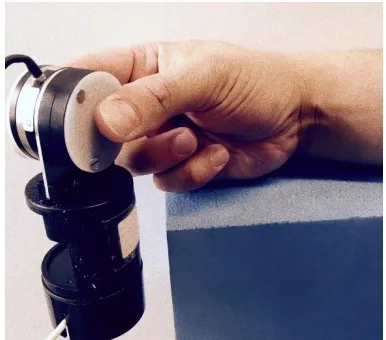
position of flexion/extension and ulnar/radial deviation and exerting the minimum of force, just enough to prevent dropping, while holding it over the gap, as shown in Figure 1.
Fig. 1 Grip force sensor and correct hand position
Participants were introduced to the system and the procedure of the test. Holding the grip sensor hanging in the gap, they were invited to increase and reduce the intensity of their compression force while they watched the force variation in Newtons on a secondary screen, just to find a comfortable grip force level high enough to prevent slippage (Nazir et al. 2017), generally between 1.5 and 2.5 N. During the test, the secondary screen was turned off, and the participants did not have access to the primary screen. Furthermore, the participants kept their eyes closed while they listened to each playlist and held the grip force sensors. All tests were administered by the first author.
The experimentation was comprised of two unimanual tasks (right hand: UD; left hand: UN). After hearing the keyword, the participants took the grip force sensor and held it over the table gap with eyes closed, and they listened to the playlist while mentally counting the number of keyword repetitions. Mentally counting the repetitions was adopted as a strategy to ensure the participants’ attention to the listening instead of the hand holding the sensor. At the end of the playlist, they opened their eyes and returned the grip force sensor on the table, and then they reported the number of keyword repetitions and waited approximately one minute before repeating the task for the complementary playlist, counting the same keyword. Once they completed the first task, the participants received a second keyword for the second task, following the same procedure.
Motor-Evoked Potentials Recording
Participants were comfortably seated with the forearm in a neutral position on the grip force sensor table. The skin was prepared by cleaning and abrading each site of electrode placement for reducing skin resistance and improving surface contact. MEP were recorded from the right and the left first dorsal interosseous muscles (FDI) at rest, using Ag/Ag Cl Electrodes (Ambu® Blue Sensor M-00-S). The FDI muscles were localized by palpatory anatomy during active opposition of the first and second extended fingers. The ground electrode was placed on the ipsilateral ulnar styloid process. Then, the electrodes were secured with tape.
in a series of 10 stimuli at the lowest stimulator output was recorded as the FDI hotspot and this stimulator output as the RMT. The hotspot location was recorded by the Brainsight®. The same process was then repeated on the other hemisphere. Ten stimuli were applied at the hotspot for each hemisphere at 120% RMT, and the FDI MEP values were recorded.
IPS Repetitive Transcranial Magnetic Stimulation
The P3 point of the international 10–20 system was selected to stimulate the left IPS (Herwig et al. 2003). A Magstim Rapid2 stimulator with a flat 70-mm figure-of-eight magnetic coil was used to deliver rTMS trains of five pulses at 1 Hz, 60% of maximal stimulator output. A total of 300 pulses was delivered for five minutes. The coil was positioned tangentially to the skull with its handle oriented 45º to the midline. Earplugs were provided to protect from the noise associated with the rTMS coil discharge. Participants were comfortably seated during the stimulation, and they were oriented to signal any discomfort by raising the fingers from the grip force sensor table.
Procedure
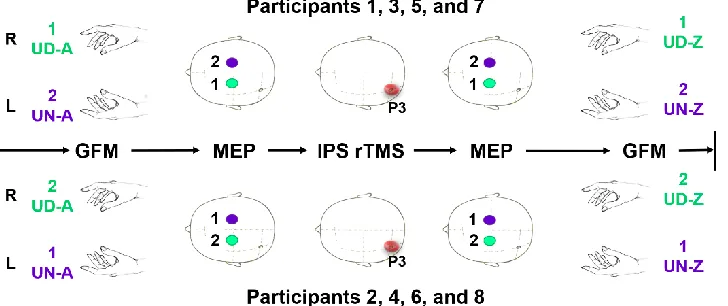
Details of the procedures are depicted in Figure 2. Following the first recordings of the grip force and MEP and rTMS procedure, the subject tracker and the swimming cap used to trace the 10–20 system were removed, as well the surface electrodes to ensure the comfort for the second grip force recording. The procedure ended with grip force recordings taken immediately following the second MEP recording. The first participant performed UD GFM before UN GFM, and MEP was measured at the left hemisphere before the right hemisphere prior to and following left IPS rTMS; the second participant performed the reverse order, and so successively, as shown in Figure 2.
Fig. 2 Timeline of a single test R: right side; L: left side; GFM: grip force modulation; MEP: motor-evoked potentials; IPS rTMS: intraparietal sulcus repetitive transcranial magnetic stimulation; P3: 10–20 international system point referring to the left intraparietal sulcus; UD: unimanual task, right hand; UN: unimanual task, left hand; A: evaluation conducted prior to IPS rTMS; Z: evaluation conducted following IPS rTMS
Data Acquisition
almost 95% of signal energy conservation. Only the compression force Fz was evaluated, since a previous study had found no differences between Fz alone and the sum of the three-axis forces (Frak et al. 2010).
Electromyography (EMG) signals were amplified (x1000) and band-pass filtered (1 Hz–1 kHz) by means of a second-order Butterworth filter, sampled (10 kHz) with a laboratory A/D conversion system (PCI- MIO-16E-4, National Instruments, Texas, USA), displayed, and recorded for posterior analysis.
Data Analysis
Electrophysiological analysis of MEP recordings was performed off-line. The peak-to-peak amplitude of the FDI MEP before and after IPS rTMS was normalized to baseline and compared to each other using one-way repeated measures (1-WRM) ANOVA with Greenhouse–Geisser correction for both left and right motor cortex stimulation. The same procedure was applied to analyze the FDI MEP duration.
Grip force values for each verb repetition were recorded from the 200 ms before to 1000 ms following the verb onset. The data prior to the keyword onset were averaged and used to normalize the subsequent data. This procedure was executed for each keyword repetition. Data referring to each repetition were rejected if the force variation in the 1000 ms following the keyword onset was equal to or greater than 200 mN or had developed at a rate greater than 100 mN/100 ms (Nazir et al. 2017). If 30% or more of the verbs of a single task were rejected, the participant was rejected. According to this method, one man was excluded from the analysis, since he executed voluntary left-hand movements during the pre-rTMS GFM test. All valid repetitions were averaged for each participant in 100 ms time intervals from 0 to 1000 ms for each moment, thus generating a GFM pre-rTMS and a GFM post-rTMS dataset for each participant.
Data were organized according to the condition and the moment: right-hand unimanual task before (UD-A) and after (UD-Z) the rTMS stimulation and left-hand unimanual task before (UN-A) and after (UN-Z) the rTMS stimulation. Only the action verbs were analyzed in this study, since the comparison between non-action nouns and action verbs is already extensively documented (Frak et al. 2010; Aravena et al. 2012). Each condition was analyzed by means of a 1-WRM ANOVA to identify the occurrence of GFM when there was a significant difference between baseline and consecutive time intervals. A post-hoc Least Significant Difference (LSD) was conducted when the GFM was identified to determine the first time interval significantly different from baseline. A two-way repeated measures (2-WRM) ANOVA was conducted with TREATMENT (pre/post) and TIME INTERVAL (0–1000 ms) as factors for each hand to evaluate the influence of the IPS rTMS on the GFM of each hand. Paired t-tests two by two were made between pre- and post-rTMS when the TREATMENT factor had a significant main effect (i.e., UD-A vs. UD-Z and UN-A vs. UN-Z, if necessary).
RESULTS
MEP
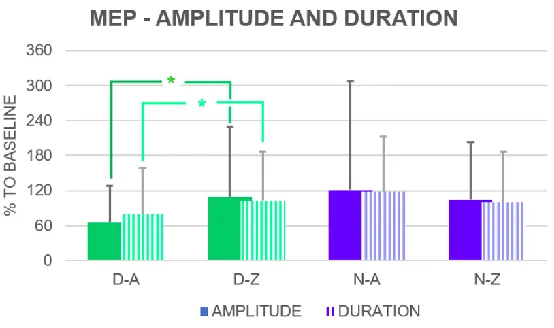
Prior to the rTMS stimulation, 1-WRM ANOVA found that MEP amplitude was different between both hemispheres (right > left, F (1,69) = 5.748, p = 0.019, d = 0.29), as well as MEP duration (right > left, F (1,69) = 7.896, p = 0.006, d = 0.36), but the effect size was small for both measures.
Fig. 3 MEP peak-to-peak amplitude and duration expressed as a percentage of the baseline D: left hemisphere; N: right hemisphere; A: MEP before IPS rTMS; Z: MEP after IPS rTMS; * = significant difference
Following the IPS rTMS, 1-WRM ANOVA did not find a difference between both left and right hemispheres for either MEP amplitude (F (1,69) = 13.773, p < 0.001, d = 0.45) or MEP duration (F (1,69) = 0.061, p = 0.805, d = 0.03).
GFM
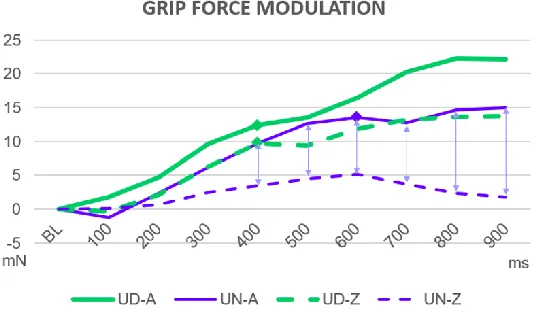
1-WRM ANOVA found GFM for UD-A (F (1.883,11.298) = 10.053, p = 0.003) and UN-A (F (1.673,10.037) = 9.421, p = 0.0063). Post-hoc LCD found that GFM started at a 400–500 ms time interval for UD-A (t (6) = 2.593, p = 0.0410, d = 0.98) and at a 600–700 ms time interval for UN-A (t (6) = 2.573, p < 0.0422, d = 0.97).
DISCUSSION
Our study found an increase in the FDI MEP amplitude and duration for the right hand following IPS inhibition by rTMS, which did not occur for the left hand. Such a finding indicates that the IPS inhibition generated an ipsilateral M1 release, with which the IPS has strong functional connections (Binkofski et al. 1999; Luppino et al. 1999; Schubotz and von Cramon 2001; Verhagen et al. 2008). Our findings reflect a reduction of the modulatory influence exerted by the left IPS on the left M1 (Allart et al. 2017; Karabanov et al. 2017). Since the IPS is related to several aspects of reaching and gripping, this modulatory rule could be understood as a close control of the hands’ movements (Tunik et al. 2005; Schubotz and von Cramon 2001). Therefore, changes in the acceleration of motion, the maximum grip force exerted, and the positioning of the fingers for the grip (Davare et al. 2007) reflect the loss of the control exerted by the inferior parietal lobe and are in line with our findings regarding the increase of the amplitude of the MEP.
The left anterior intraparietal area (AIP), the anterior portion of the IPS, has been associated with unimanual grip control and to the grip/load forces ratio increase following its TMS disruption for both the right and left hands (Davare et al. 2007, Jacobs et al. 2010). This increase could reflect a release of both the left and right M1, but these studies did not evaluate the MEP. In our study, left IPS inhibition increased the left M1 MEP amplitude and duration but did not alter the right M1 MEP, suggesting that the mechanism related to the grip/load force ratio increasing in the right hemisphere was not based on the release of the M1. While the left IPS has been associated with unimanual grip control, the right IPS has been associated with bimanual grip control (Le et al. 2017). However, only the bilateral lesion of AIP has impaired the hand shaping for unimanual griping (Davare et al. 2007). Consequently, the interrelation between the left and right IPS seems to be sensitive to different aspects of grip, either in unimanual or bimanual tasks, and could even be partially responsible for the differences between left and right MEP. Even though the left IPS is dominant for some aspects of left-hand unimanual griping, our results suggest that the left IPS does not present a continuous modulatory action on the right M1 such as that it exerts on the left M1.
Since IPS inhibition did not modify right M1 excitability, UN-Z could occur on the same neuronal basis of UN-A. However, the language-induced UN GFM following the IPS inhibition was near nonexistent. Therefore, statistical analysis easily allowed identifying the language-induced modulation attenuation. On the other hand, IPS inhibition increased the excitability of the left M1, as seen by the changes in MEP at rest. This higher excitability should implicate in an equivalent increase to the right-hand UD, but it did not change following IPS rTMS. The similarity of values in a more excited neuronal basis suggests that the modulation following IPS inhibition also was less intense in the left hemisphere, therefore suggesting that the inhibition of the left IPS reverberated on the language-induced GFM of both hands.
It is known that the IPS has a strong relationship with fine finger control (Verhagen et al. 2008) and strong connections to the PMv for online grip control (Ghosh and Gattera 1995; Rizzolatti and Luppino 2001; Tanné-Gariépy et al. 2002; Haller et al. 2009). In our study, the sensor gripping remained constant throughout the playlist listening without object shape, size, or mass perturbations. Thus, language-induced GFM prior to IPS inhibition occurred in a context in which the IPS, PMv, and M1 were already activated and engaged in the gripping action. Modulation, therefore, had a favorable environment for development, since the pathways for auditory processing include the inferior parietal lobe and the premotor cortex (Stout and Chaminade 2012).
have its activation reduced following IPS inhibition. Thus, even though IPS inhibition did not affect the ventral pathway of the auditory processing (which directly connects the temporal lobe and Broca’s area), it reduced activation of the PMv, therefore reducing the activation of the dorsal pathway. Since the PMv connects the IPS to Broca’s area and Broca’s area to the M1 (Hampson et al. 2002; Jung-Beeman 2005; Lemaire et al. 2013), its reduction would explain the reduction of language-induced GFM in this hemisphere.
Although da Silva et al. (2018) have found it impossible to say whether left-hand language-induced GFM is driven entirely by Broca’s area, Broca homolog, or both, our findings indicate that left-hand GFM could not be produced by the right hemisphere. Our results seem to indicate that the left-hand GFM is solely or mainly driven by Broca’s area, which influences the right hemisphere through the left PMv, which, in turn, has strong connections with the right PMv (Lemaire et al. 2013).
Therefore, although the left IPS are related to the grip control and the language-induced GFM, its inhibition by rTMS led to a dissociation of these roles, triggering a release of the left M1 and, at the same time, bilaterally reducing GFM.
CONCLUSION
Our study was the first to investigate the effects of left IPS inhibition on both hemispheres regarding M1 excitability and language-induced modulation. MEP amplitude and duration increased ipsilaterally, but language-induced GFM was reduced in both hemispheres. These results may help to better comprehend the IPS function on the skilled motor and linguistic networks.
SUPPLEMENTARY MATERIAL
Complete MEP and GFM dataset are provided in Online Resource 1.
CONFLICT OF INTEREST
RLS was supported by the National Council for Scientific and Technological Development (CNPq) – Science Without Borders Program [grant number: 202464/2014-8]. This work was aided by a grant from Fondation de l’Institut de Réadaptation de Montréal, Canada. The funders had no role in study design, data collection, and analysis, decision to publish, or preparation of the manuscript. The authors declare that they have no conflict of interest.
ETHICAL APPROVAL
All procedures performed in studies involving human participants were in accordance with the ethical standards of the institutional and/or national research committee and with the 1964 Helsinki declaration and its later amendments or comparable ethical standards.
REFERENCES
Aravena P, Delevoye-Turrell Y, Deprez V, Cheylus A, Paulignan Y, Frak V, et al (2012) Grip force reveals the context sensitivity of language-induced motor activity during “action words” processing: evidence from sentential negation. PLOS ONE 7:e50287. https://doi.org/10.1371/journal.pone.0050287.
Baggio G, Cherubini P, Pischedda D, Blumenthal A, Haynes JD, Reverberi C (2016) Multiple neural representations of elementary logical connectives. Neuroimage 135:300-310. https://doi.org/10.1016/j.neuroimage.2016.04.061.
Binkofski F, Buccino G, Posse S, Seitz RJ, Rizzolatti G, Freund H (1999) A fronto-parietal circuit for object manipulation in man: evidence from an fMRI-study. Eur J Neurosci 11:3276-3286. https://doi.org/10.1046/j.1460-9568.1999.00753.x.
Cohen NR, Cross ES, Tunik E, Grafton ST, Culham JC (2009) Ventral and dorsal stream contributions to the online control of immediate and delayed grasping: a TMS approach. Neuropsychologia 47:1553-1562. https://doi.org/10.1016/j.neuropsychologia.2008.12.034. da Silva RL, Labrecque D, Caromano FA, Higgins J, Frak V (2018) Manual action verbs modulate the grip force of each hand in unimanual or symmetrical bimanual tasks. PLOS ONE 13:e192320. https://doi.org/10.1371/journal.pone.0192320.
Davare M, Andres M, Clerget E, Thonnard J-L, Olivier E (2007) Temporal dissociation between hand shaping and grip force scaling in the anterior intraparietal area. J Neurosci 2007 27:3974–3980. https://doi.org/10.1523/JNEUROSCI.0426-07.2007.
Davare M, Rothwell JC, Lemon RN (2010) Causal connectivity between the human anterior intraparietal area and premotor cortex during grasp. Curr Biol 20:176–181. https://doi.org/10.1016/j.cub.2009.11.063.
Fedorenko E, Duncan J, Kanwisher N (2013) Broad domain generality in focal regions of frontal and parietal cortex. Proc Natl Acad Sci 110:16616–16621. https://doi.org/10.1073/pnas.1315235110.
Frak V, Nazir T, Goyette M, Cohen H, Jeannerod M (2010) Grip force is part of the semantic representation of manual action verbs. PLOS ONE 5:e9728. https://doi.org/10.1371/journal.pone.0009728.
Ghosh S, Gattera R (1995) A comparison of the ipsilateral cortical projections to the dorsal and ventral subdivisions of the macaque premotor cortex. Somatosens Mot Res 12:359-378. https://doi.org/10.3109/08990229509093668.
Gutteling TP, Park SY, Kenemans JL, Neggers SFW (2013) TMS of the anterior intraparietal area selectively modulates orientation change detection during action preparation. J Neurophysiol 110:33–41. https://doi.org/10.1152/jn.00622.2012.
Haller S, Chapuis D, Gassert R, Burdet E, Klarhöfer M (2009) Supplementary motor area and anterior intraparietal area integrate fine-graded timing and force control during precision grip. Eur J Neurosci 30:2401-2406. https://doi.org/10.1111/j.1460-9568.2009.07003.x. Hampson M, Peterson BS, Skudlarski P, Gatenby JC, Gore JC (2002) Detection of functional connectivity using temporal correlations in MR images. Hum Brain Mapp 15:247-262. https://doi.org/ 10.1002/hbm.10022.
Herwig U, Satrapi P, Schönfeldt-Lecuona C (2003) Using the International 10-20 EEG System for positioning of transcranial magnetic stimulation. Brain Topogr 16:95–99. https://doi.org/10.1023/B:BRAT.0000006333.93597.9d.
Hickok G, Poeppel D (2007) The cortical organization of speech processing. Nature reviews Neuroscience 8:393-402. https://doi.org/10.1038/nrn2113.
Husain FT, Fromm SJ, Pursley RH, Hosey LA, Braun AR, Horwitz B. (2006) Neural bases of categorization of simple speech and non-speech sounds. Hum Brain Mapp 27:636-651. https://doi.org/10.1002/hbm.20207.
Jung-Beeman M (2005) Bilateral brain processes for comprehending natural language. Trends Cogn Sci 9:512–518. https://doi.org/10.1016/j.tics.2005.09.009.
Karabanov AN, Ritterband-Rosenbaum A, Christensen MS, Siebner HR, Nielsen JB (2017) Modulation of fronto-parietal connections during the rubber hand illusion. Eur J Neurosci 45:964-974. https://doi.org/ 10.1111/ejn.13538.
Le A, Vesia M, Yan X, Crawford JD, Niemeier M (2017) Parietal area BA7 integrates motor programs for reaching, grasping, and bimanual coordination. J Neurophysiol 117:624-636. https://doi.org/10.1152/jn.00299.2016.
Lefaucheur JP, André-Obadia N, Poulet E, Devanne H, Haffen E, Londero A, et al (2011) Recommandations françaises sur l’utilisation de la stimulation magnétique transcrânienne répétitive (rTMS): Règles de sécurité et indications thérapeutiques. Neurophysiol Clin 41:221–295. https://doi.org/10.1016/j.neucli.2011.10.062.
Lemaire JJ, Golby A, Wells WM 3rd, Pujol S, Tie Y, Rigolo L, Yarmarkovich A, Pieper S, Westin CF, Jolesz F, Kikinis R (2013) Extended Broca's area in the functional connectome of language in adults: combined cortical and subcortical single-subject analysis using fMRI and DTI tractography. Brain Topogr 26:428-41. https://doi.org/ 10.1007/s10548-012-0257-7.
Luppino G, Murata A, Govoni P, Matelli M (1999) Largely segregated parietofrontal connections linking rostral intraparietal cortex (areas AIP and VIP) and the ventral premotor cortex (areas F5 and F4). Exp Brain Res 128:181-187. https://doi.org/10.1007/s002210050833.
Makuuchi M, Friederici AD (2013) Hierarchical functional connectivity between the core language system and the working memory system. Cortex 49:2416-2423. https://doi.org/10.1016/j.cortex.2013.01.007.
Makuuchi M, Grodzinsky Y, Amunts K, Santi A, Friederici AD (2013) Processing noncanonical sentences in Broca's region: reflections of movement distance and type. Cereb Cortex 23:694-702. https://doi.org/10.1093/cercor/bhs058.
Nazir TA, Hrycyk L, Moreau Q, Frak V, Cheylus A, Ott L, et al (2017) A simple technique to study embodied language processes: the grip force sensor. Behav Res Methods 49:61–73. https://doi.org/10.3758/s13428-015-0696-7.
Oldfield RC (1971) The assessment and analysis of handedness: The Edinburgh inventory. Neuropsychologia 9:97–113. https://doi.org/10.1016/0028-3932(71)90067-4.
Parker GJM, Luzzi S, Alexander DC, Wheeler-kingshott CAM, Ciccarelli O, Lambon MA (2005) Lateralization of ventral and dorsal auditory-language pathways in the human brain. Neuroimage 24:656-666. https://doi.org/10.1016/j.neuroimage.2004.08.047.
Ramayya AG, Glasser MF, Rilling J K (2010) A DTI investigation of neural substrates supporting tool use. Cerebral Cortex 20:507-516. https://doi.org/10.1093/cercor/bhp141.
Rice NJ, Tunik E, Grafton ST (2006) The anterior IPS mediates grasp execution, independent of requirement to update: new insights from transcranial magnetic stimulation. J Neurosci 26:8176–8182. https://doi.org/10.1523/JNEUROSCI.1641-06.2006.
Rizzolatti G, Luppino G (2001) The cortical motor system. Neuron 31:889-901. https://doi.org/10.1016/S0896-6273(01)00423-8. Rumiati RI, Weiss PH, Shallice T, Ottoboni G, North J, Zilles K, et al (2004) Neural basis of pantomiming the use of visually presented objects. Neuroimage 21:1224-1231.
Schubotz RI, von Cramon DY (2001) Functional organization of the lateral premotor cortex: fMRI reveals different regions activated by anticipation of object properties, location and speed. Brain Res Cogn Brain Res 11:97-112. https://doi.org/10.1016/S0926-6410(00)00069-0.
Stout D, Chaminade T (2012) Stone tools, language and the brain in human evolution. Philos Trans R Soc B Biol Sci 367:75–87. https://doi.org/10.1098/rstb.2011.0099.
Tanné-Gariépy J, Rouiller EM, Boussaoud D (2002) Parietal inputs to dorsal versus ventral premotor areas in the macaque monkey: evidence for largely segregated visuomotor pathways. Exp Brain Res 145:91-103. https://doi.org/10.1007/s00221-002-1078-1079. Tate MC, Herbet G, Moritz-Gasser S, Tate JE, Duffau H (2014) Probabilistic map of critical functional regions of the human cerebral cortex: Broca’s area revisited. Brain 137:2773–82. https://doi.org/10.1093/brain/awu168.
Tian X, Zarate JM, Poeppel D (2016) Mental imagery of speech implicates two mechanisms of perceptual reactivation. Cortex 77:1-12. https://doi.org/10.1016/j.cortex.2016.01.002.
Tunik E, Frey SH, Grafton ST (2005) Virtual lesions of the anterior intraparietal area disrupt goal-dependent on-line adjustments of grasp. Nat Neurosci 8:505-511. https://doi.org/10.1038/nn1430.
van Dam WO, Desai RH (2016) The semantics of syntax: the grounding of transitive and intransitive constructions. J Cogn Neurosci 28:693-709. https://doi.org/10.1162/jocn_a_00926.
Verhagen L, Dijkerman HC, Grol MJ, Toni I (2008) Perceptuo-motor interactions during prehension movements. J Neurosci 28:4726-4735. https://doi.org/10.1523/JNEUROSCI.0057-08.2008.
Vesia M, Bolton DA, Mochizuki G, Staines WR (2013) Human parietal and primary motor cortical interactions are selectively modulated during the transport and grip formation of goal-directed hand actions. Neuropsychologia 51:410-417. https://doi.org/ 10.1016/j.neuropsychologia.2012.11.022.
Whitney C, Kirk M, O'Sullivan J, Lambon Ralph MA, Jefferies E (2012) Executive semantic processing is underpinned by a large-scale neural network: revealing the contribution of left prefrontal, posterior temporal, and parietal cortex to controlled retrieval and selection using TMS. J Cogn Neurosci 24:133-147. https://doi.org/10.1162/jocn_a_00123.