O R I G I N A L R E S E A R C H
Computational analysis of naturally occurring
resistance-associated substitutions in genes
NS3,
NS5A, and
NS5B
among 86 subtypes of hepatitis C
virus worldwide
This article was published in the following Dove Press journal: Infection and Drug Resistance
Ruihong Wu 1
Dongfeng Geng2 Xiumei Chi1 Xiaomei Wang1 Xiuzhu Gao1 Hongqin Xu1 Ying Shi1 Yazhe Guan1 Yang Wang1 Jinglan Jin1 Yanhua Ding3 Junqi Niu1
1Department of Hepatology, First
Hospital of Jilin University, Changchun,
Jilin Province 130021, People’s Republic
of China;2Centre for Reproductive
Medicine, Centre for Prenatal Diagnosis, First Hospital of Jilin University, Changchun, Jilin Province 130021,
People’s Republic of China;3Phase I
Clinical Research Center, The First Hospital of Jilin University, Changchun,
Jilin Province 130021, People’s Republic
of China
Background and objective:Direct-acting antivirals (DAA) facing resistance continue to
be used in some areas worldwide. Thus, identifying hepatitis C virus (HCV) genotypes/ subtypes and loci with certain prevalent resistance-associated substitutions (RASs) deserves attention. We investigated the global and regional frequencies of naturally occurring RASs among all confirmed HCV subtypes (n=86) and explored co-occurring and mutually exclu-sive RAS pairs within and between genesNS3,NS5A, andNS5B.
Methods:A total of 213,908 HCV sequences available as of July 10, 2019 were retrieved
from the NCBI nucleotide database. After curation, 17,312 NS3, 8,478 NS5A, and 25,991 NS5B sequence fragments from DAA-naïve patients were screened for RASs. MEGA 6.0 was used to translate aligned nucleotide sequences into amino acid sequences, and RAS pairs were identified by hypergeometric analysis.
Results:RAS prevalence varied significantly among HCV subtypes. For example, D168E,
highly resistanct to all protease inhibitors except voxilaprevir, was nearly absent in all subtypes except in 43.48% of GT5a sequences. RASs in NS3 exhibiting significantly different global distribution included Q80K in GT1a with the highest frequency in North America (54.49%), followed by in Europe (22.66%), Asia (6.98%), Oceania (6.62%), and South America (1.03%). The prevalence of NS3 S122G in GT1b was highest in Asia (26.6%) and lowest in Europe (2.64%). NS5A L28M, R30Q, and Y93H in GT1b, L31M in GT2b, and NS5B C316N in GT1b was most prevalent in Asia. A150V in GT3a, associated with sofosbuvir treatment failure, was most prevalent in Asia (44.09%), followed by Europe (31.19%), Oceania (24.29%), and North America (19.05%). Multiple mutually exclusive or co-occurring RAS pairs were identified, including Q80K+R155K and R155K+D168G in GT1a and L159F+C316N and R30Q (NS5A)+C316N (NS5B) in GT1b.
Conclusion:Our data may be of special relevance for those countries where highly effective
antivirals might not be available. Considering the specific RASs prevalence will help the clinicians to make optimal treatment choices. The RASs pairs would benefit anti-HCV drug development.
Keywords:hepatitis C virus, direct-acting antiviral, resistance-associated substitution, subtype
Introduction
Infection with hepatitis C virus (HCV) is a global public health problem. Between
130 and 170 million people are HCV chronically infected1 and up to 4 million
individuals are newly infected with HCV annually.2Persistent HCV infection induces
Correspondence: Yanhua Ding Phase I Clinical Research Center, The First Hospital of Jilin University, Changchun, Jilin Province 130021,
People’s Republic of China
Tel +86 4 318 878 2168 Email [email protected]
Junqi Niu
Department of Hepatology, The First Hospital of Jilin University, Changchun,
Jilin Province 130021, People’s Republic of
China
Tel +86 4 318 187 5101 Email [email protected]
Infection and Drug Resistance
Dove
press
open access to scientific and medical research
Open Access Full Text Article
Infection and Drug Resistance downloaded from https://www.dovepress.com/ by 118.70.13.36 on 22-Aug-2020
high risk for developing severe liver diseases, such as liver
cirrhosis and hepatocellular carcinoma.2,3HCV is an
envel-oped positive-sense single-stranded RNA virus whose repli-cation can be robust; model-based calculations indicate
production of 1012 virions/day.4,5 This high-level
replica-tion and a lack of viral RNA polymerase proofreading
contribute to HCV’s genetic divergence. The virus is
cur-rently classified into seven major genotypes and 86
sub-types according to the International Committee on
Taxonomy of Viruses (June 2017) (https://talk.ictvonline.
org/ictv_wikis/flaviviridae/w/sg_flavi/56/hcv-classifica
tion) with ~30% divergence at the genotype level and ~15%
divergence at the subtype level.6HCV clearance, which is
associated with reduced rates of de novo hepatocellular
carcinoma,7is strongly dependent on HCV
genotype/sub-type when induced by interferon-based antiviral therapy with sustained virologic response (SVR) rates of
approxi-mately 50–80%.8–10
HCV therapy has been revolutionized with the advent of direct-acting antivirals (DAA) that directly target HCV gene products, including NS3 protease inhibitors, NS5A inhibitors, nucleos(t)ide inhibitors (NI), and non-nucleo-side inhibitors (NNI) of the NS5B RNA-dependent RNA
polymerase.11 Generally, DAA based regimens yield
highly promising SVR rates (>90%). However, virologic failure still occurs and has been associated with the emer-gence of HCV variants with resistance-associated substitu-tions (RASs), which impair drug susceptibility. Notably, RASs can occur naturally in a genotype/subtype-depen-dent manner before DAA-induced selective pressure
occurs.12–17 For example, the SVR rate of daclatasvir/
asunaprevir was severely attenuated due to baseline
RASs (65.4% with RASs vs 94.3% without RASs).18
Moreover, due to the negative effects of RAS Q80K on
the efficacy of simeprevir, clinical guidelines recommend
pre-treatment screening in patients infected with HCV
subtype GT1a.19,20Thus, assessing the prevalence of
natu-rally occurring RASs in different HCV genotypes/subtypes and determining their global geographic distribution will help optimize the selection of therapeutic regimens.
Several studies have assessed the prevalence of natu-rally occurring RASs in HCV genes NS3, NS5A, and/or NS5B from DAA-naïve patients but have focused on
par-ticular subtypes21–25 or have used HCV sequence
databases26–28 containing a relatively small number of
sequences covering very few subtypes. Welzel et al29
performed the largest study to date including 46 subtypes across 5 geographic regions, but the RAS distributions
determined in that study were based on clinical trials from regional medical centers in primarily developed
countries and thus may not reflect the global HCV RAS
landscape.
To address this knowledge gap, the aims of our current study were to (1) investigate the global and regional
pre-valence of HCV RASs among all confirmed HCV
sub-types (n=86) by mining HCV sequences in NCBI nucleotide database and Los Alamos HCV database, (2)
explore the RASs pairs showing significant more or less
co-occurrence.
Materials and methods
HCV datasets
HCV genomic sequences available as of July 10, 2019 were retrieved from the NCBI nucleotide database (https://www.ncbi.nlm.nih.gov/nucleotide) in GenBank (full) format using the following searching criteria: the
title contained the words“hepatitis C virus”and the
organ-ism was “hepatitis C virus”. The following information
was extracted for each sequence: accession number, times of sampling and publication, HCV genotype/subtype, geo-graphic region, and treatment. If the above-mentioned parameters were not available, we extracted the informa-tion from publicainforma-tions linked with the sequences. A total of 213,908 HCV genomic sequences were ultimately retrieved. Only one sequence from any duplicate sets and the sequence obtained from the last visit for patients with multiple visits was retained for further analysis. Sequence exclusion criteria were as follows: (1) no NS3, NS5A, or NS5B fragments present; (2) low quality; (3) from non-human hosts; (4) different clone sequences from the same patient; (5) sequences that encoded non-functional pro-teins; (6) sequences without any available subtype infor-mation or with mixed-genotypes; (7) groups of sequences
with ambiguous DAA treatment information (eg, “some
DAA-treated patients”) that did not specify which patients/
sequences were DAA-treated; and (8) sequences from
DAA-treated patients. Sequences were confirmed to be
from DAA-treated patients based on the NCBI database description and/or the linked publications. Finally, 17,312 NS3, 8,478 NS5A, and 25,991 NS5B sequences were retained for further analysis.
All nucleotide sequences were aligned using the Los
Alamos HCV Database (LANL;http://hcv.lanl.gov/compo
nents/sequence/HCV/search/searchi.html), which also pro-vided curated HCV subtype and geographic region
Infection and Drug Resistance downloaded from https://www.dovepress.com/ by 118.70.13.36 on 22-Aug-2020
information for some sequences. All sequences were aligned against the H77 reference sequence (GenBank accession no. NC_004102). The aligned nucleotide sequences in FASTA format were downloaded and then translated into their corresponding amino acid sequences with MEGA 6.0 software (Center for Evolutionary Medicine and Informatics, Tempe, AZ, USA) and manu-ally checked and edited as necessary. The MEGA 6.0 output table was further analyzed with R (version 2.10.0) to calculate allele frequencies for each RAS. We focused
only on the defined genomic regions relevant to drug
resistance, including the first 630 amino acids in NS3,
the first 100 amino acids in NS5A, and all 591 amino
acids in NS5B.
RASs
RASs were defined by a combination of substitutions
sum-marized in three review papers,30–32 and others recently
reported associated with DAA treatment failure and/or
con-ferred a ≥2-fold change in susceptibility compared with a
reference strain via in vitro replicon assays.33–39
NS3 RASs included V36A/G/L/M, Q41K/R, F43C/I/L/
S/V, T54A/S, V55A/I, Y56F/H/N, Q80G/H/K/L/R,
S122D/G/N/R/T, S138T, R155C/G/I/K/L/N/Q/S/T/W,
A156G/H/K/L/M/S/T/V, V158A, A166T, D168/A/C/E/F/ G/H/I/K/L/N/Q/R/S/T/V/Y, I170T/V, and L175M.
NS5A RASs included K24/A/E/G/N/Q/R, S24F/H/T, Q24K/T, T24A/S, K26E, M28A/G/I/K/S/T/V, L28A/ F/I/M/S/T/V, F28C/M/S/V,Q30D/E/G/H/I/K/L/N/R/S/T/Y, R30C/E/G/H/K/N/Q/S/T, A30G/H/K/V, L30A/F/G/H/Q/
R/S, L31F/I/M/P/V/W, M31F/I/L/V, P32A/L/Q/R/S,
S38F, Q54H, H58D/L/N, P58A/D/G/L/R/S/T, T58A/D/G/
H/L/N/S, E62D/L, A92K/P/T, C92A/K/N/R/S/T, E92K,
Y93C/F/H/I/L/N/R/S/T/W, and T93A/H/I/N/S.
NS5B RASs included A150V, L159F, G188D, K206E, E237G, N244I, S282G/R/T, M289I/L, L314H, C316F/H/ N/Y, L320F, V321A/I, S368T, A395G, N411S, M414I/T/ V, N444K, C445F, E446K/Q, Y448C/H, C451S, A553T/V, G554S, S556G/N/R, G558R, D559G/N, Y561H, and S565F.
Statistical analysis
Differences in RAS prevalence among geographic regions
were determined using Fisher’s exact test. Probabilities
(P-values) of observing a pair of RASs together in no
fewer or no greater than n sequences by random chance were calculated using the hypergeometric test. Statistical analyses were performed using R (version 2.10.0).
A P value <0.05 was considered to be statistically
significant.
Results
Prevalence of naturally occurring NS3
RASs in 86 HCV subtypes
The prevalence of naturally occurring NS3 RASs in
dif-ferent HCV subtypes is shown inTable 1. Majority of NS3
RASs were absent or have very low frequencies (<0.5%), and only several RASs including Q80K, S122G/T/N and D168E were observed in a high rate of sequences in a
subtype dependent manner (Figure S1A). The RAS Q80K
confers low-level resistance to simeprevirin vitro and is
associated with a reduced treatment responsein vivo. We
found Q80K-positive sequences in 31.74% of HCV sub-type GT1a sequences (2277/7178) but only 1.14% of sequences in subtype GT1b (81/7176). This RAS was found frequently in subtypes GT1d (86.67%, 13/15), 5a (100%, 46/46), and 6a (98.28%, 402/409) but was very rare in subtype 3a (0.24%, 2/820). The RAS was also observed in 16.67% (1/6) of subtype 1i sequences. All GT4 and other GT1, 3, 5, 6, 7 subtypes harbored no Q80K-positive sequences. Q80R, which confers resistance to simeprevir/asunaprevir/faldaprevir, was rarely present in G1a (0.49%, 35/7178), G1b (0.3%, 21/7176), 3i (16.67%, 1/6), 4d (1.45%, 1/69), and 6a (0.24%, 1/409). Similarly, R155K, which carries variants associated with resistance to protease inhibitors such as simeprevir, asuna-previr, paritepravir, vaniasuna-previr, and faldaasuna-previr, was rarely present in 0.96% (69/7164) of GT1a, 16.67% (1/6) 1h, and 0.25% (2/805) 3a sequences. A156L/T/V, the only RASs conferred high resistance (>100-fold) to voxilaprevir (a potent pan-genotypic second generation of protease inhi-bitor), were not detected except in 1a, and 1b with fre-quencies <0.05%. The RASs at position D168, highly resistant to all protease inhibitors except voxilaprevir, were rare (approximately 1%) in nearly all HCV subtypes, whereas D168E occurred in 43.48% (20/46) of GT5a sequences. RASs at position 122, which confer resistance to simeprevir, asunaprevir and/or voxilaprevir in GT1a and/or GT1b, was highly prevalent in GT5a (122T, 73.9%), GT6a (122N, 76.3%) and GT1b (122G, 9.34%). S122R (confers resistance to simeprevir and asunaprevir) was exclusively detected in GT2 and with GT2
subtype-specific frequencies (i.e., 100% in 2b, 2c, 2d, 2e, 2f, 2i, 2j,
2l, 2m, 2q and 2t but only 1.89% (1/53) in 2a and 0% in 2r and 2u). These present of these RASs may limit the use of
Infection and Drug Resistance downloaded from https://www.dovepress.com/ by 118.70.13.36 on 22-Aug-2020
T
able
1
Pr
e
valence
of
naturally
occurring
NS3
RASs
in
86
HCV
subtypes
Sub-type
No
.
of
seq
a
V36 AGLM
Q41 KR
F43 CILSV
T54 AS
V55AI
Y56 FHN
Q80 GHKLR
1a
7071,
7180
1.50L,
0.48M,
0.01A/G
0.01R
0.01L,
0.01S
3.02S,
0.01A
2.25A,1.82I
0.67F
,0.06H
31.74K,1.14L,0.49R,0.01G,0.01H
1b
6849,
7133
0.96L,
0.03M,
0.01A
0.04R,0.03K
0.04L
2.01S
0.44A,021I
26F
3.68L,1.14K,0.30R,0.03H,0.01G
1c
5
.
.
.
.
.
.
.
1d
15
13.33L
.
.
66.7S
.
6.67F
86.67K
1e
15
100L
.
.
100S
6.67I
.
.
1g
5
20L
.
.
80S
.
.
.
1h
6
.
.
.
.
.
.
.
1i
6
16.67L
.
.
.
.
16.7F
16.67K
1j
1
.
.
.
.
.
.
.
1k
1
.
.
.
.
.
.
.
1l
9
22.22L
.
.
.
.
11.1F
77.8L
1m
2
.
.
.
.
.
.
.
1n
2
.
.
.
.
.
50F
50L
2a
53
98.11L
.
.
.
.
3.77F
98.1G,1.89Q
2b
111
100L
.
.
.
.
3.6F
100G
2c
9,
46
100L
.
.
.
.
100F
100G
2d
1
100L
.
.
.
.
100F
100G
2e
1
100L
.
.
100A
.
100F
100G
2f
2
100L
.
.
.
.
100F
100G
2i
4
100L
.
.
.
.
100F
100G
2j
6
83.3L,16.7M
.
.
.
.
100F
100G
2k
4
75L
.
.
.
.
75F
75G
2l
4
100L
.
.
.
.
.
100G
2m
4
100L
.
.
.
.
100F
100G
2q
2
100L
.
.
.
.
100F
100G
2r
1
100L
.
.
.
.
100F
100G
2t
1
100L
.
.
.
.
100F
100G
2u
1
100L
.
.
.
.
.
100G
3a
780,
820
99.6L
.
.
0.24S
0.24I
0.24F
0.24K
3b
138
100L
.
.
1.45S
.
.
.
(
Continued
)
Infection and Drug Resistance downloaded from https://www.dovepress.com/ by 118.70.13.36 on 22-Aug-2020
T
able
1
(Continued).
Sub-type
No
.
of
seq
a
V36 AGLM
Q41 KR
F43 CILSV
T54 AS
V55AI
Y56 FHN
Q80 GHKLR
3d
1
100L
.
.
.
.
.
.
3e
1
100L
.
.
.
.
.
.
3g
2
100L
.
.
.
.
.
.
3h
2
100L
.
.
.
.
.
.
3i
6
100L
.
.
.
.
.
16.67R
3k
2
100L
.
.
.
.
.
.
4a
83,
92
97.8L
.
.
6.52S
.
.
.
4b
2
100L
.
.
.
.
.
.
4c
1,
2
100L
.
.
.
.
.
.
4d
49,
69
100L
.
.
.
.
.
1.45R
4f
11
100L
.
.
.
.
.
.
4g
3
100L
.
.
.
.
.
.
4k
4
100L
.
.
.
.
.
.
4l
3
100L
.
.
.
.
.
.
4m
4,
5
100L
.
.
.
.
.
.
4n
3,
4
100L
.
.
.
.
.
.
4o
4
100L
.
.
.
.
.
.
4p
1
100L
.
.
.
.
.
.
4q
1
100L
.
.
.
.
.
.
4r
6
100L
.
.
.
.
.
.
4s
1
100L
.
.
.
.
.
.
4t
1
100L
.
.
.
.
.
.
4v
4
100L
.
.
.
.
.
.
4w
2
100L
.
.
.
.
.
.
5a
46
100L
.
.
.
.
100F
100K
6a
409
.
.
.
.
.
0.73F
98.28K,0.24L,0.24R
6b
2
.
.
.
.
.
.
.
6c
2
.
.
.
.
.
.
.
6d
1,2
50L
.
.
.
.
.
.
6e
10
.
.
.
.
.
.
.
(
Continued
)
Infection and Drug Resistance downloaded from https://www.dovepress.com/ by 118.70.13.36 on 22-Aug-2020
T
able
1
(Continued).
Sub-type
No
.
of
seq
a
V36 AGLM
Q41 KR
F43 CILSV
T54 AS
V55AI
Y56 FHN
Q80 GHKLR
6f
22
100L
.
.
.
.
.
.
6g
2
100L
.
.
.
.
.
.
6h
5
.
.
.
.
.
.
.
6i
3
.
.
.
.
.
.
.
6j
3
.
.
.
.
.
.
.
6k
8
12.5L
.
.
.
.
.
.
6l
8,
9
11.11L
.
.
.
.
.
.
6m
4
.
.
.
.
.
.
.
6n
25
.
.
.
.
.
.
.
6o
3
.
.
.
.
.
.
.
6p
2
.
.
.
.
.
.
.
6q
3
.
.
.
.
.
.
.
6r
3
.
.
.
.
.
66.7F
.
6s
3
100L
.
.
.
.
100F
.
6t
4
100L
.
.
.
.
50F
.
6u
3
.
.
.
.
.
.
.
6v
6
.
.
.
.
.
.
.
6w
3
100L
.
.
.
.
.
.
6xa
3
.
.
.
.
.
100F
.
6xb
2
.
.
.
.
.
.
.
6xc
1
.
.
.
.
.
.
.
6xd
3
100L
.
.
.
.
.
33.3L
6x
e
2
.
.
.
.
.
.
.
6xf
2
50L
.
.
.
.
.
.
7a
2
100L
.
.
.
.
.
.
7b
1
100L
.
.
100S
.
.
.
(
Continued
)
Infection and Drug Resistance downloaded from https://www.dovepress.com/ by 118.70.13.36 on 22-Aug-2020
T
able
1
(Continued).
Sub-type
S122 DGNR
T
R155 CGIKLNQSTW A156 GHKLMSTV
V158A
A166T
D168 An
y
one
I170 TV
L175M
1a
6.43G,0.85N,0.18T
,0.01R
0.96K,
0.01M,
0.04T
,
0.01S
0.04T
0.01
.
0.23E,
0.01G,0.01N
5.49V
,0.11T
2.32
1b
9.34G,4.46T
,3.2N,0.04R
.
0.01T
.
0.03
0.67E,
0.03Q,0.01V
66.1V
,0.15T
96.4
1c
80N
.
.
.
.
.
80V
.
1d
6.67T
.
.
.
.
.
100V
100
1e
73.3N,20.0T
.
.
.
.
.
93.3V
.
1g
20N
.
.
.
.
.
100V
.
1h
16.7T
16.67K
.
.
.
.
100V
100
1i
.
.
.
.
.
.
100V
100
1j
100N
.
.
.
.
.
100V
.
1k
100T
.
.
.
.
.
.
.
1l
22.2T
,
11.1N
.
.
.
.
.
88.9V
.
1m
50T
.
.
.
.
.
.
.
1
n
.
.
.
...
.
5
0
2a
1.89R
.
.
.
.
.
1.89V
1.89
2b
100R
.
.
.
.
.
1.80V
.
2c
100R
.
.
.
.
.
.
.
2d
100R
.
.
.
.
.
.
.
2e
100R
.
.
.
.
.
.
.
2f
100R
.
.
.
.
.
.
.
2i
100R
.
.
25
.
.
.
.
2j
100R
.
.
.
.
.
.
.
2k
75R
.
.
.
.
.
25V
25
2l
100R
.
.
.
.
.
100V
.
2m
100R
.
.
.
.
.
.
.
2q
100R
.
.
.
.
.
.
.
2r
100T
.
.
.
.
.
.
.
2t
100R
.
.
.
.
.
.
.
2
u
.
.
.
...
.
.
3a
0.37T
0.25K
0.12G
.
5.59T
98.9Q,0.50R,0.13H/K
4.41V
0.13
3b
0.73T
5.07I,
4.35M
.
.
.
100Q
.
.
3d
.
.
.
.
.
100Q
.
.
3e
.
.
.
.
.
100Q
.
.
(
Continued
)
Infection and Drug Resistance downloaded from https://www.dovepress.com/ by 118.70.13.36 on 22-Aug-2020
T
able
1
(Continued).
Sub-type
S122 DGNR
T
R155 CGIKLNQSTW A156 GHKLMSTV
V158A
A166T
D168 An
y
one
I170 TV
L175M
3g
.
.
.
.
.
100Q
.
.
3h
.
.
.
.
.
100Q
.
.
3i
.
.
.
.
.
100Q
100V
.
3k
.
.
.
.
.
100Q
.
.
4a
96.7T
.
.
.
.
.
90.6V
.
4b
50T
.
.
.
.
.
100V
.
4c
100T
.
.
.
.
.
100V
.
4d
95.7T
.
.
.
1.75
.
98V
.
4f
100T
.
.
.
.
.
100V
.
4g
100T
.
.
.
.
.
100V
.
4k
100T
.
.
.
.
.
100V
.
4l
100T
.
.
.
.
.
100V
.
4m
.
.
.
.
.
.
75V
.
4n
100T
.
.
.
.
.
100V
.
4o
100T
.
.
.
.
.
100V
.
4p
100T
.
.
.
.
.
100V
.
4q
100N
.
.
.
.
.
100V
.
4r
100T
.
.
.
.
.
100V
.
4s
100N
.
.
.
.
100T
100V
.
4t
100T
.
.
.
.
.
100V
.
4v
75N
.
.
.
.
.
100V
.
4w
100T
.
.
.
.
.
100V
.
5a
73.9T
.
.
.
.
43.5E
8.7V
.
6a
76.3N,0.49D/G
.
.
.
0.49
1.71E
0.24V
100
6b
100T
.
.
.
.
.
.
100
6c
.
.
.
.
.
.
100V
100
6d
100T
.
.
.
.
.
100V
100
6e
80T
.
.
.
.
.
100V
100
6f
100T
.
.
.
.
.
100V
100
6g
100N
.
.
.
.
50E
100V
100
6h
100N
.
.
.
.
.
80V
,20A
100
6i
.
.
.
.
.
.
100V
100
6j
100N
.
.
.
.
.
100V
100
(
Continued
)
Infection and Drug Resistance downloaded from https://www.dovepress.com/ by 118.70.13.36 on 22-Aug-2020
T
able
1
(Continued).
Sub-type
S122 DGNR
T
R155 CGIKLNQSTW A156 GHKLMSTV
V158A
A166T
D168 An
y
one
I170 TV
L175M
6k
100T
.
.
.
.
.
100V
100
6l
25N,25T
.
12.5V
.
.
.
100V
100
6m
100T
.
.
.
.
.
.
100
6n
100N
.
.
.
.
.
100V
100
6o
100T
.
.
.
.
.
100V
100
6p
100T
.
.
.
.
.
100V
100
6q
100T
.
.
.
.
.
100V
100
6r
100T
.
.
.
.
.
100V
100
6s
66.7T
.
.
.
.
.
100V
100
6t
100T
.
.
.
.
.
100V
100
6u
100T
.
.
.
.
.
100V
100
6v
100T
.
.
.
.
.
100V
100
6w
.
.
.
.
.
.
100V
100
6xa
100T
.
.
.
.
.
100V
100
6xb
100T
.
.
.
.
.
50V
100
6xc
100T
.
.
.
.
.
.
100
6xd
66.7N
.
.
.
.
.
100V
100
6x
e
100T
.
.
.
.
.
100V
100
6xf
100T
.
.
.
.
.
100V
100
7a
100G
.
.
.
.
100Q
100V
100
7b
.
.
.
.
.
100Q
.
.
Notes:
Data
ar
e
pr
esented
as
%.
The
dot
denotes
0%.
aNot
all
the
positions
w
er
e
analyzed
using
the
same
number
of
sequences.
The
fi
rst
fi
gur
e
is
the
lowe
st
number
,
and
the
second
fi
gur
e
is
the
largest
number
.
n.a.:
not
applicable
because
of
differ
ent
natural
amino
acid
sequences
in
the
respective
HCV
genotype/subtype
(NS3
V170
and
M175
ar
e
the
dominant
amino
acids
in
GT1b).
Infection and Drug Resistance downloaded from https://www.dovepress.com/ by 118.70.13.36 on 22-Aug-2020
some inhibitors for treating the corresponding subtypes. V36L, associated with resistance to asunaprevir, paritepra-vir, and faldapreparitepra-vir, was uncommon in GT1a (1.50%) and
1b (0.96%) but more frequent (13.33% to 100%) in five
GT1 subtypes including 1d, 1e, 1g, 1i, and 1l. This RAS was also found in almost all GT2, 3, 4, 5, and 7 sequences, as well in several GT6 subtypes. Another asunaprevir/ paritepravir/faldaprevir RAS, V36M, was only observed in GT1a (0.48%) and 1b (0.03%). T54S was infrequent in GT1a (3.02%) and 1b (2.01%). The frequency of V170A
was extremely low (<0.1%) in GT1a or GT1b but signifi
-cantly varied among other subtypes with respect to fre-quency. Lastly, three RASs (Q41R, F43L/S, Y56H) were only found in GT1a or GT1b and at an extremely low prevalence. (<0.1%)
Prevalence of naturally occurring NS5A
RASs in 86 HCV subtypes
The prevalence of naturally occurring NS5A RASs in
different HCV subtypes is shown in Table 2. Similar to
NS3, most RASs were absent or have very low frequencies
(<0.5%) (Figure S1B). RAS Y93H was associated with
reduced NS5A-targeted DAA efficacy, with or without
L31M/V/I, in GT1b-infected patients.40 Y93H appeared
in sequences of subtypes GT1a (0.41%, 12/2928), 1b (4.25%, 80/1882), 1c (25%,1/4), 1m (50%, 1/2), 3a (1.35%, 14/1114), 4a (3.33%,1/30), 4b (50%,1/2), 4g (33.33%,1/3), 7a (100%,2/2) and 7b (100%,1/1). Other substitutions at this position, such as Y93C/F/N/S, were uncommon in GT1a, 1b, 2a, 3a, and 6a (0.03%-1.92%), but were prevalent in other subtypes, including GT1c, 1g, 1m, 4w, 6e, 6m, 6n, 6o, 6u, 6v, and 6xe (15.38%-100%). L31M, which confers resistance to daclatasvir/omibitasvir/ ledipasvir, has been associated with reduced
elbasvir/gra-zoprevir efficacy in patients with HCV-GT1a infection.17
L31M was rare in GT1a (0.65%,19/2928) and 1b (2.63%,49/1865) sequences and absent in GT3a, 5a, and all GT6 subtypes except in one GT6a sequence. In
con-trast, this RAS was frequently detected (≥50%) in
sub-types G1d, 1e, 1l, 1m, 3b, and a majority of GT2 and 4 subtypes. A30K, which is associated with daclatasvir resistance, was only detected in 2.25% of GT3a sequences but was found in nearly 100% of sequences from other GT3 subtypes. The most commonly observed RAS in GT1b was Q54H (26.76%, daclatasvir resistance). RASs
L28M (daclatasvir/ombitasvir resistance) and R30Q
(daclatasvir resistance) were identified in 2.37% and
4.66% of GT1b sequences, respectively.
Prevalence of naturally occurring NS5B
NI-speci
fi
c and NNI-speci
fi
c RASs in 86
HCV subtypes
The prevalence of naturally occurring NI-specific NS5B
RASs and NNI-specific RASs in different HCV subtypes
is shown inTable 3. Except for a few RASs with high rates,
others have very low rates (Figure S1C). A150V has
recently been found to be associated with a reduced response to treatment with sofosbuvir and ribavirin, with
or without pegylated interferon in GT3a infected patients.34
A150V is highly prevalent in sequences of GT3a (31.5%, 103/327). L159F was found in 11.19% (297/2655) of GT1b sequences but in only 0.09% (2/2346) of GT1a sequences. S282T, the only known variant conferring sofosbuvir resis-tance in vitro, rarely appeared in GT1a (0.19%, 10/5182), 1b (0.15%, 11/7440), 2b (0.22%, 1/455), 3a (0.03%, 1/ 3003) and 4a (0.35%, 3/857).
All observed NNI-specific RASs are associated with
dasabuvir. C316N was common in sequences of GT1b
(43.09%, 3179/7377), GT4f (81.61%, 71/87), 4b
(14.29%, 2/14), and 1e (10.17%,6/59). C316H was
observed in GT1b (1.19%, 88/7377) and 5–10% of several
GT4 subtypes but was more prevalent in GT4r (60.32%, 76/126). The frequency of S556G was higher in GT1b than in GT1a (11.77% vs.0.79%) and was found in 6h (85.71%, 6/7), 6e (5.26%, 1/19), and GT2, 3, 4, 5 and 7 subtypes (nearly 100%). However, this RAS was absent in other GT1 subtypes and GT6 subtypes, although S556N, a closely related variant, was harbored by GT4r (75%, 3/4). S556R was found in GT1a (0.34%) and in several GT6 subtypes (6a, 6e, 6n, 6o, 6p, 6q, 6s, 6t, 6u, 6xc, and 6xf).
Geographical distribution of RASs
Country of origin information was available for
approxi-mately 70% of the analyzed sequences. We classified these
sequences into Asia, Europe, North America, Central
America, South America, Former USSR, Oceania,
Africa, Caribbean, or Middle East clusters according to
geographic region definitions in the Los Alamos HCV
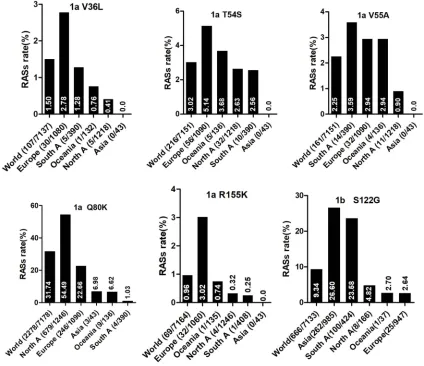
Database. The majority of RASs in most HCV subtypes were similarly distributed among different geographic regions worldwide. NS3 RASs with distinctly variable prevalence by geographic region including Q8OK in GT1a, V36L in GT1a, S122G in GT1b and so on
Infection and Drug Resistance downloaded from https://www.dovepress.com/ by 118.70.13.36 on 22-Aug-2020
T
able
2
Pr
e
valence
of
naturally
occurring
NS5A
RASs
in
86
HCV
subtypes
Subtype
No
.of
seq
a
K24 AEGNQR
b
M28 AGIKSTV
F28CS
L28 AFIMSTV
Q30 DEGHIKLNRSTY R30 CEGHKNQST
A30 GHKV
1a
2855,
2928
0.46R,0.21E,0.32Q
3.79V
,
0.38T
,0.10I
n.a.
n.a.
1.30L,
0.79H,
0.44R
n.a.
n.a.
1b
1817,
1882
1.93K
n.a.
n.a.
0.11F
,2.37M,0.11V
n.a.
4.66Q,0.59K,0.05H
n.a.
1c
4
.
50V
.
50M,50V
.
100Q
.
1d
1
.
.
.
.
100R
.
.
1e
2
50R
.
.
100M
.
100Q
.
1g
2
50R
.
.
.
50.00R
50.00Q
.
1h
3
100Q
.
.
.
100R
.
.
1i
1
100Q
.
.
.
100R
.
.
1j
1
.
.
.
100M
.
100Q
.
1k
1
.
100A
.
100A
.
100Q
.
1l
3
66.67G
.
.
100M
33.33R
66.67Q
.
1m
2
.
.
.
100M
50S
50S,50Q
.
1n
2
.
.
.
100M
.
100Q
.
2a
52
.
.
.
100F
100K
100K
100K
2b
145
.
.
.
4.83F
99.3K
99.3K
99.3K
2c
9
.
.
33.3C
66.67F
22.2R,77.8K
77.8K
77.8K
2d
1
.
.
.
.
100K
100K
100K
2e
1
.
.
.
100F
100K
100K
100K
2f
2
50F
50S
50S
50F
,50S
100K
100K
100K
2i
4
.
.
.
100F
100K
100K
100K
2j
6
.
.
.
66.67F
100K
100K
100K
2k
4
25Q
.
.
25.00F
25R,75K
75K
75K
2l
2
.
.
.
.
100K
100K
100K
2m
4
.
.
.
.
50R,50K
50K
50K
2q
2
.
.
.
.
100K
100K
100K
2r
1
.
.
.
100F
100K
100K
100K
2t
1
.
.
.
.
100K
100K
100K
2u
1
.
.
.
100F
100K
100K
100K
3a
1112,
1114
1.08A,0.09T
0.27V
,0.09T
.
0.09T
,99.2M
1.26L,
0.90T
,0.45S
0.90T
,0.45S
2.25K,0.81V
3b
19
.
.
.
100M
5.26R,84.2K
84.2K
84.2K (Continued
)
Infection and Drug Resistance downloaded from https://www.dovepress.com/ by 118.70.13.36 on 22-Aug-2020
T
able
2
(Continued).
Subtype
No
.of
seq
a
K24 AEGNQR
b
M28 AGIKSTV
F28CS
L28 AFIMSTV
Q30 DEGHIKLNRSTY R30 CEGHKNQST
A30 GHKV
3d
1
.
.
.
100M
100K
100K
100K
3e
1
.
.
.
100M
100K
100K
100K
3g
2
50T
.
.
100M
100K
100K
100K
3h
2
.
.
.
100M
.
.
.
3i
6
.
.
.
100M
16.67R,83.3K
83.3K
83.3K
3k
2
100G
.
.
50M
100K
100K
100K
..
.
.
.
.
.
.
.
4a
30
.
6.67V
.
10M,6.67V
86.67L,3.33R,3.33H3.33S
3.33H,3.33S
3.33H
4b
2
.
.
.
.
50.00S
50.00S
.
4c
1
.
.
.
.
100R
.
.
4d
11
.
.
.
.
90.91R
.
.
4f
6
.
.
.
.
66.67R
33.33Q
.
4g
3
.
.
.
.
66.67L,33.33R
.
.
4k
3
.
.
.
.
100R
.
.
4l
3
.
.
.
.
100R
.
.
4m
4
.
.
.
.
100S
100S
.
4n
3
.
.
.
.
100R
.
.
4o
4
.
.
.
100M
100T
.
.
4p
1
.
.
.
.
100R
.
.
4q
1
.
.
.
.
100R
.
.
4r
7
.
42.86V
,28.6I
.
28.6I,28.6M,42.7V
100R
.
.
4s
1
.
.
.
.
100R
.
.
4t
1
.
.
.
.
100R
.
.
4v
4
.
.
.
.
100R
.
.
4w
2
.
.
.
100M
100S
100S
.
..
.
.
.
.
.
.
.
5a
23
100Q
.
.
.
.
100Q
.
6a
116
89.7Q,6.03R
2.59V
.
23.3F
,2.59V
100R
.
.
6b
2
.
100T
.
100T
100R
.
.
6c
2
.
100V
.
100V
50T
50T
. (Continued
)
Infection and Drug Resistance downloaded from https://www.dovepress.com/ by 118.70.13.36 on 22-Aug-2020
T
able
2
(Continued).
Subtype
No
.of
seq
a
K24 AEGNQR
b
M28 AGIKSTV
F28CS
L28 AFIMSTV
Q30 DEGHIKLNRSTY R30 CEGHKNQST
A30 GHKV
6d
1
100R
100V
.
100V
100T
100T
.
6e
13
15.38R
46.15V
.
53.9M,46.2V
100S
100S
.
6f
18
.
61.11T
,38.89A
.
61.1T
,38.9A
100S
100S
.
6g
2
.
.
.
100M
50.00S
50.00S
.
6h
5
.
100V
.
100V
.
.
.
6i
3
.
66.67V
.
66.67V
.
.
.
6j
4
.
100V
.
100V
.
.
.
6k
8
25R
100V
.
1
00V
.
.
.
6l
7
.
100V
.
100V
.
.
.
6m
4
.
100V
.
100V
100S
100S
.
6n
9
.
100V
.
100V
100S
100S
.
6o
4
.
.
.
.
.
.
.
6p
3
.
66.67V
.
33.3M,66.7V
100S
100S
.
6q
3
.
100V
.
100V
100S
100S
.
6r
3
.
33.33G,33.33T
.
33.33T
.
.
.
6s
3
33.33R
.
.
33.3M
100S
100S
.
6t
4
.
100V
.
100V
100S
100S
.
6u
2
.
100V
.
100V
100S
100S
.
6v
4
.
100V
.
100V
100S
100S
.
6w
3
.
100T
.
100T
.
.
.
6xa
3
.
100V
.
100V
100S
100S
.
6xb
2
.
100V
.
100V
.
.
.
6xc
1
.
100V
.
100V
.
.
.
6xd
3
.
.
.
66.67F
100R
.
.
6x
e
2
.
100V
.
100V
100S
100S
.
6xf
2
50R
100V
.
100V
.
.
50V
7a
2
.
.
.
.
100S
100S
.
7b
1
.
.
.
.
100S
100S
. (Continued
)
Infection and Drug Resistance downloaded from https://www.dovepress.com/ by 118.70.13.36 on 22-Aug-2020
T
able
2
(Continued).
Subtype
L31 FIMPVW
P32 ALQRS
Q54 H
H58 DLN
c
E62 DL
A92KPT
d
Y93 CFILNRSTW
Y93 H
1a
0.65M
0.03L,0.07S
96.52
0.10D
,0.10N
1.4D
0.51P
0.24C
,0.17N,
0.07F
,
0.03S
0.41
1b
2.63M,0.27I,0.05F
0.05S
26.76
3.43S,0.8T
,0.48L,0.48A,0.05R
0.05D
,0.21L
1.28T
0.05C
,
0.05F
,
0.05S
4.25
1c
.
.
75.00
.
50D
.
25N
25.00
1d
100M
.
.
.
.
.
.
.
1e
50M
.
50.00
.
.
100T
.
.
1g
.
.
.
.
.
.
100F
.
1h
.
.
.
.
.
.
.
.
1i
.
.
100
.
.
.
.
.
1j
.
.
.
.
.
.
.
.
1k
.
.
.
.
.
.
.
.
1l
100M
.
33.33
.
.
.
.
.
1m
50M
.
.
.
50D
.
50.00C
50.00
1n
.
.
.
.
100D
.
.
.
2a
82.7M
.
.
.
.
.
1.92F
.
2b
64.8M
.
.
.
.
0.69A,0.69S
.
.
2c
11.1M
.
.
.
.
.
.
.
2d
.
.
.
.
.
.
.
.
2e
100M
.
.
.
.
100S
.
.
2f
100M
.
.
.
.
50S
.
.
2i
100M
.
.
.
.
.
.
.
2j
100M
.
.
.
.
.
.
.
2k
75M
.
25.00
.
.
25A
.
.
2l
.
.
.
.
50L
100S
.
.
2m
100M
.
.
.
.
100S
.
.
2q
50M
.
.
.
.
.
.
.
2r
100M
.
.
.
.
.
.
.
2t
.
.
.
.
.
.
.
.
2u
100M
.
.
.
.
.
.
.
3a
0.18P
.
.
0.09L
3.32L
.
0.36C
,
0.09F
1.35
3b
84.2M,5.26V
.
.
.
36.8D
.
.
.
(
Continued
)
Infection and Drug Resistance downloaded from https://www.dovepress.com/ by 118.70.13.36 on 22-Aug-2020
T
able
2
(Continued).
Subtype
L31 FIMPVW
P32 ALQRS
Q54 H
H58 DLN
c
E62 DL
A92KPT
d
Y93 CFILNRSTW
Y93 H
3d
100M
.
.
.
.
.
.
.
3e
.
.
.
.
.
.
.
.
3g
50M,50V
.
.
.
.
.
.
.
3h
.
.
.
.
.
.
.
.
3i
.
.
.
.
.
.
.
.
3k
100M
.
.
.
100L
.
.
.
..
.
.
.
.
.
.
4a
3.33V
.
100
.
10D
.
.
3.33
4b
.
.
100
.
50D
50P
50T
50.00
4c
.
.
100
.
.
.
.
.
4d
.
.
100
.
.
.
.
.
4f
.
.
100
.
.
.
.
.
4g
.
.
100
.
.
.
33.3R
33.33
4k
66.7L
.
100
.
.
.
.
.
4l
.
.
100
.
.
.
.
.
4m
.
.
100
.
.
.
.
.
4n
33.3L
.
100
.
.
.
.
.
4o
.
.
100
.
25D
.
.
.
4p
.
.
100
.
.
.
.
.
4q
.
.
100
.
.
.
.
.
4r
85.7L
.
100
.
.
.
.
.
4s
100L
.
100
.
.
.
.
.
4t
.
.
100
.
.
.
.
.
4v
.
.
100
.
.
.
.
.
4w
.
.
100
.
.
.
100S
.
L31FIMPVW
.
.
.
.
.
.
.
5a
.
.
.
.
.
.
.
.
6a
0.86M
.
98.28
.
1.72L
.
0.86I,
0.86S
.
6b
.
.
100
100S
.
.
.
.
6c
.
.
100
100G
.
100P
.
.
6d
.
.
.
100S
.
.
100I
.
6e
.
.
.
7.69H
.
.
15.38S
.
(
Continued
)
Infection and Drug Resistance downloaded from https://www.dovepress.com/ by 118.70.13.36 on 22-Aug-2020
T able 2 (Continued). Subtype L31 FIMPVW P32 ALQRS Q54 H H58 DLN c E62 DL A92KPT d Y93 CFILNRSTW Y93 H 6f . . 94.44 16.7S,5.56L . . . . 6g . . . . . . . . 6h . . 100 20S . . . . 6i . . 100 . 66.7D . . . 6j . . 75.00 50A 50D . . . 6k . . 25.00 . 87.5D . . . 6l . . . . 100D . . . 6m . . 100 . . . 100S . 6n . . 100 . . . 100S . 6o . . . 100A . . 50S . 6p . . 100 . . . . . 6q . . 100 . . . . . 6r . . . 33.3S . . . . 6s . . 100 . . . . . 6t . . . 100G . . . . 6u . . . . . . 100S . 6v . . . . . . 100S . 6w . . 100 . 66.7D . . . 6xa . . 100 . . . . . 6xb . . . . 100D . . . 6xc . . . . . . . . 6xd . . 100 33.3A . . . . 6x e . . 100 . . . 100S . 6xf . . . . . . . . 7a . . . . 100L . . 100 7b . . . . . . . 100 Notes: Data ar e pres ented as %. The dot denotes 0%. aNot all the positions wer e analyzed using the same number of sequences. The fi rst fi gur e is the lowe st number , and the second fi gur e is the largest number . n.a. not applicable because of differ ent natural amino acid sequences in the re spectiv e HCV genotype/subtype (NS5A K24, M28, Q30, and H58 ar e the dominant amino acids in G T1a; F28 is the dominant amino acid in subtype 2a and L28 in subtype 2b; A30 is the dominant amino acid in GT3; T93 is the dominant amino acid in GT6). bFo r GT1b, Q24K was scr eened; for GT3 and GT2 except GT2a, S24FHT w er e scr eened. cFor GT1b, P58A/D/G/L/R/S/T was scr eened; for GT6, T58A/D/ G/H/L/N/S w er e scr eened. dFo r GT2, C92A/K/N/R/S/T was scr eened; for GT3, E92K wer e scr eened.No sequences harbor ed S38F . K26E was found in 0.11% of 1a, and 0.27% of 3a sequences.
Infection and Drug Resistance downloaded from https://www.dovepress.com/ by 118.70.13.36 on 22-Aug-2020
T able 3 Pr e valence of naturally occurring NS5B RASs in 86 HCV subtypes Sub type No .of seq a NS5B NI RAS position A150 V L159 F K206 E E237G S282 TGR M289 IL L320 F V321AI 1a 1433, 5412 . 0.09 0.12 1.54 0.19T ,0.02G,0.02R 0.10L 0.02 0.23I,0.02A 1b 2090, 7462 0.08V 11.2 0.03 0.06 0.15T ,0.26R,0.03G 0.01I 0.03 1.83I,0.01A 1c 3, 27 . . . . . . . . 1d 1, 27 . . . . . . . . 1e 2, 59 . . . . . . . . 1g 2, 41 . . . . . . . 2.7I 1h 3, 30 . . . . . . . . 1i 1, 6 . . . . . . . . 1j 1, 4 . . . . . . . . 1k 1, 8 . . . . . . . 100I 1l 3, 40 . . . . . . . 2.5I 1m 2, 5 . . . . . . . . 1n 2, 2 . . . . . . . 100I 2a 28, 742 13.8 . . . . 1.49I, 0.54L 0.14 . 2b 97, 460 1.03 . . 3.02 0.22T 7.73I . 0.44I 2c 13, 286 . . . . . 0.35I . 0.78I 2d 1, 9 . . . . . . . . 2e 1, 25 . . . . . 100L . . 2f 2, 14 . . . . . . . . 2i 4, 84 . . . . . 1.19I, 2.38L . . 2j 6, 89 . . 16.7 4.76 . 1.12I . . 2k 9, 72 . . . . . 1.39I . 3.17I 2l 2, 20 . . . . . 5.00I, 90.0L . . 2m 3, 21 . . . . . . . . 2q 2, 5 . . . . . 20.00I . . 2r 1, 13 100 . . . . . . 46.2I 2t 1, 1 . . . . . . . . 2u 1, 1 . . . . . . . . 3a 90, 3155 31.5 . 7.38 0.45 0.2R,0.03T 0.07L 0.03
0.13I (Continued
)
Infection and Drug Resistance downloaded from https://www.dovepress.com/ by 118.70.13.36 on 22-Aug-2020
T able 3 (Continued). Sub type No .of seq a NS5B NI RAS position A150 V L159 F K206 E E237G S282 TGR M289 IL L320 F V321AI 3b 20, 672 2.63 . 7.92 0.67 0.15G . . . 3d 1, 3 . . 100 . . . . . 3e 1, 4 . . . . . . . . 3g 2, 8 . . . . . . . . 3h 2, 12 . . . . . 100L . . 3i 5, 20 . . 33.3 . . . . . 3k 2, 57 . . 55.6 . . . . . 4a 42, 857 . . . 10.05 0.35T ,0.12R 0.95L 0.12 0.12I 4b 2, 14 . . . . . 7.14L . 7.14I 4c 1, 59 . . . . 1.69G . . 3.77I 4d 25, 672 . . . 0.95 0.18R 0.18I, 0.18L . . 4f 5, 87 . . . 2.38 . . . . 4g 3, 16 . . . . . . . 6.25I 4k 3, 127 . . . . 1.57G 0.79L . 7.14I 4l 5, 31 . . . 9.68 . 7.69L . . 4m 4, 29 . . 25 . . . . . 4n 2, 31 . . . 3.23 . . . . 4o 4, 44 . . . . . 2.38I . . 4p 1, 16 . . . . . . . . 4q 1, 15 . . . . . 26.7L . . 4r 3, 126 . . . 1.15 . . . 60.3I 4s 1, 3 . . . . . . . . 4t 1, 22 . . . . . . . . 4v 2, 6 . . . 66.67 . 16.7L . . 4w 2, 2 . . . . . . . . 5a 37, 419 . . . . . 1.19I 0.25 . 6a 118, 1290 . . . . 0.08R 1.16L . . 6b 2, 9 . . . . . 77.8L . . 6c 2, 12 . . . . . 100L . . 6d 1, 13 . . . . . 100L .
. (Continued
)
Infection and Drug Resistance downloaded from https://www.dovepress.com/ by 118.70.13.36 on 22-Aug-2020
T
able
3
(Continued).
Sub
type
No
.of
seq
a
NS5B
NI
RAS
position
A150 V
L159 F
K206 E
E237G
S282 TGR
M289 IL
L320 F
V321AI
6e
16,
139
.
.
.
.
.
98.6L
.
.
6f
5,
121
.
.
.
.
.
98.4L
.
0.87I
6g
2,
5
.
.
.
.
.
.
.
.
6h
5,
42
.
.
.
.
.
.
.
.
6i
4,
38
.
.
.
.
.
.
.
.
6j
4,
16
.
.
.
.
.
50.0L
.
.
6k
8,
31
.
.
.
.
.
100L
.
.
6l
7,
42
.
.
14.3
.
.
100L
.
.
6m
4,
21
.
.
87.5
.
.
.
.
.
6n
8,
196
.
.
6.45
.
.
94.9L
.
0.54I
6o
4,
13
.
.
.
.
.
100L
.
.
6p
2,
15
.
.
.
.
.
6.67I,
93.3L
.
.
6q
3,
18
.
.
.
.
.
100L
.
16.7I
6r
3,
11
.
.
.
.
.
100L
.
.
6s
3,
5
.
.
.
100
.
100L
.
.
6t
4,
4
.
.
.
.
.
100L
.
.
6u
2,
43
.
.
.
.
.
4.65L
.
.
6v
4,
6
.
.
.
.
.
.
.
.
6w
3,
4
.
.
.
.
.
100
L
.
.
6xa
3,
4
.
.
.
.
.
.
.
.
6xb
2,
2
.
.
.
.
.
100L
.
.
6xc
1,
1
.
.
.
.
.
100L
.
.
6xd
3,
3
.
.
.
.
.
33.3L
.
.
6x
e
2,
2
.
.
50
.
.
100L
.
.
6xf
2,
4
.
.
.
.
.
100L
.
.
7a
2,
2
.
.
.
.
.
.
.
.
7b
1,
2
.
.
.
.
.
.
.
. (Continued
)
Infection and Drug Resistance downloaded from https://www.dovepress.com/ by 118.70.13.36 on 22-Aug-2020
T able 3 (Continued). Sub type NS5B NNI RAS position C316 NYHF S368T N411S M414 TIV C445 F E446 KQ Y448 CH A553 ITV G554 SD S556 GNR G558R D559GN 1a 0.02N, 0.09Y . . 0.11T . 0.11Q, 0.04K 0.07H, 0.04C 0.06V . 0.79G,0.34R, 0.11N 0.42 . 1b 43.09N, 0.09Y ,1.19H 0.03 . 0.14T , 0.32I,0.03V 0.67 98.46Q 0.26H, 0.03C . 0.09D 11.77G,0.83N 0.09 0.05N 1c . . . . . . . . . . . . 1d . . . . . 100Q . . . . . . 1e 10.17N . . . . . . . . . . . 1g 5.26Y , 2.63H . . . . 20Q . . . . . . 1h . . . . 100 . . . . . . . 1i . . . . . 100Q . . . . . . 1j . . . . . . . . . . . . 1k . . . . . . 100H . . . . . 1l 2.50H . . . . . . . . . . . 1m . . . . . . . . . . . . 1n . . . . . . . . . . . . 2a 0.14Y . . . 100 . . 100V . 100G . . 2b . . . . 100 . . 95.37V . 100G . . 2c . . . . 100 . . 87.5V , 6.25I 100S 100G . . 2d . . . . 100 . . 100V . 100G . . 2e . . . . 100 . . 87.5V . 100G . . 2f . . . . 100 . . 75V 25I . 100G . . 2i . . . . 100 . . 100 100S 100G . . 2j . . . . 100 . . 50V , 33.3I, 16.7T . 100G . . 2k 3.12H . . . 90.9 9.09Q . 88.89V . 88.9G . . 2l . . . . 100 . . 100V . 100G . . 2m . . . . 100 . . 100V 100S 100G . . 2q . . . . 100 . . 100V . 100G . . 2r 7.69N, 7.69Y . . . 100 . . 100V . 100G . . 2t . . . . 100 . . 100V . . . . 2u . . . . 100 . . 100V . 100G . . 3a 0.03Y . 0.34 . 99.7 0.12Q . 100V 1.04S 97.8G . 1.11N ( Continued )
Infection and Drug Resistance downloaded from https://www.dovepress.com/ by 118.70.13.36 on 22-Aug-2020
T able 3 (Continued). Sub type NS5B NNI RAS position C316 NYHF S368T N411S M414 TIV C445 F E446 KQ Y448 CH A553 ITV G554 SD S556 GNR G558R D559GN 3b . . . . 100 0.99Q 0.33H 100V . 100G . . 3d . . . . 100 100Q . 100V . 100G . . 3e . . . . 100 . . 100V . 100G . . 3g . . . . 100 . . 100V . 100G . . 3h . . . . 100 . . 100V . 100G . . 3i . . . . 100 . . 100V . 100G . . 3k . . . . 100 . . 100V . 100G . . 4a 0.48N . . 91.4V ,7.76I 100 . . 100V . 100G . . 4b 14.29N, 7.14H . . 50V 100 . . 100V . 100G . . 4c 5.66Y , 3.77H . . 100I 100 . . 100V . 100G . . 4d 0.16Y . . 2.80T , 96.8I 100 . . 100V . 100G . . 4f 81.61N . . 83.3V ,16.7I 100 . . 100V . 100G . . 4g 6.25H . . . 100 . . 100V . 100G . . 4k 0.79Y , 4.76H . . . 100 . . 100V . 100G . . 4l . . . . 100 . . 100V . 100G . . 4m . . . . 100 . . 100V . 100G . . 4n 4.35Y . . . 100 . . 100V . 100G . . 4o . . . . 100 . . 100V . 100G . . 4p . . . . 100 . . 100V . 100G . . 4q . . . . 100 . . 100V . 100G . . 4r 60.3H,0.79N . . 9.09I 100 . . 100V . 75N . . 4s . . . . 100 . . 100V . 100G . . 4t . . . . 100 . . 100V . 100G . . 4v . . . . 100 . . 100V . 100G . . 4w . . . . 100 . . 100V . 100G . . 5a . . . . 98.1 . . 100V 5.41S 97.3G . . 6a . . . . 100 . 0.41H . . 0.84R . . 6b . . . . 100 . . . . . . . 6c . . . . 100 . . . . . . . 6d . . . . 100 . . . . . . . ( Continued )
Infection and Drug Resistance downloaded from https://www.dovepress.com/ by 118.70.13.36 on 22-Aug-2020
T able 3 (Continued). Sub type NS5B NNI RAS position C316 NYHF S368T N411S M414 TIV C445 F E446 KQ Y448 CH A553 ITV G554 SD S556 GNR G558R D559GN 6e 0.72Y 2.33 . . 98.2 . . . . 5.26G,94.7R . . 6f . . . . 100 . . . . . . . 6g . . . . 100 . . . . . . . 6h . . . . 100 . . . . 85.71G . . 6i . . 11.1 . 100 . . . . . . . 6j . . . . 100 . . . . . . . 6k . . . . 100 . . . . . . . 6l . . . . 100 . . . . . . 10.0G 6m . . . . 100 . . . . . . . 6n . . . 1.16V 100 . 1.16H . . 12.5R . . 6o . . . . 100 . . 25V . 75R . . 6p . . . . 100 . . 50V . 100R . . 6q . . . . 100 . . . . 100R . . 6r . . . . 100 . . . . . . . 6s . . . . 100 . . 100V . 100R . . 6t . . . . 100 . . . . 25R . . 6u . . . . 100 . . . . 100R . . 6v . . . . 100 . . . . . . . 6w . . . . 100 . . . . . . . 6xa . . . . 100 . . . . . . . 6xb . . . . 100 . . . . . . . 6xc . . . . 100 . . . . 100R . . 6xd . . . . 100 . . . . . . 33.3G 6x e . . . . 100 . . . . . . . 6xf . . . . 100 . . . . 100R . . 7a . . . . 100 . . 100V . 100G . . 7b . . . . 100 . . . 100S 100G . . Notes: Data ar e pres ented as %. The dot denotes 0%. C451S wer e detected in 1.05% of 1b sequences, G188D in 0.82% of 3a, N224I in 3.06% of 3a and in 3.45% of 6k, A395G in 0.75% of 4a, and Y561H in 0.10% of 1b. L314H, N444K, S565F w er e not found. aNot all the positions w er e analyzed using the same number of sequences. The fi rst fi gur e is the low est number , and the second fi gur e is the largest number .
Infection and Drug Resistance downloaded from https://www.dovepress.com/ by 118.70.13.36 on 22-Aug-2020
(Figure 1,P<0.05). Q80K in GT1a was mostly prevalent in North America (54.49%, 679/1246), followed by Europe (22.66%, 246/1090), Asia (6.98%, 3/43), Oceania (6.62%, 9/136), and South America (1.03%, 4/390). NS5A RASs (L28M, R30Q, Q54H, and Y93H in GT1b, L31M in
GT2b, and E62L in GT3a) varied significantly in
geo-graphic prevalence (Figure 2, all P-values <0.05). L28M,
R30Q, and Y93H in GT1b showed the highest prevalence in Asia. NS5B RASs exhibited distinct global distribution
patterns are present in Figure 3. C316N/H was found
mostly in Asia (73.20%, 1923/2627), followed by in the Former USSR (63.77%, 213/334), Europe (31.82%, 415/ 1304), North America (22.81%, 52/228), South America (21.39%, 182/851), Oceania (10.64%, 5/47), the Middle East (21.82%, 24/110), Africa (4.49%, 7/156), Central America (0%, 0/10), and the Caribbean (0%, 0/12). In
contrast, Asia had the lowest prevalence of L159F in GT1b (0.62%, 2/322), while S556G in GT1b commonly appeared in Oceania (26.92%, 7/26) but infrequently in North America (4.49%, 8/178). A150V in GT3a was most prevalent in Asia (44.09%), followed by Europe (31.19%), Oceania (24.29%), and North America (19.05%).
Naturally occurring combined RASs
The associations of RASs within and between the HCV NS3, NS5A, and NS5B genes were investigated using ahypergeometric test to detect significantly more or less
frequent RAS co-occurrences. This analysis identified
pairs of variants that may result in improved or reduced
fitness, and RASs were defined as co-occurring or
mutually exclusive based on their observed frequencies. Subtypes GT1a and 1b were separately analyzed. For Figure 1The global and regional frequency of naturally occurring NS3 RASs that showed unequal distribution by geographic regions. In each plot, except for thefirst bar representing the global prevalence, geographic regions were arranged in descending order according to the frequency of RASs. Sequences were clustered into Asia, Europe, North America, Central America, South America, Former USSR, Oceania, Africa, Caribbean or Middle East. In each plot, regions with <10 sequences were not shown.
Region definition was according to the Los Alamos HCV Database.“A”in North A, South A and Central A denotes America.
Infection and Drug Resistance downloaded from https://www.dovepress.com/ by 118.70.13.36 on 22-Aug-2020
each pair of RASs, only overlapping sequences were used.
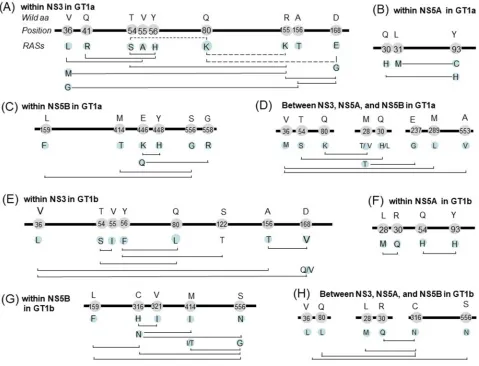
Dozens of RAS pairs were identified. In GT1a, RAS
combinations within NS3 is shown in Figure 4A. Q80K
has three partners (R155K, D168E, and T54S), but the
frequencies of all their combinations was significantly
lower than expected. Q80K and R155K were respectively observed in 31.87% (2275/7137) and 0.96% (69/7137) of GT1a sequences, but the pair was only found in 0.056% (4/7137) of sequences compared with the expected level (0.308%). Thus, these RASs were considered a mutually exclusive pair. All of these RASs, except Q80K, showed
significantly higher co-occurrences with other RASs than
expected. For example, R155K tends to be present with V36M, D168G, and T54S. Co-occurring pairs in NS5A
included L31M+Y93C and Q30H+Y93H (Figure 4B), and
those in NS5B included NI-L159F+NNI-S556G and
NNI-M414T+NNI-S556G (Figure 4C). We also identified
some co-occurring RASs pairs among NS3, NS5A, and NS5B, including NS3-Q80K+NA5A-M28T/V, NS3-T54S +NS5A-Q30H/L and NS3-V36M+NS5B-A553V and so on (Figure 4D). Two RASs from different regions co-occurred rarely in this study (one or two of the 734 sequences). This means that each of these RASs occurred rarely, but they tend to be co-occurred.
For GT1b, co-occurring pairs in NS3, NS5A, and
NS5B were shown in Figure 4E, F, and G respectively.
NS3 RAS pairs included T54S+Q80L, Y56F+S122T and so on. NS5A pairs included Y93H+Q54H and L28M
+R30Q. Within NS5B, similar to GT1a, pairs
NI-L159F+NNI-S556G and NNI-M414I/T+NNI-S556G
were identified. Other pairs included C316H+V321I.
Figure 2NS5A RASs rate with significantly different frequencies among different geographic regions. In each plot, thefirst bar represents the global prevalence and geographic regions were arranged in descending order according to the frequency of RASs. Sequences were clustered into Asia, Europe, North America, Central America,
South America, Former USSR, Oceania, Africa, Caribbean or Middle East. In each plot, only regions with at least 10 sequences were shown. Region definition was according
to the Los Alamos HCV Database.“A”in North A, South A and Central A denotes America.
Infection and Drug Resistance downloaded from https://www.dovepress.com/ by 118.70.13.36 on 22-Aug-2020