IJEDR1603111
International Journal of Engineering Development and Research (www.ijedr.org)678
A Research On Design And Development Of Sound
Jacket For Hermetically Sealed Compressor Using
Visco-Elastic Material
1Tejas D. Kulkarni, 2V.H.Sohani, 3A. A. Kumbhojkar
1P.G. Student, Department of Mechanical Engineering, P.V.P.I.T Budhgaon, Sangli, Maharashtra, India 2Senior Engineer, Emerson Climate Technologies (India)Pvt.Ltd., Karad
3Associate Professor, Department of Mechanical Engineering, P.V.P.I.T Budhgaon, Sangli, Maharashtra, India
Abstract - Recently, noise and vibration problems are gaining increasing importance in the electrical home appliances and the trend is to manufacture lighter and higher quality goods. It is complicated to find the generating source and propagating path of noise in the compressor. Fractional horse power reciprocating compressors are commonly found in HVAC systems such as household refrigerators and air-conditioners. The noise is a major issue in case of reciprocating compressor which leads to human perception. In order to address the noise perception, issue the concept of sound jacket is incorporated over the compressor shell. The viscoelastic material used for the developing sound jacket will help in attenuating the sound propagating from compressor and will lead to quiet operation.
Index Terms— Fractional horse power reciprocating compressor, HVAC systems, human perception, sound jacket, viscoelastic material.
I.INTRODUCTION
A compressor is the most important and often the costliest component of any vapor compression refrigeration system (VCRS). Compressors are often noisy & effective solution is often required to suppress the noise emitted from them. Compressor noise is usually a nuisance because they are sitting on comparatively lightweight structures. Use of visco-elastic material may be thought of to address the issue.
Viscoelasticity may be defined as material response that exhibits characteristics of both a viscous fluid and an elastic solid. An elastic material such as a spring retracts to its original position when stretched and released, whereas a viscous fluid such as putty retains its extended shape when pulled. A viscoelastic material (VEM) combines these two properties-it returns to its original shape after being stressed. The degree to which a material behaves either viscously or elastically depends mainly on temperature and rate of loading (frequency). Many polymeric materials (plastics, rubbers, acrylics, silicones, vinyls, adhesives, urathanes, and epoxies, etc.) having long- chain molecules exhibit viscoelastic behavior. It is further found that visco-elastic materials have good vibration and noise damping properties.
The mechanism for reducing sound depends on from where the sound comes from. If it is generated within a room then sound is absorbed. If it is airborne, it is originating from outside then it is necessary to insulate the space. And if it is transmitted through the structure then the structure needs to be isolated from the source of vibration. The effective solution attenuating the compressor noise is by developing a sound proof jacket made up from visco-elastic materials.
II. OUTLINEOFPROJECTWORK
The project work is outlined in following three sections:
1. Theoretical analysis: -
Studying the basic refrigeration cycle and Construction of Hermetic Reciprocating Compressor. Study of the physics of sound.
Studying of working of reciprocating compressor.
Studying the earlier NVH test results in order to compare difference between sound pressure and sound power. Discussing and finalizing various compressor model on which sound jacket is to be incorporated.
Designing and developing sound jacket from the prototype compressor.
2. Experimental Analysis:
To develop suitable setup to carry out the experimental analysis for compressor model for:
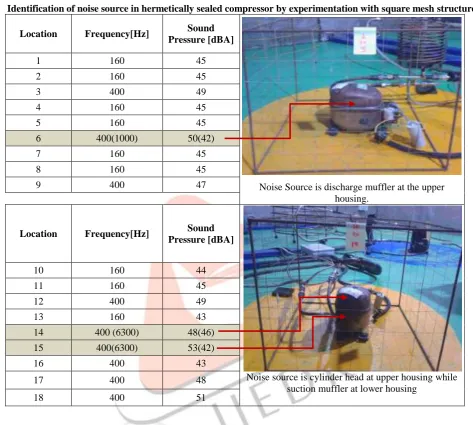
Identification of noise source in hermetically sealed compressor by experimentation with square mesh structure. To determine the sound power and pressure by experimental analysis with and without sound jacket for various
compressor models at NVH lab.
IJEDR1603111
International Journal of Engineering Development and Research (www.ijedr.org)679
To carry out the performance testing for compressor model with and without sound jacket for determining compressorperformance.
To carry out the appliance testing of compressor with and without sound jacket.
III.EXPERIMENTALANALYSIS\
1. Identification of noise source in hermetically sealed compressor by experimentation with square mesh structure:
Location Frequency[Hz] Sound
Pressure [dBA]
1 160 45
2 160 45
3 400 49
4 160 45
5 160 45
6 400(1000) 50(42)
7 160 45
8 160 45
Noise Source is discharge muffler at the upper housing.
9 400 47
Location Frequency[Hz] Sound
Pressure [dBA]
10 160 44
11 160 45
12 400 49
13 160 43
14 400 (6300) 48(46)
15 400(6300) 53(42)
16 400 43
17 400 48 Noise source is cylinder head at upper housing while
suction muffler at lower housing
18 400 51
2. Overall sound power attenuation from experimental analysis with and without sound jacket for various compressor models at NVH lab.
Table 1 Overall Sound Power(dBA) attenuation by NVH testing
Compressor Model Sound Jacket Overall sound attenuation in sound
power [dBA]
A
J1 2.8
J2 0.5
J3 1.8
J4 1.5
B
J1 0.6
J4 5.3
IJEDR1603111
International Journal of Engineering Development and Research (www.ijedr.org)680
C J4 6.2
D J4 6.2
E J4 6.3
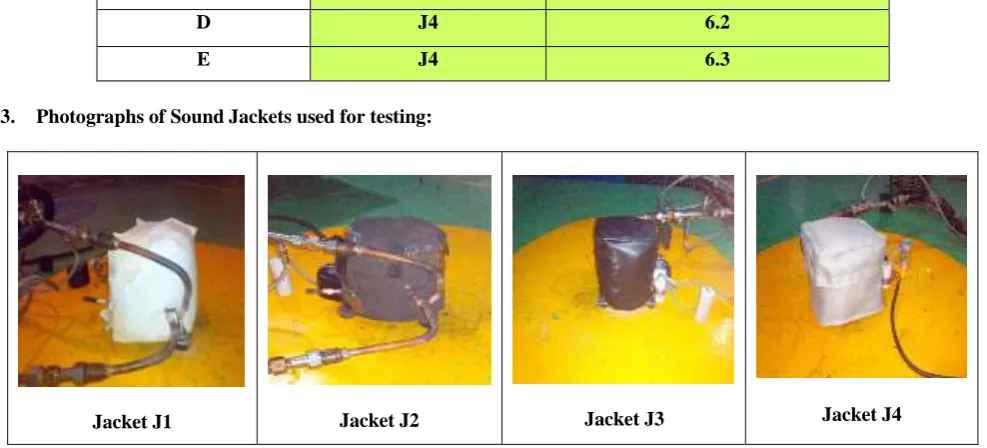
3. Photographs of Sound Jackets used for testing:
4. Finalization of Jacket Based On Insertion Loss Values:
Table 2 Insertion Loss (dBA) values for different sound jacket
Frequency [Hz] Jacket J1 Jacket J2 Jacket J3 Jacket J4
100 -1.07 0 5.18 0.01
125 3.69 0 -0.92 -6.8
160 0.84 -2.28 3.66 -3.09
200 -2.03 -0.57 4.06 0.02
250 -0.62 -2.06 -0.02 -0.03
315 -0.63 0.64 -1.88 3.4
400 0.15 2.06 -1.77 2.41
500 -2.04 0.03 -0.87 -2.37
630 0.28 -0.72 1.4 3.09
800 -0.99 2.87 1.35 -4.61
1000 2.13 0.5 -0.79 -10.44
1250 2.5 3.58 0.25 -5.37
1600 0.1 1.69 0.94 -2.79
2000 2.6 1.34 0.62 -8.14
2500 3.78 0.84 -1.92 -6.35
3150 4.01 -1.24 -2.19 -10.07
4000 4.04 -5.15 -6.51 -14.81
5000 6.14 -4.74 -3.32 -14.83
6300 6.43 -1.81 -5.64 -4.28
8000 7.67 -5.62 -2.18 -4.81
10000 1.67 0.45 -5.31 -7.55
Note-Negative value denotes the insertion loss (dBA) over the corresponding frequency(Hz) by various mentioned sound jackets.
Graph 1 Trend for insertion loss Vs Frequency for different sound jackets
IJEDR1603111
International Journal of Engineering Development and Research (www.ijedr.org)681
5. Performance testing of compressor with and without sound jacket:Table 3 Performance testing for with and without sound jacket for compressor Performance Data
Sr. No. Parameters Without
jacket
With
jacket(J4) Variation (%)
1 Mass flow (lbm/hr) 28.5 27.9 -2.1053
2 Cooling Capacity (BTU/hr) 1991.7 1949.4 -2.1238
3 EER 8.58 8.38 -2.331
4 Current(Amps) 1 1 0
5 Power(watts) 232 232.6 0.25862
Thermal Performance
Sr.No. Parameters Without jacket (°F)
With
jacket(J4) (°F) Variation (°F)
1 Top Shell 147.9 184.7 (36.80)
2 Bottom Shell 146.7 186.3 (39.60)
3 Middle at shell 169.5 181.1 (11.60)
4 Discharge Line 159.5 165.7 (6.20)
5 Winding Temp.
(M/A/M+A) 189/178/177 202/198/197 (13/20/20)
6. Appliance testing of compressor with and without sound jacket:
7. Table 3 Sound Pressure (dBA) values by appliance testing Sound Pressure (dBA)
Appliance Orientation
35°C Ambient 43°C Ambient
With Jacket (J4)
Without Jacket
With Jacket (J4)
Without Jacket
Front 51.7 53.6 52 53.1
Left 51.9 53.4 53.3 52.9
Right 52.7 52.7 52 53
Back 55.5 56.2 56 56
Graph 2 Trend for sound pressure Vs appliance orientation at Application Test lab -20 -15 -10 -5 0 5 10 1 0 0 1 2 5 1 6 0 2 0 0 2 5 0 3 1 5 4 0 0 5 0 0 6 3 0 8 0 0 1 0 0 0 1 2 5 0 1 6 0 0 2 0 0 0 2 5 0 0 3 1 5 0 4 0 0 0 5 0 0 0 6 3 0 0 8 0 0 0 1 0 0 0 0 In ser tio n lo ss ( d B )
Frequency (1/3 octave band)(Hz)
IJEDR1603111
International Journal of Engineering Development and Research (www.ijedr.org)682
IV.CONCLUSIONS
From the experimental work carried on the design and development of sound jacket for hermetically sealed compressor using viscoelastic materials the following findings are discussed,
1. The NVH testing carried at semi-anechoic chamber, the testing conducted by four different sound jacket over wide range of compressor. The experimental test result concluded that the major sound power attenuation was observed in the frequency range of 1K to 10 K Hz frequency range in 1/3 octave band. The maximum overall sound power attenuation was observed in Jacket J4 ranging from 5.3-6.3 dBA. Hence the jacket J4 was finalized for further testing.
2. The insertion loss values of the sound jacket was basically calculated in order to justify the maximum sound attenuating capacity. From the stated insertion loss values, it can be concluded that the jacket J4 has maximum insertion loss of 15 dBA. 3. The performance testing was carried out by finalized sound jacket J4. The performance testing result concluded that the variation of the performance parameters values are within the specified limit of ± 5% as per IS5111 standard. The test also concluded there is only 4°C increase in shell temperature of compressor by sound jacketing which does not lowers the cooling capacity of compressor.
4. The appliance testing was conducted to address the issue of human sound perception issue. The sharp noise from the compressor was eliminated and sound pressure attenuation of 2dBA was achieved.
ACKNOWLEDGMENT
I hereby take an opportunity to express my deepest gratitude to my guide, Prof. A. A. Kumbhojkar and Mr. Vardhan Sohani (Senior Engineer), Emerson Climate Technologies (India) Pvt. Ltd, Karad for their excellent guidance, caring, patience, and providing me with an excellent atmosphere for doing project work and patiently correcting my writing. I also express my thanks to Mr. Shridattaprasad Deshpande (Divisional Manager), Emerson Climate Technologies (India) Pvt. Ltd, Karad for their valuable cooperation for completion of this research work. Many thanks to entire team of M/S Emerson Climate Technologies India Pvt.Ltd. Karad and all teaching and non-teaching staff, friends from P.V.P.I.T Budhgaon, Sangli, for helping me in every aspect for completing my project work.
REFERENCES
[1] Myklestad N. O., Journal of Applied Mechanics. The concept of complete damping. 19, 284-286,(1952).
[2] C. D. Johnson and D. A. Kienholz. Finite element prediction of damping in structures with constrained viscoelastic layers. AIAA Journal, 20(9):1284, 1982. AIAA 81-0486R.
[3] Ungar E. E., "Structural Damping", Chapter 12 in Noise and Vibration Control Engineering: Principles and Applications, Leo. L. Beranek (Editor). John Wiley & Sons, Inc., (1992).
[4] D.D.L. Chung, Review materials for vibration damping, Journal of material science 36 (2001) 5733-5737
[5] Mohan D. Rao, Recent applications of visco-elastic damping for noise control in automobiles and commercial airplanes, Journal of Sound and Vibration 262 (2003) 457–474.
[6] http://www.emersonclimate.com/europe/ProductDocuments/CopelandLiterature/DGE140-SoundShell-EN_0.pdf,(2012) (Accessed on 18th September 2015)
[7] https://www.osha.gov/dts/osta/otm/new_noise/background.pdf (Accessed on 28th March 2016)
[8] IS 3745:2012, Determination of sound power levels and sound energy levels of noise sources using sound pressure precision methods for anechoic rooms and hemi-anechoic rooms (Accessed on 10th September 2015)
[9] IS 5111:1993, Testing of Refrigerant compressor (Accessed on 25th January 2016)
[10]IS1475-1(2001): Self-Contained Drinking Water Coolers, Part1: Energy Consumption and Performance [MED3: Refrigeration and Air Conditioning] (Accessed on 21st March 2016)
49 50 51 52 53 54 55 56 57
Front Left Right Back
So
u
n
d
P
ress
u
re
(d
B
A
)
Appliance Orientation
With Jacket
W/O Jacket
With Jacket