
Chiral Imbalance in QCD and its consequences
Alexander Andrianov1,2,Vladimir Andrianov1,and Domenec Espriu2,
1Faculty of Physics, Saint Petersburg State University, Universitetskaya nab. 7/9, Saint Petersburg 199034,
Russia, and
2Departament de Física Quàntica i Astrofísica and Institut de Ciéncies del Cosmos (ICCUB),Universitat de
Barcelona, Martí i Franqués 1, 08028 Barcelona, Spain
Abstract. Under extreme conditions of high temperature and/or large quark (baryon) density, the vacuum of QCD changes its properties, and deconfinement, chiral symmetry restoration as well as chiral symmetry breaking take place. These transitions (phases) are accompanied by the rapid change in the rate and nature of topological transitions connecting different topological sectors. The heavy ion collisions (HIC) program opens a possibility to study these phenomena in so-called non-Abelian Quark-gluon plasma (QGP). In these phases the currents of light quarks (vector and axial-vector) can be in-dependently examined for right-handed (RH) and left-handed (LH) quarks. To describe such a quark matter chiral chemical potential can be introduced to quantify the presence of chirality imbalance (ChI) i.e. the difference between the average numbers of RH and LH quarks in the fireball after HIC. In this review talk we will focus our attention on the discussion of the ChI related developments in heavy ion physics at central collisions and the plans for the future experiments aimed at establishing (or falsifying) the pres-ence of Local spacial Parity Breaking (LPB) in heavy ion data. We describe some of experimental observables in detecting the signal of LPB. A number of measurements is proposed that allow to reach a definite conclusion on the occurrence of LPB effects in non-Abelian QGP produced in central heavy ion collisions and its simulation within a number of QCD-inspired models is outlined. Based on the effective meson theory in the presence of Chern-Simons interaction it is found that the spectrum of massive vector mesons splits into three polarization components with different effective masses. More-over a resonance broadening occurs that leads to an increase of spectral contribution to the dilepton production as compared to the vacuum state. The asymmetry in production of longitudinally and transversely polarized states ofρandωmesons for various values of the dilepton invariant mass can serve as a characteristic indication of the LPB in CERES, HADES, PHENIX, STAR, NA60 and ALICE experiments.
1 Introduction and Outline
Nowadays Quantum Chromodynamics (QCD) represents a theory with known symmetries and well established elementary constituents. However their interaction leading to the observed hadron states
still needs in the adequate description beyond the perturbation theory, especially, at low and interme-diate energies.
It is widely believed that such a non-perturbative dynamics occurs due to the nontrivial topology of QCD vacuum as a consequence of the compactness of non-Abelian color gauge groupS U(3). Its compactness allows for topologically nontrivial configurations of the gluon field. These configurations essentially determine the QCD vacuum structure. The latter is composed of the superposition of an infinite set of topologically distinct states connected by tunneling instanton-like transitions [1] and becomes a “θ-vacuum” of the theory [2, 3]. It is likely that topological effects in QCD are responsible for the chiral symmetry breaking (see [4, 5] for a review).
With the light current quark masses negligible compared to relevant energy scales, the QCD La-grangian has an approximate chiral symmetry. However this symmetry is not realized in the ground state due to formation of quark-anti-quark pair condensate in the QCD vacuum. This is of course the well-known phenomenon of spontaneously broken chiral symmetry which is a fundamental property of QCD. On the other hand, lattice QCD computations have shown that with increasing temperature such a vacuum condensate will be melting with the chiral symmetry being restored at sufficiently high temperatureT >Tc ∼170MeV[6, 7]. Therefore, chiral symmetry restoration at high temperatures
is also a basic prediction of QCD. With such a symmetry in light quark sector, the currents (vector and axial-vector) in quark-gluon phase (QGP) can be independently examined for right-handed (RH) and left-handed (LH) quarks. To describe such a matter a chiral chemical potential can be introduced in order that to quantify the presence of chirality imbalance i.e. the difference between the numbers of RH and LH chiral fermions in the system. Quarks with specific chirality have their momentum direction correlated with spin orientation.
There remains however the crucial question of how to achieve a chiral QGP with chirality im-balance in the first place. The process of creating nonzero chirality pertains to the famous “chiral anomaly” [8, 9]. This anomaly implies the breaking of axial current conservation by quantum loop effects. Correspondingly, locally, chirality imbalance can be generated through nonorthogonal elec-tric and magnetic field strength. Such fields can be either QED EM fields or QCD chromo-EM ones. In QCD the gluon configurations generating chiral imbalance globally exist: they are the topologi-cal solitons such as instantons and sphalerons. These topologitopologi-cal objects play crucial role for non-perturbative dynamics in QCD vacuum [10] as well as in hot QGP [11, 12]. Such configurations have their global topological winding numberQw, and when coupled with chiral fermions, can generate an amount of global chirality imbalance via chiral anomaly:NR−NL =2Qwfor each flavor of light
quarks. In short, the chirality imbalance is a direct manifestation of the QCD topological fluctuations and could become observable through the asymmetry in polarizations of dilepton pairs [13] in central heavy ion collisions (HIC) and the Chiral magnetic wave (CMW) in non-central HIC [14]. Summa-rizing one can say that the Chiral imbalance (ChI) of quarks is a remarkable phenomenon that stems from highly nontrivial interplay of chiral symmetry of QCD, axial anomaly, and the topology of gluon configurations.
In this talk we focus the reader’s attention on the discussion of ChI related developments in heavy ion physics atcentralcollisions and the plans for the future experiments aimed at establishing (or falsifying) the presence of Local parity breaking (LPB) in HIC data.
We describe:
Where and how does chiral imbalance appear: Phenomenology of parity breaking in finite volume.
Chiral imbalance in quark-gluon phase: topological charge vs. axial (chiral) charge: topological vs. chiral chemical potentials.
Observables sensitive to chiral imbalance - manifestation of LPB in heavy ion collisions (HIC): dilepton polarization asymmetry [13].
2 Phenomenology of parity breaking in finite volume
Parity is a well established global symmetry of strong interactions. Are there any reasons to believe it may be broken in a finite volume?! Local large fluctuations in the topological charge presumably exist in a hot environment and are responsible for LPB.
• Quantum fluctuations ofθparameter: P-odd bubbles [14], their manifestation in Chiral Magnetic Effect (CME)[15]) (an earlier proposal: [16] ).
• New QCD phase characterized by a spontaneous parity breaking due to formation of neutral pion-like background [17, 18] .
• High energy production of pseudoscalar gluelumps⇔of parity-odd bunches of gluon jets⇒then a PB background remains inside a hot dense nuclear fireball in HIC !?
Observable effects:
• Forperipheralheavy ion collisions they lead to the Chiral Magnetic Effect (CME): LargeB ⇒ largeE ⇒charge separation[14].
• Forcentralcollisions (and light quarks) they correspond to a phase with axial chemical potential μ50 located in "fluctons" of few-Fermi size [13].
The two effects are complementary!
3 Topological charge and topological chemical potential
In hot QCD (in heavy ion collisions) a metastable topological chargeT5 may arise in a finite volume due to sphaleron-like transitions [19].
T5= 1 8π2
vol.
d3xεjklTr
Gj∂kGl−i2 3G
jGkGl
it may survive for a sizeable lifetime in a heavy-ion fireball
ΔT50 for Δtτfireball 5÷10 fm/c;
(7±1 fm/c [20])
For the fireball lifetime one can trigger the value ofΔT5 0 introducing into the QCD La-grangian a topological chemical potentialμθin a gauge invariant way viaΔLtop=μθΔT5, where
ΔT5=T5(tf)−T5(0)= 1 8π2
tf
0 dt
vol.
d3xTrGμνGμν .
We notice that in finite 3+1 dimensional volume the so-called index theorem does not work and the jump of topological charge is not necessarily integer.
4 Axial baryon charge and axial chemical potential
Theexactoperator law in QCD, the partial conservation of axial current (broken by current quark
massesmqfor light quarksq=u,d,sand gluon anomaly)
∂μJ5μ−2imqJ5= 1 8π2Tr
GμνGμν
predicts the rigid relations between changes in topology of gauge configurations and the induced axial charge (for small quark massesmq 0). If the gluon and quark flows across the volume boundary of
a fireball are reasonably small (a fireball is metastable) then,
d dt
Q5−2NfT5
0, Q5=
vol. d3x
u,d,s
q†γ5q=NL−NR,
and the chiral charge generated in a heavy ion collision is approximately conserved duringτf ireball.
The characteristic left-right oscillation time is governed by inverse quark masses. Indeed if an excess of left(or right)-handed quark statesqL(x0 =0) arises in the fireball in the initial moment of central collision then their further evolution in the rest frame can be approximately characterized by the following equation,
q(x0)
cos(mqx0)−iγ0sin(mqx0)
qL(0). (1)
Therefore after a periodΔx0 ∼π/2mqleft-handed quark states become essentially right-handed.
• Foru,d quarks 1/mq ∼ 1/5 MeV−1∼ 40 fm τfireball and the left-right quark mixing can be
neglected during fireball life time.
• For squark 1/ms ∼ 1/150 MeV−1 ∼ 1 fm τfireball and the chiral charge averaged over the
fireball volume and its lifetime vanishesQs
Correspondingly foru,dquarks in a background with the jump of topological chargeΔT50 or with the chiral (axial) chargeQ5 0 QCD can be equally described at the Lagrangian level by introducing a topological chemical potentialμθor an axial chemical potentialμ5
ΔT5 1 2Nf
Q5 ⇐⇒ μ5 1 2Nf
μθ,
ΔLtop =μθΔT5 ⇐⇒ ΔLq=μ5Q5
Thus one can think about a generation of chiral imbalance from non-trivial topological charge or visa versa inducing a topologically non-trivial gluon configuration by imbalance of left- and right-handed quark densities. As both properties are related locally one may get a parity violation generated by either charge in a finite volume of fireball and visible during fireball lifetime.
How doesμ5affect the hadronic phenomenology?
5 Effective meson theory in a medium with LPB
In the environment with chiral chemical potential the scalar sector can be described by using the spurion technique in the chiral Lagrangian with an isosingletμ5[21],
Dν=⇒Dν−i{Iqμ5δ0ν,·}=Dν−2iIqμ5δ0ν, (2) where for three light flavors Iq ≡ diag[1,1,0] in accordance with the preceding discussion. An
effective Lagrangian is required to include the lightest isoscalar degrees of freedom such as σand a0(980), which will be mixed with their pseudoscalar partnersη, ηandπ, respectively.
In the lowest order of chiral expansion such an effective lagrangian reads,
L=1 4Tr
DμHDμH†+ B
2Tr m(Hˆ +H
†)+M2
2 Tr
HH†
−λ1
2 Tr (HH
†)2−λ2 4 Tr
HH†2+c
2(detH+detH
†)
+d1
2Tr m(HHˆ
†H+H†HH†)+d2
2Tr m(Hˆ +H
†)TrHH† (3)
where theS U(3)L×S U(3)R chirally invariant part is parameterized by constantsM, λ1,2,cand soft chiral symmetry breaking is realized with the help of vertices containing ˆm =diag[mu,md,ms] and
constantsB,d1,2. The convenient splitting of scalar fields is given by
H=ξΣξ, ξ=exp
iΦ 2f
, Φ =λaφa, Σ =λbσb
The v.e.v. of the neutral scalars are defined asvi = Σiiwherei = u,d,s, and, in the chiral limit
ˆ
m=0, satisfy the following gap equations:
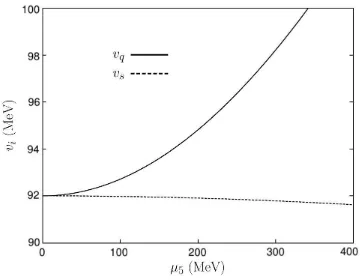
(2μ25+M2)−2(λ1+λ2)v2q−λ2v2s+cvs=0;
(−2λ2+ c vs
)v2q+M2−(2λ1+λ2)v2s =0,
Figure 2.Vacuum condensates in the presence of chiral imbalance
Evidently for largeμ5the correct solution has the following asymptotics,
v2
q=
2μ25+M2+ c2
4λ2
2(λ1+λ2)
+O(1/μ25), vs=
c 2λ2
+O(1/μ25).
These solutions are depicted in the Fig.2.
We stress that the consistent solution with a finite limit for strange quark constituent massvs vq
exists if the term breakingU(1)A symmetry is in action. Meantime the constituent masses for light
u,dflavours is growing with chiral chemical potential, first as∼μ2
5and next as∼μ5. Moreover even if the spontaneous chiral symmetry breaking is absent for M2 < 0 in parity-even environment this CSB will be triggered by chiral imbalance.
The lattice computations perfectly confirm [22] this behavior against chiral chemical potential.
For further purposes we need the non-strange meson sector andηs
Φ = ⎛ ⎜⎜⎜⎜⎜ ⎜⎜⎜⎜⎝ηq+π
0 √2π+ 0 √
2π− ηq−π0 0
0 0 √2ηs
⎞ ⎟⎟⎟⎟⎟ ⎟⎟⎟⎟⎠,Σ =
⎛ ⎜⎜⎜⎜⎜
⎜⎜⎜⎜⎝vu+σ+a 0 0
√
2a+0 0 √
2a−0 vd+σ−a00 0
0 0 vs
⎞ ⎟⎟⎟⎟⎟ ⎟⎟⎟⎟⎠ ηq ηs =
cosψ sinψ −sinψ cosψ
η η
Forμ5 = 0, in the chiral limit ˆm = 0 we adoptvu = vd =vs = v0 ≡ fπ ≈ 92 MeV. The coupling constants (in units of MeV) are fitted to phenomenology assuming isospin symmetry with the help of χ2minimization (MINUIT):
b=−3510100/m,M2=1255600,c=1252.2, λ1=67.007,
λ2=9.3126,d1=−1051.7/m,d2=523.21/m,
wherem≡mq=(mu+md)/2 andm/ms1/25.
One, of course, should not expect the range of applicability of dim-4 meson lagrangian for chem-ical potentials larger than few hundreds of MeV. Nevertheless the predictions for lightest states, pions can be well controlled within the chiral perturbation theory.
5.1 New eigenstates of strong interactions with LPB (isotriplet)
We present a simple case of mixing due to LPB in the isotriplet sector withπanda0. The kinetic and mixing terms in the Lagrangian are given by
L=1 2(∂a0)
2+1 2(∂π)
2−1 2m
2 1a20−
1 2m
2
2π2−4μ5a0π,˙
where
m2
1=−2[M2−2(3λ1+λ2)v2q−λ2v2s
−cvs+2(3d1+2d2)mvq+2d2msvs+2μ25]
m22=2m vq
b+(d1+2d2)v2q+d2v2s
After diagonalization in the momentum representation, the new (momentum-dependent) eigen-states are defined ˜πand ˜a0.
˜
a0 mass shows an enhancement, butμ5has to be understood as a perturbatively small parameter. A better treatment of ˜a0would require heavier degrees of freedom.
5.2 New eigenstates of strong interactions with LPB (isosinglet)
Two new processes are likely to appear inside the fireball: the decaysη, η → ππthat are strictly forbidden in QCD on parity grounds.
In a medium where parity is broken: are these processes relevant within the fireball? Can these particles reach thermal equilibrium?!
Figure 4.For high energiesk0,|k|>m1m2/(4μ5)≡kcπ˜, in-medium ˜πgoes tachyonic. Nevertheless, energies are always positive (no vacuum instabilities).
O(p4) terms lead to couplings such as
Lηππ∼ 16μ5 Fηf2 π
L∂η ∂π∂π,
whereL∼10−3. A rough estimate of the partial width shows a strong dependence onμ
5asΓη→ππ∝μ25 and gives values similar or higher thanΓρ→ππ=150 MeV.
In the isosinglet sector, we show the mixing ofη,σandη. The kinetic and mixing terms in the Lagrangian are given by
L=1 2[(∂σ)
2+(∂η
q)2+(∂ηs)2]−
1 2m
2 3σ2−
1 2m
2 4η2q−
1 2m
2 5η2s
−4μ5ση˙q−2
√
2cvqηqηs,
where
m23=−2(M2−6(λ1+λ2)v2q−λ2v2s+cvs
+6(d1+2d2)mvq+2d2msvs+2μ25),
m2 4=
2m vq
b+(d1+2d2)v2q+d2v2s
+2cvs,
m25=2ms vs
[b+2d2v2q+(d1+d2)v2s]+
cv2
q
vs
.
After diagonalization, the new eigenstates are ˜σ, ˜ηand ˜η.
Again, for high energiesk0,|k|>kcη˜withkcη˜ ≡
m3
4μ5m5
m2
4m25−8c2v2q, in-medium ˜ηgoes tachyonic.
˜
η mass also shows an enhancement and a better treatment would require the inclusion of heavier
The cubic couplings used to calculate the widths ˜η,σ,˜ η˜→π˜π˜ from the Lagrangian are given by
Lσaa =2[(3d1+2d2)m−2(3λ1+λ2)vq]σa20, Lσππ=v12
q
(∂π)2vq−(b+3(d1+2d2)v2q+d2v2s)mπ2
σ,
Lηaπ =v22
q
a0[∂ηq∂πvq−(b+(3d1+2d2)v2q+d2v2s)mηqπ],
Lσaπ =−4vμ5
q
σa0π,˙ Lηaa=−
2μ5 vq
˙
ηqa20, Lηππ=0.
After diagonalization, one replaces the initial{ηq, ηs, σ}to{η,˜ σ,˜ η˜}and{π,a0}to{π,˜ a˜0}.
The widths are firstly computed at the rest frame of the decaying particle and secondly with a boosted particle.
˜
ηexhibits a smooth behaviour withΓη˜ ∼60 MeV↔mean free path∼3 fmLfireball∼5÷10 fm. Possible thermalization! Down toμ5 ∼100 MeV, ˜σwidth decreases and becomes stable. The visible bumps in these two channels seem to reflect the tachyonic nature of the decaying ˜π. ˜ηwidth grows up to the GeV scale (violation of unitarity). More degrees of freedom are needed.
interme-diate bump appears (creation of 2 tachyons) and grows fast as one increasesqbecoming the global maximum whenq700 MeV.
6 Vector mesons in a medium with LPB
LPB can be investigated in e.m. production of leptons and photons in hot/dense nuclear matter via heavy ion collisions.
• Thus e.m. interaction extends the axial charge by e.m. anomaly,
Qq5 → Q˜5=Q5q−T5em, T5em= Nc
8π2
vol.
d3xεjklTr
ˆ Aj∂kAˆl.
• Now chiral chemical potentialμ5is conjugated to (nearly) conserved ˜Q5.
• In the hadron phase QCD bosonization of total ˜Q5 can be realized [13] with the help of meson Lagrangian and the Vector Meson Dominance providing a good precision in coefficients.
Lint=q¯γμVˆμq; Vμˆ ≡ −eAμQ+ 1
2gωωμI+ 1 2gρρ
0 μτ3, (Vμ,a)≡
Aμ, ωμ, ρ0μ
whereQ= τ3
2 + 1
6, gωgρ ≡g6.
In the parity-odd effective lagrangian for vector mesons the following term is generated
ΔL εμνρσ
Tr ζμVνVρσ
withζμ=ζδμ0for a spatially homogeneous and isotropic background andζ ∝μ5. Two different cases of isospin structure forμ5:
Isosinglet pseudoscalar background (T μ) [RHIC, LHC]
Pion-like (isotriplet) background (μT) [FAIR, NICA]
Massive MCS electrodynamics for vector mesons is described by the following lagrangian
LMCS =−14Fαβ(x)Fαβ(x)+12m2Aν(x)Aν(x)+12ζμAν(x) ˜Fμν(x)+g.f.
In momentum space wave Eqs.
gλν
k2−m2−kλkν+iελναβζαkβ
aλ(k)=0; kλaλ(k)=0. (4) Energy spectrum for transversal polarizations is governed by
ωk,±=
k2+m2±ζ|k|, (5)
and for longitudinal polarization it remains intact,
ωk,L=
√
k2+m2 (6)
After diagonalization of mass matrix the mass spectrum is given by
m2
where=0,±1 is the type of meson polarization. Thusm2
V,+<m2V,L<m2V,−.
If ˆζis an isosinglet the photon itself happens to be unaffected by CS interaction. The position of the poles for±polarized vector mesons is moving with wave vector|k|. This splitting unambiguously signifies LPB. Can it be measured?
→Dilepton production in HIC from the decaysρ, ω→e+e−potentially contains sufficient infor-mation on LPB.
6.1 Manifestation of LPB in heavy ion collisions in dilepton production
L,±contribution for vector mesons before acceptance corrections:
dNee dM cV
α2Γ
Vm2V
3π2g2M2 ⎛ ⎜⎜⎜⎜⎝M2−n2
Vm2π
m2
V−n2Vm2π
⎞ ⎟⎟⎟⎟⎠3/2
×
∞
M
dk0
k2 0−M2 ek0/T−1
m4
V,
M2−m2
V,
2 +m4
V, Γ2
V m2 V
,
wherenV =2,0;|k| =
k2
0−M2 andM2 >n2Vm2π. cV absorbs combinatorial factors different forρ
andω,μ, finite volume suppression.
Simulations of distorted spectral functions are implemented with PHENIX acceptance: |yee| <
0.35,|pe
t|>200 MeV, gaussianMeesmearing (width=10 MeV)
The PHENIX/STAR anomaly: an abnormale+e−yield is observed in central HIC.
Figure 6.Abnormal excess of dileptons: on the left PHENIX data[23] and on the right STAR data[24]
It may be explained partially by the local parity breaking shown in Fig.5
6.2 Polarization asymmetry: dilepton angular distributions
In [25] it was suggested to detect a splitting of dilepton polarizations averaged over angular sectors. There are two convenient choices of this splitting.
Case A: the angleθAbetween the two outgoing leptons in the laboratory frame.
Figure 7. The ρ spectral function is presented for fixed μ5 = 300 MeV. cosθA ∈ [−0.2,0],[0,0.2],[0.2,0.4],[0.4,0.6] and [0.6,0.8] in the left panel, and cosθA ≥ −0.2,0,0.2,0.4 in the right one. Results are corrected for PHENIX experimental acceptance.
Case B: the angleθB between one of the two outgoing leptons in the laboratory frame and the
Figure 8. Theρspectral function is presented for fixedμ5 =300 MeV. cosθB ∈ [0.3,0.4],[0.4,0.5],[0.5,0.6] and [0.6,0.7] in the left panel, and cosθB≤0.4,0.5,0.6,0.7 in the right one. Results are corrected for PHENIX experimental acceptance.
7
Conclusions and Outlook
In the report a medium (a fireball) is regarded with chiral imbalance occurring in heavy ion colli-sions at high energies. To describe such a quark (hadron) matter chiral chemical potential can be introduced to quantify the presence of chirality imbalance i.e. the difference between the numbers of Right-(Left-)handed quarks in the fireball after HIC at central collisions. In such a medium (in hadron phase) the possibility of phase formation with a Local special Parity Breaking is described. Based on the effective meson theory in the presence of Chern-Simons interaction it is found that the spectrum of massive vector mesons splits into three polarization components with different effective masses. Accordingly a resonance broadening occurs that leads to an increase of spectral contribution to the dilepton production as compared to the vacuum state. In particular, in a hadron phase some of experimental observables are presented for detecting the signal of LPB. The asymmetry in pro-duction of longitudinally and transversely polarized states ofρandωmesons for various values of the dilepton invariant mass can serve as a characteristic indication of the LPB in CERES, HADES, PHENIX, STAR, NA60 and ALICE experiments. Also QCD-motivated models are considered from whose properties the phenomenon of LPB could be found. The results are compared with lattice calculations for the investigated phases.
Acknowledgements
This work has been supported through grants FPA2013-46570, 2014-SGR-104 and Consolider CPAN. Funding was also partially provided by the Spanish MINECO under project MDM-2014-0369 of ICCUB (Unidad de Excelencia ‘Maria de Maeztu’). A.A. and V.A. were supported by Grant RFBR projects 16-02-00348 and also got a financial support of SPbSU, in particular, by projects 11.42.1049.2016, 11.42.1051.2016.
References
[3] G. ’t Hooft, Phys. Rev. D14, 3432 (1976) [Erratum-ibid. D18,2199 (1978)].
[4] D.I. Dyakonov and V.Y. Petrov, Phys. Lett. B147, 351 (1984); Sov. Phys. JETP62, 204 (1985); ibid.62, 431 (1985); Nucl. Phys. B272, 457 (1986).
[5] T. Schaefer and E. V. Shuryak, Rev. Mod. Phys.70, 323 (1998); [hep-ph/9610451] [6] S. Borsanyi et al. [Wuppertal-Budapest Collaboration], JHEP.073, 1009, (2010). [7] A. Bazavov et al., Phys. Rev. D85, 054503 (2012).
[8] S. L. Adler, Phys. Rev.177, 2426 (1969).
[9] J. S. Bell and R. Jackiw, Nuovo Cim. A60, 47 (1969).
[10] G. ’t Hooft, hep-th/0010225; T. Schaefer and E. V. Shuryak, Rev. Mod. Phys.70, 323 (1998). [11] E. Shuryak, arXiv:1412.8393 [hep-ph]; Prog. Part. Nucl. Phys. 62, 48 (2009).
[12] J. Xu, J. Liao and M. Gyulassy, Chin. Phys. Lett. 32, no. 9, 092501 (2015); arXiv:1508.00552 [hep-ph].
[13] A.A. Andrianov, V.A. Andrianov, D. Espriu, X. Planells, Physics Letters B710,230 (2012); Phys. Rev. D90, 034024 (2014).
[14] D.E. Kharzeev, R.D. Pisarski, M.H.G. Tytgat, Phys. Rev. Lett.81, 512 (1998); K. Buckley, T. Fugleberg, and A. Zhitnitsky, Phys. Rev. Lett.84, 4814 (2000); D.E. Kharzeev, Phys. Lett. B 633, 260 (2006); D.E. Kharzeev, Ann. Phys. (NY) 325, 205 (2010); D.E. Kharzeev, A. Zhitnitsky, Nucl. Phys. A797, 67 (2007); D.E. Kharzeev, L.D. McLerran, H.J. Warringa, Nucl. Phys. A803, 227 (2008); K. Fukushima, D.E. Kharzeev, H.J. Warringa, Phys. Rev. D78, 074033 (2008); K. Fukushima, D.E. Kharzeev, H.J. Warringa, Nucl. Phys. A836, 311 (2010).
[15] T. D. Lee and G. C. Wick Phys. Rev. D9, 2291 (1974). [16] A.Vilenkin, Phys.Rev. D22, 3080 (1980).
[17] A.A.Anselm, Phys.Lett. B217,169 (1989); A.A.Anselm, M.G.Ryskin, A.G.Shuvaev, Surv. in HEP11, 27 (1997.
[18] A.A. Andrianov, D. Espriu, Phys. Lett. B663,450 (2008); A.A. Andrianov, V.A. Andrianov, D. Espriu, Phys. Lett. B678,416 (2009).
[19] F. R. Klinkhamer and N. S. Manton, Phys. Rev. D 30, 2212 (1984); V. A. Kuzmin, V. A. Rubakov, and M. E. Shaposhnikov, Phys. Lett. B155, 36 (1985); L. McLerran, E. Mottola, and M. E. Shaposhnikov, Phys. Rev. D43, 2027 (1991); G. D. Moore and K. Rummukainen, Phys. Rev. D61, 105008 (2000); E. Shuryak and I. Zahed, Phys. Rev. D67, 014006 (2003).
[20] R. Rapp and J. Wambach “Chiral symmetry restoration and dileptons in relativistic heavy-ion collisions,” in: Advances in Nuclear Physics (Adv. Phys. Part. Nucl. (APPN), Vol. 25, J. W. Negele and E. Vogt, eds.), Kluwer, New York (2002), pp. 1–205; W. Liu and R. Rapp, Nucl. Phys. A796, 101 (2007); H. van Hees and R. Rapp, Nucl. Phys. A806, 339 (2008).
[21] A. A. Andrianov, D. Espriu & X. Planells, Eur. Phys. J. C73:2294 (2013).
[22] V. V. Braguta and A. Y. Kotov, Phys. Rev. D93, no. 10, 105025 (2016); V. V. Braguta, V. A. Goy, E. M. Ilgenfritz, A. Yu. Kotov, A. V. Molochkov, M. Muller-Preussker, and B. Petersson. JHEP, 06:094, 2015.
[23] A. Adare et al. [PHENIX Collaboration], Phys. Rev. C 81 (2010) 034911, arXiv:0912.0244 [nucl-ex].
[24] L. Adamczyk et al. [STAR Collaboration], Phys. Rev. Lett.113, no. 2, 022301 (2014) Adden-dum: [Phys. Rev. Lett.113, no. 4, 049903 (2014)] arXiv:1312.7397 [hep-ex].
![Figure 6. Abnormal excess of dileptons: on the left PHENIX data[23] and on the right STAR data[24]](https://thumb-us.123doks.com/thumbv2/123dok_us/8155438.1360296/12.482.65.417.415.545/figure-abnormal-excess-dileptons-left-phenix-right-star.webp)
![Figure 8..6, 0.7 in the right one. Results are corrected for PHENIX = 0.7] in the left panel, and cosB.and [0.6, The ρ spectral function is presented for fixed θ ≤ 0.4, 0.5, 0B μ5 300 MeV](https://thumb-us.123doks.com/thumbv2/123dok_us/8155438.1360296/13.482.65.416.77.215/figure-results-corrected-phenix-spectral-function-presented-xed.webp)
