Dalitz Plot Analysis of Three-body Charmonium Decays at
BA
B
AR
Antimo Palano1,3,⋆
1INFN and University of Bari, Via Orabona 4, 70125 Bari, Italy
Abstract. We present results on the measurement of the I=1/2KπS-wave through a model independent partial wave analysis ofηcdecays toKS0K
+π−andK+K−π0produced
in two-photon interactions. We also perform Dalitz plot analyses of the J/ψdecays to π+π−π0,K+K−π0andK0
SK
±π∓produced in the initial state radiation process.
1 Introduction
Charmonium decays can be used to obtain new information on light meson spectroscopy. Ine+e− interactions, samples of charmonium decays can be obtained using different processes.
• In two-photon interactions we select events in which thee+ ande− beam particles are scattered at small angles and remain undetected. Only resonances withJPC = 0±+,2±+,3++,4±+.... can be produced.
• In the Initial State Radiation (ISR) process, we reconstruct events having a (mostly undetected) fast forwardγIS Rand, in this case, onlyJPC =1−−states can be produced.
2 Study of
η
c→
K
K
¯
π
The BaBar Dalitz plot analysis of theηc→ K+K−ηandηc →K+K−π0has provided the unexpected
observation ofK∗
0(1430) → Kη[1]. We also find that the ηc three-body hadronic decays proceed almost entirely through the intermediate production of scalar meson resonances.
We study the reactions [2]
γγ → KS0K+π−
, γγ → K+K−π0 .
In the following, details on events reconstruction will be given only for theK0SK+π−
final state. We select events having only four tracks. Since two-photon events balance the transverse momentum, we requirepT, the transverse momentum of theKS0K
+π−
system with respect to the beam axis, to be pT <0.08GeV/c. We also defineM2rec ≡(pe+e−−prec)2, where pe+e−is the four-momentum of the
initial state andprecis the four-momentum of theKS0K
+π−system and remove ISR events requiring
M2
rec>10GeV2/c4. TheKS0K
+π−mass spectrum in theη
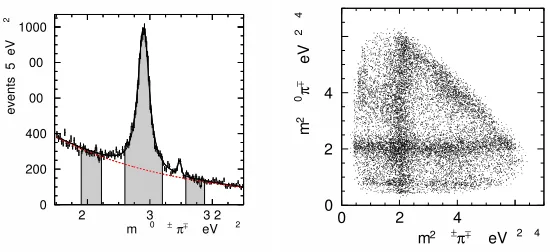
cmass regions is shown in Fig. 1(left) and
theηcDalitz plot is shown in Fig. 1(right). The Dalitz plot is dominated by the presence of horizontal
and vertical uniform bands at the position of theK∗
0(1430) resonance. The corresponding distributions forηc→K+K−π0can be found in Ref. [1] and present similar features.
2
eV ±
π
± 0
m
2 3 3 2
2
events5eV
0 200 400 00 00 1000
4 2
eV
± π
±
2
m
0 2 4
4
2
eV
±
π
0
2
m
0 2 4
Figure 1.(left)K0
SK
+π−mass spectrum in two-photon interactions and (right) theη
c→KS0K
+π−Dalitz plot.
The ηc signal regions contain 12849 events with (64.3±0.4)% purity for ηc → KS0K
+π− and
6494 events with (55.2±0.6)% purity forηc → K+K−π0. The backgrounds below theηcsignals are
estimated from the sidebands. We observe asymmetricK∗’s in the background to theηc→ KS0K +π−
final state due to interference between I=1 and I=0 contributions.
3 Dalitz plot Analysis of
η
c→
K
K
¯
π
We perform unbinned maximum likelihood fits using the Isobar model [3] and Model Independent Partial Wave Analysis (MIPWA) [4]. In the MIPWA theKπmass spectrum is divided into 30 equally spaced mass intervals 60 MeV/c2 wide and for each bin we add to the fit two new free parameters, the amplitude and the phase of theKπS-wave (constant inside the bin). We also fix the amplitude to 1.0 and its phase toπ/2 in an arbitrary interval of the mass spectrum (bin 11 which corresponds to a mass of 1.45 GeV/c2). The number of additional free parameters is therefore 58. Due to isospin conservation in the decays, amplitudes are symmetrized with respect to the twoKπdecay modes. TheK∗
2(1420),a0(980),a0(1400),a2(1310), ... contributions are modeled as relativistic Breit-Wigner functions multiplied by the corresponding angular functions. Backgrounds are fitted separately and interpolated into theηcsignal regions. The fits improves when an additional high massa0(1950)→ KK¯ I=1 resonance is included with free parameters in bothηcdecay modes. The weighted average of
the two measurement is:m(a0(1950))=1931±14±22 MeV/c2,Γ(a0(1950))=271±22±29 MeV. The statistical significances for thea0(1950) effect (including systematics) are 2.5σforηc→KS0K
+π−
and 4.0σforηc→K+K−π0.
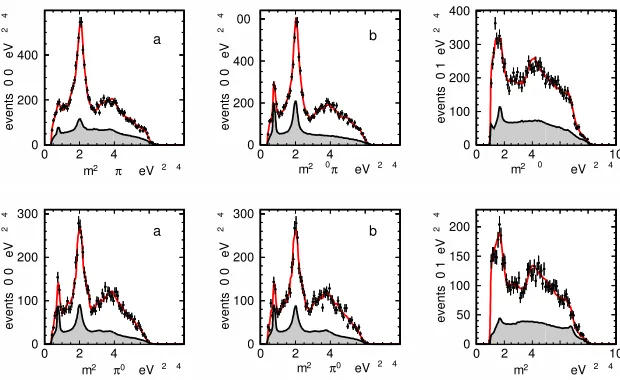
The Dalitz plot projections with fit results forηc → KS0K +π−
andηc → K+K−π0 are shown in
Fig. 2. The fitted fractions and phases are given in Table 1. We observe a good description of the data. We note that theK∗(892) contributions arise entirely from background.
In comparison, the isobar model gives a worse description of the data, withχ2/N
cells=457/254=
1.82 andχ2/N
cells = 383/233 = 1.63 respectively for the twoηcdecay modes. The resulting Kπ
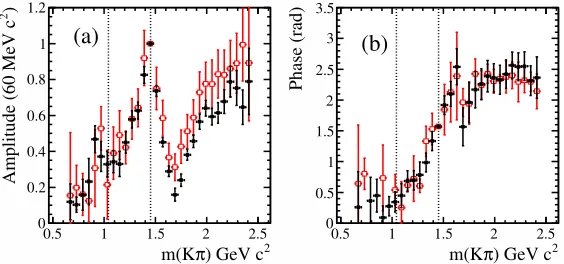
S-wave amplitude and phase for the two ηc decay modes is shown in Fig. 3. We observe a clear
K0∗(1430) resonance signal with the corresponding expected phase motion. At high mass we observe the presence of the broad K∗0(1950) contribution with good agreement between the two ηc decay
modes. Comparing with LASS [5] and E791 [4] experiments we note that phases before the Kη′
2 eV ± π ± 0 m
2 3 3 2
2 events5eV 0 200 400 00 00 1000 4 2 eV ± π ± 2 m
0 2 4
4 2 eV ± π 0 2 m 0 2 4
Figure 1.(left)K0
SK
+π−mass spectrum in two-photon interactions and (right) theη
c→K0SK
+π−Dalitz plot.
The ηc signal regions contain 12849 events with (64.3±0.4)% purity for ηc → KS0K
+π− and
6494 events with (55.2±0.6)% purity forηc → K+K−π0. The backgrounds below theηcsignals are
estimated from the sidebands. We observe asymmetricK∗’s in the background to theηc→ KS0K +π−
final state due to interference between I=1 and I=0 contributions.
3 Dalitz plot Analysis of
η
c→
K
K
¯
π
We perform unbinned maximum likelihood fits using the Isobar model [3] and Model Independent Partial Wave Analysis (MIPWA) [4]. In the MIPWA theKπmass spectrum is divided into 30 equally spaced mass intervals 60 MeV/c2 wide and for each bin we add to the fit two new free parameters, the amplitude and the phase of theKπS-wave (constant inside the bin). We also fix the amplitude to 1.0 and its phase toπ/2 in an arbitrary interval of the mass spectrum (bin 11 which corresponds to a mass of 1.45 GeV/c2). The number of additional free parameters is therefore 58. Due to isospin conservation in the decays, amplitudes are symmetrized with respect to the two Kπdecay modes. TheK∗
2(1420),a0(980),a0(1400),a2(1310), ... contributions are modeled as relativistic Breit-Wigner functions multiplied by the corresponding angular functions. Backgrounds are fitted separately and interpolated into theηcsignal regions. The fits improves when an additional high massa0(1950)→ KK¯ I=1 resonance is included with free parameters in bothηcdecay modes. The weighted average of
the two measurement is:m(a0(1950))=1931±14±22 MeV/c2,Γ(a0(1950))=271±22±29 MeV. The statistical significances for thea0(1950) effect (including systematics) are 2.5σforηc→KS0K
+π−
and 4.0σforηc→K+K−π0.
The Dalitz plot projections with fit results forηc → KS0K +π−
andηc → K+K−π0 are shown in
Fig. 2. The fitted fractions and phases are given in Table 1. We observe a good description of the data. We note that theK∗(892) contributions arise entirely from background.
In comparison, the isobar model gives a worse description of the data, withχ2/N
cells=457/254=
1.82 andχ2/N
cells = 383/233 = 1.63 respectively for the two ηc decay modes. The resultingKπ
S-wave amplitude and phase for the two ηc decay modes is shown in Fig. 3. We observe a clear
K0∗(1430) resonance signal with the corresponding expected phase motion. At high mass we observe the presence of the broad K0∗(1950) contribution with good agreement between the two ηc decay
modes. Comparing with LASS [5] and E791 [4] experiments we note that phases before the Kη′
threshold are similar, as expected from Watson [6] theorem but amplitudes are very different.
4 2 eV π 2 m
0 2 4
4 2 events00eV 0 200 400 a 4 2 eV π 0 2 m
0 2 4
4 2 events00eV 0 200 400 00 b 4 2 eV 0 2 m
0 2 4 10
4 2 events01eV 0 100 200 300 400 4 2 eV 0 π 2 m
0 2 4
4 2 events00eV 0 100 200 300 a 4 2 eV 0 π 2 m
0 2 4
4 2 events00eV 0 100 200 300 b 4 2 eV 2 m
0 2 4 10
4 2 events01eV 0 50 100 150 200
Figure 2. (top)ηc →KS0K
+π−and (bottom)η
c →K+K−π0 Dalitz plots projections. The superimposed curves are from the fit results. Shaded is contribution from the interpolated background.
Table 1.Results from theηc→KS0K
±π∓andη
c→K+K−π0MIPWA. Phases are determined relative to the (KπS-wave)Kamplitude which is fixed toπ/2 at 1.45 GeV/c2.
ηc→KS0K
±π∓ η
c→K+K−π0
Amplitude Fraction (%) Phase (rad) Fraction (%) Phase (rad)
(KπS-wave)K 107.3±2.6±17.9 fixed 125.5±2.4±4.2 fixed
a0(980)π 0.8±0.5± 0.8 1.08±0.18±0.18 0.0±0.1±1.7
-a0(1450)π 0.7±0.2± 1.4 2.63±0.13±0.17 1.2±0.4±0.7 2.90±0.12±0.25
a0(1950)π 3.1±0.4± 1.2 −1.04±0.08±0.77 4.4±0.8±0.8 −1.45±0.08±0.27
a2(1320)π 0.2±0.1± 0.1 1.85±0.20±0.20 0.6±0.2±0.3 1.75±0.23±0.42
K∗
2(1430)K 4.7±0.9± 1.4 4.92±0.05±0.10 3.0±0.8±4.4 5.07±0.09±0.30
Total 116.8±2.8±18.1 134.8±2.7±6.4
−2 logL −4314.2 −2339
χ2/Ncells 301/254=1.17 283.2/233=1.22
4 Dalitz plot analysis of
J
/ψ
→
π
+π
−π
0,
J
/ψ
→
K
+K
−π
0and
J
/ψ
→
K
S0K
±
π
∓Only a preliminary result exists, to date, on a Dalitz-plot analysis ofJ/ψdecays toπ+π−π0[7]. While large samples ofJ/ψdecays exist, some branching fractions remain poorly measured. BES III exper-iment has performed an angular analysis ofJ/ψ → K+K−π0. The analysis requires the presence of a broadJPC=1−−state in theK+K−threshold region, which is interpreted as a multiquark state [8].
We study the following reactions:
2
) GeV c
π
m(K
0.5 1 1.5 2 2.5
)
2
Amplitude(60MeVc
0 0.2 0.4 0.6 0.8 1 1.2
(a)
2
) GeV c
π
m(K
0.5 1 1.5 2 2.5
Phase(rad)
0 0.5 1 1.5 2 2.5 3 3.5
(b)
Figure 3. TheI =1/2KπS-wave amplitude (a) and phase (b) fromηc→ K0SK
+π−(solid (black) points) and
ηc→K+K−π0(open (red) points); only statistical uncertainties are shown. The dotted lines indicate theKηand Kη′thresholds.
whereγISRindicate the (mostly undetected) ISR photon. We computeMrec2 ≡(pe−+pe+−ph+−ph−−
ph0)2, wherehindicates the three hadrons in the final states. This quantity should peak near zero for ISR events. We select events in the ISR region by requiring|Mrec2 | < 2GeV2/c4 for the reactions involving aπ0and|M2rec|<1.5GeV2/c4for the reaction with aKS0. We fit the mass spectra using the
Monte Carlo resolution functions described by a Crystal Ball+Gaussian functions. We obtain 19560
±164 events forJ/ψ → π+π−π0with (91.3±0.2)% purity, 2002±48 forJ/ψ → K+K−π0 with (88.8±0.7)% purity, and 3694±64 with 93.1±0.4 purity for J/ψ → K0
SK
±π∓. The efficiency is
mapped and fitted on the (m(h+h−),cosθ
h) plane, whereθh is theh+helicity angle in the J/ψrest
frame. To obtain the measurements of the relative branching fractions, we correct yields by weighting each event by the inverse of the efficiency and perform background subtraction by assigning negative weights to events theJ/ψsidebands regions. We measure the ratio
R1=
B(J/ψ → K+K−π0)
B(J/ψ → π+π−π0) =0.120±0.003(stat)±0.009(sys), (1)
where many systematic uncertainties cancel out due to the similar event topology of theJ/ψdecay modes. The PDG reportsB(J/ψ → π+π−π0) =(2.11±0.07)×10−2, while the branching fraction
B(J/ψ → K+K−π0) has been measured by Mark II [9] using 25 events, to be (2.8±0.8)×10−3. These values give a ratioRPDG
1 =0.133±0.038, in agreement with our measurement. Using a similar procedure and correcting correcting for unseenK0
S decay modes, we compute the relative branching
fraction
R2=
B(J/ψ→K0
SK ±π∓)
B(J/ψ→π+π−π0) =0.265±0.005(stat)±0.021(sys). (2)
The branching fractionB(J/ψ→ K0
SK ±π∓
) has been measured by Mark I [10], using 126 events, to be (26±7)×10−4. Using the above measurements we obtain an estimate ofRPDG
2 =0.123±0.033, which deviates by 3.6σfrom our measurement.
5
J
/ψ
→
π
+π
−π
0Dalitz plot analysis
2
) GeV c
π
m(K
0.5 1 1.5 2 2.5
)
2
Amplitude(60MeVc
0 0.2 0.4 0.6 0.8 1 1.2
(a)
2
) GeV c
π
m(K
0.5 1 1.5 2 2.5
Phase(rad)
0 0.5 1 1.5 2 2.5 3 3.5
(b)
Figure 3. TheI =1/2KπS-wave amplitude (a) and phase (b) fromηc→ KS0K
+π−(solid (black) points) and
ηc→K+K−π0(open (red) points); only statistical uncertainties are shown. The dotted lines indicate theKηand Kη′thresholds.
whereγISRindicate the (mostly undetected) ISR photon. We computeMrec2 ≡(pe−+pe+−ph+−ph−−
ph0)2, wherehindicates the three hadrons in the final states. This quantity should peak near zero for ISR events. We select events in the ISR region by requiring|Mrec2 | < 2GeV2/c4 for the reactions involving aπ0and|M2rec|<1.5GeV2/c4for the reaction with aKS0. We fit the mass spectra using the
Monte Carlo resolution functions described by a Crystal Ball+Gaussian functions. We obtain 19560
±164 events forJ/ψ → π+π−π0 with (91.3±0.2)% purity, 2002±48 forJ/ψ → K+K−π0with (88.8±0.7)% purity, and 3694±64 with 93.1±0.4 purity for J/ψ → K0
SK
±π∓. The efficiency is
mapped and fitted on the (m(h+h−),cosθ
h) plane, whereθh is theh+ helicity angle in theJ/ψrest
frame. To obtain the measurements of the relative branching fractions, we correct yields by weighting each event by the inverse of the efficiency and perform background subtraction by assigning negative weights to events theJ/ψsidebands regions. We measure the ratio
R1=
B(J/ψ → K+K−π0)
B(J/ψ → π+π−π0) =0.120±0.003(stat)±0.009(sys), (1)
where many systematic uncertainties cancel out due to the similar event topology of the J/ψdecay modes. The PDG reportsB(J/ψ → π+π−π0) =(2.11±0.07)×10−2, while the branching fraction
B(J/ψ → K+K−π0) has been measured by Mark II [9] using 25 events, to be (2.8±0.8)×10−3. These values give a ratioRPDG
1 =0.133±0.038, in agreement with our measurement. Using a similar procedure and correcting correcting for unseenK0
S decay modes, we compute the relative branching
fraction
R2=
B(J/ψ→K0
SK ±π∓)
B(J/ψ→π+π−π0) =0.265±0.005(stat)±0.021(sys). (2)
The branching fractionB(J/ψ→ K0
SK ±π∓
) has been measured by Mark I [10], using 126 events, to be (26±7)×10−4. Using the above measurements we obtain an estimate ofRPDG
2 =0.123±0.033, which deviates by 3.6σfrom our measurement.
5
J
/ψ
→
π
+π
−π
0Dalitz plot analysis
The Dalitz plot forJ/ψ → π+π−π0is shown in Fig. 4 and is dominated by threeρ(770)π contribu-tions. We perform a Dalitz plot analysis using the isobar model with amplitudes described by Zemach
4 2
eV
0 π π 2
m
0 2 4
4
2
eV
0
π
π
2
m
0 2 4
Figure 4.J/ψ → π+π−π0Dalitz plot.
tensors [11, 12] and the Veneziano model [13]. The results from the Dalitz analysis are tabulated in Table 2 and fit projections are shown in fig. 5. The Veneziano model deals with trajectories rather
4 2
eV
π π
2
m
0 2 4 10
4
2
events01eV
0 500 1000
4 2
eV
0
π
±
π
2
m
0 2 4 10
4
2
events01eV
0 500 1000 1500 2000
Figure 5.(left)m2(π+π−) and (right)m2(π±π0) forJ/ψ → π+π−π0. Shaded is the background interpolated from J/ψsidebands.
than single resonances. The complexity of the model is related ton, the number of Regge trajectories included in the fit which requires n=7, described by 19 free parameters.
Figure 8(a) shows the combinatorial cosθπhelicity angle vs.m(ππ). Figure 8 also shows them(ππ)
mass projection for|cosθπ|<0.2 for the isobar model fit (b) and Veneziano model (c). The helicity
Table 2.Results from the Dalitz-plot analysis of theJ/ψ → π+π−π0channel. When two uncertainties are
given, the first is statistical and the second systematic. The error on the amplitude is only statistical.
Final state Amplitude Isobar fraction (%) Phase (radians) Veneziano fraction (%)
ρ(770)π 1. 114.2±1.1 ±2.6 0. 133.1±3.3
ρ(1450)π 0.513±0.039 10.9±1.7 ±2.7 −2.63±0.04±0.06 0.80±0.27
ρ(1700)π 0.067±0.007 0.8±0.2 ±0.5 −0.46±0.17±0.21 2.20±0.60
ρ(2150)π 0.042±0.008 0.04±0.01±0.20 1.70±0.21±0.12 6.00±2.50
ω(783)π0 0.013±0.002 0.08±0.03±0.02 2.78±0.20±0.31
ρ3(1690)π 0.40±0.08
Sum 127.8±2.0±4.3 142.5±2.8
χ2/ν 687/519=1.32 596/508=1.17
2
e c
π π
m
1 2 3
π
θ
os
1
−
5
−
5 1
a
2
e c
π π
m
1 2 3
2
events003eV
1 1
2
1
3
1 b
2
e c
π π
m
1 2 3
2
events003eV
1 1
2
1
3
1 c
Figure 6.(a) Binned scatter diagram of cosθπ3vs m(π1π2). (b), (c)ππmass projection in the|cosθπ|<0.2 region for all the threeππcharge combinations. The horizontal lines in (a) indicate the cosθπselection. The dashed line in (b) is the result from the fit with only theρ(770)πamplitude. The fit in (b) uses the isobar model and the shaded histogram shows the background distribution estimated from theJ/ψsidebands. The fit in (c) uses the Veneziano model.
6
J
/ψ
→
K
+K
−π
0and
J
/ψ
→
K
S0K
±π
∓Dalitz plot analyses
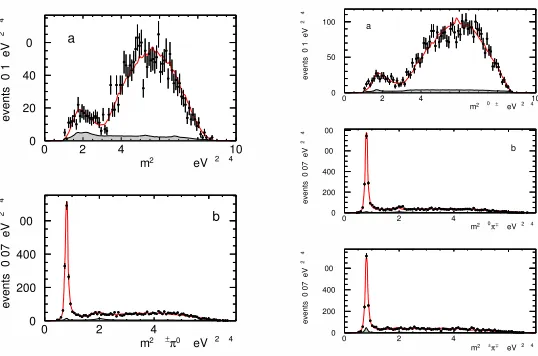
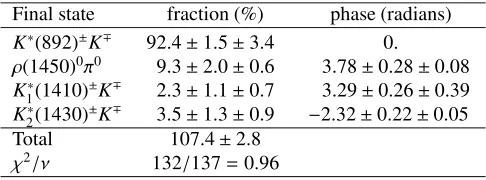
We perform a Dalitz-plot analysis ofJ/ψ → K+K−π0in theJ/ψsignal region. Figure 7(left) shows the Dalitz plot for theJ/ψsignal region and Fig. 8(left) shows the Dalitz plot projections. We observe that the decay is dominated by theK∗(892)±K∓amplitude. We also observe a diagonal band which we tentatively attribute to theρ(1450)0π0amplitude. We fit theJ/ψ → K+K−π0Dalitz plot using the isobar model. The results from the fit are given in Table 3 and fit projections are shown in Fig. 8(left). The Dalitz analysis is describing well theK+K−threshold region and therefore we assign the broad enhancement in theK+K−mass spectrum to the presence of theρ(1450) resonance: the present data do not require the presence of an exotic contribution.
We perform a similar Dalitz plot analysis of J/ψ → KS0K±π∓ in the J/ψsignal region. Fig-ure 7(right) shows the Dalitz plot for theJ/ψsignal region and Fig. 8(right) shows the Dalitz plot projections. We fit theJ/ψ → KS0K
±π∓
Table 2.Results from the Dalitz-plot analysis of theJ/ψ → π+π−π0channel. When two uncertainties are
given, the first is statistical and the second systematic. The error on the amplitude is only statistical.
Final state Amplitude Isobar fraction (%) Phase (radians) Veneziano fraction (%)
ρ(770)π 1. 114.2±1.1 ±2.6 0. 133.1±3.3
ρ(1450)π 0.513±0.039 10.9±1.7 ±2.7 −2.63±0.04±0.06 0.80±0.27
ρ(1700)π 0.067±0.007 0.8±0.2 ±0.5 −0.46±0.17±0.21 2.20±0.60
ρ(2150)π 0.042±0.008 0.04±0.01±0.20 1.70±0.21±0.12 6.00±2.50
ω(783)π0 0.013±0.002 0.08±0.03±0.02 2.78±0.20±0.31
ρ3(1690)π 0.40±0.08
Sum 127.8±2.0±4.3 142.5±2.8
χ2/ν 687/519=1.32 596/508=1.17
2
e c
π π
m
1 2 3
π θ os 1 − 5 − 5 1 a 2 e c π π m
1 2 3
2 events003eV 1 1 2 1 3 1 b 2 e c π π m
1 2 3
2 events003eV 1 1 2 1 3 1 c
Figure 6.(a) Binned scatter diagram of cosθπ3vs m(π1π2). (b), (c)ππmass projection in the|cosθπ|<0.2 region for all the threeππcharge combinations. The horizontal lines in (a) indicate the cosθπselection. The dashed line in (b) is the result from the fit with only theρ(770)πamplitude. The fit in (b) uses the isobar model and the shaded histogram shows the background distribution estimated from theJ/ψsidebands. The fit in (c) uses the Veneziano model.
6
J
/ψ
→
K
+K
−π
0and
J
/ψ
→
K
S0K
±π
∓Dalitz plot analyses
We perform a Dalitz-plot analysis ofJ/ψ → K+K−π0in theJ/ψsignal region. Figure 7(left) shows the Dalitz plot for theJ/ψsignal region and Fig. 8(left) shows the Dalitz plot projections. We observe that the decay is dominated by theK∗(892)±K∓amplitude. We also observe a diagonal band which we tentatively attribute to theρ(1450)0π0amplitude. We fit theJ/ψ → K+K−π0Dalitz plot using the isobar model. The results from the fit are given in Table 3 and fit projections are shown in Fig. 8(left). The Dalitz analysis is describing well theK+K−threshold region and therefore we assign the broad enhancement in theK+K−mass spectrum to the presence of theρ(1450) resonance: the present data do not require the presence of an exotic contribution.
We perform a similar Dalitz plot analysis of J/ψ → KS0K±π∓in the J/ψsignal region. Fig-ure 7(right) shows the Dalitz plot for theJ/ψsignal region and Fig. 8(right) shows the Dalitz plot projections. We fit theJ/ψ → KS0K
±π∓
Dalitz plot using the isobar model. The results from the best fit are summarized in Table 4. The decay is dominated by theK∗(892) ¯K,K2∗(1430) ¯Kandρ(1450)±π∓
4 2 eV 0 π 2 m
0 2 4
4 2 eV 0 π 2 m 0 2 4 4 2 eV ± π ± 2 m
0 2 4
4 2 eV ± π 0 2 m 0 2 4
Figure 7.(left)J/ψ → K+K−π0and (right)J/ψ →K0
SK
±π∓Dalitz plots.
4 2
eV
2
m
0 2 4 10
4 2 events01eV 0 20 40 0 a 4 2 eV 0 π ± 2 m
0 2 4
4 2 events007eV 0 200 400 00 b 4 2 eV ± 0 2 m
0 2 4 10
4 2 events01eV 0 50 100 a 4 2 eV ± π 0 2 m
0 2 4
4 2 events007eV 0 200 400 00 00 b 4 2 eV ± π ± 2 m
0 2 4
4 2 events007eV 0 200 400 00
Figure 8.(left) Dalitz plot projections with fit results forJ/ψ → K+K−π0. (right) Dalitz plot projections with
fit results forJ/ψ →K0
SK
±π∓. Shaded is the background interpolated fromJ/ψsidebands.
amplitudes with a smaller contribution from theK∗
1(1410) ¯Kamplitude. Also in this case we assign the broad enhancement observed in theK0
SK
±mass projection to the presence of theρ(1450)±resonance.
In the Dalitz-plot analysis ofJ/ψ → K+K−π0, the data are consistent with the observation of the decayρ(1450)0 → K+K−. This allows a measurement of its relative branching fraction to
ρ(1450)0 → π+π−. We obtain:
B(ρ(1450)0 → K+K− )
Table 3.Results from the Dalitz-plot analysis of theJ/ψ → K+K−π0signal region. When two uncertainties are
given, the first is statistical and the second systematic.
Final state fraction (%) phase (radians) K∗(892)±K∓ 92.4±1.5±3.4 0.
ρ(1450)0π0 9.3±2.0±0.6 3.78±0.28±0.08 K∗
1(1410)
±K∓ 2.3±1.1±0.7 3.29±0.26±0.39
K∗
2(1430)
±K∓ 3.5±1.3±0.9 −2.32±0.22±0.05 Total 107.4±2.8
χ2/ν 132/137=0.96
Table 4.Results from the Dalitz-plot analysis of theJ/ψ → K0
SK
±π∓signal region. When two uncertainties are
given, the first is statistical and the second systematic.
Final state fraction (%) phase (radians) K∗(892) ¯K 90.5±0.9±3.8 0.
ρ(1450)±π∓ 6.3±0.8±0.6 −3.25±0.13±0.21
K∗
1(1410) ¯K 1.5±0.5±0.9 1.42±0.31±0.35 K∗
2(1430) ¯K 7.1±1.3±1.2 −2.54±0.12±0.12 Total 105.3±3.1
χ2/ν 274/217=1.26
7 Ackowledgements
This work was supported (in part) by the U.S. Department of Energy, Office of Science, Office of Nuclear Physics under contract DE-AC05-06OR23177.
References
[1] J. P. Leeset al.[BaBar Collaboration], Phys. Rev. D89, no. 11, 112004 (2014) [2] Charge conjugation is implied through all this work.
[3] S. Eidelmanet al.[Particle Data Group], Phys. Lett. B592, no. 1-4, 1 (2004).
[4] E. M. Aitalaet al.[E791 Collaboration], Phys. Rev. D73, 032004 (2006) Erratum: [Phys. Rev. D 74, 059901 (2006)]
[5] D. Astonet al., Nucl. Phys. B296, 493 (1988). [6] K. M. Watson, Phys. Rev.88, 1163 (1952).
[7] L. Chenet al.[MARK-III Collaboration], SLAC-PUB-5674.
[8] M. Ablikimet al., (BESIII Collaboration), Phys. Lett. B710, 594 (2012). [9] M.E.B. Franklinet al., (Mark II Collaboration) Phys. Rev. Lett.51, 963 (1983). [10] F. Vannucciet al., (Mark I Collaboration) Phys. Rev. D151814 (1977). [11] C. Zemach, Phys. Rev.133, B1201 (1964).
[12] C. Dionisiet al., Nucl. Phys. B169, 1 (1980).