Spontaneous Spin Polarization of Electrons by Diluted
Magnetic Heterostructures
Chang Woo Lee1, Amalorpavam John Peter1,2*
1Department of Chemical Engineering and Green Energy Center, College of Engineering,
Kyung Hee University, Gyeonggi, South Korea
2Government Arts College, Madurai, India
E-mail:*[email protected]
Received January 13, 2011; revised February 25, 2011; accepted March 26, 2011
Abstract
The spin dependent electron transmission phenomenon in a diluted resonant semiconductor heterostructure is employed theoretically to investigate the output transmission current polarization at zero magnetic field. Transparency of electron transmission is calculated as a function of electron energy and the well width, within the one electron band approximation along with the spin orbit interaction. Enhanced spin-polarized resonant tunneling in the heterostructure due to Dresselhaus and Rashba spin-orbit coupling induced splitting of the resonant level is observed. We predict that a spin-polarized current spontaneously emerges in this het-erostructure and we estimate theoretically that the polarization can reach 40%. This effect could be employed in the fabrication of spin filters, spin injectors and detectors based on non-magnetic semiconductors.
Keywords: Spin Polarized Transport, Spin Injection, Spin-Orbit Coupling, Resonant Tunneling
1. Introduction
Spin-polarized injection of electrons into semiconductor has attracted a rapidly growing interest due to its poten-tial application in spintronics devices recently. During the last years the fabrication and characterization of di-luted magnetic semiconductors (DMSs) nanostructures has rapidly evolved. The essential effort of the scientists is concentrated on studying of the spin-polarized trans-port in nanosize multilayer structures, which are includ-ing alternatinclud-ing layers of ferromagnetic metals and non- magnetic semiconductors. Operation of a spintronic de-vice requires efficient spin injection into a semiconductor, spin manipulation, control and transport, and spin detec-tion.
Owing to the possibility of controlling and probing magnetic properties by the electronic subsystem or vice versa, DMSs have successfully been employed to ad-dress a number of important questions concerning the nature of various spin effects in various environments and at various length and time scales. At the same time, DMS exhibit a strong sensitivity to the magnetic field and temperature as well as constitute important media for generation of spin currents and for manipulation of lo-calized or itinerant spins by, e.g., strain, light,
contain-C. W. LEE ET AL. 1273
ing a description of band electrons coupled to localized spins is used to calculate the intrasubband spin-flip life-time due to scattering of electrons by magnons in Cd1-xMnxTe quantum well structures [13].
Advances in modern epitaxial growth technologies such as Molecular-Beam Epitaxy and Metalorganic Chemical Vapor Deposition have paved the way with an opportunity to produce semiconductor heterostructures in which the material parameters can be changed over a wide range and controlled within considerable accuracy. This level of quality allows the relevant theoretical analysis within the framework of relatively simple ap-proximations for semiconductor band structures. So it is worthwhile to investigate how to obtain spin-polarized electronic current using the spin-splitting effect in the resonant transmission heterostructures. Spin-orbit inter-action couples spin states and space motion of conduc-tion electrons in the plane perpendicular to growth direc-tion that opens a possibility to polarize, manipulate and detect spins by moderate electrical field. The effect of Rashba spin-orbit interactions due to in-built or external electric field on the spin polarized transport in the case of a non-magnetic semiconductor heterostructure has been theoretically investigated and it is reported that the spin polarization can reach 40% to 50% with moderate elec-tric fields [14,15]. Recently, it is predicted that the zero- field spin-dependent electron tunneling with spin polari-zation of 20% even in the case of a nonmagnetic semi-conductor if the system lacks center of inversion [16]. John Peter [17] has shown the polarization efficiency raises upto 45% when non-magnetic asymmetric quan-tum well is used. Qing-feng Sun et al., [18] proposed a novel scheme to efficiently polarize and manipulate the electron spin in a quantum dot showed that the direction and the strength of the spin polarization is well control-lable and manipulatable by simply varying the bias or the gate voltage. However, in the case of symmetric poten-tial barriers, the interface spin-orbit coupling does not lead to a dependence of tunneling on the spin orientation. Spin-dependent resonant tunneling in non-magnetic semiconductor heterostructures has prominent perspec-tives in the emerging field of spintronics. Devices based on spin-dependent tunneling are suggested for utilization as components in the spin-field-effect transistor. Spon-taneous spin-polarized current in a nonuniform Rashba interaction system has been studied recently [19] wherein they have demonstrated a spontaneous spin-polarized current emerges in the absence of any magnetic material and magnetic field due to the combination of the coher-ence effect and the Rashba interaction.
In this letter, we analyze the spin-dependent transmis-sion phenomenon in resonant transmistransmis-sion structures. The spin-polarized electronic current is due to spin
split-ting of electronic bands in asymmetric heterostructures. We investigate the spin-polarized transport through a heterostructure which does not include any magnetic material and magnetic field, only has the spin-orbit cou-pling. We predict that a spin-polarized current spontane-ously emerges in this heterostructure. The spin-polarized transmission current in resonant transmitting hetero- structures at zero magnetic field is studied. We demon-strate that asymmetry of the electron distribution in the electrode regions with spin depended transmission prob-ability can provide output current polarization. Trans-parency of electron transmission through a diluted mag-netic heterostructure of CdTe/CdMnTe/CdTe has been calculated as a function of electron energy as well as the well width using the proposed model which includes the combined effects of Dresselhaus and in-plane Rashba spin-orbit interactions, within the one electron band ap-proximation. The proposed model for the calculation of transmission coefficients and the polarization efficiency in the well system with Rashba and Dresselhaus spin- orbit coupling is described in Section 2. The results of the numerical calculations obtained by transfer matrix approach are presented in Section 3.
2. Spin-Dependent Transmission Probability
We consider the transmission of electrons with the initial wave vector k
k||,kz
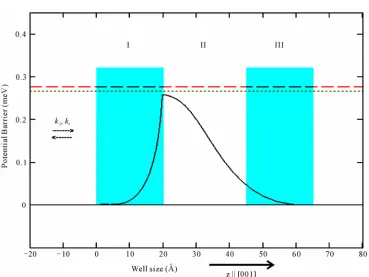
through a diluted magnetic het- erostructure, CdTe/CdMnTe/CdTe grown along z|| [001] as shown in Figure 1. Here k|| is the wave vector in theplane of the interfaces, and kz is the wave vector compo-nent normal to the barrier and pointing in the direction of transmission. The electron motion in each layer of the structure is described by the Hamiltonian [20],
2 2 2 2
||
* 2 *
ˆ
2 2 SO
k
H V
m z m
z
(1)
where m* is the electron effective mass, V(z) is the
het-erostructure potential as shown in Figure 1, and HSO is the spin-dependent contribution to the effective Hamilto-nian equal to the sum of HD and HR as given below. HD is the spin-dependent k3 Dresselhaus term and H
R is the in-plane Rashba term, both describing the spin splitting of conduction electrons in zinc-blende-lattice semicon-ductors. Assuming that the barrier structure has been designed such that the kinetic energy ε is much smaller than the barrier height V0, the Dresselhaus term [21,22] is
simplified to,
22
ˆ ˆ
D x x y y
H k k
z
Figure 1. Flat band symmetric CdTe/CdMnTe/CdTe well heterostructure. The barrier height is taken as 320 meV and the well size is 25 Å. Espin up is 0.1691 eV and Espin down is 0.14182 eV for the first state. Transmission of electrons with the
wave vector k = (k||, kz) through the potential barrier V of width a grown along z.
,R x y y x
H k k (3) The Dresselhaus term (2) is diagonalized by the spi-nors [21]
where is a material constant, ˆx and ˆy are the Pauli matrices, and the coordinate axes x, y, z are as-sumed to be parallel to the cubic crystallographic axes [100], [010], [001], respectively.
1 1
2 e i
(6)
which describe the electron states “+” and “–” of the opposite spin directions. Here is the polar angle of the wave vector k in the plane of the barrier and
k||cos , sin , k|| kz
. k The eigen spin states “+” and “–” propagate through the well with conservation of the spin orientation.
For the fixed in-plane wave vector k||, the wave
func-tions of the electrons are of the form
u z
exp
i ||. , r k ρ
(4)where ρ = (x, y) is an in-plane coordinate of the barrier and is a spinors. The electrons propagating through
well are described in the regions I, II and III (see Figure 1) as below [24]
With the diagonalized Dresselhaus spin-orbit coupling term, the electron behavior in the well is described by
1 1
1 1
cos sin
cosh sinh
i i i i i i
i
i i i i i i
A z z B z z
u z
A z z B z z
2
2
0 0 i i
k k
2 2
0 2
|| 2
0 2
1 b
d u z q
u z m k
dz
. (7)
for
(5)
Therefore, the wave vector q through the well is
given by [21]
0
|| 2
2
1 b
q q
m k
(8) where
1, 2,3, , 1
i N
and i kiwhere where 0 is the reciprocal length of decay of the wave
function in the well when the spin-orbit interactions are omitted as given by
q
2 2
2
i i
m
k V
C. W. LEE ET AL. 1275
2 2
0 2 ||
2
1
b b b
z
w w
m V m m
q k k
m m
(9)
Here mb and mw are the electron effective masses in the barrier and well respectively.
In the proposed model the effect of the in-plane Rashba spin-orbit interaction on the spin dependent tun-neling through double barrier is described by diagonal-izing the in-plane Rashba term (Equation (3)) by the same spinors (Equation (6)),which are used to diagonal-ize the Dresselhaus term, and we derive,
2 2 0 || 2 2 2 0 bd u z m
q k u z
dz
. (10)
The Equation (10) describes the electron behavior in the barrier with the in-plane Rashba spin-orbit coupling with the wave vector q through the well
2
0 2
2mb
q q k
|| . (11)
Hence the combined effect of Dresselhaus and Rashba spin interactions on the spin dependent transmitting through the well is described by
2
2 0 2 ||
2 || 2 2 0 2 1 b b m q k
d u z
u z m k dz
, (12)
The wave vector through the well including both Dresselhaus and in-plane Rashba spin-orbit coupling can therefore be q || 2 0 2 || 2 2 2 1 b b m k q q m k (13)
The transmission coefficient is calculated by trans- fer matrix approach [25] and the spin polarization effi-ciency P that determines the difference of transparency for the spin states “+” and “–” through the barrier is
t 2 2 2 t t P t t
2 . (14)
3. Numerical Results and Conclusions
We have chosen CdTe and CdMnTe because of the same crystal structures and lattice constants. The relevant pa-rameters for CdTe are Eg = 1.606 eV, m = 0.67 me and for CdMnTe, Eg = 1.587 eV, m = 0.67 me, k|| = 2 × 10⁸
m–1 and α = 8.73 × 10⁻¹² eV. The suitable parameter for
the barrier height of CdTe is 0.32 eV. In the numerical calculations, we choose the system size to be: well width,
b = 25 Å, barrier thickness, a = 20 Å, and the barrier height, V = 320 meV. The real part of the transmitting total wave function corresponding to E = 0.28672 eV is shown in Figure 1. Espin up is 0.265245 eV and Espin down is 0.276529 eV for the first state. Transmission of electrons with the wave vector through the potential bar-rier V of width is grown along z. The transmission reso-nances occur nearly at the discrete energy values corre-sponding to the well. The transparency t2 and the
spin polarization efficiency P of symmetrical well of heterostructure of CdTe/CdMnTe/CdTe with fixed k|| =
2 × 10⁸ m–1 have been calculated as a function of
elec-tron energy as well as the well width and the results are presented in Figures 2 to 5. wherein the first transmis-sion resonance occurs at the discrete energy value, 0.28672 eV, for a given value of V. These figures show the polarization efficiency P, as a function of the electron energy with Dresselhaus spin-orbit term and the Rashba term and combined effects of both the effects.
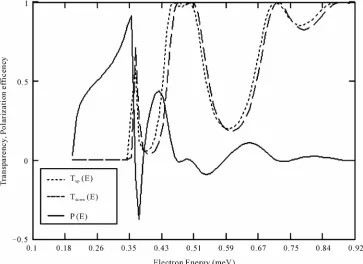
Figure 2 shows the transparency Tup, Tdown, and the polarization efficiency P, of the CdTe/CdMnTe/CdTe symmetrical well hetero structure as a function of the electron energy at fixed k|| = 2 × 10⁸ m–1 with
Dressel-haus spin-orbit term. It is seen that both the spin-up and spin down electrons are transmitted completely showing resonant transmission. However, this transmission reso-nance occurs at different incident energy for different values of k. At a given initial wave vector of electrons, the polarization efficiency shows the peak value for every bound states with the strength of the Dresselhaus spin-orbit coupling (Equation (8)). However, this peak is broadened, resonance peaks shift to lower-energy regions and their corresponding transmission spectrum becomes more complex for higher bound states.
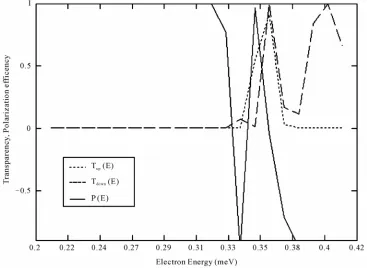
Figure 3 displays the transparency Tup, Tdown, and the polarization efficiency P, of the CdTe/CdMnTe/ CdTe symmetrical well hetero structure as a function of the electron energy at fixed k|| = 2 × 10⁸ m–1 with Rashba
spin-orbit term. It is seen that both the spin-up and spin down electrons are transmitted completely showing resonant transmission. The first transmission electron energy occurs earlier for spin up electrons. The polariza-tion efficiency decreases drastically with the strength of the Rashba spin-orbit coupling upto the first discrete energy value and then increases beyond this value of electron energy (Equation (11)). However, this peak is broadened for higher bound states and resonance peaks shift to lower-energy regions.
Figure 2. The transparency Tup, Tdown, and the polarization efficiency P, of the CdTe/CdMnTe/CdTe a symmetrical barrier
hetero structure as a function of the electron energy at fixed k|| = 2 × 10⁸ m–1 with Dresselhaus spin-orbit term. Well width, b = 25
Å, barrier thickness, a = 20 Å and the barrier height, V = 320 meV. The inset figure shows the transparency and the
polariza-tion efficiency for the range of energy between 0.30 eV and 0.40 eV.
Figure 3. The transparency Tup, Tdown, and the polarization efficiency P, of the CdTe /CdMnTe/CdTe symmetrical barrier
hetero structure as a function of the electron energy at fixed k|| = 2 × 10⁸ m–1 with Rashba spin-orbit term. Well width, b = 25
, barrier thickness, a = 20 Å and the barrier height, V = 320 meV.
[image:5.595.117.480.414.678.2]C. W. LEE ET AL. 1277
[image:6.595.113.480.406.674.2]in-built or external electric field on the spin polarized transport has been theoretically computed and reported that the spin polarization can reach 40% to 50% with moderate electric fields [246]. Moreover, it is predicted that the zero-field spin-dependent electron tunneling with spin polarization of 20% even in the case of a nonmag-netic semiconductor if the system lacks center of inver-sion [21].
Figure 4 shows the transparency Tup, Tdown, and the polarization efficiency P, of the CdTe/CdMnTe/CdTe symmetrical well hetero structure as a function of the electron energy at fixed k|| = 2 × 10⁸ m–1 including both
Dresselhaus and Rashba spin-orbit coupling terms. It is seen that both the spin-up and spin down electrons are transmitted completely showing resonant transmission. As spin-up electrons see shallower well compared to spin-down electrons, the spin down electron shows the lower transmission coefficients than the transmission coefficients of spin-up electrons. Also the spin-up and spin-down resonances are separated on energy scale by less than 1 meV. However there occurs a drastic increase in polarization efficiency with both the spin orbit cou-pling terms are included (Equation (13)). Eventually this figure shows the enhancement of the efficiency of po-larization when both the spin orbit terms are included. Carlos Egues [27] has reported similar results in the case
of a diluted magnetic semiconductor.
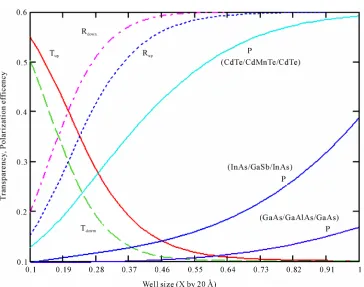
In Figure 5, the polarization efficiency as a function of a well width qoa is plotted. The solid and dotted curves correspond respectively to the variation of the reflected and transmission coefficients for a rectangular potential barrier. The polarization strongly depends on the electron wave vector k|| parallel to the barrier. This
result suggests a device for spin injection into quantum wells assuming two quantum wells separated by a tun-neling barrier and a current flowing along one of the quantum wells. The in-plane current results in nonzero average electron wave vector k|| in a spin polarization of
carriers. The k3 Dresselhaus terms in the effective
Ham-iltonian of bulk semiconductor of the barrier are shown to be depended of the tunnelling and transmission on the spin orientation [21]. The polarization efficiency is found to be about 60% in our calculation when compared to non-magneitc materials having the efficiency less the 40% [17].
4. Conclusions
In conclusion, the result suggests the fabrication of spin filters and a device for spin injection into quantum wells, on the base of the diluted magnetic heterostructures. Spin-dependent resonant tunneling in diluted magnetic
Figure 4. The transparency Tup, Tdown, and the polarization efficiency P, of the CdTe/CdMnTe/CdTe symmetrical barrier
hetero structure as a function of the electron energy at fixed k|| = 2 × 10⁸ m–1 including both Dresselhaus and Rashba
spin-orbit terms. Well width, b = 25Å, barrier thickness, a = 20 Å, π
4
Figure 5. The transparency Tup, Tdown, Rup, Rdown and the polarization efficiency P, of the CdTe/CdMnTe/CdTe, InAs/GaSb/
InAs (Ref. [17]) and GaAs/GaAlAs/GaAs (Ref. [17]) heterostructures as a function of the well width at fixed k|| = 2 × 10⁸ m–1
including both Dresselhaus and Rashba spin-orbit terms. Well width, b = 25 Å, barrier thickness, a = 20 Å and the barrier
height, V = 320 meV.
semiconductor heterostructures has prominent perspec-tives in the emerging field of spintronics. We would like to point out that the calculations presented use a simple model of the resonant transmission structures through a heterostructure and a simple one electron band approxi-mation with spin-orbit coupling. The heterostructure does not include any magnetic material and magnetic field, only has the spin-orbit coupling. And we predict that a spin-polarized current spontaneously emerges in this heterostructure. Due to the combination of the co-herence effect and the Rashba interaction, a spontaneous spin-polarized current emerging in the absence of any magnetic material and magnetic field has been studied recently [19]. Thus the spin-polarized current is gener-ated without a magnetic field is good agreement with their results. However, the structures have realistic pa-rameters but the proposed estimate of the total polarized current is only a starting point of the investigation of this new effect. The effect of Dresselhaus and Rashba spin- orbit interactions could be favorably engineered for fab-ricating spin injectors and detectors based on non-mag- netic semiconductors [28]. We have demonstrated that the k3 Dresslhaus terms in the effective Hamiltonian of
semiconductors lacking a center of inversion yield a con-siderable spin polarization of electrons transmitting
through the well. This effect could be employed for cre-ating spin filters. Further experimental investigations of the effects in the areas like spintronics and nanocomput-ers, we hope that the present work will stimulate more experimental activities to lend support to our calcula-tions.
5. Acknowledgements
The author thanks the CSIR, India for the grant (No.03 (1159)/10/EMR-II) for the financial support of this work.
6. References
[1] Y. Ohno, D. K. Young, B. Beschoten, F. Matsukura, H. Ohno and D. D. Awschalom, “Electrical Spin Injection in a Ferromagnetic Semiconductor Heterostructure,” Nature, Vol. 402, 1999, pp.790-792. doi:10.1038/45509
[2] J. A. Nesteroff, Y. V. Pershin and V. Privman, “Polariza-tion of Nuclear Spins from the Conductance of Quantum wire,” Physical Review B, Vol. 69, 2004, pp. 121306(R). [3] P. Středa and P Šeba, “Antisymmetric Spin Filtering in
C. W. LEE ET AL. 1279
doi:10.1103/PhysRevLett.90.256601
[4] Y. V. Pershin and C.Piermarocchi, “Relaxation of Con-duction Electron Spins in Semiconductors,” Applied Physics Letters, Vol. 86, No. 21, 2005, pp. 212107-1-3. doi:10.1063/1.1935747
[5] G. A. Prinz, “Spin-Polarized Transport,” Physics Today, Vol. 48, No. 4, 1995, p. 58.
[6] G. A. Prinz, “Magnetoelectronics,” Science, Vol. 282, 1998, pp. 1660-1663. doi:10.1126/science.282.5394.1660 [7] D. Loss. D and D. P. DiVincenzo, “Quantum Computa-tion with Quantum Dots,” Physical Review A, Vol. 57, No. 20, 1998, pp. 120-123.
[8] B. E. Kane, “A silicon-based nuclear spin quantum com-puter,” Nature, Vol. 393, 1998, pp. 133-137.
doi:10.1038/30156
[9] S. Das Sarma, “Spintronics,” American Science, Vol. 89, 2001, pp. 516.
[10] D. D. Awschalom, M. E. Flatte and N. Samarth, “Spin-tronics,” Scientific American, Vol. 286, 2002, pp. 66-73. doi:10.1038/scientificamerican0602-66
[11] H. Akinaga and H. Ohno, “Semiconductor Spintronics,”
IEEE Transactions on Nanotechnology, Vol. 1, No. 1, 2002, pp. 19-31. doi:10.1109/TNANO.2002.1005423 [12] J. C. Egues, “Spin-Dependent Perpendicular
Magneto-transport through a Tunable ZnSe/Zn1-xMnxSe
Het-erostructure,” Physical Review Letters, Vol. 80, No. 20, 1998, pp. 4578-4581.
doi:10.1103/PhysRevLett.80.4578
[13] E. Souto, O. A. C. Nunes, F. M. S. Lima, D. A. Agrello and A. L. A. Fonseca, “Spin Waves Amplification in An-tiferromagnetic Semiconductors Stimulated by Infrared Laser Field,” Physical Review B, Vol. 68, No. 12, 2003, p. 125317. doi:10.1103/PhysRevB.68.125317
[14] A. Voskoboynikov, S. S. Liu, C. P. Lee and O. Tretyak, “Spin-Dependent Tunneling in Double-Barrier Semicon-ductor Heterostructures,” Physical Review B, Vol. 59, No. 19, 1999, pp. 12514-12520.
[15] A. de Andrada e Silva and G. C. La Rocca, “Elec-tron-Spin Polarization by Resonant Tunneling,” Physical Review B, Vol. 59, No. 24, 1999, pp. 15583-15585. doi:10.1103/PhysRevB.59.R15583
[16] V. I. Perel’, S. A. Tarasenko, I. N. Yassievich, S. D. Ganichev, V. V. Bel’kov and W. Prettl, “Spin-Dependent Tunnelling through a Symmetric Barrier,” Physical Re-view B, Vol. 67, No. 20, 2003, p. 201304.
doi:10.1103/PhysRevB.67.201304
[17] A. J. Peter, “Electron-Spin Polarization on a Non-Mag-netic Heterostructure,” Phyics Letters A, Vol. 372, No. 31, 2008, pp. 5239-5242. doi:10.1016/j.physleta.2008.06.025 [18] Q.-F. Sun and X. C. Xie, “Bias-Controllable Intrinsic
Spin Polarization in a Quantum Dot,” Physical Review B, Vol. 73, No. 23, 2006, p. 235301.
doi:10.1103/PhysRevB.73.235301
[19] Q.-F. Sun and X. C. Xie, “Spontaneous Spin-Polarized Current in a Nonuniform Rashba Interaction System,”
Physical Review B, Vol. 71, No. 15, 2005, p. 155321. doi:10.1103/PhysRevB.71.155321
[20] M. M. Glazov, P. S. Alekseev, M. S. Odnoblyudov, V. M. Chistyakov, S. A. Tarasenko and I. N. Yassievich, “Spin- dependent Resonant Tunneling in Symmetrical Double- Barrier Structure,” Physical Review B, Vol. 71, No. 15, 2005, p. 155313. doi:10.1103/PhysRevB.71.155313 [21] V. I. Perel, S. A. Tarasenko, I. N. Yassievich, S. D.
Gani-chev, V. V. Bel’kov and W. Prettl, “Spin-Dependent Tun-neling through a Symmetric Semiconductor Barrier,”
Physical Review B, Vol. 67, No. 20, 2003, p. R201304. doi:10.1103/PhysRevB.67.201304
[22] G. Dresselhaus, “Spin-Orbit Coupling Effects in Zinic Blende Structures,” Physical Review, Vol. 100, No. 2, 2005, pp. 580-586. doi:10.1103/PhysRev.100.580 [23] Yu. A. Bychkov and E. I. Rashba, “Oscillatory Effects
and the Magnetic Susceptibility of Carriers in Inversion Layers,” Journal of Physics C, Vol. 17, No. 33, 1984, p. 6093.
[24] A. K. Ghatak, “Basic Quantum Mechanics,” Macmillan Ind. Ltd, India, 2002, p. 242.
[25] E. O. Kane, “Tunneling Phenomenon in Solids,” Plenum, New York, 1969.
[26] A. Voskoboynikov, S. S. Liu, C. P. Lee and O. Tretyak., “Spin-Polarized Electronic Current in Resonant Tunnel-ing Heterostructures,” Journal of Applied Physics, Vol. 87, No. 1, 2000, pp. 387-391. doi:10.1063/1.371872 [27] J. C. Egues, “Spin-Dependent Perpendicular
Magneto-transport through a Tunable ZnSe/Zn1-xMnxSe
Het-erostructure: A Possible Spin Filter?” Physical Review Letters, Vol. 80, No. 20, 1998, pp. 4578-4581.
doi:10.1103/PhysRevLett.80.4578