120 | P a g e
PERFORMANCE ANALYSIS OF VARIOUS CREDIT
CARD FRAUD DETECTION APPROACHES: A
REVIEW
Suman
1, Dharminder Kumar
2 1Research Scholar, Computer Science & Engineering Department, Guru Jambheshwar University of
Science and Technology, Hisar-Haryana, (India)
2
Computer Science & Engineering Department, Guru Jambheshwar University of Science and
Technology, Hisar-Haryana, (India)
ABSTRACT
A lot of transactions occur in banking sector due to day to day operations. E-Commerce is widely used in busy
life. In E-commerce life, credit card transactions are increasing day by day. This will increase in frauds in
credit card. Credit card fraud is a major problem in financial industry. Many technologies have been developed
to reduce the fraud in credit card such as data mining fuzzy logic, machine learning genetic programming,
sequence alignment, markov model etc. The primary motive of this paper is to survey the approaches which are
used for detecting fraud in credit card and also evaluate each methodology based on certain design criteria.
The use of these techniques will help to distinguish the credit card transactions into two types as legitimate and
fraudulent transactions.
Keywords: Credit Card, Data Mining, Entropy, Supervised Learning, Self -Organizing Map.
1.
INTRODUCTION
Bank is a financial institution which accepts deposit from public and it becomes great disquietude for bank if
occur any kind of fraud in deposit. It is mentioned in [1] that there are many kind of fraud and generally
financial fraud much affects the bank fraud. Due to fastest growing online banking activities, it is found that
nearly 44% of population of U.S using these online transactions. According to John T.S Quah [2] it is projected
loss of $8.2 billion in the year 2006 with $3 billion in U.S alone. Data mining is a new emerging technology that
can detect credit card fraud very effectively [1]. As according to them, by the help of Data Mining we can detect
hidden patterns and can find out the relationship between data set. Fraud act as the wrongful/criminal deception
intended to result in financial or personnel gain. So, Credit Card Fraud is an illegal or fulsome use of card or
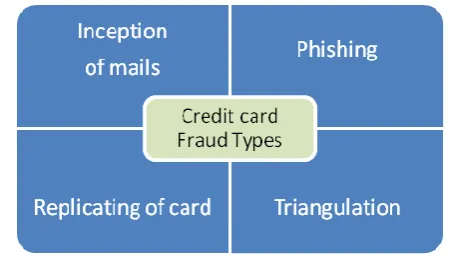
unusual transaction behavior. As shown in the Fig. 1 there are so many frauds detected that affect the bank,
merchants as well as customers. Some of them are listed below:
Inception of mails of newly issued cards.
Copying or replicating of card information through cloned websites.
121 | P a g e
Triangulation In this type of fraud, fraudster make an authentic looking website and advertises to sell goods
at highly lower prices. Unaware users attract to those sites and make online transactions. They submit their
card information to buy those goods. And then fraudsters use this card information to make genuine
transactions.
Fig. 1 Types of Frauds
II. LITERATURE SURVEY
A large number of Fraud detection Models (FDMs) have been proposed during the past years. Each model could
be shown work well with a unique dataset, but no model appropriate to do well on all datasets. There are various
models for credit cards fraud detection [3][4][5]. They are hidden markov model [6] which is based on markov
model, artificial neural network models which are based upon machine learning and artificial intelligence
[7][8][9][10][11], game theory models[13], peer group analysis[12], dempster shafer model [14] which is based
on Bayesian learning and dempster shafer theory, computational intelligence model [2] based on self organizing
map. CARDWATCH :A Neural Network Based Database Mining System for Credit Card Fraud Detection [15]
which is based upon data mining approach [16] and neural network models , the Bayesian Belief Networks [17]
which is based upon artificial intelligence and reasoning under uncertainty will counter frauds in credit cards
and also used in intrusion detection [18]. Real-time credit card fraud detection using computational intelligence
[2] and Credit card fraud detection using entropy and Bayesian network [19]. Most of the above mentioned
credit card fraud detection system involve machine learning, pattern matching and artificial intelligence. Some
models also used meta-heuristic techniques such as genetic algorithm; scatter search and particle swarm
optimization.
This paper compares and analyzes few approaches that have been used for detecting fraud in credit card. It
includes Dempster –Shafer theory and Bayesian learning, Hidden Markov model, Computational Intelligence
(SOM), Fraud detection using SOM with PSO [20], Max Entropy with Bayesian Learning. Section II gives an
overview of these approaches; a comparative survey presents in section III and section IV conclude and
summarize the fraud detection approaches.
122 | P a g e
2.1 A fusion approach using Dempster–Shafer theory and Bayesian learning[14]
The Fraud detection system consists of four components, namely, rule-based filter, Dempster–Shafer adder,
transaction history database and Bayesian learner. Rule-based filter (RBF) consists of generic as well as
customer-specific rules which classify an incoming transaction as fraudulent with a certain probability. This
layer can have rules R1 Address mismatch and R2 Outlier detection. The role of the DSA is to combine
evidences from the rules R1 and R2 and compute an overall belief value for each transaction. Transaction
history database is the transaction repository component of the proposed FDS. Bayesian learner is a tool to
measure evidences supporting alternative hypotheses and arrive at optimal decisions.
2.2 Credit Card Fraud Detection using Hidden Markov Model[6]
An HMM is a double embedded stochastic process with two hierarchy levels. An FDS runs at a credit card
issuing bank. Each incoming transaction is submitted to the FDS for verification. FDS receives the card details
and the value of purchase to verify whether the transaction is genuine or not. It tries to find any anomaly in the
transaction based on the spending profile of the cardholder, shipping address, and billing address, etc. If the FDS
confirms the transaction to be malicious, it raises an alarm, and the issuing bank declines the transaction. The
concerned cardholder may then be contacted and alerted about the possibility that the card is compromised.
2.3 Fraud detection using SOM & PSO[20]
Proposed approach is SO-PSO (Self Organized Particle Swarm Optimization) i.e. combination of SOM and
PSO. This method made different clusters is based on Euclidian Distance. They define each particle by (X1,
X2…..Xn) and weight vector by (W1, W2…..Wm) respectively. Then weight is updated to all nodes within a
topological distance. The value of learning parameter is initially set with small random value. After applying
this procedure PSO approach is applied on the updated weight of SOM. The method calculated the velocity and
position of each particle under near about 2580 number of iterations.
2.4 Max Entropy with Bayesian learning[19]
In the proposed fraud detection system, the number of phases designed to analyze the deviation of each
transaction from the normal behavior of the cardholder are done by using information theory. The general idea
behind this theory is that outlying instances affect the information contents of the data set because of their
surprising nature. Entropy values are used to estimate the score which is “further strengthened or weakened
according to its similarity” with the deceitful or the legitimate transaction. “In order to meet this functionality, the proposed FDS” consists of five components which are described in the Figure 1. The first component is item
analyzer where the items are analyzed according to the spending behavior of the cardholder. Standardization is
the second component where domain independency is achieved. The third component is entropy reckoning
where entropy is calculated for finding out the similarity in the transactions. Transaction record catalog is the
fourth component where fraudulent or genuine transactions are stored. The fifth component is Bayesian
123 | P a g e
2.5 Fraud detection using Computational
Intelligence(SOM)[2]
Multilayer approach was built in this research which consists of initial authentication and screening layers, risk
scoring and behavior analysis layer (core layer) and a layer of further review and decision-making. First two
layers consist of verification of PIN, address and expiry date etc and the last layer for manual review of results.
Main layer is core layer consist of two sub-layers a layer of SOM followed by either a feed-forward neural
network or rule-based risk scoring system. Euclidean-distance and Gravity function are used as measures of
similarity. The proposed approach is at early stage of a research aiming at using the properties of SOM to
achieve efficient and cost-effective real-time fraud detection.
III. COMPARISON PARAMETERS
The Parameters used for comparison of various Fraud Detection Systems are Accuracy, Fraud Detection Rate in
terms of True Positive and false positive, Error rate, cost and training required, supervised Learning.
Accuracy: It represents the fraction of total number of transactions (both genuine and fraudulent) that have been
detected correctly.
Method: It describes the methodology used to counter the credit card fraud. The efficient methods like sequence
alignment, machine learning, neural networks are used to detect and counter frauds in credit card transactions.
True Positive (TP): It represents the fraction of fraudulent transactions correctly identified as fraudulent and
genuine transactions correctly identified as genuine.
False Positive (FP): It represents fraction of genuine transactions identified as fraudulent and fraudulent
transactions identified as genuine. Training data: It consists of a set of training examples. The fraud detection
systems are initially trained with the normal behavior of a cardholder.
Error Rate: It tells that how much the result value is actually deviated from actual value. Error Rate =
1-Accuracy
Supervised Learning: It is the machine learning task of inferring a function from supervised training data.
IV. PERFORMANCE ANALYSIS OF VARIOUS FRAUD DETECTION APPRAOCHES
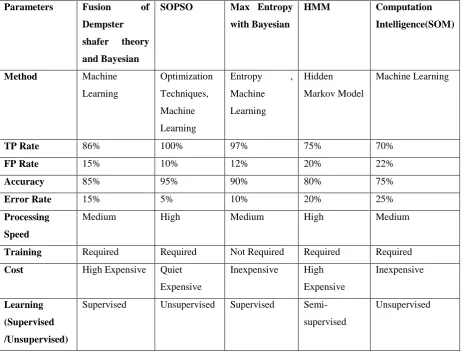
To compare various credit card fraud detection approaches a comparison table was prepared. All approaches
have positive and negative features. Results show that the fraud detection systems such as SOPSO, Dempster
and Max Entropy have very high accuracy in terms of TP and FP. At the same time, the processing speed is fast
enough to enable on-line detection of credit card fraud in case of HMM and SOPSO. Comparison performed is
124 | P a g e
Table 1: Comparison of various fraud detection approaches
Parameters Fusion of
Dempster
shafer theory
and Bayesian
SOPSO Max Entropy
with Bayesian
HMM Computation
Intelligence(SOM)
Method Machine
Learning
Optimization
Techniques,
Machine
Learning
Entropy ,
Machine
Learning
Hidden
Markov Model
Machine Learning
TP Rate 86% 100% 97% 75% 70%
FP Rate 15% 10% 12% 20% 22%
Accuracy 85% 95% 90% 80% 75%
Error Rate 15% 5% 10% 20% 25%
Processing
Speed
Medium High Medium High Medium
Training Required Required Not Required Required Required
Cost High Expensive Quiet
Expensive
Inexpensive High
Expensive
Inexpensive
Learning
(Supervised
/Unsupervised)
Supervised Unsupervised Supervised
Semi-supervised
Unsupervised
V. CONCLUSION
For any card issue bank, credit card fraud detection system must be efficient. A number of techniques have been
proposed to detect credit card fraud. Credit card fraud detection has drawn quite a lot of interest from the
research Community. The SOPSO fraud detection systems improve the system accuracy. Since the Fraud
detection rate of SOPSO fraud detection systems in terms of true positive is 100% and shows good results in
detecting fraudulent transactions. Approach using Max entropy and Bayesian learning also shows good accuracy
in fraud detection rate and processing speed is also high.
The Fraud detection rate of SOM and Hidden Markov model is very low compare to other methods. The
processing speed of Max Entropy with Bayesian is not so fast but training is not required in this approach. SOM
along with other optimization techniques can be effectively used to counter frauds in other domains such as
telecommunication and banking fraud detection. Approaches discussed in this survey papers have its own
features in positive or negative sense. This type of survey will help us to build a hybrid approach for financial
125 | P a g e
REFERENCES
[1] Chan, P. K., Fan, W., Prodromidis, A. L., & Stolfo, S. J. (1999). Distributed data mining in credit card
fraud detection. IEEE Intelligent Systems and Their Applications, 14(6), 67-74.
[2] Quah, J. T., & Sriganesh, M. (2008). Real-time credit card fraud detection using computational
intelligence. Expert systems with applications, 35(4), 1721-1732.
[3] Masuda, B. (1993). Credit card fraud prevention: A successful retail strategy.Crime prevention studies, 1,
121-34.
[4] Delamaire, L., Abdou, H. A. H., & Pointon, J. (2009). Credit card fraud and detection techniques: a
review. Banks and Bank systems, 4(2), 57-68.
[5] Bhatla, T. P., Prabhu, V., & Dua, A. (2003). Understanding credit card frauds.Cards business
review, 1(6).
[6] Srivastava, A., Kundu, A., Sural, S., & Majumdar, A. (2008). Credit card fraud detection using hidden
Markov model. IEEE Transactions on dependable and secure computing, 5(1), 37-48.
[7] Maes, S., Tuyls, K., Vanschoenwinkel, B., & Manderick, B. (2002, January). Credit card fraud detection
using Bayesian and neural networks. In Proceedings of the 1st international naiso congress on neuro
fuzzy technologies (pp. 261-270).
[8] Haykin, S. S. (2001). Neural networks: a comprehensive foundation. Tsinghua University Press.
[9] Brause, R., Langsdorf, T., & Hepp, M. (1999). Neural data mining for credit card fraud detection.
In Tools with Artificial Intelligence, 1999. Proceedings. 11th IEEE International Conference on (pp.
103-106). IEEE.
[10] Ghosh, S., & Reilly, D. L. (1994, January). Credit card fraud detection with a neural-network. In System
Sciences, 1994. Proceedings of the Twenty-Seventh Hawaii International Conference on (Vol. 3, pp.
621-630). IEEE.
[11] Chang, R. I., Lai, L. B., Su, W. D., Wang, J. C., & Kouh, J. S. (2007). Intrusion detection by
backpropagation neural networks with sample-query and attribute-query. International Journal of
Computational Intelligence Research, 3(1), 6-10.
[12] Weston, David J., et al. "Plastic card fraud detection using peer group analysis." Advances in Data
Analysis and Classification 2.1 (2008): 45-62.
[13] Vatsa, V., Sural, S., & Majumdar, A. K. (2005, December). A game-theoretic approach to credit card
fraud detection. In International Conference on Information Systems Security (pp. 263-276). Springer
Berlin Heidelberg.
[14] Panigrahi, S., Kundu, A., Sural, S., & Majumdar, A. K. (2009). Credit card fraud detection: A fusion
approach using Dempster–Shafer theory and Bayesian learning. Information Fusion, 10(4), 354-363.
[15] Aleskerov, E., Freisleben, B., & Rao, B. (1997, March). Cardwatch: A neural network based database
mining system for credit card fraud detection. In Computational Intelligence for Financial Engineering
126 | P a g e
[16] Phua, C., Lee, V., Smith, K., & Gayler, R. (2010). A comprehensive survey of data mining-based fraud
detection research. arXiv preprint arXiv:1009.6119.
[17] Ezawa, K. J., & Norton, S. W. (1996). Constructing Bayesian networks to predict uncollectible
telecommunications accounts. IEEE Expert: Intelligent Systems and Their Applications, 11(5), 45-51.
[18] Ezawa, K. J., & Norton, S. W. (1996). Constructing Bayesian networks to predict uncollectible
telecommunications accounts. IEEE Expert: Intelligent Systems and Their Applications, 11(5), 45-51.
[19] Kumar, D., & Arora, S. (2016). A Hybrid Approach Using Maximum Entropy and Bayesian Learning for
Detecting Delinquency in Financial Industry. International Journal of Knowledge-Based Organizations
(IJKBO), 6(1), 60-73.
[20] Arora S., & Kumar,D. Hybridization of SOM and PSO for detecting fraud in credit card. International