Data Anonymization for Requirements Quality Analysis: a Reproducible
Automatic Error Detection Task
Juyeon Kang
†∗Jungyeul Park
‡∗†PROMETIL, 52 rue Jacques Babinet. 31100 Toulouse, France.
‡CONJECTO, 74 rue de Paris. 35000 Rennes, France.
Abstract
In this work, we aim at identifying potential problems of ambiguity, completeness, conformity, singularity and readability in system and software requirements specifications. Those problems arise particularly when they are written in a natural language. While we describe them from a linguistic point of view, the business impacts of each potential error are also considered in system engineering context. We investigate and explore error patterns for requirements quality analysis by manually analyzing the corpus. This analysis is based on the requirements grammar that we developed in our previous work. In addition, this paper extends our previous work in a two-fold way: (1) we increase more than twice the number of evaluation data (1K sentences) through a manual verification process, and (2) we anonymize all sensible and confidential entities in evaluation data to make our data publicly available. We also provide the baseline system using conditional random fields for requirements quality analysis, and we obtain 79.47% for the F1score on proposed evaluation data.
Keywords:Requirements quality analysis (ReQA), error detection in ReQA, data anonymization, reproducible task
1.
Introduction
Among technical documents, requirements are a central is-sue since they must comply with a high number of con-straints of e.g. readability, lack of ambiguity and implicit data, feasibility, relevance, traceability, conformity and overall cohesion and coherence (Firesmith, 2003; Alred et al., 2011). For example,Ambient pressure shall be perma-nently maintainedrelies too much on the operator’s knowl-edge and practice: what pressure should be maintained to be ambient and what to do in case of interruption? A wrong interpretation may lead to accidents and damages.
There exists different types of references for guiding the writing of high quality requirements. Among them, we can cite:
• the standards of IEEE (ISO/IEC/IEEE29148:2011),
• ARP4754A (Aerospace Recommended Practice),
• the recommendations of INCOSE (Guide for Writing Requirements), and
• IREB (International Requirements Engineering Board)
We can also refer to the principles of controlled natural languages, mainly, those defined in ASD-STE100 (Sim-plified Technical English by Aerospace and Defense In-dustries Association of Europe). Those documents show that requirements must be non-ambiguous consistent, cor-rect, complete, verifiable, singular, readable, feasible and traceable. However, when writing or revising a set of re-quirements, it is particularly challenging to make sure that texts read easily and are unambiguous for any domain ac-tor (Weiss, 1990; Grady, 2013). There are several facac-tors like overload, time missing, novices and specific domain knowledge needed. Tools controlling the authoring quality
∗
Both authors contributed equally to this work.
of requirements can be useful for automatically proofread-ing large quantities of requirements. Since we presented the very first linguistic model for requirements quality analysis (ReQA) (Kang and Park, 2016), there are many requests for releasing data. While we build training data from the pub-lic domain corpus (Baroni et al., 2009) using an automatic method to boost the overall learning ability, we extract sen-tences from the actual documents for requirements qual-ity and annotate manually error labels for evaluation data. Most documents of requirements often contain restricted information, and documents that we used for evaluation data are also confidential in which we cannot directly re-lease them. Therefore, in this paper, we perform the data anonymization process for ReQA evaluation data, and we release them for a reproducible automatic error detection task. Training and anonymized evaluation data are available athttps://github.com/jungyeul/rqa.
2.
Errors in ReQA
when a requirement contains one of the lexical or syntactic errors as listed in Figure 1.
3.
Anonymization
Among technical documents, Software and system Re-quirements Specifications (SRS) contain highly confiden-tial data, so that the information security must be guaran-teed. For example, a SRS of a vehicle includes software, hardware and networking subsystems that make up the to-tal system. These documents specify key performance pa-rameters (such as operations speed, response time, avail-ability, portability and maintainability), functional capabil-ities, data structure and elements, safety, constraints, etc. The loss of this information can lead to significant finan-cial losses and reputational damage. Thus, the accurate data anonymization allows to preserve the confidentiality of re-quirements documents and makes them useful as a linguis-tic corpus for a Natural Language Processing (NLP) task like automatic error detection.
Different approaches for the data anonymization were stud-ied and applstud-ied mainly in preserving privacy from social media and health information from medical data. In so-cial network sites (SNS), web pages are designed for hu-man interaction like sharing opinions, experiences and feel-ing between unknown users of any domain. Massive data flow in SNS contains personal information (birthday, email address, social relationship, friendship, etc.) which should be protected. For the purpose of preserving such a sensi-tive data, some studies focus on anonymization techniques of those data. Among anonymization techniques and algo-rithms developed for the privacy protection on relational data, Fredj et al. (2015) describes an approach based on the generalization in order that the illustration of differ-ent generalization algorithms helps data publishers select-ing an adequate technique for each data. Zhou et al. (2008) presents privacy information modeling methods along with the state-of-art anonymization approaches: clustering-based approach and graph modification approach. In clin-ical research, the health data anonymization is required for the protection of patient records. Dernoncourt et al. (2017) proposes a de-identification system of health infor-mation, referred to as protected health information (PHI), namely age, contact, date, ID, location, name, profession. Based on Artificial Neural Networks (ANN) and Condi-tional Random Fields (CRF) models, they obtained F1
-scores of 99.229% and 99.023%, respectively, on MIMIC de-identification datasets, showing that the ANN model outperforms the CRF model on all types of datasets on which the system is tested. In this work, we propose to anonymize sensitive elements that may result in the prob-lem of confidentiality in using requirements documents. It is first necessary to identify confidential information. For that purpose, we manually analyzed 15 SRSs with more than 4000 requirements of different types and domains coming from several companies and organizations. Figure 2 shows the most commonly appearing sensitive data in requirements documents: the named entities, quanti-tative values, parametric values and references. Named en-tities expose domain specific terms and acronyms proper to a specific project. Domain specific sensitive terms, due
to their specificity, provide more information than common terms. These terms have significant meaning in a specific domain. For example, ice condition can be referred to as a meteorological term in a common sense, but in terms of the aviation safety, ICE CONDITION indicates a spe-cific status waiting an action. An acronym ACU can be re-ferred to asAustralian Catholic UniversityorA confirmer ult´erieusementin a French SRS, but in a more specific con-text, ACU (Air Control Unit) is related to air flow controller which gives information on its used domain. Quantitative values disclose direct information about key performance parameters while parametric values do not directly expose parameters. However, it is possible that the latter may be in-dicative of different parameters. Concerning the references, some of standards and norms might be public but many of requirements also refer to internal guidelines. Thus, it will be reassuring to take them into account. Once iden-tified the most sensitive elements to anonymize, we man-ually made up a dictionary of entities including domain specific terms, acronyms and parametric values. Based on this predefined dictionary, we replace original data by ran-domizing the characters of entities and numeric values. The dictionary of entities and anonymized data that is used in this work as evaluation data set was validated by an expert in Requirements Engineering in terms of data security and utility. During our survey, we could not find contributions applied to the data anonymization of requirements, mostly because the requirements are confidential texts which are not intended to be publicly released. Therefore, this paper focuses on the identification of sensitive and confidential information from the requirements documents.
4.
ReQA Data
4.1.
Training data
We already detailed how to build training data by using part-of-speech (POS) tagging and syntactic parsing in Kang and Park (2016). Since we use the automatic method to build the training data, we minimize the POS label errors and parsing results by introducing the filtering method. We use the consensus results Dˆ by intersection between two results usingD(M1)∩ D(M2)whereDis raw text data,
Miis a learning algorithm to annotate raw text data, andDˆ
Singularity Combinators: (i)X and X’where POS (part-of-speech) labels (or phrase type) of X and X’ are same. X= verb (infinitive form), verb phrase, noun, noun phrase, adjective, value followed by a unit of measurement
Completeness Passive construction: (i) modal(shall) be {AdvP} Verb (Action, pp): shall be used, shall be properly used
Pronouns: (i)Pron (possessive) Noun:their application; (ii)Pron (possessive) NP:their proper development; (iii)Pron (demonstrative) modal(shall):this shall,these shall
Conformity Negations: (i)modal Neg:shall not
Modals: (i)modal {AdvP} Verb(Action, inf):would implement,should correctly implement
Readability Lexical items: quantifiers (e.g.each,some,all) and acronyms (e.g.ACR,CPU)
Ambiguity Combinators: (i)X or X’where POS labels (or phrase types) of X and X’ are same. X= verb (infinitive form), verb phrase, noun, noun phrase, adjective, value followed by a unit of measurement.
Lexical items: confusing terms, vague adjectives, adverbs
Figure 1: Five constraints and their errors patterns
Named entities Domain specific terms:ICE CONDITION, Torque motor, Pre-cooler Acronyms:EMCU, MEK, AMMC, JSC, ECU
Parametric values ASTM-G-3769, 5V UPS, @TM REACH DEFAULT
Quantitative values any numeric symbols followed or preceded by units of measurement
References Standards/Norms:MIL-STD-753C, MT1, DO-160F Requirements ID:MCS-QQ-P-47
Figure 2: Sensitive elements in requirements documents
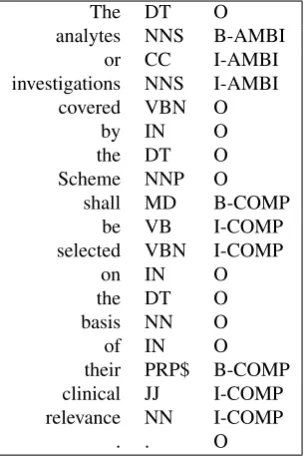
The DT O analytes NNS B-AMBI
or CC I-AMBI investigations NNS I-AMBI
covered VBN O
by IN O
the DT O Scheme NNP O
shall MD B-COMP be VB I-COMP selected VBN I-COMP
on IN O
the DT O basis NN O
of IN O
their PRP$ B-COMP clinical JJ I-COMP relevance NN I-COMP
. . O
Figure 3: An example sentence from training data.
the completeness error because of the possessive pronoun their. It probably refers to one of the following antecedents: analystes,investigations,the Schemebut we need extra in-formation to correctly identify the reference oftheir.
According to the standards IEEE (29148:2011), a require-ment should be concise and a single sentence. In this pa-per, we add a new constraint 10 ≤ n ≤ 80where n is the length of sentences. Note that Kang and Park (2016) doesn’t have the length constraint, and it yields the smaller data size. Then, we split 90-10 ratio for training and de-velopment data sets. Table 1 shows the number of tokens and sentences, and Figure 4 shows the number of annotated error labels in the current data sets.
sentences tokens
train 35,826 590,886 dev 3,980 64,769 eval 988 23,076
Table 1: Number of tokens and sentences
0 2000 4000 6000 8000 10000 12000 14000 16000 18000 20000
AMBI COMP CONF READ SING
Numbers of error lables
train dev eval
Figure 4: Number of annotated error labels
4.2.
Evaluation data
Among the SRSs documents that we have mentioned in
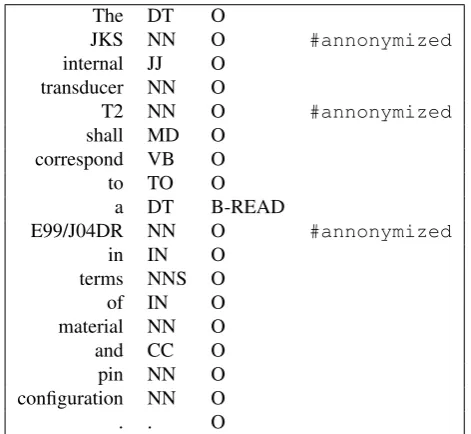
origi-The DT O
JKS NN O #annonymized
internal JJ O transducer NN O
T2 NN O #annonymized
shall MD O correspond VB O to TO O
a DT B-READ
E99/J04DR NN O #annonymized
in IN O
Figure 5: An example sentence from anonymized evalua-tion data.
nally for the name of the transducer and the connector, and they are completely anonymized.
5.
Experiments and Results
We use CRFs (Lafferty et al., 2001) for training and test-ing with proposed data sets.1 ±2 word/POS window con-text and a bi-gram word/POS model are used as a feature set.2We use 0.1 for L2-regularization. We obtain 79.49%
F1-score on the new evaluation data set. Table 2 shows the
detailed results for each error label. READ error labels are entirely based on lexical information and we correctly an-notate over 95% of them because we have enough lexical information in training data. CONF error labels show only about 30% of precision because even though the expected modals as erroneous should have been detected exclusively in the main clauses, many of them were identified in the subordinated clauses where their use is allowed. AMBI and SING error labels for the combinator error pattern are usu-ally required parsing results. While we used parsing results for building training data, we didn’t consider these results for training the models. This is one of the main reasons that AMBI error labels have a relatively low recall. However, dependency information is difficult to be integrated in the sequence labeling model with dependency distance. More-over, dependency parsing results are not often correct for conjunction marks such asor andand, which we use for the combinator error pattern.
6.
Conclusion and Future Perspectives
We have presented linguistic models and a new anonymized evaluation data set for ReQA. A tool helping to improve the requirements authoring quality allows to reduce multiple proofreading steps which are time-consuming and costly
1
We use Wapiti (Lavergne et al., 2010) for training and evalu-ation, available athttps://wapiti.limsi.fr.
2A trained model and training parameters are also available at
https://github.com/jungyeul/rqa.
prec.(%) recall(%) F1(%) num.
AMBI 40.31 70.85 51.38 392 COMP 75.68 95.61 84.49 403 CONF 32.56 97.67 48.84 129 READ 91.57 98.80 95.05 629 SING 71.20 90.67 79.77 191
(all) 69.78 92.34 79.49
Table 2: Experiment results: precision, recall, F1-scores,
and the number of entities.
but crucial in the whole life cycle of the Requirements En-gineering. The accuracy of this kind of tool is obviously very important as technical authors (users) can reject to use them once they generate false positives of more than 20%. To reduce the rate of false positives, the model that we de-veloped is based on the error patterns manually identified in the linguistic framework of the requirements grammar. In this paper, we can enrich the error patterns depending on the lexical information by adding more lexical items into our model. Additionally, the five constraints and the corresponding errors patterns do not cover all of the po-tential errors. It is necessary to revise and complete them in order to detect other error types: (1) detection of over-specified elements (design/solution parts – how the system realizes the required action – included in the requirements) for the Singularity, (2) detection of grammatical errors (e.g. ditransitive verbs missing one of arguments likethe system shall send the received configuration) for the Complete-ness. There are also another types of constraints more ambi-tious such as the problem of consistency and of redundancy between requirements or sets of requirements. For those er-rors, we need to consider contextual information over a re-quirement sentence and to understand semantic meaning of the requirements and the relation between them. These are a great challenge for ReQA and we leave them as a future work of this paper.
7.
Bibliographical References
Alred, G. J., Brusaw, C. T., and Oliu, W. E. (2011). Hand-book of Technical Writing, Tenth Edition. St. Martin’s Press; 10 edition, New York.
Baroni, M., Bernardini, S., Ferraresi, A., and Zanchetta, E. (2009). The WaCky wide web: a collection of very large linguistically processed web-crawled corpora. Language Resources and Evaluation, 43(3):209–226.
Brants, T. (2000). TnT – A Statistical Part-of-Speech Tag-ger. InProceedings of the Sixth Conference on Applied Natural Language Processing, pages 224–231, Seattle, Washington, USA. Association for Computational Lin-guistics.
Dernoncourt, F., Lee, J. Y., Uzuner, O., and Szolovits, P. (2017). De-identification of patient notes with recurrent neural networks.Journal of the American Medical Infor-matics Association, 24(3):596–606.
Firesmith, D. (2003). Specifying Good Requirements. Journal of Object Technology, 2(4):77–87.
for Selecting a Generalization Algorithm. Procedia Computer Science, 60:206–215.
Grady, J. O. (2013). System Requirements Analysis. Else-vier; 2 edition.
Kang, J. and Park, J. (2016). Generating a Linguistic Model for Requirement Quality Analysis. In Proceed-ings of the 30th Pacific Asia Conference on Language, Information and Computation: Posters (PACLIC 30), pages 439–447, Seoul, Korea.
Lafferty, J. D., McCallum, A., and Pereira, F. C. N. (2001). Conditional Random Fields: Probabilistic Models for Segmenting and Labeling Sequence Data. In Proceed-ings of the Eighteenth International Conference on Ma-chine Learning, ICML ’01, pages 282–289, San Fran-cisco, CA, USA. Morgan Kaufmann Publishers Inc. Lavergne, T., Capp´e, O., and Yvon, F. (2010). Practical
Very Large Scale CRFs. InProceedings of the 48th An-nual Meeting of the Association for Computational Lin-guistics, pages 504–513, Uppsala, Sweden. Association for Computational Linguistics.
Nivre, J., Hall, J., and Nilsson, J. (2006). MaltParser: A Data-Driven Parser-Generator for Dependency Parsing. InProceedings of the Fifth International Conference on Language Resources and Evaluation (LREC’06). Weiss, E. H. (1990). 100 Writing Remedies: Practical
Ex-ercises for Technical Writing. Greenwood.