642 | P a g e
STOCK MARKET ANALYSIS
Kartik Sharma
1, Akilesh Rao
2, Rushabh Shah
3, Sujay Sail
4 1234Department of Information Technology,Atharva
College of Engineering Malad, Mumbai(India)
ABSTRACT
Stock market has traditionally been the proving grounds for data mining applications. There is a lack of efficient models which can emulate the heuristic reasoning of humans based on current events/trends. The proposed system is an attempt to reconcile computed sentiments alongside traditional/more common data mining. Datasets consisting of historical data as well as recent headlines will be mined to ascertain stock price movement. This system aims to predict stock price movement more accurately by emulating instinctual reasoning by implementing sentiment analysis.
I. INTRODUCTION
In a financially volatile market, as the stock market, it is important to have a very precise prediction of a future
trend. Because of the financial crisis and scoring profits, it is mandatory to have a secure prediction of the values
of the stocks. Stock Market Prediction is the act of trying to determine the future value of a company stock or
other financial entity traded on an exchange. The successful prediction of stock’s future price could yield
significant profit.
Google Finance
Stock values for a range of dates is obtained using Google Finance and includes the open, close, high and low values for a given day which will be an important dataset to perform mathematical computation and generate visualizations [6].
Headlines
The headlines or news will be imported using Google News into the system and that forms our second dataset that will be used to generate the sentiment of the people towards the company. Sentiment Analysis will be performed on this dataset [6].
The Fig. 1.1 is a brief description of the functionality of the proposed system. To resolve the problems of existing work i.e. just the mathematical regression algorithm and manual analysis of the sentiments, the
proposed system incorporates a new approach wherein the sentiment analysis is also been computerized by
using libraries offered by Python thereby reducing the manual work of analyzing trends and rumors. The
proposed work will solve the problems faced by human error as almost everything is automated.
1. To import the dataset from Google Finance and find out the pattern based upon the historical data.
2. Generate the output in the form of visualizations.
3. Import the news headlines related to the company from Google News into the system.
643 | P a g e
Fig. 1.1II. REVIEW OF LITERATURE
2.1 Financial Sentiment Analysis Based on Machine Learning
The aforementioned paper attempted to figure out the best approach to perform sentiment analysis in aid of
predicting stock market movement, Naive Bayes and SVM chief among them. The proposed system benefitted
from this paper by observing the use of sentiment analysis in a stock market context environment as well as the
efficacy of SVM over Naive Bayes as a text classifier. It assisted in the development of the premise of the
proposed system as well as a tentative implementation of basic sentiment analysis [1].
2.2 Stock Prediction using Twitter Sentiment Analysis
The proposed system consists of 2 approaches, that is to say, data mining and sentiment analysis. This particular
article/paper helped provide insight into the process of how a sentiment can be mined from textual data. It also
assisted the proposed system in learning the kind of vocabulary as is entailed when dealing with the stock
market [2].
2.3 Stock Market Prediction using Data Mining
The proposed system consists of 2 approaches, that is to say, data mining and sentiment analysis. This particular article/paper helped provide insight into the process of how conventional methods of data mining go about predicting stock market movement as well as assisted the proposed system in learning where information extracted using sentiment analysis could be helpful in aid of prediction accuracy to the traditional methods [3].
2.4 Prediction of Stock Market using Data Mining and Artificial Intelligence
644 | P a g e
used in the stock market. It helped the proposed system ascertain sentiment analysis as the better companion to the traditional data mining approach instead of employing an artificial agent. It was noted, however, that the agent was highly effective in shaving off the delays faced by human operators in placing calls [4].
2.5 Stock Market Prediction using Artificial Neural Networks
As was the case with the previous paper, this paper was studied so as to provide a better-rounded context as to the techniques related to data mining used in the stock market. It helped the proposed system ascertain sentiment analysis as the better companion to the traditional data mining approach instead of employing a neural network in cases which called for the supervised approach. It was noted however that a neural network worked extremely well in situations which called for the unsupervised approach [5].
III. OBJECTIVES
The objective of the proposed system is to predict the future stock movement. This will be accomplished with the help of 2 types of datasets. Firstly, historical data from Google Finance will be mined to garner traditionally available predictions. Consequently, sentiments in the form of news headlines are assimilated to divine general heuristic consensus. These results, as two independent predictions, are then combined to generate a final output which will be used to predict the next day’s opening price.
3.2 Methodology
3.2.1 Datasets
There are 2 types of data sets included in the proposed system. The data sets used for regression models would be imported from online portals such as Google Finance/ Yahoo Finance. These data sets have comprehensive list of attributes relating to stock prices and are available for download freely in .csv file formats. The reason why we have chosen this data set is because it provides all the information that is required to predict stock values in a simple csv format which makes it easier to import in the algorithm. The second set of data is for Sentiment Analysis. This data set consists of news headlines/tweets which are imported from online APIs to predict the overall sentiment related to the company stock. Both these data sets are then individually divided into two sets for training and testing purposes.
3.2.2 Algorithm
645 | P a g e
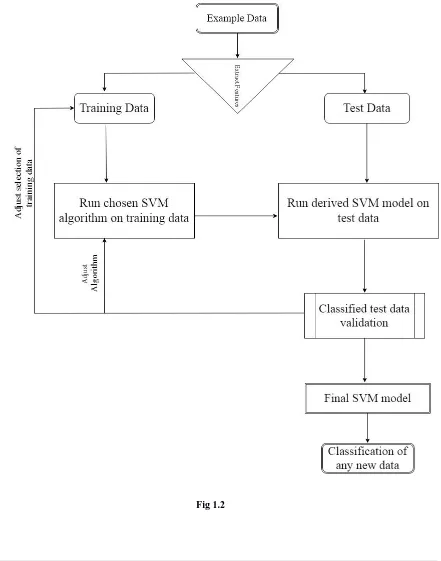
approach to benefit from the best of both worlds. It is derived from “Logistic Regression” but boasts accuracy comparable to those of the more complex algorithms out there.
Fig 1.2 shows the functionality of the SVM classifier
646 | P a g e
IV. CONCLUSION
The proposed algorithm worked on the views/ opinions of their viewers on the shares. Stock Market is such a
field where views of the users matter. The views of the experts affect a lot to the traders who want to enter into
the market. The unsupervised and supervised learning depend methods help to find the results in a better way.
The combinational study is done to get better accuracy. Further, optimizations can be done in sequence to get
improved results.
REFERENCES
[1] J. Bollen and H. Mao, “Twitter mood as a stock market predictor”. IEEE Computer, 44(10):91–94.
[2] C.-C. Chang and C.-J. Lin, “LIBSVM: A library for support vector machines.” ACM Transactions on
Intelligent Systems and Technology, 2:27:1–27:27, 2011.
[3] G. P. Gang Leng and T. M. McGinnity, “An on-line algorithm for creating self-organizing fuzzy neural networks.” Neural Networks, 17(10):1477–1493.
[4] A. Lapedes and R. Farber, “Nonlinear signal processing using neural network: Prediction and system modeling.” In Los Alamos National Lab Technical Report.
[5] A. E. Stefano Baccianella and F. Sebastiani, “Sentiwordnet 3.0: An enhanced lexical resource for sentiment analysis and opinion mining.” In LREC. LREC.