726 | P a g e
Smart trolley in mall by using Microcontroller & RFID
Shubhangi Mahajan
1, Pallavi Aher
2, PoonamKolamkar
3,Rohit
Bachhe
4Prof.S.M.More
51,2,3,,4,5,
Department of Electrical Engineering
Guru Gobind Singh Polytechnic, Nashik.(MSBTE, Mumbai)
ABSTRACT
Nowadays, large grocery stores are used by millions of people for the acquisition of products. Barcode scanners are time consuming process engaging the customers to stick to the billing section for a long time. Hence there is a need for an innovative product with the societal acceptance that aids the convenience, comfort and efficiency in everyday life.
In this paper, architecture is presented which blends Radio frequency identification (RFID) and wireless technology to provide ‘on spot’ billing in super markets. It uses the RFID based system application in the shopping trolley and the RFID card which is used as a security access for the product. The Liquid crystal display (LCD) that is fixed to the trolley displays the product name, cost and the total cost of all purchased products. The bill is transmitted to the server end through the Wi-Fi technology.
The software simulation is done using Proteus software and hardware is implemented using 8051 microcontroller. This promotes quick shopping and immediate pay without any queuing process. It reduces labour efforts and increases efficiency by minimizing errors.
Keywords: - microcontroller, RFID, Proteus software, transmitter, receiver, LCD.
I.INTRODUCTION
In recent years a deep structural change has occurred, with consequences on economic growthand society,
especially in factors such as territorial occupation, urbanization, openness to global markets, demography,
family structures and cultural and consuming patterns. Innovation in communication and information
technologies has caused a revolution in values, knowledge and perceptions in all areas.
The grocery industry sector is nowadays extremely important in worldwide economy, with its recent evolution
in technological, political, social and economic terms making it one of the most convenient and diverse
businesses across the globe.
The challenges and opportunities created by electronic business have caused the sharing of information between
business partners to improve operational performance, consumer service and solution development. The
emergence of new technologies, such as Radio Frequency Identification (RFID) and wireless networks,makes
727 | P a g e The main objective of proposed system is to provide a technology oriented, low-cost, easily scalable RFID
system for shopping. The objective of this project is to improve the speed of purchase by using RFID. This
project is designed to use the security system application in the shopping trolley. If the product is put into the
trolley then it will display the amount and also the total amount. RFID card is used for accessing of the products.
So this project improves the security performance and also the speed.
II.WORKING
In the development and discussion of the proposed shopping trolley, all the product information is stored in a
database at a main server. RFID tags are used to uniquely identify products.
As the products are selected and added into the cast, the RFID reader will identify the product and the price will
be displayed on the LCD display. If the customer chooses to drop a selected product, another RFID reader
which is at the outlet side of the trolley identifies the product and its price will be deducted from the total price
and the value will be displayed on the LCD display.
After the completion of the shopping the customer has to press the „complete‟ button. This enables the total bill
being generated after confirmed purchase of all the selected products in the shopping trolley.
At the same time, this information is sent to the database server through the wireless unit. The server database is
then updated to reflect the existing stock available after deducting the number of products purchased. This
ensures a smooth inventory management. The integrated system is built around 8051 microcontroller, 16x2
LCD display and miscellaneous circuit including power supply as shown in Figure.
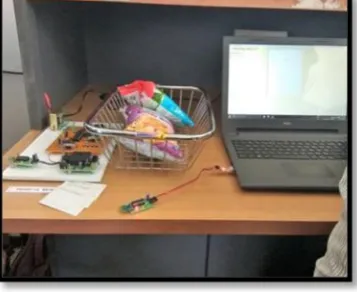
Fig. 1. Model
728 | P a g e
A. POWER SUPPLY:
When working with electronics, you always need one basic thing is Power. In every electronic circuit power
supply is required. The electric power is almost exclusively generated, transmitted and distributed in the form of
alternating current as an economical proposition. However for many applications we require dc supply. Batteries
cannot be used for the purpose as they are costly and require frequent replacement. Therefore, it is necessary to
convert available ac supply into the required dc supply. This is achieved by an electronic device known as
rectifier. The proper working of each and every component, the exact amount of voltage and current to be
supplied to it. If the powers exceed its limit, it can be fatal.
729 | P a g e LCD (liquid crystal display ) screen is an electronic display module and find a wide range of applications. A
16*2 lcd display is very commonly LCD display to show different indication.
C. REGULATOR
Voltage regulators are mainly used for good regulation, stabilization and temperature independent of load
voltage. Now a day‟s regulator ICs are used for these purposes.
IC voltage regulators are compact in size, light in weight, cheaper in cost, provided with inbuilt
protection circuits. Hence they are invariably used in almost all voltage regulators.78XX series is a three
terminal positive voltage regulated IC. Here XX stands for regulated output voltage values.
D. MAX232
I recently had the desire to be able to see data from an microcontroller for development and debugging
purposes. I wanted an easy way to have my microcontroller talk to my PC (and vise versa) with a minimum
number of parts. The easiest way to do this was to utilize the UART capabilities of the microcontroller to talk to
my PC through the serial port. One problem is that the microcontrollers puts out 5V for “high” (on) and 0V for “low” (off). The RS-232 standard (which PC serial ports use) required -15V for high and +15v for low!
Obviously the microcontroller needs somehelp to achieve this. The easiest way was to use the MAX232 serial
level converter which costs about 3 bucks at DigiKey. Note that it requires a few 10uF capacitors to function
properly.
730 | P a g e
E. RFID TAG
An RFID tag is a microchip combined with an antenna in a compact package; the packaging is
structured to allow the RFID tag to be attached to an object to be tracked.
The tag's antenna picks up signals from an RFID reader or scanner and then returns the signal,
usually with some additional data (like a unique serial number or other customized
information).RFID tags can be very small - the size of a large rice grain.Others may be the size of a
small paperback book
731 | P a g e
FLOW CHART
Flow Chart
In the development and discussion of the proposed shopping trolley, all the product information is stored in a
database at a main server. RFID tags are used to uniquely identify products.
As the products are selected and added into the cast, the RFID reader will identify the product and the price will
732 | P a g e is at the outlet side of the trolley identifies the product and its price will be deducted from the total price and the
value will be displayed on the LCD display.
After the completion of the shopping the customer has to press the „complete‟ button. This enables the total bill
being generated after confirmed purchase of all the selected products in the shopping trolley.
At the same time, this information is sent to the database server through the wireless unit. The server database is
then updated to reflect the existing stock available after deducting the number of products purchased. This
ensures a smooth inventory management. The integrated system is built around 8051 microcontroller, 16x2
LCD display and miscellaneous circuit including power supply as shown in Figure.
RFID technology
RFID stands for Radio-Frequency IDentification. The acronym refers to small electronic devices that consist
of a small chip and an antenna. The chip typically is capable of carrying 2,000 bytes of data or less. RFID
technology has been available for more than fifty years.
System has three parts:
1- A scanning antenna.
2- A transceiver with a decoder to interpret the data.
3- A transponder - the RFID tag - that has been programmed with information
HOW RFID WORKS?
The scanning antenna puts out radio-frequency signals in a relatively short range. The RF radiation
does two things:
It provides a means of communicating with the transponder (the RFID tag) AND
It provides the RFID tag with the energy to communicate (in the case of Passive RFID tag .
This is an absolutely key part of the technology; RFID tags do not need to contain batteries, and can
therefore remain usable for very long periods of time (maybe decades).
733 | P a g e They can take whatever shape you need; for example, you could build them into a door frame to accept
data from persons or objects passing through.
When an RFID tag passes through the field of the scanning antenna, it detects the activation signal
from the antenna. That "wakes up" the RFID chip, and it transmits the information on its microchip
to be picked up by the scanning antenna.
In addition, the RFID tag may be of one of two types Active RFID tag have their own power source;
the advantage of these tags is that the reader can be much farther away and still get the signal. Even
though some of these devices are built to have up to a 10 year life span, they have limited life spans
passive RFID tag , however, do not require batteries, and can be much smaller and have a virtually
unlimited life span.
ADVANTAGES:-
1. Avoiding the waste of time.
2. System helps to the consumer to calculate his/her total with help of smart trolley so, he/she can shop
within his/her budget.
APPLICATION:-1. We implement to simplify the billing process, make it swift & increase the security using RFID
technique. This will take the overall shopping experience to a different level.
2. Automatic billing of products by using RFID technique will be a more viable option in the future.
3. The system based on RFID technique is efficient, compact and shows promising performance
IV.CONCLUSION
The intended objectives were successfully achieved in the prototype model developed. The developed product is
easy to use, low-cost and does not need any special training.
This architecture of the system can be used in the shopping systems for intelligent and easy shopping in the
malls to save time, energy and money of the consumers.
In this project RFID card is used as security access for product. If the product is put in to the trolley means it
will shows the amount and also the total amount. In this project RFID card is used for accessing the products.
So this project improves the security performance and also the speed. This project also best suit for present fast
growing RFID technology.
V.FUTURE SCOPE
There are a few challenges that can be resolved to make proposed system more efficient by using a more
734 | P a g e browse the offers facility of payment within the cart by using swapping card can be used to make cart more
advance and to provide consumer a better shopping experience.
AUTHORS:
NAME: SHUBHANGI S. MAHAJAN
EDU: DIPLOMA IN THIRD YEAR ELECTRICAL
COLLAGE: GURU GOBIND SINGH, NASHIK
MARKS: 68%
NAME: PALLVI D.AHER
EDU :DIPLOMA IN THIRD YEAR ELECTRICAL
COLLAGE: GURU GOBIND SINGH, NASHIK
MARKS : 75%
NAME:Poonam A. Kolmankar
EDU :DIPLOMA IN THIRD YEAR ELECTRICAL
COLLAGE: GURU GOBIND SINGH, NASHIK
MARKS: 66.39%
NAME :Rohit Bachchhe
EDU :DIPLOMA IN THIRD YEAR ELECTRICAL
COLLAGE: GURU GOBIND SINGH, NASHIK