1 | P a g e
Image Filtering Techniques-A Review
Ramanjeet Kaur
1, Er. Ram Singh
21
Student, Department of Computer Engineering,
Punjabi University Patiala, Punjab, (India)
2
Assistant Professor, Department of Computer Engineering,
Punjabi University Patiala, Punjab, (India)
ABSTRACT
Image processing is a field consists of various stages for processing an image .One of the most important stage
of image processing is image enhancement which effects the pictorial view of an image. In image enhancement,
noise removal is very important and for this image filters are used.This paper provides a detailed study of
various filtering techniques. The focus is on bilateral filtering as it is different from other filtering techniques in
respect of parameters used. It is used to filter both gray scale and RGB images.
Keywords—Bilateral filtering; RGB image; Grayscale image
I.
INTRODUCTION
Image processing is a vast field consisting of lots of processes which are performed on images to make them
better and to enhance the appearance of images. One of an important process is image enhancement method.
The need of image enhancement is there due to disturbances in an image which results into poor quality image.
To improve the quality of images, noise reduction methods are used. These noise reduction methods are called
filters in the field of image processing. Wide range of filters are there in literature varies as per there complexity.
The noise is basically be additive, multiplicative or mixed noise. Additive noise means the noise added to a
pixels and results into alteration of pixel values whereas multiplicative noise is a noise multiplied with pixel
values and mixed noise may be a combination of both additive and multiplicative noise.
Some of the well-known filters are mean filter, median filter, min-max filter, gaussian filter and bilateral filter.
All filters uses a window mask for filtering process. Methods based on anisotropic diffusion (AD), weighted
least squares(WLS) and robust estimation were also proposed as an additive noise removal iterative approaches
[15].The performance of all filters are measured using some quality analysis matrices like Peak Signal to Noise
Ratio (PSNR), Mean Square Error (MSE), Mean Absolute Error (MAE) and Time Complexity [6].Also these
analysis matrices are used for analyzing the type of noise present in an image by comparing the original image
with thenoisy image [2].This paper presents the review of mean, median, gaussian and different types of
bilateral filtering techniques along with various types of noise which are responsible for image degradation.
This paper is organized as follows. Section II provides an introduction to different types of noise and their
mathematical models. Section III provides the basic concept of filtering and different variants of image filtering,
2067 | P a g e
II.
NOISE
MODELS
A noisy image can be represented as [6]:
𝑔 𝑥, 𝑦 = 𝐼 𝑥, 𝑦 + 𝑛 𝑥, 𝑦 (1)
Where 𝑔 𝑥, 𝑦 is the noisy image, 𝐼 𝑥, 𝑦 is the original image and 𝑛 𝑥, 𝑦 is the noise.
There are different categories of noise in image processing literature. Some of the common types of noises are
(a) Gaussian noise, (b) Salt and Pepper noise, (c) Speckle noise and (d) Mixed noise.
Probability Density Function(PDF) is a graphical distributionof noise.Mean
and standard deviation
2are the main parameters in representation of noise models.
(a) Gaussian noise: It is additive noise and mainly happens during image acquisition process. The original
pixel values are altered due to addition of noise [6].
PDF: Where 𝑛 represents the grey level, 𝜎 is the standard deviation [2].
𝑝𝑛 𝑛 = 𝜋𝜎12𝑒
−𝑛 2 𝜎2 (2)
Fig. 1: Normal distribution curve
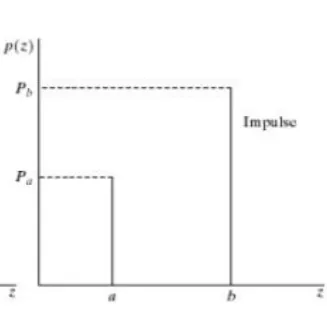
(b) Impulse noise: Also called salt & pepper noise. It occurred during communication process and results
into black and white spots in an image. That’s why it is called salt (white) and pepper (black) noise. It
results into white pixels in darker regions and black pixels in brighter regions [6].
(𝐳) = ppab for z = a for z = b
0 otherwise
(3)
𝑝𝑎≈ 𝑝𝑏≠ 0 for Salt & Pepper Noise.
2068 | P a g e
(c) Speckle noise: It is similar to Gaussian noise and mainly occurs during communication process ofimages. It is basically a multiplicative noise as can be seen from the equation given below[6]:
J=I + n*I (4)
Here n is the uniformly distributed random noise with mean 0 and variance v [6].
PDF equation is [14]:
𝐹(𝑔) =(∝−1)!𝑎𝑔∝−1∝𝑒−𝑔𝑎 (5)
(d) Mixed noise: It is mixture of different types of noise in an image.
III. FILTERING TECHNIQUES
For removal of noise, number of filtering techniques are there in literature. Basically, they are of two types:
Linear filtering techniques and Non-linear filtering techniques. Linear filtering is that whose output is linear as
its input but in non-linear technique the out is not-linear.Some important types of filters are explained below:
Mean Filter is a linear spatial filter which changes the noisy pixel value by a mean of neighborhood pixel
values.
Median filter is a filter which changes the pixel value with the median of neighborhood pixels. The major
drawback of median filter is that the all pixels are substituted by the median of the window even if the pixel
under concern is uncorrupted. This will worsen the overall visual quality of the image. In addition, the simple
median filter fails to preserve the edges [3].
It is defined as [14]:
𝐹 𝑚, 𝑛 = 𝑚𝑒𝑑𝑖𝑎𝑛 𝑥 𝑖, 𝑗 , 𝑖, 𝑗 ∈ 𝑤 (6)
Where 𝑤 means a neighborhood to the nearby location 𝑚, 𝑛 in an image.
Max and Min filter is also a linear filter which selects the maximum and minimum pixel values from a
neighborhood of noisy pixels and then replaces it with them [4].
Gaussian Filter is especially known for image blurring. In this each individual pixel is replaced with a total
weight of intensities called Gaussian convolution kernel. The mathematical equation is given below [14]:
𝑔 𝑥, 𝑦 =𝑀1 𝑓 𝑥, 𝑦 exp − 𝑥−𝑖 22𝜎+ 𝑦−𝑗 2 2 (7)
(i, j) ∈ 𝑆 where S is pixel set in the neighborhood.
Bilateral filtering is a non-linear technique which is non-iterative, local and simple [2]. It is defined as a
weighted average of nearby pixels, in a way very similar to Gaussian filtering but it taken into account both
pixel and intensity values. This concept of bilateral filtering is proposed by C. Tomasi and R. Manduchi. It is
non-linear and smooths an images (both gray scale and color images) while preserving edges, it work on two
parameters i.e. geometric closeness and their photometric similarity [2].
The bilateral filter 𝐼𝐵 at pixel p can be represented as [2]:
𝐼𝐵 𝑝 = 1
𝑊𝑝 𝑞∈𝑁 𝑝 𝐺𝜎𝑠 ǁ𝑝 − 𝑞ǁ 𝐺𝜎𝑟 ǀ𝐼𝑝− 𝐼𝑞ǀ 𝐼𝑞(8)
Here 𝑊𝑝 ensures pixel weight, I is the intensity value and𝜎𝑠,𝜎𝑟 are the spatial and range standard deviations [2].
2069 | P a g e
𝐺𝜎𝑟 ǀ𝐼𝑝− 𝐼𝑞ǀ 𝐼𝑞= 𝑒𝑥𝑝 −
ǀ𝐼𝑝−𝐼𝑞ǀ2
2𝜎𝑟2 (10)
𝐺𝜎𝑠 ǁ𝑝 − 𝑞ǁ = 𝑒𝑥𝑝 −ǁ𝑝−𝑞ǁ
2
2𝜎𝑠2 (11)
IV. LITERATURE REVIEW
C. Tomasiet al. proposed the concept of bilateral filtering which is non-linear and smooths an images (both gray
scale and color images) while preserving edges, it work on two parameters i.e. geometric closeness and their
photometric similarity. In color images, bilateral filtering results into no phantom colors along edges
anddecreases phantom colors where they appear in the original image[2].
Pooja Sharma et al.analyzed and compared various noise removal methods. Mainly two types of de-noising
techniques were analyzed i.e. spatial domain filtering and transform domain filtering. The results showed that
the performance of the wavelet filter is better than spatial domain filters. Spatial domain filters sometimes
results into over smoothing and blur image as itwork by smoothing over a fixed window[4].
Priyanka Kamboj et al.explained various types of noise models and different filtering techniques both linear as
well as non-linear along with their advantages and disadvantages. Various performance analysis parameters
(PSNR, MSE, BPP, SNR etc.) were considered[5].
SweetyDeswal et al. gave a broad description of various forms of noise and explained different bilateral filtering
techniques such as adaptive bilateral filter, Modified double bilateral filter, switching bilateral filter and joint
bilateral filter to remove noise on the basis ofdifferent performance metrics such as Peak Signal to Noise Ratio
(PSNR), Mean Square Error (MSE), Mean Absolute Error (MAE) and Time Complexity. Matlab-9 was used for
simulation and concluded that Joint Bilateral Filter (JBF) technique is the best for removing Gaussian noise as
its PSNR is higher than other bilateral filtering techniques. JBF uses Patch-Match algorithm Modified for
finding matching packets and also perform Non Local Means (NLM) which is used to average all pixels in an
image.For impulse noise, Double Bilateral Filter (MDBF) technique shows good results and Switching Bilateral
Filter (SBF) technique work well for mixed noise as seen from results[6].
Manjeet Kaur et al. proposed an improved version of adaptive Bilateral Filter to overcome the gaussian noise
from color images. The technique was executed in MATLAB-9.The performance of a technique was measured
through various existing parameters like Peak Signal to Noise Ratio (PSNR), Mean Square Error (MSE), Mean
Absolute Error (MAE), and Normalized Color Difference (NCD)[7].
Ravneet Kaur et al. compared various image de-noising techniques for high density salt and pepper noise. It was
observed that the Simple Median Filter (SMF) and Trimmed Median Filter (TMF) does not work well on high
density noise and do not take away noise efficiently with high densities such as (60%, 70%, 80%, 90%).
Therefore, an evaluation study of SMF, TMF and Bilateral filter was performed to eradicate high density noises
from the images[8].
S.Arivazhagan et al. proposed a spatial and transform based approach by combining Bilateral Filter (BF), Joint
Bilateral Filter (JBF) and Wavelet Thresholding (WT) in order to achieve a clear image without blurring edges,
curves, and textures. .First of all, the BF and JBF were used as edge preserving filters but it gave blurred image
2070 | P a g e
Modified Bayes Shrinkage (MBS) rule. At the last, in third stage, JBF was applied to the resultant image of WTto preserve edges. The experimental results proved this method as an effective as compared to other noise
removal methods[9].
MelikaMostaghim et al. carried out a comparative study of four different types of non-linear filters,Kuwahara,
Mean shift, Bilateral and SNN by adding two types of noise (Salt & Pepper noise and Gaussian noise).The result
shows that the mean filter was better than another filters as it prevents noisy edges and detected the weak
edges[10].
WanlaphaPhummara et al. investigated the ideal parameters of the bilateral filter (spatial and range parameter)
using four different types of images. The simulation results showed that the both parameters should be
transformed depending on the noise power and the particulars of an image used. If the noise power was high, the
parameters should be set at high levels. These values should be reduced on the Increasing in an SNR. Secondly,
they determined the suitable types of images for the bilateral filter and then compared the performance of
bilateral filterswith Gaussian filter and switching bilateral filter. The simulation results showed that the bilateral
filter gave the best performance[11].
RandeepKaur et al. compared the contrast enhancement techniques on medical images. The techniques includes
neighborhood operation, average filter, bilateral ratinex, imadjust and sigmoid function.All these techniques
werecompared with each other to attain the better enhancementtechniques. The four separate parameters (signal
to noise ratio (PSNR), mean square error (MSE), normalization coefficient (NC) and root mean square error
(RMSE) were used[12].
Shuxu Jing et al. proposed a structuresensitive bilateral filter by designing a novel weighting functionusing the
second order variations of local color values. The proposed filter results in an image stylization effect wherean
image was represented by more flatten while distinguishablecolor regions. Comparisons with other methods
verified the validity and efficiency of the proposed filter[13].
AzadehNooriHoshyar et al.compared the performances of different types of image filters on medical
images(skin cancer images).The comparison was done among five common filters-Median Filter, Adaptive
Median Filter, Mean Filter, Gaussian Filter and Adaptive Wiener filter by removing different types of noises
like gaussian, Salt & Pepper noise, Poisson noise and Speckle noise from cancer images. The Adaptive wiener
filter was resulted out to be a best filter in diverse intensities of Gaussian, Poisson and low intensities of
Speckle, Adaptive Median Filter in Salt & Pepper noise and Mean Filter in high intensities of Speckle[14].
V. CONCLUSION
In this paper, we presented different filtering techniques as mentioned in literature. Each filter has its own
properties. Based on the type of noise and amount of filtering required, the suitable filter is choose. The most
common type of noise is gaussian noise and to remove thisnoise,among all the filters discussed above, bilateral
filtering techniques arethe most suitable due to their edge preserving nature.
REFERENCES
[1] R.C. Gonzalez, R.E. Woods, Digital Image Processing (Prentice Hall, 2002).
[2] C. Tomasi and R. Manduchi, “Bileteral filtering for gray and color images” Proc. IEEE Int. Conf. Comput.
2071 | P a g e
[3] E.Jebamalar Leavline, D.Asir Antony Gnana Singh,” Salt and Pepper Noise Detection and Removal in Gray
Scale Images: An Experimental Analysis” International Journal of Signal Processing, Image Processing and
Pattern Recognition Vol.6, No.5 (2013).
[4] Pooja Sharma and Amandeep Kaur,” Comparison Of Different Techniques Of Digital Image Denoising”
International Journal of Engineering Research & Technology (IJERT) vol. 2 Issue 4, April – 2013 ISSN:
2278-0181.
[5] Priyanka Kamboj and Versha Rani ”A Brief Study of Various Noise Model and filtering techniques”Journal
of Global Research in Computer Science Volume 4, No. 4, April 2013.
[6] Sweety Deswal, Shailender Gupta and Bharat Bhushan ”A Survey of Various Bilateral Filtering
Techniques” International Journal of Signal Processing, Image Processing and Pattern Recognition Vol.8,
No.3 (2015).
[7] Ravneet Kaur and Navdeep Singh “A comparison of image denoising techniques for high density
salt-&-pepper noise removal” International Journal for Technological Research in Engineering Volume 2, Issue
11, July-2015.
[8] Manjeet Kaur, Shailender Gupta and Bharat Bhushan”An Improved Adaptive Bilateral Filter to Remove
Gaussian Noise from Color Images”International Journal of Signal Processing, Image Processing and
Pattern Recognition vol.8, no.3 (2015), pp.49-64.
[9] S.Arivazhagan, N.Sugitha and M.Vijay ”A New Hybrid Image Restoration Method Based on Fusion of
Spatial and Transform Domain Methods” IEEE 2012.
[10] MelikaMostaghim, Elnaz Ghodousi and Farshad “Image Smoothing Using Non-Linear Filters A
Comparative Study” IEEE 2014.
[11] Wanlapha Phummara, Kriengkri Langampol, Wilaiporn Lee and Vorapoj Pattanavijit “An optimal
performance investigation for bilateral filter under four different image types” 11th International
Conference on Signal-Image Technology & Internet-Based Systems 2015.
[12] Randeep Kaur and Sandeep Kaur “Comparison of Contrast Enhancement Techniquesfor Medical Image”
IEEE.
[13] Shuxu Jing, Youquan Liu and Kun Xu “A Second Order Variation Based Bilateral Filter for Image
Stylization and Texture Removal”International Conference on Virtual Reality and Visualization, 2016.
[14] Azadeh Noori Hoshya, Adel Al-Jumaily, Afsaneh Noori Hoshyar ” Comparing the Performance of Various
Filters on Skin Cancer Images” International Conference on Robot PRIDE 2013-2014 - Medical and
Rehabilitation Robotics and Instrumentation, ConfPRIDE 2013-2014
[15] Michael Elad “On the origin of the bilateral filter and ways to improve it” IEEE Transactions on Image