1859 | P a g e
Classification of Indian Classical Dance Steps
using HOG Features
Surbhi Gautam
1, Garima Joshi
2, Nidhi Garg
31,2,3
ECE Department, UIET, PanjabUniversity, Chandigarh
ABSTRACT
In this paper Histogram Oriented Gradient (HOG) features are extracted to classify the postures in a Indian
classical dance video dataset. The aim is to design an automated system that can recognize the steps of Indian
classical dance in a video. As a video consists of frames of different actions, so features representing shapes
can be used to interpret the dance steps. HOG based features are capable of representing the shape in varying
background conditions. The proposed system performance is analyzed for total number of 50 poses taken from
9 different Bharatanatyam videos in varying background conditions. To find an optical size of HOG based
features Taguchi analysis for L-9 orthogonal array is implemented.
Keywords
-Histogram Oriented Gradient, Human activity recognitionIndian Classical Dance
dataset, SVM
I. INTRODUCTION
India, being a land of diverse culture. The dance forms have also originated from different parts of India. These have been developed according to local traditions and rituals of that particular place. There are numerous styles of dances, broadly they are classified as classical dance and folk dance. Among these, the eight principal classical Indian dances are Bharatnatyam, Kathak, Kathakali, Kuchipudi, Odissi, Sattriya, Mohiniattyam and Manipuri. There are number of particular actions and handgestures called “mudras”related to each dance form [1]. Bharatanatyam is a classical dance which originally belongs to the state of Tamil Nadu. This dance form is a solo performance of a woman indicating traditional themes and spiritual ideas. It is performed in seven sub-postures or “margam” (Alarippu, Jatiswaram, Shabdam, Varnam, Padam, Thillana, Attrie). Each action is representative and is clearly defined. Therefore, they can beinterpreted into meaningful context. An activity recognition system can be deployed to automatically interpret these steps.
Human activity recognition is an important area of research under the field of Human Computer Interaction (HCI). The main motive of an activity recognition setup is to analyze and interpret events and their context from a video data. Its applications include surveillance systems, patient monitoring system, sports-play analysis, un-manned aerial vehicles, sign language translator and variety of systems that include interaction between human and electronic devices. Levels of human activities are categorized as follows:
i. ACTIONS: Simple and single movements like bending, walking or running.
1860 | P a g e
In the work presented in this paper, human activity recognition system has been realized to recognize the steps of Bharatanatyam dance form [2-3].
II. LITERATURE SURVEY
Various works have been reported in literature in the area of human activity recognition. Vishwakarma and Kapoor analysed unified frame work for human activity recognition for KTH, Weizmann dataset and Ballet dataset. For Ballet dataset for eight poses, an average recognition rate of 94.25 % was achieved. R-transform and Spatial Edge Distribution based features were used [4]. Apiraksa et.al worked on simple poses. Features were extracted based on compactness and radial distance. It For 200 images for which it gave an accuracy of 91% [5]. Kaka and Uke proposed a human detection system based on Histogram of Oriented Gradients (HOG) features [6]. Amer. et.al proposed a sum- product network for activity recognition. The proposed method was tested on Volleyball dataset, along with the benchmark datasets VIRAT, UT-Interactions, KTH, and TRECVID MED 2011 [7]. Ciptadi and Rehg minimized human efforts in interactive tracking by learning sequence-specific model parameters. VIRAT and Infant Mother Interaction dataset were used [8]. Moon et.al proposed a dataset for describing Visual Events by Extending VIRAT Ground 2.0.The dataset adopted 75 video clips from VIRAT [9]. Wang and Ji presented a work on Video event recognition with Deep Hierarchical Context Model. Average recognition accuracy for VIRAT 1.0 Ground dataset is 68.88% [10]. Khodabandeh et.al worked on discovering human interaction in videos with limited data labeling. Dataset used were VIRAT and UT-interaction. Average accuracy of 81.40% was achieved for VIRAT and 90.83% for UT []. Collumeau et.al studied global, semi-local and local approaches for hand gesture recognition. In this HOG, Zernike moments (ZM), Scale Invariants Feature Transform (SIFT) were used [11]. Therefore, as reported in literature, the human activity recognition based on shape features can be used to classify the steps of any well-defined dance form such as Ballet dance. On similar lines, in this paper a HOG based classification system for Indian classical dance is presented.
III. HISTOGRAM OF ORIENTED GRADIENTS
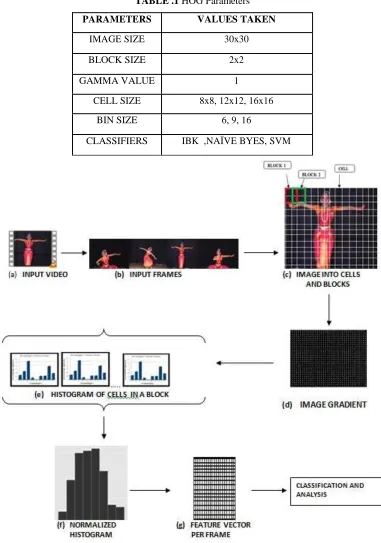
1861 | P a g e TABLE .1 HOG Parameters
PARAMETERS VALUES TAKEN
IMAGE SIZE 30x30 BLOCK SIZE 2x2 GAMMA VALUE 1
CELL SIZE 8x8, 12x12, 16x16 BIN SIZE 6, 9, 16
CLASSIFIERS IBK ,NAÏVE BYES, SVM
Fig. 2 STEPS TO CALCULATE HOG
IV. EXPERIMENTATION AND RESULTS
The overall system performance depends on value of parameters or factors mentioned in Table 2. To understand the influence of 3 different independent variables with each variable having 3 set values (level values). The
number of experimental run required for 3 factors with 3 levels is 27 in a full factorial design. While using
1862 | P a g e
combination of control factors. To maximizethe outcome „Larger is Better‟ is chosen and is given by Equation (1). The variation of levels foreach factor is listed in Table 2.
S/N = -10 log10(Mean of Sum of Square of Reciprocal of Measured Data ) (1)
Table 2. Variation of Parameters (3 Factors x 3 Level)
Factors Parameter Levels
1 2 3
A Cell Size [8x8] [12x12] [16x16]
B Bin Size 6 9 12
C Classifier IBK NB SVM
No. of Runs Required in FF design= 27
No. of Runs in Taguchi Design= 9 using L9 orthogonal array
Table 3 L-9 Orthogonal Array
Run Cell Size Bin Size (B) Classifier Accuracy Size Time
(A) (C) (%) (sec)
1 [8x8] 6 IBK 97.92 865 2.77
2 [8x8] 6 NB 82.62 385 .95
3 [8x8] 6 SVM 91.96 97 6.82
4 [12x12] 9 IBK 97.92 1297 2.98
5 [12x12] 9 NB 83.23 577 9.02
6 [12x12] 9 SVM 95.07 145 8.63
7 [16x16] 12 SVM 97.92 1729 49.59
8 [16x16] 12 IBK 78.45 49 .01
9 [16x16] 12 NB 83.61 193 .14
Confirmation [8x8] 9 SVM 99.39 1297 41.81
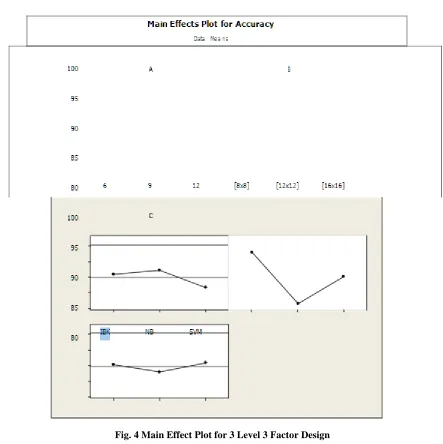
1863 | P a g e Fig. 4 Main Effect Plot for 3 Level 3 Factor Design
Taguchi analysis calculates the Rank of each factor on basis of Delta value. In this experiment Bin Size is placed at Rank 1, followed by choice of classifier and cell size is at Rank 3. Therefore, it can be concluded that the Bin Size is important as compared to the Classifier and Cell size as can be seen in main effect plot for accuracy in Fig.3. Weka software is used for classification. System performance SVM, IBK and NB is analysed. Table .3 shows the accuracy of different classifiers corresponding to Bin size 9, Cell Size [8x8] and SVM gives are the best set of values .Maximum accuracy comes 99.39% as seen in confirmation run.
Taguchi Analysis: Accuracy versus Cell Size, Bin Size, Classifier
Factors: 3
Runs: 9
Columns of L9 (3**4) Array
1 2 3
Response Table for Signal to Noise Ratios
1864 | P a g e Level A B C
1 17.04 20.29 17.22
2 17.74 15.14 15.72
3 16.97 16.33 18.80
Delta 0.78 5.15 3.08
Rank312
V. CONCLUSION AND FUTURE WORK
Indian classical dance recognition system has been designed based on Human activity recognition. 9 Bharatanatyam videos [16] are considered to extract 50 different dance steps. SVM gives the maximum accuracy for the set of HOG parameters selected using Taguchi analysis. The work can be extended to include more complex datasets, subject variations, number of poses, complex background and further classifying the sequence of steps rather than a stand alone step. Recognition of complex actions and automatic removal of redundant frames in a video is a major challenge in this field.
REFRENCES
[1] J. Lin, Y. Ding, A Temporal Hand Gesture Recognition System Using HOG And Motion Trajectory ,
Optik - International Journal for Light and Electron Optics Vol. 124, (24), pp. 6795-6798, 2013.
[2] H. Hasan, S.Abdul-Kareem, Static Hand Gesture Recognition Using Neural Networks, Journal -Artificial Intelligence Review, Vol. 41, (2), pp 147–181, 2014.
[3] Bharatanatyam dance: http://www.culturalindia.net
[4] D. K. Vishwakarma , R. Kapoor , Unified Frame Work for Human Activity Recognition using Spatial Edge and R transform, 29th IEEE Conference on Pattern Recognition, pp 341-353, 2016.
[5] A.J. Apiraksa, W. Pongstiensak, T. Konda, Simple Shaped Based Approach to Hand Gesture Recognition, Electronics Computer Telecommunication and Information Technology International Conference, pp 851-855, 2010.
[6] S.Kake , N.J. Uke, Niraja Jain, Real Time Human Detection Using HOG Features as Human Descriptors and Variable Size Sliding Window, Advances in Computer Science and Information Technology, Vol. 1, pp. 27-29, 2014.
[7] M. R. Amer, S. Todorovic, Sum Product Network for Activity Recognition, IEEE Conference on Pattern Analysis and Machine learning, pp 800-813, 2016.
[8] Ciptadi , J. M. Rehg, Minimizing Human Efforts in Interactive Tracking by Incremental Learning of model parameters, IEEE International Conference on Computer Vision, pp 4382-4390, 2015. [9] J. Moon, Y. Kwon, K. Kang, Action Net-VE Dataset-A dataset for describing visual events by
extending VIRAT 2.0, IEEE International Conference on signal processing, image processing and pattern recognition, pp 1-4, 2015.
1865 | P a g e
[11] M. Khodabandeh, A. Vahdat, G. Zhou, Discovering Human Interactions in Video IEEE Conference on Computer Vision and Pattern Recognition, pp 9-18, 2015.
[12] N Dalal , B. Triggs, Histogram of Oriented Gradient for Human Detection in CVPR, Vol. 1, pp 886-893,2005.
[13] Matt Davis, FeratSahin, Hog feature human detection system- Systems Man Cybernetics (SMC), IEEE International Conference, pp 002878 – 002883, 2016.
[14] Xiaoyu Wang ,Tony X .Han , Shuicheng Yan , An hog –LBP human detector with partial occlusion handling, IEEE 12th International conference on computer vision .
[15] N. H. Dardas , N. D. Georgans, Real Time Hand Gesture Recognition Using Bag-of-Features and SVM, IEEE transaction on instrumentation and measurement, pp 3592-3567, 2016.