1353 | P a g e
Comparative Evaluation of Deep Architectures for Face
Recognition in Unconstrained Environment (FRUE)
Deeksha Gupta
Department of Computer Science and Applications, MCM DAV College for Women, Chandigarh, (India)
ABSTRACT
Face recognition is one of the most reliable and popular recognition schemes under biometric systems. Face recognition methods perform well on the dataset where all face images are carefully collected and are frontal and free from noise. But for face images suffering from change in illumination, brightness, background, expression, pose etc., the face recognition becomes a challenging task. Deep learning has carved a niche in developing artificial intelligence based applications by providing high quality results. Three most important requirements for a reliable Deep learning based Face recognition system is large training dataset of face images, an effective training procedure and a powerful validation mechanism. In this paper current state of art deep architectures for face recognition are investigated and evaluated. This paper also specifies various training and testing datasets for face recognition with their availability.
Keywords: Face Recognition, Deep Learning, Convolutional Neural Network
I. INTRODUCTION
Face recognition is a technique in which computers are used for the analysis of the face to distinguish the
biological features. It is one of the most fast growing areas of research in image processing and computer vision
due to its numerous real time applications. Its wide range of applications include security system, access control,
Surveillance, image database investigations, entertainment, social websites ,mobile applications and Pervasive
Computing[1]. Though face recognition is the basic ability of human beings to identify and recognize human
faces but it is a difficult problem for computers to identify and verify faces especially in unconstrained
environment. The reason behind intricacy is large variation in the face expression, illumination, background,
brightness, partial occlusion, alignment of camera, pose and facial change due to aging of the person. In spite of
major recent advances in the field of face recognition it is always a challenge to meet human being recognition
potential in case of unconstrained conditions.
Nowadays the researcher‟s focus in face recognition research has moved from traditional face recognition
systems based on geometric characteristics or statistical characteristics like PCA and LDA based algorithms to
deep learning[2]. Deep learning application has already shown its success in various fields like speech
recognition, natural language processing, object detection and identification and many more. Deep learning
facilitates a general purpose learning procedure to learn highly distinctive features automatically. The biggest
command of deep learning is its capacity to classify the given data with high accuracy and deriving generic
1354 | P a g e variations like illumination, orientation, brightness and background. Deep learning, also known as, Deep
Convolutional Neural Networks (DCNN) are biologically inspired improvement over multilayer perceptron
neural networks (MLPNN)[3].Although, deep networks are much harder to train as compared to simple neural
network but outperform the later.
This paper includes extensive evaluation and comparison of various DCNN architecture devised for Face
Recognition in Unconstrained Environments (FRUE). Section 2 of the paper specifies the various popular
training and testing face images datasets, section 3 covers methodology behind face recognition using Deep
Learning , section 4 represents various state of art Deep architectures for face recognition and section 5 contains
the extensive evaluation Deep Learning based FR systems.
II. TRAINING AND TESTING DATA SETS
DCNN approach is a data driven approach. Larger training set makes training of DCNN a very time consuming
affair but results in better face recognition performance. An effective training and testing dataset for FR systems
should be generalized to unconstrained environment. The face images of dataset should be rich in variations in
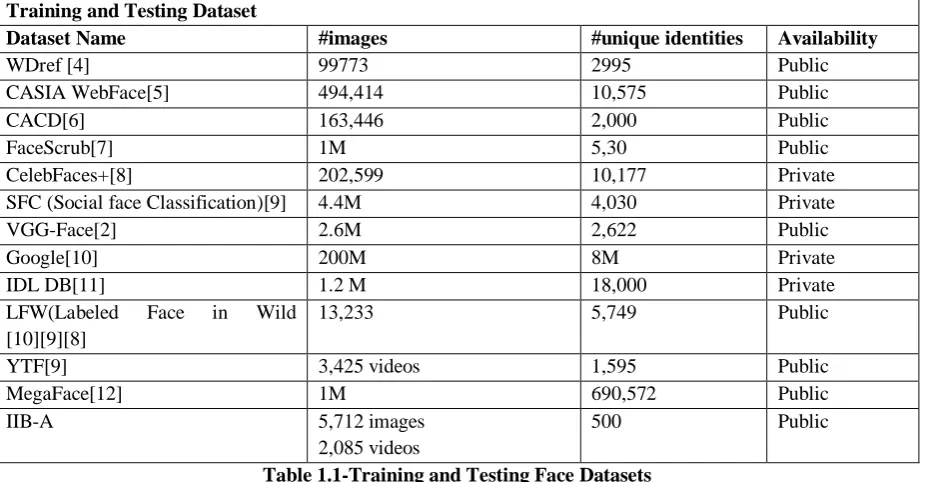
pose, expression, illumination, brightness, position of camera etc. Various popular training and testing dataset
with their credentials are given in Table 1.1.
Table 1.1-Training and Testing Face Datasets
For face recognition, DCNN is trained against all the images in dataset. Feature vector is extracted for all the
images of training dataset and stored in database. The various parameters used for training of DCNN are
adjusted using back propagation and appropriate optimization technique.
III. METHODOLOGY
Face recognition system is a multistage process. Broadly classified, the various stages of FR system include
image preprocessing, feature extraction, image classification followed by face verification shown in Fig. 1. In
Training and Testing Dataset
Dataset Name #images #unique identities Availability
WDref [4] 99773 2995 Public
CASIA WebFace[5] 494,414 10,575 Public
CACD[6] 163,446 2,000 Public
FaceScrub[7] 1M 5,30 Public
CelebFaces+[8] 202,599 10,177 Private
SFC (Social face Classification)[9] 4.4M 4,030 Private
VGG-Face[2] 2.6M 2,622 Public
Google[10] 200M 8M Private
IDL DB[11] 1.2 M 18,000 Private
LFW(Labeled Face in Wild [10][9][8]
13,233 5,749 Public
YTF[9] 3,425 videos 1,595 Public
MegaFace[12] 1M 690,572 Public
IIB-A 5,712 images
2,085 videos
1355 | P a g e Deep learning based Face recognition the feature extraction and image classification is performs using Deep
Convolutional Neural Network whereas image processing may include deep learning based procedures.
Figure 1: multi-stage Face recognition process
3.1 Image Preprocessing
This is the first step of any face recognition system. In this step the image is made ready for image
representation. This stage has three basic components: Face detection followed by Image cropping and Face
alignment.
3.1.1 Face detection
Face detection or face localization is the first most step of image preprocessing. Some Face Recognition systems don‟t need face detection because the images in training dataset are already in normalized form. However,
Algorithms used for face recognition in unconstrained environment require to perform face detection. Face
detection includes identification of sub-regions in image containing face, ignoring the background and other
objects in the image and enclosing such sub-regions in bounding box. Face detection algorithms also perform
face normalization for further effective face analysis of image[13]. Face normalization deals with elimination of
irrelevant information for face identification. It includes the removal of noise, illumination, brightness from
image as well as normalizing the face image size. The performance of face detection method is measured in
terms of detection rate and false alarm. Face detection methods can be either sub space based or feature base
methods[10] [13]. But in case of face detection in unconstrained environment sub-space based and features
based methods fail to confine the discriminative information whereas CNN based detection algorithms are
providing good results. So overcoming from this limitation of traditional face detection methods, in past decade
CNN based face detection models [14] [15] [16] are getting more popularity.
3.1.2 Face Alignment
After face detection face alignment is performed, where the required 2D or 3D transformations are performed
on face image depending upon the requirement of deep model architecture. The vital requirement of face
alignment process is to localize the characteristic fiducial Points (two eyes, nose and mouth corners) in the
cropped face image, so that transformation can be done corresponding to the localized positions.
Schroff et. al [10] proposed FR system where no or little 2D transformation is required. FR methods given by Wang [8] and Liu [11] perform 2D affine transformation for face image alignment. Taigman et. al [9] proposed method performs both 2D and 3D affine transformations to generate 3D frontal view model of face for further
processing.
1356 | P a g e It is the second stage of face recognition system which includes extraction of sophisticated features from
preprocessed image. In deep learning the bottom layers are used to extract low level features from the image like
presence of edges, corner, texture and moving towards top layers the high level features like position and size of
face, nose, eyes mouth etc are mined from low level output features of previous layers. The subsequent
convolutional layer combines the features of previous layer using formula given below:
xi= ith input map, yj=jth output map, kij=convolutional kernel between map i and j, bj=bias of jth output map. Various filters like sobel operator[17], Gaussian filter[9], Gabor filters[10], Haar filter[16] are used to extract
features from image. These extracted features are represented in the form of feature vector. As architecture
moves from bottom layers to top layers the dimension of feature vectors is reduced intentionally to reduce the
computational cost.
3.3 Classification
This stage is responsible to label the image with the corresponding class with some tolerance error rate. At this
stage the features extracted at image representation stage are used to classify the image. Here the high
dimensional image feature vector is down sampled to low dimensional sophisticated feature vector and using
fully connected layer with classifier the aim is achieved. One to many image mapping is performed to find the
corresponding class for the input image. The various classifiers available are SVM[9][10], Softmax[5][9] [8]etc.
3.4 Face Verification
Face verification is second paradigm of face recognition system. Face verification ensure that two input images
of same identity should fall under same class. Under face verification one to one image mapping is done. Metric
learning method is used to verify the face with the face image database. Weighted Chi square[9], Joint
Bayesian[8][14],Triplet loss based on L2 distance[10], cosine function[5] are some example of metric learning
methods that can be used for verification. Verification methods are independent on feature extraction procedures
and can process both hand crafted and CNN learned features.
IV. DEEP ARCHITECTURES FOR FACE RECOGNITION
4.1 Deepface
Taigman et. al [9] proposed method where the 3D aligned face images are generated to cope up with out of plane rotations, using multi stage approach, to train the DCNN against large dataset SFC. In [9], First, the input
image is cropped to face followed by 2D transformations. After performing 2D alignment, 3D affine
transformations are done to produce 3D aligned front face view using 3D analytical model. The resulting 3D
align images are given as input to DNN. The DNN has 8 layers architecture. In this architecture after 3 layers of
interleaved convolutional layer and pooling layer, three locally connected layers are used followed by 3 fully
connected layers. The purpose of locally connected layers is to generate efficiently the high level features
without adding to the computations. In [9], The most of the generated features are sparse due to application of
nonlinear Function ReLU after every convolutional layer, Local connected layer and fully connected layer and
1357 | P a g e using back propagation and updating the parameters by SGD. K-way softmax classifier (k is no. of classes) is
used for classification after the last layer of architecture. The author tested the proposed system against LFW
and obtained remarkable performance (97.35%).
4.2 DeepId
Wang [8], proposed CNN based face recognition architecture, named as Deep hidden IDentity (DeepID),
consists of network fusion of CNNs. In Wang [8] face recognition approach, During preprocessing stage the
face images are aligned across 5 fiducial points(center of 2 eyes, mouth corners, nose tip) using 2 D
transformations. Then the input image is segmented into 60 patches to extract different features from different
parts of face image. Each patch is of size 31X31X1 or 39X31X1. These patches are given as input to DCNN.
The network architecture is made up of 9 layers. First seven layer are interleaved convolutional layer and
pooling layers. The eighth layer is DeepID layer and last layer is Softmax layer. The length of output feature
vector is reduced to 160 at fully connected deepID layer so that only very high level, compact and
discriminative features can be used for classification and irrelevant variations can be suppressed. The DeepID
feature is obtained by combining DeepId layer output feature of all networked CNN. For training of network
SGD (Stochastic Gradient Descent) method is used with gradient calculated by back propagation method. For
similarity metric learning Joint Bayesian method is implemented.
Successors of DeepId named DeepId2[18], DeepId2+ [19], DeepId3[20] were developed to improve the
performance. Instead of using only identification information for DCNN training DeepID2 applies both
identification and verification signals for training of DCNN[18]. DeepId2+ further improves performance by
using much larger training set (combination of CelebFaces+ and WDRef datasets), increasing the no. of filters
and including Fully connect layer at early with supervisory information [19]. The latest version DeepId3 has
even more denser CNN network and outperforms its predecessors.
4.3 FaceNet[10]
This face recognition method is produced by Google research group. In this approach training images are
thumbnail that are cropped to face area, so no 2D or 3D transformation is required. This dense architecture has
22 layers. Along with convolutional layer, pooling layer, Fully connect layer, DCCN also contains local
Normalization layers to perform normalization over local input regions. Normalization layer works on the
volume of the input map vector. 140 M parameters are required for training of DCNN. DCNN generates 128D
embedding (Euclidean distance) for image representation by using triplet loss function. The triplet selection is
the most crucial component of this Face recognition system. A triplet consists of group of three face images
where two images are of same person and one image of different identity. The triplet selection is done by using
data mining techniques. Euclidean distance of images is generated such that the same identity images have less
distance than that of different identity image. Unlike [8], only one CNN is implemented and Support Vector
Machine classification function is used for mapping of input image to its corresponding class.
4.4 VGG Net FR
Parkhi et. al. [2] proposed a face recognition system that utilized VGG net model for designing the architecture.
1358 | P a g e continuous convolution layer jointly are used to extract complex features. Normalization and ReLu
implementations speed up the training of CNN. The contiguous convolution layers are used with small size
kernel to reduce no. of parameter and hence the computational cost. Inspired from Schroff et. al.[10] , VGG Net
FR has very deep CNN architecture and uses triplet loss based metric learning method. CNN is trained by
optimizing the multinomial logistic regression using SGD (Stochastic Gradient Descent). Softmax log function
is implemented for classification and L2 based metric learning method is used for face verification.
4.5 Webface
Dong et. al. [5] proposed another CNN based face recognition architecture, referred to as WebFace.The work in [5] includes collection of face image database containing around 494,414 images of 10,575 unique identities,
which is made publicaly available, and training CNN for the collected database. Webface uses a much deeper
CNN architecture and multiple loss functions.It has 17 layers architecture , having 10 convolutional layer, 5
pooling layer and 3 fully connected layers. inspired from VGG model [2], Dong et. al. [5] designed architecture
uses 3X3 sized kernels to cope up with complexity of network. Like Wang [8], Webface also combines softmax
identification and Contrastive verification loss functions as objective function.
V. EVALUATION
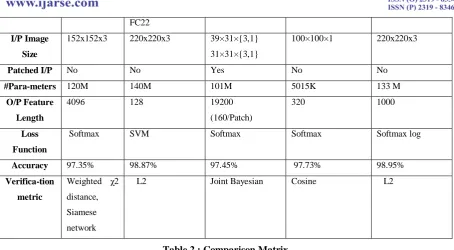
Above investigated deep architectures are evaluated on the basis of various factors related to underlying deep
architecture and its training. These factors include training dataset used, required image alignment before CNN
training, number of layers in underlying deep architecture, different layers with sequence in the architectures,
input image size, patch fusion , no. of parameters required for training, length of output feature produced at last
layer for driving classification, classifier used, accuracy obtained on LFW and metric learning method adopted
for verification .
Deepface FaceNet DeepID CASIA/webface VGG Net
Training
Dataset
SFC Google CelebFace+ CASIA WebFace VGG Face
Alignment 2D and 3D
affine
Transformatio
n
No alignment 2D
Transformations
2D Transformations 2D
#Layers 8 22 9 17 21
Architec-ture
Layers*
C1P2C3
L4L5
L6FC7
FC8
C1P2N3C4
CP5N6P7C
8
CP9p10C11
CP12C13C
P14C15P16
P17CC18C19
FC20FC21
C1P2C3P4
C5P6C7
DeepID8 FC9
C1C2P3C4
C5P6C7
C8P9C10 C11P12C13
C14P15FC16
FC17
C1C2P3C4
C5P6C7
C8C9P10 C11
C12C13P1
4C15C16
C17P18FC19
1359 | P a g e FC22
I/P Image
Size
152x152x3 220x220x3 39×31×{3,1}
31×31×{3,1}
100×100×1 220x220x3
Patched I/P No No Yes No No
#Para-meters 120M 140M 101M 5015K 133 M
O/P Feature
Length
4096 128 19200
(160/Patch)
320 1000
Loss
Function
Softmax SVM Softmax Softmax Softmax log
Accuracy 97.35% 98.87% 97.45% 97.73% 98.95%
Verifica-tion
metric
Weighted χ2
distance,
Siamese
network
L2 Joint Bayesian Cosine L2
Table 2 : Comparison Matrix
*Layers : C-Convolutional Layer followed by ReLu, Cp-Cross Channel Pooling Layer (network in network
layer), P- Pooling Layer, N-Normalization Layer, L-Local Connected Layer, FC- Fully Connected Layer,
CC-Concatenation Layer
VI. CONCLUSION
Deep learning has become breakthrough in face recognition. Deep Convolutional Neural Networks have shown
tremendous reduction in the face recognition error rate due to their capability of learning from a very large
training data set like SFC, LFW(Labeled Faces in Wild benchmark) and YTF (YouTube Face Dataset)[10]
especially for face recognition in unconstrained environments (FRUE).
In this paper an extensive survey of various Deep learning based architectures for face recognition is given.
Along with the architecture details of various methods their comparison is done on various factors like no. of
parameters, feature length generated and their performance.
Although DCNN are performing very well in face recognition, there are some aspects of DCNN that require
further investigation, as during training and testing DCNN requires large memory to store parameters and high
time for implementation. Although SGD algorithms are performing very well with GPU based implementation
but still some more effective, fast and scalable algorithms are required to develop.
Deep learning methods need to handle very large no. of input- outputs nodes, parameters and hyper-parameter
(no. of layers, learning rate, kernel size, stride, padding size etc.). All these parameters and hyper parameters are
internally related. So it is quite difficult to adjust them together. So improved optimization techniques need to be
design to make training of Deep Convolutional Neural Network easier.
REFERENCES
1360 | P a g e [2] O. M. Parkhi, A. Vedaldi, and A. Zisserman, “Deep Face Recognition,” no. Section 3, 2015.
[3] H. Shimodaira, “Multi-Layer Neural Networks,” pp. 2–4, 2015.
[4] D. Chen, X. Cao, L. Wang, F. Wen, and J. Sun, “Supplemental material for „ Bayesian Face Revisited : A Joint Formulation ,‟” no. 2, pp. 1–5.
[5] D. Yi, Z. Lei, S. Liao, and S. Z. Li, “Learning Face Representation from Scratch.”
[6] B. C. Chen, C. S. Chen, and W. H. Hsu, “Cross-age reference coding for age-invariant face recognition and
retrieval,” Lect. Notes Comput. Sci. (including Subser. Lect. Notes Artif. Intell. Lect. Notes
Bioinformatics), vol. 8694 LNCS, no. PART 6, pp. 768–783, 2014.
[7] H. W. Ng and S. Winkler, “A data-driven approach to cleaning large face datasets,” 2014 IEEE Int. Conf.
Image Process. ICIP 2014, pp. 343–347, 2014.
[8] X. Wang, “DeepID : Deep Learning for Face Recognition Machine Learning with Big Data.”
[9] Y. Taigman, M. A. Ranzato, T. Aviv, and M. Park, “DeepFace : Closing the Gap to Human-Level Performance in Face Verification.”
[10] F. Schroff, D. Kalenichenko, and J. Philbin, “FaceNet: A unified embedding for face recognition and clustering,” Proc. IEEE Comput. Soc. Conf. Comput. Vis. Pattern Recognit., vol. 07–12–June, pp. 815–
823, 2015.
[11] J. Liu, “Targeting Ultimate Accuracy : Face Recognition via Deep Embedding,” pp. 1–5.
[12] I. Kemelmacher-Shlizerman, S. Seitz, D. Miller, and E. Brossard, “The MegaFace Benchmark: 1 Million Faces for Recognition at Scale,” 2015.
[13] S. Duffner, “Face Image Analysis With Convolutional Neural Networks,” Thesis, p. 191, 2007.
[14] J.-C. Chen, R. Ranjan, A. Kumar, C.-H. Chen, V. M. Patel, and R. Chellappa, “An End-to-End System for Unconstrained Face Verification with Deep Convolutional Neural Networks,” 2015 IEEE Int. Conf.
Comput. Vis. Work., pp. 360–368, 2015.
[15] L. Huang, Y. Yang, Y. Deng, and Y. Yu, “DenseBox: Unifying Landmark Localization with End to End Object Detection,” pp. 1–13, 2015.
[16] P. Viola and M. Jones, “Rapid object detection using a boosted cascade of simple features,” Proc. 2001
IEEE Comput. Soc. Conf. Comput. Vis. Pattern Recognition. CVPR 2001, vol. 1, p. I-511-I-518, 2001. [17] W. Wang, J. Yang, J. Xiao, S. Li, and D. Zhou, “Face Recognition Based on Deep Learning,” vol. 8, no.
10, pp. 812–820, 2015.
[18] Y. Sun, X. Wang, and X. Tang, “Deep Learning Face Representation by Joint Identification-Verification,” pp. 1–9, 2014.
[19] Y. Sun, X. Wang, and X. Tang, “Deeply learned face representations are sparse, selective, and robust,”
Proc. IEEE Comput. Soc. Conf. Comput. Vis. Pattern Recognit., vol. 07–12–June, pp. 2892–2900, 2015. [20] X. Tang, “DeepID3: Face Recognition with Very Deep Neural Networks,” pp. 2–6.