Using CHIMERA detector at LNS for
gamma-particle coincidences
G. Cardella1, L. Acosta9, L. Auditore4, M.B. Chatterjiee8,
A. Castoldi7, E. De Filippo1, D. Dell’Aquila6, S. De Luca4,
B. Gnoffo1, C. Guazzoni7, L. Francalanza6, G. Lanzalone2,5, I. Lombardo6, N. Martorana2,3, S. Norella4, A. Pagano1,
E.V. Pagano2,3, M. Papa1, S. Pirrone1, G. Politi1,3, L. Quattrocchi4, F. Rizzo2,3, P. Russotto1, A. Trifir`o4,
M. Trimarchi4, G. Verde1 and M. Vigilante6
1 INFN, Sezione di Catania, Via S. Sofia, 95123 Catania, Italy 2 INFN - Laboratori Nazionali del Sud, Via S. Sofia, Catania, Italy
3 Dip. di Fisica e Astronomia, Universit`a di Catania, Via S. Sofia, Catania, Italy
4 INFN - Gruppo collegato di Messina, Dip. di Fisica, Universit`a di Messina, Italy
5 Facolt`a di Ingegneria e Architettura, Universit`a Kore, Enna, Italy 6 INFN, Sezione di Napoli, Dipartimento di Fisica,
Universit`a Federico II, Napoli, Italy
7 Politecnico di Milano, Dipartimento di Elettronica, Informazione e Bioingegneria and INFN, Sezione di Milano, Italy
8 Saha Institute for Nuclear Physics, Kolkata, India 9 Instituto de F´ısica, Universidad Nacional Autonoma de Mexico,
Mexico D.F. 0100, Mexico
Abstract
angular distributions. γ-particle coincidence measurements were also performed in reactions induced by neutron rich exotic beams produced through in-flight fragmentation at LNS. In recent experiments also the Farcos array was used to improve energy and angular resolution mea-surements of the detected charged particles. Results obtained with both stable and radioactive beams are reported.
1
Introduction
Relatively large yields of various neutron rich and poor exotic beams, of energy ranging from 20 to 50 MeV/A, are available at LNS [1], and in par-ticular we used 6,8He, 8,9Li, 10,11Be, 13B, 16,17C, 68Ni. In order to benefit of such beams with CHIMERA detector [2, 3] a tagging system [4] was de-veloped to identify event by event the isotopic composition of the produced exotic particles. This system was recently updated to allow trajectory mea-surement with a PPAC detector. To improve the energy and angular resolu-tion measurements of particles produced in reacresolu-tions induced by the exotic beams we used a prototype of the new FARCOS detection system under construction in Catania [5]. Moreover, as recently shown [6], it was possi-ble to extract further information on reaction mechanisms also by looking to γ-ray energy and angular distribution by using the CsI(Tl) detectors of the CHIMERA sphere (from 30o to 174o). This latter information will be of fundamental interest in one of the next experiments planned to be per-formed in CHIMERA, i.e. the study of isoscalar excitation of the PIGMY resonance on 68Ni [7]. In this paper we shortly describe in the next para-graph the production and identification of the fragmentation beam. In the last paragraph we summarize some of the recently published performances of our CsI(Tl) crystals when they are used as γ-ray detectors and some results concerning the coincidences between particles and γ-rays, together with future perspectives.
2
Beam production, and tagging system
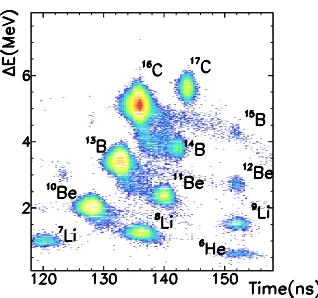
Figure 1: Identification scatter plot for the production of16C/10,11Be beams.
The tagging system is based on the use of a 32x32 strips double side silicon strip detector (DSSSD) measuring the energy loss of the impinging beam particles. The identification of the particles is achieved by combining this energy loss with the time of flight information (TOF). The start of this TOF measurement is provided by a large size micro-channel plate (MCP) [4] mounted 13 m away from the DSSSD. The stop is given by the signal delivered by the front strips of the DSSSD.
An example of the obtained identification scatter plot is shown in fig.1 for the production of16C and10,11Be by the fragmentation of18O 55 AMeV primary beam. To measure trajectories we have installed, at the entrance of the CHIMERA sphere, a PPAC position sensitive detector. The position information provided by DSSSD and PPAC allows to extract the beam tra-jectory. This is a basic measurement to sketch the beam profile at the target position during the beam commissioning phase.
3
Gamma ray detection
Figure 2: γ-ray spectrum detected in CHIMERA CsI(Tl) in coincidence with proton from elastic scattering on carbon target (filled spectrum), and in coincidence with proton from inelastic scattering leaving the carbon excited at the 4.44 MeV level (empty spectrum).
of the 4.44 MeV level is reported. The angular distribution is described by the formulasin2(2θ)+cost as it is expected, for quadrupole decay, in case of proton spin-flip events [6]. Similar results were obtained for all investigated energies, more details can be found in ref. [6]. A pure sin2(2θ) behavior is obtained using a zero spin projectile as16O.
Figure 3: Center of mass angular distributions of γ-ray from the decay of 12C4.44 populated at different proton beam energies.
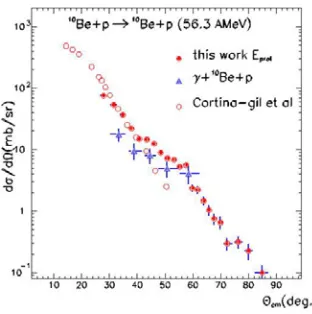
Figure 4: Center of mass angular distributions measured for the reaction10Be+p, see text.
mea-sured for the reaction 10Be+p at 56 A.MeV. This angular distribution was extracted with the kinematical coincidence method that we have recently developed [8]. Comparing such angular distribution with the one measured in the past by Cortina-Gil [9] with SPEG (open dots), we note that our data have the same behavior of those obtained with spectrometer up to about 35o. At larger angles we observe a change in the slope of the angular distribu-tion. This is due to the contribution of inelastic channels that cannot be discriminated by the elastic one in our data, due to the resolution of our CsI(Tl) detector. This effect is shown by the inelastic angular distribution (blue triangles) obtained measuring in coincidence withγ-ray the couples of proton and 10Be.
Further work is in progress to improve the energy resolution of CsI(Tl) detectors by using the new GET electronics [10]. The new electronics will also add new trigger capabilities for the CsI(Tl) stage that at present time is not available with standard DAC of CHIMERA, where the main trigger is given by electronic signals delivered by silicon detectors.
References
[1] see http://fribs.lns.infn.it/upgrade-results.html
[2] A.Pagano et al Nucl.Phys. A 734 (2004) 504 and ref. therein
[3] A.Pagano, Nuclear Physics News International, 22:1(2012)25
[4] I. Lombardo et al Nucl.Phys.B (Proc.Suppl.) 215(2011)272
[5] G.Verde et al Journ. of Phys.: Conf. Ser. 420 (2013) 012158;
E.Pagano et al proceedings of this conference; Technical design report -TDR/INFN for the farcos project (https://192.84.151.50/joomla/)
[6] G.Cardella et al NIMA 799(2015)64
[7] E. G. Lanza, A. Vitturi, M. V. Andres, F. Catara and D. Gambacurta, Phys. Rev. C 84, 064602 (2011)
[8] L.Acosta et al NIM A 715 (2013) 56
[9] Cortina-Gil et al Phys.Lett.b 401(1997)9