J. Phys. F : Metal Phyz., 1971. Vol. 1. Printed in Great Britain
Theory of regular arrays of defects:
The void lattice
A. M. STONEHAM
Theoretical Physics Division. AERE. Harwell. UK
M S . received 4ih Julie 197 1
Abstract. Detects in crystals may form a regular array. rather than a random distribu- tion. The lattice of voids produced in irradiated molybdenum is a remarkable example ofthis. We give a general method of calculating the energy per defect in the array which exploits the periodicity of the defect lattice. The existence of the void lattice depends on the elastic interaction between voids. The present approach can treat both arbitrarily anisotropic elastic continua and discrete lattices. and is readily extended to discuss the stability of the defect lattice. The results predict that a void lattice should occur in molybdenum. and compare a number of models for the void. Stability against shear of the void lattice is not discussed in the present paper. The ratio of the void lattice spacing to void radius predicted is 2 . 2 to 4.5 and is smaller than the \ d u e of about 10 observed. The results are in general agreement with the more approximate Malen-Bullough treatment.
1. Introduction
The voids produced in the irradiation of high purity molybdenum are found to form a regular array. This 'void lattice' has been observed under nitrogen ion irradiation (Evans 1971) and neutron irradiation (Eyre 1971 private communication). Both the void lattice and that of the host are bcc. and they have the same axes. T pically the voids are a few tens ofA in radius and are separated by one or two hundred
K
. The arrays can be regular
over regions as large as microns across. Thus they form a most remarkable natural lattice, almost macroscopic in scale.The major interaction between voids comes from the elastic strain fields around the voids. Malen and Bullough (1971) have argued very clearly that the (cubic) anisotropic elasticity of the host lattice is a major factor in making the void lattice. On the one hand, the anisotropy shows directly in the observed stability of the void lattice crystal axes which are parallel to those of the host. On the other hand, the interaction between two voids in an isotropic elastic medium is always attractive (Willis and Bullough 1969). so the anisotropy appears to be essential in giving the repulsive terms which keep the void spacing from becoming small. Exactly the same arguments suggest that the cubic (rather than isotropic) point symmetry of the voids themselves is important.
Malen and Bullough (1971) gave the basic theory of the phenomenon, and our analysis will make several similar assumptions. Thus the voids are represented by an array of body forces in an elastically anisotropic host crystal. and an aim of the calculation is to find the spacing of the void lattice in terms of the properties of the isolated void and of the perfect host lattice. However. the details of the calculation are quite different. Whereas Malen and Bullough calculated the interaction between two voids initially. and then summed these interactions over the lattice. the present treatment goes directly to the energy of the array of voids. This leads to some simplifications, and to the removal of certain approximations such as multipole expansions and truncation of lattice sums. Further, some m a e compli- cated effects can be treated. such as recognising the atomic structure of the host lattice, the inclusion of phonon dispersion. and the possibility of treating highly anisotropic crystals. Thus. whilst the physical basis of the problem is essentially identical with the Malen- Bullough model. the analysis is totally different.
The changes in method follow from one feature in particular : it is recognized from the start that the voids form a regular lattice.
We calculate the energy per void in that lattice directly. The approach is outlined in 0 2 , and the results are analysed in
8
3, where the comparison with the Malen-Bullough work is given in detail.2. Theory of the void lattice
2.1. T h e energy per void in the array
ments x of the various lattice atoms :
The energy of the distorted host lattice, containing no voids, is quadratic in the displace- (1) The force-constant matrix is A, and the lattice is assumed harmonic. The effect of the defects is represented by body-forces F, which give an extra term in the energy
&(X) =
-
F . X. ( 2 )Any effects of the applied forces on the force-constant matrix are ignored : we consider the response of the perfect lattice, rather than the imperfect lattice, to these forces. This is equivalent to the use of the simple inclusion model by Malen and Bullough.
The lattice configuration which minimizes the total energy is easily found from the equilibrium equation
EL(x) = EL(0)
+
+ x . A . X.giving
x = A - ' . F. (4)
Clearly A- is just the Green function of elasticity theory, although slightly generali~ed t o be valid for a discrete lattice. The change in total energy can also be found. Writing A - ' G , the Green function
AE = - i F . G . F. ( 5 )
This energy is the sum of a decrease in ED and an increase in the strain energy EL. In treating a periodic array of defects, it is useful to Fourier transform these expressions, so that the periodicity becomes explicit. Thus the direct-space forces F(n and Green function G(1
-
l'), which refer to specific sites I and l', are replaced by their transformsG ( q ) =
1
G(I - I ) exp { - i q . ( I-
I)}
1 - 1 '
1
G ( I -
I) = , z G ( q ) e x p { i q . ( l - l')}4
The sums over q are over the first Brillouin zone. The change in total energy is
( 7 )
The sum is a finite sum if the forces in real space, F(I), are applied in a regular periodic array. If the voids lie on a lattice we may find the strain energy per void by simply evaluating
780 A . M . Stoneham
the finite sum. This simplicity comes from an exploitation of the periodicity of the defect lattice.
The method described is very similar to Kanzaki’s (1957) treatment of isolated defects. However, Kanzaki needed the approximation that the distortion near a single defect and the distortion near a defect in an array were the same. Here no such approximation is needed.
2.2. T h e defect forces
We now discuss the forces F ( f ) by which one of the defects is represented. In principle the forces should be chosen so that they give the correct displacements near an isolated void. However, large voids are usually highly faceted, rather than spherical, and it appears to be difficult to derive a unique set of forces. It is probable that a careful analysis of the
x ray scattering of the system would yield adequate results (cf Kanzaki 1957), but such data are not available. Instead we try a variety of force configurations with the appropraite cubic symmetry. The predictions based on these sets, or on combinations of them, can then be compared with experiment.
The different sets of forces representing a single void were all radial forces F applied at various positions on a sphere of radius R centred on the void. Four sets were chosen: simple cubic, acting along the (100) directions : body-centred cubic, acting along the (1 11) directions : face centred cubic, acting along the (1 10) directions, and spherical, in which a uniform pressure p E F l R 2 is applied over the sphere.
The change in energy involves F(q), the Fourier transform of the forces. The components of
i?
can be written in the general formF.(q) = (2iRF’) vq,+,(q) (9)
where v is a numerical factor. The various functions
4,
and v are given below, where we have chosen +,(O) = 1 for normalization andSimple cubic: v = 1
Body centred: v = 4
Face centred: v = 4
sin Q,
Q,
4,
=-4n Spherical: v = -
3
So far we have considered the forces appropriate to a single void. When there is an array of voids only the forces F ( q ) for which q is a reciprocal lattice vector of the void lattice are relevant. We consider this lattice shortly. One result can be seen directly, and proves useful in checking numerical work : the void lattice parameter and the void radius can be chosen so that the forces from the different voids cancel exactly. This would correspond to voids touching each other-an unphysical situation, but a useful check. Thus for simple-cubic forces we need Q,/z to be integral, for example. There is no simple condition in the spherical case.
2.3. T h e Reciprocal Lattice
other possible defect lattice configurations. We assume that there is one void for every n3
atoms. Thus, if the atoms in the perfect crystal are at sites r f , then the voids are at sites ntj.
ignoring the change in lattice parameter due to the voids. In the same way, if the reciprocal lattice points for the perfect host lattice are qr, then those for the void lattice are qJn. As
the void lattice spacing increases. its reciprocal lattice points get closer together. The finite sum for AE is over n3 points in the first Brillouin zone of the host lattice, although symmetry can be used to simplify the sum greatly.
The shape and size of the Brillouin zone are determined by the structure of the host lattice. Our results only reduce to continuum elasticity when n is so large that the shape of the zone is not important. Thus our method goes beyond that of Malen and Bullough in that some geometric effects of the host lattice structure are included.
The reciprocal lattice for a bcc crystal is discussed by Smith (1961), for example. If the edge of the unit cube in the direct lattice is d, then the void reciprocal lattice points are
2TI nd
= - k
where
(k,
+
k ,+
k,) is an even integer. Ifk,
>
k ,>
k,,
then the edge of the Brillouin zone is the facek,
+
k,
= n.2.4. T h e Lattice Green function
The lattice Green function relates lattice displacements to applied body forces, as in (4). In principle G can be calculated when the microscopic force constants of the lattice are known. We shall use the Green function appropriate to the elastic continuum instead. This is our most important approximation.
The Fourier transform of the Green function,
8,
can be given analytically for an arbitrarily anisotropic cubic lattice (eg Dederichs and Leibfried 1969). In contrast, G can only be found by a variety of approximation techniques, such as a perturbation expansion in the anisotropy. Thus the use of the Fourier transform expression for AE, equation (8) has a great advantage over the direct space form (5).The perfect-lattice Green function G(q) can be expressed as follows
where the K i are the direction cosines (qiiq) of q, and
Li(q) = (1
+
SKj?)-’The dimensionless factors y and 6 depend only on the elastic constants
The anisotropy vanishes when 6 is zero. For molybdenum y = 2.60 and 6 = 0.8836. The sign of the anisotropy factor is important, and Malen and Bullough have argued a stable void lattice can only occur if 6 is positive.
One of the major errors in the use of the elastic Green function is that it ignores phonon dispersion : the velocity of sound for acoustic modes decreases at higher wave vectors. We have used a crude approximation to see if our results are sensitive to dispersion. This approximation consists of multiplying
d
by a factor proportional to (1+
E q 2 ) , where E is782
A . M . Stotieham2.5. Stability of the Lattice
The method described can easily be extended to examine the stability of the defect lattice against deformation. Since we are using the perfect lattice Green function. the simplest stability criteria (the signs of the elastic constants) can be treated in one of two ways. We may do the sum (8) over new wave vectors q, corresponding to the reciprocal lattice in the distorted configuration, or we may simply alter the point of application of the forces. This second approach is easiest, since the appropriate derivatives of the forces (and hence of terms in AE) can be obtained analytically. The stability criterion then merely requires a finite sum of the same form as A€. We defer discussion of stability against shear to a later paper.
3. Results
The finite sums in (8) are very simple to compute. We now turn to the fundamental questions : does the anisotropic elasticity model account for the void lattice. what is the dependence on the various parameters, and what are the implications?
3.1. Results for inolybdenuin
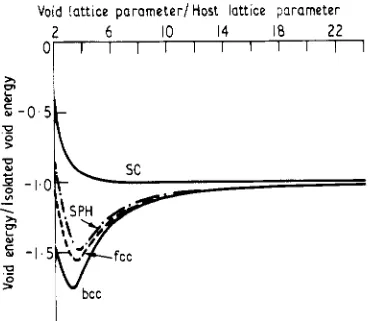
For molybdenum, the theory predicts that the energy per void is minimized for afinite separation of the voids when the bcc. fcc or spherical force arrays are used. For the simple cubic array there is no minimum : the energy per void decreases monotonically as the void separation increases (strictly, in this case, there are minima when the force arrays from neighbouring voids overlap, but even these unphysical solutions give a higher energy per void than infinite separation). Typical variations of void energies with separation are shown in figure 1. The spacing of the void lattice depends on the void ‘radius’, R, at which
Void lattice p a r a m e t e r / Host lattice parameter
:
:
Figure 1, Energy per void in a bcc void lattice as a function of the \ oid latticc spacing. Values are given for the four force arrays of s 2 . 2 . For ease of comparison we have taken the void radius equal to the cube edge of the host lattice unit cell. even though that means the bcc and fcc forces d o not act at lattice sites. The energies are normalized
to be equal when the void lattice spacing is very large.
the forces are applied, and on the choice of force array. The edge of the unit cube of the bcc void lattice.
D,
appears to the roughly proportional to the radius.!?
.
3.1 (bcc)R
Exact proportionality does not occur because of the implicit discreteness of the host lattice: R and D can only take certain discrete values, and the analytic value of R which minimizes :he energy expression need not correspond to one of these. However at larger R
the disciepancies become negligible. Malen and Bullough have observed the practical importance of a constant ratio D R. Phonon dispersion has no effect at all on D I R in the simple model of § 2.4. Thus a continuum model is probably adequate in the present case. The ratio of void lattice parameter to void radius also seems insensitive to the elastic anisotropy, suggesting that the lack of spherical symmetry of the voids is also an important factor. The fcc force-array model of the void shows the largest reduction in void spacing for a given reduction in anisotropy.
Slight increases in DiR can be achieved by taking combinations of force arrays, although the binding energy per void in the lattice is correspondingly reduced. Thus we find
DIR
-
4 5 for a combination of bcc and simple cubic arrays with opposite signs and with magnitudes chosen so that the long-range strain field vanishes.3.2. Comparison with experiment and with the Malen-hllough theory
There are too many unknowns to make a really useful comparison with experiment. It appears that ratio (DIR) observed is of order 10, rather than 2.2 to 45 predicted. There are three likely sources of the discrepancy. One is an inadequate choice of a force array: the arrays described in 42.2 were chosen purely for analytic convenience. A second is an inadequate choice of Green function: we have used a continuum Green function for the perfect lattice. This is probably the major error. The third possibility is that interactions which have been left out are important. These include the induced interaction. and effects from changes in the lattice modes involving anharmonicity. However, in an isotropic lattice these other forces tend to reduce DiR, rather than increase it.
The Malen-Bullough theory uses exactly the same approximations in setting up the model. In addition, they make some extra approximations in solving the model. These include a truncated multipole expansion in calculating the interaction between two voids, the truncation of certain poorly-convergent sums, and the use of the real-space Green function, which limits the method to small anisotropy. There is also no easy way of in- cluding the discreteness of the host lattice. or phonon dispersion, in their treatment. The advantage of their method is that one gains insight by having an explicit expression for the interaction between two voids. The two methods agree in almost all respects. They agree that the simple cubic forces do not give a stable lattice. and predict similar values for DIR.
Thus, for molybdenum at least, the final results are the same in both cases. 4. Conclusion
We have shown how the energy of a periodic array of defects in a crystal may be calcu- lated. The method exploits the periodicity so as to reduce the energy per defect to a finite sum of terms, and this sum can be evaluated easily both for elastic continua of arbitrary anisotropy and for a discrete host lattice. The method has been applied to various models of the void lattice in molybdenum, and largely confirms the more approximate results of Malen and Bullough. The method can also be extended to discuss the stability of the void lattice. The theory should also be applicable to other systems in which a periodic array of defects occurs.
Acknowledgments
I am indebted to Dr. K. Malen and D r R. Bullough for valuable discussions.
References
DEDERICHS. P. H. and LEIBFRIED. G . . 1969. Phys. Rev.. 188. 1175-83. EVANS. J. H.. 1971. Nature. 229. 403.
784 A . M . Stoneham
MALEN. K. and BULLOUGH. R.. 1971. Br. Nucl. Engng Cor$ Reading 1971. eds S. F. Pugh. M. H.
SMITH. R . A.. 1961. Wave Mechanics of Crystalline Solids. (Chapman and Hall). WILLIS. J . R. and BULLOUGH. R.. 1969. J. Nucl. Mater.. 32. 76-87.