Tight Private Circuits: Achieving Probing Security with
the Least Refreshing
Sonia Bela¨ıd1, Dahmun Goudarzi1,2, and Matthieu Rivain1 1
CryptoExperts, Paris, France
2 ENS, CNRS, INRIA and PSL Research University, Paris, France
{sonia.belaid,dahmun.goudarzi,matthieu.rivain}@cryptoexperts.com
Abstract. Masking is a common countermeasure to secure implementations against side-channel attacks. In 2003, Ishai, Sahai, and Wagner introduced a formal security
model, namedt-probing model, which is now widely used to theoretically reason on the
security of masked implementations. While many works have provided security proofs
for small masked components, calledgadgets, within this model, no formal method
al-lowed to securely compose gadgets with a tight number of shares (namely,t+ 1) until
recently. In 2016, Bartheet al.filled this gap withmaskComp, a tool checking the security
of masking schemes composed of several gadgets. This tool can achieve provable security with tight number of shares by inserting mask-refreshing gadgets at carefully selected locations. However the method is not tight in the sense that there exists some composi-tions of gadgets for which it cannot exhibit a flaw nor prove the security. As a result, it is overconservative and might insert more refresh gadgets than actually needed to ensure
t-probing security. In this paper, we exhibit the first tool, referred to as tightPROVE,
able to clearly state whether a shared circuit composed of standard gadgets (addition,
multiplication, and refresh) is t-probing secure or not. Given such a composition, our
tool either produces a probing-security proof (valid at any order) or exhibits a security
flaw that directly implies a probing attack at a given order. Compared to maskComp,
tightPROVEcan drastically reduce the number of required refresh gadgets to get a prob-ing security proof, and thus the randomness requirement for some secure shared circuits. We apply our method to a recent AES implementation secured with higher-order mask-ing in bitslice and we show that we can save all the refresh gadgets involved in the s-box layer, which results in an significant performance gain.
Keywords: Side-channel, Masking, Composition, Private Circuits
1
Introduction
Most cryptographic algorithms are assumed to be secure against the so-called black-box at-tacks, where the adversary is restricted to the knowledge of inputs and outputs to recover the secret key. However, the late nineties revealed a new class of attacks, referred to as
side-channel attacks, that exploit the physical leakages (e.g. temperature, power consumption) of
components which execute implementations of cryptographic algorithms. Many implementa-tions of symmetric cryptographic algorithms have been broken so far [16, 6], raising the need for concrete and efficient protection.
A sound and widely deployed approach to counteract side-channel attacks is the so-called
masking countermeasure that was simultaneously introduced in 1999 by Chari et al. [7] and
in dwhich makes the masking order a sound security parameter with respect to side-channel attacks.
In order to design masking schemes and theoretically reason on their security, the commu-nity has defined several leakage models. In the most realistic one, thenoisy leakage model intro-duced by Rivain and Prouff [18] as a specialization of theonly computation leaksmodel [17], the adversary gets a noisy function of each intermediate variable of the cryptographic computation. Unfortunately, this model is not very convenient to build security proofs as it requires complex mutual information computations. A second and widely used leakage model is the t-probing
model introduced by Ishai, Sahai, and Wagner [14] in which the adversary gets the exact values
of t chosen intermediate variables. As it manipulates exact values in a limited quantity, this model is advantageously much more convenient for security proofs. In order to benefit from the advantages of both models, Duc, Dziembowski, and Faust demonstrated in [11] a reduction from the noisy leakage model to thet-probing model. In a nutshell, an implementation that is secure in thet-probing model is also secure in the more realistic noisy leakage model for some level of noise.
In their seminal work [14], Ishaiet al.proposed at-probing secure masking scheme for any circuit based ond= 2t+ 1 shares. This scheme was extended by Rivain and Prouff in [19] with the aim to derive a tightt-probing secure implementation of AES, wheretightness means that thet-probing security is obtained with the optimal number ofd=t+ 1 shares. In particular, they show that the so-called ISW multiplication gadget actually achieves tight probing security provided that the two input sharings are mutually independent. In order to obtain tight security for the full AES circuit, Rivain and Prouff suggested to insert refresh gadgets that renew the randomness of sharings at carefully chosen locations [19]. But the proposed refresh gadget was shown to introduce a flaw in the composition [9]. In 2016, Bartheet al.introduced new security notions to fill this gap, namely the t-non interference and the t-strong non interference [2]. When these notions are met by a set of gadgets, one can easily reason on the probing security of their composition. Informally, a gadget is t-non interfering (or t-NI) if and only if any set of at most t intermediate variables can be perfectly simulated with at most t shares of each input. Since t input shares are trivially independent from the input itself as long as t < d, non-interference trivially implies probing security. While this notion was first defined in [2], it was actually already met by most existing gadgets. One step further, a gadget ist-strong non interfering (or t-SNI) if and only if any set of t intermediate variables among which tout are output variables can be perfectly simulated with tint=t−tout shares of each input sharing. This property makes it possible to compose any set of SNI gadgets since it stops the propagation of dependencies. A concrete tool to build probing secure implementations from unprotected implementations is provided [2] which was later calledmaskComp. Following this work, numerous examples of globally probing secure schemes were proposed with a decomposition in identified NI and SNI gadgets [20, 10, 3]. While these schemes achieve their security goals, each inserted SNI refresh gadget increase the requirement of fresh randomness which is generally expensive to generate. And up to now, no efficient method exists to check the probing security of any given composition of gadgets. As a result, existing tools such asmaskCompare overconservative and might insert more refresh gadgets than necessary.
security of hardware implementations. However this tool still suffers from the same efficiency limitations as the previous ones.
Motivation and Contributions. The method of Bartheet al.[2] allows one to safely compose t-NI andt-SNI gadgets and get probing security at any order. Nevertheless, it is not tight and makes use of more refresh gadgets than required. In many contexts, randomness generation is expensive and might be the bottleneck for masked implementations. For instance, Journault and Standaert describe an AES encryption shared at the order d= 32 for which up to 92% of the running time is spent on randomness generation [15]. In such a context, it is fundamental to figure out whether the number of t-SNI refresh gadgets inserted by Barthe et al.’s tool maskComp is actually minimal to achievet-probing security. In this paper, we find out that it is not and we provide a new method which exactly identifies the concrete probing attacks in a Boolean shared circuit.
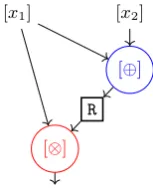
Let us take a simple example. We consider the small randomized circuit referred to as Circuit 1 and illustrated in Figure 1 with [⊕] a t-NI sharewise addition, [⊗] a t-SNI multiplication, and two Boolean sharings [x1] and [x2]. Applying Bartheet al.’s toolmaskCompon this circuit automatically inserts at-SNI refresh gadget in the cycle formed by gates [x1], [⊕], and [⊗] as represented in Figure 2. However, it can be verified that for any masking order t, the initial circuit is t-probing secure without any additional refresh gadget. Therefore, in the following, this paper aims to refine the state-of-the-art method [2] to only insert refresh gadgets when absolutely mandatory for thet-probing security.
[x1] [x2]
[⊕]
[⊗]
Fig. 1.Graph representation of Circuit 1.
[x1] [x2]
[⊕]
R
[⊗]
Fig. 2.Graph representation of Circuit 1 after
maskComp.
More specifically, our contributions can be summarized as follows:
(1.) We introduce formal definitions of the probing, non-interfering, and strong-non-interfering security notions for shared circuits based on concrete security games. Although these defi-nitions are no more than a reformulation of existing security notions, we believe that they provide a simple and precise framework to reason about probing security.
(2.) From the introduced game-based definitions, we provide a reduction of the probing security of a givenstandard shared circuit –i.e.a shared circuit composed of ISW multiplication gadgets, sharewise addition gadgets and SNI refresh gadgets– to the probing security of a simpler circuit of multiplicative depth 1 and for which the adversary is restricted to probe the multiplication inputs (which are linear combinations of the circuit inputs).
(3.) We give an algebraic characterization of the final security game, which allows us to express the probing security of any standard shared circuit in terms of linear algebra.
(5.) We apply tightPROVE to the efficient implementation of the AES s-box developed by Goudarzi and Rivain in [13]. Based on the previous state of the art, this s-box was implemented using one SNI refresh gadget per multiplication gadget (to refresh one of the operands), hence requiring a total of 32 refresh gadgets (which was later on con-firmed by the maskComp tool). Our new method formally demonstrates that the same d-shared implementation is actually t-probing secure with no refresh gadget for any d= t+ 1. We provide implementation results and a performance analysis: this new imple-mentation achieves an asymptotic gain up to 43%. The code is provided on the website
https://github.com/CryptoExperts/tightPROVE.
(6.) We extend our results to larger circuits by establishing new compositional properties on t-probing secure gadgets. In particular, these new composition properties well apply to the case of SPN-based block ciphers. We also show that they apply to a wide range of Boolean circuits with common gadgets and input sets.
Paper Organization. In Section 2, useful notions are introduced, security definitions for composition are formalized through concrete security games, and some useful security results are provided. Section 3 provides our security reduction for standard shared circuits. Section 4 then details our new method to exactly determine the probing security of a standard shared circuit. It also gives an upper bound on the number of required refresh gadgets together with an exhaustive method to make a standard shared circuit achieve tight probing security. In Section 5, our new method is extended to apply to larger circuits, and in particular to SPN-based block ciphers, with new compositional properties. Finally, Section 6 describes the new tool tightPROVEwe implemented to experiment our method on concrete circuits.
2
Formal Security Notions
2.1 Notations
In this paper, we denote byF2the finite field with two elements and byJi, jKthe integer interval
Z∩[i, j] for any two integersi andj. For a finite set X, we denote by|X | the cardinality of
X and byx← X the action of pickingxfromX independently and uniformly at random. For some (probabilistic) algorithmA, we further denotex← A(in) the action of running algorithm Aon some inputsin(with fresh uniform random tape) and settingxto the value returned by A.
2.2 Basic Notions
A Boolean circuit is a directed acyclic graph whose vertices are input gates, output gates,
constant gates of fan-in 0 that output constant values, and operation gates of fan-in at most 2 and fan-out at most 1 and whose edges are wires. In this paper we consider Boolean circuits with two types of operation gates: addition gates (computing an addition onF2) and multiplication gates (computing a multiplication onF2). Arandomized circuitis a Boolean circuit augmented with random-bit gates of fan-in 0 that outputs a uniformly random bit.
A d-Boolean sharing of x∈ F2 is a random tuple (x0, x1, . . . , xd−1) ∈ Fd2 satisfyingx = Pd−1
i=0 xi. The sharing is said to beuniformif, for a givenx, it is uniformly distributed over the subspace of tuples satisfyingx=Pdi=0−1xi. A uniform sharing ofxis such that anym-tuple of
itsshares xi is uniformly distributed overFm2 for anym≤d−1. In the following, ad-Boolean
sharing of a given variable x is denoted by [x] when the sharing order d is clear from the context. We further denote by Enc a probabilisticencoding algorithm that maps x∈F2 to a fresh uniform sharing [x].
Ad-shared circuitCis a randomized circuit working ond-shared variables. More specifically,
f. AprobeonCrefers to a wire index (for some given indexing ofC’s wires). Anevaluation of Con input [x1], . . . , [xn] under a set of probesP refers to the distribution of the tuple of wires pointed by the probes in P when the circuit is evaluated on [x1], . . . , [xn], which is denoted byC([x1], . . . ,[xn])P.
We consider a special kind of shared circuits which are composed of gadgets. A gadget is a simple building block of a shared circuit that performs a given operation on its input sharing(s). For instance, for some two-input operation ∗, a∗-gadget takes two input sharings [x1] and [x2] and it outputs a sharing [y] such that y =x1∗x2. In the paper, we specifically consider three types of gadgets, namely ISW-multiplication gadgets ([⊗]), ISW-refresh gadgets ([R]) and sharewise addition gadgets ([⊕]). The ISW-multiplication gadget, introduced in [14], takes two d-sharings [a] and [b] as inputs and computes the output d-sharing [c] such that c=a·b as follows:
1. for every 0≤i < j≤d−1, pick uniformly at random a valueri,j overF2; 2. for every 0≤i < j≤d−1, computerj,i←(ri,j+ai·bj) +aj·bi;
3. for every 0≤i≤d−1, computeci←ai·bi+P j6=iri,j.
The ISW-refresh gadget is actually the ISW-multiplication gadget in which the second operand [b] is set to the constant Boolean sharing (1,0, . . . ,0). The output [c] is thus a fresh independent sharing ofa. Finally, a sharewise addition gadget computes ad-sharing [c] such thatc=a+b by letting ci ← ai+bi for every 0 ≤ i ≤ d−1. When called with a second operand equal to the constant Boolean sharing (1,0, . . . ,0), such a sharewise addition gadget computes the complementary of its first operandc=a.
Definition 1. A standard shared circuit is a shared circuit exclusively composed of ISW-multiplication gadgets, ISW-refresh gadgets, and sharewise addition gadgets as described above.
2.3 Game-Based Security Definitions
In the following, we recall the probing, non-interfering, and strong non-interfering security notions introduced in [14, 2] and we formalize them through concrete security games. Each of these games is defined for a given n-inputd-shared circuit C and it opposes anadversary A, which is a deterministic algorithm outputting a set of (plain) inputs x1, . . . , xn and a set of probesP, to a simulatorS, which aims at simulating the distributionC([x1], . . . ,[xn])P.
Probing Security. We first recall the definition from [14]. Our game-based definition is then given with a proposition to state the equivalence of both notions.
Definition 2 (from [14]). A circuit is t-probing secure if and only if any set of at most t
intermediate variables is independent from the secret.
Probing Security Game. The t-probing security game is built based on two experiments as
described in Figure 3. In both experiments, an adversaryAoutputs a set of probesP (indices of circuit’s wires) such that|P|=tandninput values x1, . . . , xn∈F2.
In the first (real) experiment, referred to asExpReal, the chosen input valuesx1, . . . , xn are mapped intonsharings [x1], . . . ,[xn] with encoding algorithmEnc. The resulting encodings are given as inputs to the shared circuitC. The real experiment then outputs a random evaluation C([x1], . . . ,[xn])P of the chosen gates through at-uple (v1, . . . , vt).
In the second experiment, referred to asExpSim, the probing simulator S takes the (ad-versary chosen) set of probes P and outputs a simulation of the evaluationC([x1], . . . ,[xn])P,
which is returned by the simulation experiment. The simulator wins the game if and only if the two experiments return identical distributions.
Proposition 1. A shared circuit C is t-probing secure if and only if for every adversary A,
there exists a simulator S that wins the t-probing security game defined in Figure 3, i.e. the
ExpReal(A, C):
1. (P, x1, . . . , xn)← A()
2. [x1]←Enc(x1), . . . ,[xn]←Enc(xn) 3. (v1, . . . , vt)←C([x1], . . . ,[xn])P 4. Return (v1, . . . , vt)
ExpSim(A,S, C):
1. (P, x1, . . . , xn)← A() 2. (v1, . . . , vt)← S(P) 3. Return (v1, . . . , vt)
Fig. 3.t-probing security game.
Proof. From right to left, if for every adversaryA, there exists a simulator S that wins thet
-probing security game defined in Figure 3, then any set of probes is independent from the secret asShas no knowledge of the secret inputs. ThusCis triviallyt-probing secure by Definition 2. From left to right, if the random experimentsExpReal(A, C) andExpSim(A,S, C) do not output identical distributions, then there exists a set of at mosttintermediate variables which cannot be perfectly simulated without the knowledge of the input secrets. As a consequence, the circuit
is nott-probing secure from Definition 2.
A shared circuitC which is t-probing secure is referred to as a t-private circuit. It is not hard to see that a d-shared circuit can only achieve t-probing security for d > t. When a d-shared circuit achievest-probing security withd=t+ 1, we call it a tight private circuit.
Non-Interfering Security. The non-interfering security notion is a little bit stronger ([2]). Compared to the probing security notion, it additionally benefits from making the security evaluation of composition of circuits easier. We recall its original definition from [2] before we give an equivalent formal game-based definition.
Definition 3 (from [2]). A circuit is t-non-interfering (t-NI) if and only if any set of at
most tintermediate variables can be perfectly simulated from at most t shares of each input.
Non-Interfering Security Game. The t-non-interfering (t-NI) security game is built based on
two experiments as described in Figure 4. In both experiments, an adversaryAoutputs a set of probesP (indices of circuit’s wires) such that|P|=tandninput sharings [x1], . . . ,[xn]∈Fd2.
The first (real) experiment, referred to as ExpReal, simply returns an evaluation ofC on input sharings [x1], . . . , [xn] under the set of probes P.
The second experiment, referred to as ExpSim, is defined for a two-round simulator S = (S1,S2). In the first round, the simulator S1 takes the (adversary chosen) set of probes P and outputs nsets of indices I1, . . . ,In ⊆ {1, . . . , d}, such that|I1| =· · ·=|In|=t. In the second round, in addition to the set of probes P, the simulator S2 receives the (adversary chosen) input sharings restricted to the shares indexed by the setsI1, . . . ,In, denoted [x1]I1, . . . , [xn]In, and outputs a simulation ofC([x1], . . . ,[xn])P, which is returned by the simulation
experiment. The simulator wins the game if and only if the two experiments return identical distributions.
Proposition 2. A shared circuitCist-non-interfering secureif and only if for every adversary
A, there exists a simulatorS that wins thet-non-interfering security game defined in Figure 4,
i.e. the random experimentsExpReal(A, C)andExpSim(A,S, C)output identical distributions.
Proof. From right to left, if for every adversary A, there exists a simulator S that wins the
ExpReal(A, C):
1. (P,[x1], . . . ,[xn])← A() 2. (v1, . . . , vt)←C([x1], . . . ,[xn])P 3. Return (v1, . . . , vt)
ExpSim(A,S, C):∗
1. (P,[x1], . . . ,[xn])← A() 2. I1, . . . ,In← S1(P)
3. (v1, . . . , vt)← S2(P,[x1]I1, . . . ,[xn]In) 4. Return (v1, . . . , vt)
∗
Fort-NI: |I1|=· · ·=|In|=t.
Fort-SNI:|I1|=· · ·=|In|=|Pint| ≤t.
Fig. 4.t-(S)NI security game.
Strong Non-Interfering Security. The strong non-interfering security is a stronger notion than non-interfering security as it additionally guarantees the independence between input and output sharings. The latter property is very convenient to securely compose gadgets with related inputs.
Definition 4 (Strong non-interfering security from [2]).A circuit ist-strong non-interfering
(t-SNI) if and only if any set of at mosttintermediate variables whoset1 on the internal
vari-ables (i.e. intermediate varivari-ables except the output’s ones) and t2 on output variables can be
perfectly simulated from at mostt1 shares of each input.
Strong Non-Interfering Security Game. The t-strong-non-interfering (t-SNI) security game is
similar to the t-NI security game depicted in Figure 4. The only difference relies in the fact that the first-round simulator S1 outputsn sets of indicesI1, . . . ,In ⊆ {1, . . . , d}, such that |I1| =· · ·=|In| =|Pint| ≤t where Pint ⊆ P refers to the probes on internal wires, i.e.the probes in P which do not point to outputs of C.
Proposition 3. A shared circuit C is t-strong-non-interfering secure if and only if for every
adversaryA, there exists a simulatorS that wins thet-SNI security game defined in Figure 4,
i.e. the random experimentsExpReal(A, C)andExpSim(A,S, C)output identical distributions.
Proof. From right to left, if for every adversary A, there exists a simulator S that wins the
t-non interfering security game defined in Figure 3, then any set of probes can be perfectly simulated from sets of at most |Pint| =t1 shares of each input. ThusC is triviallyt-strong non-interfering from Definition 4. From left to right, if the random experimentsExpReal(A, C) andExpSim(A,S, C) do not output identical distributions, then there exists a set of at mostt intermediate variables which cannot be perfectly simulated from setsIj of input shares whose cardinalities are less thant1. As a consequence, the circuit is nott-strong non interfering secure
from Definition 4.
2.4 Useful Security Results
This section states a few useful security results. From the above definitions, it is not hard to see that for any shared circuitC we have the following implications:
C ist-SNI ⇒ C ist-NI ⇒ C ist-probing secure
while the converses are not true. While the ISW-multiplication (and refresh) gadget defined above was originally shown to achieve probing security, it actually achieves the more general notion of strong non-interfering security as formally stated in the following theorem:
Theorem 1 ([2]). For any integersdandt such that t < d, the d-shared ISW-multiplication
gadget [⊗] and thed-shared ISW-refresh gadget[R] are botht-SNI.
Lemma 1. Let C be an-input(t+ 1)-shared t-SNI circuit. Then for every(x1, . . . , xn)∈Fn2,
an evaluation of C taking n uniform and independent (t+ 1)-Boolean sharings [x1], . . . ,[xn]
as input produces a sharing[y](of some valuey∈F2 function ofx1, . . . , xn) which is uniform
and mutually independent of [x1], . . . ,[xn].
Proof of Lemma 1 is available in Appendix A.
3
A Security Reduction
This section provides a reduction for thet-probing security of a standard (t+ 1)-shared circuit C as defined in Section 2. Through a sequence of games we obtain a broad simplification of the problem of verifying whether C is probing secure or not. At each step of our reduction, a new game is introduced which is shown to be equivalent to the previous one, implying that for any adversary A, there exists a simulator S that wins the new game if and only if the circuit C is t-probing secure. We get a final game (see Game 3 hereafter) in which only the inputs of the multiplication gadgets can be probed by the adversary and the circuit isflattened
into an (equivalent) circuit of multiplicative depth one. This allows us to express the probing security property as a linear algebra problem, which can then be solved efficiently as we show in Section 4.
In a nutshell, our Game 0 exactly fits the game-based definition oft-probing security given in the previous section. Then, with Game 1, we prove that verifying thet-probing security of a standard shared circuit Cis exactly equivalent to verifying thet-probing security of the same circuitCwhere the attackerAis restricted to probe inputs of refresh gadgets, pairs of inputs of multiplication gadgets, and inputs and outputs of sharewise additions (i.e., no internal gadgets variables). Game 2 then shows that verifying thet-probing security of a standard shared circuit Cwith a restricted attackerAis equivalent to verifying thet-probing security of a functionally equivalent circuit C0 of multiplicative depth one where all the outputs of multiplication and
refresh gadgets in C are replaced by fresh input sharings of the same values in the rest of the circuit. Finally, with Game 3, we show that we can even restrict the adversary to probe only pairs (xi, yj) where xi (resp.yj) is the ith share ofx(resp. thejth share ofy) and such that xandy are operands of the same multiplication inC. These three games are deeply detailed hereafter and proofs of their consecutive equivalence are provided at each step. An overview is displayed on Figure 5.
Game 0
tprobes on a st.
shared circuit
Game 1 Game 2 Game 3
no probe on internal variables
equivalent circuit of multiplicative depth 1
probes only on multiplications’ inputs
Fig. 5.Overview of the sequence of games.
of probes P returned by A, noted P0 in the following, has a different form explicitly defined
below.
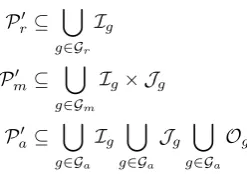
Let us associate an index g to each gadget in the standard shared circuit and denote by G the set of gadget indices. Let us further denote byGr, Gm andGa the index sets of refresh gadgets, multiplication gadgets and addition gadgets, such that G =Gr∪ Gm∪ Ga. Then we can denote byIgandJgthe indices of circuit wires which are the shares of the (right and left) input operands of gadget g ∈ G (where Jg =∅ if gadget g is a refresh). Similarly, we denote by Og the indices of circuit wires which represent the output of gadget g ∈ G. From these notations, an admissible set of probes P0 from the adversary in the new game is of the form
P0 =P0
r∪ Pm0 ∪ Pa0
where
Pr0 ⊆ [ g∈Gr
Ig
Pm0 ⊆ [ g∈Gm
Ig× Jg
P0
a ⊆ [
g∈Ga
Ig [
g∈Ga
Jg [
g∈Ga
Og
and |P0| = t. That is, each of the t elements of P0 either is a pair of index in I
g× Jg for a multiplication gadget g, or a single index in Ig for a refresh gadgetg, or a single index in Ig∪ Jg∪ Ogfor an addition gadget. Note that in the latter case, the index can correspond to any wire in the addition gadget (which is simply composed oft+ 1 addition gates).
Let tm be the number of probes on multiplication gadgets, i.e. tm = |P0
m|, and tar the number of probes on refresh or addition gadgets,i.e.tar=|P0
a∪ Pr0|, so thattm+tar=t. The evaluation C([x1], . . . ,[xn])P0 then returns aq-tuple forq= 2tm+tar, which is composed of
the values taken by the wires of indexi∈ P0
a∪ Pr0, and the values taken by the wires of indexi and j with (i, j)∈ P0
m. The new experimentsExpReal1(A, C) andExpSim1(A,S, C), carefully written in Figure 6, each output a q-tuple and, as before, the simulator wins Game 1 if and only if the associated distributions are identical.
ExpReal1(A, C):
1. (P0
, x1, . . . , xn)← A()
2. [x1]←Enc(x1), . . . ,[xn]←Enc(xn) 3. (v1, . . . , vq)←C([x1], . . . ,[xn])P0 4. Return (v1, . . . , vq)
ExpSim1(A,S, C):
1. (P0
, x1, . . . , xn)← A() 2. (v1, . . . , vq)← S(P0) 3. Return (v1, . . . , vq)
Fig. 6.Game 1.
Proposition 4. A standard shared circuitC ist-probing secure if and only if for every
adver-saryA, there exists a simulatorS that wins Game 1 defined above, i.e. the random experiments
ExpReal1(A, C)andExpSim1(A,S, C)output identical distributions.
Proof. Basically, the proof is based on the fact that with the SNI property on the gadgets
in our circuit, each probe in a t-SNI gadget can be replaced by 1 or 2 probes on the input sharing(s) of the gadget. The complete proof can be found in Appendix B.
[x1] [x2] [x3]
[⊕] R
[⊗] [⊗]
[⊗] [⊗]
[v1]
[v2]
[v3] [v4]
[v5] [v6]
CircuitC
[x1] [x2] [x3] [x4] [x5] [x6] [x7] [x8] [v2]
q [v3]
q [v4]
q [v5]
q [v6]
q
[⊕] R
[⊗] [⊗]
[⊗] [⊗]
[v1]
CircuitC0
Fig. 7.Illustration of theFlattentransformation.
each output of a multiplication or a refresh gadget inC is replaced by a fresh new input shar-ing of the same value in the rest of the circuit. The new circuit hence takesN input sharings [x1], . . . ,[xn],[xn+1], . . . ,[xN], withN =n+|Gm|+|Gr|. The two circuits are functionally equiv-alent in the sense that for every input (x1, . . . , xn) there exists an extension (xn+1, . . . , xN) such thatC([x1], . . . ,[xn]) andC0([x1], . . . ,[xN]) have output sharings encoding the same val-ues. This transformation is further referred to asFlatten in the following, and is illustrated on Figure 7.
The resulting Game 2 is illustrated on Figure 8. Although the additional inputsxn+1, . . . , xN are deterministic functions of the original inputs x1, . . . , xn, we allow the adversary to select the full extended input x1, . . . , xN for the sake of simplicity. This slight adversarial power overhead does not affect the equivalence between the games.
ExpReal2(A, C):
1. C0←Flatten(C) 2. (P0
, x1, . . . , xN)← A()
3. [x1]←Enc(x1), . . . ,[xN]←Enc(xN) 4. (v1, . . . , vq)←C0([x1], . . . ,[xN])P0 5. Return (v1, . . . , vq)
ExpSim2(A,S, C):
1. C0←Flatten(C) 2. (P0, x1, . . . , xN)← A() 3. (v1, . . . , vq)← S(P0) 4. Return (v1, . . . , vq)
Fig. 8.Game 2.
Proposition 5. A standard shared circuitC ist-probing secure if and only if for every
adver-saryA, there exists a simulatorS that wins Game 2 defined above, i.e. the random experiments
ExpReal2(A, C)andExpSim2(A,S, C)output identical distributions.
Proof. Basically, the proof is based on the fact that the output encodings of a ISW
multipli-cation are completly independent of its inputs encodings. The complete proof can be found in Appendix B.
Corollary 1. A standard shared circuitCist-probing secure if and only if the standard shared circuit Flatten(C)ist-probing secure.
thet-probing security of a circuitC0=Flatten(C) when the attacker is restricted to probes on multiplication and refresh gadgets’ inputs, and intermediate variables of sharewise additions. In order to further reduce it, we translate the current problem into a linear algebra problem. In the following, we denote byxi,j thejth share of theith input sharing [xi] so that
[xi] = (xi,0, xi,1, . . . , xi,t), for every i∈J1, NK. Moreover, we denote by−→xj∈FN
2 the vector composed of thejth share of each input sharing:
− →
xj= (x0,j, x1,j, . . . , xN,j).
As a result of the Flatten transformation, each probed variable in the q-tuple (v1, . . . , vq) = C([x1], . . . , [xN])P0 is a linear combination of the input sharings [x1], . . . , [xN]. Moreover,
since the addition gadgets are sharewise, for every k ∈J1, qK, there is a single share index j such that the probed variable vk only depends of thejth shares of the input sharings, giving:
vk =−→ak· −→xj , (1)
for some constant coefficient vector −→ak ∈FN2. Without loss of generality, we assume that the tuple of probed variables is ordered w.r.t. the share index j corresponding to each vk (i.e.
starting from j = 0 up to j =t). Specifically, theq-tuple (v1, . . . , vq) is the concatenation of t+ 1 vectors
− →
v0 =M0· −x→0 , −→v1=M1· −→x1, . . . −→vt=Mt· −→xt , (2) where the matrix Mj is composed of the row coefficient vectors −→ak for the probed variable indicesk corresponding to the share indexj.
Lemma 2. For any (x1, . . . , xN)∈FN2 , theq-tuple of probed variables(v1, . . . , vq) =C([x1],
. . . , [xN])P0 can be perfectly simulated if and only if the Mj matrices satisfy
Im(M0T)∩Im(M1T)∩ · · · ∩Im(MtT) =∅ .
Moreover, if the Mj matrices are full-rank (which can be assumed without loss of generality),
then the above equation implies that (v1, . . . , vq)is uniformly distributed.
Proof. Without loss of generality we can assume that theMjmatrices are full-rank since
other-wise the probed variablesv1, . . . , vq would be mutually linearly dependent and simulating them would be equivalent to simulating any subset (vk)k∈K⊆J1,qKdefining a free basis of (v1, . . . , vq),
and which would then induce full-rank matrices Mj.
Throughout this proof, we denote−→x = (x1, . . . , xN). We first show that a non-null inter-section implies a non-uniform distribution of (v1, . . . , vq) which is statistically dependent on −
→x. Indeed, a non-null intersection implies that there exist a non-null vector−→w ∈
FN2 satisfying −
→w =−→u0·M0=−→u1·M1=· · ·=−→ut·Mt. (3)
for some (constant) vectors−u0→, . . . ,−→ut. It follows that t
X
j=0 − → uj· −→vj =
t X
j=0 −
→w· −→xj=−→w· −→x ,
which implies that the distribution of theq-tuple (v1, . . . , vq) = (→−v0 k · · · k −→vt) is non-uniform and dependent on−→x.
We now show that a null intersection implies a uniform distribution (which can then be easily simulated). The uniformity and mutual independence between the sharings [x1], . . . , [xN] implies that we can see −→x1, . . . , xt→− as tuniform and independent vectors on FN2 , and
−→ x0 as
− →
The joint distribution of−→v1, . . . ,−→vt is hence clearly uniform. Then each coordinate of−→v0is the result of the inner product−→r · −x0→where−→r is a row ofM0. By assumption, there exists at least one matrix Mj such that−→r /∈Im(MT
j ). It results that−→r · −→xj is a uniform random variable independent of −→v1, . . . , −→vt and the other coordinates of −→v0 (since M0 is full-rank). Since the latter holds for all the coordinates of −x0→ we get overall uniformity of (−→v0 k · · · k −→vt) which
concludes the proof.
Lemma 2 allows us to reduce thet-probing security of a standard shared circuit to a linear algebra problem. If an adversary exists that can choose the set of probes P0 such that the
transposes of induced matricesM1, . . . , Mt have intersecting images, then the distribution of (v1, . . . , vq) depends on (x1, . . . , xN) and a perfect simulation is impossible (which means that the circuit is not probing secure). Otherwise, the tuple (v1, . . . , vq) can always be simulated by a uniform distribution and the circuit is probing secure. This statement is the basis of our verification method depicted in the next section. But before introducing our verification method, we can still simplify the probing security game as shown hereafter by using Lemma 2.
Game 3. In this last game, the adversary is restricted to probe the multiplication gadgets only. Formally,Areturns a set of probesP0=P0
r∪ Pm0 ∪ Pa0 such thatPr0 =∅andPa0 =∅. Such a set, denoted P00 is hence composed oft pairs of inputs fromS
g∈GmIg× Jg. The evaluation
C([x1], . . . ,[xn])P00then returns aq-tuple forq= 2t. The new experimentsExpReal3(A, C) and
ExpSim3(A,S, C), displayed in Figure 6, each output a q-tuple and, as before, the simulator wins Game 3 if and only if the associated distributions are identical.
ExpReal3(A, C):
1. C0←Flatten(C) 2. (P00
, x1, . . . , xN)← A()
3. [x1]←Enc(x1), . . . ,[xN]←Enc(xN) 4. (v1, . . . , vq)←C0([x1], . . . ,[xN])P00 5. Return (v1, . . . , vq)
ExpSim3(A,S, C):
1. C0←Flatten(C) 2. (P00
, x1, . . . , xN)← A() 3. (v1, . . . , vq)← S(P00) 4. Return (v1, . . . , vq)
Fig. 9.Game 3.
Proposition 6. A standard shared circuitC ist-probing secure if and only if for every
adver-saryA, there exists a simulatorS that wins Game 3 defined above, i.e. the random experiments
ExpReal3(A, C)andExpSim3(A,S, C)output identical distributions.
Proof. Basically, the proof is based on the fact that probing a cross products ai·bj allows
you to gain informations on the two shares ai and bj. The complete proof can be found in Appendix B.
4
Probing-Security Verification for Standard Shared Circuits
In this section, we describe a formal verification method that checks for any t ∈N whether
a standard (t+ 1)-shared circuit C achieves t-probing security for every t ∈ N. Specifically,
our tooltightPROVE either provides a formal proof that C ist-probing secure (whereC is a standard shared circuit with sharing order t+ 1), or it exhibits aprobing attack againstC for the givent, namely it finds a set of probesP (indices of wires) in the (t+ 1)-shared instance of C, such that|P|=t, for which the evaluationC([x1], . . . ,[xn])P cannot be simulated without
4.1 Linear Algebra Formulation
As demonstrated in the previous section, the t-probing security game for a standard (t+ 1)-shared circuitCcan be reduced to a game where an adversary selects a set of probesP00solely
pointing to input shares of the multiplication gadgets of aflattened circuitC0. In the following, we will denote bymthe number of multiplication gadgets inC(or equivalently inC0) and by g ∈J1, mKthe index of a multiplication gadget of C. We will further denote by [ag] and [bg]
the input sharings of theg-th multiplication gadget so that we have
[ag] = (−→ag· −→x0, . . . ,−→ag· −→xt) and [bg] = (−→bg· −→x0, . . . ,−→bg· −→xt), (4) for some constant coefficient vectors−→ag,−→bg ∈FN2, recalling that−→xj denotes the vector with the jth share of each input sharing [x1], . . . , [xN]. In the following, the vectors{−→ag,−→bg}g are called
theoperand vectors.
In Game 3, the adversary choosestpairs of probes such that each pair points to one share of [ag] and one share of [bg] for a multiplication gadget g. Without loss of generality, the set of pairs output by the adversary can be relabeled as a set of triplet P ={(g, j1, j2)} where g ∈J1, mKis the index of a multiplication gadget,j1 andj2 are share indices. For any triplet
(g, j1, j2)∈ P the two input sharesa−→g· −→xj1 and − →
bg · −→xj2 are added to the (2t)-tuple of probed variables to be simulated. This set of triplets exactly defines a sequence oft+ 1 matricesM0, . . . ,Mt, defined iteratively by adding−→agto the rows ofMj1 and−→bg to the rows ofMj2 for each (g, j1, j2)∈ P. Equivalently, the matrixMj is defined as
Mj=rows({−→ag ; (g, j,∗)∈ P} ∪ {−→bg ; (g,∗, j)∈ P}), (5) for every j∈J0, tKwhererowsmaps a set of vectors to the matrix with rows from this set.
Lemma 2 then implies that a probing attack onCconsists of a set of probesP ={(g, j1, j2)} such that the transposes of the inducedMj have intersecting images. Moreover, since the total number of rows in these matrices is 2t, at least one of them has a single row−→w. In particular, the image intersection can only be the span of this vector (which must match the row of all single-row matrices) and this vector belongs to the set of operand vectors {−→ag,−→bg}g. In other words, there exists a probing attack on C if and only if a choice of probes P ={(g, j1, j2)} implies
Im(M0T)∩Im(M1T)∩ · · · ∩Im(MtT) =h−→wi. (6) for some vector −→w ∈ {−→ag,
− →
bg}g. In that case we further say that there is a probing attack on the operand vector −→w.
In the remainder of this section, we describe an efficient method that given a set of vector operands{−→ag,−→bg}g (directly defined from a target circuit C) determines whether there exists a parameter t and a set P ={(g, j1, j2)}(of cardinality t) for which (6) can be satisfied. We prove that (1) if such setsP exist, our method returns one of these sets, (2) if no set is returned by our method then the underlying circuit is t-probing secure for any sharing order (t+ 1).
4.2 Method Description
The proposed method loops over all the vector operands −→w ∈ {−→ag, − →
bg}g and checks whether there exists a probing attack on−→w (i.e.whether a setP can be constructed that satisfies (6)).
For each−→w ∈ {−→ag, − →
bg}gthe verification method is iterative. It starts from a setG1⊆J1, mK
defined as
G1={g; −→ag=−→w} ∪ {g ; − →
bg =−→w}. (7)
NamelyG1contains the indices of all the multiplication gadgets that have−→w as vector operand. Then the set of free vector operands O1 is defined as
The terminology of free vector operand comes from the following intuition: if a probing ad-versary spends one probe on gadget g ∈ G1 such that−→ag =→−w to add−→w to a matrixMj (or equivalently to get the share −→w · −→xj), then she can also add −→bg to another matrix Mj0 (or
equivalently get the share −→bg · −x→j0) for free. The adversary can then combine several free
vec-tor operands to make −→w ∈Im(MT
j0) occur without directly adding−→w to Mj0 (or equivalently
without directly probing−→w · −xj→0). This is possible if and only if−→w ∈ hO1i.
The free vector operands can also be combined with the operands of further multiplications to generate a probing attack on−→w. To capture such higher-degree combinations, we define the sequences of sets (Gi)i and (Oi)i as follows:
Gi+1={g ; −→ag∈ −→w+hOii} ∪ {g ; −→bg∈ −→w+hOii} , (9) and
Oi+1={−→bg ; −→ag∈ −→w +hOii} ∪ {−→ag ; −→bg ∈ −→w +hOii} . (10) for every i≥1. The rough idea of this iterative construction is the following: if at step i+ 1 a probing adversary spends one probe on gadgetg ∈ Gi+1 such that −→ag∈ −→w+hOii, then she can add −→ag together with some free vector operands of previous steps to Mj in order to get −
→w ∈Im(MT
j ). Then she can also add − →
bg to another matrixMj0, making
− →
bg a new free vector operand of step i+ 1.
Based on these definitions, our method iterates the construction of the setsGi andOi. At setpi, two possible stop conditions are tested:
1. ifGi=Gi−1, then there is no probing attack on−→w, the method stops the iteration on −→w and continues with the next element in the set of vector operands;
2. if−→w ∈ hOii, then there is a probing attack on−→w, the method stops and returnsTrue(with −
→w and the sequence of sets (Gi,Oi)
i as proof);
The method returnsTrueif there exists a concrete probing attack on a vector−→w ∈ {−→ag,−→bg}g for a certain sharing ordert+ 1. Otherwise, it will eventually stop with vector operand−→w since the number of multiplications is finite and sinceGi⊆ Gi+1for everyi≥1. When all the possible vector operands have been tested without finding a probing attack, the method returnsFalse. Algorithm 1 hereafter gives a pseudocode of our method whereNextSetsdenotes the procedure that computes (Gi+1,Oi+1) from (Gi,Oi) and is implemented in Section 6.
Algorithm 1Search probing attack
Input: A set of vector operands{−→ag,
− →
bg}g
Output: Trueif there is probing attack on some−→w ∈ {−→ag,
− →
bg}g andFalseotherwise
1. for all−→w∈ {−→ag,
− →
bg}g do 2. (G1,O1)←NextSets(∅,∅,{−→ag,
− →
bg}g,−→w) 3. if −→w ∈ hO1ithen returnTrue
4. fori= 1tomdo
5. (Gi+1,Oi+1)←NextSets(Gi,Oi,{−→ag,
− →
bg}g,−→w) 6. if Gi+1=Githen break
7. if −→w ∈ hOiithen returnTrue 8. end for
9. end for 10. return False
[x1]=−→w1 [x2]=−→w2 [x3]=−→w3
[⊕]
− → w4
[⊕]
− →w 5
[⊗] [⊗] [⊗]
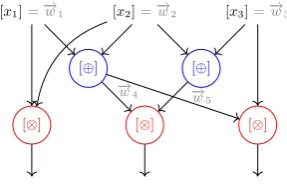
Fig. 10.Graph representation of a second Boolean circuit.
4.3 Toy Examples
Two examples are provided hereafter to illustrate our iterative method in the absence then in the presence of a probing attack.
In the very simple example of Figure 1, two variables are manipulated in multiplications in the circuit C: −→w1 = −→x1 and →−w2 =−→x1+−→x2. The set of multiplications G is of cardinality one since it only contains one multiplication (−→w1,−→w2). Following the number of variables, the method proceeds at most in two steps:
1. As depicted in Algorithm 1, the method first determines whether there exists a probing attack on−→w1. In this purpose, a first setG1is built, such thatG1= (−→w1,−→w2) andO1=−→w2. Since G1 6= ∅ and −→w1 6= −→w2, then a second set must be built. However, there is no multiplication left, that isG2=G1and so there is no attack on−→w1.
2. The method then focuses on −→w2. In this purpose, a dedicated set G1 is built, such that G1 = (−→w2,→−w1) and O1 = −→w1. Since G1 6= ∅ and −→w2 6= −→w1, then a second set must be built. However, there is no multiplication left, that isG2=G1and so there is no attack on −
→w
2 either. Since there is no input variable left, the method returns False, which means that there is no possible probing attack on this circuit.
Figure 10 provides a second Boolean circuit. It manipulates five variables−→wi as operands of multiplication gadgets: −→w1 =−→x1, −→w2 =−→x2, −→w3 =−→x3, −→w4 =−→x1+−→x2, and −→w5 =−→x2+−→x3. The set of multiplications G is of cardinality three with (−→w1,−→w2), (−→w4,−→w5), and (−→w3,−→w4). Following the number of variables, the method proceeds at most in five steps:
1. The method first determines whether there exists a probing attack on−→w1. In this purpose, a first setG1is built, such thatG1= (−→w1,−→w2) andO1=→−w2. SinceG16=∅and−→w16=−→w2, then a second set must be built.G2 =G1∪ {(−→w4,−→w5),(−→w4,−→w3)} since −→w4=−→w1+−→w2. However, −→w1 ∈ O/ 2(=< −→w2,−→w3,−→w5 >), so a third set must be built. Since there is no multiplication left, that isG3=G2, there is no attack on−→w1.
2. The method then focuses on −→w2. In this purpose, a dedicated set G1 is built, such that G1= (−→w2,−→w1) andO1=−→w1. SinceG16=∅and−→w26=−→w1, then a second set must be built. G2 =G1∪ {(−→w4,−→w5),(−→w4,−→w3)} since −→w4 =−→w2+−→w1. And in that case, −→w2 ∈ O2(=< −
→w
1,−→w3,−→w5>) since−→w2=−→w3+−→w5. Thus the method returnsTrue and there exists an attack on−→w2=−→x2 for some masking ordert.
4.4 Proof of Correctness
Proposition 7. For every i ∈ N, if −→w ∈ hOii then there exists t ∈ N and P ={(g, j1, j2)}
with |P|=timplying Ttj=0Im(MT
j ) =−→w.
Proposition 8. Let i >1 such that G1⊂ · · · ⊂ Gi−1=Gi and−→w /∈ hOii. Then for any t∈N
andP ={(g, j1, j2)} with|P|=t we have−→w /∈Ttj=0Im(MT j ). Proofs of Propositions 7 and 8 are available in Appendix C.
4.5 Towards Efficient Construction of Tightt-Private Circuits
Our formal verification method exactly reveals all the t-probing attacks on standard shared circuits. A sound countermeasure to counteract these attacks is the use of refresh gadgets. We discuss here how to transform a flawed standard shared circuit into a t-private circuit with exactly the minimum number of refresh gadgets.
In a first attempt, we easily show that refreshing the left operands of each multiplication in C is enough to providet-probing security.
Proposition 9. A standard shared circuit C augmented witht-SNI refresh gadgets operating
on the left operand of each multiplication gadget is t-probing secure.
In a second attempt, we need to slightly modify Algorithm 1 so that it conducts an analysis on all the possible operands in order to return a complete list of the flawed ones. So far, it stops at the first flaw. With such a list for a standard shared circuit, we can show that refreshing only the flawed operands is enough to providet-probing security.
Proposition 10. A standard shared circuitCaugmented witht-SNI refresh gadgets operating
on each flawed operand, as revealed by our method, of its multiplication gadgets is t-probing
secure.
Proofs of these propositions are available in Appendix C.
Propositions 9 and 10 provide an upper bound of the required number of refresh gadgets in a standard shared circuit to achieve probing security at any order t. If we denote by m the number of multiplications in a standard shared circuit C and by o the number of flawed operands returned by our method, thenCis to be augmented of at mostr= min(m, o) refresh gadgets to achieve probing security at any ordert. Given this upper bound, an iterative number of refresh gadgets from 1 to rcan be inserted at each location inCin order to exhibit a tight private circuit with a minimum number of refresh gadgets.
5
Further Steps
Now that we are able to exactly determine thet-probing security of standard shared circuits, a natural follow-up consists in studying the t-probing security of their composition. In a first part, we establish several compositional properties, and then we show how they apply to the widely deployed SPN-based block ciphers. We eventually discuss the extension of our results to generic shared circuits.
5.1 Generic Composition
This section is dedicated to the statement of new compositional properties on tight private circuits. In a first attempt, we show that the composition of at-private circuit whose outputs coincide with the outputs of t-SNI gadgets with another t-private circuit is still a t-private circuit.
– at-probing secure circuitC1 whose outputs are all outputs oft-SNI gadgets,
– at-probing secure circuitC2 whose inputs areC1’s outputs.
Then, C=C2◦C1 ist-probing secure.
Proof. As the outputs of the first circuitC1are the outputst-SNI gadgets, we get from Lemma
1 that the input encodings ofC1and the input encodings ofC2are independent and uniformly distributed. Then, the proof is straightforward from Proposition 5. Basically, the analysis of C’st-probing security can be equivalently reduced to the analysis of thet-probing security of C0=Flatten(C) in which each output of at-SNI gadget is replaced by a fresh new input sharing of the corresponding value in the rest of the circuit, i.e.C2. As a consequence,C ist-probing secure if and only if bothC1andC2 aret-probing secure, which is correct by assumption. In a second attempt, we establish the secure composition of a standard shared circuit that implements a (shared) linear surjective transformation through several sharewise addition gadgets, that we refer to as a t-linear surjective circuit, and a standardt-probing circuit. Proposition 12. Let us consider a standard shared circuitC composed of two sequential cir-cuits:
– at-linear surjective circuitC1, exclusively composed of sharewise additions,
– at-probing secure circuitC2 whose inputs areC1’s outputs.
Then, C=C2◦C1 ist-probing secure.
Proof. We consider a standard shared circuit C with input −→x = (x1, . . . , xn) composed of a
t-linear surjective circuit C1 as input to a t-probing secure circuit C2. We denote by −→y = (y1, . . . , yn0) the set ofC1’s outputs, or equivalently the set ofC2’s inputs. From Proposition 6,
thet-probing security ofCcan be reduced to thet-probing security of circuitC0=Flatten(C)
for probes restricted to the multiplications’ operands. In our context,C1is exclusively composed of sharewise additions, so the probes are restricted to C2. From Lemma 2, any set of probed variables on C2’s multiplications operands (v1, . . . , vq) can be written as the concatenation of thet+ 1 vectors
− →
v0=M0· −→y0 , −→v1=M1· −→y1 , . . . −→vt=Mt· −→yt , where
Im(M0T)∩Im(M1T)∩ · · · ∩Im(MtT) =∅ . (11) To achieve global t-probing security for C, we need to achieve a null intersection for matri-ces that apply on C’s inputs instead of C2’s inputs. As C1 implements a linear surjective transformationf, there exists a matrixMf of rankn0 such that
∀0≤i≤t, −→yi =Mf· −→xi.
As a consequence, any set of probes (v1, . . . , vq) in C0 as defined in Game 3 can equivalently be rewritten as the concatenation of thet+ 1 vectors
− →
v0=M0·Mf· −→x0 , −→v1 =M1·Mf· −x1→, . . . −→vt =Mt·Mf· −→xt. By contradiction, let us assume that
Im(MfT·M0T)∩Im(MfT·M1T)∩ · · · ∩Im(MfT·MtT)6=∅, that is, there exists a non-null vector−→w such that
−
→w ∈Im(MT
f ·M0T)∩Im(MfT ·M1T)∩ · · · ∩Im(MfT ·MtT). Equivalently, there exists−→z0,−→z1, . . . ,−→zt such that
− →w =MT
f ·M T
0 · −→z0=M T f ·M
T
1 · −→z1 =. . .=M T f ·M
From Equation (11), there exist at least two distinct indicesiandj in {0, . . . , t}, such that MiT · −→zi 6=M
T j · −→zj.
As−→w =MT
f ·MiT· −→zi =MfT·MjT· −→zj, the differenceMiT· −→zi−MjT· −→zj belongs toMfT’s kernel. But from the surjective property ofMf, MfT has full column rankn
0, and thus a null kernel:
dim(Ker(MfT)) =n0−dim(Im(MfT)) = 0. As a consequence,MT
i · −→zi−MjT· −→zj = 0 and sinceMiT· −→zi 6=MjT· −→zj we have a contradiction
which completes the proof.
Eventually, we claim that twot-private circuits on independent encodings form at-private circuit as well.
Proposition 13. Let us consider a standard shared circuit C composed of two parallel t
-probing secure circuits which operate on independent input sharings. Then, C = C1kC2 is
t-probing secure.
Proof. As the input sharings are independent, the result is straightforward from Lemma 2.
5.2 Application to SPN-Based Block Ciphers
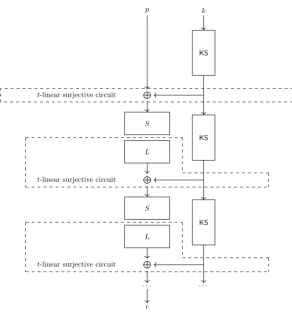
An SPN-based block cipher is a permutation which takes as inputs a key k in {0,1}κ and a plaintext pin {0,1}n and outputs a ciphertextc in {0,1}n, where n and κare integers. As illustrated in Figure 14 in Appendix D, it is defined by successive calls to a round function and by an optional expansion algorithm KS. The round function is a combination of a non linear permutation S and a linear permutationL.
Proposition 14. Let C be a standard shared circuit implementing an SPN block cipher as
pictured in Figure 14. And letCS andCKS be the standard shared (sub-)circuits implementing
S andKSrespectively. If both conditions
1. CS’s andCKS’s outputs aret-SNI gadgets’ outputs,
2. CS and CKS are t-probing secure (for any sharing ordert+ 1),
are fulfilled, then C is also t-probing secure.
Note that ifS’s andKS’s outputs are nott-SNI gadgets’ outputs, then the linear surjective circuit can be extended to the last t-SNI gadgets’ outputs of these circuits without loss of generality.
Proof. As S and KS are t-probing secure, it follows from Proposition 13, that when
imple-mented in parallel on independent input encodings, their composition is t-probing secure as well. Then, as the output of their composition matches the outputs of t-SNI gadgets, then they can be sequentially composed with a t-probing secure circuit from Proposition 11. Fi-nally, the composition of linear surjective circuits witht-probing secure circuits is ensured by Proposition 12, which completes the proof.
5.3 Extension to Generic Shared Circuits
On Standard Shared Circuits. The method presented in this paper through Sections 3 and 4 aims to accurately establish the t-probing security of a standard shared circuit for any sharing ordert+ 1. Namely, it is restricted to Boolean shared circuits exclusively composed of ISW-multiplication gadgets, ISW-refresh gadgets, and sharewise addition gadgets. While the assumption on addition gadgets is quite natural, the restrictions made on the multiplication and refresh gadgets can be relaxed. The reduction demonstrated in Section 3 only expects the refresh gadgets to be t-SNI secure to ensure the equivalence between Game 1 and the initial t-probing security game. Afterwards, t-probing security is equivalently evaluated on a correspondingflattened circuit with probes on multiplications’ operands only. Therefore, there is no restriction on the choice of refresh gadgets but their t-SNI security. While multiplication gadgets are also expected to be t-SNI secure for the equivalence between Game 1 and the initial t-probing security game to hold, this feature is not enough. To prove this equivalence, multiplication gadgets are also expected to compute intermediate products between every share of their first operand and every share of their second operand. Otherwise, our method could still establish the probing security of a circuit, but not in a tight manner, meaning that security under Game 3 would imply probing security but insecurity under Game 3 would not imply insecurity w.r.t. the original probing insecurity notion. Our method would hence allowed false negatives, as state-of-the-art methods currently do. Beyond the advantages of providing an exact method, this restriction is not very constraining since not only the widely deployed ISW-multiplication gadgets but also the large majority of existing ISW-multiplication gadgets achieve this property.
On Circuits on Larger Fields. Since ISW-multiplication gadgets and ISW-refresh gadgets can straightforwardly be extended to larger fields our reduction and verification method could easily be extended to circuits working on larger fields.
6
Application
Following the results presented in previous sections, we developed a tool in sage,tightPROVE, that takes as input a standard shared circuit and determines whether or not it ist-probing se-cure with Algorithm 1. Specifically, the standard shared circuit given as input totightPROVEis expressed as a set of instructions (XOR,AND,NOT,REFRESH) with operands as indices of either shared input values or shared outputs of previous instructions. Namely, the XORinstructions are interpreted as sharewise addition gadgets of fan-in 2, the NOT instructions as sharewise addition gadgets of fan-in 1 with the constant shared input (1,0, . . . ,0), theANDinstructions as ISW-multiplication gadgets of fan-in 2, and the REFRESH instructions as ISW-refresh gad-gets of fan-in 1. As an application, we experimented tightPROVE on several standard shared circuits. First, we analyzed thet-probing security of the small examples of Section 4 as a sanity check. Then, we investigated thet-probing security of the AES s-box circuit from [5] and com-pared the result with what the maskComptool produces. Additionally, we studied the impact of our tool to practical implementations (for both the randomness usage and the performance implications).
6.1 Application to Section 4 Examples
of pairs of operands, namely the inputs to the multiplications in the circuit. Finally, Algorithm 1 is evaluated on the obtained list of operands.
[x1] [x2]
[⊕]
[⊗]
→ ;; 2 XOR 1 2
AND 1 3 →
l i s t _ c o m b = [1 ,3]
-c o m b = 1
= > NO A T T A C K ( G2 = G1 ) G: [[(1 ,3) ] , []] O: [[3] , []]
-c o m b = 3
= > NO A T T A C K ( G2 = G1 ) G: [[(1 ,3) ] , []] O: [[1] , []]
-( ’ No a t t a c k found ’)
Fig. 11.New method applied on example 1.
The first example is based on a standard shared circuit that takes 2 shared inputs and then performs two operations, namely a sharewise addition (XOR) and an ISW-multiplication (AND). TheANDinstruction takes two inputs, namely the output of theXORand one of the two inputs of the circuit, which means that there is only two possible target vectors for an attack to be mounted. They are displayed in the list list comb. For both these two vectors successively displayed with variable comb, the tool generates their respective sets G1andO1, as defined in Section 4. Then sinceG2is equal toG1 for both vectors, the tool outputs that no attack could be found. The circuit is thust-probing secure. The complete process is described in Figure 11.
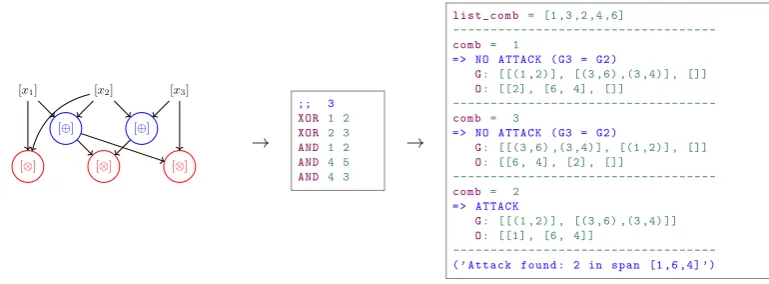
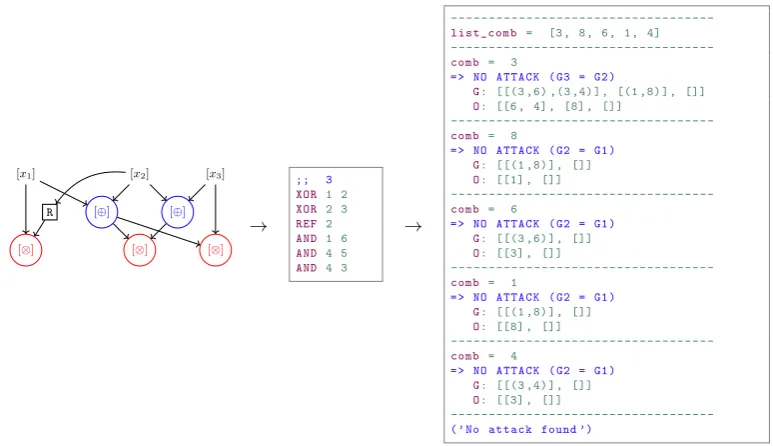
The second example is based on a standard shared circuit that takes 3 shared inputs and then performs 5 operations, namely 2 sharewise additions (XOR) and 3 ISW-multiplications (AND). The three ANDinstructions take five distinct inputs, which means that there are five possible target vectors for an attack to be mounted. For the two first target vectors, no attack could be found as the tool expressed all the multiplications in the circuit with two sets G1 and G2 without finding any attack. For the third target vector, after the construction of G2 an attack was found as the target vector belonged to the span of the set O2. The complete process is described in Figure 12. Moreover, we verified that by adding a refresh gadget on the operand for which our tool finds an attack prior to the multiplication where it is used, the tool is not able any more to find an attack on the new circuit for this example. The results can be found in Figure 15 of Appendix E.
[x1] [x2] [x3]
[⊕] [⊕]
[⊗] [⊗] [⊗]
→ ;; 3 XOR 1 2 XOR 2 3 AND 1 2 AND 4 5 AND 4 3
→
l i s t _ c o m b = [1 ,3 ,2 ,4 ,6]
-c o m b = 1
= > NO A T T A C K ( G3 = G2 )
G: [[(1 ,2) ] , [(3 ,6) ,(3 ,4) ] , []] O: [[2] , [6 , 4] , []]
-c o m b = 3
= > NO A T T A C K ( G3 = G2 )
G: [[(3 ,6) ,(3 ,4) ] , [(1 ,2) ] , []] O: [[6 , 4] , [2] , []]
-c o m b = 2
= > A T T A C K
G: [[(1 ,2) ] , [(3 ,6) ,(3 ,4) ]] O: [[1] , [6 , 4]]
-( ’ A t t a c k f o u n d : 2 in s p a n [1 ,6 ,4] ’)
6.2 Application to AES s-box
At Eurocrypt 2017, Goudarzi and Rivain [13] proposed an efficient software implementation of the s-box of the AES for higher-order masking. Based on the Boolean circuit of Boyaret al.[5], their implementation evaluates the s-box on a state under bitsliced representation with only 32 AND gates. In order to be t-probing secure without doubling the number of shares in the encoding of sensitive variables, a conservative choice was made to add a refresh gadget prior to each multiplication. As explained in Section 1, a major drawback of such a conservative approach is the performance overhead induced by the number of calls to refresh gadgets due to the randomness usage.
In order to obtain efficient implementations of the AES s-box and to be tight on the number of randomness requirement, we have applied our tool to the circuit of the s-box reordered by Goudarzi and Rivain without any refreshing gadget. Interestingly, we obtained that no attack can be found for any masking order. More precisely, the tool first identified 36 distinct target vectors out of the 64 possible operands of multiplication gadgets (it can be easily checked on the circuit found in Section 6 of [13]). For each of the 36 target vectors, the corresponding set G1 is constructed. Then, for every variable the algorithm stops as the respective sets G2 are always equal to the respective setsG1. The complete report of the tool results can be found in Table 2 of Appendix F. In the first and third columns of Table 2, the expressions of the target vectors as linear combinations of input variables or multiplications input are given and in the second and fourth columns, the corresponding sets G1 are displayed, all in hexadecimal form.
To prove the security of the AES s-box circuit, our tool took only 427 ms. This speed is mainly due to the fact that for each possible target variable, only the setG1 is computed. For comparison, we looked at the time taken by the maskVerif tool of [1]. For a masking order t= 2,maskVeriffound no attack in 35.9 sec and fort= 3 in approximately 10 hours.
2 4 6 8 10
0.5 1 1.5
·105
t
clo
ck
cycles
[13] with TRNG-1 [13] withTRNG-2
Our implementation with TRNG-1 Our implementation with TRNG-2
Fig. 13.Timings of at-probing secure AES s-box implementation.
have implemented the AES s-box circuit in bitslice for a generic masking order to see the im-pact in performances between a full refresh approach (i.e.the conservative choice of Goudarzi and Rivain and the result of maskComp) and a no refresh approach (our new tool). Each of this two approaches produces a circuit that is at leastt-probing secure for any masking order t. Both produced circuit are securely composable with other circuits (formaskComp from the proofs given in [2] and for our tool from the result of Section 5). To be consistent with the state of the art, the randomness in our implementations can be obtained from a TRNG with two different settings: a first setting with afreeTRNG that outputs 32-bit of fresh randomness every 10 clock cycles (as in [13]) and a second setting with a constrained TRNG that outputs 32-bit of fresh randomness every 80 clock cycles (as in [15]). The performance results can be found in Table 1. For both approaches, the number of refresh gadgets used and the number of randomness needed are displayed. Then, the timing in clock cycles for both settings are shown. We can see that our tool allows to divide by 2 the number of required randomness and benefits from an asymptotic gain of up to 43% in speed. The comparison of the timings for several masking orders are depicted in Figure 13.
Nb. of Refresh Nb. of Random Timing (Set. 1) Timing (Set. 2)
[13] 32 32t(t−1) 408t2+ 928t+ 1262 1864t2−528t+ 1262
this paper 0 16t(t−1) 295.5t2+ 905.5t+ 872 1069t2+ 132t+ 872
Table 1.Performance results of the implementation AES s-box depending on the number of refresh gadgets.
Acknowledgments
We would like to thank Fran¸cois-Xavier Standaert and Ga¨etan Cassiers for their in-depth review and helpful comments.
References
1. G. Barthe, S. Bela¨ıd, F. Dupressoir, P.-A. Fouque, B. Gr´egoire, and P.-Y. Strub. Verified proofs of
higher-order masking. In E. Oswald and M. Fischlin, editors,EUROCRYPT 2015, Part I, volume
9056 ofLNCS, pages 457–485. Springer, Heidelberg, Apr. 2015.
2. G. Barthe, S. Bela¨ıd, F. Dupressoir, P.-A. Fouque, B. Gr´egoire, P.-Y. Strub, and R. Zucchini.
Strong non-interference and type-directed higher-order masking. In E. R. Weippl, S. Katzenbeisser,
C. Kruegel, A. C. Myers, and S. Halevi, editors,ACM CCS 16, pages 116–129. ACM Press, Oct.
2016.
3. G. Barthe, S. Bela¨ıd, T. Espitau, P. Fouque, B. Gr´egoire, M. Rossi, and M. Tibouchi. Masking
the GLP lattice-based signature scheme at any order. InAdvances in Cryptology - EUROCRYPT
2018 - 37th Annual International Conference on the Theory and Applications of Cryptographic Techniques, Tel Aviv, Israel, April 29 - May 3, 2018 Proceedings, Part II, pages 354–384, 2018.
4. R. Bloem, H. Groß, R. Iusupov, B. K¨onighofer, S. Mangard, and J. Winter. Formal verification
of masked hardware implementations in the presence of glitches. In Advances in Cryptology
-EUROCRYPT 2018 - 37th Annual International Conference on the Theory and Applications of Cryptographic Techniques, Tel Aviv, Israel, April 29 - May 3, 2018 Proceedings, Part II, pages 321–353, 2018.
5. J. Boyar, P. Matthews, and R. Peralta. Logic minimization techniques with applications to
cryp-tology. Journal of Cryptology, 26(2):280–312, Apr. 2013.
6. E. Brier, C. Clavier, and F. Olivier. Correlation power analysis with a leakage model. In M. Joye
and J.-J. Quisquater, editors,CHES 2004, volume 3156 ofLNCS, pages 16–29. Springer,
7. S. Chari, C. S. Jutla, J. R. Rao, and P. Rohatgi. Towards sound approaches to counteract
power-analysis attacks. In M. J. Wiener, editor,CRYPTO’99, volume 1666 ofLNCS, pages 398–412.
Springer, Heidelberg, Aug. 1999.
8. J.-S. Coron. Formal verification of side-channel countermeasures via elementary circuit
transfor-mations. Cryptology ePrint Archive, Report 2017/879, 2017.http://eprint.iacr.org/2017/879.
9. J.-S. Coron, E. Prouff, M. Rivain, and T. Roche. Higher-order side channel security and mask
refreshing. In S. Moriai, editor,FSE 2013, volume 8424 ofLNCS, pages 410–424. Springer,
Hei-delberg, Mar. 2014.
10. J.-S. Coron, F. Rondepierre, and R. Zeitoun. High order masking of look-up tables with common
shares. Cryptology ePrint Archive, Report 2017/271, 2017.http://eprint.iacr.org/2017/271.
11. A. Duc, S. Dziembowski, and S. Faust. Unifying leakage models: From probing attacks to noisy
leakage. In P. Q. Nguyen and E. Oswald, editors,EUROCRYPT 2014, volume 8441 ofLNCS,
pages 423–440. Springer, Heidelberg, May 2014.
12. L. Goubin and J. Patarin. DES and differential power analysis (the “duplication” method). In
C¸ etin Kaya. Ko¸c and C. Paar, editors,CHES’99, volume 1717 ofLNCS, pages 158–172. Springer,
Heidelberg, Aug. 1999.
13. D. Goudarzi and M. Rivain. How fast can higher-order masking be in software? In J. Coron
and J. B. Nielsen, editors,EUROCRYPT 2017, Part I, volume 10210 ofLNCS, pages 567–597.
Springer, Heidelberg, May 2017.
14. Y. Ishai, A. Sahai, and D. Wagner. Private circuits: Securing hardware against probing attacks.
In D. Boneh, editor,CRYPTO 2003, volume 2729 ofLNCS, pages 463–481. Springer, Heidelberg,
Aug. 2003.
15. A. Journault and F.-X. Standaert. Very high order masking: Efficient implementation and security
evaluation. In W. Fischer and N. Homma, editors, CHES 2017, volume 10529 ofLNCS, pages
623–643. Springer, Heidelberg, Sept. 2017.
16. T. S. Messerges. Using second-order power analysis to attack DPA resistant software. In C¸ etin
Kaya. Ko¸c and C. Paar, editors, CHES 2000, volume 1965 ofLNCS, pages 238–251. Springer,
Heidelberg, Aug. 2000.
17. S. Micali and L. Reyzin. Physically observable cryptography (extended abstract). In M. Naor,
editor,TCC 2004, volume 2951 ofLNCS, pages 278–296. Springer, Heidelberg, Feb. 2004.
18. E. Prouff and M. Rivain. Masking against side-channel attacks: A formal security proof. In
T. Johansson and P. Q. Nguyen, editors,EUROCRYPT 2013, volume 7881 ofLNCS, pages 142–
159. Springer, Heidelberg, May 2013.
19. M. Rivain and E. Prouff. Provably secure higher-order masking of AES. In S. Mangard and F.-X.
Standaert, editors,CHES 2010, volume 6225 ofLNCS, pages 413–427. Springer, Heidelberg, Aug.
2010.
20. R. Zhang, S. Qiu, and Y. Zhou. Further improving efficiency of higher order masking schemes by
decreasing randomness complexity.IEEE Trans. Information Forensics and Security, 12(11):2590–