Shahram Khazaei ? and Siavash Ahmadi??
Sharif University of Technology
[email protected],[email protected]
Abstract. Hill is a classical cipher which is generally believed to be resistant against ciphertext-only attack. In this paper, by using a divide-and-conquer technique, it is first shown that Hill withd×dkey matrix overZ26 can be broken with computational complexity ofO(d26d), for
the English language. This is much less than the only publicly known attack, i.e., the brute-force with complexity ofO(d326d2). Then by using the Chinese Remainder Theorem, it is shown that the computational complexity of the proposed attack can be reduced to O(d13d). Using an information-theoretic approach, supported by extensive simulation results, it is shown that the minimum ciphertext length required for a successful attack increases by a factor of about 7 and 9.8, respectively for these two attacks in comparison with the brute-force attack. This is the only serious attack on Hill since its invention in 1929.
Keywords: Hill cipher, ciphertext-only attack, classical ciphers, Chi-nese Remainder Theorem, entropy, redundancy
1
Introduction
Classical ciphers refer to a type of historically used ciphers which now have fallen into disuse. They are usually divided into substitution and transposition ciphers. In substitution ciphers, groups of letters are systematically replaced throughout the plaintext with other groups of letters, while in transposition ciphers, the letters themselves are kept unchanged, but their order within the plaintext is scrambled according to some well-defined scheme. There are several classical ciphers such as Caesar, monoalphabetic and polyalphabetic substitution ciphers, Vigen`ere square, Great, Morse Code, Pigpen, Scytale, Columnar, Chinese cipher, and so on [7, 5, 8].
Cryptanalysis of classical ciphers is usually a simple work, and most of them are broken not only with Known Plaintext Attacks (KPA), but also with Ciphertext-Only Attacks (COA). Of course, the requisite of breaking a cipher with COA is
?Shahram Khazaei is with the Department of Mathematical Sciences, Sharif
Univer-sity of Technology.
?? Siavash Ahmadi is with the Information Systems and Security Lab (ISSL),
existence of some redundancy in the messages (e.g., an English text), else the cipher is information-theoretically secure.
Interestingly, some of these ciphers are still quite resistant against the COA. Our focus on this paper is on the Hill cipher [2], a polygraphic substitution cipher based on linear algebra, invented by Lester S. Hill in 1929. This cipher uses matrix multiplication of ad×dsecret key matrix with 1×dplaintext blocks over
Z26 to compute the ciphertext blocks. Because of linear property of the cipher,
one can easily show that with KPA, the Hill cipher can be simply broken and the matrix of production (i.e., the key matrix) can be extracted. Nevertheless, it is generally accepted that mounting COA on Hill is much harder [10, 8].
The trivial exhaustive key space search ond×dHill requires 26d2 matrix multi-plications. To the best of our knowledge, no better attack has ever been reported in the literature. We remark that taking into account the invertibility of the key matrix does not lead to a substantially improved attack. It is well-known (e.g., see [4]) that the number of invertibled×dmatrices overZ26, i.e., the size of key
spaceK, can be calculated as follows:
|K|= 26d2 d
Y
i=1
(1−2−i)(1−13−i)>0.229×26d2
As it can be seen, this leads to marginal improvement and the asymptotic com-plexity of the attack does not change, let alone that determining the invertibil-ity of a matrix demands some extra effort. Although the complexinvertibil-ity of 26d2 for brute-force COA on Hill is common knowledge (see [11]), it seems that there is no report on the possibility of any further improvements in the literature. We have also reviewed several cryptography books. Some are content to say that “[Hill] can be difficult to break with a ciphertext-only attack” [8], some just say that “A ciphertext-only attack [on Hill] is harder” [10]. In addition the lat-ter states that cryptanalysis based on letlat-ter frequency does not work because the Hill cipher encrypts blocks of letters together. Nonetheless, in this paper, we show that cryptanalysis based on letter frequency works just fine. In addition, we have surveyed several introductory crypto courses offered by renowned crypto scholars and noticed none of them pays enough attention to COA attack on Hill. One exception is a professor of mathematics at Northern Kentucky Univer-sity [1] who discusses COA on a 2×2 Hill using bigram frequencies in his lecture notes. In another course at the Department of Computer Science of University of Rochester [3], lots of effort is made to explain the COA on 3×3 Hill, in a course project devoted to COA on Hill using a specific computer program. None of these methods can be extended to break even 4×4 Hill.
as Strassen’s method [9], the complexity of trivial brute-force attack will be O(d326d2). In fact, by using Strassen’s method, the complexity will reduce to O(dlog2726d2)≈O(d2.80726d2). However, a better approach is to, by eliminating
the repeated calculations, tweak the attack to one with computational complex-ity of O(d26d2). We will not explore this possibility further but the idea will be clear when we present Algorithm 1 in Section 5.
We show that for the English language, a COA can be applied on Hill much faster than full search of key matrix elements (i.e., the brute-force attack). Our first key contribution leads us to a new COA that uses a divide-and-conquer technique by searching over each column of the decryption key matrix, sepa-rately. Here, by leveraging the non-uniformity of monograms, we perform the attack. The computational complexity of our COA isO(d26d) which is already dramatically lower than the previous ones. In our second contribution, using the Chinese Remainder Theorem (CRT), we devise an attack with computational complexity of O(d13d), leveraging non-uniformity of monograms when consid-ered both modulo 2 and 13. This leads to practical COA on Hill withdas large as say 10 (notice that 10×1310 ≈ 240.4 which is considered affordable on a
typical PC in a tolerable amount of time).
The rest of paper is organized as follows. Section 2 presents the preliminaries of the paper. In section 3, Hill cipher will be described. COA on Hill using mono-grams and CRT-based divide-and-conquer attack are introduced in Section 4 and Section 5, respectively. Experimental results are presented in Section 6. Finally, we conclude the paper in Section 7.
2
Preliminaries
We need the following preliminaries to describe and analyze our attacks, most of which (expect Definitions 4 and 5) can be found in [8].
English language properties. Various people have estimated frequencies, i.e.,
probabilities of occurrence of the 26 letters of the English language. Letfi de-note the correct frequency of the ith letter of English alphabet, also known as monogram frequencies. We use the frequencies reported in [8] as our reference. IfX is a random variable with probability distribution of that of English mono-grams, then the entropy of X, define as H1 =Pifilog2fi, is estimated to be
H1≈4.1718. The frequencies ofn-gram’s and n-gram entropy, denoted byHn,
are similarly defined.
Definition 1 (natural entropy and redundancy). The natural entropyH
H = lim n→∞
Hn n ,
R= 1− H
log2|P|. (1)
Experimental results for the natural entropy of English language, with|P|= 26, shows that 1.0 ≤H ≤1.5. For later references, we use the more conservative lower boundH ≈1.0.
Definition 2 (unicity distance). The minimum ciphertext length required to
break a cipher, i.e., determine the secret key almost uniquely, is called the unicity distance of the cipher.
Using information theory concepts, it is straightforward to show that the unicity distance of a cipher can be calculated according to the following theorem.
Theorem 1. The unicity distance of a cipher with key spaceK, over a plaintext
space with alphabetP and redundancyR, is:
n0≈
log2|K| Rlog2|P|.
We remark that many cryptanalysis techniques mount a COA only using the non-uniformity of monograms, instead of taking advantage of the full redundancy in the plaintext. This, however, causes to require a longer ciphertext to find the key almost uniquely. In this case, one should notice that, for calculating the the minimum ciphertext length, the redundancyRmust be computed according to Eq. (1) with H =H1 when using Theorem 1. The cryptanalysis techniques
based on monogram frequencies usually use index of coincidence, defined below, to measure how well a string of English alphabet matches with English language in terms of monograms.
Definition 3 (index of coincidence). The index of coincidence (IC) of a
string P over English alphabet with the observed (normalized) frequency fiˆ for the ith letter (i.e., P
ifˆi= 1) is defined as:
IC(P) =X i
ˆ fifi
SUWKD assumption, using statistical hypothesis testing similar to those used in correlation attacks [6], one can argue that the optimum criteria to measure how well a string matches with English language in terms of monograms, is the index of maximum likelihood, defined as follows.
Definition 4 (index of maximum likelihood).The index of maximum
like-lihood (IML) of a string P over English alphabet with the observed (normalized) frequencyfˆi for theithletter is defined as:
IML(P) =−X i
ˆ filog2fi
To the best of our knowledge, this is the first time that IML is used for cryptanal-ysis of classical ciphers instead of IC. Our simulation results in Section 6 verifies the optimality of IML. We formalize the notion of how well a string over English alphabet matches with English language using the following definition. We ignore to provide a similar definition based on IC due to its non-optimality.
Definition 5 (monogram-wise meaningful string).We say that a stringP
over English alphabet is monogram-wise meaningful if the correspondingIML(P)
is greater than a certain threshold.
Let us discuss how a ciphertext C of a cipher with key spaceK can be broken using brute-force attack and based on monogram frequencies. To find a few can-didates as the potential correct keys, one approach is to decrypt the ciphertext with all possible candidate keys K ∈ K and report those whose correspond-ing decrypted strcorrespond-ing is monogram-wise meancorrespond-ingful for an appropriately chosen threshold. Another approach is to report the key (or a few keys) with the high-est IML for the corresponding decrypted string. Essentially, if the threshold in Definition 5 is chosen properly based on the ciphertext length and the key space size, these two approaches are statistically the same. The interested reader is referred to [6] for justification.
3
Description of Hill
Without loss of generality, we assume that for Hill cipher, the plaintext space is the set of all meaningful English strings of length a multiple of an integerd. Each character is naturally interpreted as an element of Z26. To encrypt a plaintext
P = (p1, p2, ..., pmd) using ad×dkey matrix KoverZ26, it is first divided into
KPA on Hill. Hill can be easily broken in the standard KPA model. Suppose that the attacker knowsdlinearly independent blocks of plaintext, (Pi1, Pi2, ..., Pid), and the corresponding ciphertext blocks, (Ci1, Ci2, ..., Cid). All block pairs (Pij, Cij) can be collected from one single plaintext/ciphertext pair or from multiple plaintext/ciphertext pairs. The attacker can then construct the matrices U = (PT
i1, P
T i2, ..., P
T id)
T and W = (CT i1, C
T i2, ..., C
T id)
T, and easily calculate the
cor-responding key matrix as K = U−1W. Because of linear independence of the
matrixU rows, the invertibility of this matrix is ensured.
COA on Hill. Although Hill is easily broken with KPA, there is no reported
attack faster than brute-force attack in COA model, with the assumption that the plaintext is an English text. The existing redundancy of English text can be used to mount COA on Hill, e.g, using a brute-force attack. In this case, we have |K| ≈ 26d2, |P|= 26, and H ≈1.0. Therefore, R ≈ 0.787 and by Theorem 1, the attack can determine the secret key almost uniquely if the ciphertext is of length at least:
n0≈
log226d2 0.787 log226
≈1.27d2 (2)
In the rest of the paper, we show how our new attacks can be applied on Hill cipher in the COA model much faster than brute-force attack, with slightly increased required ciphertext length.
4
COA on Hill using monograms
In this section, we describe a brute-force attack on Hill using monograms only (instead of the whole language redundancy). We then further improve the attack using the divide-and-conquer technique. However, this will not result in finding the correct secret decryption matrix and, instead, we will find the secret matrix uniquely up to an unknown permutation of its columns. The correct order of the columns can then be determined using bigram frequencies very efficiently which is equivalent to breaking a permutation cipher. First we define the notion of a representative key. Before definition, note that a ciphertext blockCis decrypted under a decryption key matrix K−1 according to P = CK−1. We abuse the notation and similarly denote the decryption of a ciphertext C of an arbitrary length, but a multiple ofd, byP =CK−1.
Definition 6 (representative key). For a given ciphertextC, we say that a
(candidate) decryption key matrix K−1 is a representative key if the decrypted
4.1 brute-force attack on Hill
In order to characterize the representative keys for the Hill cipher, we need to take into account the following theorem, whose proof is straightforward based on the given definitions so far.
Theorem 2 (permutation rule). For a given ciphertextC, if a matrixK−1
is a representative key, then so is a matrix produced by any arbitrary permutation of the columns of K−1.
Consequently, for a long enough ciphertext and for a well-chosen threshold, all thed! matrices derived from the correct key matrix are the only representative keys. We conclude that in order to find all the representative keys, one can exhaust all theO(26d2/d!) matrices — which are equivalent in terms of column permutation — instead of a brute-force attack over all possible matrices. Let us discuss the unicity distance of the attack, i.e., the minimum ciphertext length to determine the d! correct representative keys almost uniquely. We need to plug |K| ≈ 26d2
/d!, |P| = 26 and R ≈ 0.1107 (corresponding to H ≈ 4.1758) in Theorem 1:
log2(26d
2
/d!)
0.1107 log226 ≈8.96d
2−O(logd)
In other words, if the ciphertext length is about the above amount, then the secret matrix is almost uniquely determined up to an unknown permutation over its columns. The bigram frequencies can then be used to distinguish the correct permutation of a correct representative key with computational complexity of O(d2), ignorable in comparison with the overall exponential complexity of the
attack. Therefore, we can ignore the complexity of the permutation attack and consider finding a correct representative key as the end goal. To summarize, the computational complexity of the attack, without bothering to use fast matrix multiplication algorithms, isO(d326d2/d!) =O(d226d2/logd).
4.2 A divide-and-conquer attack on Hill
We describe how a divide-and-conquer technique can be used to transform the brute-force attack into a new attack with high improvement in computational complexity. This attack is based on three key observations:
i) LetKj−1denote thejthcolumn of a candidate matrixK−1. Given a
ii) We expect that the monogram frequencies are still observed if we decimate an English language string (e.g., by keeping the letters which aredpositions apart). In other words, for enough number of ciphertext blocksCi’s, and for a columnKj−1of the correct decryption matrix K−1, the sequence of p(ij)’s is monogram-wise meaningful.
iii) We conclude that each column of decryption key matrix can be found sepa-rately and independently by trying all (2d−1)(13d−1)≈26dpossibilities for a column. Since there is no superiority in considering each column, guessing a single column of K−1 actually reveals all the correct columns, provided that the ciphertext is long enough.
Using Theorem 1, the enough number of decrypted letters for almost uniquely determining a column, in fact all the d columns, of the decryption matrix can be calculated as:
log226d
0.1107 log226 ≈8.96d.
Notice that the enough ciphertext length for obtaining the above amount of decrypted letters is equal to
n(26)0 ≈8.96d2 . (3)
Compared with the trivial brute-force attack, which takes advantage of the full redundancy of the English plaintext, the required minimum length to mount a successful attack increases by a factor ofn(26)0 /n0≈7; see Eq. (2).
x0T = [25,· · · ,25
| {z }
t
, xt, xt+1,· · · , xd],
xT = [0,· · ·,0
| {z }
t
, xt+ 1, xt+1,· · ·, xd] .
Notice that x−x0 mod 26 is a 0-1 vector whose only top t+ 1 elements are 1. Sincedi,t =Ci(x−x0), thedi,t’s can be precomputed as the modulo 26 sum of the first t+ 1 elements ofCi. The reader can easily convinces himself that the
forloop at the Step 12 in Algorithm 1 updates the IML of the sequence ofpi’s accordingly.
Algorithm 1Divide-and-conquer attack on Hill inO(d26d)
Require: A ciphertextCof lengthn=md
Ensure: A representative decryption matrixK−1 1: DivideCintomblocksC1,· · ·, Cm
2: fort= 0 tod−1do
3: fori= 1tomdo
4: Setdi,tto the modulo 26 sum of the firstt+ 1 elements ofCi 5: SetK−1 to an arbitraryd×dmatrix
6: SetI to an all−∞vector of lengthd
{thej’th element ofI corresponds to the IML of thej’th column ofK−1}
7: fori= 1tomdo
8: Setpi= 0
{pi is a decrypted letter ofCiusing an all-zero guess for a column ofK−1} 9: Setiml= IML(p1,· · ·, pm) =−log2f0
10: foralld×1 vectorsx(except the all-zero vector) in lexicographical orderdo
11: Lettdenote the maximum number of zeros at the top ofx. 12: fori= 1tomdo
13: iml=iml− 1
mlog2fpi
14: pi=pi+di,t mod 26 15: iml=iml+ 1
mlog2fpi
16: if xis not all-zero modulo 2 or 13then
17: if K−1 has a columnywhose corresponding IML is smaller thanimlthen
18: Replace the columnyinK−1 withx
19: Replace the corresponding IML value inIwithiml
5
A CRT based divide-and-conquer attack on Hill
Observation 3 (Z13 and Z2 entropy) Let X denote a random variable over
Z26 with the probability distribution of that of English letters. TheZ13 entropy
of English monograms is defined to be the entropy of the random variable (X mod 13). Similarly, we define the Z2 entropy. A simple calculation shows that
Z13 andZ2 entropy of English monograms are 3.4052 and 0.9865, respectively.
The corresponding redundancies are then 0.0798 and0.0135.
With this observation, the same procedure for divide-and-conquer attack can be done in order to find the columns of the decryption key matrix modulo 2 and 13. To be more precise, for example, in order to find the decryption key matrix columns modulo 13, the ciphertext is first reduced modulo 13. Then all possible 13d−1 values for a column modulo 13 are tried using the brute-force attack. Finally, the bestdcandidates for the probable columns modulo 13 are identified. The minimum ciphertext length required to almost uniquely find a representative decryption key matrix modulo 13 can be approximated as follows:
n(13)0 ≈ log213
d
0.0798 log213×d≈12.5d
2. (4)
A similar procedure can be performed to find a representative decryption key matrix modulo 2, requiring the following amount of ciphertext length:
n(2)0 ≈ log22d
0.0135 log22×d≈74d
2. (5)
Interestingly, to find a representative key modulo 26, the attack can be devised in two different ways using the CRT. Although the computational complexities are the same, the required ciphertext lengths for a successful attack are differ-ent.
Combinational attack.Perform the divide-and-conquer attack modulo 13
and 2, and attain a representative decryption key matrix overZ13 and one
over Z2. Here, the enough ciphertext lengths for performing these attacks
using Theorem 1 are 12.5d2 for
Z13 and 74d2 for Z2. Now, combine each
column j of the representative key over Z13 with all the d columns of the
representative key overZ2 and extract d vectors for the j’th column over
Z26using the CRT. Then by calculating IML for all of these dpossibilities,
the vector with largest index is considered as the j’th column of the rep-resentative key overZ26. The computational complexity of this method is
O(d13d+d2d+d4) =O(d13d), and the enough ciphertext length is 74d2.
Lifting attack.Perform the divide-and-conquer attack over modulo 13 only,
and attain a representative key over Z13. Then for each column j of the
matrix do the following steps to lift theZ13representative key into one over
a) combine all the 2d−1 non-zero vectors over
Z2 with the j’th column
and compute the corresponding vectors overZ26 using the CRT.
b) calculate the IML for each one and choose the vector with the largest index as thej’th column of the representative key matrix overZ26.
Now a representative key overZ26is attained. The computational complexity
of this method is O(d13d +d32d) = O(d13d), but the enough ciphertext length is 12.5d2, i.e., only a factor of n(13)
0 /n0≈9.8 larger than the trivial
brute-force attack.
6
Experimental Results
In this section, we study and compare the experimental results with theoretical approaches. We are interested in the success probability of the attacks in terms of the ciphertext length. For this purpose, we produce graphs indicating the success probability of the attacks versus a length coefficientλ, corresponding to an attack that uses a ciphertext of length λn0 wheren0 (see Eq. (3)–(5)) is the
theoretical minimum ciphertext length for mounting a “successful” attack. If our SUWKD (simple uniform wrong key decryption) assumption holds in practice, we expect to have a significant probability of success (say 20–40%) whenλ= 1. Increasing the ciphertext length by a small factor (sayλ≈4–5) should then lead to an attack with success probability very close to one. We typically perform our simulation forλbetween 1 and 5.
To perform our simulations, we produce plaintexts with statistically independent letters whose distributions correspond to that of English monograms. In other words, we do not model the full redundancy of English language by producing meaningful plaintexts due to not being so easy to handle. As our attacks are only based on monogram distribution, this does not really matter. To verify this statement, we also perform a final simulation using real English text.
6.1 Finding a representative key modulo 26, 13 and 2
Fig. 1 presents the simulation results for finding a representative key modulo 26, 13 and 2. The modulo 26 attack exactly implements the Algorithm 1. The experiment is performed forNrandomly chosen sample ciphertexts of length 5n0
wheren0≈8.96d2(see Eq. (3)). Each sample ciphertext is produced by choosing
a random key matrix and a random simulated plaintext. Then, for different values ofλ∈ {1,1.2,1.4,1.6,1.8,2,2.5,3,3.5,4,4.5,5}, the attack is applied to a prefix of length λn0 (more precisely d× bλn0/dc) on each sample. The attack
1 1.5 2 2.5 3 3.5 4 4.5 5 0
0.2 0.4 0.6 0.8 1
λ
Probabilit
y
IML IC
(a) Modulo 26 results ford= 5 withn0 ≈
8.96d2 (see Eq. 3) usingN= 100 samples.
1 1.5 2 2.5 3 3.5 4 4.5 5
0 0.2 0.4 0.6 0.8 1
λ
Probabilit
y
IML IC
(b) Modulo 13 results ford= 6 withn0≈
12.5d2 (see Eq. 4) usingN= 100 samples.
1 1.5 2 2.5 3 3.5 4 4.5 5
0 0.2 0.4 0.6 0.8 1
λ
Probabilit
y
IC and IML
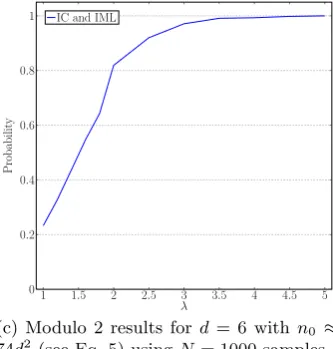
(c) Modulo 2 results ford = 6 with n0 ≈
74d2 (see Eq. 5) usingN = 1000 samples.
Fig. 1. Simulation results for the success probability of finding a representative key modulo 26, 13 and 2 in terms ofλusing ciphertexts of lengthλn0.
This can be done by modifying Algorithm 1 accordingly. Fig. 1(a) presents the simulation results for d= 5 using N = 100 samples for both IML and IC. The modulo 13 and 2 attacks have been simulated similarly. Recall that the minimum ciphertext length for these two cases aren0≈12.5d2(see Eq. (4)) andn0≈74d2
(see Eq. (5)), respectively. Figures 1(b) and 1(c) present the simulation results for d = 6 using N = 100 and N = 1000 samples, respectively, for these two moduli.
1. Our simulation results verify the superiority of using IML over IC. As we can see, IML works much better than IC to find a correct representative key over Z26 and Z13. However, it does not matter to use which one over Z2.
Using some simple calculations one can justify this by showing that IML of a string overZ2 can be well approximated as an affine function of its IC.
2. The SUWKD assumption holds quite well for the attack on finding a correct representative key overZ13andZ2as forλ≈4.5 we already reach a success
probability of almost one.
3. The SUWKD assumption, however, does not hold quite well for the attack on finding a correct representative key overZ26as forλ≈5 we reach a success
probability of only about 96%. We will explore this issue and study the reason of this phenomena in next subsection. In any case, although interesting, this does not really matter since the success probability approaches one by using a slightly larger value forλ.
6.2 Lifting a representative key over Z13 intoZ26
Fig. 2 presents the simulation results for finding a representative key modulo 26 assuming that we already know a representative key modulo 13, using the approach that was used in the “lifting attack” in Section 5.
Recall that each column of the representative key overZ13 is combined with all
2d−1 non-zero vectors over Z2 to compute a vector overZ26 using the CRT.
According to Theorem 1, the minimum ciphertext length to be able to find the representative key modulo 26 almost uniquely should be
n0≈
log2(2d)
0.1107 log226×d≈1.9d
2 . (6)
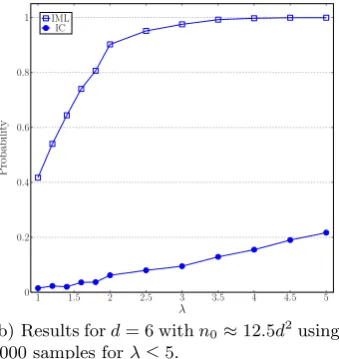
Fig. 2(a) depicts the simulation results for d= 6 using N = 1000 samples. As it can be seen, the SUWKD assumption does not hold quite well here since for finding a correct representative key we need λ to be greater than 30. Stated differently, if a wrong key is the same as the original key modulo 13, then the decrypted ciphertext using the wrong key can not be treated as a random string due to its correlation with the original plaintext. This justifies our third point in the previous subsection since 30×1.9d2>5×8.96d2.
However, luckily our attack for finding a representative key modulo 13 already requires a ciphertext of lengthn0≈12.5d2. Fig. 2(b) depicts the simulation
1 2 3 4 5 6 7 8 9 10 11 12 13 14 15 16 17 18 19 20 21 22 23 24 25 26 27 28 29 30 31 32 33 0
0.2 0.4 0.6 0.8 1
λ
Probabilit
y
IML IC
(a) Results ford= 6 withn0≈1.9d2 (see Eq. 6) using 1000 samples forλ≤33.
1 1.5 2 2.5 3 3.5 4 4.5 5
0 0.2 0.4 0.6 0.8 1
λ
Probabilit
y
IML IC
(b) Results ford= 6 withn0≈12.5d2using
1000 samples forλ≤5.
Fig. 2. Success probability of finding a representative key modulo 26 in terms of λ assuming that we already know a representative key modulo 13 using ciphertexts of lengthλn0.
6.3 Success probability of our attack
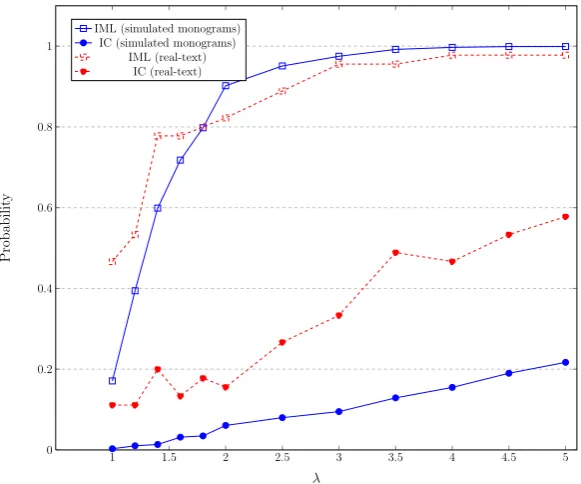
Although our attack using IML on the real-text is highly consistent with the attack on simulated text, there is a slight difference for the attack that uses IC, the reason of which is unclear to us.
1 1.5 2 2.5 3 3.5 4 4.5 5 0
0.2 0.4 0.6 0.8 1
λ
Probabilit
y
IML (simulated monograms) IC (simulated monograms)
IML (real-text) IC (real-text)
Fig. 3.Success probability of our attack (lifting attack) in terms ofλusing ciphertexts of length λn0 with n0 ≈ 12.5d2 for d = 6: the blue solid-line is for the simulated
plaintext computed as the product of Fig. 1(b) and Fig. 2(b) whereas the red dashed-line is for real text from “Alice in the Wonderland” using 45 samples.
7
Conclusion
re-sults. Beating our results or proving its optimality based on some reasonable computational complexity assumptions remains an open problem.
Acknowledgment. This work has been supported by Iranian National
Sci-ence Foundation (INSF) under contract no. 92027548 and Sharif Industrial Re-lation Office (SIRO) under grant no. G931223. The initial idea of the basic divide-and-conquer attack was proposed by the following student in an intro-ductory course in cryptography at the Department of Mathematical Sciences at Sharif University of Technology offered by the first author: Navid Alamati, Mohammad-Esmaeil Hasani, and Morteza Hasanvand. We would like to specially thank Siavash Riahi for his extensive simulation result of Section 6.
References
1. C. Christensen. Polygraphic Substitution Ciphers: The Hill Cipher, II. http: // www. nku. edu/ ~ christensen/ 1402% 20Hill% 20cipher% 20part% 20II. pdf, Ac-cessed Summer 2015.
2. L. S. Hill. Cryptography in an algebraic alphabet. In American Mathematical Monthly, pages 306–312. 1929.
3. B. Hu. Introduction to Cryptology: Hill Cipher Remarks. http: // www. cs. rochester. edu/ ~ bh/ csc290/ hill. html, Accessed Summer 2015.
4. J. Overbey, W. Traves, and J. Wojdylo. On the keyspace of the hill cipher. Cryp-tologia, 29(1):59–72, 2005.
5. D. E. Robling Denning.Cryptography and data security. Addison-Wesley Longman Publishing Co., Inc., 1982.
6. T. Siegenthaler. Correlation-immunity of nonlinear combining functions for cryp-tographic applications.IEEE Transactions on Information Theory, 30(5):776–780, 1984.
7. A. Sinkov.Elementary cryptanalysis: a mathematical approach, volume 22 ofNew mathematical library. 1966. With a supplement by Paul L. Irwin. Reissued in 1975 and 1980.
8. D. R. Stinson. Cryptography: theory and practice. CRC press, 2005.
9. V. Strassen. Gaussian elimination is not optimal. Numerische Mathematik, 13(4):354–356, 1969.
10. S. S. Wagstaff Jr. Cryptanalysis of number theoretic ciphers. CRC Press, 2002. 11. E. Wikipedia. Hill Cipher. https: // en. wikipedia. org/ wiki/ Hill_ cipher,