What Contribution Can Residential Field Courses Make to the
Education of 11-14 Year-olds?
Ruth Amos and Michael Reiss
Contact details for editorial correspondence
Michael Reiss, Institute of Education, University of London, 20 Bedford Way,
London WC1H 0AL [email protected]
Brief description of article
Residential fieldwork can have a number of benefits for science education but
teachers need to plan how to maximise these
Abstract
In this article we evaluate the effects that residential field courses had for 428
KS3 (11-14 year-old) students from 10 London schools in 2004. Teachers and
students reported that levels of motivation and participation were very high,
particularly where activities were adventure-based rather than purely
academic. Many students surpassed their own expectations of achievement
during the courses, and both students and teachers felt that the general levels
of trust in others and the self-confidence shown by the students on the
courses were higher than in school. Teachers were very impressed overall by
the development of teamwork skills amongst the students and the vast
majority of students maintained or built positive relationships with each other,
with teachers and with centre staff. However, although students generally
recognised that they had used or learnt new subject-specific skills, few
teachers had planned how to monitor the effectiveness of the learning
opportunities or how to follow them up in the longer term.
Key words
Informal learning, residential field work, personal/social impact
Learning science outside the classroom
There have long been enthusiasts for learning school science outside the classroom and in many secondary schools the ‘biology fieldtrip’ has existed
for decades. Although concerns have been expressed that fieldwork is
declining (Lock and TiIling, 2002), the last decade or so has seen a renewed
interest in learning science outside the classroom and this has manifested
itself in a number of ways (Braund and Reiss, 2004). For one thing, there has
been a very considerable growth, not just in the UK but in many other
countries too, in the educational role of such out-of-school sites of science
learning as museums, science centres, zoos and botanic gardens.
In addition, organisations such as Learning through Landscapes
(http://www.ltl.org.uk/) have helped many schools to develop the educational potential of their school grounds. Indeed, even back in 1955 the Department
of Education & Science was exhorting schools to improve their school
grounds for educational uses (Department of Education & Science, 1955).
Things have moved on a pace since then and in July 2002 the House of
Commons Select Committee on Science and Technology called for fieldwork
to be strongly recommended in all 14-19 science courses (House of
Commons Select Committee on Science and Technology, 2001).
The training of teachers, in science and other subjects, has now begun to
catch up with these developments. Since September 2002 one of the
standards for the award of Qualified Teacher Status expected of all trainee
teachers in England and Wales is:
As relevant to the age range they are trained to teach, they are able to
plan opportunities for pupils to learn in out-of-school contexts, such as
school visits, museums, theatres, field-work and employment-based
settings, with the help of other staff where appropriate,
(Department for Education and Skills, 2002/3, p. 10. Standard 3.1.5.)
However, the benefits of fieldwork, including residential fieldwork, remain
an initiative to provide residential fieldwork to 11-14 year-olds from across the
socio-economic spectrum.
The 2004 London Challenge Residential Initiative
The 2004 London Challenge Residential Initiative offered 51 schools from the
London boroughs of Hackney, Haringey, Islington, Lambeth and Southwark
the opportunity to take a group of Key Stage 3 students (11-14 year-olds)
away on a fully-funded residential course at a designated rural field study
centre in the UK or Eire. The Field Studies Council (FSC) had developed a
wide range of curriculum-linked (science, geography, PE) and eco-adventure
courses after extensive consultation with schools (FSC, 2004a; 2004b) and
with the backing of London Challenge (the Excellence in the Cities coordinator
for the Department of Education and Science (DfES)).
We were commissioned to evaluate the initiative and in our evaluation we
used a framework of questions that derived from Rickinson et al. (2004) who
proposed four possible areas of impact that outdoor learning might have:
cognitive impacts – concerning knowledge, understanding and other
academic outcomes
affective impacts – encompassing attitudes, values, beliefs and
self-perceptions
interpersonal / social impacts – including communication skills,
leadership and teamwork
physical / behavioural impacts – relating to physical fitness, physical
skills, personal behaviours and social actions.
Methodology
Thirteen courses with 428 students from 10 London schools (two from each of
the five boroughs) were studied. The students were asked to complete a
two-sided A4 questionnaire, with both open and closed questions, before and after
the course. The questionnaire (available from us) examined attitudes to
relevant subjects in school (science, geography, PE) as well as expectations
for and feelings about the course. The questionnaires were distributed and
collected by the lead teacher in each school. The intention was to give
students time to reflect upon going on and returning from the course.
The lead teachers were interviewed before and after the course. The first
interview was conducted over the telephone and its purpose was to establish the teacher’s understanding of the programme of activities as well as their
expectations for impacts on the pupils. The second interview was conducted
at school, one to four weeks after the end of the course, and concentrated on
the impacts with reference to Rickinson et al. (2004), as well as the
expectations set out by the teachers in the first interview.
In five of the schools a small focus group of students was interviewed one to
two weeks after the course. The questions concentrated on impacts with
reference to those proposed by Rickinson et al. (2004). The students were in
small groups of females and males (between three to six students in each
group). The questions used were closed and similar to many of those asked of
the teachers. All interviews and focus groups were audio-taped and
transcribed.
For each of three schools a visit of between one and two days was made to
Course descriptions
The courses sampled in this study were run at five FSC field centres in
England, Wales and Eire. Schools were offered two types of course. The first
type was more curriculum-focused. Two courses were entitled Gifted &
Talented (one geography-based; one science-based), one Real Science and
another a SATs Booster. These four courses focused on ecology or
geography (which included much that science teachers and science educators
would recognise as earth science) in the field and made some or considerable use of time in the field centres’ classrooms or laboratories to initiate or review
learning activities. Two of the science-based courses were at FSC
Nettlecombe, set on the edge of Exmoor. Students studied freshwater
habitats, identified small mammals and plants in local woodlands and visited
nearby Porlock Bay to examine coastal erosion. On the third course at FSC
Orielton on the Pembrokeshire coast, the focus was on seawater ecology. For
example, students learned how to investigate and build a profile of plant and
animal life on a rocky shore. There was a great emphasis on the students
working in groups, learning to observe, collect and record data and to ask
questions about the environments that they were in.
The second type was described as Eco-adventure, with an emphasis on
physical activities such as climbing, shelter-building and rafting-making,
intended to foster team building and problem-solving skills. Nine of the 13
courses we studied were of this type with little or no time was spent in the
classrooms / laboratories at the field centres. Instead, opportunities for
science experiences during these courses arose informally. Course tutors
guided students on walks and night hikes, drawing their attention to features
of the woodland, river valley and coastal environments through which they
were passing. These features included plant and animal life, weathering and
erosion effects and historical human impacts on the environment. The tutors
often presented the students with stories of the local areas to engage them.
Students also learnt about sustainable living (modelled extensively at all the
Findings
General feedback from the teachers
The overwhelming feedback from all 13 teachers involved in the courses was
very positive. One described the opportunity to take difficult students from
challenging backgrounds away on a residential course [as] invaluable [with]
the potential to change things. [Throughout, italics indicates the original words
of teachers / students; square brackets indicate material added by us.] All 13
teachers were explicit in their praise for and appreciation of the experiences
gained by the students at each centre. One stated that the centre experience
enabled students to understand the relationships between human impacts on
the environment, the history of the area and conservation issues in a far more
accessible way than at school. Several felt that the course was a great
opportunity for students and teachers to work together in a more relaxed,
open way. One celebrated the fact that the course had enabled us to see a
great potential in inner city kids which is often not so apparent in school. One
teacher described an immediate effect back at school, saying things are very
different with difficult kids now they are back. They are sitting (in class) right in
front of me, getting on, encouraging others. Other staff have noticed a
difference. Another hoped that London Challenge might make it possible for
every student in a year group to have this experience – imagine the
possibilities.
More detailed feedback from the teachers can be seen using the four potential
types of impact identified by Rickinson et al. (2004).
Cognitive impacts
All 13 teachers identified learning opportunities on the course within the
national curricula for science, geography or PE. The most frequently cited
human use of land and team building (specifically in PE). However, 10 of the
teachers were unable to give specific examples of knowledge or
understanding gained by students, as they did not focus on or record detailed
learning outcomes during the courses. The exceptions were the teachers of
the group at Rhyd-y-creuau where detailed worksheets were provided for
each activity on which students wrote descriptions, and recorded and
analysed data. The accompanying teachers (two geography and one science)
had planned the course with the centre tutors and contributed greatly to the
taught sessions.
Students on the two curriculum courses at Nettlecombe wrote extensive notes
about the ecology they were about to experience while a course tutor
presented the science underpinning each activity. Students then recorded
results / findings on individual worksheets on returning from the field. The
students on the other sciencecourse and the geography course recorded
observational data. Indeed, at key points on all the courses, students were
required to read instructions, gather information and use other resources
(such as maps) linked to activities and thereby to develop literacy and
numeracy skills. Students in two groups wrote in journals at the end of each
day.
Four teachers specifically commented on the positive effect the hands-on,
active learning style had on the engagement and learning of students and
suggested that learning was more effective because of this practical
approach. The emphasis on adventure activities into which learning
opportunities for ecology / geography were woven was mentioned by several
teachers as a very important factor: the trip was not sold as geography or
science, but as adventure to the students so there was less resistance to the
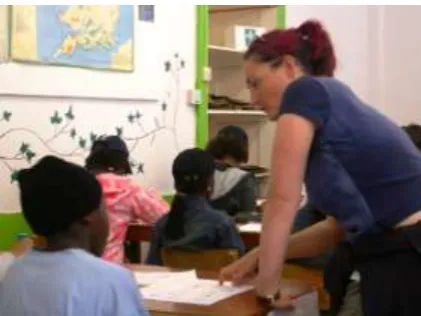
academic parts. Students were mostly observed working in a focused and
purposeful way throughout classroom / laboratory sessions (Figure 1).
However, the teachers with two groups were concerned that sessions were too long at some points during their courses so that students’ levels of
Figure 1 Students working purposefully in the science laboratory at
Nettlecombe.
Only one teacher planned to use work carried out on the course directly back
at school. Another teacher wanted to build upon teamwork skills in PE using
examples from the course. Most other teachers could identify opportunities to
link the work to the science / geography curricula but were a little unclear
about how they would pursue this saying, for example, I will let the science
department know what we did. However, no teacher had a clear, purposeful
plan of how to monitor the longer-term benefits of the knowledge and
understanding that the students may have gained during the course or of how
it might be measured. This was possibly as a result of courses being booked
at short notice. Some referred tentatively to GCSE results as a possible
indicator. Accordingly, the actual longer-term cognitive impacts of the courses
on the students will be difficult to assess.
Only two schools did any preparatory academic work before the courses. One
of these schools conducted some ecology lessons; another did a small
amount of introductory geography work. In fact, several teachers advocated
the element of surprise / anticipation inherent in taking students away to learn
and did not want to dilute that by preparing activities at school.
Five groups had asked / were planning to ask students to contribute to
displays, newsletters and presentations in assemblies or simply to write an
account of their experiences back at school. Two groups of students were
Affective impacts
Teachers reported that students’ attitudes towards participation in the
activities were very good. Six felt that it was markedly different there. More
students were more willing, more active. There was a much higher level of
motivation. Others reported that the students’ enthusiasm was just as strong
as in school. Students received an immense boost to their self-esteem and
confidence when they realised they were achieving well alongside those who
normally do so more visibly at school. One Head of Year in a second interview
noted that several students had re-identified themselves within their classes
back at school and were now seemingly far more confident amongst their
peers. Students’ attitudes to being in very rural environments were generally
extremely positive.
Interpersonal and social impacts
Nine teachers noted that students’ levels of trust in one another improved over
the course. Generally, students readily accepted that rules were necessary for
safety, success and respect. Eleven of the 13 groups were made up of
students who did not necessarily know each other well before the trip,
although very rarely did a student not know anyone else. All teachers
observed new friendships being formed among students and one Head of
Year noted in the second interview that students are subsequently interacting
back at school and the trip has initiated this. She hoped that the group will
infiltrate the whole year and foster better relationships generally as students
move into Year 9. Teachers were extremely pleased with the development of
teamwork skills that students negotiated whereas they wouldn’t in school.
Most teachers felt that the impacts on males and females were very similar on
also friendlier, more open interactions between males and females than at
school. Three teachers felt that some girls had demonstrated better
organisational / leadership skills at key moments than boys, often leading to
more successful outcomes. No other particular groups, such as ethnic
minorities, were seen as having experienced different impacts. Two teachers
mentioned that for cultural or religious reasons some students, particularly
girls, would not attend residential courses at all.
Physical and behavioural impacts
Two teachers felt that most of the students were physically fit, five that the
fitness varied across the group and two (one of whom was a Head of PE) that
they were not very fit. All students could access all the activities, although
teachers reported that some overweight students found the walking difficult
and a few struggled with climbing. Difficulties with walking may have been
partly due to lack of motivation as some of the same students performed very
well over the same distance during orienteering.
Teachers were generally pleased with the emphasis on developing key
physical skills. They cited surfing, canoeing and horse riding as very popular
activities and they felt that stamina, balance, swimming and upper body / arm
strength were all developed in specific sessions.
Teachers reported many examples of students surpassing their own
expectations of what they might be able to achieve during key activities. Many
of the water-based activities were a big challenge for some. Almost without
exception, students did achieve success and received an enormous boost to
their self-esteem.
Most teachers recognised that where there had been a combination of
academic / adventure activities, students appeared to have enjoyed the
adventure ones more. All teachers commented that students’ behaviour was
as good as, and often better than, at school. There were some minor
General feedback from the students
Three hundred and ten before questionnaires were received from 11 groups
and 203 after questionnaires from 11 groups. Only 8 of the 13 groups returned
both before and after questionnaires. Many students did not complete all the
open response questions in either the before or after questionnaire and a very
small number of students ticked only one column for almost every question.
Information has been aggregated to describe the overall findings as no school
managed to provide complete sets of data for every student.
A t-test comparison was applied to each of the closed questions, for females
and males separately, to ascertain whether the courses had significant
impacts on their attitudes towards science, geography, PE and so on. Most of
the values of t revealed no significant difference. Only one of the comparisons
for boys and five for girls have before and after means that differ significantly
at the p 0.05 level (i.e. there is at most a one in twenty probability that the
difference could be due to chance). The overall shortage of significant
changes may be due to the fact that the mean scores before the students
participated in the courses revealed that they already felt generally positive
about their abilities and generally confident about the trip.
On one course, girls felt more confident about participating in group work after
the course, realising that listening skills are more important than they had
previously thought. On another course, girls felt that they had become more
effective members of a team in sports and were more confident in new places
but felt that listening well was less important than they had previously thought.
On one course, the boys actually said after the course that they enjoyed
geography less than before but this may have been due to their not
appreciating the connection between school subjects and the eco-activities at
the centre. The girls on one course, however, now felt more confident in new
The answers to open questions have been used to provide overall quantitative
data on the expectations for and impacts of the courses. The data for the
specific, curriculum-focused questions have been collated as appropriate for
each type of course. The percentage values quoted are based upon the
number of questionnaires received and, where applicable, upon the number of
responses made to each question.
The overwhelming response of the students participating in all courses was
very positive. Ninety seven percent of students who responded stated that
they had enjoyed their course (although 11% of these had a least one
reservation). Eighty three percent would definitely go on a similar trip again –
I’d love to go again –and a further 10% would go if some changes were
made. Suggested changes included better food, choosing their own room,
more free time, less school work. Many students welcomed the opportunity to
do new things, be in nature, to get to know people in school better. They
described the courses as brilliant / amazing / wonderful, the best school trip
ever, a great time, fun, interesting and educational, I will never forget it.
Students in one group expressed the most doubt about going on another trip,
most citing too much work as the main reason. This may have been as a
result of the course taking place after the end of the summer term.
More detailed feedback from the students is summarised below within the four
impacts defined by Rickinson et al. (2004). Comparisons have been drawn,
where possible, between student expectations before the course and how
they felt afterwards. While the main interest, for many science teachers and
educators, is likely to be on the cognitive impacts of field courses, affective,
interpersonal / social and physical / behavioural impacts are important for a
number of reasons, not least because the evidence suggests that unless
these impacts kick in, cognitive expectations are not met.
Cognitive expectations and impacts
Before the courses, about 7% of students were looking forward to learning
memories of the experience. Only 1% of responses referred to learning
something new. Beforehand, the majority of students (76%) were able to
describe at least one skill or area of knowledge from geography, science or
another appropriate curriculum area that they might need to use on the trip.
The examples given included map and compass work, orienteering, ecology,
experiments, investigations and observations.
Over half (56%) could suggest at least one new area / skill that they would
learn about map skills, orienteering, the environment / science outdoors,
animals / plants. On the four curriculum-focused courses, students were often
more specific: identification of animals, setting mammal traps, habitats,
freshwater animals, coastal erosion, mapping and navigation.
After the courses, 78% described at least one skill or area of knowledge from
geography, science or another appropriate curriculum area that they needed
to use, and examples closely matched those that they had expected: map
work, ecology, orienteering. Some new areas emerged including rocks /
fossils, classification or chemistry for some groups.
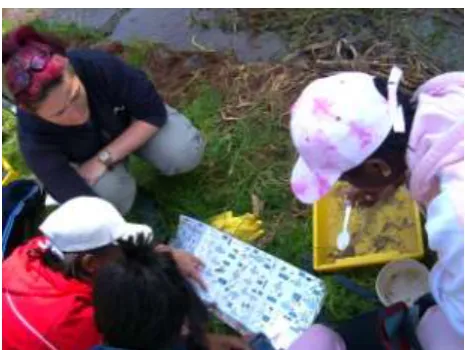
Students in one group were observed carrying out a freshwater ecology study
at Nettlecombe (Figure 2). Initially, the small stream to which they were led in
the grounds visibly unimpressed them. However, when it brought forth a great
variety and number of invertebrates and fish they were totally enthralled. The
extent to which they were able to observe and classify the animals was in
dramatic contrast to the work that they would probably be able to do in their
Figure 2 Freshwater ecology at Nettlecombe.
The following are a sample of science-based questions asked of the students
who went to FSC Rhyd-y-creuau in North Wales before and after their
experiences:
1. If you can, describe how soil is formed.
Only seven appropriate responses were made before the course,
talking about, for example, decomposed things, erosion and
weathering. However,after the course 13 appropriate responses were
given.
2. What effects might a river have on the landscape?
While all the students could give a suitable response before the course
using terminology such as erosion and fertile land, after the course,
more specific, geological terms such as abrasion, U-shaped valleys
and transport were apparent in answers.
3. In Snowdonia, where you are going / have been, how were many of
the mountains formed?
Only four responses were given before the course, citing three factors:
plate collision, during ice age and glaciers. Afterwards, there were 19
responses, citing five factors: glaciers, plate tectonics, volcanoes,
mountains was initially under the sea and land was initially under the
This suggests that by the end of the course, students had gained more
knowledge about these earth science learning outcomes.
Affective expectations and impacts
Eighty five percent of students stated that they generally felt positive before
going on the trip about going on it, making such comments as I feel very
excited, I feel great / good, I can’t wait, I feel (very) confident. Nine percent felt
neutral and 6% expressed some reservation: I feel a bit nervous / scared /
anxious.
When asked before going on the tip if anything worried them about it, 53% of
students expressed a specific concern such as I’m worried about not being
able to do things / getting lost / getting hurt / the long journey / insects and
spiders / animals. Very few (four) students were specifically worried that they
might not be safe. After the course, 41% of students stated that there had
been a specific problem during the trip such as argued with friends, strange food, fell off [something], couldn’t climb, didn’t want to wear cold wetsuit, bus
late after surfing, was ill, lost something, bitten by midges, rained too much,
students from other places were rude, foul smells, problem with room /
showers, journey too long. Of these, about half felt that some solution had
been found where that had been possible.
Interpersonal or social expectations and impacts
The vast majority of students could suggest examples of the factors needed to
promote effective teamwork with co-operation, listening well, good
communication and being friendly constituting about 80% of the ideas. A
smaller number cited respect, agreement / no arguing, practical / logical,
ability, leadership, positive encouragement, good behaviour, concentration
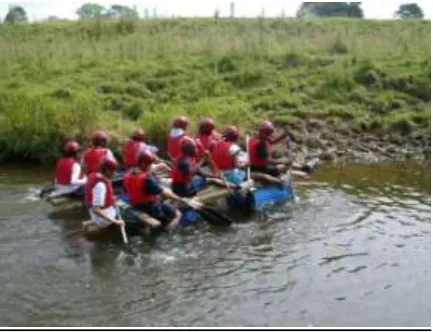
Eight six percent of responses after the course suggested that teams had
worked well together the whole time (see Figure 3) with a further 7%
describing effective teamwork as happening sometimes. The most important
success factors observed by the students were listening well, co-operating,
helping / supporting one another,which matched well with those expected.
Figure 3 Team building at Castle Head.
Physical or behavioural expectations and impacts
About 80% of the students were aware that they would be learning new
physical skills such as surfing, canoeing, climbing and horse riding but 16%
could not identify any and a small proportion (3%) thought that they would not
learn any new skills. After the course, 66% identified a new physical skill that
they had learned such as climbing, horse riding, canoeing, surfing or hill
walking,and several mentioned improving skills in football and building
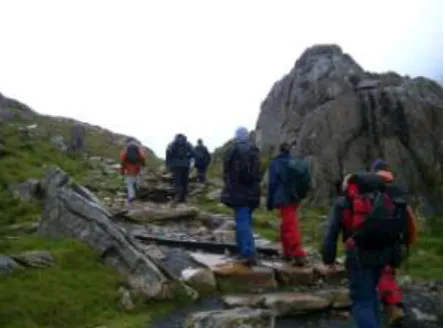
stamina. A few students felt that the hill walking had been an unwelcome
challenge: why did we do the walk? However, others (Figure 4) were actively
engaged in observing geological features, listening to the history of land use
as well as noticing social implications of living in rural areas: I can’t believe
Figure 4 Climbing Snowdon.
Discussion and recommendations
Residential fieldwork has great potential to enhance learning in school science
and other subjects. In this study the teachers readily acknowledged the
opportunities for academic learning. However, although students generally
recognised that they had used or learnt new subject-specific skills few
teachers had planned how to monitor the effectiveness of the learning
opportunities or how to follow them up in the longer term.
Both teachers and students reported that levels of motivation and participation
were very high, particularly where activities were adventure-based rather than
purely academic. In a number of cases the second interviews with the
teachers showed that these positive effects had continued back in school. This ‘diffuse’, non-subject-specific effect of residential fieldwork will likely ring
true to anyone who has run residential trips but probably needs further
investigation.
Several teachers noted that students’ self esteem was boosted during
challenging activities, especially for students who are more reluctant to take
part in school-based work. Many students surpassed their own expectations
of achievement during the courses, and these achievements were often
Students and teachers felt that the general levels of trust in others and the self
confidence shown by the students on the courses were higher than in school.
Teachers were very impressed overall by the development of teamwork skills
amongst the students and the vast majority of students maintained or built
positive relationships with each other, with teachers and with centre staff.
Based on these findings we propose the following recommendations for
undertaking residential, science-related fieldwork with 11-14 year-olds:
Teachers need to liaise fully with residential course staff and tutors to
plan the content of courses effectively for their students.
Curriculum-based activities need to be balanced with adventure and/or
social activities to ensure that student motivation is high. For example:
a rock-climbing activity might precede an investigation into weathering
and erosion; students might design and build a raft after examining the ecology of the river nearby. The ‘story’ of the science of the local area
then begins to make more sense.
After a course, work back in school needs to build on the science that
has been learnt on the course. Much that is learnt on fieldwork courses
can easily be woven into units of ecology and earth science at KS3 for
Years 7, 8 or 9. This includes looking at a wide range of habitats, at
food webs and at the rock cycle. As science teachers and educators
we can also learn from our geography colleagues and use fieldwork to
promote Sc1 skills in preparation for KS3 SATs and GCSE coursework.
Contact with and feedback from parents is useful to assess the impacts
of courses. Parents can also explain the cultural / religious implications
of residential visits which are important for some families.
More work is still needed to assess the longer-term impacts of
fieldwork.
References
Braund, M. & Reiss, M. J. (Eds) (2004). Learning Science Outside the
Department of Education & Science (1955) Building Bulletin, Department of
Education and Science, London.
Department for Education and Skills (2002/3) Qualifying to Teach:
Professional Standards for Qualified Teacher Status and Requirements for
Initial Teacher Training, Teacher Training Agency, London. Available at
www.tta.gov.uk/qualifyingtoteach
Field Studies Council (2004a) London Challenge: Interim Report on Key
Stage 3 residential courses, Field Studies Council, Preston Montford.
Field Studies Council (2004b) Questionnaire survey: Report on Key Stage 3
residential courses in London Boroughs (excluding Islington, Haringey,
Hackney, Lambeth and Southwark), Field Studies Council, Preston
Montford.
House of Commons Select Committee on Science and Technology (2002)
Third Report: Science Education from 14 to 19, Stationery Office, London.
Lock, R. and Tilling, S. (2002) Ecology fieldwork in 16 to 19 biology. School
Science Review, 84(307), 79-87.
Ruth Amos is a researcher and PGCE co-ordinator and Michael Reiss
professor of science education at the Institute of Education, University of
London.