Automatize parameter tuning in Ring-Learning-With-Errors-based
leveled homomorphic cryptosystem implementations
Vincent Herbert
??
Abstract. Lattice-based cryptography offers quantum-resistant cryptosystems but there is not yet official recommendations to choose parameters with standard security levels. Some of these cryptosystems per-mit secure computations and aim at a wider audience than cryptographic community. We focus on one of them, a leveled homomorphic cryptosystem (LHE): Brakersi/Fan-Vercauteren’s (BFV) one. The family of LHE cryptosystems needs to be well-instantiated not only to protect input and output ciphertexts and to perform efficiently computations, but also, for them, parametrization constrains the quantity of homo-morphic computations that can be performed with guarantee of correctness. It demands to choose parame-ters accordingly. In addition, each implementation brings external constraints to optimize performance. All of this makes it tedious for the non-expert user to choose parameters. To solve this, we have developed CinguParam to help user to instantiate implementations of BFV in different libraries: Cingulata, FV-NFLlib
and Microsoft SEAL (release 3.3). CinguParam permits to generate an up-to-date database of parameter
sets in function of computation budget, security parameters and implementation choices. This tool includes a notion of budget to ensure correct homomorphic computations and the one of BKZ reduction cost model to grasp the gap from concrete security, nowadays. It makes use of the LWE-Estimator to obtain up-to-date secu-rity estimations. CinguParam permits to select automatically a suitable parameter set with Cingulata and it
can be used to generate code snippets to set parameters with FV-NFLlib and Microsoft SEAL (release 3.3).
1
Introduction
Homomorphic encryption offers services to manipulate encrypted data without having access to their associated clear form. As data are encrypted from the beginning to the end of the process, it permits for instance, to share private data with powerful servers in order to delegate costly computations and to get valuable results. But choosing cryptographic parameters is a challenging task in homomorphic cryptography [1] based on the LWE (Learning with Errors) problem [2]. If parameters are inapropriately chosen, not only the attackers could access the data or the key, but also the result of homomorphic computations could be wrong.
In this document, we focus on parameters for the BFV (Brakerski/Fan-Vercauteren) [3,4],Leveled Homomorphic Encryption (LHE) scheme, based on the Ring-LWE problem [5], which has multiple open-source implementations [6,7,8,9] in C++.
We have developed CinguParam [10], a tool to ease the choice of parameters in such implementations. We propose different parameter settings rather than fixing one parameter set, in order to propose to the user different choices so that he could get the best set according to his precise needs. It aims to generate correct and secure parameters sets to perform homomorphic computations. It contains a database of parameter sets (see 4.1) which can be easily extended, if needed. In terms of security, LWE attacks are currently the best ones [11, p.8] against Ring-LWE-based cryptosystem. CinguParam makes use of the LWE-Estimator [12] which estimates an up-to-date security of LWE instances. We point that today, nobody has definitive concrete security parameter for lattice-based cryptosystems. Our tool helps to follow research progress. Indeed, there is still some way to go for that:
– Security reduction between lattice problems and LWE problem is not tight for lattice with dimension n <
187149 (less than 18 bits) [13].
– The best practical attacks (primal and dual ones) against Ring-LWE make use of BKZ-type algorithms em-ploying enumeration or sieving algorithms. Their cost is unknown, there exist many BKZ cost models [14]. – For most of the models, security estimation is a lower bound under some hypotheses [14]. These are pessimistic
views from the defender side.
– There are several recent progresses to better understand and estimate security against LWE attacks, for instance [13,15,16].
Our tool CinguParam permits to compare the impact of parameter choices for homomorphic computations and to measure the uncertainty on concrete security level, at this stage, in the cryptographic community.
In Section 2, we establish notation for BFV scheme. In Section 3, we provide algorithms used to generate suitable parameters for BFV, and introduce a vocabulary with the willingness to clarify process with a high-level perspective. CinguParam could be extended to determine parameters for other schemes implementations. In Section 4, we present and analyze our experimental results in two parts: we consider CinguParam in standalone mode first, then we combine it with existing tools: Cingulata, FV-NFLlib, Microsoft SEAL (release 3.3).
2
Scheme parameters
Let us begin to categorize the different parameters of BFV scheme. We employ them in algorithms to gener-ate secure parameters (see Section 3) that can be employed to process correctly a predetermined quantity of homomorphic computations.
BFV is a scheme based on a variant of LWE where data (plaintexts and ciphertexts) are in a polynomial ring. Let the defining polynomialf be a 2-power cyclotomic polynomial.
– ciphertext coefficient countn
– ciphertext modulusq
– Gaussian (noise/error) widthσ
– private key distributionχ overZ[X]/(f)
We retain two approaches to determine Gaussian noise widthσ. Note that the first one depends on nand is hardness-reduction compliant [17,18]:
σ=
2√nasymptotic approach 8
√
2π performance approach [19,20]
Default choice ofσ depends on cryptosystem implementation choices, it is indicated in Table 1.
2.1 Correctness parameters
Informally, each circuit1 to be evaluated by the homomorphic encryption scheme is associated to a circuit cost depending on the cost and on the order of evaluated operations. Circuit budget defines the family of circuits that can be operated over fresh ciphertexts (the ones which are obtained directly from encryption, i.e., without any previous homomorphic operations), the ones whose cost is less than the budget. There exist several approaches to define and estimate operation costs (see Section 3). They depend on:
– the homomorphic scheme – the circuit budget
– the multiplicative depthL
– the plaintext modulust
Relinearization Method 1
– integer baseω for gadget decomposition [21], also called decomposition bit count
Relinearization Method 2
– relinearization integerk
– Bk bound on relinearization error distribution
– ciphertext relinearization modulusp
1
Cingulata take into account Boolean circuits whereas FV-NFLlib and Microsoft SEAL (release 3.3) perform
2.2 Security parameters
There is not yet satisfying solution to choose tightly parameters with a given security level for LWE-based ho-momorphic cryptosystems. This drives us to decline several notions around security levels, in order to highlight current situation.
– desired security levelλ0
– BKZ lattice reduction cost model – estimated security levelλ(cost model)
– approximated security levelλ1(cost model) (see Table 3
– tolerance between desired and estimated security levels. Indeed, there can be important gaps between them. Implementations constraints restrain flexibility on parameter choices (e.g., n is a power of two). Other con-straints are indicated in Table 1.
– compatibility with Regev quantum security reduction proof [17] which impacts on Gaussian noise widthσ
– number of LWE samples (n,q,relin param)
– success probabilityin distinguishing attack on LWE decision problem [22]
3
How to generate up-to-date, correct and secure parameters?
To derive parameters setting for LHE cryptosystems [23] is not a trivial question:
– Security based on variants of LWE is a burning issue. It asks more than ever to keep informed about crypt-analyses results.
– Correct decryption is an additional constraint with LHE cryptosystems compared to traditional cryptosystems. The quantity and the nature of operations that will be operated over the fresh ciphertexts must be known before parametrization. This is a strong constraint.
– Performance is an open problem, as we want to ensure concrete secure computations (e.g., homomorphic computations) in everyday life (see Table 2).
CinguParam makes use of the LWE-Estimator [12] to estimate security against LWE attacks. The LWE-Estimator is also used to generate (n, q) parameters in a document provided by the consortium HomomorphicEncryption.org [19]. This document offer recommendations which consist in tight LWE attack cost estimations based on BKZ Sieve and Q-Core Sieve cost models (Table 4). These recommendations are independant with the scheme used and with implementation choices (Table 2). In particular, it does not take into account noise growth which depends on the chosen scheme and thus do not consider correctness as required for LHE cryptosystems. This explains why for same n, their parameters offer better security levels with smallerq, what may seem counterintuitive [19, pp. 26-29].
Correct decryption depends on (noise/errors) added deliberately during encryption and amplified during each homomorphic operations to the ciphertexts in order to preserve confidentiality. Too much noise leads to decryption failures. Noise is a central notion in LWE-based cryptosystems. Ciphertext noise can be defined pessimistically (from the defender point of view) as the infinite norm of a polynomial which takes part in decryption step. It has different definitions[24, p.11]. Its computation requires the secret key [25]. For practical usage, with a private circuit, we use conservative upper bounds on the circuit noise. The choice of noise definition does not tighten significantly the bound to determine the quantity of secure computations we can operate correctly. In the current version of CinguParam, we employ theinherent noise as in the original paper [4].
We define the following terminology:
– max encryption noisefor an upper bound on the noise of a fresh ciphertext,
– max decryption noisefor an upper bound on the noise allowing a correct decryption,
– max circuit noisefor an an upper bound on the noise after evaluating a homomorphic circuit. – max relin noisefor an an upper bound on the noise after relinearizing a ciphertext.
The ratio
max decryption noise(scheme)
max encryption noise(scheme)
Algorithm 1:GenerateParam(politic, L, cost model, λ0, t, gen method)
f irst pass=T rue
(n, q) = (n0, q0)
σ, χ, , relin method←politic
if gen method=M inCorrectM odulusthen
whilefirst pass or estimated security is inadequate do f irst pass=F alse
q=M inCorrectM odulus(n, σ, χ, , L, t, relin param)
noise rate=σq
λ= LWE-Estimator(n, q, χ, noise rate, nr samples,
cost model)
n=n×2
n=n/2
else if gen method=M inSecureDegreethen
whilefirst pass ormax circuit noise≥max decryption noisedo f irst pass=F alse
(n,σ
q, λ) =M inSecureDegree(q, λ, χ, cost model, relin param,
security reduction)
max encryption noise(scheme)
max circuit noise(scheme, circuit)
max decryption noise(scheme)
q=q×scale q=q/scale
Algorithm 2:MinSecureDegree
n=n0
f irst pass=T rue
whilefirst pass or estimated security is inadequate do f irst pass=F alse
noise rate=σ q
λ= LWE-Estimator(n, q, χ, noise rate, nr samples,
cost model)
n=n×2
n=n/2
return(n,σ q, λ)
Algorithm 3:MinCorrectModulus
q=q0
f irst pass=T rue
whilefirst pass ormax circuit noise≥max decryption noisedo f irst pass=F alse
max encryption noise(scheme)
max circuit noise(scheme, circuit)
max decryption noise(scheme)
q=q×scale
// scale depends on implementation constraints and modify generation time, database size
The BFV case
Maximal noise in a fresh ciphertext and maximal noise of a (homomorphic) ciphertext have been computed in [26] for some ring-LWE-based LHE schemes. In particular for the BFV scheme [3,4], noise growth has been well described in [27]. We only recall its bound (Equation 1) to compute maximal circuit noise after evaluating a circuit of given multiplicative depthL. In practice, two difficulties with BFV scheme occur:
– Multiplicative depth does not take into account noise growth caused by additions. How to take it into account to avoid incorrect decryption? This could be done by evaluating the variance of the noise at the end of the circuit rather than the infinite norm. This would be more optimistic, from the defender point of view. – In most of the cases, multiplicative depth is sufficient to ensure correct decryption. But still, how to determine
multiplicative depth? This question is solved with Cingulata compiler toolchain and runtime environnement [8]. It is employed with CinguParam, see Section 4.2 and serves to automatize parameter choice. This imple-mentation focuses on binary ciphertexts manipulated with Boolean circuits and permits to interact easily with CinguParam. It is not done in implementations using arithmetic circuits, in our knowledge.
In the BFV scheme, the simplest way to determine the noise budget is derived from the multiplicative depth
L. Let us recall, L is the maximal number of multiplications between any input and any output of the circuit we operate to evaluate secure computations. In the case of homomorphic encryption, inputs and outputs are ciphertexts.
In a more general setting, noise growth does not necessarily depend on the multiplicative depth. For instance, with the TFHE scheme [28], the focus is directed on the number of gates.
max encryption noise(BFV) =Berror(, σ)(1 + 2δB key) (1)
whereδis the polynomial multiplication expansion factor,i.e., max{ ka×bk∞
kak∞kbk∞ :a, b∈Z[X]/(X
n+ 1)},B
error(, σ) = √
2erfc−1()σ and Bkey are respectively an upper bound on the error distribution (resp. the private key
distri-bution). The function erfc is the complementary error function and the quantity denotes the distinguishing attack advantage on LWE-decision problem, i.e., the statictical distance within noise distribution and Gaussian distribution. For short, noise distribution is bounded byBerror(, σ) with probability 1−.
max circuit noise(BFV, L) =XL×max encryption noise+L×XL−1(Y +max relin noise)
with
X =δt(4 +δBkey),
Y =δ2Bkey(Bkey+t2)
and
max relin noise(BFV) =
δ×
log(q) log(ω)
×ω×Berror(, σ) ifrelin param= 1
q×Bk×δ
p +
δ×Bkey+ 1
2 ifrelin param= 2
A ciphertext is well decrypted if the circuit noise is smaller than the decryption noise. Circuit budget is used to generate secure and correct parameters with CinguParam. To ensure correct decryption, it has to be greater than decryption cost.
We can extend the vocabulary, similarly to [25], to express intuitively noise constraints:
– min decryption cost, the minimal cost to ensure correct decryption, – min circuit budget, the minimal cost of the circuit evaluation,
max circuit noise(BFV, L) =w
min circuit budget(BFV, L) =−log22w
max decryption noise(BFV) = q
t
−(q modt) 2
min decryption cost(BFV) =−log2( jq
t
k
Parameters must fulfill these equivalent conditions to ensure a correct result after decryption:
max circuit noise≤max decryption noise (2)
min circuit budget≥min decryption cost (3)
Implementation politic Cingulata BFV SEAL BFVa FV-NFLlib
ciphertext modulusq power of 2 upper bounded
bproduct of distinct primes product of particular primescof size of the type
each prime congruent to 1 modulo 2n(NTT multiplications)dused to store the polynomial (i.e., 16,32 or 64 bits) minus two
plaintext modulust 2 ≥2 (integer encoder) ≥2
a prime congruent to 1 modulo 2n(batch encoder)
default Gaussian noise widthσ 2√n 3.2 3.2
standard deviationσ√2π 2√2πn 8 8
statistical distancewithin
2−64 2−28 2−128 (see [29])
noise distribution and Gaussian distribution
noise max widthBerror(, σ) 10σ(as recommended in [4]) 6σ 14σ
private key distributionχ uniform distribution in{0,1}
n
uniform distribution in{−1,0,1}n noise distribution
with Hamming weight 63
compatible with Regev’s security reduction yes no no
relinearization method [4] 2 1 1
Table 1. Implementation politics are parameter constraints in different implementations of BFV scheme. The parameter
nis the ciphertext polynomial degree, a power of two, for performance reason.
a
Up to release 3.2 of this library, ciphertext modulus bitsize is restricted to multiple of 10. This impeaches tight parametrization in a similar manner as FV-NFLlib, in Table 2.
bSee the file native/src/seal/util/hestdparms.h in Microsoft SEAL (release 3.3) for upper bounds on size depending on
modulus degree. c
See the file include/nfl/params.hpp for exact form in FV-NFLlib library d
The congruence is required for batching with CRT.
4
Analysis and presentation of experimental results
4.1 CinguParam in standalone mode
CinguParam permits to:
– generate and store a database of parameter sets for different
• desired levels of security
• multiplicative depths
• implementation politic
– estimate with hindsight the security of parameter sets against LWE attacks
Input parameters Database contains files whose names indicate main input parameters in the following order:
– The circuit multiplicative depth, an integer 0≤L≤20 – The BKZ lattice reduction cost model (see Table 4) – The approximated security levelλ1(80,128,192,256) – The plaintext modulust(see Table 1)
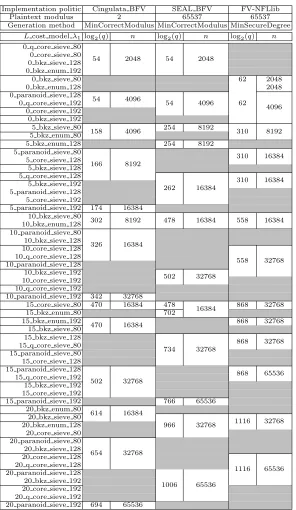
Implementation politic Cingulata BFV SEAL BFV FV-NFLlib Plaintext modulus 2 65537 65537 Generation method MinCorrectModulus MinCorrectModulus MinSecureDegree
Lcost modelλ1log2(q) n log2(q) n log2(q) n
0 q core sieve 80
54 2048 54 2048 0 core sieve 80
0 bkz sieve 128 0 bkz enum 192
0 bkz sieve 80 62 2048
0 bkz enum 128
62
2048 0 paranoid sieve 128 54 4096
54 4096
4096 0 q core sieve 192
0 core sieve 192 0 bkz sieve 192 5 bkz sieve 80
158 4096 254 8192 310 8192 5 bkz enum 80
5 bkz enum 128 254 8192 5 paranoid sieve 80
166 8192
310 16384 5 core sieve 128
5 bkz sieve 128 5 q core sieve 128
262 16384
310 16384 5 bkz sieve 192
5 paranoid sieve 128 5 core sieve 192
5 paranoid sieve 192 174 16384 10 bkz sieve 80
302 8192 478 16384 558 16384 10 bkz enum 128
10 paranoid sieve 80
326 16384 10 bkz sieve 128
10 core sieve 128
558 32768 10 q core sieve 128
10 paranoid sieve 128
10 bkz sieve 192 502 32768 10 core sieve 192
10 q core sieve 192
10 paranoid sieve 192 342 32768 15 core sieve 80 470 16384 478
16384 868 32768 15 bkz enum 80 702
15 bkz enum 192
470 16384 868 32768 15 bkz sieve 80
15 bkz sieve 128
734 32768
868 32768 15 q core sieve 80
15 paranoid sieve 80 15 core sieve 128 15 paranoid sieve 128
502 32768
868 65536 15 q core sieve 192
15 bkz sieve 192 15 core sieve 192
15 paranoid sieve 192 766 65536 20 bkz enum 80
614 16384 20 bkz sieve 80
966 32768 1116 32768 20 bkz enum 128
20 core sieve 80 20 paranoid sieve 80
654 32768 20 bkz sieve 128
20 core sieve 128
1116 65536 20 q core sieve 128
20 paranoid sieve 128
1006 65536 20 bkz sieve 192
20 core sieve 192 20 q core sieve 192
20 paranoid sieve 192 694 65536
Table 2.Some parameters from CinguParam database for different politics and plaintext moduli. Let us recall, ciphertexts
are represented by polynomials of degreenwith coefficients of bitsize log2(q), in BFV cryptosystem. Computation budget
(multiplicative depth, in this case) has an important impact on memory/time cost. Different files have same parameters,
the approximated security levelλ1 reflects the degree of pessimism/optimism of each BKZ cost model and the difficulty to
determine security level compared to traditional cryptosystems.
Security and correctness In general, security strength is defined in terms of bit of security (e.g., 80 for legacy standard protection level, 128 for security at least ten-years, 192 for long-term protection). For post-quantum systems, 5 different categories [30, pp.15-19] have been defined by NIST because of uncertainties on security estimations. The first approach is known from a wider audience. For this reason, we make use of it, in CinguParam.
exist many models in the literature2. Each model correspond to a bound on the cost of BKZ-family lattice reduction algorithm. There exist important gaps between estimations as shown in [14]. In other words, it is not possible to obtain desired security level with certitude, we only have estimations according to a BKZ cost model.
The database in CinguParam contains parameter sets considering this selection of BKZ lattice reduction cost models and can be extended for any model of your choice. It is stored in xml files. We select five cost models which are commonly used in the literature. They are given in Table 4 from the most optimistic to the most pessimitic, from the defender point of view.
Security is estimated a priori against primal attack [11] via uSVP. A posteriori, we estimate security against dual-lattice attack and small/sparse secret variant [31] as well as lattice decoding attacks [32]. All estimations are operated with LWE-Estimator [12].
In addition, homomorphic cryptosystem is costly in terms in performance. This forces to reduce the parameter range to lessen costs. For instance, the ciphertext polynomial degree is a power of two. This kind of restriction prevents to have a parameter set with a chosen security levelλ(cost model).
To face the situation, we associate a desired security level with an interval of estimated security in Table 3.
Estimated security range Approximated security level
J80,128−tolerance gapK 80 J128−tolerance gap,192−tolerance gapK 128 J192−tolerance gap,256−tolerance gapK 192 J256−tolerance gap,312K 256
Table 3.There is a gap between concrete security and desired security in lattice based cryptography. For the time being, we only associate an approximated security level with an estimated security range. Estimations are bounds on attack cost
given a BKZ lattice reduction cost model. Arbitrarily, we choosetolerance gap= 8 during database generation. This can
be easily modified if desired.
BKZ cost models Short description Reference
BKZ Enum Enumeration algorithm prevail for dimension<70, sieving one for greater dimensions. [33, Table 4] BKZ Sieve The number of calls to an SVP oracle is polynomial and estimated heuristically. [34, Figure 3] Core Sieve (mode classical) Core models evaluate one call to an SVP oracle
[11] Q-Core Sieve (mode quantum) The attacker benefit from Grover’s search algorithm
Paranoid Sieve (mode paranoid) Best plausible attack cost
Table 4. Default BKZ lattice reduction cost models in CinguParam database. We can easily extend it for better models
to come. The costs are exponential in the blocksize βfor each model, they are defined inhttps://bitbucket.org/malb/
lwe-estimator/raw/HEAD/estimator.py.
4.2 CinguParam combined with cryptosystems implementations
We focus here on implementations with recent activities. Let us present them briefly. On one hand, Microsoft SEAL is a library permitting to use two homomorphic encryption schemes: full-RNS BFV [35] and CKKS [36]. The release 3.3 (june 2019) increases flexibility on parameter choices by removing implementation constraints on bitsize of ciphertext moduliq. On the other hand, Cingulata is a compiler toolchain and runtime environment for running programs over encrypted data with two homomorphic encryption schemes since june 2019: BFV and TFHE [28]. With Microsoft SEAL (release 3.3) and potentially any implementation of BFV, we can generate automatically snippets to initialize cryptographic parameters by selecting any parameter set in CinguParam. We demonstrate with Cingulata, a more practical usage of CinguParam. Parameters are selected automatically using CinguParam as a submodule for any program written for BFV implementation in Cingulata. During compilation of the program describing the homomorphic computations, Cingulata evaluates the circuit multiplicative depth associated to each test written in a C++program. Afterwards, CinguParam makes use of it to select automatically parameter set in
the database. Default security parameters are λ1 = 128, cost mode=BKZ Sieve. Plaintext modulus is t = 2 in Cingulata. If no parameter set is found given input parameters (L, cost model, λ1, t), a static choice is made by default to find some approaching parameter set. For instance, a parameter set with multiplicative depthL+ 1 or
L+ 2 is chosen if no parameter set is found for the quadruplet of input parameters. An interactive mode is also proposed to select manually a parameter set in a filtered database if nothing corresponds to input parameters.
4.3 Future works
There exist several trails to extend our work :
– Tighten noise estimation to improve performance (see Table 2) using noise variance, in the average case (see Section 3). In counterpart, this approach requires additional hypotheses.
– Take into account hybrid relinearization technique introduced in [37]. – Extend CinguParam with other LWE-based homomorphic cryptosystems.
References
1. Gentry, C., et al.: Fully homomorphic encryption using ideal lattices. In: Stoc. Volume 9. (2009) 169–178
2. Regev, O.: On lattices, learning with errors, random linear codes, and cryptography. Journal of the ACM (JACM)
56(6) (2009) 34
3. Brakerski, Z.: Fully Homomorphic Encryption without Modulus Switching from Classical GapSVP
4. Fan, J., Vercauteren, F.: Somewhat Practical Fully Homomorphic Encryption. IACR Cryptology ePrint Archive2012
(2012) 144
5. Lyubashevsky, V., Peikert, C., Regev, O.: On Ideal Lattices and Learning with Errors over Rings. In Gilbert, H., ed.: Advances in Cryptology – EUROCRYPT 2010, Berlin, Heidelberg, Springer Berlin Heidelberg (2010) 1–23
6. : FV-NFLlib. https://github.com/CryptoExperts/FV-NFLlib(2016) CryptoExperts.
7. Carpov, S., Dubrulle, P., Sirdey, R.: Armadillo: A Compilation Chain for Privacy Preserving Applications. In: Pro-ceedings of the 3rd International Workshop on Security in Cloud Computing. SCC ’15, New York, NY, USA, ACM (2015) 13–19
8. : Cingulata. https://github.com/CEA-LIST/Cingulata(2019) CEA List, Paris-Saclay, France.
9. : Microsoft SEAL (release 3.3). https://github.com/Microsoft/SEAL(2019) Microsoft Research, Redmond, WA.
10. : CinguParam. https://github.com/CEA-LIST/CinguParam(2019) CEA List, Paris-Saclay, France.
11. Alkim, E., Ducas, L., P¨oppelmann, T., Schwabe, P.: Post-quantum key exchange — A New Hope. In: 25th{USENIX}
Security Symposium ({USENIX}Security 16). (2016) 327–343
12. Albrecht, M.R., Player, R., Scott, S.: On the concrete hardness of learning with errors. Journal of Mathematical
Cryptology9(3) (2015) 169–203
13. Sarkar, P., Singha, S.: Verifying Solutions to LWE with Implications for Concrete Security. Cryptology ePrint Archive,
Report 2019/728 (2019)https://eprint.iacr.org/2019/728.
14. Albrecht, M.R., Curtis, B.R., Deo, A., Davidson, A., Player, R., Postlethwaite, E., Virdia, F., Wunderer., T.: Estimate
all the LWE, NTRU schemes!https://estimate-all-the-lwe-ntru-schemes.github.io/docs/.
15. Bai, S., Miller, S., Wen, W.: A refined analysis of the cost for solving LWE via uSVP . Cryptology ePrint Archive,
Report 2019/502 (2019)https://eprint.iacr.org/2019/502.
16. Guo, Q., Johansson, T., M˚artensson, E., Wagner, P.S.: On the Asymptotics of Solving the LWE Problem Using
Coded-BKW with Sieving. Cryptology ePrint Archive, Report 2019/009 (2019)https://eprint.iacr.org/2019/009.
17. Peikert, C.: How (not) to instantiate ring-LWE. In: International Conference on Security and Cryptography for
Networks, Springer (2016) 411–430
18. Regev, O.: The Learning With Errors problem. Invited survey in CCC7(2010)
19. Albrecht, M., Chase, M., Chen, H., Ding, J., Goldwasser, S., Gorbunov, S., Halevi, S., Hoffstein, J., Laine, K., Lauter, K., Lokam, S., Micciancio, D., Moody, D., Morrison, T., Sahai, A., Vaikuntanathan, V.: Homomorphic Encryption Security Standard. Technical report, HomomorphicEncryption.org, Toronto, Canada (November 2018)
20. Chase, M., Chen, H., Ding, J., Goldwasser, S., Gorbunov, S., Hoffstein, J., Lauter, K., Lokam, S., Moody, D., Morrison, T., Sahai, A., Vaikuntanathan, V.: Security of Homomorphic Encryption. Technical report, HomomorphicEncryp-tion.org, Redmond WA, USA (July 2017)
21. Bonnoron, G., Fontaine, C., Gogniat, G., Herbert, V., Lapotre, V., Migliore, V., Roux-Langlois, A.: Somewhat/Fully Homomorphic Encryption: Implementation Progresses and Challenges. In: C2SI 2017 : 2nd International Conference on Codes, Cryptology and Information Security. Volume 10194 - LNCS (Lectures Notes in Computer Science)., Rabat, Morocco, Springer (April 2017) 68 – 82
23. Migliore, V., Bonnoron, G., Fontaine, C.: Practical Parameters for Somewhat Homomorphic Encryption Schemes on
Binary Circuits. IEEE Transactions on Computers67(11) (2018) 1550–1560
24. Costache, A., Laine, K., Player, R.: Homomorphic noise growth in practice: comparing BGV and FV. Cryptology
ePrint Archive, Report 2019/493 (2019)https://eprint.iacr.org/2019/493.
25. Laine, K.: Simple encrypted arithmetic library 2.3. 1
26. Bos, J.W., Lauter, K., Loftus, J., Naehrig, M.: Improved security for a ring-based fully homomorphic encryption scheme. In: IMA International Conference on Cryptography and Coding, Springer (2013) 45–64
27. Lepoint, T., Naehrig, M.: A comparison of the homomorphic encryption schemes FV and YASHE. In: International Conference on Cryptology in Africa, Springer (2014) 318–335
28. Chillotti, I., Gama, N., Georgieva, M., Izabach`ene, M.: TFHE: Fast Fully Homomorphic Encryption Library (August
2016)https://tfhe.github.io/tfhe/.
29. Dwarakanath, N.C., Galbraith, S.D.: Sampling from discrete Gaussians for lattice-based cryptography on a constrained
device. Applicable Algebra in Engineering, Communication and Computing25(3) (Jun 2014) 159–180
30. : Submission Requirements and Evaluation Criteria for the Post-Quantum Cryptography Standardization Process. https://csrc.nist.gov/Projects/Post-Quantum-Cryptography(2016) NIST.
31. Albrecht, M.R.: On dual lattice attacks against small-secret LWE and parameter choices in HElib and SEAL. Cryptology
ePrint Archive, Report 2017/047 (2017)https://eprint.iacr.org/2017/047.
32. Bai, S., Galbraith, S.D.: Lattice Decoding Attacks on Binary LWE. In Susilo, W., Mu, Y., eds.: Information Security and Privacy, Cham, Springer International Publishing (2014) 322–337
33. Chen, Y., Nguyen, P.Q.: BKZ 2.0: Better Lattice Security Estimates. In Lee, D.H., Wang, X., eds.: Advances in Cryptology – ASIACRYPT 2011, Berlin, Heidelberg, Springer Berlin Heidelberg (2011) 1–20
34. Albrecht, M.R., Ducas, L., Herold, G., Kirshanova, E., Postlethwaite, E.W., Stevens, M.: The General Sieve Kernel and New Records in Lattice Reduction. In: Advances in Cryptology - EUROCRYPT 2019 - 38th Annual International Conference on the Theory and Applications of Cryptographic Techniques, Darmstadt, Germany, May 19-23, 2019, Proceedings, Part II. (2019) 717–746
35. Bajard, J.C., Eynard, J., Hasan, A., Zucca, V.: A Full RNS Variant of FV like Somewhat Homomorphic Encryption Schemes. In: Selected Areas in Cryptography - SAC, St. John’s, Newfoundland and Labrador, Canada (August 2016) 36. Cheon, J.H., Kim, A., Kim, M., Song, Y.: Homomorphic encryption for arithmetic of approximate numbers. In: International Conference on the Theory and Application of Cryptology and Information Security, Springer (2017) 409–437
37. Chen, H., Dai, W., Kim, M., Song, Y.: Efficient multi-key homomorphic encryption with packed ciphertexts with
application to oblivious neural network inference. Cryptology ePrint Archive, Report 2019/524 (2019)https://eprint.