End-to-end security in
active networks
Ian Brown
a thesis submitted for the degree of
Doctor of Philosophy in Computer Science
University of London
Abstract
Active network solutions have been proposed to many of the problems caused by the increasing heterogeneity of the Internet. These systems allow nodes within the network to process data passing through in several ways.
Allowing code from various sources to run on routers introduces numerous security concerns that have been addressed by research into safe languages, restricted execution environments, and other related areas. But little attention has been paid to an even more critical question: the effect on end-to-end security of active flow manipulation.
This thesis first examines the threat model implicit in active networks. It develops a framework of security protocols in use at various layers of the networking stack, and their utility to multimedia transport and flow processing, and asks if it is reasonable to give active routers access to the plaintext of these flows. After considering the various security problems introduced, such as vulnerability to attacks on intermediaries or coercion, it concludes not. We then ask if active network systems can be built that maintain end-to-end security without seriously degrading the functionality they provide. We describe the design and analysis of three such protocols: a distributed packet filtering system that can be used to adjust
multimedia bandwidth requirements and defend against denial-of-service attacks; an efficient composition of link and transport-layer reliability mechanisms that increases the performance of TCP over lossy wireless links; and a distributed watermarking service that can efficiently deliver media flows marked with the identity of their recipients. In all three cases, similar functionality is provided to designs that do not maintain end-to-end security.
Finally, we reconsider traditional end-to-end arguments in both networking and security, and show that they have continuing importance for Internet design. Our watermarking work adds the concept of splitting trust throughout a network to that model; we suggest further
Table of contents
ABSTRACT ... 2
TABLE OF FIGURES... 6
ACKNOWLEDGEMENTS... 6
RELATED PUBLICATIONS ... 8
1 INTRODUCTION... 10
1.1 CONTRIBUTIONS... 12
2 COMMUNICATIONS SECURITY ... 14
2.1 INTRODUCTION... 14
2.2 CRYPTOGRAPHIC CONCEPTS... 14
2.2.1 SECRET-KEY CRYPTOGRAPHY... 15
2.2.2 PUBLIC-KEY CRYPTOGRAPHY... 15
2.2.3 HASH FUNCTIONS... 15
2.2.4 MESSAGEAUTHENTICATIONCODES... 16
2.3 SECURITY AT EACH NETWORK LAYER... 16
2.3.1 PHYSICAL LAYER... 16
2.3.2 LINK LAYER... 17
2.3.3 NETWORK LAYER... 18
2.3.4 TRANSPORT LAYER... 21
2.3.5 SESSION LAYER... 22
2.3.6 APPLICATION LAYER... 23
2.3.7 HUMAN-COMPUTER LAYER... 25
2.4 CONCLUSION... 26
3 SECURE MULTIMEDIA CONFERENCING ... 28
3.1 INTRODUCTION... 28
3.2 BASIC CONFERENCING ARCHITECTURE... 28
3.3 TRANSPORT MECHANISM... 28
3.4 PACKET MULTIMEDIA FORMATS... 30
3.4.1 AUDIO... 30
3.4.2 VIDEO... 30
3.4.3 WHITEBOARD... 31
3.5 SESSION DESCRIPTIONS,ANNOUNCEMENTS AND INVITATIONS... 32
3.6 SECURITY CONSIDERATIONS IN MULTICAST CONFERENCING... 33
3.7 ENCRYPTED AND AUTHENTICATED SESSION DESCRIPTIONS... 34
3.7.1 AUTHENTICATION OF SESSION ANNOUNCEMENTS... 34
3.7.4 CHANGING ENCRYPTION KEYS DURING SESSIONS... 36
3.8 USE OF SMART CARDS FOR SECURE CONFERENCING... 36
3.9 CONCLUSION... 37
4 UNCONVENTIONAL THREATS TO ACTIVE SERVICES ... 38
4.1 INTRODUCTION... 38
4.2 UNCONVENTIONAL THREATS... 39
4.2.1 JUDICIAL DISCOVERY PROCESSES... 39
4.2.2 IMPORT AND EXPORT SEARCHES... 40
4.2.3 DECRYPTION AND KEY WARRANTS... 41
4.2.4 SIGNALSINTELLIGENCE... 41
4.2.5 INSIDER ATTACKS... 43
4.2.6 LOSS OF COMMON CARRIER STATUS... 44
4.3 REAL-LIFE NON-REPUDIATION... 45
4.4 CONCLUSION... 46
5 DISTRIBUTED PACKET FILTERING ... 48
5.1 INTRODUCTION... 48
5.2 END-TO-END MECHANISMS... 48
5.2.1 RECEIVER-DRIVENLAYEREDMULTICAST... 48
5.2.2 SCALABLECONSENSUS-BASEDBANDWIDTHADAPTATION... 49
5.3 MEDIA GATEWAYS... 50
5.4 CONGESTION HINTS... 52
5.4.1 SOURCE-BASED PRUNING... 52
5.4.2 FRACTIONAL SOURCE-BASED PRUNING... 52
5.4.3 HINT DEFINITION... 53
5.4.4 IPV6HINTS... 55
5.4.5 HINT AGGREGATION... 55
5.4.6 SERVICE MOBILITY... 56
5.4.7 FLOW FAIRNESS... 57
5.4.8 AUTHENTICATION... 57
5.4.9 PACKET FILTER PERFORMANCE... 58
5.4.10 RESULTS... 58
5.5 DISTRIBUTED DEFENCE AGAINST FLOODING ATTACKS... 62
5.5.1 PERFORMANCE... 63
5.6 CONCLUSION... 68
6 INCREASING TCP PERFORMANCE OVER LOSSY LINKS ... 70
6.1 INTRODUCTION... 70
6.2 RELIABLE UNICAST... 70
6.3 CONGESTION CONTROL... 70
6.4 REDUCING THE IMPACT OF LOSSY LINKS... 71
6.4.1 INDIRECTTCP ... 71
6.4.2 TCPSNOOP... 71
6.4.4 USING LINK-LAYER RELIABILITY... 72
6.4.5 PROTOCOL... 73
6.5 RELIABLE MULTICAST ENHANCEMENT... 74
6.6 FAST HANDOFF... 75
6.6.1 PROTOCOL... 75
6.7 CONCLUSION... 76
7 DISTRIBUTED FINGERPRINTING... 78
7.1 INTRODUCTION... 78
7.2 CONTENT PROTECTION USING TRUSTED HARDWARE... 78
7.3 BROADCAST PROTECTION... 80
7.4 EFFICIENT FINGERPRINTING... 80
7.5 MULTICASTSECURITY... 80
7.6 ROUTERSUPPORT... 81
7.7 LAYERING ANDFEC... 81
7.8 PROTOCOLOVERVIEW... 82
7.9 PROTOCOL... 83
7.10 ANALYSIS... 85
7.11 CONCLUSION... 87
8 CONCLUSIONS AND FURTHER WORK... 89
8.1 END-TO-END CONSIDERATIONS... 90
8.2 MIXING POLITICS AND ENGINEERING... 91
8.3 THE FUTURE OF ACTIVE NETWORKS... 92
8.4 FUTURE WORK... 93
8.4.1 DISTRIBUTED PACKET FILTERING... 93
8.4.2 IMPROVINGTCPPERFORMANCE OVER LOSSY LINKS... 93
8.4.3 WATERCASTING... 94
8.4.4 TRUSTED EXECUTION ENVIRONMENTS... 94
8.4.5 PREVENTING OBSERVATION ATTACKS... 95
Table of figures
Figure 2.2: Authentication Header format ... 19
Figure 2.3: Encapsulating Security Payload packet format ... 19
Figure 3.1: the VIdeoConferencing tool... 28
Figure 3.2: Secure Web access to session descriptions ... 35
Figure 5.1: filter effect on throughput. ... 51
Figure 5.2: filter operation ... 51
Figure 5.3: hint flow and effect ... 53
Figure 5.4: base station using and forwarding hints... 56
Figure 5.5: testbed configuration... 58
Figure 5.6: UTG selective forwarding memory and CPU usage ... 59
Figure 5.7: UTG transcoding memory and CPU usage... 59
Figure 5.8: Packet filter CPU usage ... 59
Figure 5.9: bandwidth utilisation in equal-layer schemes ... 60
Figure 5.10: bandwidth utilisation in exponential-layers schemes ... 61
Figure 5.11: quality scale ... 61
Figure 5.12: filtered and transcoded clip playback ... 61
Figure 5.13: quality ratings of transcoded and filtered video ... 62
Figure 5.14: system load on filtering machine by number of attackers (400B packets) ... 63
Figure 5.15: effect of filtering DDoS traffic on one "good" stream (400B packets) .. 64
Figure 5.16: system load on filtering machine by number of attackers (20B packets)64 Figure 5.17: effect of filtering DDoS traffic on one "good" stream (20B packets) .... 65
Figure 5.18: UCL network and filtering capacity ... 66
Figure 5.19: Department of Computer Science network ... 67
Figure 6.1: base station manages retransmissions and NACKs ... 72
Figure 6.2: moving between base stations ... 75
Figure 7.1: Filtering transmission groups to obtain a unique fingerprint ... 84
Acknowledgements
This research would not have been possible without: • my family, especially my mum and dad;
• the eternally patient Peter Kirstein and Steve Hailes;
• long and fruitful discussions in the Jeremy Bentham with Jon Crowcroft and Ken Carlberg;
• my other friends and colleagues: Anne Adams, Ross Anderson, John Andrews, Dan Armstrong, Adam Back, Dave Banisar, Simon Bell, Roy Bennett, Dave Bentley, Peter Bentley, Nicholas Bohm, Anna Bouch, Stuart Butchers, Caspar Bowden, Dominic Brady, Sacha Brostoff, Andrew Brown, James Brown, Stuart Butchers, Keith Campbell, Joc Chappell, Ben Crowe, Dan Crowe, Laura Dekker, Greg Fitzharris, Brian Gladman, Dean Griffiths, Ian Grigg, Tristan Henderson, Orion Hodson, Nadia Kausar, Jungwon Kim, Dave Lewis, Hugh Mallinson, Simon Martin, David Maxwell, Piers O’Hanlon, Tom Owen, Colin Perkins, Farez Abdul Rahman, Michael Rang, Elinor Rodgerson, Angela Sasse, Phil Treleaven, Matt Trotter, Tom Tuppen, Anna Watson, Carol Webb, Dirk Weirich and Gillian Wilson;
• And especially Simon Davies and Gus Hosein, who have shown that good tapas and rioja are the most important ingredients of any successful thesis.
Related publications
The following research has contributed to this thesis. It is organised here by the chapter describing the relevant work, and listed with citations and Web location.
Communications security
Ken Carlberg and Ian Brown. Framework for Supporting IEPS in IP Telephony. IETF draft, November 2000.
http://www.cs.ucl.ac.uk/staff/K.Carlberg/saic/draft-carlberg-IEPS-Framework-00.txt
Ian Brown. Securing IEPS over IP. ETSI TIPHON #22 document 58, Bethesda, March 2001.
http://docbox.etsi.org/tech-org/tiphon/Document/tiphon/05-200103-Bethesda/22TD058 -IEPS Security.doc
Secure multimedia conferencing
Peter Kirstein, Ian Brown and Edmund Whelan. Secure multicast conferencing. Proc. DARPA Information Survivability Conference, Hilton Head Island, South Carolina, January 2000.
http://www.cs.ucl.ac.uk/staff/I.Brown/pimms/secure-conf.ps
Unconventional threats to active networks
Nicholas Bohm, Ian Brown and Brian Gladman. Strategic export controls: the impact on cryptography. The Computer Law and Security Report, 5(2), March/April 1999.
http://www.fipr.org/publications/fexport.html
Ian Brown and Gus Hosein. Serve Yourself... Shifting Power Away from the Brothers. Proc. ACM Computers, Freedom and Privacy 2000, Toronto, April 2000.
http://www.cs.ucl.ac.uk/staff/I.Brown/little-brother/
Ian Brown, Simon Davies and Gus Hosein (ed). The Economic Impact of the Regulation of Investigatory Powers Bill. British Chambers of Commerce report, June 2000.
http://www.britishchambers.org.uk/newsandpolicy/ict/ripbillsummary.htm
Ian Brown. The Regulation of Investigatory Powers Act 2000. International Forum on Surveillance by Design (invited talk), London, September 2000.
Ross Anderson, Nicholas Bohm and Ian Brown. Maintaining consumer confidence in electronic payment mechanisms. Cambridge Economic Crime Symposium (invited talk), September 2000.
Nicholas Bohm, Ian Brown and Brian Gladman. Electronic commerce: who carries the risk of fraud? Journal of Information, Law and Technology, October 2000.
http://elj.warwick.ac.uk/jilt/00-3/bohm.html
Ian Brown and Ben Laurie. Security against compelled disclosure. Proc. 16th Annual Computer Security Applications Conference, New Orleans, December 2000.
http://www.acsac.org/2000/papers/47.pdf
Simon Davies and Ian Brown. Expert defence witness report for Reg. vs. Connell, Redbridge Youth Court, 19—20 October 2000.
Ian Brown. E-commerce and fraud. Science, Technology and Justice (invited talk), London, November 2001.
Distributed fingerprinting
Ian Brown, Colin Perkins and Jon Crowcroft. A method and apparatus for generating multiple watermarked copies of an information signal. Patent Cooperation Treaty application
Brian Gladman, Nicholas Bohm and Ian Brown. Could New Chip Privacy and Security Measures Tie Users’ Hands? Comment to Intel Corp., July 1999.
http://www.cs.ucl.ac.uk/staff/I.Brown/chip-sec.htm
Ian Brown, Colin Perkins and Jon Crowcroft. Watercasting: distributed watermarking of multicast media. Proc. Networked Group Communication '99, Pisa, November 1999.
http://www.cs.ucl.ac.uk/staff/I.Brown/pimms/watercast.ps.gz
Ian Brown and Simon Davies. The new corporate threat to freedom of expression. Third UNESCO Congress on Ethical, Legal and Societal Challenges of Cyberspace, Paris, November 2000.http://webworld.unesco.org/infoethics2000/report_151100.html#brown
Conclusion and further work
Ian Brown and Ian Grigg. Distributed Mailing Lists. Work-in-progress, November 1997.
http://www.cs.ucl.ac.uk/staff/I.Brown/dml/dml.html
1
Introduction
“The nation's growing dependency on technology systems has resulted in a heightened vulnerability of our banking system, critical transportation networks, and vital government services, while also significantly increasing the incidence and complexity of crime.”
–US Attorney-General John Ashcroft
“Imagine the disruption to the nation’s infrastructure caused by someone’s failure to auction off their great grandmother’s curios on e-Bay.”
–Wayne Madsen "To date, we in the Senate have heard a great deal about the needs of law enforcement in the digital age and the risk that robust encryption poses to the traditional methods employed by law enforcement. At the same time, we have heard almost nothing about the privacy interests of law-abiding citizens.”
– Senator John Ashcroft
The Internet is now beginning to fulfil its original promise as a universal communications medium. The level of traffic is currently doubling annually [Odlyzko01] and will continue to grow as connectivity is embedded into almost all electronic devices. Safety-critical systems such as medical infrastructure are being brought on-line.
The resulting importance of the network as a piece of “critical infrastructure” has already led to a raft of new legislation to regulate and police on-line activity [Brown00b]. This political energy, along with that spent making the Internet insecure for intelligence purposes over the last 25 years [Diffie97], might better have been spent on securing critical network services. But even network designers are developing systems that reduce rather than improve security. This thesis is concerned with the security implications of a currently popular concept called active networking. Its aim is to transform the Internet into a massive computational resource that can be programmed and reconfigured by users [Tennenhouse97]. Applications can run on arbitrary nodes and even be part of packets, executing at each stage of their journey as they travel through the network. Programs move right down into the network and data-link layers. This allows much easier reconfiguration of the network and its protocols.
Active networks would require a radical re-engineering of the Internet. Amir et al. suggest instead that in-network computation be restricted to the application layer [Amir98]. By preserving the existing routing and forwarding semantics of the current Internet architecture, services can be deployed gradually in today’s networks.
Many different types of active services have been proposed. They can be grouped into three types:
1. Gateways between networks using different protocols such as IPv4 and IPv6 or the Public Switched Telecommunications Network and the Internet [Brown01]. These gateways are becoming less useful as the world standardises on IP as a universal transport.
2. Distribution nodes that provide copies of large amounts of data to several clients in order to conserve bandwidth. These can work at the network or application layer, and provide real-time and delayed copies. Content Distribution Networks containing these nodes are a fast-growing industry sector. The nodes can alter the traffic passing through, filtering or transcoding data to reduce bandwidth requirements or provide individual versions of data to different clients.
But whether operating at the network or application layer, such services often require access to the plaintext of a data stream to perform their processing effectively. The use of end-to-end cryptographic protocols greatly complicates the operation of many active network
components. Santos, Spring and Wetherall’s packet-caching schemes, for example, are useless if those packets contain encrypted and thus uncacheable data [Santos98, Spring00]. Many active network designs completely ignore the question of data security. Others use a throwaway paragraph to explain how cryptographic protection can be removed or sidestepped to allow data processing, often by severely limiting the location of services or requiring security protocols to be made less secure:
• “in our model, the transcoder is an application level agent that is deployed by the user, within that user’s administrative domain. Thus, the user will be able to configure the transcoder with the session key(s) in a secure fashion.” [Amir95] • “end-to-end encryption that covers the entire payload, such as IPSEC, precludes
many useful network-embedded services that are already deployed, such as firewalls, transparent proxies, and wireless boosters. For this reason, variant encryption
standards that expose header fields are likely to emerge.” [Wetherall99]
This thesis examines whether such steps are advisable or necessary. We take a wide look at the field, surveying unconventional threats and investigating active network schemes in three areas: multimedia communication between heterogeneous receivers; efficient TCP
communication over lossy wireless links; and the scalable fingerprinting of media streams with the identity of their recipients.
We begin in chapter two by examining the different security protocols in use from the lowest physical layer to the highest human-computer layer in today’s Internet. We identify
significant overlap in functionality between the network, transport and application layers, and suggest that a combination of network-layer protocols with application-layer assistance provides the most flexible solution for a wide range of application requirements in active services. In chapter three, we show how this combination can be used by multimedia conferencing systems, and describe the protocols used to provide secure conferencing facilities. We also detail the enhancements we have made to these protocols. This gives the background of the area that the majority of active services focus on, and the basis for the services we consider in the rest of the thesis.
Chapter four describes unconventional threats to active services. It considers a number of attacks on data confidentiality and integrity by government agencies and litigation not normally considered in the security literature. Misuse of the judicial discovery process, Customs powers, newly emerging key disclosure warrants and misdirected signals intelligence product are all threats to the confidentiality of the best-protected system. And introducing “reasonable doubt” into the minds of jury members considering evidence of the integrity of data from a “secure” system is much easier than many engineers realise. We show that these attacks place almost impossible security requirements upon active network nodes with access to the plaintext of the data they are processing.
This does not mean that active services will by definition always be insecure. The remaining chapters of the thesis consider three separate problems that can be addressed using active networks. Chapters five and six consider media gateways and TCP performance enhancers, and show that it is possible to achieve similar results using active services that do not require access to the plaintext of data. Chapter seven describes the problems of fingerprinting media distributed to large numbers of recipients, and an active network “watercasting” solution we have developed that can operate on ciphertext streams.
scalable and distributed way that has minimal impact on end users’ perception of quality. We further demonstrate that our system can be used to defend against denial of service attacks throughout a network.
TCP performance enhancers have been used to reduce the impact of wireless links on TCP flows. TCP reacts badly to lossy wireless links because it assumes losses are due to congestion and so scales back throughput. Active network solutions reduce loss levels by caching and retransmitting lost packets from base stations and modifying acknowledgements returning to the sender. This cannot work with network-layer security protocols where the acknowledgements are encrypted or authenticated if the base station does not have access to the cryptographic keys used. We instead propose building on link-layer reliability
mechanisms whilst ensuring they do not conflict with TCP’s congestion control, by providing information on available cache size from the base station to the client. We also show how this can enhance the performance of reliable multicast schemes.
Finally we detail the problems that have been seen with attempts to protect intellectual property using trusted hardware clients, and describe an alternative we have developed: a scalable active service method of fingerprinting data as it is distributed with information identifying the recipient. This allows pirated content to be traced back to the legitimate purchaser that illegally allowed it to be redistributed, and does not rely on a client to act against its owner’s interests. It also reduces the amount of trust needed in network nodes, which do not require access to the plaintext of the data.
We conclude by reviewing our work, then taking a wider look at some of the questions it raises. Active networks have been criticised as violating the end-to-end network principles that have been central to the design of the Internet. We believe our work shows that some of the problems used to justify violating these principles can be solved in a way more consistent with the end-to-end philosophy. We consider the future direction of active networks given exponentially increasing bandwidth and connectivity: at least in core networks, this may remove many reasons for in-network services. We also comment on the continuing damage political action is doing to network security, which makes end-to-end security principles as important as ever.
We hope to continue development of the protocols we have created consistent with these principles, and complete this thesis by detailing the further work we have planned.
1.1 Contributions
Our main contributions are as follows:
• Developing a unified model of communications security from the physical to human-computer layer with regard to active services and applying it to secure multimedia conferencing;
• Describing unconventional attacks that real-world active service designers must take account of;
• Showing that a distributed packet filtering service can shape encrypted multimedia traffic to available bandwidth with minimal impact on users compared to media gateways, whilst also providing a defence against denial of service attacks;
• Describing an alternative to TCP error-correcting proxies that gives information to end-systems to allow them to efficiently compose transport and link layer reliability protocols;
• Developing an alternative to trusted hardware clients for intellectual property
2
Communications security
#!/bin/perl -sp0777i<X+d*lMLa^*lN%0]dsXx++lMlN/dsM0<j]dsj $/=unpack('H*',$_); $_=`echo 6dio\U$k "SK$/SM$n\EsN0p[lN*1lK[d2%Sa2/d0$^Ixp" |dc`;
s/\W//g;$_=pack('H*',/((..)*)$/)
–Adam Back
2.1 Introduction
Communications security is a field that covers a wide range of techniques for protecting the confidentiality and integrity of transmitted data. These techniques are becoming more important as increasing amounts of sensitive information such as credit card numbers or medical records moves to travel over open networks such as the Internet.
In this chapter, we present an overview of the most important communications security techniques and their impact on active services. Cryptography forms the basis of the majority of these schemes, so is briefly considered before the most important systems and protocols being developed to protect systems in the non-military world are described. It is worth noting that defence agencies the world over are increasingly using Commercial Off-The Shelf (COTS) systems for cost reasons.
Whilst each security protocol has a different focus, their functionality overlaps to a significant degree. Ultimately, all provide the basic security services of confidentiality and integrity. (Ironically, although the Internet is often criticised for being insecure, TCP/IP provides the other basic service – availability – very well). Some provide them at a more general level, usually lower down the protocol stack. Others are very application specific.
Previous work has examined these schemes in isolation, without considering whether protocols could be used together or are indeed redundant given the existence of potentially more suitable alternatives. In this chapter we take an integrated look at protecting information from its source to destination, from the lowest physical-layer protection to the highest human-computer interface designs. Throughout, we consider the benefits and costs of end-to-end security and the impact of different protocols upon active network components.
2.2 Cryptographic concepts
Cryptography has a very long history in military and diplomatic activity [Kahn67]. It allows messages to be encrypted so they are only readable by the intended recipient. It can also be used to create digital signatures for messages, so that the recipient can be confident of the identity of the sender and that the contents of the message have not been altered in transit. Many historical ciphers, such as that used by Julius Caesar, relied upon the secrecy of their algorithm to protect information. The Caesar cipher simply rotated each character in a message three letters forward in the alphabet to encrypt data, and three letters back to decrypt it. But this security by obscurity fails catastrophically if an attacker discovers the algorithm: every message protected by it becomes vulnerable. As any decryption algorithm used in a modern computer system must be present in every system where data must be decrypted, it is almost impossible to prevent an adversary acquiring such a system and then
reverse-engineering the algorithm from its software or hardware.
2.2.1 Secret-key cryptography
Secret-key or symmetric ciphers use the same key to encrypt and decrypt data. Block ciphers encipher one block of data, usually 64 or 128 bits long, at a time. Stream ciphers produce a keystream that isexclusive-or’d with plaintext data to encrypt, and with ciphertext to decrypt.
The most widely-used symmetric cipher is the 25-year old US DES (Data Encryption Standard), despite weak security resulting from its small keysize of 56 bits [NIST88]. Until January 2000, US export controls prevented any product containing a stronger cipher from having an international market, and the resulting reduction in economies of scale discouraged the development of even US versions of such software and hardware. But some US
companies, and most international firms, use either Triple DES (applying DES three times with different keys to the same piece of data) or other ciphers with larger keys such as IDEA (International Data Encryption Algorithm) or RC5 [Schneier96]. Triple DES, while slow, is still popular due to its many years of analysis and patent-free status. The US National Institute of Standards and Technology has recently chosen an Advanced Encryption Standard from several competing new ciphers to succeed the DES [NIST01].
2.2.2 Public-key cryptography
Key management – securely distributing the symmetric keys needed by parties communicating using secret-key ciphers – is a difficult problem. Public-key ciphers ameliorate this difficulty, allowing two parties to securely negotiate a key over an insecure link or for each party to publish a public key that encrypts data that can then only be decrypted using a private key kept secure by each party. A public key can also be used to verify a signature made using its related private key.
The Diffie-Hellman key-exchange protocol was developed by the inventors of public-key cryptography, Whit Diffie and Martin Hellman. It allows two parties communicating over an insecure link to negotiate a secret key that even an eavesdropper with full passive access to the link could not compute. Its security is based on the difficulty of calculating discrete logarithms [Diffie76]. It is used in almost every online communication system. The Station-To-Station variant protocol allows the two communicating parties to authenticate each other while negotiating a key by signing various parts of the exchange [Diffie92]. This defends against an active attacker who can alter the data flowing between the two parties during the key negotiation phase.
RSA, named after its inventors (Ron Rivest, Adi Shamir and Len Adleman), is a popular off-line system whose security relies on the difficulty of factoring the product of two large prime numbers [Rivest78]. Its signing function is simply encryption using the sender’s private key, verifiable by decrypting using their public key. The other widespread off-line system is the Digital Signature Standard, designed by the US National Security Agency for creating digital signatures [NIST91]. Its patent-free status means it has been used along with another public-key encryption algorithm like Elgamal [Elgamal84] in preference to RSA in recent Internet standards.
Public keys are usually made available as part of a public-key certificate. This contains additional information such as the identity of the key’s owner and the uses to which the certificate should be put, and a signature to authenticate this information.
2.2.3 Hash functions
The two most common hash functions used in cryptography are Message Digest 5 (MD5) [Rivest92] and the Secure Hash Algorithm (SHA) [NIST91]. MD5 is the most recent of a series designed by Ron Rivest, and is widely used in cryptographic protocols. SHA was designed by NSA as part of their Digital Signature Standard, and has recently become more popular due to its perceived greater security (mainly caused by a longer output value and Hans Dobbertin’s partially successful attack on MD5 [Dobbertin96]).
Because public-key cryptography is very computationally expensive, the hash of a set of data is usually signed rather than the data itself.
2.2.4 Message Authentication Codes
A MAC is a hash combined with a secret key that is required to compute and verify that MAC. Where two parties share such a secret key, it is a fast alternative to signing data using a public-key cipher. Any hash function can be turned into a MAC by encrypting the hash output with a symmetric cipher, using a provably secure transform such as the HMAC
[Krawczyk97].
2.3 Security at each network layer
The Open Systems Interconnection (OSI) model was developed by the International Standards Organisation to enable compatible devices to communicate using standardised protocols [Day83]. It separated communications functionality into seven layers, each
performing a distinct function with minimal information required to flow between layers. The first two layers (physical and data link) are concerned with decisions such as the voltages or signals used to represent bits and the data frames that transmitted data is broken up into. The network, transport, session, presentation and application layers are concerned with different software services provided to applications by the network: routing and reliability at one end, application-specific functionality at the other. While OSI can provide a useful conceptual model, few real-world networks follow it closely due to its complexity.
The TCP/IP reference model was developed for the US Department of Defense to allow multiple networks to interconnect and to perform reliably even when large portions of a network was damaged [Cerf74]. It assumes the presence of the physical and data link layers,
then adds its own internet, transport and application layers. These map very closely to the OSI network, transport and application layers. The TCP/IP application layer subsumes the small amount of functionality present in the OSI session and presentation layers.
We use a model composed of the OSI physical, data link and session layers and the OSI and TCP/IP network, transport and application layers. The OSI’s presentation layer has been omitted: it provided little functionality, and no security schemes have been proposed at this level – ironically, as only political considerations prevented the OSI designers from assigning security to this layer [Tanenbaum98].
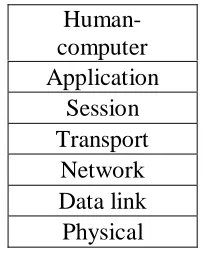
Our model also contains a final human-computer layer. If a human is at either end of a communications link, it is important that data is securely transmitted to them from the last communications device, and from their “output” – voice, facial expression, etc. – back into the network.
2.3.1 Physical layer
The physical layer transports raw bits between two points. If access to the medium used to carry bits is prevented or detectable, all data travelling over that medium can be secured.
Human-computer Application
Session Transport
Network Data link Physical
Almost all users of networks rely on physical security to protect their data, but faith in such protection is rather misplaced. Not only are such networks’ cables rarely protected from physical wiretapping, computers on shared access links can use packet sniffing software to perform sophisticated analyses and searches of traffic passing by. While protocols that send plaintext passwords unprotected over such links are still widespread, this creates a gaping vulnerability.
Physically secured lines were widely used before cryptography, particularly public-key, became widespread. The NSA used shielded cables at their Maryland headquarters to protect secure telephone lines [Diffie99]. The British armed forces used cables pressurised with nitrogen and monitored at both ends to detect any deviation from known profiles that might indicate the wires had been drilled into and tapped [Hartley99].
Quantum cryptography can provide a physically secure communication channel that is impossible to eavesdrop on without alerting the communicating parties. It takes advantage of Heisenberg’s uncertainty principle, one consequence of which is that you cannot measure the state of a quantum system without affecting it.
If information was sent over a quantum link, an eavesdropper could still access it, even though this would alert the two end points as the eavesdropper affected the link state. Therefore, classical cryptographic techniques are also used. Key material is sent over the quantum line and used in encrypting the data being sent.
Several experimental quantum lines have been built, using optical fibre over several
kilometres [Brassard98]. A recent experiment demonstrated a quantum laser link in the open air and suggested that satellites could be supplied with new encryption keys using this technique as they orbited over a base station [Buttler98]. And advances in materials science now allow single photons to be reliably generated, which is important to the security and efficiency of quantum links [Benjamin00].
One potential application is battlefield communications or monitoring, where a direct laser link between participants carries audio and video data over an ad-hoc network. This would also provide better traffic analysis protection than radio communication – extremely
important for maintaining surprise and preventing targetting of a signal’s origin. But even this would likely be augmented by higher layer security.
Physical security is most useful between two systems with a direct link. While a line may be secure, if intermediate nodes are required to carry the link further, these nodes become targets. But as they have access to unprotected data, they are able to run active services that require access to that data.
2.3.2 Link layer
The link layer turns a raw physical connection into a line free of undetected transmission errors by splitting data into frames, sequentially transmitting them and processing
acknowledgements. It works on a hop-by-hop basis, where systems only communicate with their direct neighbours.
Bluetooth is a link-layer radio protocol being designed by Ericsson, Intel and others to provide low-cost short-range radio links. Its major aim is to reduce the need for cables to connect devices such as keyboards or printers to computers, or link a phone and its base station.
The Point-to-Point Protocol is designed for simple links, usually switched circuits or dial-up lines, which transport data between two peers. It allows multiplexing of different network-layer protocols simultaneously over the same link. A Link Control Protocol is used to agree on various options such as encapsulation formats, and to authenticate the peers to each other. Network Control Protocols are used to set up options for encapsulated network-layer
protocols, such as assigning an IP address [Simpson94].
PPP authentication is performed using the Challenge Handshake Authentication Protocol [Simpson96]. The host being authenticated is sent a random challenge value, which it combines with a session identifier and secret known to both peers then returns. The challenging host also calculates this value and checks that it matches the value returned. CHAP can be re-run at any time during the connection. If the returned authentication value is incorrect, the connection is terminated.
The Encryption Control Protocol allows PPP’s data frames to be encrypted using a negotiated algorithm [Meyer96]. Once the basic link options have been configured, either of the peers may send aconfigure-requestframe to the other containing a set of algorithms they are willing to use to decrypt data. The receiver will reply with the algorithm it is willing to use, or close the link if none of them are acceptable. From that point on, the data within each frame from the receiver to the sender is encrypted with the agreed algorithm. The same process is carried out to determine the algorithm used in the other direction, which is not necessarily the same as the first. At any point when one of the peers cannot decrypt received data, it sends areset-requestmessage then discards any further received encrypted frames. The recipient of the request resets itself to an initial state and sends a request-ack, which resets the state at the other end of the connection. The peers then begin communicating securely again.
Link layer security is very difficult to use successfully outside a tightly controlled organisation such as the armed forces. It works only on a direct link, requiring strong protection for intermediate nodes in a network. It is marginally useful for confidentiality between peripherals such as a Walkman and its headphones, but for other applications end-to-end security at a higher layer is far more useful. Its main use is authenticating devices to each other; a cordless phone to its base station, for example. And as with the physical layer, intermediate nodes are able to provide active services with plaintext access.
Physical and link layer security’s biggest advantage is that they transparently protect streams without requiring software producing those streams to be modified. This is particularly useful for low-capability devices such as headphones that would be overloaded by processing-intensive security code. Key management is also greatly simplified: only the two nodes on the end of a link need share a key, which can be changed independently of any other node on the network. And traffic analysis is difficult, as all routing and structural information in the traffic is hidden.
2.3.3 Network layer
In packet-switched networks such as the Internet, data are grouped into packets that are independently routed to their destination. If the network drivers providing this service can provide security, data streams will be transparently secured with no need to modify applications.
The Internet Protocol Security (IPSEC) working group of the Internet Engineering Task Force is completing standardisation of security mechanisms for IP packets. Their work is a
mandatory part of IPv6 and can also be supported using option fields in IPv4. The
specifications provide an algorithm-independent framework into which specific cryptographic methods can be inserted [Thayer98].
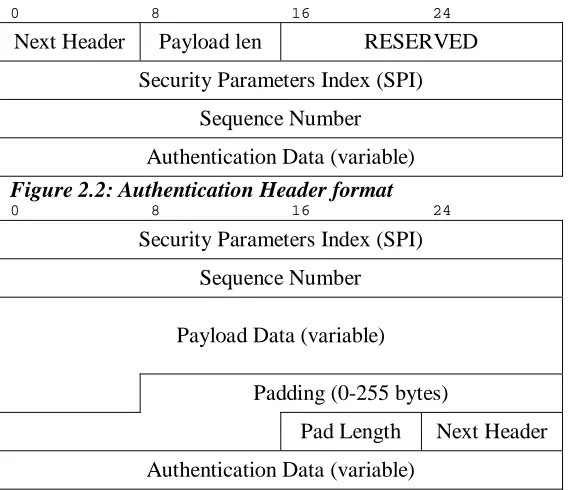
[Kent98a]. The Encapsulating Security Payload (ESP) provides confidentiality, as shown in figure 2.3 [Kent98b]. Both mechanisms can be used in tunnel mode (an entire IP packet is encapsulated within another before applying the security services) or transport mode (only higher-layer data is secured). ESP mode can also incorporate authentication procedures, but an authentication-only mode was politically convenient: US export restrictions on
cryptography only apply to systems that provide confidentiality. AH also allows the protection of immutable and predictable IP headers, which ESP cannot provide in transport mode.
0 8 16 24
Next Header Payload len RESERVED
Security Parameters Index (SPI)
Sequence Number
Authentication Data (variable) Figure 2.2: Authentication Header format
0 8 16 24
Security Parameters Index (SPI)
Sequence Number
Payload Data (variable)
Padding (0-255 bytes)
Pad Length Next Header
Authentication Data (variable)
Figure 2.3: Encapsulating Security Payload packet format
The Authentication Header is placed between the IP and higher layer headers of a packet, and contains information that the recipient can use to authenticate the sender and contents of the rest of the packet. This is more efficient than applying transformations to the entire packet. An anti-replay service can prevent old traffic being resent to a host, using the sequence numbers in the authentication header.
Data can be placed in an Encapsulating Security Payload before it leaves the sender, hiding its contents until it reaches the receiver, who decrypts it using the secret key they share with the sender. In tunnel mode, the source and destination of the encapsulated packet can be hidden, so preventing some traffic analysis attacks. The padding used to ensure the data being encrypted is the correct length for use with a specific cipher can also be extended to conceal the true length of that data, providing further traffic flow confidentiality. Transport mode is simpler, and normally used between end systems. If a security gateway is at either end of a connection, tunnel mode must be used. Tunnel mode is also less disruptive to the current Internet infrastructure, as packets look entirely normal to routers. Only at the end of their journey are the encrypted and authenticated contents of a packet decapsulated. Security gateways can forward such packets to hosts without IPSEC support.
AH and ESP both require communicating hosts to share secret keys to authenticate and encrypt transmitted data. It is relatively simple to manually configure hosts with fixed keys, but this is completely unscalable. Hosts need also to agree on the cryptographic systems they both understand.
attack, and optionally identify each host. Various types of public-key certificate can be used at this stage to increase the security of the authentication.
AH and ESP are relatively easily extended to multicast packets, but key management is much harder for multicast groups. While protocols exist to allow group key negotiation or
distribution [Hardjano98a], they are not scalable and thus defeat the purpose of multicast – particularly its ability to rapidly change group membership. They also reduce security by providing central points of attack.
One suggested solution divides a multicast network into trunk and leaf regions. Each leaf region contains one or more key management entities, which manage the security of hosts within that region. The trunk region consists of the “border” key manager from each leaf region. As traffic passes from a host through its leaf region, the trunk region and then into the other leaf regions, an active service key translator decrypts and re-encrypts traffic
appropriately [Hardjano98b].
Region separation increases the scalability of the scheme, and allows different regions to use different intra-group key management protocols. Within both regions, members can be added and deleted at will, and keys changed, without affecting hosts in other regions. Key managers must run on trusted hosts (specified by the traffic originator in a one-to-many flow, or
democratically agreed among leaf members in a many-to-many situation) but can therefore use long-lived keys, while allowing leaves to rapidly and independently give new keys to their members. This point could give plaintext access to other active services.
The main advantage of security at the network layer is its transparency to applications. If two communicating hosts are running IPSEC-enhanced drivers, any links between them can automatically be secured. As IPSEC is a mandatory part of IPv6, this will eventually become the norm. Connectionless sessions such as videoconferencing using the User Datagram Protocol can also be protected much more easily at this layer than at the transport layer. Traffic analysis protection can be automatically applied to all data flows rather than requiring separate applications to provide their own schemes.
By default, different processes owned by multiple users on the same machine will use the same encryption keys and access policies for links to the same machines. This host-based security is ideal for implementing virtual private networks, which many firewall systems are now starting to do [Oppliger97]. But, subject to approval by the administrator of a machine, IPSEC-aware services and applications at higher layers can also use enhanced interfaces to the network layer to allow individual control over the operation of IPSEC, with user-oriented keys, algorithm selection and other option choices. This gives a flexibility more usually associated with the transport layer.
While the network layer is not traditionally end-to-end, IPSEC’s encapsulation and tunnelling modes can provide end-to-end security by providing the information required to route packets through the network in cleartext packet headers. This complicates the operation of active network components such as firewalls or Network Address Translators, which require access to information inside the encrypted packet data. The simplest solution to this problem is for security to switch from the network layer at the firewall or NAT to the link or physical layers inside the affected network. This also helps organisations that require cleartext access to data travelling into or out of their networks.
Traffic analysis protection is more difficult with end-to-end schemes, but can be supported using active services that do not require plaintext access (and indeed use multiple layers of encryption). Onion routing, for example, transports information through a series of
data to prevent attackers using periods of inactivity to attempt to trace data passing between different routers. This makes it very difficult for an attacker to track traffic passing through the network, even if they have compromised a number of routers and can monitor all data flows.
2.3.4 Transport layer
The transport layer is responsible for splitting information from the session layer into smaller units and passing it to the network layer for transport to the other end of a connection. If high throughput is required, data might be multiplexed across several connections. If creating or maintaining a network connection is expensive, several connections might be multiplexed into one. The transport layer is the first true end-to-end layer, where a program on one machine talks to a similar program on another, rather than a host talking to another host or router. A naming service is also provided so a process can describe with whom it wants to communicate.
The Secure SHell (SSH) architecture was designed as a secure replacement for the session-layertelnet, but is based on a secure transport layer protocol [Ylonen99]. Data is sent over a reliable network connection in blocks of up 35000 bytes (or larger when both parties agree), and can be compressed, encrypted, and authenticated with a Message Authentication Code. The keys used to encrypt and authenticate the data packets can be negotiated when the link is created, and authenticated either way using one of several public-key algorithms. After every hour or gigabyte of data sent, the two parties choose a new key using the same algorithms. Random cover data can be sent at any time in packets marked “ignore” to protect against traffic analysis.
Secure Sockets Layer is probably the most widely used security standard on the Internet. It is a transport-level protocol designed by Netscape to enable secure communication between a Web browser and server. Almost all secure Web access takes place over a SSL connection. TLS (Transport Layer Security) is the standardised successor to SSL [Dierks99]. Its goal is to provide privacy and data integrity between two communicating applications. Its two main protocols are the record protocol, which provides a private and reliable connection, and the handshake protocol, used to authenticate client and server and negotiate cryptographic algorithms and keys.
The record protocol fragments data into blocks of 214bytes or less. Each block can be compressed, encrypted, and authenticated using a Message Authentication Code. TLS and SSH both allow the use of stream as well as block ciphers even though both are packetizing protocols. This allows a stream of data to be encrypted or decrypted as each byte arrives for processing, reducing latency – particularly important for interactive applications. A key calculation algorithm is used to generate keys, Initialisation Vectors for the encryption and MAC secrets from secret parameters supplied by the handshake protocol.
The handshake protocol negotiates each session: a session identifier, compression method, cipher specification (encryption and MAC algorithms), 48-byte master secret, a resumable flag and optional certificates for either party. A resumable session can be used to set up several connections. A session can be renegotiated at any time during a connection. Alert messages of varying levels may be sent; “fatal” alerts cause the connection to be terminated and session invalidated for future connections.
The Domain Name System is the Internet’s naming mechanism, mapping addresses such as
e-mail, Web access or IPSEC can also be supplied using this mechanism. The operation of the DNS protocol itself can be authenticated, and with an auxiliary mechanism [Eastlake97], DNS information can be dynamically and securely updated.
Transport layer security is not as transparent as network layer protection. Inter-process communication libraries must be updated, and applications must be updated if they are to make use of any security beyond the default provided by those libraries. It is much easier, however, for applications to be distributed to users with transport layer security services. Netscape can distribute its secure sockets code with its browser and provide secure connections without requiring users to install an IPSEC-aware network driver. Process-to-process security is also the default mode of operation, rather than the network layer’s host-to-host [Oppliger97].
End-to-end security at this layer allows network-layer active services such as TCP performance boosters to function, but prevents services such as ‘transparent Web proxies’ from accessing the application-layer data they require. Explicit Web proxies generally do not cache secured content because it may contain especially sensitive information such as credit card numbers, and is usually personalised for one receipient. Because the DNS works in a specifically hierarchical manner, with queries directed up a tree toward the authoritative nameserver for a given domain, DNSSEC automatically uses ‘hop-by-hop’ protection of links between client and nameservers.
2.3.5 Session layer
The session layer enables users on different machines to establish sessions that provide ordinary data transport and enhanced services useful in some applications. It is unclear whether mail transport protocols (SMTP, POP, IMAP etc.) belong here or at the application layer; but it is generally agreed thattelnetis a session-layer protocol.
Blaze and Bellovin surveyed securetelnetimplementations and designed their own that used standardtelnetoptions [Blaze95]. After discovering that the daemon at the other end of a connection supports security extensions (using the WILL/WONT, DO/DONT
mechanism), their securetelnetnegotiates a key using the SEND/IS protocol. A one-way function of the agreed key is presented as a challenge to the user, who calculates a response with a hand-held authentication device. Traffic between the two hosts is then encrypted.
The two authors also designed an encrypted session manager.esmexploits the BSD “pseudo-tty” mechanism to run secure sessions over IP and other connections such astip,kermit
anddatakit. A user runs it on their local host before remotely logging in to another system and runningesmin server mode on that machine. The two processes negotiate a key and then encrypt further traffic. The only authentication provided is a one-way function of the agreed key in the remote environment. By operating at this layer,esmcan provide security across application-layer firewalls and multi-hop logins.
SSH runs two session-layer protocols over its transport layer protocol: the user authentication and connection protocols. They allow secure remote login and secure port and X11
forwarding over insecure network connections.
The authentication protocol begins with the server sending the client a list of the
authentication methods it supports. It may also send a message to be displayed to the user warning that only authorised users may connect to the server, important for later prosecution of intruders in some jurisdictions. The client chooses an authentication method it also
The connection protocol allows interactive login sessions, remote execution of commands and forwarded TCP/IP and X11 connections. It can multiplex all links from a client to a server into one encrypted connection to impede traffic analysis. It also allows communication with an authentication agent, which can cache passphrases for a user-specified time to reduce the need for them to be entered every time a new connection is opened.
The session layer is an oddity, really only encompassing remote terminal facilities. As popular operating systems have largely changed over to graphical user interfaces, it has become less important. Security at this level is mostly useful for securingtelnetand its successors such as SSH, providing transport-layer services with a small number of
enhancements to ease the securing of terminal and X11 software. X-Windows is unfortunately unlikely to be widely adopted outside the Unix world without built-in support in Microsoft Windows, but a secure version would be extremely useful in both operating systems. Because the session layer is generally used to provide individual point-to-point connections, active services at this layer provide little benefit, and so far none have been proposed.
2.3.6 Application layer
The application layer contains a vast number of protocols defined and used by applications to communicate with each other. Web browsing, electronic mail and videoconferencing services are just a few examples. The common thread is that processing of an application-level
protocol requires an understanding of the semantics and not just syntax of the data passing through.
Many application protocols are now being extended to operate securely. The Internet Engineering Steering Group insists that all new Internet protocols contain a section on security considerations [Postel97]. Some protocols are designing their own security extensions, while others are providing standardised ways to access lower-layer security. Secure Web access is an interesting example of both. The Secure Hypertext Transfer Protocol extends HTTP to allow documents to be signed and encrypted [Shostack95]. HTTP over TLS runs a normal HTTP session over a TLS connection on port 443 [Rescorla98]; TLS over HTTP uses HTTP options to initiate a TLS link on a current HTTP connection [Khare98]. SHTTP allows fine-grained control over the security of individual documents, although an application could use a combination of TLS and HTTP to achieve the same effect.
E-mail remains the most widely used communication software on the Internet. S/MIME (Secure Multipurpose Internet Mail Extensions) [Ramsdell99] and PGP (Pretty Good Privacy) [Callas98] are competing to become the standard to authenticate and provide privacy for electronic messages. Both use MIME and similar public and private-key cryptographic algorithms to encrypt and sign parts of messages. S/MIME is more standards-based, using existing X.509 certificates, cipher modes and MIME transport encodings, while PGP uses its own formats. Unfortunately the two are not interoperable. Port 465 has also been assigned to run the Simple Mail Transfer Protocol over TLS between SMTP servers, which protects mail between but not on mail servers. Ideally this would be used to deliver mail directly from the sender’s machine to an SMTP server running on the recipient’s workstation [Brown00a]. Videoconferencing tools are being gradually extended to allow secure meetings. The Session Announcement and Initiation protocols (SAP and SIP) allow multimedia sessions to be announced and participants invited using two simple ASCII-based protocols. Extensions have been defined to allow authenticated and private announcements and invitations using
S/MIME and PGP formats [Handley00, Handley99b]. These messages can also contain keys used to encrypt the conference material itself using the Real-time Transport Protocol
encrypted and authenticated whilst still allowing header compression, which is useful for low-capacity wireless links [Blom01].
Numerous application-layer schemes are also being designed to allow anonymous browsing and messaging by preventing traffic analysis. Crowds routes HTTP requests around a number of nodes running its proxy software; each node randomly decides whether to forward a received request to its destination or to another node [Reiter98]. E-mail mixes strip identifying headers from messages and route them via several nodes that delay, re-order, and pad
outgoing data [Chaum81]. Unlike network-layer traffic protection, application-layer schemes can check the content of traffic for identifying information as well as protect its transmission. Therefore application-layer protection is often applied in conjunction with network-layer schemes.
Before transmitted information has been cryptographically protected at the originating machine, and after it has been decrypted at its destination, it is vulnerable to malicious software. Memory management in operating systems is vital to prevent one application eavesdropping on the data of another. Trusted windows, display drivers and Graphical User Interfaces are all necessary to display secure information. But the protection of computer systems is a topic at least as large as communications security, and will not be discussed further here. Interested readers might start with the US government’s standards for secure systems to gain some appreciation of the task involved [DoD85].
If information cannot be adequately protected in end systems, it can at least be traced if compromised using fingerprinting. This watermarks each copy of a piece of data with details of its recipient. Almost all watermarking schemes work at the application layer. They
manipulate low-significance bits, compression variables or other signal characteristics in audiovisual data, inter-word and line spacing in text, and other datatype-specific parameters. This obviously requires application-specific knowledge in marking algorithms. Unfortunately, simple attacks such as introducing jitter or resampling data defeat almost all current
watermarking schemes, and other designs can be broken with slightly more effort [Petitcolas98]. Hopefully, the next generation of algorithms will be more robust.
Watermarking large numbers of data streams is a processing-intensive task, and ideally suited to distribution throughout components in the network being used to distribute that data. We describe a scheme called watercasting in chapter seven that performs this distributed watermarking without requiring those components to be trusted and have access to the plaintext of the data [Brown99a].
Application layer security has an advantage where separate services are required for different pieces of information. Lower layer security can set up secure links between hosts and
processes, but can only provide coarse-grained services for information flowing over those links [Oppliger97]. HTTP allows different components of a Web page to be fetched using different connections, so a client could request different security services for different components simply by setting up transport or network layer secure links separately for each one. But SHTTP allows different security properties to be applied to parts of the same file. Servers may wish to sign relatively slowly-updated data with a more secure off-line key, but sign constantly changing parts of the same page with a less secure on-line key, for example. Being built into applications, this security layer also requires no interaction with services outside an application. This makes it easy to deploy, but difficult to write. It is much easier for an application to request a set of security services from an inter-process communication library or IP stack than to provide and maintain all of its own security code. It is also difficult for non-specialist application designers to design secure protocols, particularly without the scrutiny of the many security engineers who contributed to the development of standards such as IPSEC.
code. Application-layer proxies that provide security services such as encrypting and signing e-mail at the user’s workstation without requiring any modification of other software can ease the transition to this state [Brown99b].
End-to-end application-layer security can work with some active services that do not require access to protected application data such as Web caches, but not others that do such as transcoders.
2.3.7 Human-computer layer
Secure communication involving a human requires a secure link between computer and human inputs and outputs. Since humans are not equipped with cryptographic processors (although this would be an interesting application of neural implants!) other mechanisms must be used to ensure the confidentiality and authenticity of transmitted information.
Computer monitors give off a small but significant amount of electromagnetic radiation while displaying images. Signals can also be picked up from power lines. So-called Tempest
emanations can be detected even by low-cost TV equipment and used to reconstruct a monitor image at a distance [Eck85]. Hardware Tempest protection requires expensive metallic shielding of equipment or the rooms containing it [US90], and so is rarely used outside the military and diplomatic worlds.
To provide some degree of protection to those with smaller budgets, Kuhn and Anderson developed ‘soft Tempest’ fonts that make text information hard to detect and reconstruct by removing high-frequency components and putting random variations into characters
[Kuhn98]. PGP 6 contains a secure viewer that uses these fonts to display particularly sensitive information. Kuhn suggests that their techniques could be implemented on graphics cards, providing protection for all software running on a machine. It would also be easy to add to display drivers or fonts, again providing protection without requiring individual applications to be modified.
Video and particularly audio output are available to an attacker close by a system. With remote access laptops or PDAs, confidential information could be overheard or seen in a public area such as a train. Simple hardware devices like micro-louvre screens that reduce the angle from which a monitor can be viewed, or headphones, reduce these risks. But stronger protection is available from devices that limit the locations at which information can be viewed. If users can only access sensitive data from restricted areas, it is much less likely that attackers will have the physical access to eavesdrop on their data – either in person or using bugging devices. It can also limit the ability of users to display confidential information to unauthorised recipients. Denning and MacDoran describe a system that uses the Global Positioning Satellite network to provide an unforgeable location signature from a remote device [Denning96]. It uses the unpredictability of GPS signals due to satellite orbit
perturbations and the signal instabilities added by the US Department of Defense to prevent spoofing. The location information can be updated every few microseconds if required. Similar considerations apply to information going from human to computer, with the added concern of authenticity. The strongest authentication software is no use if the information it is authenticating comes from an attacker.
Most current systems require users to log-in to a system using passwords, which are notorious for being badly chosen and used. An interesting variation is passfaces, where users are required to remember and then pick out certain faces during the log-in procedure [Davies94]. This takes advantage of the very good human memory for faces, and the difficulty in
A better solution is to continually authenticate the user with one or more of their inputs. Everyone has a distinctive typing style that can be recognised by software, so keyboard input can be checked [Shepherd95]. Keyboards and mice could even have fingerprint recognition built in. Automatic voice and face recognition systems can validate multimedia input [Cope90] – it has been suggested that cellphones should simply stop working when used by an unauthorised speaker. And iris scans have proven to be very accurate discriminators [Daugman94], and could be made part of facial recognition techniques.
Security of the human-computer interface is absolutely vital. Information can criss-cross the planet safely using links secured at any of the lower layers, but be compromised at the first or last hop into or out of the network. Some applications are starting to use the techniques outlined in this section, but most would be best applied by the operating system in order to benefit all applications without requiring each to be modified. Combining soft Tempest with location-based access control should greatly reduce the threats to confidentiality of
information, while continual biometric authentication of users ensures that incorrect
information is not inserted into a system before lower layer cryptographic techniques are used to protect its authenticity.
2.4 Conclusion
In this chapter, we have examined security protocols from the lowest physical layer up to the human-computer interface. Because they protect different information at each protocol layer, their effect on active services is varied.
There are many schemes to provide confidentiality and authentication services to transmitted data at each of these layers. The methods of the two lowest levels are becoming decreasingly useful as the complexity of networks increases, particularly since their primary benefit of traffic analysis protection can now be provided at higher layers with active service assistance. There is little to choose between network and transport-layer protection for general data streams. As IPSEC becomes a normal feature of all networked systems and develops standard interfaces for applications, it seems there will be less need for transport security – although it may remain popular due to its prevalence in Web browsers. It can also be used with network layer protocol boosters such as TCP snoop. Session layer services are likely to be replaced by higher-level application protocols running over lower-level secure streams.
Application-layer security will remain important for its ability to apply different services to different parts of data, although it can be replaced in many programs by standardised methods of using lower-level services, as anticipated by RTP [Schulzrinne96]. E-mail security will remain the most important application-layer service due to different requirements for different sections of messages. Its store-and-forward nature also means that it is very difficult to use lower-level security services, as no direct link is made between the sender and recipient of a message. Using short-life encryption keys and applying additional lower-layer security to the links between mail servers can reduce the security vulnerabilities this introduces [Brown00a]. Protection of information once it has reached its destination is a more difficult problem. Requiring trusted hardware or software (the latter an oxymoron on insecure platforms like Windows) at all clients to restrict the redistribution of data seems to be a battle that has already been lost when there are more than a few authorised recipients outside a tightly-restricted organisation like the armed forces. New systems seem to be broken almost as soon as they are released, and the economic incentive for breaking such protection can only increase as the value of information being transmitted across networks grows.
Other current active network services will be difficult to use once the data streams they are processing use end-to-end encryption. If in-network components were provided with the plaintext of data, either through using physical or link-layer protection or some mechanism to make them one of the end points using end-to-end encryption, they would become valuable targets to attackers. Services must adapt to allow the processing of encrypted streams. This would be easiest using IPSEC, possibly with extra non-security-critical information in cleartext packet headers.
Firewalls are caused great difficulty by encrypted data streams. There is no way they can check information flowing through them if its plaintext is not available. Organisations may consider it vital to stop viruses or hackers entering their networks, or sensitive information flowing out. This is best achieved by configuring clients to use one IPSEC link to the organisation’s firewall, which constructs another to the destination outside the network. Physical-layer protection of the internal network also reduces the risks to information it carries. This is one example of data moving between trust domains: different threats require different responses. More sophisticated schemes label information according to its sensitivity, and will not allow highly-sensitive data to travel over networks without adequate protection [NIST94].
Each layer hides different traffic information. SSH can multiplex connections, hiding the port numbers of UDP and TCP connections. IPSEC can hide all higher-level protocol information in tunnelling mode. Powerful traffic analysis protection has been an important advantage of physical and link-layer security schemes, but the work of Chaum [Chaum81] and others has allowed active services to provide this service to higher-layer schemes.
E-mail and Web application-layer traffic protection is now in widespread use. Network-layer schemes are starting to become more popular. They provide protection to all higher-level services, but cannot check the content of transmitted data for identity information. This is important if data should be anonymous to the recipient as well as attackers en route. A combination of general network-layer protection with specific application-layer checking of mail and News messages, Web form data, etc. at source therefore seems best, and is used by the Onion Routing system [Reed98b].