Dual System Encryption via Predicate Encodings
Hoeteck Wee⋆
ENS, Paris, France
Abstract. We introduce the notion ofpredicate encodings, an information-theoretic primitive reminiscent of linear secret-sharing that in addition, satisfies a novel notion of reusability. Using this notion, we obtain a unifying framework for adaptively-secure public-index predicate encryption schemes for a large class of predicates. Our framework relies on Waters’ dual system encryption methodology (Crypto ’09), and encompass the identity-based encryption scheme of Lewko and Waters (TCC ’10), and the attribute-based encryption scheme of Lewko et al. (Eurocrypt ’10). In addition, we obtain several concrete improvements over prior works. Our work offers a novel interpretation of dual system encryption as a methodology for amplifying a one-time private-key primitive (i.e. predicate encodings) into a many-time public-key primitive (i.e. predicate encryption).
1 Introduction
Predicate encryption [41, 10, 31] is a new paradigm for public-key encryption that enables fine-grained access control for encrypted data. In predicate encryption, ciphertexts are associated with descriptive valuesxin addition to a plaintext, secret keys are associated with functionsf, and a secret key decrypts the ciphertext if and only iff(x)=1. Here,f may express an arbitrarily complex access policy, which is in stark contrast to traditional public-key encryption, where access is all or nothing. Predicate encryption generalizes both identity-based encryption (IBE) [42, 8, 18] where f checks for equality, and attribute-based encryption (ABE) [41, 26], where f encodes a boolean formula. The security requirement for predicate encryption enforces resilience to collusion attacks, namely any group of users holding secret keys for different functions learns nothing about the plaintext if none of them is individually authorized to decrypt the ciphertext. This should hold even if the adversaryadaptivelydecides which secret keys to ask for.
Terminology. Throughout this work, we use predicate encryption to refer to public-index predicate encryption, and reserve attribute-based encryption for the special case where the predicate is computed by a boolean formula.
Dual system encryption. In [44], Waters introduced the powerfuldual system encryptionmethodology for building adaptively secure predicate encryption. In a dual system encryption scheme, there are two types of keys and ciphertexts: normal and semi-functional. Normal keys and ciphertexts are used in the real system, while the semi-functional objects are gradually introduced in the hybrid security proof. The proofs are often quite complex and delicate. In spite of the large body of work relying on the dual system encryption methodology (e.g. [33, 36, 39, 34, 37, 32, 40]), there seems to be no concrete, overarching framework explaining these schemes. In particular, even in the simplest information-theoretic setting in composite-order groups, we do not have a clear understanding of why the Lewko-Waters heuristic [33] for deriving dual system encryption schemes via “embedding” works for the IBE scheme in [7] but not the ABE scheme in [26] (even under the “one use” restriction). We also do not have a formal, systematic approach for deriving the functional objects used in the security proof: for instance, the semi-functional keys in the dual system IBE in [33] have independent random semi-semi-functional components, whereas those in the ABE scheme in [36] are carefully designed to have certain correlations.
Decoupling functionalities? A recurring trend in predicate encryption, which arose with both the introduction of dual system encryption and lattice-based techniques [23, 13], is a systematic adaption of prior selectively secure in bilinear groups to achieve either improved parameters (e.g. shorter ciphertexts for HIBE) or larger classes of functionalities (e.g. from IBE to ABE). Moreover, the new schemes often bear a structural resemblance to prior schemes. The phenomenon suggests that we should aim to decouple the way we encode a predicate/functionality in an encryption scheme from the design and analysis of the scheme.
1.1 Our contributions
of our framework is a notion of predicate encodings. Roughly speaking, predicate encodings are an information-theoretic primitive reminiscent of secret-sharing schemes that in addition, satisfies a novel notion of reusability. Using predicate encodings, we obtain new insights into the dual system encryption methodology and new concrete predicate encryption schemes. Before we describe our results, we present an overview of predicate encodings.
Predicate encodings. A predicate encoding for a Boolean predicate P(·,·), is specified by a pair of algorithms (sE,rE) with a common private inputwand in addition,
– sender encodingsEtakes as input (x,w) and outputssE(x,w).
– receiver encodingrEtakes as input (α,y,w) and randomnessr, and outputsrE(α,y,w;r).
The basic requirements forαare the same as that for secret-sharing:
(reconstruction.) ifP(x,y)=1, we can recoverαfrom the encodings;
(privacy.) ifP(x,y)=0, the encodings hideαperfectly.
The key conceptual novelty in predicate encoding (over other existing notions e.g. [45, 4, 20, 28, 24, 29, 1]) which enables us to handle collusions in predicate encryption is w-hiding. Informally, w-hiding stipulates that we can hide all information aboutwin the receiver encoding by setting the randomnessr
to some fixed value (e.g. we can hidewin the expressionr wby settingr to 0). Note that the definition of
w-hiding treatwandr differently. Finally, we impose some algebraic structure in the encodings similar to that for linear secret-sharing, in order to carry out encoding and reconstruction “in the exponent” in the encryption scheme.
We stress that the requirements for predicate encodings are fairly basic and indeed, we readily obtain predicate encodings for a large class of predicates like HIBE, doubly spatial encryption and ABE, many of which are implicit in prior selectively secure schemes [7, 11, 9]. Moreover, privacy for these encodings follows readily from linear algebra, as is typically the case for information-theoretic primitives and constructions. On the other hand, the encodings in [26, 3] do not satisfying our requirements (c.f. Section 5.5); this provides a partial explanation as to why the Lewko-Waters heuristic [33] cannot be applied to these schemes.
Predicate encryption from predicate encodings. Starting from a predicate encoding forP, we construct a predicate encryption scheme in composite-order bilinear groups whose order is the product of three primesp1,p2,p3, and establish adaptive security in amodular manner via Waters’ dual system
encryption methodology. Here, a secret keysky can decrypt a ciphertextctxiffP(x,y)=1. We associate
ciphertext with sender encoding and secret keys with receiver encodings. Correctness will rely on the reconstruction property modulo p1, whereas security against collusions will rely on privacy and w
-hiding modulop2. The third subgroup corresponding top3is used for additional randomization which
we ignore in this overview. Roughly speaking, the master public key, secret key and ciphertext are of the form:
where g1 is a generator of order p1. Observe that the lengths of w, sE and rE correspond naturally
to the sizes of the public parameters, ciphertexts and secret keys. If P(x,y)=1, decryption works by reconstructingαfromsE(x,w) andrE(α,y,w;r) in the exponent via a pairing.
Proof strategy. We outline the key challenges in establishing adaptive security of the predicate encryp-tion scheme, which yields new insights into dual system encrypencryp-tion methodology:
– First, predicate encoding is essentially a private-key primitive, in thatα-privacy against an adversary that does not see the shared randomnessw, whereaswmust be made public in order that encryption uses the samewas that used for decryption. The scheme overcomes this conundrum by publishing onlyg1win the public parameters. This leaks information aboutw (modp1) so that we can exploitα
-reconstruction modulop1, but completely hidesw (modp2) so thatα-privacy holds modulop2. In
the final step in the hybrid security proof, the message is masked byαmodulop2whereas the public
parameters and all secret keys reveal no information aboutαmodulop2. Security then follows via a
simple information-theoretic argument.
– Second, predicate encoding only provides one-time security, that is, α-privacy no longer holds if we usew across more than one receiver encoding, as will be the case when an adversary requests multiple secret keys. We overcome this difficulty by ensuring that in each step in the proof of security, at most one secret key leaks information aboutw (modp2). In particular, both normal and
semi-functional keys reveals no information aboutw (modp2). We only leak information aboutw
(modp2) when transitioning from a normal to a semi-functional key, one key at a time. During the
transition, we rely onw-hiding to “erase” information about w (modp2) from all remaining keys
(see Fig 2 and Lemma 3).
– Finally, predicate encoding only provides non-adaptive security, namelyα-privacy only holds ifx,y
are fixed in advance. On the other hand, an adversary may choose a key query y after seeing the challenge ciphertext forx, which leaksrE(x,w,r). This is where we rely crucially on the fact that the encoding achievesperfectα-privacy, for which non-adaptive implies adaptive privacy. To the best of our knowledge, this is the first time this requirement is explicitly pointed out for use in dual system encryption. (A recent work [6] highlights several subtleties in defining and achieving adaptive privacy in the related setting of garbled circuits.)
In short, dual system encryption allows us to boost security in a private-key, one-time, non-adaptive setting to a full-fledged public-key, many-time, adaptive setting! Along the way, we introduce a concep-tual simplification where we define the semi-functional entities via auxiliary algorithms, reminiscent of Cramer-Shoup projective hashing [19].
Instantiations. Our final predicate encryption scheme is adaptively secure under the standard Subgroup Decision Assumptions in composite order bilinear groups. We note that our implementation of the dual system encryption methodology differs in subtle ways from prior composite-order instantiations in [33, 36] (see e.g. Remark 2). In addition to a unifying proof of security for a large class of predicates, we obtain the several concrete improvements over prior works:
the final transition in the proof of security with an information-theoretic argument instead of a computational one.
– We reduce the key size of the (key-policy) ABE in [36] by half. The improvement comes from eliminating some redundant randomization in the associated encoding.
– We obtain novel (to the best of our knowledge) and simple constructions of adaptively-secure non-zero inner product encryption and doubly spatial encryption in composite-order bilinear groups.
1.2 Discussion
Predicate encodings decouple and modularize the essential information-theoretic properties from the broader mechanics of a dual system cryptosystem and its analysis. Previous dual-system proofs are often monolithic and hard to follow, and the core new ideas are sometimes buried underneath lots of algebraic notation that is repeated (or only slightly tweaked) from one scheme to another. Our framework allows us to distill the core argument that is common to dual system cryptosystems from a separate information-theoretic argument which is tailored to the underlying predicate.
Open problems. This work raises a number of open problems.
– Do bilinear (or multi-linear) predicate encodings exist for all polynomial-time computable pred-icates? An affirmative answer would yield adaptively secure ABE for circuits [25, 21], without relying on complexity leveraging. However, even achieving perfect α-hiding without the bilinear requirements would likely require overcoming long-standing barriers.
– Can we prove lower bounds on the length ofw,rE orsEfor predicate encodings (corresponding to public parameters, secret keys and ciphertext sizes respectively)? In particular, the encodings for ABE require thatrEgrows with the size of the formula (c.f. Section 5.5) and we conjecture that such a dependency is in fact necessary for perfectα-privacy.
– Finally, we note that our work does not cover more recent applications of dual system encryption in the computational setting for ABE with short ciphertexts [35]. There,α-privacy is computational, for which we no longer get adaptive from non-adaptive security “for free”. We leave these extensions for future work.
Subsequent work. In subsequent works [15, 16], we built upon the ideas introduced here in several ways. In [15], we introduced dual system groups, a step towards abstracting the underlying group structure needed to support the dual system encryption methodology. This is orthogonal and complementary to this work, which is about abstracting how we encode the predicate/functionality. In [16], we presented the first adaptively secure IBE where the security loss does not depend on the number of secret key queries, partially resolving an open problem in [43, 22]. The crucial insight lies in replacing the one-time predicate encoding for IBE (a randomized MAC) with a reusable one (a pseudorandom function). Specifically, we rely on dual system encryption methodology to “compile” the Naor-Reingold PRF [38] which is a private-key primitive into a fully secure IBE.
2 Preliminaries
Notation. We denote bys←RSthe fact thatsis picked uniformly at random from a finite setS. By PPT, we denote a probabilistic polynomial-time algorithm. Throughout, we use 1λas the security parameter. We use·to denote multiplication as well as component-wise multiplication. We use lower case boldface to denote (column) vectors over scalars and upper case boldcase to denote vectors of group elements as well as matrices. Given two vectorsx=(x1,x2, . . .),y=(y1,y2, . . .) over scalars, we use〈x,y〉to denote the
standard dot productx⊤y. Given a group elementg, we writegxto denote (gx1,gx2, . . .).
2.1 Composite Order Bilinear Groups and Cryptographic Assumptions
We instantiate our system in composite order bilinear groups, which were introduced in [12] and used in [31, 33, 36]. A generator G takes as input a security parameter λand outputs a description G:=(N,G,GT,e), whereN is product of distinct primes ofΘ(λ) bits,GandGT are cyclic groups of order
N, ande:G×G→GT is a non-degenerate bilinear map. We require that the group operations inGandGT
as well the bilinear mapeare computable in deterministic polynomial time.We consider bilinear groups
Gwhose ordersN are products of three distinct primesp1,p2,p3(that is, N =p1p2p3). We can write G=Gp1Gp2Gp3whereGp1,Gp2,Gp3are subgroups ofGof orderp1,p2andp3respectively. In addition, we useGp∗i to denoteGpi\ {1}. We will often writeg1,g2,g3to denote random generators for the subgroups
Gp1,Gp2,Gp3of orderp1,p2andp3respectively.
Cryptographic assumptions. Our construction relies on the following two assumptions which are essentially the first two of three assumptions used in [33, 36] and are instances of the General Subgroup Decision Assumption in composite-order groups [5]. We define the following two advantage functions:
AdvSD1
G,A(λ) := |Pr[A(G,D,T0)=1]−Pr[A(G,D,T1)=1]|
whereG←G,T0← Gp1 ,T1←R Gp1Gp2
andD:=(g1,g3,g{1,2}),g1←RG∗p1,g3←RG ∗
p3,g{1,2}←RGp1Gp2
AdvSD2
G,A(λ) := |Pr[A(G,D,T0)=1]−Pr[A(G,D,T1)=1]|
whereG←G,T0← G∗p1Gp3 ,T1←R G∗p1G ∗
p2Gp3
andD:=(g1,g3,g{1,2},g{2,3}),g1←RG∗p1,g3←RG ∗
p3,g{1,2}←RGp1Gp2,g{2,3}←RGp2Gp3 Assumption 1 (resp. 2) asserts that for all PPT adversariesA, the advantageAdvSD1
G,A(λ) (resp.Adv
SD2
G,A(λ))
is a negligible function inλ.
2.2 Predicate Encryption
We define predicate encryption in the framework of key encapsulation. A predicate encryption scheme for a predicateP(·,·) consists of four algorithms (Setup,Enc,KeyGen,Dec):
Enc(mpk,x)→(ctx,κ). The encryption algorithm gets as inputmpkand an attributex∈X. It outputs a
ciphertextctxand a symmetric keyκ∈{0, 1}λ. Note thatxis public givenctx.
KeyGen(msk,y)→sky. The key generation algorithm gets as inputmskand a valuey∈Y. It outputs a
secret keysky. Note thatyis public givensky.
Dec(sky,ctx)→κ. The decryption algorithm gets as inputskyandctxsuch thatP(x,y)=1. It outputs a
symmetric keyκ.
Correctness. We require that for all (x,y)∈X×Ysuch thatP(x,y)=1,
Pr[(ctx,κ)←Enc(mpk,x);Dec(sky,ctx)=κ)]=1,
where the probability is taken over (mpk,msk)←Setup(1λ,X,Y) and the coins ofEnc.
Security definition. For a stateful adversaryA, we define the advantage function
AdvPE
A(λ) :=Pr
b=b′:
(mpk,msk)←Setup(1λ,X,Y);
x←AKeyGen(msk,·)(mpk);
b←R{0, 1};κ1←R{0, 1}λ
(ctx,κ0)←Enc(mpk,x);
b′←AKeyGen(msk,·)(ctx,κb) −1 2
with the restriction that all queries y thatAmakes toKeyGen(msk,·) satisfies P(x,y)=0 (that is,sky
does not decryptctx). A predicate encryption scheme isadaptively secureif for all PPT adversariesA, the
advantageAdvPE
A(λ) is a negligible function inλ.
3 Bilinear Predicate Encodings
In this section, we describepredicate encodingsmore formally. Then, we discuss several examples, before describing thebilinearrequirement.
3.1 Predicate encodings
Fix a predicateP:X×Y→{0, 1}. A predicate encoding for Pis a pair of algorithms (sE,rE), wheresE
is deterministic and takes as input (x,w)∈X×W; andrEis randomized and takes as input (α,y,w)∈ D×Y×Wand randomnessr ∈R. (We stress thatWandRplay very different roles, as evident in the
w-hiding property.) In addition, we require that (sE,rE) satisfy the following three properties:
(α-reconstruction.) For all (x,y)∈X×Ysuch thatP(x,y)=1 and for allr, we can (efficiently) recoverα givenx,y,sE(x,w),rE(α,y,w;r).
(α-privacy.) For all (x,y) ∈ X×Y such that P(x,y) = 0, and for all α ∈ D, the joint distribution
identicallydistributed:
{x,y,α,sE(x,w),rE(α,y,w;r)} and {x,y,α,sE(x,w),rE(α′,y,w;r)}
where the randomness is taken over (w,r)←RW×R.
(w-hiding.) There exists some element 0∈Rsuch that for all (α,y,w)∈D× ∈Y×W,rE(α,y,w; 0) is statistically independent ofw, that is, for allw′∈W:
rE(α,y,w; 0)=rE(α,y,w′; 0)
Remark 1. We rely crucially on the fact thatαisperfectlyhidden in the proof of security, so that non-adaptive indistinguishability implies non-adaptive indistinguishability. (This is not true in the statistical or computational setting.) Concretely, we claim thatα-privacy implies that even ify is chosenadaptively
after seeing (x,α,rE(x,w)), the distributions
rE(α,y,w;r) and rE(0,y,w;r)
are perfectly indistinguishable. This simply follows from the fact that an adaptive distinguisher with advantage ϵ can be converted into a non-adaptive distinguisher with advantage ϵ/|Y| via random guessing. Since any non-adaptive distinguisher has advantage 0, we must haveϵ=0 to begin with. The same argument applies to the setting wherexis chosenadaptivelyafter seeing (y,α,rE(·,y,w;r)).
Remark 2. We note thatw-hiding as defined is not the only way to achieve “w-reusability”. For instance, for the equality predicate as in IBE, the Lewko-Waters scheme [33] achieves reusability by essentially maskingrE(α,y,w;r) with a fresh one-time pad for each secret key query. This works for IBE and HIBE becauserE(α,y,w;r) has the uniform distribution for everyy. However, this approach does not work for the ABE predicate. Indeed, by usingw-hiding, we obtain a different proof of security of the Lewko-Waters HIBE.
Example 1: equality. Fix an integer N to be the product of threeλ-bit primes. Consider the equality predicate whereX=Y=[N] andP(x,y)=1 iffx=y. The following is a predicate encoding for equality used in [7, 33]:
– D:=ZN;W:=Z2N;R:=Z∗N.
– sE(x, (w1,w2)) :=(1,w1+w2x)
– rE(α,y, (w1,w2);r) :=(α+r(w1+w2y),−r)
Forα-reconstruction whenx=y, simply take the dot product of the two vectors. Forα-privacy when
x̸=y,1we exploit the fact that (w1+w2x,w1+w2y) are pairwise independent andr ∈Z∗N. (Note that
perfectα-privacy does not hold if we setRto beZNinstead ofZ∗N.) To achievew-hiding, we simply set
r=0.2
Example 2: equality. Consider the same predicate and construction as before, but replacerEby
rE(α,y, (w1,w2)) :=(α+(w1+w2y),−1).
1Here, we will even assume gcd(x−y,N)=1; otherwise, we can find a non-trivial factor ofN.
This still satisfiesα-reconstruction andα-privacy, but notw-hiding nor linear receiver encoding (the latter property is defined in the next Section).
3.2 Bilinearity
Fix a primep. Let (sE,rE) be a predicate encoding forP:X×Y→{0, 1}, whereXandYmay depend onp. We say that (sE,rE) isp-bilinearif it satisfies the following properties:
(input domains.) D=Zp,W=ZℓpWandR=ZℓpR×(Z∗p)ℓ
′
Rfor some integersℓW,ℓR,ℓ′ R.3
(output domains.) The output ofsEandrEare (column) vectors overZp.
(affine sender encoding.) For allx∈X,sE(x,·) is affine inw.
(linear receiver encoding.) For all (α,y,w)∈D×Y×W,rE(·,y,w;·) is linear inα,r.
(bilinearα-reconstruction.) For all (x,y) such thatP(x,y)=1, we can efficiently compute a linear map
Mx y(a matrix overZp) such that for allr∈R,
sE(x,w)⊤Mx yrE(α,y,w;r)=α
(w-hiding.) For all (α,y,w)∈D× ∈Y×W, we have
rE(α,y,w;0)=rE(α,y,0;0)
where we use0to refer to the all zeroes vector inZℓpWand inZpℓR+ℓR′.4
The above definition extends to any integerN by replacingZp,Zp∗withZN,Z∗Nrespectively.
Remark 3. We will exploit the affine sender encoding and linear receiver encoding to computesEandrE
“in the exponent”. Fixg∈GN.
– Affine sender encoding implies that givenx∈Xalong withg,gw, we can computegsE(x,w); indeed, we will slightly abuse notation and write this assE(x,gw).
– Similarly, linear receiver encoding implies that given (y,w)∈Y×Walong withgα,gr(but notg), we can computegrE(α,y,w;r); again, we will write this asrE(gα,y,w;gr).
Extensions. We also consider two extensions, first to handle randomized sender’s encoding in Sec-tion 5.5 and second to support delegaSec-tion in SecSec-tion 5.3.
4 Predicate Encryption from Bilinear Encoding
We present a predicate encryption scheme in composite-order bilinear groups whose order is the product of three primes (c.f. Section 2.1), for any predicate P(·,·) which admits a bilinear predicate encoding. In addition, we show that the scheme is adaptively secure under the General Subgroup Decision Assumption. We refer to Section 1.1 for an overview of the construction and the proof.
3The distinction betweenZ
pandZ∗pis significant because we requireperfectα-privacy.
Property Where it is used bilinearα-reconstruction Decand correctness affine sender encoding Enc
linear receiver encoding KeyGen,KeyGená
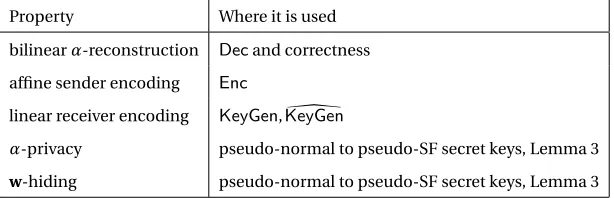
α-privacy pseudo-normal to pseudo-SF secret keys, Lemma 3 w-hiding pseudo-normal to pseudo-SF secret keys, Lemma 3
Fig. 1.Properties of predicate encodings and where they are used
4.1 Construction
Fix a predicateP:X×Y→{0, 1}. Given aN-bilinear predicate encoding (sE,rE) forP, we may construct a predicate encryption scheme forPas follows:
Setup(1λ,X,Y): On input (1λ,X,Y), first generateG←G(1λ), then sampleH:GT →{0, 1}λfrom a family
of pairwise-independent hash functions. In addition, sampleα←RZN,w←RW, and output5
pp:=(G,H,g1,g3) and mpk:=(g1w,e(g1,g1)α) and msk:=(g1αg2α,w)
KeyGen(msk,y): On inputmsk=(g1αg2α,w) and a predicatey, sampler←RRand output6
sky:=rand3(rE(g1αg2α,y,w;g1r))=rand3(g
rE(α,y,w;r) 1 ·g
rE(α,y,w;0) 2 )
Here,rand3is an algorithm that randomizes theGp3-components, namely on input a vectorC∈GℓN,
outputsC·g3r′wherer′←RZℓN.
Enc(mpk,x): On input an attributex∈X, samples←RZNand output the ciphertext and symmetric key
ctx:=(sE(x,g1w))s=gsE (x,w)s
1 and κ:=H((e(g1,g1)α)
s)
Dec(sky,ctx): On inputsky andctxwhereP(x,y)=1, output
H(e(ctx,sk
Mx y
y ))
whereMx yis the matrix for bilinear reconstruction ande(ctx,sk
Mx y
y ) :=
∑
ie((ctx)i,∑j(sky)
(Mx y)i,j
j ).
5If we want to be able to derive multiple (mpk,msk) from the samepp, we will need to append a random generator ofG {1,2}
topp, which we can then use to samplemsk. Note that this will not affect the proof of security, since such a generator is provided to the distinguisher in both Assumption 1 and 2.
Correctness. For all (x,y)∈X×Ysuch thatP(x,y)=1, we have
Dec(sky,ctx)=Dec(g1rE(α,y,w;r)g2rE(α,y,w;0)Z3,g1sE(x,w)s) =H(e(g1sE(x,w)s, (g1rE(α,y,w;r)g2rE(α,y,w;0)Z3)Mx y)) =H(e(g1sE(x,w)s, (g1rE(α,y,w;r))Mx y))
=H(e(g1,g1)〈sE(x,w)s,Mx yrE(α,y,w;r)〉) =H((e(g1,g1)α)s)
4.2 Proof of security
We prove the following theorem:
Theorem 1. Under Assumptions 1 and 2 (c.f. Section 2.1), the predicate encryption scheme described in Section 4.1 is adaptively secure (c.f. Section 2.2). More precisely, for any adversaryAthat makes at most q queries against the predicate encryption scheme, there exist adversariesA1,A2,A3whose running times are essentially the same as that ofA, such that
AdvPE
A(λ)≤AdvGSD,A11 (λ)+q·Adv
SD2
G,A2(λ)+q·Adv
SD2
G,A3(λ)+2−Ω(λ)
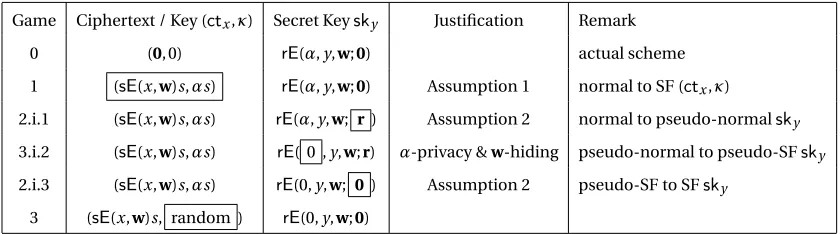
The proof follows via a series of games, outlined in Section 1.1 and summarized in Fig 2. Following Wa-ters’ dual system encryption metholodogy [44], there are two types of keys and ciphertexts: normal and semi-functional. We first describe two auxiliary algorithms (analogous to “private evaluation” algorithms in Cramer-Shoup projective hashing [19]), and then defining the semi-functional distributions via these auxiliary algorithms.
Auxiliary algorithms. We consider the following algorithms: a deterministic algorithmEncdfor comput-ing ciphertexts and a randomized algorithmKeyGenáfor computing secret keys.
d
Enc(pp,x;msk′,C): On inputx∈X, along withmsk′=(h,w)∈GN×WandC∈GN, output:
(ctx,κ) :=(CsE(x,w),H(e(C,h))
Observe that for all (pp,mpk,msk) output bySetupand for alls∈ZN, we have
Enc(mpk,x;s)=(g1sE(x,w)s,H(e(g1,g1)αs)
)
=Encd(pp,x;msk,g1s)
á
KeyGen(msk′,y;R): On inputmsk′=(h,w)∈GN×W,y∈YandR∈GN, sampler←RRand output
sky:=rand3(rE(h,y,w;Rr))
Observe that, for anymsk′,yand anyR∈G∗p1Gp3, the following three distributions are identical:
KeyGen(msk′,y) and KeyGená(msk′,y;g1) and KeyGená(msk′,y;R)
Game Ciphertext / Key (ctx,κ) Secret Keysky Justification Remark
0 (0, 0) rE(α,y,w;0) actual scheme 1 (sE(x,w)s,αs) rE(α,y,w;0) Assumption 1 normal to SF (ctx,κ)
2.i.1 (sE(x,w)s,αs) rE(α,y,w; r ) Assumption 2 normal to pseudo-normalsky
3.i.2 (sE(x,w)s,αs) rE( 0 ,y,w;r) α-privacy &w-hiding pseudo-normal to pseudo-SFsky
2.i.3 (sE(x,w)s,αs) rE(0,y,w; 0) Assumption 2 pseudo-SF to SFsky
3 (sE(x,w)s, random ) rE(0,y,w;0)
Fig. 2.Sequence of games in the semi-functional space (theGp2-subgroup), where we drew a box to highlight the differences
between each game and the preceding one, and games 2.i.xx refer to thei’th secret key.
Auxiliary distributions. We consider the following auxiliary distributions for ciphertext and secret keys, where (pp,mpk,msk,α,w) are sampled as inSetup.
– semi-functional (SF) master secret key:mskd=(g1α ,w).
– normal ciphertexts:
d
Enc(pp,x;msk,C), C←R Gp1
this is identically distributed to real ciphertexts as computed usingEnc(mpk,x).
– semi-functional (SF) ciphertexts: d
Enc(pp,x;msk,Cb), Cb←R Gp1Gp2
– normal secret keys:
á
KeyGen(msk,y;R), R←R G∗p1Gp3
this is identically distributed to real secret keys as computed usingKeyGen(msk,y).
– pseudo-normal secret keys:
á
KeyGen( msk,y;R), R←R Gp∗1G ∗
p2Gp3
– pseudo-semi-functional (pseudo-SF) secret keys:
á
KeyGen( mskd ,y;R), R←R Gp∗1G ∗
p2Gp3
– semi-functional (SF) secret keys:
á
KeyGen(mskd ,y;R), R←R G∗p1Gp3
Game sequence. We present a series of games. We writeAdvxxto denote the advantage ofAinGamexx.
– Game0: is the real security game (c.f. Section 2.2).
– Game1: is the same asGame0except that the challenge ciphertext is semi-functional. We also modify
the distribution ofκ0accordingly.
– Game2,i fori =1, . . . ,q: is the same asGame1, except the firsti−1 keys are semi-functional, and
the lastq−i keys are normal. There are 4 sub-games, where thei’th key transitions from normal in
Game2.i.0, to pseudo-normal inGame2.i.1, to pseudo-SF inGame2.i.2, to SF inGame2.i.3. – Game3: is the same asGame2,q,3, except thatκ0←R{0, 1}λ.
InGame3, the view of the adversaryAis statistically independent of the challenge bitβ. Hence,Adv3=0.
We complete the proof by establishing the following sequence of lemmas.
Lemma 1 (normal to semi-functional ciphertexts).There existsA1whose running time is roughly that ofAsuch that
|Adv0−Adv1| ≤AdvGSD,A11 (λ)
Proof. We will rely on Assumption 1. On input D = (G,g1,g3,g1αgα2) and T ∈ {T0,T1} where T0 ←R
Gp1,T1←RGp1Gp2, the adversaryA1simulatesAas follows:
Setup. SampleH,was inSetup, setmsk:=(g1αg2α,w) and output
pp:=(G,H,g1,g3) and mpk:=(g1w,e(g1,g1αg2α)).
Ciphertext. Compute (ctx,κ0)←Encd(pp,x;msk,T).
Key Queries. On input thej’th key queryyj, output
skj←KeyGená(msk,y;g1)
Output. Output whateverAoutputs.
Observe that whenT =T0←RGp1, the output is identical to that in Game 0, and whenT=T1←RGp1Gp2,
the output is identical to that in Game 1. ⊓⊔
Lemma 2 (normal to pseudo-normal secret keys).There existsA2whose running time is roughly that ofAsuch that for all i=1, 2, . . . ,q,
|Adv2.i.0−Adv2.i.1| ≤AdvGSD,A22 (λ)
Proof. We will rely on Assumption 2. On inputD =(G,g1,g3,g{1,2},g{2,3}) andT ∈{T0,T1} whereT0←R
G∗p1Gp3,T1←RG∗p1G ∗
p2Gp3, the adversaryA2simulatesAas follows:
Setup. Sampleα,H,was inSetup, set
msk:=(g1α·g{2,3},w) and mskd:=(g1α,w)
and output
Ciphertext. Compute (ctx,κ0)←Encd(pp,x;msk,g{1,2}).
Key Queries. On input thej’th key queryyj, output
skyj←
á
KeyGen(mskd,yj;g1) ifj<i (semi-functional key)
á
KeyGen(msk,yj;T) ifj=i (normal vs pseudo-normal key) á
KeyGen(msk,yj;g1) ifj>i (normal key)
Output. Output whateverAoutputs.
Observe that whenT=T0←RG∗p1Gp3, the output is identical to that in Game 2.i.0, and whenT =T1←R
G∗p1G∗p2Gp3, the output is identical to that in Game 2.i.1. ⊓⊔
Lemma 3 (pseudo-normal to pseudo-SF secret keys).For all i=1, 2, . . . ,q,
|Adv2.i.1−Adv2.i.2| =0
Proof. Observe that the only difference between Game 2.i.1 and Game 2.i.2 lies in the distribution of skyi, which we sample usingmsk=g1αg2α andmskd =g1α respectively. This means the only difference
between Game 2.i.1 and Game 2.i.2 lies in theGp2-component ofskyi, which are given by
g2rE(α,yi,w;r) and g2rE(0,yi,w;r) (∗)
respectively, where r ←R R. By the Chinese Remainder Theorem, it suffices to focus on the Gp2 -components of challenge ciphertext and secret keys, which are independent of the correspondingGp1 -components. Observe that for allj̸=i, theGp2-component ofskyj is given by:
{
rE(0,yj,w;0)=rE(0,yj,0;0) ifj<i (semi-functional key)
rE(α,yj,w;0)=rE(α,yj,0;0) ifj>i (normal key)
where the equality above follows byw-hiding. This means that only the challenge ciphertext and theskyi
leaks any information aboutw (modp2). It now follows from theα-privacy property (modulop2) and P(x,yi)=0 that
rE(α,yi,w;r) (modp2) and rE(0,yi,w;r) (modp2)
are identically distributed from the view-point of the adversary. (Here, we also use secrecy ofr (modp2).)
This holds even if the adversary choosesyi adaptively after seeing the challenge ciphertextctx, or if the
challengexis chosen after the adversary seesskyi (c.f. Remark 1). ⊓⊔
Lemma 4 (pseudo-SF to SF secret keys).There existsA3whose running time is roughly that ofAsuch that for all i=1, 2, . . . ,q,
Proof. We will again rely on Assumption 2. The proof is completely analogous to Lemma 2, exceptA3
usesmskd instead ofmskto sampleskyj.That is,A3outputs
skyj←
á
KeyGen(mskd,yj;g1) ifj<i (semi-functional key)
á
KeyGen(mskd,yj;T) if j=i (pseudo-SF vs SF key) á
KeyGen(msk,yj;g1) ifj>i (normal key)
Observe that whenT =T1←RG∗p1G ∗
p2Gp3, the output is identical to that in Game 2.i.2, and whenT =
T0←RGp∗1Gp3, the output is identical to that in Game 2.i.3. ⊓⊔
Lemma 5 (final transition).
|Adv3.q.3−Adv4| ≤2−Ω(λ)
Proof. In Game 3.q.3, all the secret keys are semi-functional, which means they leak no information whatsoever aboutα (modp2). Next, let us examine the (semi-functional) challenge ciphertext. Observe
that the quantity (from which the symmetric keyκ0is derived)
e(Cb,g1α)·e(Cb,g2α)
has logp2 =Θ(λ) bits of min-entropy as long asCb∈Gp1G∗p2, which occurs with probability 1−1/p2. Then, by the left-over hash lemma,κ0=H(e(Cb,g1α)·e(Cb,g2α)) is 2−Ω(λ)-close to the uniform distribution
over {0, 1}λ. The claim follows readily. ⊓⊔
5 Instantiations of Predicate Encodings
We presentN-bilinear predicate encodings for a large class of predicates that have been considered in the literature. For concreteness, think of N as the order of the composite-order bilinear group. Note that in the proof ofα-privacy, whenever we compute some valuev̸=0∈ZN, we will simply assume
that gcd(v,N) =1; otherwise, we will be able to compute a non-trivial factor of N. Instantiated via our framework, we obtain the adaptively-secure composite-order (H)IBE, ABE and spatial encryption schemes in [33, 36, 14]. In addition, we obtain novel (to the best of our knowledge) and simple constructions of adaptively-secure NIPE and doubly spatial encryption.
5.1 Inner Product (IPE)
Predicate [31]. Here,X=Y:=ZdNand
P(x,y)=1 iff〈x,y〉 =0
First encoding (short secret keys) [7].
– W:=ZN×ZNd;R:=Z∗N.
Second encoding (short ciphertext) [11].
– W:=ZN×ZdN;R:=ZN×Z∗N.
– sE(x, (u0,u)) :=(1,u0+ 〈x,u〉)
– rE(α,y, (u0,u); (r′,r)) :=(ru−r′y,r,α−u0r)
5.2 Non-Zero Inner Product (NIPE)
Predicate [2]. Here,X=Y:=ZdN and
P(x,y)=1 iff〈x,y〉 ̸=0
The constructions exploit the following simple algebraic fact: givenx,y,u0x+u,〈y,w〉,
– if〈x,y〉 ̸=0, then we can recoveru0. – if〈x,y〉 =0, thenu0is perfectly random.
First encoding (short ciphertext).
– W:=ZdN;R:=Z∗N.
– sE(x,w) :=(〈w,x〉, 1)
– rE(α,y,w;r) :=(r,αy−rw)
Second encoding (short secret keys).
– W:=ZN×ZNd;R:=Z∗N.
– sE(x, (u0,u)) :=(u0x+u, 1)
– rE(α,y, (u0,u);r) :=(r,α+u0r,r〈u,y〉)
5.3 Spatial Encryption
Predicate [9]. Here,X:=ZdN,Y:=ZdN×ℓand
P(x,Y)=1 iffx∈span(Y)
Recall from [9] that spatial encryption generalizes HIBE.
Supporting delegation. Consider a predicate P that supports delegation, namely, there is a partial ordering≤onYsuch that for allx∈X, the predicateP(x,·) is monotone, i.e.
(y≤y′)∧P(x,y)=1=⇒ P(x,y′)=1.
Encoding (short ciphertext) [9, 11, 33, 14].
– W=ZN×ZdN;R=Z∗N.
– sE(x, (u0,u)) :=(u0+u⊤x, 1)
– rE(α,Y, (u0,u);r) :=(ru⊤Y,−r,α+r u0)
α-privacy holds for all r ∈ Z∗N, and relies on the fact that if x ∉ span(Y), then u⊤x is statistically independent ofu⊤Yfor a randomu←RZdN.
5.4 Doubly Spatial Encryption
Predicate [27]. Here,X:=ZN×ZNd×ℓ,Y:=Zd×ℓ
′
N and
P((x0,X),Y)=1 iff (x0+span(X))∩span(Y)̸= ;
Encoding [27].
– W=ZN×ZdN;R=Z∗N.
– sE((x0,X), (u0,u)) :=(u0+u⊤x0,u⊤X, 1) – rE(α,Y, (u0,u);r) :=(ru⊤Y,−r,α+r u0)
α-privacy holds for allr ∈Z∗N, and relies on the fact that if (x0+span(X))∩span(Y)= ;then u⊤x0 is
statistically independent ofu⊤X,u⊤Yfor a randomu← RZdN.
5.5 Attribute-Based Encryption (ABE)
We define (monotone) access structures using the language of (monotone) span programs [30].
Definition 1 (access structure [4, 30]).A(monotone) access structurefor attribute universe[n]is a pair
(M,ρ)whereMis aℓ×ℓ′matrix overZNandρ: [ℓ]→[n]. Givenx=(x1, . . . ,xn)∈{0, 1}n, we say that
xsatisfies(M,ρ)iff1∈span〈Mx〉,
Here,1:=(1, 0, . . . , 0)∈Zℓ′ is a row vector;Mxdenotes the collection of vectors{Mj:xρ(j)=1}whereMj
denotes the j ’th row ofM; and span refers to linear span of collection of (row) vectors overZN.
That is,xsatisfies (M,ρ) iff there exists constantsω1, . . . ,ωℓ∈ZNsuch that ∑
j:xρ(j)=1
ωjMj=1.
Observe that the constants {ωj} can be computed in time polynomial in the size of the matrixMvia
Gaussian elimination.
KP-ABE Predicate [26, 41]. Here,X:=ZℓN,Y:={(M,ρ) :M∈ZℓN×ℓ′,ρ: [ℓ]→[ℓ] is a permutation} (that is, ℓ=n) and
Encoding. Our encoding improves upon that in [36] by reducing the length ofrE(and thus the secret key size) from 2ℓtoℓ+1 elements.
– W=ZℓN;R=ZNℓ′−1×Z∗N.
– sE(x,w) :=(x1w1, . . . ,xℓwℓ, 1)
– rE(α, (M,ρ),w; (u,r)) :=(α1−r wρ(1), . . . ,αℓ−r wρ(ℓ),r) whereαi:=Mi (α
u
)
is thei’th share ofαand(αu) denotes the column vector inZℓN′formed by concatenatingα∈ZNandu∈Zℓ
′−1
N .
In the prior construction [36],rEis given by
(α1−r1wρ(1), . . . ,αℓ−rℓwρ(ℓ),r1, . . . ,rℓ).
Here,α-privacy holds for allr∈Z∗N, and relies crucially on the fact thatρis injective.
Remark 5 (GPSW encoding [26]).It is instructive here to revisit the encoding used in the selective ABE in [26] whererEis given by
(α1/wρ(1), . . . ,αℓ/wρ(ℓ)).
This implies α-privacy but only in a statistical sense (the encoding only hides non-zero shares). Moreover, it does not satisfyw-hiding.
CP-ABE Predicate [26, 17]. As before withXandYswitched, so that
P((M,ρ),y)=1 iffysatisfies (M,ρ)
Encoding. In the following encoding, we allowsEto be randomized:
– W=ZℓN×ZN;R=Z∗N.
– sE((M,ρ), (w,v);u) :=(1,wρ(1)+v1, . . . ,wρ(ℓ)+vℓ) wherevi:=Mi (v
u
)
is thei’th share ofv.
– rE(α,y, (w,v);r) :=(α+r v,r, {wjr}j:yj=1)
Randomized sender encodings. We may handle the extension to randomized sender encodings where
sEtakes additional randomnessuas follows:
– the requirement forα-privacy holds over random coin tosses ofsE;
– affine sending encoding says that we can computegsE(x,w)givengw,xand the coin tosses used insE;
– we extend the definition ofEncandEncdto use randomizedsEin a straight-forward manner;
– the proof remains largely unchanged except for accounting for sender randomness when invoking α-privacy in the proof of Lemma 3.
References
[1] B. Applebaum, Y. Ishai, and E. Kushilevitz. Cryptography in NC0.SIAM J. Comput., 36(4):845–888, 2006.
[2] N. Attrapadung and B. Libert. Functional encryption for inner product: Achieving constant-size ciphertexts with adaptive security or support for negation. InPublic Key Cryptography, pages 384–402, 2010.
[3] N. Attrapadung, B. Libert, and E. de Panafieu. Expressive key-policy attribute-based encryption with constant-size ciphertexts. InPublic Key Cryptography, pages 90–108, 2011.
[4] A. Beimel.Secure Schemes for Secret Sharing and Key Distribution. Ph.D., Technion - Israel Institute of Technology, 1996. [5] M. Bellare, B. Waters, and S. Yilek. Identity-based encryption secure against selective opening attack. InTCC, pages 235–
252, 2011.
[6] M. Bellare, V. T. Hoang, and P. Rogaway. Adaptively secure garbling with applications to one-time programs and secure outsourcing. InASIACRYPT, pages 134–153, 2012.
[7] D. Boneh and X. Boyen. Efficient selective-ID secure identity-based encryption without random oracles. InEUROCRYPT, pages 223–238, 2004.
[8] D. Boneh and M. K. Franklin. Identity-based encryption from the Weil pairing.SIAM J. Comput., 32(3):586–615, 2003. [9] D. Boneh and M. Hamburg. Generalized identity based and broadcast encryption schemes. InASIACRYPT, pages 455–470,
2008.
[10] D. Boneh and B. Waters. Conjunctive, subset, and range queries on encrypted data. InTCC, pages 535–554, 2007. [11] D. Boneh, X. Boyen, and E.-J. Goh. Hierarchical identity based encryption with constant size ciphertext. InEUROCRYPT,
pages 440–456, 2005.
[12] D. Boneh, E.-J. Goh, and K. Nissim. Evaluating 2-DNF formulas on ciphertexts. InTCC, pages 325–341, 2005.
[13] D. Cash, D. Hofheinz, E. Kiltz, and C. Peikert. Bonsai trees, or how to delegate a lattice basis. InEUROCRYPT, pages 523–552, 2010.
[14] C. Chen, Z. Zhang, and D. Feng. Fully secure doubly-spatial encryption under simple assumptions. InProvSec, pages 253–263, 2012.
[15] J. Chen and H. Wee. Dual system groups and its applications — compact HIBE and more. Full version in preparation, 2013. Preliminary version in [?].
[16] J. Chen and H. Wee. Fully, (almost) tightly secure IBE from standard assumptions. IACR Cryptology ePrint Archive, Report 2013/803, 2013. Preliminary version in [?].
[17] L. Cheung and C. C. Newport. Provably secure ciphertext policy ABE. In ACM Conference on Computer and Communications Security, pages 456–465, 2007.
[18] C. Cocks. An identity based encryption scheme based on quadratic residues. InIMA Int. Conf., pages 360–363, 2001. [19] R. Cramer and V. Shoup. Universal hash proofs and a paradigm for adaptive chosen ciphertext secure public-key
encryption. InEUROCRYPT, pages 45–64, 2002. Also, Cryptology ePrint Archive, Report 2001/085. [20] U. Feige, J. Kilian, and M. Naor. A minimal model for secure computation. InSTOC, pages 554–563, 1994.
[21] S. Garg, C. Gentry, S. Halevi, A. Sahai, and B. Waters. Attribute-based encryption for circuits from multilinear maps. In
CRYPTO (2), pages 479–499, 2013. Also, Cryptology ePrint Archive, Report 2013/128.
[22] C. Gentry. Practical identity-based encryption without random oracles. InEUROCRYPT, pages 445–464, 2006.
[23] C. Gentry, C. Peikert, and V. Vaikuntanathan. Trapdoors for hard lattices and new cryptographic constructions. InSTOC, pages 197–206, 2008.
[24] Y. Gertner, Y. Ishai, E. Kushilevitz, and T. Malkin. Protecting data privacy in private information retrieval schemes. J. Comput. Syst. Sci., 60(3):592–629, 2000.
[25] S. Gorbunov, V. Vaikuntanathan, and H. Wee. Attribute-based encryption for circuits. InSTOC, pages 545–554, 2013. Also, Cryptology ePrint Archive, Report 2013/337.
[26] V. Goyal, O. Pandey, A. Sahai, and B. Waters. Attribute-based encryption for fine-grained access control of encrypted data. InACM Conference on Computer and Communications Security, pages 89–98, 2006.
[27] M. Hamburg.Spatial Encryption. Ph.D., Stanford University, 2011. Also, Cryptology ePrint Archive, Report 2011/389. [28] Y. Ishai and E. Kushilevitz. Private simultaneous messages protocols with applications. InISTCS, pages 174–184, 1997. [29] Y. Ishai and E. Kushilevitz. Randomizing polynomials: A new representation with applications to round-efficient secure
computation. InFOCS, pages 294–304, 2000.
[30] M. Karchmer and A. Wigderson. On span programs. InStructure in Complexity Theory Conference, pages 102–111, 1993. [31] J. Katz, A. Sahai, and B. Waters. Predicate encryption supporting disjunctions, polynomial equations, and inner products.
InEUROCRYPT, pages 146–162, 2008.
[33] A. B. Lewko and B. Waters. New techniques for dual system encryption and fully secure HIBE with short ciphertexts. In
TCC, pages 455–479, 2010.
[34] A. B. Lewko and B. Waters. Decentralizing attribute-based encryption. InEUROCRYPT, pages 568–588, 2011.
[35] A. B. Lewko and B. Waters. New proof methods for attribute-based encryption: Achieving full security through selective techniques. InCRYPTO, pages 180–198, 2012.
[36] A. B. Lewko, T. Okamoto, A. Sahai, K. Takashima, and B. Waters. Fully secure functional encryption: Attribute-based encryption and (hierarchical) inner product encryption. InEUROCRYPT, pages 62–91, 2010.
[37] A. B. Lewko, Y. Rouselakis, and B. Waters. Achieving leakage resilience through dual system encryption. InTCC, pages 70–88, 2011. Cryptology ePrint Archive, Report 2010/438.
[38] M. Naor and O. Reingold. Number-theoretic constructions of efficient pseudo-random functions.J. ACM, 51(2):231–262, 2004.
[39] T. Okamoto and K. Takashima. Fully secure functional encryption with general relations from the decisional linear assumption. InCRYPTO, pages 191–208, 2010.
[40] T. Okamoto and K. Takashima. Adaptively attribute-hiding (hierarchical) inner product encryption. InEUROCRYPT, pages 591–608, 2012. Also, Cryptology ePrint Archive, Report 2011/543.
[41] A. Sahai and B. Waters. Fuzzy identity-based encryption. InEUROCRYPT, pages 457–473, 2005. [42] A. Shamir. Identity-based cryptosystems and signature schemes. InCRYPTO, pages 47–53, 1984.
[43] B. Waters. Efficient identity-based encryption without random oracles. InEUROCRYPT, pages 114–127, 2005.
[44] B. Waters. Dual system encryption: Realizing fully secure IBE and HIBE under simple assumptions. InCRYPTO, pages 619–636, 2009.