Article
Data pruning of tomographic data for the calibration of
strain localization models
William Hilth1*, David Ryckelynck1and Claire Menet2
1 2
3 4 5 6
7 8
1 MinesParisTech,PSLResearchUniversity,MAT-CentredesMatériaux,CNRSUMR7633,BP8791003Evry,France
2 UniversityofLyon,INSAdeLyon,UMRCNRS5510,Villeurbanne,France
* Correspondence:[email protected]
Abstract: ThedevelopmentandgeneralizationofDigital VolumeCorrelation(DVC)onX-raycomputed tomographydatahighlighttheissueoflongtermstorage.Thepresentpaperproposesanewmodel-freemethod forpruningtheDVCdata.Thesizeoftheremainingsampleddatacanbeuser-defined,dependingontheneeds concerningstoragespace. Thedatapruningprocedureisdeeplylinkedtohyper-reductiontechniques. The DVCdataofaresin-bondedsandtestedinuniaxialcompressionisusedasanillustratingexample.
Therelevanceofthepruneddataistestedafterwardsformodelcalibration. AnewFiniteElementModel Updating(FEMU)techniquecoupledwithanhybridhyper-reductionmethodisusedtosuccessfullycalibratea constitutivemodeloftheresinbondedsandwiththepruneddataonly.
Keywords:Archive;ModelReduction;3DReconstruction;InverseProblemPlasticity;DataScience 9
1. Introduction 10
With the development and the generalization of digital image correlation (DIC) or digital volume 11
correlation (DVC) techniques on Computed Tomography (CT) data, the volume of data acquired has drastically 12
increased. This raises new challenges, such as data storage, data mining or the development of relevant 13
experiments-simulations dialog methods such as model validation and model calibration. 14
In experimental mechanics, the access to full 3D fields like displacement or strain fields is far richer than 1D 15
load-displacement curves. These data can drive finite element simulations for model calibration. Although 16
extremely convincing, the increasing resolution of the full-field measurement tools, such as X-ray Computed 17
Tomography, leads to an explosion of the volume of data to store. The long term storage of CT data sets is 18
nowadays an issue (see van Ooijenet al.[1]). 19
This paper proposes a numerical method for pruning 3D data set related to DVC when it becomes necessary 20
to free up storage capacity. It aims to preserve the ability to identify constitutive equations reflecting strain 21
localization. It is a mechanical based approach to prune DVC data. Original experimental data are preserved 22
solely in a reduced experimental domain (RED). 23
Compression of data is known to be a convenient approach to restore storage capacity. For instance, MP3 24
files are a fairly common way to reduce the size of audio files for a daily use (see Pan [2]). However, a non 25
negligible loss of information is needed, but controlled. The MP3 compression roughly consists in filtering 26
certain components of the non-reduced audio file that are actually non-audible for most people. In other words, 27
the MP3 algorithm was made to prune the audio data that are not absolutely necessary. Usually the compression 28
rate is around 12. In the same philosophy, there can be a way to massively compress the experimental data 29
taken from experiments with a controlled loss of information based on an algorithm that detects the pertinent 30
information. This has been proposed in Cioaca and Sandu [3] by using a sensitivity analysis with respect to 31
variations of calibration parameters. These parameters are the coefficients of a given model that should reflect 32
the experimental observations. The result is that the pruned data are dedicated to a given model. In this paper, 33
a model-free approach is proposed. It aims to make possible various calibrations with different models after 34
data pruning. Here, the relevant information are local but situated in regions submitted to strain localization. 35
The data submitted to the pruning procedure are the outputs of a Digital Volume Correlation that reconstructs 36
the displacement fieldu(x,t)for observations at time instants(tj)j=1,...Nt, over a spatial domainΩ, wherex 37
is a position vector. The geometry of the experimental sample is approximated by a mesh and the determined 38
displacement is decomposed on finite element (FE) shape functions [4]. 39
The proposed method can be linked to data pruning or data cleaning methods described in the literature for 40
machine learning [5]. The aim of these procedures are not to reduce data storage but to improve the data quality 41
by accurate outliers detection for instance [6]. In Honget al.[7], a data pruning method is employed to filter the 42
noise in the data set. 43
Using the FE approximation of the experimental fields paves the way to further simulations. In the calibration 44
procedure, the full-field measurements are used as inputs of an inverse problem that aims to determine a given set 45
of parametersµ={µ1, . . . ,µm}. These parameters are the coefficients of given constitutive equations. Their 46
values are unknown or not known precisely. The most straightforward method is called Finite Element Model 47
Updating (FEMU) (see Kavanagh and Clough [8], Kavanagh [9]). It is a rather common way to optimize a 48
set of parameters taking into account the experimental data and balance equations in mechanics. It consists in 49
computing the discrepancy between the FE approximation of the experimental fields and the FE simulations. 50
Thus, an optimization loop is done onµwhere the FE method is used as a tool for assessing the relevance of the 51
parameter set. The objective function, or cost function, of the optimization can focus on the difference between 52
the computed and experimental displacement fields (FEMU-U), forces (FEMU-F, or force balance method), or 53
the strain fields (FEMU-ε) or a mix between all these sub-methods. A review of FEMU applications can be found 54
in Iennyet al.[10]. The method is particularly suitable for: 55
• Non-isotropic materials (e.g.: orthotropic materials in Lecompteet al.[11] or Molimardet al.[12] or 56
anisotropic materials such as the human skin [13]) ; 57
• Heterogeneous materials such as composites [14]; 58
• Heterogeneous tests like open-hole tests (e.g.: Lecompteet al.[11], Molimardet al.[12]) or CT-samples 59
[15]; 60
• Special cases of local phenomena like strain localization or necking (e.g.: Forestieret al.[16], Gitonet al. 61
[17]) or the illustrating case of the present paper; 62
• Multi-materials configurations (e.g.: solder joints studied in Cugnoniet al.[18] or heterogeneous material 63
identification done in Latourteet al.[19]); 64
• Determination of the boundary conditions [20]. 65
One of the recent developments concerning FEMU is to couple this method with reduced order models 66
(ROMs) to cut down the computation time in the parameters optimization loop. An example of such recent 67
developments can be found in Neggerset al.[21] where a method called FEMU-b is highlighted, or in Cugnoni 68
et al. [22]. The FEMU-b consists in determining an intermediate space of predominant empirical modes 69
associated to a reduction procedure, like the Proper Orthogonal Decomposition (see Aubryet al.[23]) or the 70
PGD [24]. The discrepancy is computed between the experimental and simulated reduced variables, where the 71
reduced variables are solutions of reduced equations. 72
In Ryckelynck [25], it has been shown that ROMs can be supplemented by a reduced integration domain, by 73
following the hyper-reduction method. This leads the way for for data pruning methods that preserve calibration 74
capabilities. Here, the dimensionality reduction of experimental data enables the restriction of experimental data 75
to a reduced experimental domain (RED). This RED is a subdomain of the specimen where the experimental 76
data are sampled. It is not necessarily a connected domain. The calibration capabilities of the proposed data 77
pruning are assessed by using the FEMU with an hybrid hyper-reduction method (H2ROM) [26]. Hence, the 78
FEMU is not done on the complete domain but on the RED determined by the data pruning. The result is a fast 79
calibration procedure, with low memory requirement and a validated data pruning protocol. 80
The remaining part of the paper is structured as follows. In Section2, the proposed method for data pruning 81
is described. The DVC is recalled. A dimensionality reduction then hyper-reduction are performed to compute 82
compression with X-ray tomography. In Section4, the calibration of an elastoplastic model enables to validate 84
the pruning protocol. 85
Notations 86
2ndorder tensors are denoted bya∼. Matrices are denoted by capital bold lettersAand vectors are denoted 87
by bold lower-case charactersa. The colon notation is used to denote the extraction of a submatrix or a vector (at 88
columnifor example):a=A[:,i]. Sets of indices are denoted by calligraphic charactersA. The element of a 89
matrixAat rowiand columnjis denotedAijorAα[i,j]when the matrix notationAαhas a subscript. ais the
90
restriction ofato the reduced experimental domain. 91
2. Data pruning by following an hyper-reduction scheme 92
2.1. Digital Volume Correlation 93
Let’s consider a specimen occupying a domainΩ undergoing a certain mechanical test. With image acquisition techniques, grayscale images are obtained in 3D. The Digital Volume Correlation aims to determine the displacement fielduat every positionxinΩat a given deformed state at timet. f andgare the gray levels at the reference and deformed states. They are related by the equation:
g(x) = f(x+u(x,t)) (1)
The conservation of the optical flow is linearized by assuming that the reference image is differentiable, hence the local residual to minimize,η(x,t)is:
η2(x,t) = [u(x,t).∇f(x) + f(x)−g(x)]2 (2)
where∇f is the gradient of f.
This local residual is integrated over the whole domainΩto be a function to minimize:
φ2(u,t) =
Z
Ω[u(x,t).∇f(x) +f(x)−g(x)]
2d
x (3)
This is an ill-posed problem. To well-pose the problem, the displacement field can be restricted to a kinematic 94
subspace. Here, the displacement field is assumed to be decomposed over a set of vector functionsψj(x)that 95
corresponds to the shape functions of a FE model defined onΩ. 96
u(x,t) = Nd
∑
i=1
aiexp(t)ψi(x) (4)
whereNdis the number of degrees of freedom of the mesh,a exp
i theithnodal degree of freedom in the FE model.
aexpdenotes the vector of degrees of freedom to be determined. With this restriction to the kinematic subspace, the objective function is now a quadratic form of theaexpi , and its minimization is a linear system, set up for each observation of a deformed state:
Maexp=f (5)
where the matrixMand the vectorfare:
Mij =
Z
Ω(ψi(x).∇f(x))
ψj(x).∇f(x)
dx (6)
fi=
Z
Ω[g(x)− f(x)]ψi(x).∇f(x)dx (7)
coefficient vectoraexp(tj), and the local residualη(x,tj). From the displacement field, a strain fieldε∼is extracted assuming small strains:
ε ∼=
1 2
∇∼u+∇∼uT (8)
This strain is thus calculated at each Gauss point of the mesh used for the DVC. For pressure dependent or plastic materials, it can be convenient to subdivide the strain field in its deviatoric part and its hydrostatic part:
ε ∼=ε∼
s+ ε ∼
v, with ε ∼
v=tr( ε
∼)I∼ (9)
whereI∼is the unit tensor. 97
It is worth noting that the pruning procedure only focuses on the displacement and not on the strain. It is 98
considered that the strain can be computed in post-processing (thanks to Equation8) and are not worth saving. 99
The strain tensor is actually considered as temporary data used to compute a reduced experimental domain. 100
2.2. Dimensionality reduction 101
The first step of the pruning procedure consists in performing a dimensionality reduction of the experimental 102
data. It is based on singular value decomposition. This approach is similar to the Principal Component Analysis 103
(PCA). But here, a reduced basis of empirical modes is obtained without centering the data. 104
The experimental data from DVC are saved into two matrices,QuandQεdefined as:
Qu[i,j] =aexpi (tj), i=1 . . .Nd, j=1 . . .Nt (10)
and
Qε[i,j] =εsαβ(eγ,tj) (11)
Qε[i,j+Nt] =εvαβ(eγ,tj) (12)
whereeγtheγthGauss point, and:
i=β+3(α−1) +9(γ−1)
α=1 . . . 3, β=1 . . . 3, γ=1 . . .Ng
j=1 . . .Nt
withNgbeing the number of integration points in the mesh.Quis aNd×Ntmatrix andQεis a(9Ng)×(2Nt)
105
matrix. For the sake of simplicity, we did not account for the symmetry of the strain tensor. 106
The first step of the pruning procedure consists in performing a first dimensionality reduction of the DVC data. Only the reduced basis and coordinate are kept instead of the snapshot matrixQu. The procedure is also done on the snapshot matrix of the stainQεbut not in order to reduce storage (as the stain data are not saved).
The corresponding reduced basis is used as a temporary tool to compute afterwards the reduced domain. The determination of the empirical modes is performed thanks to a Singular-Value Decomposition (SVD):
Qu=VuSu(Wu)T+Ru (13)
Qε=VεSε(Wε)T+Rε (14)
whereVx ∈ RNd×Nx, withx = uorε, is an empirical reduced basis for displacement or strain respectively, Nx ≤rank(Qx),Sx =diag(σx1, . . . ,σxNx) ∈R
Nx×Nx,σ
x1 ≥σx2≥ . . .≥σxNx andWx ∈ R
Nt×Nx. Both
VxandWxare orthogonal. The residualRxhas a 2-norm such as:
where etol is a numerical parameter (typically 10−3). According to the Eckart-Young theorem, the matrix 107
Vx(Vx)TQxis the best approximation of rankNxforQxby using the reduced basisVx. 108
The relevance of the dimensionality reduction of the displacement data appears to be conditioned by the 109
difference between the number of time stepsNt and the order of the approximation Nu, asQu ∈ RNd×Nt 110
andVu ∈RNd×Nu.In situtests observed in X-ray CT tend to have few time steps so the first dimensionality 111
reduction may not be efficient. Moreover, due to the resolution of the Computed Tomograpy, data have generally 112
an important number of degrees of freedom. In other words, the snapshot matrixQuhas a lot of lines (Nd) but 113
few columns (Nt). The memory cost is mostly due to the number of dof of the problem. That is why the proposed 114
pruning protocol is based on a hyper-reduction method in order to reduce significantly this number of dof. 115
2.3. Hyper-reduction 116
The proposed pruning method has its roots in the hyper-reduction method [27]. An hyper-reduced order model is a set of FE equations restricted to a reduced integration domain (RID) when seeking an approximate solution of FE equations with a given reduced basis. In few words, this approach accounts for the low rank of the reduced approximation to set up the reduced equations of a given FE model. Let’s explain this with a simple linear and elastic finite element model. Let’sK∈RNd×Nd be the stiffness matrix of this FE model andc∈RNd the right hand side term of the following FE balance equations:
K aFE=c (16)
whereaFE∈RNd is the solution of the FE equations. For a given reduced basis of rankNRV∈RNd×NR, the approximate reduced solution of the balance equations is denoted byaRsuch that:
aR=V bR (17)
wherebR ∈RNRare the variables of the reduced order model. It turns out that the rank ofK Vmust beNR 117
in order to find a unique solutionbR. SinceNdis usually larger thanNR, it exists a selection of few rows of 118
KVthat preserves the rank of the selected submatrix. By following the hyper-reduction method proposed in 119
Ryckelyncket al.[27], this row-selection is achieved by considering balance equations set up on a reduced 120
integration domain (RID). In former works on hyper-reduction, the RID were generated by using simulation data. 121
Here, the RED is similar to a RID, but its construction uses solely experimental data, that is to say that the reduced basis used to perform this row selection comes from Equations14. That’s why the pruning method is called a model-free approach. One of the advantages of such method is that the data pruning has not to be performed again if the constitutive model is changed. The RED is denoted byΩexpR ⊂Ω. For a given RED, a set of few degrees of freedom subscripts can be defined as:
F =
i∈ {1, . . . ,Nd}|
Z
Ω\Ωexp R
ψ2i(x)dx=0
(18)
Hyper-reduced balance equations are restricted to the RED by using convenient test functions [27] such that:
(V[F, :])TK[F, :]VbR= (V[F, :])Tc[F] (19)
When the reduced basis contains empirical modes and few FE shape functions located inΩexpR , the method 122
is termed hybrid hyper-reduction [26]. The RID must be large enough to haverank(K[F, :]V) = NRand 123
rank(V[F, :]) =NR. Hencecard(F)≥NR. 124
In the usual hyper-reduction method the RID is generated by the assembly of elements containing 125
interpolation points related to various reduced basis. These reduced bases are extracted from simulation 126
data generated by a given mechanical model for various parameter variations [27]. Here, the RED construction 127
is based exclusively on the reduced bases related toQuandQε. The RED is the union of several subdomains:
128
ΩuandΩεgenerated from the reduced matricesVuandVε, a domain denoted byΩ+corresponding to a set of
neighboring elements to the previous subdomains, and a zone of interest (ZOI) denoted byΩuser. In the sequel, 130
Ωuseris set up to evaluate the force applied by the experimental setup on the specimen. 131
Ωuis designed as if we would like to reconstruct experimental displacements outsideΩuby usingVuand 132
given experimental displacement inΩu. On a restricted subdomainΩu, we only have access to a restricted set of 133
nodal displacements. The set of their indices is denoted byPu. The set of remaining displacement indices is 134
denoted byHusuch thataexp[Hu]is the vector to be reconstructed by knowingaexp[Pu]. Various approaches 135
have been proposed in the literature to perform this kind of reconstruction. They are related to data completion 136
[28] or data imputation [29] for instance. Here, we have the opportunity to choose the setPu, because the 137
reconstruction issue is only formal. By using the DEIM method proposed in Chaturantabut and Sorensen [30], 138
we can obtain the setPusuch thatVηu[Pu, :]is a square and invertible matrix. Then, in that situation, the number 139
of selected degrees of freedom inPuis the number of empirical modes inVu. But in the present application, 140
this set could be too small to get robust calibrations after data pruning. Then, we propose a modification of the 141
DEIM algorithm in order to multiply the number of selected indices by a given factorK. We name this algorithm 142
K-Selection With empIrical Modes (K-SWIM). The modified algorithm is shown in Algorithm1. WhenK=1, 143
this algorithm is exactly the same as the usual DEIM algorithm in Chaturantabut and Sorensen [30]. In the 144
sequel, the set of selected indices by using K-SWIM is denoted byPu(K). The same reasoning is applied to the 145
reconstruction of the experimental strain tensors. The K-SWIM algorithm applied toVεdefinesP
(K)
ε .
146
For given sets of indicesPu(K)andPε(K), the RED is:
Ωexp
R :=Ωu∪Ωε∪Ω+∪Ωuser, Ωu :=∪k∈P(K)
u
supp(ψk) Ωε:=∪k∈P(K)
ε
supp(ψεk). (20)
where supp is the support of the function andψεkare the shape functions related to the strain tensor in the FE 147
model used to computeaexp. 148
Algorithm 1:K-SWIM Selection of variables With empIrical Modes
Input : integerK, linearly independent empirical modesvk∈Rd,k=1, . . .M Output: variables index setP(K)
1 setP0:=∅,j=0,U1= [ ]; // initialization
2 forl=1, . . .Mdo
3 ql ←vl−Ul( (Ul[Pj, :])TUl[Pj, :])−1(Ul[Pj, :])Tvl[Pj]; // residual vector 4 fork=1, . . .Kdo
5 j j+1; // increment
6 ij arg maxi∈{1,...,d}|qI[i]|; // index selection
7 ql[ij]←0; // variable already selected
8 Pj Pj−1∪ {ij}; // extend index set
9 Ul+1 [v1, . . .vl]; // truncated reduced matrix 10 setP(K):=Pj.
Algorithm1is properly defined if in line 3 the matrix(Ul[Pj, :])TU
l[Pj, :]is invertible, forl>1with 149
j= (l−1)K, or equivalently if the following property is fulfilled.
150
Theorem 1. Ul+1[Pj+K, :]TUl+1[Pj+K, :]is invertible forl>0andj= (l−1)K. 151
Proof. Let’s assume thatUl[Pj, :]TUl[Pj, :]is invertible forl >1andj= (l−1)K. Then, we computeql. (vk)Mk=1is a set of linearly independent vectors. Somaxi∈{1,...,d}|qI[i]|>0. Let’s introduce the first additional
index,j? = (I−1)K+1,Pj?=Pj∪ {arg maxi∈{1,...,d}|qI[i]|}and the following residual vector:
Then,q?l =qI[Pj?]andkq?lk2>0. SoUl+1[Pj?, :]is full column rank. SincePj? ⊂ Pj+K, thenUl+1[Pj+K, :] 152
is full column rank andUl+1[Pj+K, :]TUl+1[Pj+K, :]is invertible. In addition,U2[PK, :] =v1[PK]is a non 153
zero vector. ThenU2[PK, :]TU2[PK, :]>0is invertible.
154
An other interesting property is the possible cancellation of the data pruning by using a large value of the 155
parameterKin the input of Algorithm1. The following property holds. 156
Theorem 2. IfK= Ndand if|Vηu[i, 1]| >0∀i=1, . . . ,NdthenΩR=Ω. The RED covers the full domain 157
and all the data are preserved. 158
Proof. By following Algorithm1, forl=1withK=NdandVηuas inputs (d=Nd), we obtainql =Vηu[:, 1]. 159
If|Vηu[i, 1]| > 0∀i =1, . . . ,Nd, thenPK = {1, . . . ,Nd}. Hence,Pu(Nd) = {1, . . . ,Nd}andΩu = Ωand 160
Ωexp R =Ω. 161
The second property is quite restrictive. In practice, large values ofK, withK<Nd, enable to preserve all 162
the data. The value ofKhas to be chosen according to the size of the memory that we would like the free up. 163
When the RED is available, the DVC experimental bases (Vexpu andVexpε ) are restricted toΩRand the data
164
to be stored are: 165
1. The pruned dataQexpu or the reduced basisV exp
u , whereV exp
u is obtained by the SVD applied onQ exp u only, 166
the consecutive reduced coordinatesbexpu (tj) = (Vexpu )Taexp(tj)[F]andη(x,tj)inΩexpR forj=1, . . .Nt 167
2. A reduced mesh, that is the restriction of the FE mesh toΩexpR . 168
3. The load history applied to the specimen on the subdomainΩuser. 169
4. Usual metadata related to the experiment (temperature, material parameters, ...). 170
It is also advised to store the distribution of a value of interest in the full domain and in the reduced domain. 171
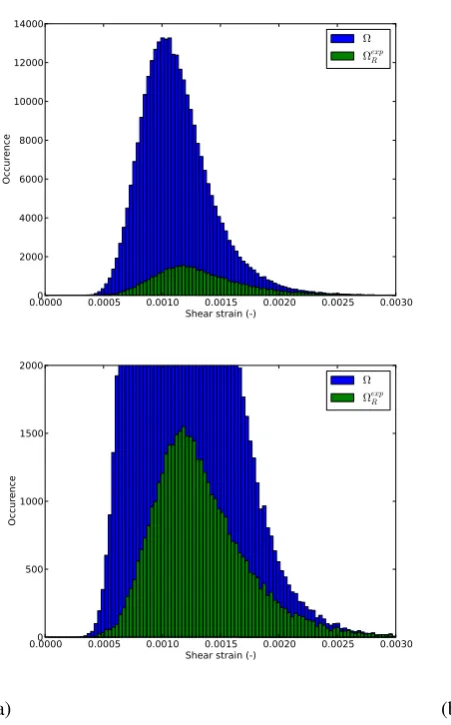
These data can be saved as histograms for example. In this present paper, the shear strain distribution was saved, 172
as this variable is extremely interesting in the case of strain localization. The additional memory cost is actually 173
negligible as it consists in storing a few hundred of floats. 174
Remark:when choosing to saveQexpu the noise is also saved, whereas inV exp
u it is partially filtered, like in PCA 175
analysis. 176
The data concerning the strains are not stored as they can be computed with the displacement data thanks to 177
Equation8. 178
Generally, in-situ experiments observed in X-ray CT do not have numerous time steps, hence the above 179
dimensionality reduction does not reduce drastically the size of the data to store. This will be illustrated 180
with the following example in Section3. The hyper-reduction of the domain is actually the predominant step for 181
data pruning. 182
2.4. Reduced mesh of the RED 183
In order to set up the hybrid hyper-reduced order model on the REDΩexpR for the calibration procedure, 184
we introduce a FE model restrained to the RED. This defines a reduced mesh. The FE shape functions of the 185
reduced mesh are denoted by(ψi)i=1,...card(F)such that: 186
ψi(x) =ψF
i(x)∀x∈Ω exp
R (21)
whereFiis theithindex in the setF of degrees of freedom in the RED:
F =
i∈ {1, . . .Nd}|
Z
Ωexp R
ψ2i(x)dΩ>0
(22)
card(F)is the number of degrees of freedom of the reduced mesh. This changes the index numbering. The setF is then transformed intoF?such that:
The complement set of F? is denotedI. It contains the degrees of freedom inΩexpR that are connected to Ω\Ωexp
R in the full original mesh. For a given empirical reduced basisV,V∈Rcard(F)×Nis its restriction to the RED:
V=V[F, :] (24)
The hybrid FE/reduced approximation is obtained by adding few columns of the identity matrix toV. In this hybrid approximation, we only add FE degrees of freedom that are not connected to the degrees of freedom inI. The resulting set of degrees of freedom is denoted byR. In Baigeset al.[26] it has been shown that this permits to have strong coupling in the resulting hybrid approximation. Let’s define the subdomain connected to
I:
ΩI =∪i∈Isupp(ψi) (25)
Then we get:
R=
i∈ {1, . . . ,card(F)}| Z
ΩI
ψ2i(x)dx=0
(26)
The hybrid reduced basis is denoted byVH. It reads, by using the Kronecker delta (δji):
VH[:, 1 :N] =V, VH[i,N+k] =δRki k=1, . . . ,card(R) (27)
We assume that:
(VH[F?, :])TK[F?, :]VH= (VH[F, :])TK[F, :]VH (28)
whereVHcontainsVin its first columns and keep the same columns of the identity matrix (with renumbered rows) in the latest columns andKandcare computed on the reduced mesh ofΩexpR . This assumption is relevant in mechanical problems without contact condition, in the framework of first strain-gradient theory. We refer the reader to Fauqueet al.[31] for the extension of the hybrid hyper-reduction method to contact problems. It follows that the hybrid hyper-reduced equations for a linear problem reads:
(VH[F?, :])TK[F?, :]VHbR= (VH[F?, :])Tc[F?] (29)
In case of non linear problems,Kis the FE tangent stiffness matrix computed on the reduced mesh andcis the 187
opposite of the residual of FE balance equations in the reduced mesh. If the matrix(VH[F?, :])TK[F?, :]VH 188
does not have a full rank, it is suggested to remove the columns ofVthat cause the rank deficiency, incrementally 189
by starting from the last column. When using the SVD to obtainVfrom data, the last columns have the smallest 190
contribution in the data approximation. 191
Theorem 3. WhenΩexpR =Ωthen the hybrid hyper-reduced equations are the original FE equations on the full 192
mesh. 193
Proof. IfΩexpR = Ω, thenI = ∅,F? = R = {1, . . . ,Nd}and the reduced mesh is the original mesh. In 194
addition, all the empirical modes have to be removed fromVHto get a full rank system of equations. HenceVH
195
is the identity matrix. So the hybrid hyper-reduced equation are exactly the original FE equations. There is no 196
complexity reduction. 197
In the sequel, the empirical reduced basis is extracted from data restrained to the RED, by using the SVD. Let’s denote byXthe data available on the full mesh, before the data pruning. Then, after pruning, the empirical reduced basis is related toX=X[F, :]:
X=V S WT+R,V∈Rcard(F)×N (30)
Theorem 4. If etol = 0. If both Hybrid hyper-reduced equations and FE equations have a unique 199
solution respectively, and if the FE solution aFE belongs to the subspace span by the data, such that 200
kaFE−X W S−1VTaFE[F]k = 0, thenbR[1 : N] = VTaFE[F] andbR[1+N : card(H) +N] = 0T
R,
201
where0R is a vector of zero inRcard(R). This means that the hyper-reduced solution is exact and the FE 202
correction in the hybrid approximation is null. 203
Proof. Let’s introduce the matrixVb =X W S−1. Then,
b
V[F, :] =X W S−1=V (31)
IfkaFE−V Vb TaFE[F]k = 0, thenkaFE[F]−VbbFEk = 0 withbbFE = VTaFE[F] and[(bbFE)T,0T
R]T
fulfills the following equation:
K[F?, :]VH[(bbFE)T,0TR]T=c[F?] (32)
Then, the balance equations of the hybrid hyper-reduced equations are fulfilled by[(bbFE)T,0T
R]T. If both hybrid
204
hyper-reduced equations and FE equations have a unique solution respectively, then the solution of the hybrid 205
hyper-reduced equations isbR= [(bbFE)T,0T
R]T.
206
3. Illustrating example: polyurethane bonded sand studied with X-ray CT 207
3.1. Material and test description 208
The material studied here is a polyurethane bonded sand used in casting foundry to mold the internal cavities 209
of foundry parts. The resin makes bonds between grains and improves drastically the mechanical properties 210
of the cores (stiffness, maximum yield stress, traction strength...). The material has been extensively studied 211
with standards laboratory tests, focusing on macroscopic displacement-force curves. This casting sand has been 212
experimentally investigated by Jomaaet al.[32] and Bargaouiet al.[33]. These macroscopic data are completed 213
with anin-situuniaxial compression test studied in X-ray CT on an as-received sample. According to Bargaoui 214
et al.[33], the process used to make the cores (Cold Box process) guarantees the homogeneity of the material. In 215
the sequel, the resin bonded sand is supposed homogeneous. 216
The sample is a parallelepiped (20.0×22.4×22.5 mm3). The load was increased (with a constant 217
displacement rate of 0.5 mm/min) and the displacement was stopped at several levels, noted Pi. During 218
these stopped displacement periods, the sample was scanned with a tension beam of 80 kV and an intensity 219
of 280µA.P0corresponds to the initial state, before the appliance of the load. Then seven tomography scans
220
were performed at increasing compressed states. AtP7, the sample is broken. The bottom and top extremities
221
were excluded from the images because of the artifacts induced by the plates. A grayscale image of the tested 222
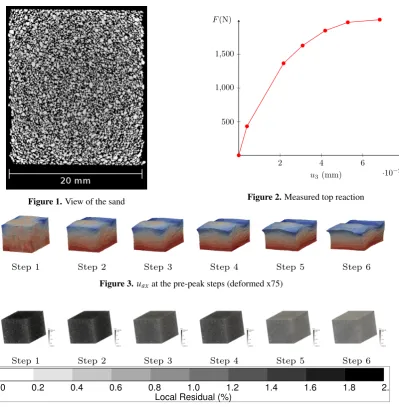
cemented sand is displayed in Figure1. During the test, the reaction is measured at the top of the sample. It is 223
plotted in Figure2. The first 6 steps (non-broken sample) are situated before the peak of the loading curve. 224
3.2. DVC and error estimation 225
The displacement fields at these different stages were calculated using a 3D-digital image correlation (DVC) 226
software named Ufreckles, developed by LaMCos (see Réthoréet al.[4]). A finite element continuum method is 227
used to calculate the displacement field with a non-linear least square error minimization method. The chosen 228
element size is near 0.5 mm. The final region of interest is 20.0×22.4×15.8 mm3. The top of the sample has been 229
excluded. The DVC is performed on a parallepipedic mesh composed of around 470,000 degrees of freedom. 230
The DVC showed that the pre-peak displacement field is extremely non-homogeneous as shown in Figure3. The 231
pre-peak noise is relatively homogeneous (Figure4). The noise is more predominant at the first steps where the 232
displacement is really small and thus the DVC reconstruction was more complicated. The test showed a complex 233
and rich behavior of the material tested with namely a non-homogeneous displacement field and pre-peak strain 234
bifurcations. The experimental data are very suited for testing the ability of a given model to predict such 235
Figure 1.View of the sand
2 4 6
·10−2 500
1,000 1,500
u3(mm) F(N)
Figure 2.Measured top reaction
Step 1 Step 2 Step 3 Step 4 Step 5 Step 6
Figure 3.uaxat the pre-peak steps (deformed x75)
Step 1 Step 2 Step 3 Step 4 Step 5 Step 6
0.0 0.2 0.4 0.6 0.8 1.0 1.2 1.4 1.6 1.8 2.0
Local Residual (%)
Figure 4.Noise at the pre-peak step (max: 2%)
3.3. Building the reduced experimental basis 237
As precised in the data pruning procedure, the experimental displacement and strain snapshot matrices are 238
computed. The attention is drawn to the fact that the studied test has not a lot of time steps (Nt=7) and the 239
experimental mesh is not that big. The DVC matricesQuandQεare respectively 474,405×7 and 1,774,080×14.
240
If the truncated SVD is applied on these matrices, only 6 modes are extracted for the displacement and 13 for 241
strain. As the number of time steps is rather small, the use of empirical modes does not reduce the size of the 242
experimental data, as stated before. 243
In other words, the experimental data are not suited for the dimensionality reduction. This method is 244
efficient on matrices with numerous columns and rather few lines, whereas tomographic data tend to have the 245
exact opposite : few columns (time steps) and a lot of lines (degrees of freedom). 246
3.4. RED after DVC on the specimen 247
The building procedure has three main inputs: 248
• The empirical modesVuandVε.
249
• TheKparameter for K-SWIM (Algorithm1). 250
During the test, the loading curve was measured at the top of the sample. In order to compare computed 252
and measured reactions for model assessment, the elements at the top of the mesh are considered as a ZOI. In the 253
remaining,Ω+is one layer of elements aroundΩu∪Ωε∪Ωuser. 254
The RED was determined varying the numberKof selected lines in the K-SWIM Algorithm. Its influence is 255
assessed in Figure5. ForK=1, the standard DEIM algorithm selects very few degrees of freedom. Most of the 256
RED is actually the ZOI. This is due to the relatively low number of modes contained in the reduced basis (only 257
6). This apparent issue can be overcome by selecting more lines during the K-SWIM algorithm. When increasing 258
K, the number of degrees of freedom linearly rises. The attention is drawn on the fact that the resultant RED 259
forK=25 orK=50 are discontinuous, as it is usually the case when using hyper-reduction methods. The newly
260
selected zones are situated in the sheared regions. 261
(a)K=1 (b)K=25 (c)K=50
Nd=47,382 (10% ofΩ) Nd=73,911 (15.6% ofΩ) Nd=98,064 (20.5% ofΩ)
Figure 5.Influence ofKin the K-SWIM algorithm
The final RED selected was the one computed withK=25(around 15.6% of the total domainΩ). It is 262
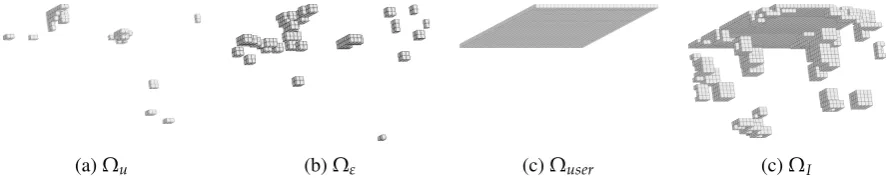
displayed in Figure5b. The reduced domain construction is analyzed in Figure6where the subdomainsΩu,Ωε, 263
ΩuserandΩIare displayed. 264
(a)Ωu (b)Ωε (c)Ωuser (c)ΩI
Figure 6.Different subdomains for the selected RED forK=25
A summary of the different matrix sizes at each step is displayed in Table1. As stated before, it’s clear that 265
for this kind of data, the PCA analysis does not reduce significantly the memory usage. The hyper-reduction 266
scheme used allowed to save up to 85% of the memory space for the illustrating example. 267
Experimental Data Empirical Modes Pruned data
Qu 474405×7 Vexpu 474405×6 Vexpu 73911×6
bexpu 6×7 bexpu 6×7
Memory saved 15% 85%
Experiments
Image acquisition
DIC/DVC
Data pruning Model reduced basis
H2ROM
predictions
Cost Function
Optimized parametersµ∗
FEM calculations on Ω withµ∗
H2ROM
prediction validated
Validatedµ∗ Parameter sensibility study
Initial guess
Updateµ
f
aexp,η bexp
u Vexpu RED
µ0
Qmodel u
Vmodelu
bmodel(µ)
No
Yes
Yes
No
Figure 7.Flowchart of the FEMU-H2ROM
4. Finite Element Model Updating-H2ROM 268
4.1. Assessing the relevance of the pruned data 269
In this section, the relevance of the pruned data for further usage is discussed. The data extracted from 270
computed tomography can have various purposes. This paper focuses on its use for model calibration, and is 271
illustrated with thein-situcompressive test of a resin bonded sand presented in the previous section. The main 272
aim of this part is to prove that a reduced integration domain computed thanks to a model free procedure is 273
relevant to assess or calibrate an arbitrary constitutive model. 274
It is supposed here that the inputs of the present section are: 275
• The mesh of the total experimental domainΩ; 276
• The mesh of the reduced experimental domainΩexpR ; 277
• The reduced basis of the displacement on the RED and the corresponding reduced coordinatesVexpu and 278
bexpu ; 279
• The relevant boundary conditions; 280
• The probability distributions of shear strain onΩandΩexpF . 281
The model used for the illustrating example is a constitutive elastoplastic model withmunknown parameters 282
to calibrate. The procedure employed is a Finite Element Model Updating (FEMU) technique, coupled with an 283
hybrid hyper-reduction method for the solution of approximate balance equations. The use of such method is 284
straightforward as the input data are actually hyper-reduced. This approach is termed FEMU-H2ROM. 285
The FEMU-H2ROM method is resumed in the flowchart of the Figure7. The blue part concerns the data pruning 286
q
p
p
tp
cp
c(1+
b
)
f(b= 0) f(b >0)
Figure 8.Yield surfaces in the(p,q)plane
4.2. Constitutive model MC-CASM 288
4.2.1. Presentation 289
The resin-bonded sand behavior is modeled with a relatively simple constitutive model based on the 290
Cemented Clay and Sand Model (C-CASM). It consists in the extension of the Clay And Sand Model developed 291
by Yu [34] for unbonded sand and clay to bonded geomaterials within the framework developed by Gens and 292
Nova [35]. The C-CASM has been extensively described in Rioset al.[36]. The Modified Cemented Clay And 293
Sand Model (MC-CASM) presented here has some modifications of the C-CASM: 294
• Addition of a damage law whose equation is phenomenological (based on cycled compressive tests); 295
• The hardening law of the bonding parameterbis different: a first hardening precedes the softening. It is 296
supposed here that the polyurethane resin goes through a first hardening before breaking. 297
It is supposed here that the yield function was previously calibrated with standard laboratory tests. The 298
calibration concerns the parameters involved in the different damage and hardening laws that can be more difficult 299
to assess with macroscopic loading curves. In the continuation of the paper, the equivalent von Mises stress will 300
be denotedqand the mean pressurep. The MC-CASM equations are summarized hereafter. 301
4.2.2. Yield function 302
The yield function, f, of the constitutive model is defined by: 303
f(σ;pc,b) =
q
M(p+pt)
n + 1
lnrln
p
+pt
pc(1+b) +pt
(33)
M,r, andnare constant parameters that control the shape of the yield function.pcis the preconsolidation
pressure, that is to say the maximum yield pressure during an isotropic compressive test (see Roscoeet al.[37]). bis the bounding parameter modeling the amplification of the yield surface due to intergranular bonding. ptis the traction resistance of the soil defined by Gens and Nova [35] as:
pt=αbpc (34)
Whereαis a constant parameter modeling the influence of the binder on the traction resistance. The yield 304
function is supposed to be calibrated. This means thatM,r,n,αand the initial values ofpcandbare known. 305
The yield surfaces of the unbonded (blue) and bonded sand (red) are plotted in Figure8. 306
4.2.3. Hardening and damage laws 307
The model has two hardening variables: the preconsolidation pressurepcand the bonding parameterb. The evolution ofpcis directly controlled by the incremental plastic volumetric strainε˙pv, whereasbrelies on a plastic strain damage measureh:
˙ pc
pc =µ1ε˙
p
v (35)
˙
The incremental value ofhis defined as a weighting of the effects of the incremental plastic shear strain and the incremental plastic volumetric strain:
˙
h=µ2|ε˙ps|+µ3|ε˙pv| (37)
The model also includes a damage law whose formulation is purely phenomenological:
E=E0(1−D) (38)
D=µ4hµ5 (39)
The hardening and damage laws providem=7 unknown parameters to calibrate. 308
4.3. Calibration protocol by using the hybrid hyper-reduction method 309
The FEMU-H2ROM is preceded by an off-line phase similar to an unsupervised machine learning phase. It 310
consists in building the empirical reduced basisVthat is mandatory to set up the hybrid hyper-reduced equations. 311
It is similar to the first step of the data pruning method: a snapshot matrix is constructed based on simulations 312
and experimental results (and not on experiments only). 313
The starting point of the off-line phase is to assess the parameter sensibilities of the model starting from an 314
initial guessµ0={µ01, . . . ,µ0m}. This guess can come from a previous calibration, or a calibration done using 315
macroscopic force-displacement curves of standard tests without predicting strain localization. 316
The off-line calculations are performed on the full domainΩand thus can be time consuming. The boundary 317
conditions are the experimental displacements taken from the computed tomography imposed at the top and 318
the bottom of the sample. The displacement field is not imposed inside the sample because one of the aims of 319
the model is to correctly capture the strain localization appearing inside the sample during the test, under the 320
constraint of balance equations. Imposing the displacement field inside the specimen gives less balance equation 321
to fulfill.mcalculations are made onΩ. Attention is drawn on the fact that these calculations can be done in 322
parallel. Only the displacement snapshot matrices are needed. A total ofm+1independent calculations are 323
performed: 324
• One initial calculation whereµ=µ0, which givesQu(µ0); 325
• mparameters sensibility calculations whereµ=µi ={µ01, . . . ,µ0i +δµ0i, . . . ,µ0m}, which giveQu(µi) 326
fori=1, . . . ,m 327
Once done, these calculations are restricted to the reduced experimental domainΩexpR . They are denoted
Qu(µi)fori=0, . . . ,m. All these results have to be aggregated in one snapshot matrixXbefore the computation of the empirical modesV. Instead of concatenating them+1matrices into one, a Derivative Extended Proper Orthogonal Decomposition (DEPOD) method is used (see Schmidtet al.[38]). This approach has been validated in previous works on model calibration with hyper-reduction Ryckelynck and Missoum Benziane [39]. This allows to capture the effects of each parameter variation.
X= [αVexpu bexpu ,Qu(µ0), kQu(µ
0)k
2kQu(µ1)−Qu(µ0)k(Qu(
µ1)−Qu(µ0)), . . . , kQu(µ0)k 2kQu(µm)−Qu(µ0)k
(Qu(µm)−Qu(µ0))] (40)
The first termαVexpu bexpu corresponds to the pruned experimental data. It is weighted by a custom parameter 328
αthat enables to give more impact to the experimental fluctuations in the empirical modes. The finite element 329
methods tends to smooth these fluctuations thus provoking a certain loss of information. 330
Empirical modes depending on the factorαare displayed in Figure9. Forα=0, that is to say without 331
experimental data in the bulk, the empirical modes have strong fluctuations only at the top and the bottom of 332
the specimen, where the experimental boundary conditions are imposed. This can be explained by the natural 333
smoothing that ensures the finite element method with rather elliptic equations. Increasing the importance of the 334
modes (α=10) the last empirical mode is roughly smooth: this is due to the POD algorithm that filters the data. 336
In the sequel, we chooseα=1. The experimental data are as important as simulation data related to FE balance 337
equations. 338
α
= 0
α
= 1
α
= 10
First mode
Second mode
Third mode
Last mode
Figure 9.kukof the DEPOD modes depending onα
Once V is available, the hybrid reduced basis VH can be defined. Then, the experimental reduced coordinates are projected on the empirical reduced basis to be compared during the optimization loop:
b
bexp= (VH)TVexpu b exp
u (41)
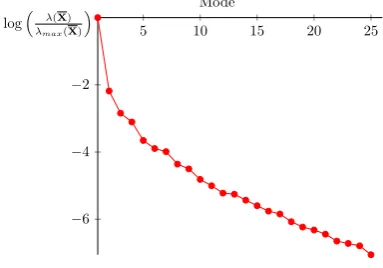
For the proposed example, there is a fast decay of the singular value (see Figure10whereePODis set to 339
10−4). When this decay is not sufficient to provide a small number of empirical modes, we refer the reader to
340
Ghavamianet al.[40], Peherstorferet al.[41] and Haasdonket al.[42] to cluster the data in order to divide the 341
time interval and construct local reduced basis in time. 342
5 10 15 20 25
−6 −4 −2
Mode log λ(X)
λmax(X)
Figure 10.Singular values ofXverifyingλ(X)>ePODλmax(X)
4.4. Discussion on Dirichlet boundary conditions 343
After the data pruning, experimental data are available in allΩexpR . When displacements are constrained to 344
follow the experimental data, we loose FE balance equations. The following property helps to discuss about the 345
Dirichlet boundary conditions. 346
Theorem 5. Ifα>0,etol=0and the experimental dataQ ex
u fulfill the FE equations onΩexR with the following additional Dirichlet boundary conditions:
and if both hybrid hyper-reduced equations and FE equations onΩexR are unique, then the solution of the 347
hybrid hyper-reduced equation is the exact projection of the experimental data on the empirical reduced basis 348
bR(µ) = [(VTQexu)T,0TR]T, withkQexu −V VTQexu k=0. 349
Proof. Let’s consider a linear elastic FE problem. If Qexu fulfills the FE equations onΩexR, with additional Dirichlet boundary conditions, then:
aFE(tj,µ) =Qexu [:,j] j=1 . . .M
and
K[F?, :]aFE−c[F?] =0
Ifα>0andetol =0, then
aFE(tj,µ) =V bFE(tj,µ) j=1 . . .M,
with
bFE(tj,µ) =VTQexu [:,j] j=1 . . .M
Then
K[F?, :]V bFE(tj,µ)−c[F?] =0 j=1 . . .M
and
(VH[F?, :])TK[F?, :]V bFE(tj,µ)−(VH[F?, :])Tc[F?] =0 j=1 . . .M
SobR(µ) = [(bFE(tj,µ))T,0TR]Tis the unique solution of the hybrid hyper-reduced equations, and the exact 350
projection of the restrained FE solution. 351
The last property does not imply that imposingaFE(tj,µ)[I] = Qexu[I,j]as a boundary condition to 352
degrees of freedom inI is the best way to fulfill FE balance equations. In fact, with the additional boundary 353
conditions onI, the maximum of available FE equations is card(F?). The Property4means that if the empirical 354
reduced basis is exact, then all theNd FE balance equations are fulfilled inΩ. In a sense, in the proposed 355
calibration protocol, we better trust in FE balance equations than in experimental data. Accurate FE balance 356
equations can be obtained by a convenient mesh ofΩ, although noise is always present in experimental data. 357
4.5. Cost function and parameters updating 358
In the optimization loop, a given set of parametersµis assessed. The H2ROM calculations provide the 359
reduced coordinates associated with the empirical basis previously determined on the RED denotedbR(µ). The 360
top reactionFcomp(µ)is also calculated as the average axial stress in the ZOI. 361
In the example, the cost function evaluates two scales of error: the microscale error between experimental and 362
computed reduced coordinates and the macroscale error between the measured and computed top reactions. 363
These error functions are respectively denotedχ2u(µ)andχ2F(µ). 364
The microscale error is defined as:
χ2u(µ) =kbR(µ)−bbexpk2Ωexp R
(43)
The choice of the norm is user-dependent. The inverse covariance matrix of the displacement is the best norm for a Gaussian noise according to Tarantola [43], Kaipio and Somersalo [44] for a Bayesian framework. However, in this present study, to keep the treated problem rather simple, this error function is chosen:
χ2u(µ) = (bR(µ)−bbexp)T(bR(µ)−bbexp) (44)
The macroscale error is defined as:
χ2F(µ) =kFcomp(µ)−Fexpk2Ωexp F
where ΩexpF is the top of the sample, where the experimental load was measured. The experimental load measurements are supposed uncorrelated and their variance is denoted byσ2F. In a Bayesian framework, for a Gaussian noise corrupting the load measurements [21], the previous equation can be written as:
χ2F(µ) = 1
NtσF2{F comp(
µ)−Fexp}T{Fcomp(µ)−Fexp} (46)
For the the optimization loop, the final objective function is a weighted sum of the two previous sub-objective functions:
χ2(µ) =cuχ2u(µ) +cFχ2F(µ) (47)
wherecuandcFare the weights. They can be chosen to balance the two cost functions or to privilege one scale 365
to another. In the illustrating example, the cost function is balanced. A classical Levenberg-Marquardt algorithm 366
is employed for the minimization of the error function and the update of the parameters vectorµ. 367
4.6. Model calibration and FEM validation 368
The optimization loop took 53 iterations. The speed ratio between FEM calculations and H2ROM predictions 369
is around 70. Moreover the H2ROM predictions only needed around 3% of the FEM calculation memory cost. 370
The H2ROM predictions converge way more easily than the FEM calculations. The problem simulated in the 371
optimization loop is a displacement imposed problem. The use of the reduced basis to predict the displacement 372
field facilitates drastically the convergence. That explains also the important speed-up time that does not come 373
only from the reduction of the integration domain. 374
Figure11displays the experimental and the computed top reactions (initial and optimized). At the end of the 375
optimization loop, it is mandatory to assess the relevance of the H2ROM prediction. The FEMU-H2ROM is 376
dependent on the initial guessµ0. This input determines the relevance of the reduced basis of the model after the 377
parameters sensibility study and the DEPOD analysis. During the model updating, the parameters set can be 378
too different from the initial guess. As a consequence, the empirical reduced basisVHmay not be accurate and 379
the H2ROM predictions will not be admissible. That is to say that the discrepancy between hyper reduced and 380
Finite Element calculations may not be negligible. That’s why the optimized parameters setµ∗must be validated 381
with FEM calculations on the full domainΩ. It is worth noting that if the experimental data are included in the 382
DEPOD, the final H2ROM prediction should be close to the experiments. 383
In a similar manner to the optimization loop, an error function between both calculations can be defined focusing 384
on the microscale (displacement error) and macroscale (top reactions differences). 385
Concerning the microscale, the discrepancy is only computed in the RED, as H2ROM predictions are only made 386
on this domain and cannot be reconstructed in the full domain with this particular approach. 387
r2u(µ∗) =kaH 2ROM
(µ∗)−aFE(µ∗)k2Ωexp F
(48)
=aH2ROM(µ∗)−aFE(µ∗)
T
aH2ROM(µ∗)−aFE(µ∗)
(49)
In the same manner, the macroscale discrepancy is:
r2F(µ∗) =kFH 2ROM
(µ∗)−FFE(µ∗)k2Ωexp F
(50)
=FH2ROM(µ∗)−FFE(µ∗)
T
FH2ROM(µ∗)−FFE(µ∗)
(51)
The microscale and macroscale errors should not exceed a few percents of the FEM calculations. In Figure11 388
the FEM top reaction is plotted in orange. It is clear that its value is extremely close to the one computed thanks 389
to H2ROM. The error is around 1% at each step. 390
This final verification is purely numerical. If the H2ROM predictions are validated, it is advised to analyze deeper 391
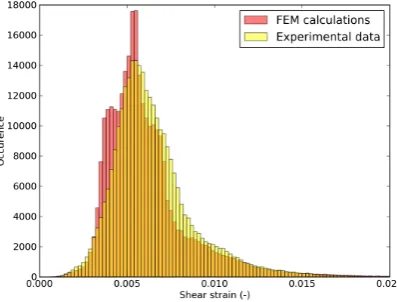
the RED. In the illustrating example, the computed and measured shear strain distributions were compared. The 393
analysis is summarized in the histograms displayed in Figure12for the last pre-peak step. The discrepancy 394
between computed and measured distributions was considered here as satisfying. 395
In the case of notable differences between H2ROM prediction and FEM calculations, or between FEM 396
calculations and experiment, the FEMU-H2ROM is not validated. Two solutions are possible to overcome this 397
issue: 398
1. Perform again the whole parameters sensibility study withµ0 = µ∗. This implies to do mparallel 399
calculations again. 400
2. Concatenate the previously determined matrix Xfrom Equation 40 withQu(µ∗)and perform a new 401
truncated SVD to determine ultimately an enriched reduced basisVH. No new FEM calculations are 402
needed. 403
The first solution should be performed in the case of strong differences between H2ROM prediction and FEM 404
calculations. The second option "only" costs a FEM calculation. It is also possible to modify the optimization 405
loop to include regularly FEM-H2ROM comparison and enrichVHincrementally. 406
1 2 3 4 5 6
·10−2
500 1,000 1,500
u3(mm)
F(N)
Experiment
µ0 µ∗ FEM verification
Figure 11.Result of the H2ROM optimization
5. Discussion 407
5.1. Limitations of the pruning procedure 408
The present paper focused on DVC sets and not on the images themselves. They are known to be as-well 409
particularly heavy and perhaps more problematic than the DVC data. The pruning procedure considers that 410
they can be deleted. Actually, it can be problematic. For instance, new DVC algorithm could improve the 411
determination of the displacement field (for example for complex problems involving cracks). 412
The images could be pruned too, in the sense that the only the pixels of the images inside the determined RED 413
can be conserved. However, we preconize to store only the reduced DVC data when the data storage is an issue. 414
In the case of non homogeneous materials, the data concerning the inhomogeneity outside the RED must be 415
saved as well. 416
5.2. A posteriori study of the RED 417
An a posteriori study of the determined RED was performed. The present discussion will focus on the 418
shear strain distributions inside the whole domainΩand the REDΩexpR for the illustrating example. It would 419
be preferable that the pruning procedure stores in the RED the most different configurations. The shear strain 420
distributions in the whole domain and in the RED might be different (not the same mean value for example). The 421
Figures13(a) and14(a) present the shear strain distributions at the first and last pre-peak step. It appears that 422
the statistical distribution of the shear strain inside the RED is not the same than the one inside the full domain. 423
Nevertheless, zooms at both histograms in Figures13(b) and14(b) reveal that the extremum values of the shear 424
strain are conserved. One can see that the RED contains nearly all the elements where the shear is maximal. 425
Even if the proposed procedure is model-free, it is intimately linked with the mechanics of solids: it will store 426
preferably the data that is mechanically more relevant. For strain localization phenomenon, it is the most sheared 427
zone. The proposed method is not statistical: it induces actually a sampling bias. 428
6. Conclusion 429
The present paper proposed a pruning data procedure for DVC data that is model free and versatile. The 430
K-SWIM algorithm, through its parameterK, enables the user to define the size of the stored data. 431
The resultant data can still be used afterwards for calibration for instance. The use of hybrid hyper-reduction is 432
particularly suitable for the pruned data as it enables a non-negligible reduction of memory and time costs in the 433
FEMU optimization loop. The FEMU-H2ROM method is thus a new way to use massive DVC data for deeper 434
mechanical studies. 435
Acknowledgments 436
The authors would like to acknowledge the Agence Nationale pour la Recherche for their financial support 437
for the FIMALIPO project. 438
References 439
440
1. van Ooijen, P.M.A.; Broekema, A.; Oudkerk, M. Use of a Thin-Section Archive and Enterprise 3-Dimensional
441
Software for Long-Term Storage of Thin-Slice CT Data Sets—A Reviewers’ Response.Journal of Digital Imaging
442
2008,21, 188–192. doi:10.1007/s10278-007-9041-8.
443
2. Pan, D. A tutorial on MPEG/audio compression. IEEE MultiMedia1995,2, 60–74. doi:10.1109/93.388209.
444
3. Cioaca, A.; Sandu, A. Low-rank approximations for computing observation impact in 4D-Var data assimilation.
445
Computers and Mathematics with Applications2014,67, 2112 – 2126. Efficient Algorithms for Large Scale Scientific
446
Computations, doi:https://doi.org/10.1016/j.camwa.2014.01.024.
447
4. Réthoré, J.; Roux, S.; Hild, F. From pictures to extended finite elements: extended digital image correlation (X-DIC).
448
Comptes Rendus Mécanique2007,335, 131 – 137. doi:http://dx.doi.org/10.1016/j.crme.2007.02.003.
0.0000 0.0005 0.0010 0.0015 0.0020 0.0025 0.0030 Shear strain (-)
0 2000 4000 6000 8000 10000 12000 14000
Occur
ence
Ω Ωexp
R
0.0000 0.0005 0.0010 0.0015 0.0020 0.0025 0.0030 Shear strain (-)
0 500 1000 1500 2000
Occur
ence
Ω Ωexp
R
(a) (b)
Figure 13.Shear strain distributions in the whole domain and in the RED at the first step
5. Rojanaarpa, T.; Kataeva, I. Density-Based Data Pruning Method for Deep Reinforcement Learning. 2016
450
15th IEEE International Conference on Machine Learning and Applications (ICMLA), 2016, pp. 266–271.
451
doi:10.1109/ICMLA.2016.0051.
452
6. Hu, Y.; Chen, H.; Li, G.; Li, H.; Xu, R.; Li, J. A statistical training data cleaning strategy for the PCA-based chiller
453
sensor fault detection, diagnosis and data reconstruction method. Energy and Buildings2016,112, 270 – 278.
454
doi:https://doi.org/10.1016/j.enbuild.2015.11.066.
455
7. Hong, Y.; Kwong, S.; Chang, Y.; Ren, Q. Unsupervised data pruning for clustering of noisy data. Knowledge-Based
456
Systems2008,21, 612–616. doi:{10.1016/j.knosys.2008.03.052}.
457
8. Kavanagh, K.T.; Clough, R.W. Finite element applications in the characterization of elastic solids. International
458
Journal of Solids and Structures1971,7, 11 – 23. doi:https://doi.org/10.1016/0020-7683(71)90015-1.
459
9. Kavanagh, K.T. Extension of classical experimental techniques for characterizing composite-material behavior.
460
Experimental Mechanics1972,12, 50–56. doi:10.1007/BF02320791.
461
10. Ienny, P.; Caro-Bretelle, A.S.; Pagnacco, E. Identification from measurements of mechanical fields by finite
462
element model updating strategies. European Journal of Computational Mechanics 2009, 18, 353–376,
463
[https://www.tandfonline.com/doi/pdf/10.3166/ejcm.18.353-376]. doi:10.3166/ejcm.18.353-376.
464
11. Lecompte, D.; Smits, A.; Sol, H.; Vantomme, J.; Hemelrijck, D.V. Mixed numerical–experimental technique for
465
orthotropic parameter identification using biaxial tensile tests on cruciform specimens. International Journal of
466
Solids and Structures2007,44, 1643 – 1656. doi:https://doi.org/10.1016/j.ijsolstr.2006.06.050.
467
12. Molimard, J.; Le Riche, R.; Vautrin, A.; Lee, J.R. Identification of the four orthotropic plate stiffnesses using a single
468
open-hole tensile test.Experimental Mechanics2005,45, 404–411. doi:10.1007/BF02427987.
0.000 0.005 0.010 0.015 0.020 Shear strain (-)
0 2000 4000 6000 8000 10000 12000 14000 16000
Occur
ence
Ω Ωexp
R
0.000 0.005 0.010 0.015 0.020 Shear strain (-)
0 500 1000 1500 2000
Occur
ence
Ω Ωexp
R
(a) (b)
Figure 14.Shear strain distributions in the whole domain and in the RED at the last step
13. Meijer, R.; Douven, L.F.A.; Oomens, C.W.J. Characterisation of Anisotropic and Non-linear Behaviour of
470
Human Skin In Vivo. Computer Methods in Biomechanics and Biomedical Engineering 1999, 2, 13–27,
471
[https://doi.org/10.1080/10255849908907975]. PMID: 11264815, doi:10.1080/10255849908907975.
472
14. Bruno, L. Mechanical characterization of composite materials by optical techniques: A review. Optics
473
and Lasers in Engineering 2018, 104, 192 – 203. Optical Tools for Metrology, Imaging and Diagnostics,
474
doi:https://doi.org/10.1016/j.optlaseng.2017.06.016.
475
15. Mahnken, R.; Stein, E. A unified approach for parameter identification of inelastic material models in the frame
476
of the finite element method. Computer Methods in Applied Mechanics and Engineering1996,136, 225 – 258.
477
doi:https://doi.org/10.1016/0045-7825(96)00991-7.
478
16. Forestier, R.; Massoni, E.; Chastel, Y. Estimation of constitutive parameters using an inverse method coupled
479
to a 3D finite element software. Journal of Materials Processing Technology 2002, 125-126, 594 – 601.
480
doi:https://doi.org/10.1016/S0924-0136(02)00406-5.
481
17. Giton, M.; Caro-Bretelle, A.S.; Ienny, P. Hyperelastic Behaviour Identification by a Forward Problem Resolution:
482
Application to a Tear Test of a Silicone-Rubber. Strain2006,42, 291–297.
483
18. Cugnoni, J.; Botsis, J.; Janczak-Rusch, J. Size and Constraining Effects in Lead-Free Solder Joints. Advanced
484
Engineering Materials2006,8, 184–191. doi:10.1002/adem.200400236.
485
19. Latourte, F.; Chrysochoos, A.; Pagano, S.; Wattrisse, B. Elastoplastic behavior identification for heterogeneous
486
loadings and materials. Experimental Mechanics2008,48, 435–449. doi:10.1007/s11340-007-9088-y.
487
20. Padmanabhan, S.; Hubner, J.P.; Kumar, A.V.; Ifju, P.G. Load and Boundary Condition Calibration Using Full-field
488
Strain Measurement. Experimental Mechanics2006,46, 569–578. doi:10.1007/s11340-006-8708-2.