Making Public Key Functional Encryption Function Private,
Distributively
Xiong Fan* Qiang Tang†
Abstract
We put forth a new notion of distributed public key functional encryption. In such a functional encryption scheme, the secret key for a functionf will be split into sharesskfi. Given a ciphertextctthat encrypts a messagex, a secret key shareskfi, one can evaluate and obtain a shared valueyi. Adding all the shares up can recover the actual value off(x), while partial shares reveal nothing about the plaintext. More importantly, this new model allows us to establishfunction privacywhich was not possible in the setting of regular public key functional encryption. We formalize such notion and construct such a scheme from any public key functional encryption scheme together with learning with error assumption.
We then consider the problem of hosting services in the untrusted cloud. Boneh, Gupta, Mironov, and Sahai (Eurocrypt 2014) first studied such application and gave a construction based on indistinguishability obfuscation. Their construction had the restriction that the number of corrupted clients has to be bounded and known. They left an open problem how to remove such restriction. We resolve this problem by applying our function private (distributed) public key functional encryption to the setting of hosting service in multiple clouds. Furthermore, our construction provides a much simpler and more flexible paradigm which is of both conceptual and practical interests.
Along the way, we strengthen and simplify the security notions of the underlying primitives, including function secret sharing.
1
Introduction
Cloud computing has the advantages that the cloud servers provide infrastructure and resources that can hold data, do computation for the clients, and even host service on behalf of the individual vendor (also called service providers). Despite those appealing features, major concerns of deploy-ing such a computdeploy-ing paradigm are the security and privacy considerations, as data owner does not have control of the outsourced data.
Functional encryption [BSW11, O’N10] provides a powerful tool to enable such versatile “outsourcing” without leaking the actual data. In particular, a data owner can first encrypt his dataxand store the ciphertextcton the cloud server, and then issue a secret keyskf to the cloud for a functionalityf that the data owner would like the cloud to compute. Decryptingctusing skf yields onlyf(x) and nothing else. For instance, the client would like to request the cloud to
*Cornell University,[email protected].This material is based upon work supported by IBM under Agreement
4915013672. Any opinions, findings, and conclusions or recommendations expressed in this material are those of the author(s) and do not necessarily reflect the views of the sponsors.
apply a transformationT to all his files that satisfies a certain condition described by a predicate P. This can be easily done by defining a following functiong(·), whereg(x) =T(x),ifP(x) = 1; otherwise,g(x) =x; the data owner can simply send such a decryption keyskg to the cloud and enable the cloud to carry on the transformation given only the encrypted files. Those mechanisms could potentially enable a very powerful paradigm shift in computing. For example, content providers can simply focus on producing the data while offloading all the content management and delivery functionalities to the cloud provider. Concretely, Netflix streaming services have been migrated to Amazon cloud [net]. In particular, Netflix could codify their algorithm (such as the recommendation system)f to beskf and let Amazon cloud process all the subscriber requests expressed as ciphertext.
In many cases, hiding data only is not enough for those applications, as the function itself may already leak critical or proprietary information. In the above example, other content providers such as Hulu also hosts their service in the Amazon cloud [hul], the recommendation system might be one of the competing advantages of those content vendors. If not protected properly, one service provider has great interests to infer information about the competing vendor’s proprietary program via the cloud. For this reason,function privacywas first proposed by Shen, Shi, Waters in the setting of private key predicate encryption in [SSW09]. It requires that a decryption keyskf does not leak
anything about the functionf.
It is easy to see that for a public key functional encryption, standard function privacy cannot be possible as it is. Since the attacker who has a key skf, can generate ciphertext on the fly, and thus obtain values of f(x1), . . . , f(xn) for the plaintext x1, . . . , xn of his choices. As a result,
majority of research along this line have been carried in two paths: (i) study function privacy in the setting of private key functional encryption such as the elegant work of Brakerski and Segev [BS15]. (ii) study weakened notion of function privacy by requiring that the function comes from high-entropy distribution [AAB+13], and those are studied only in special cases of identity based encryption [BRS13a] and subspace-membership encryption [BRS13b].1
Private key functional encryption is very useful for data owner to do outsourcing, however it is not convenient for sharing applications in which multiple clients may want to freely encode inputs, i.e., a public encryption operation is needed. While putting entropy restriction on the functions is a natural choice for feasibility of function privacy in specific scenarios, it is not clear how could the weakened notion be applied in the general setting. In this paper, we are trying to answer the following question:
Can we find a realistic model that allows us to approach function privacy for general public key functional encryption?
1.1 Our contributions
Circumventing impossibility via a distributed model. We initiate the study of public key, dis-tributed functional encryption. In such a cryptographic primitive, the secret key of a function f will be split into shares skfi and distributed to different parties. Given a secret key share, and a ciphertextct that encrypts a message x, one can evaluate locally using skfi and obtains
Dec(skfi,Enc(x)) =yi. Once all the evaluation shares{y1, . . . , yn}are obtained, everyone can
recon-struct the actual evaluationf(x). This new model of distributed functional encryption naturally
generalizes the notion of threshold decryption to the setting of functional encryption, and enables the joint efforts to recover an evaluation for a plaintext from a ciphertext (i.e., computingf(x) from the ciphertextct), and when the number function shares are not enough, nothing will be revealed aboutf(x).
More interestingly, such a new model offers an opportunity to bypass the impossibility of function privacy in the setting of public key functional encryption. Intuitively, given only a share skfi (or multiple shares as long as it is below the threshold), the adversary can only learnyi which
may not be enough to determinef(x). Formalizing such intuition, we give formal definitions of public key distributed functional encryption, and transform any public key functional encryption into a distributed version supporting both message privacy and function privacy via function secret sharing [BGI15,BGI16,KZ16]. Our construction can be instantiated from any functional encryption together with Learning With Error assumption [Reg05] where the construction of function secret sharing is based on, and reconstruction from shares {y1, . . . , yn} can be done by simply summing them up.
We remark here that our notion of distributed functional encryption is different from the decentralized key generation of functional encryption [CGJS15]. The latter mainly considers how to distribute the master key setup; while we consider how to split each function into secret key shares, and use such a model as a basis for studying function privacy. We also emphasize that the goal in this work is to achieve results generically from functional encryption itself directly, instead of from stronger primitives such as indistinguishability obfuscation (iO). With the help of iO or its stronger variant, differing-inputs obfuscation, we know how to construction multi-input functional encryption [GGG+14] and also function secret sharing [KZ16], there might be alternative ways to construct distributed public key functional encryption, which we will not explore in this paper.
Hosting service in multiple clouds securely and efficiently. One of the most appealing and widely deployed applications of cloud computing is to hosting service in the cloud. Boneh, Gupta, Mironov, and Sahai gave the first formal study of such an application [BGMS15]. The security considerations in this application scenario include protecting program (service) information and clients’ inputs against a untrusted cloud and protecting program (service) information and au-thorization procedure against untrusted clients. Their construction relied on indistinguishability obfuscation (iO), and had to restrict the number of colluded/corrupted clients for both security. They left as an open problem how to get rid of such a restriction. As one major application of our function private functional encryption, we demonstrate how to tackle this challenge in the model of hosting service in multiple clouds.
Let us elaborate via a concrete example: the popular augmented-reality game Pok´emon Go server was hosted at Google Cloud [pok]. The whole game as a computer program is deployed in Google cloud servers, and players directly interact with Google cloud to play the game once they are registered. The players try to catch various level Poke Monsters depending on the locations. Thus the level and location of the monsters contained in the game program need to be hidden. At the same time, the business model for such a game is to sell virtual goods, thus the program that hosts the service in the cloud will have to authenticate those in-game equipments. If such function is not protected well, when the cloud is corrupted, such authentication could either be bypassed or even completely reaped. On the other hand, there were also huge number of security concerns about the server collecting user private information when playing the game.
may be provided to millions of clients. One simple observation we would like to highlight in the paper is that our public key functional encryption with function privacy is already very close to the powerful notion of virtual black-box obfuscation (VBB) [BGI+01]. Taking a “detour” from using iO as in [BGMS15] to using VBB, and then “instantiating” it using our functional encryption yields a new way of securely hosting service in multiple clouds, and enables us to achieve much stronger security notions that have no restriction on the number of corrupted clients. From a high level, to host a service described as a functionf in the cloud, the service provider runs our distributed functional encryption key generation algorithm and generates sharesskfi for each cloud.
It is not hard to see from the above description, as our construction following such a paradigm, we can easily extend the functionalities by encode the original functionalityf into other program gto support more advanced properties and more complex access control.
Moreover, as our distributed functional encryption only relies on a regular functional encryption instead of a general iO, this new paradigm may potentially lead efficient constructions that can be actually instantiated. For example, if a service provider only hosts a couple of functionalities in the cloud, we do not have to use the full power of general functional encryption, instead we can use the bounded collusion functional encryption [GVW12] which could be further optimized for particular functions.
Last, as our reconstruction procedure only requires an addition, it gives minimum overhead to the client.
Strengthened and simplified security models, and modular constructions. We note that since the application of hosting service in the cloud is complex, several underlying building blocks such as function secret sharing as given are not enough for our applications. We carefully decoupled the complex security notions of [BGMS15] which handles two properties for each notion. This simplification helps us identify necessary enhancements of the security notions of the underlying building blocks, which in turn, enables us to have a smooth modular construction for the complex object.
Consider the security of the program against untrusted clouds when the service is hosted in two clouds. A corrupted cloud has one share of the program, on the mean time, the cloud may pretend to be a client and send requests to the other cloud for service. This means that considering function privacy against adversaries that has only partial shares is not enough. We should further allow the adversary to query the rest of function shares to reconstruct values for a bunch of points. The desired security notion now is that the adversary should learn nothing more than the values she already obtained as above. For this reason, we propose a CCA-type of definition for function privacy. To tackle this, we revisited the security of function secret sharing and study a CCA-type of security notion for it (the existing work only considered the CPA version).
Consider the security of the program against untrusted clients. Now a legitimate client can send requests and get evaluated at arbitrary points. To ensure the security of the program which comes from the function privacy in our construction, it naturally requires a simulation style definition. While IND style of function privacy was considered in most of previous works, even for private key functional encryption [BS15], we propose to study a simulation based definition with the CCA-type of enhancement mentioned above.
clouds.
1.2 Related work
As mentioned above, despite the great potential of function privacy, our understanding of it is limited. Shen, Shi and Waters [SSW09] initiated the research on predicate privacy of attribute-based encryption in private key setting. Boneh, Raghunathan and Segev [BRS13a, BRS13b] initiated function privacy research in public key setting. They constructed function-private public-key functional encryption schemes for point functions (identity-based encryption) and for subspace membership (generalization of inner-product encryption). However, their framework assumes that the functions come from a distribution of sufficient entropy.
In an elegant work [AAB+15], Agrawal et al. presented a general framework of security that captures both data and function hiding, both public key and symmetric key settings, and show that it can be achieved in the generic group model for Inner Product FE [KSW08]. Later, in the private-key setting, Brakerski and Segev [BS15] present a generic transformation that yields a function-private functional encryption scheme, starting with any non-function-private scheme for a sufficiently rich function class.
In [BGMS15], Boneh et al. provide the first formalizations of security for a secure cloud service scheme. They also provide constructions of secure cloud service schemes assuming indistinguisha-bility obfuscation, one-way functions, and non-interactive zero-knowledge proofs.
2
Preliminaries
Notation. Let λbe the security parameter, and let ppt denote probabilistic polynomial time.
We say a function negl(·) :N→(0,1) is negligible, if for every constantc∈N, negl(n)< n−c for sufficiently largen. We say two distributionsD1, D2over a finite universeU are-close if their
statistical distance 12||D1−D2||1are at most, and denoted asD1≈D2.
2.1 Signature Scheme
In this part, we recall the syntax and security definition of a signature scheme. A signature scheme Σ= (Setup,Sign,Verify) can be described as
• (sk,vk)←Setup(1λ): On input security parameterλ, the setup algorithm outputs signing key skand verification keyvk.
• σ ←Sign(sk, m): On input signing key skand message m, the signing algorithm outputs signatureσ for messagem.
• 1 or 0 ← Verify(vk, m, σ): On input verification key vk, message m and signature σ, the verification algorithm outputs 1 if the signature is valid. Otherwise, output 0.
For the security definition of signature scheme, we use the following experiment to describe it. Formally, for anypptadversaryA, we consider the experimentExptsig
A (1λ):
2. AdversaryAsends signing queries{mi}i∈[Q]to challenger. Fori∈[Q], challenger computes σi←Sign(sk, mi) and sends{σi}i∈[Q]to adversaryA.
3. AdversaryAoutputs a forgery pair (m∗, σ∗).
We say adversaryAwins experimentExptsigA (1λ) ifm∗is not queried before andVerify(vk, m∗, σ∗) = 1.
Definition 2.1 (Existential Unforgeability) We say a signature schemeΣis existentially unforgeable if nopptadversaryAcan win the experimentExptsig
A (1λ)with non-negligible probability.
2.2 Functional Encryption
We recall the syntax and ind-based security of functional encryption introduced in [BSW11]. A functional encryption schemeFEfor function ensembleF consists of four algorithms defined as follows:
• (pp,msk) ←Setup(1λ): On input the security parameter λ, the setup algorithm outputs public parametersppand master secret keymsk.
• skf ←Keygen(msk, f): On input the master secret keymskand a functionf, the key genera-tion algorithm outputs a secret keyskf for functionf.
• ct←Enc(pp, µ): On input the public parametersppand a messageµ, the encryption algorithm outputs a ciphertextct.
• f(µ)←Dec(skf,ct): On input a secret keyskf for functionf and a ciphertextctfor plaintext µ, the decryption algorithm outputsf(µ).
Definition 2.2 (Correctness) A functional encryption scheme FE is correct if for any (pp,msk)← Setup(1λ), anyf ∈ F, andµ∈domain(f), it holds that
Pr[Dec(Keygen(msk, f),Enc(pp, µ)),f(µ)] =negl(λ)
where the probability is taken over the coins in algorithmsKeygenandEnc.
Security Definition. We present the security of functional encryption schemeFEfor function ensembleF by first describing an experimentExptFEA(1λ) between an adversaryAand a challenger in the following:
Setup: The challenger runs (msk,pp)←Setup(1λ) and sendsppto adversaryA.
Key query phase I: Proceeding adaptively, the adversaryAsubmits functionfi∈ F to challenger. The challenger then sends backskf ←Keygen(msk, fi) to adversaryA.
Challenge phase: The adversary submits the challenge pair (µ∗0, µ∗1), with the restriction that fi(µ∗0) =fi(µ∗1) for all functionsfiqueried before. The challenger first chooses a random bit
b∈ {0,1}and sends backct∗←Enc(pp, µb) to adversaryA.
Guess: Finally, the adversaryAoutputs his guessb0 for the bitb.
We say the adversary wins the experiment ifb0 =b.
Definition 2.3 (Ind-based Data Privacy) A functional encryption schemeFE= (Setup,Keygen,Enc,Dec) for a family of functionF is secure if nopptadversaryAcan win the experimentExptFE
A(1λ)with
non-negligible probability.
2.3 Spooky Encryption
We recall the definition of spooky encryption, introduced in [DHRW16] in this part. A public key encryption scheme consists a tuple (Gen,Enc,Dec) of polynomial-time algorithms. The key-generation algorithmGengets as input a security parameterλand outputs a pair of public/secret keys (pk,sk). The encryption algorithmEnctakes as input the public keypkand a bitmand output a ciphertextct, whereas the decryption algorithmDecgets as input the secret keyskand ciphertext ct, and outputs the plaintextm. The basic correctness guarantee is thatPr[Decsk(Enc(pk, m)) =m]≥ 1−negl(λ), where the probability is over the randomness of all these algorithms. The security requirement is that for anypptadversary (A
1,A2) it holds that
Prb←{0,1}[(m0, m1)← A1(pk),A2(pk,ctb) = 1]≤
1
2+negl(λ)
where (pk,sk)←Gen(1λ),ctb←Enc(pk, mb) and require|m0|=|m1|.
Definition 2.4 (Spooky Encryption) Let(Gen,Enc,Dec) be a public key encryption andEvalbe a polynomial-time algorithm that takes as input a (possibly randomized) circuitCwithn=n(λ)inputs and noutputs,C: ({0,1}∗)n→({0,1}∗)n, and alsonpairs of (public key, ciphertext), and outputsnciphertext. LetCbe a class of such circuits, we say thatΠ= (Gen,Enc,Dec,Eval)is aC-spooky encryption scheme if for any security parameterλ, any randomized circuitC∈ C, and any inputx= (x1, ..., xn)forC, the following distributions are close upto a negligible distance inλ
C(x1, ..., xn)≈SPOOK[C,x] ∆
= {(Dec(sk1,ct0
1), ...,Dec(skn,ct
0
n)) : (ct
0
1, ...,ct
0
n)←Eval(C,{(pki,cti)}i)}
where fori∈[n],(pki,ski)←Gen(1λ),cti←Enc(pki, mi).
A special case of spooky encryption, named additive-function-sharing (AFS) spooky encryption, allows us to take encryptionscti ←Enc(pki, xi) undern independent keys of inputsx1, ..., xn to ann-argument functionf, and produce new ciphertext under the samenkeys that decrypts to additive secret shares ofy=f(x1, ..., xn). Formally, the definition is the following
Definition 2.5 (AFS-Spooky) LetΠ= (Gen,Enc,Dec,Eval)be a scheme where (Gen,Enc,Dec)is a semantically secure public key encryption. We sayΠis leveled-AFS-spooky ifΠsatisfies
• If for any boolean circuitC computing ann-argument function f : ({0,1}∗)n→ {0,1}, and any input(x1, ..., xn)forC, it holds that
Pr[
n X
i=1
yi=C(x1, ..., xn) : (ct
0
1, ...,ct
0
n)←Eval(C,{(pki,cti)}i)]
• Anyn−1of the sharesyiabove are distributed-close to uniform.
• We say Π is leveled if theGen algorithm receives an additional depth parameter 1d, and the conditions above hold only for circuit of depth uptod.
Spooky Encryption with CRS. We say that (Gen,Enc,Dec,Spooky.Eval) is aC-spooky encryption scheme with CRS, if Definition2.4and2.5are satisfied if we allow all algorithms (and the adversary) to get as input also a public uniformly distributed common random string.
In [DHRW16], the authors showed how to construction-AFS-Spooky Encryption with CRS from Learning With Error assumption (LWE) [Reg05]. Their results can be summarized below:
Theorem 2.6 ([DHRW16]) Assuming the hardness of LWE assumption, there exists a leveled -AFS-spooky encryption scheme.
3
Distributed Public Key FE with Function Privacy
In this section, we give a detailed study of distributed functional encryption (DFE), and specifically a simplified DFE notion, n-out-of-n threshold functional encryption. In an (n, n)-DFE scheme, during key generation, we split a secret key corresponding to the function intonsecret key shares {skf
i}ni=1, and by running partial decryption onsk f
i and a ciphertextct, we can obtain a sharesi of
f(x), wherectis an encryption of messagex. There is also a reconstruction process that outputs f(x) onnshares{si}n
i=1. We then define security, includingfunction privacyanddata privacy, with
respect to (n, n)-DFE.
To achieve a secure DFE satisfying our security definitions, we rely on a building block, named function secret sharing [BGI15,BGI16]. We strengthen the security definition of FSS in comparison with that in [BGI15,BGI16], and show that a construction2based on spooky encryption satisfies our generalized security definition.
3.1 Syntax and Security Definition
We first describe the syntaxDFE= (DFE.Setup,DFE.Keygen,DFE.Enc,DFE.PartDec,DFE.Reconstruct):
• DFE.Setup(1λ, n,F): On input security parameter λ, threshold parameter n and function ensembleF, the setup algorithm produces (pp,msk) for the whole system.
• DFE.Keygen(f ,msk): On input a functionf ∈ F and the secret keyskiof this authority, the key generation algorithm outputsnsecret key shares{skf
i}i∈[n]for the functionf.
• DFE.Enc(pp, m): On input the public parametersppand a messagem, the encryption algorithm outputs a ciphertextct.
• DFE.PartDec(ct,skif): On input a ciphertextctand a secret key shareskfi for functionf, the partial decryption algorithm outputs a decryption sharesi.
2We remark that the construction was first sketched in [DHRW16]. Here we generalize it and provide a formal
• DFE.Reconstruct(pp,{si}n
i=1): On input the public parametersppand decryption shares{si}ni=1
for the same ciphertext, the reconstruction algorithm outputsf(m).
Definition 3.1 (Correctness) An(n, n)-DFEscheme is correct if for any(pp,msk)←DFE.Setup(1λ,1n), anyf ∈ F, and anym∈domain(f), it holds
Pr[DFE.Reconstruct(pp,{DFE.PartDec(ct,skf
i)} n
i=1),f(m)] =negl(λ)
wherect←DFE.Enc(pp, m),skfi ←DFE.Keygen(f ,msk)and the probability is taken over the coins in algorithmsDFE.KeygenandDFE.Enc.
Security Definition of DFE. As mentioned before, we consider both the data privacy and function privacy for DFE. For completeness, we give both IND-based and simulation based notions for function privacy. As we know, simulation based data privacy is infeasible [AGVW13], thus we only give a Ind based definition. It would be an interesting open problem to consider an alternative model that simulation based data privacy for functional encryption become feasible, e.g., [GVW12] The detailed definitions are below.
Definition 3.2 (Ind-based function privacy) We first describe an experimentExptDFE-func
A (1λ)
be-tween an adversaryAand a challenger as follows:
• Setup: The challenger runs(msk,pp)←DFE.Setup(1λ,1n)and sendsppto adversaryA.
• Key query phase I: Proceeding adaptively, the adversaryAsubmits functionfj ∈ F to challenger.
The challenger then sends back{skfj
i }ni=1←DFE.Keygen(msk, fj)to adversaryA.
• Challenge phase: The adversary submits the challenge function pair(f0∗, f1∗)that are not queried be-fore. The challenger first chooses a random bitb∈ {0,1}and computes{skf
∗
b
i }i∈[n]←DFE.Keygen(msk, fb∗).
Then challenge selects randomn−1keys{skf ∗
b
i }i∈S and sends them to adversaryA.
• Key query phase II: Proceeding adaptively, the adversaryA continues querying functionfj ∈
F with the restriction that f
j , f
∗
0 and fj , f
∗
1. The challenger then sends back {sk fj i }ni=1 ←
DFE.Keygen(msk, fj)to adversaryA.
• Guess: Finally, the adversaryAoutputs his guessb0 for the bitb.
We say the adversary wins the experiment ifb0=b.
A distributed functional encryption schemeΠfor a family of functionF is function private if noppt
adversaryAcan win the experimentExptDFE-func
A (1λ)with non-negligible probability.
In the simulation-based definition of function privacy, we additionally allow adversary to query oracleDFE.Dec(skf
∗
n ,·), whereskf
∗
n is the only secret key share for challenge functionf∗that is not
Definition 3.3 (Sim-based function privacy) LetΠbe a distributed functional encryption scheme for a function familyF. Consider apptadversaryA= (A1,A2)and simulatorS= (S1,S2,S3)3. We say
the function secret sharing schemeΠis simulation-secure if the following two distribution ensembles (over the security parameterλ) are computationally indistinguishable:
Real Distribution:
1. (pp,msk)←DFE.Setup(1λ, n).
2. (f∗, τ)← ADFE.Keygen(msk,·)
1 (pp).
3. {skf ∗
i }ni=1←DFE.Keygen(msk, f
∗
).
4. α← ADFE.Keygen(msk,·),DFE.Dec(sk
f∗
n,·)
2 (pp,{sk
f∗
i }n
−1
i=S, τ).
5. Output(pp, f∗, τ, α).
Ideal Distribution:
1. pp← S1(1λ, n).
2. (f∗
, τ)← AS2(·)
1 (pp).
3. {skf∗
i}
n
i=1← S2(|f∗|).
4. α← AS2(·),S
f∗
3 (·)
2 (pp,{sk f∗
i }n
−1
i=1, τ).
5. Output(pp, f∗, τ, α).
where on queryct=Enc(pp, x)made by adversaryA2, simulatorSf ∗
3 (·)makes a query to the oraclef
∗
.
Remark 3.4 We note that if a DFE construction satisfies sim-based function privacy, then we can show that it also satisfies ind-based function privacy. The challenger in the ind-based experiment ExptDFEA -func(1λ)first uses simulationS1(1λ, n)to generatepp. For key queriesfi, challenger responses
by computing{skf
ij}
n
j=1← S2(fi). For challenge function(f0∗, f
∗
1), the challenger chooses a random bitb
(letf∗=fb∗) and computes{skf∗
i}
n
i=1← S2(f
∗
). Then by sim-based function privacy as defined above, the responses for key queries simulated byS2are indistinguishable from real execution and the bitbis chosen from random, thus we show that it also satisfies ind-based function privacy.
Next, we adapt the standard ind-based data privacy for a DFE scheme.
Definition 3.5 (Ind-based data privacy) We first describe an experimentExptDFEA -data(1λ)between a
challenger and an adversaryAas below:
• Setup: The challenger runs(msk,pp)←DFE.Setup(1λ,1n)and sendsppto adversaryA.
• Key query phase I: Proceeding adaptively, the adversaryAsubmits functionfj ∈ F to challenger.
The challenger then sends back{skfj
i }ni=1←DFE.Keygen(msk, fj)to adversaryA.
3Looking ahead, we abuse the notation ofS
2in the ideal distribution, by allowing it taking two kinds of inputs: 1.
• Challenge phase: Adversary submits the challenge message pair(m∗0, m∗1)with the restriction that fi(m0) =fi(m1)for all queriedfi. The challenger first chooses a random bitb∈ {0,1}and computes
ct←DFE.enc(pp, m
b). Then sendctto adversary.
• Key query phase II: The same asKey query phase Iwith the restriction that the queryfisatisfies
fi(m0) =fi(m1).
• Guess: Finally, the adversaryAoutputs his guessb0 for the bitb.
We say the adversary wins the experiment ifb0=b.
A distributed functional encryption schemeΠfor a family of functionF is data private if noppt
adversaryAcan win the experimentExptDFEA -data(1λ)with non-negligible probability.
3.2 Building Block: Function Secret Sharing
A function secret sharing scheme provides a method to split this function into a set of separate keys, where each key enable it to efficiently generate a share of evaluationf(x), and yet each key individually does not reveal information about the details of functionf. In [BGI15,BGI16], Boyle et al. formalized the syntax and security definition of function secret sharing. In this part, we first revisit the definition of function secret sharing along with a new security definition.
3.2.1 Syntax and Security Definition
A (n, n)-function secret sharing scheme for a function familyF consists of algorithms (FSS.Setup, FSS.ShareGen,FSS.Reconstruct) described as follows:
• FSS.Setup(1λ, n,F): Given the security parameterλ, the parameternof the secret sharing system and the description of function familyF, the setup outputs the public parameterspp.
• FSS.ShareGen(pp, f): Givenppand a functionf ∈ F, the share generation algorithm outputs nshares of functionf as{fi}n
i=1.
• FSS.Reconstruct(pp,{fi(x)}n
i=1): Given an inputx, evaluating each function sharefi onx, we
obtainnoutput shares{fi(x)}n
i=1. The reconstruction algorithm then aggregates all the share
values{fi(x)}n
i=1and outputsf(x).
Definition 3.6 (Correctness) We say that an(n, n)-function secret sharing schemeFSSfor function familyF is correct, if for any functionf ∈ F,∀x∈dom(f),pp←FSS.Setup(1λ, n,F), we have
f(x) =FSS.Reconstruct(pp,{fi(x)}n
i=1)
where{fi}n
i=1←FSS.ShareGen(pp, f).
from challenge functionf∗). Moreover, the adversary is given oracle access to the share that she is not holding forf∗. The security requires that adversary cannot tell real execution from simulated one. The detailed definition is below.
Definition 3.7 (CCA-type of Security, Sim-based) LetΠbe a function secret sharing scheme for a function familyF. Consider apptadversaryA= (A
1,A2)and simulatorS= (S1,S2,S3)4. We say the
function secret sharing schemeΠis simulation-secure if the following two distribution ensembles (over the security parameterλ) are computationally indistinguishable:
Real Distribution:
1. pp←FSS.Setup(1λ, n,F).
2. (f∗, τ)← AFSS.ShareGen(pp,·)
1 (pp)
3. {f∗
i}ni=1←FSS.ShareGen(pp, f
∗
)
4. α← AFSS.ShareGen(pp,·),f ∗
n(·)
2 (pp,{f
∗
i }n
−1 i=1, τ)
5. Output(pp, f∗, τ, α).
Ideal Distribution:
1. pp← S1(1λ, n,F).
2. (f∗, τ)← AS2(·)
1 (pp).
3. {f∗
i}n
−1
i=1 ← S2(|f
∗
|)
4. α← AS2(·),S
f∗
3 ({f ∗
i}n
−1
i=1,·)
2 (pp,{f
∗
i }n
−1
i=1, τ).
5. Output(pp, f∗, τ, α).
where on queryxmade by adversaryA2, simulatorSf ∗
(·)
3 (·)makes a single query to oraclef
∗
(·)onx.
FSS Construction. LetSP= (SP.Gen,SP.Enc,SP.Dec,SP.Eval) be a F-AFS-spooky encryption as defined in Definition2.4. To make the description simpler, we add a temporary algorithm, ˆfi(x)← LocalEval( ˆfi, x), which locally evaluatesx using the i-th share ˆfi. The construction of function
secret sharing schemeΠ= (FSS.Setup,FSS.ShareGen,FSS.Reconstruct) for poly(λ)-depth circuit familyF is the following:
• FSS.Setup(1λ, n,F): The setup algorithm outputs public parameterpp= (n,F) for the system.
• FSS.ShareGen(pp, f): On input a function f ∈ F, the share generation algorithm first gen-erates a n-out-of-n secret sharing {fi}n
i=1 of the description of f, and for i ∈ [n] computes
(SP.pki,SP.ski)←SP.Gen(1λ). Then fori∈[n], encrypt the description share using spooky
en-cryptionSP.Enc(pki, fi). Output thei-th share of functionf asfi= (SP.ski,{SP.pki}ni=1,{SP.Enc(SP.pki, fi)}ni=1).
4Looking ahead, we overload the notation ofS
2in the ideal distribution, by allowing it to take two kinds of inputs: 1.
• FSS.LocalEval(fi, x): On input thei-th sharefi, which is composed of the items (SP.ski,{SP.pki}ni=1,
{SP.Enc(SP.pk
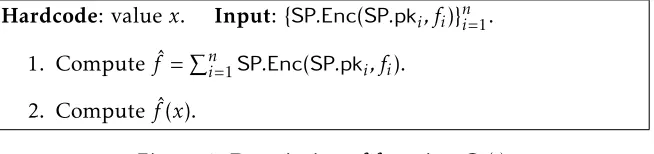
i, fi)}ni=1), and a valuex, run the spooky evaluation{ci}ni=1=SP.Eval(Cx,{SP.Enc(SP.pki, fi)}ni=1),
where the circuitCx(·) is defined as
Hardcode: valuex. Input:{SP.Enc(SP.pk
i, fi)}ni=1.
1. Compute ˆf =Pn
i=1SP.Enc(SP.pki, fi).
2. Compute ˆf(x).
Figure 1: Description of functionCx(·)
Then outputsi=SP.Dec(SP.ski, ci).
• FSS.Reconstruct(pp,{si}n
i=1): Given thenshares{si}ni=1of functionf(x), the reconstruction
algo-rithm outputsf(x) =Pn i=1si.
Correctness Proof. The correctness of our FSS construction is proved using properties ofF -AFS-spooky encryption as defined in Definition2.4.
Lemma 3.8 Our FSS construction described above is correct (c.f. Definition3.6).
Proof 1 Assuming wlog that the evaluate algorithm is deterministic, we obtain the same {ci}n
i=1 =
SP.Eval(Cx,{SP.Enc(SP.pki, fi)}n
i=1) in algorithm FSS.LocalEval( ˆfi, x), for i ∈[n]. By the correctness
ofF-AFS-spooky encryption as stated in Definition2.4, we havePn
i=1si =Cx({fi}ni=1) =f(x), where
si=SP.Dec(SP.ski, ci).
Security Proof. In this part, we show that our construction of FSS is secure as defined in Defini-tion3.7. Intuitively, for function queries other than the challenge one, the simulation computes in the exactly same method as the real execution. For the challenge function, we rely on the semantic security and psedurandomness ofn−1 evaluations of challenge function shares on any input, provided by the underlying spooky encryption to show the indistinguishability between real and simulated executions. The proof detail is the following.
Theorem 3.9 LetSPbe a secureF-AFS-spooky encryption as defined in Definition2.4. Our construction of FSS described above is secure (c.f. Definition3.7).
Proof 2 We first describe the simulation algorithmS= (S1,S2,S3)that are used in the proof.
• S1(1λ, n,F): RunFSS.Setup(1λ, n,F)to obtainppand outputpp.
• S2(inp): On inputinp=fiorinp=|f∗|:
– On input function fi, first look for (fi,{fij}jn=1) in local storage. If found, output (fi,{fij}nj=1).
Otherwise, compute{fij}n
j=1←FSS.ShareGen(pp, fi) and store(fi,{fij}nj=1)locally. Then output
(fi,{fij}n
– On input size|f∗|, first choosen−1bit stringsti of size|f∗|. Fori∈[n]computes(SP.pki,SP.ski)← SP.Gen(1λ). Then fori ∈[n−1], encrypt the description share using spooky encryptioncti ← SP.Enc(pki, ti), and ctn ←SP.Enc(pk
i,0
|f∗|
). Output fj∗ = (SP.skj,{SP.pk
i}ni=1,{cti}ni=1) for j ∈
[n−1].
• Sf ∗
3 ({f
∗
i}i∈S, x): On input n−1shares{f ∗
i}i∈S and x, for i ∈S, computeyi ←FSS.LocalEval(f ∗
i, x).
Then call the oraclef on inputxto obtainy=f∗(x). Outputyn=y−Pi∈Syi.
The view of adversary includes(pp, f∗, τ, α), where(τ, α)are states that incorporate adversary’s queries to FSS.ShareGen(pp,·) (or S2) and f∗
i<[S] (or S3). As we described above, S1(1
λ, n,F) computes
FSS.Setup(1λ, n,F) as a subroutine, so the outputppis identical in these two procedures. For each function queryfi,S2(fi)callsFSS.ShareGen(pp, fi)as a subroutine, so the output ofS2(fi)is identical
to that ofFSS.ShareGen(pp, fi). For challenge function queryS2(|f∗|), the shares given to adversary
are fj∗ = (SP.skj,{SP.pki}n
i=1,{cti}in=1) for j ∈[n−1]. By the semantic security of underlying spooky
encryption,ctnremains secure. By the second property of spooky encryption (c.f. Definition2.4), any n−1of the sharesyiabove are distributed-close to uniform, whereyi=FSS.LocalEval(f∗
i, x)for anyx.
Lastly, on queryx, in the real execution, adversary gets backyn=fn∗(x), while in the ideal execution, he gets backyn=y−Pi∈Syi, whereyi←FSS.LocalEval(f
∗
i , x). Also by property of spooky encryption
as stated in Definition2.5, then−1shares{yi}are distributed-close to uniform. Thus,ynin the ideal execution is a valid share and is identical to that in real execution.
3.3 Instantiation of DFE from FSS
LetFSS= (FSS.Setup,FSS.ShareGen,FSS.LocalEval,FSS.Reconstruct) be a function secret sharing scheme for function ensembleF, andFE= (FE.Setup,FE.Keygen,FE.Enc,FE.Dec) be a functional encryption. The description of DFE schemeDFE= (Setup,Keygen,Enc,PartDec,Reconstruct) is as follows:
• DFE.Setup(1λ, n): Run the FSS setup algorithmFSS.pp←FSS..Setup(1λ, n) and the FE setup algorithm (FE.pp,FE.msk)←FE.Setup(1λ). Output the public parametersppand master secret keymskas
pp= (FSS.pp,FE.pp), msk=FE.msk
• DFE.Enc(pp, m): Run the FE encryption algorithmct←FE.Enc(FE.pp, m). Output ciphertextct.
• DFE.Keygen(msk, f): Given a functionf ∈ F andmsk, the key generation algorithm first runs the share generation algorithm in FSS as{fi}n
i=1←FSS.ShareGen(FSS.msk, f), and then compute the
key shares by running the FE key generation asskfi ←FE.Keygen(FE.msk, Ci), fori∈[n], where the functionCi(·) is defined as
Hardcode: function sharefi Input: valuex.
Compute and outputci=FSS.LocalEval(fi, x)
Figure 2: Description of functionCi(·)
Output the secret key shares{skfi}n
• DFE.PartDec(ct,skfi): Given thei-th secret key shareskfi, compute and outputsi=FE.Dec(sk f i,ct).
• DFE.Reconstruct(pp,{si}n
i=1): Output the reconstructed result asf(m) = Pn
i=1si.
Correctness Proof. The correctness proof of our DFE construction follows directly from the correctness of FSS and FE. First by the correctness of FSS schemeFSS, the output of circuitCi(c.f.
Figure3.3) satisfiesPn
i=1ci=f(m). Secondly, by correctness of functional encryption schemeFE,
the output ofsi=FE.Dec(skif,ct), whereskif is secret key for circuitCi satisfiessi=ci. Therefore in
DFE.Keygen(msk, f), we also getf(m) =Pn i=1si.
Security Proof. In this part, we show that our construction of DFE satisfies (sim-based) function privacy and data privacy as defined above. The function privacy of our DFE construction mainly is based on the sim-based security of FSS (c.f. Definition3.7), thus in our proof below, we use the simulation algorithm of FSS to setup the system and answer adversary’s queries. The data privacy of our DFE construction directly follows the ind-based data privacy of underlying functional encryption (c.f. Definition2.3).
Theorem 3.10 LetFSSbe function secret sharing scheme satisfying security as defined in Definition3.7, our construction of DFE described above is function private (c.f. Definition3.3).
Proof 3 We first describe the simulation algorithmS= (S1,S2,S3)based on the simulation algorithms ofFSS,(FSS.S1,FSS.S2)(as described in the proof of Theorem3.9), that are used in the proof.
• S1(1λ, n): Run the FSS simulated setup algorithmFSS.pp←FSS.S1(1λ, n)and the FE setup algorithm (FE.pp,FE.msk)←FE.Setup(1λ). Sendpp= (FSS.pp,FE.pp)to adversary.
• S2(f): On input function queryf, first look for(f ,{skf
i}ni=1)in local storage. If found, send(fi,{sk f i}ni=1)
to adversary. Otherwise,S2runs the simulation algorithmFSS.S2(f)of FSS to obtain{fi}n
i=1as shares
of functionf. Then fori∈[n], computeskf
i ←FE.Keygen(msk, fi)and store(f ,{sk f
i}ni=1)locally. Send
(f ,{skfi}n
i=1)to adversary.
• Sf ∗
3 ({sk f∗
i }n
−1
i=1,ct): On input ciphertext query ct, first computex = FE.Dec(skid,ct), whereskid ←
FE.Keygen(msk,id)andiddenotes the identity function. Then fori∈[n−1], computesi=FE.Dec(skf ∗
i ,ct).
Outputsn=f(x)−Pn
−1
i=1si.
In the following, we show, that adversary’s view(pp, f∗, τ, α), where(τ, α)are states that incorporate adversary’s queries toDFE.Keygen(orS2) andDFE.Dec(skf
∗
n ,·)(orS3), are indistinguishable in the two
executions. As described above,S1computes the FSSsimulated setupFSS.S1and a realFE.Setup as subroutines, by the security of underlyingFSSscheme, we have the distribution of public parameters in real and ideal executions are statistically close. Similarly, by the security of underlyingFSSscheme, the function shares{fi}n
i=1←FSS.S2(f)computed in simulationS2(f)is indistinguishable from that
in the real executionDFE.Keygen(f), thus the responses for key queries in the real and ideal executions are indistinguishable. Lastly, the output sn = S
f∗
3 ({sk f∗
i }n
−1
i=1,ct), where ct = FE.enc(pp, x), satisfies Pn
i=1si=f(x), wheresi=FE.Dec(skf
∗
i ,ct)can be computed by the adversary himself. In conclusion, the
Theorem 3.11 LetFEbe functional encryption scheme satisfying ind-based data privacy as defined in Definition2.3, our construction of DFE described above is data private (c.f. Definition3.5).
Proof 4 The ciphertext in our DFE construction is indeed a FE ciphertext, thus by ind-based data privacy of FE scheme, our construction of DFE is data private.
4
Hosting Services Securely in Multiple Clouds
In [BGMS15], the authors consider a setting of hosting service in untrusted clouds: there exist three parties:Service providerwho owns a program and setups the whole system,cloud serverwhere the program is hosted, and arbitrary manyclients. Intuitively speaking, the service provider wants to host the programP on a cloud server, and additionally it wants to authenticate clients who pay for the service provided by programP. This authentication should allow a legitimate user to access the program hosted on the cloud server and compute output on inputs of his choice. Moreover, the programP could contain proprietary information, thus needs to be kept confidential. The authors in [BGMS15] also require that the scheme satisfies some essential properties:
Weak client: The amount of work performed by client should only depends on the size of input and security parameter, but independent of the running time of programP.
Delegation: The work performed by the service provider includes one-time setup of the whole system and authentication clients. The amount of work in one-time setup phase should be bounded by a fixed polynomial in the program size, while the amount of work incurred in authentication should only depend on the security parameter.
Polynomial slowdown: The running time of encoded program (running on cloud server) is bounded by a fixed polynomial in the running time of programP.
Boneh et al give a construction based on indistinguishability obfuscation, and their construction suffers from a restriction that the number of corrupted clients should be pre-fixed [BGMS15]. In this section, we generalize the above model by distributing encoded program shares to multiple cloud servers and resolve the open problem that to remove the restriction on number of corrupted clients from [BGMS15].
In our Distributed Secure Cloud Service (DSCS) scheme, the service provider generates a set of encoded program shares for programP, and then hosts each encoded program share on one cloud server. Any authenticated users can access the encoded program shares hosted multiple cloud servers and compute output on inputs of his choice. We also require that our DSCS scheme satisfied the above three properties.
4.1 Syntax and Security Definitions
The Distributed Secure Cloud Service scheme consists of algorithmsDSCS= (DSCS.Prog,DSCS.Auth, DSCS.Inp,DSCS.Eval,DSCS.Reconstruct) with details as follows:
• DSCS.Prog(1λ, n, P): On input the security parameterλ, the threshold parameternand a programP, it returns the distributed encoded program{P˜i}n
i=1and a secretskto be useful in
• DSCS.Auth(id,sk): On input the identity id of a client and the secret sk, it produces an authentication tokentokenidfor the client.
• DSCS.Inp(tokenid, x): On input the authentication tokentokenidand an inputx, it outputs an encoded input ˜xandαwhich is used by the client to later decode the evaluated results.
• DSCS.Eval( ˜Pi,x): On input the encoded program ˜˜ Pi and input ˜x, it produces the encoded
distributed result ˜yi= ˜Pi( ˜x).
• DSCS.Reconstruct({P˜i( ˜x)}n
i=1): On input the evaluated result {P˜i( ˜x)}ni=1, it reconstructs the
resultP(x).
Similar to the analysis in [BGMS15], the procedure goes as follows: the service provider first runs the procedureProg(1λ, P) to obtain the distributed encoded program{P˜i}n
i=1 and the secret
σ. Then fori∈[n], it will send ˜P
i to cloud serveri. Later, the service provider will authenticate
users usingσ. A client with identityid, who has been authenticated, will encode his input using procedureInp(1λ, σid, x). The client will send ˜x to cloudi, fori∈[n]. Fori ∈[n], the cloud will
evaluate the program ˜Pion encoded input ˜xand return the resultPi(x). Finally, the client can run
Reconstruct({Pi(x)}n
i=1) to obtain the resultP(x).
Security definitions. In [BGMS15], the authors consider two cases for security definition, namely untrusted cloud securityanduntrusted client security. We generalize their security definition to the DSCS setting. More specifically, we decouple the case of untrusted cloud security into two subcases, program privacyandinput privacyin untrusted cloud security. And in untrusted client security, we enhance it by allowing the set of corrupt clients colluding with some corrupt servers. In various security definitions below, we assume that the service provider is uncompromisd.
For program privacy in untrusted cloud case, the service provider first setup the whole system based on program (P0, P1) submitted by adversary. In the system, the adversary can corrupts a set
of servers and also has access to authentication and encoding oracles, but he cannot tell which programPbis used to setup the system. The only restriction here is thatP0andP1are of the same
size.
Definition 4.1 (Untrusted Cloud Security – Program Privacy) For the program privacy case in un-trusted cloud setting, we first describe the following experimentExptprog(1λ)between a challenger and
adversaryA:
• Setup: The adversary sends challenge programs(P0, P1)to challenger. The challenger choose a ran-dom bitb∈ {0,1}and obtains the challenge encoded program({P˜i}n
i=1,sk)←DSCS.Prog(1λ, n, Pb)
and sends{P˜i}n−1
i=1 to adversaryA.
• Query phase: Proceeding adaptively, the adversary A can submit the following two kinds of queries:
– Authentication query:Asends identityid
i to challenger. The challenger computestokenidi←
DSCS.Auth(id,sk)and sends backtokenidi.
– Input query:Asends(x,id)to challenger. The challenger computesct←DSCS.Inp(tokenid, x), wheretokenid
i←DSCS.Auth(id,sk). Then send backct.
We say the adversary wins the experiment ifb0=b.
A DSCS scheme is program private in untrusted cloud setting if no pptadversaryAcan win the
experimentExptprog(1λ)with non-negligible probability.
For input privacy in untrusted cloud security, the service provider first sets up the whole system using programP submitted by adversary. Then in the system, the adversary corrupts all servers, and additionally has access to authentication oracles, but he cannot distinguish the encryption of two message (m0, m1), whereP(m0) =P(m1). Put simply, beyond the evaluation of program, he
learns nothing about the underlying message.
Definition 4.2 (Untrusted Cloud Security – Input Privacy) For the input privacy case in untrusted cloud setting, we first describe the following experimentExptinp(1λ)between a challenger and adversary A:
• Setup: The adversary sends challenge programP to challenger. The challenger runs({P˜i}n
i=1,sk)←
DSCS.Prog(1λ, n, P)and sends{P˜i}n
i=1to adversaryA.
• Authentication query phase I: Proceeding adaptively, the adversary A sends identity idi to challenger. The challenger computestokenid
i ←DSCS.Auth(id,sk)and sends backtokenidi.
• Challenge phase: Adversary submits the challenge message pair(m0, m1,id∗)with the constraint
that P(m0) =P(m1). The challenger first chooses a random bit b ∈ {0,1} and computes ct← DSCS.Inp(tokenid, mb), wheretokenid∗i ←DSCS.Auth(id
∗
,sk). Then sendctto adversary.
• Authentication query phase II: The same asAuthentication query phase Iwith the restriction that the queryididoes not equalid∗in the challenge phase
• Guess: Finally, the adversaryAoutputs his guessb0 for the bitb.
We say the adversary wins the experiment ifb0=b.
A DSCS scheme is data private in untrusted cloud setting if nopptadversaryAcan win the experiment
Exptinp(1λ)with non-negligible probability.
Remark 4.3 We note that in the above data privacy definition, the challenge phase can be access multiple times as long as the query pair(m0, m1,id∗i)satisfiesP(m0) =P(m1), and challenger use the same random
bitbin generating the challenge ciphertext.
For untrusted client security, a collection of corrupt clients with the help of a subset of corrupt servers do not learn anything beyond the program’s output with respect to their identities on certain inputs of their choice, and if a client is not authenticated, it learns nothing.
Definition 4.4 (Untrusted Client Security) LetDSCSbe the secure Distributed Secure Cloud Service scheme as described above. We say the scheme satisfies untrusted client security if the following holds. Let Abe apptadversary who corrupts`clientsI={id1, . . . ,id`}. Consider any programP, letQ= poly(λ).
The experiment described below requires one additional proceduredecode. Based on these two procedures, we define simulatorS= (S1,S2). Consider the following two experiments:
The experimentReal(1λ)is as follows:
1. ({P˜}n