(will be inserted by the editor)
Conditional Cube Attack on Round-Reduced River Keyak
Wenquan Bi1 · Zheng Li1 · Xiaoyang Dong2∗ · Lu Li1 · Xiaoyun Wang1,2∗
Received: date / Accepted: date
Abstract This paper evaluates the security level of the River Keyak against the cube-like attack. River Keyak is the only lightweight scheme of the Keccak-permutation-based Authenticated Encryption Cipher Keyak, which is one of the 16 survivors of the 3rd round CAESAR competition. Dinuret al.gave the seven-round cube-like attack on Lake Keyak (1600-bit) using the divide-and-conquer method at EUROCRYPT 2015, then Huanget al.improved the result to 8-round using a new conditional cube attack at EUROCRYPT 2017. While for River Keyak, the 800-bit state is so small that the equivalent key (256-bit capacity) occupy double lanes, the attacks can not be applied to the River Keyak trivially.
In this paper, we comprehensively explore the conditional cube attack on the small state (800-bit) River Keyak. Firstly, we find a new conditional cube variable which has a much weaker diffusion than Huang et al.’s, this makes the conditional cube attack possible for small state (800-bit) River Keyak. Then we find enough cube variables for 6/7-round River Keyak and successfully launch the key recovery attacks on 6/7-round River Keyak with the time complexity 233and 249respectively. We also verify the 6 and 7-round attack on a laptop. Finally, by using linear structure technique with our new conditional cube variable, we greatly increase the freedom degree to find more cube variables for conditional cube attacks as it is complex for 800-bit state to find enough cube variables for 8-round attack. And then we use the new variables by this new method to launch 8-round conditional cube attack with the time complexity 281. These are the first cryptanalysis results on round-reduced River Keyak. Our attacks do not threaten the full-round (12) River Keyak.
Keywords River Keyak·Conditional Cube·Key Recovery·Authentication Encryption·CAESAR
Mathematics Subject Classification (2000) 94A60
1 Introduction
Nowadays, the Authenticated Encryption (AE) schemes, which provide message confidentiality and integrity simultaneously, attract a lot of attentions of the worldwide cryptanalysts. In order to find the alternatives for AES-GCM [17], the CAESAR [3] competition was launched to find secure AE algorithms in 2014, which processed to the 3rd round and 16 survivors are remained. In order to get the secure finalist, there have been a lot of security evaluations for them such as [4] [10] [16] and more analyses are needed.
Keyak [12] is one of the 16 candidates of 3rd round CAESAR competition, which is based on the Keccak-ppermutation. It has five instances: River Keyak, Lake Keyak, Sea Keyak, Ocean Keyak and Lunar Keyak. The River Keyak is the only lightweight, 800-bit-state instance and the others all have 1600-bit state. Its key size is variable, with a minimum of 128 bits; its tag sizes is 128 bits long if not truncated and the capacity is set to 256 bits long when its security strength is 128 bits according to their security claims.
Cube attack [7] is a chosen IV key-recovery attack, which was introduced by Dinur and Shamir. Since then, cube attack was applied to many different cryptographic primitives such as [1] [8] [11]. In Eurocrypt
∗Both Xiaoyang Dong and Xiaoyun Wang are corresponding authors.
Xiaoyang Dong
E-mail: [email protected]. Xiaoyun Wang
E-mail: [email protected].
1. Key Laboratory of Cryptologic Technology and Information Security, Ministry of Education, Shandong University, Jinan 250100, China.
Table 1: summary of key recovery attacks on Keyak
Instances Rounds Method Time Data Memory Source Lake Keyak 7 Divide and Conquer 276 275 243 [9]
Lake Keyak 7 Conditional cube attack 242 242 negligible [15] Lake Keyak 8 Conditional cube attack 274 274 negligible [15]
River Keyak 6 Conditional cube attack 233 233 negligible Section 4.1
River Keyak 7 Conditional cube attack 249 249 negligible Section 4.2 River Keyak 8 Conditional cube attack 281 281 negligible Section 5
2015, Dinur et al.[9] presented a key-recovery cube-like attack on round-reduced Keccak-MAC and Lake Keyak using a divide-and-conquer method. They use some auxiliary variables and carefully select the cube variables so that the cube sums depend only on a small number of key bits. They finally achieved 7-round key-recovery attack on Lake Keyak (1600 bit). Then Huang et al. [15] proposed a new conditional cube attack on Keccak-MAC and Lake Keyak. By inducing some bit conditions, they carefully select a new set of cube variables so that they do not multiply with each other in the first round as well as meet the condition that there is one variable does not multiply with other variables in the second round and then the degree over the cube variables is further reduced.
However, those attacks can not translate to the River Keyak trivially. For River Keyak, the state is 800-bit, with 25 32-bit lanes. The 256-bit capacity occupy eight lanes, double of the situation of Lake Keyak. For the divide-and-conquer method by Dinuret al., it is impossible to achieve 8-round attack and for 800-bit-state River Keyak, the 7-round cube-like attack is also difficult. When applying Huang’s conditional cube variable to the 800-bit-state cipher, only 25 cube variables could be found by Huang’s algorithms, which just could be used to achieve 6-round cube-like attack for River Keyak.
1.1 Our contributions
In this paper, we comprehensively explore the secure level of River Keyak against cube-like attack. Our contributions are in three folds. Firstly, we find a new set of conditional cube variable which has a much weaker diffusion than Huanget al.’s. Then we find some new sets of 16/32 cube variables for River Keyak, which meet the condition that they do not multiply with each other after the first round as well as meet the condition that one cube variable does not multiply with the others after the second round. This makes it possible to achieve 6/7-round key-recovery attacks on River Keyak. Secondly, we launch the 6/7-round conditional cube attack on River Keyak successfully with the time complexity 233 and 249, respectively. Our 6/7-round attacks are practical and we give the experimental verification. Finally, by applying linear structure technique [14], we find 64 cube variables (including the conditional cube variable) and extend the key-recovery attack on River Keyak to 8 rounds with the time complexity 281. The attacks are summarized in Table 1. Those are the first attacks on round-reduced River Keyak.
This paper is organized as follows: Section 2 introduces some notations, Keccak-ppermutations, River Keyak and assumptions for our attack. In Section 3, some related works are introduced. We present the attacks on 6/7-round River Keyak in Section 4. In Section 5, we use the linear structure technique to find enough new dynamic conditional cube variables and give the 8-round conditional attack result on River Keyak. At last, we conclude this paper in Section 6.
2 Preliminary
In this section we give some notations and theorems used in this paper, a brief description of Keccak-pand River Keyak, together with our attack assumptions.
2.1 notations
⊕,¬and& bitwise xor, negation, and logic AND
Si the state afteri-the round, for example,S0.5means before theχoperation of 1st round;
that is, we treat theθ,ρandπ operation as the first half round
A the state after the first inner permutation of River Keyak, where the fist message is involved A[x][y] a lane inx-th column andy-th row of stateA, 0≤x, y≤4
A[x][y][z] z-th MSB ofA[x][y], 0≤x, y≤4,0≤z≤31
K the master 128-bit key used in the initialization stage, the master key of River Keyak ki equivalent 32-bit key after first inner permutation of River Keyak, 1≤i≤8
(a)
0,0 1,0 2,0 3,0 4,0
0,1 1,1 2,1 3,1 4,1
0,2 1,2 2,2 3,2 4,2
0,3 1,3 2,3 3,3 4,3
0,4 1,4 2,4 3,4 4,4
(b)
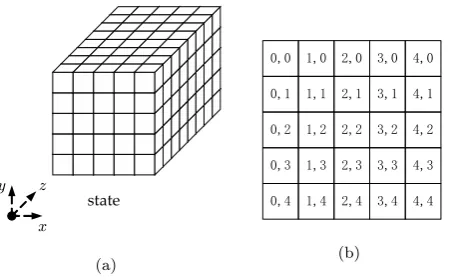
Fig. 1: (a)State of Keccak, (b)State in 2-dimension
2.2 The Keccak-pPermutations
The Keccak-ppermutations are derived from the Keccak-f permutations [2] and have a tunable number of rounds. A Keccak-ppermutation is defined by its widthb= 25×2l, withb∈ {25,50,100,200,400,800,1600}, and its numbers of roundsnr, denoted as Keccak-p[b, nr]. Whennr= 12 + 2l, Keccak-p[b, nr]=Keccak-f.
The round functionRconsists of five operations:
R=ι◦χ◦π◦ρ◦θ
Keccak-p[b, nr] works on a stateAof sizeb, which can be represented as 5×5 25b-bit lanes, as depicted in
Figure 1,A[x][y] withxfor the index of column and yfor the index of row. In what follows, indexes of x andy are in set{0,1,2,3,4}and they are working in modulo 5 without other specification.
θ:A[x, y] =A[x, y]⊕X4
j=0(A[x−1, j])⊕(A[x+ 1, j]≪1)).
ρ:A[x, y] =A[x, y]≪r[x, y]. π:A[y,2x+ 3y] =A[x, y].
χ:A[x, y] =A[x, y]⊕((¬A[x+ 1, y])&A[x+ 2, y]). ι:A[0,0] =A[0,0]⊕RC.
In River Keyak, b= 800, nr= 12, and in other schemes,b= 1600, nr = 12. In this paper, we refer to
the linear stepθ,ρandπas the first half of a round, and the remaining step χandιas the second half of a round.
2.3 A Brief Description of Keyak
Authenticated Encryption cipher Keyak is one of the 16 candidates in the 3rd round CAESAR competition, whose mode is based on Motorist mode, which is sponge-based and supports one or more duplex instances operating in parallel. The Motorist makes duplexing calls with input containing key, nonce, plaintext and metadata (possible associated data) bits and uses its output as tag or as key stream bits. To start a session, Motorist takes input as a secret and unique value, and it has three layers: Motorist, Engine and Piston layers. The Motorist layer implement user interface, Engine layer control Π ≥ 1 Piston objects and the Piston layer keeps ab-bit state and applies permutationf(Keccak-p[b] in Keyak) to it.
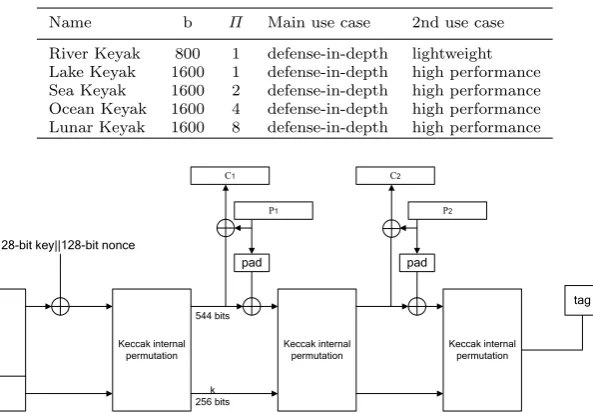
In Keyak, five instances are proposed, shown in Table 2. For all instances, the round numbers of Keccak-p[b] isnr = 12, the capacityc = 256 and the tag length τ = 128. The River Keyak is the only instance
which has 800-bit state and 1600-bit state for others. The primary recommendation is the Lake Keyak. Readers can refer to [12] for more details.
2.4 Our Attack Assumptions
Table 2: Five instances of Keyak
Name b Π Main use case 2nd use case
River Keyak 800 1 defense-in-depth lightweight Lake Keyak 1600 1 defense-in-depth high performance Sea Keyak 1600 2 defense-in-depth high performance Ocean Keyak 1600 4 defense-in-depth high performance Lunar Keyak 1600 8 defense-in-depth high performance
128-bit key||128-bit nonce
C1
P1 P2
pad pad
Keccak internal
permutation Keccak internal permutation Keccak internal permutation 544 bits
k 256 bits
tag
C2
Fig. 2: Construction of River Keyak on two blocks
Keyak processes two plaintext blocks as shown in Figure 2. Although the associated data could provide additional degrees of freedom, it has no effect on our cube attacks. Thus, the input of the first permutation call contains a key and a nonce but no optional associated data.
3 Related Works
3.1 Cube Attack
The cube attack [7] is a key-recovery attack introduced by Dinur and Shamir at EUROCYPT 2009. It assumes the output bit of a cipher can be regard as a polynomial f(k1..., kn, v1..., vm) overGF(2), where
k1, ..., kn are secret variables (e.g. the key bits),v1, ..., vmare public variables (e.g. the nonce or IV bits).
The main observation is the following theorem.
Theorem 1 [7] Given a polynomial f : Xn → 0,1 of degree d. It can be written as a sum of two polynomials:
f(k1..., kn, v1..., vm) =T·P+Q(k1..., kn, v1..., vm)
T is called maxterm and is a product of certain public variables, for example(v1, ..., vs),1≤s≤m, which
is called a cubeCT; P is called superpoly;Q(k1..., kn, v1..., vm)is the remainder polynomial and none of its
terms is divisible by T. Then the sum of f over all values of the cubeCT (cube sum) is:
X
x0=(v
1,...,vs)∈CT
f(k1, ..., kn, x0, ...vm) =P
whose degree is at most d-s, where the cube CT contains all binary vectors of the length s and the other
public variables are fixed to constants.
3.2 Dynamic Cube Attack
Dinur and Shamir introduce a variant of cube attack called dynamic cube attack [8] in FSE 2011. The basic idea is to find dynamic variable, which depends on some of the public cube variables and some private variables (the key bits), to nullify the complex function P = P1·P2+P3, whereP30s degree is relatively
lower thanP andP1·P2is complex. Then guess the key and compute the dynamic cube variables to make
P1 to be zero and the function is simplified greatly. The right guess of key will lead the cube sum to be
0,0 1,0 2,0 3,0 4,0
0,1 1,1 2,1 3,1 4,1
0,2 1,2 2,2 3,2 4,2
0,3 1,3 2,3 3,3 4,3
0,4 1,4 2,4 3,4 4,4
0,0 1,1 2,2 3,3 4,4
3,0 4,1 0,2 1,3 2,4
1,0 2,1 3,2 4,3 0,4
4,0 0,1 1,2 2,3 3,4
2,0 3,1 4,2 0,3 1,4
0,0 1,0 2,0 3,0 4,0
0,1 1,1 2,1 3,1 4,1
0,2 1,2 2,2 3,2 4,2
0,3 1,3 2,3 3,3 4,3
0,4 1,4 2,4 3,4 4,4
0,0 1,1 2,2 3,3 4,4
3,0 4,1 0,2 1,3 2,4
1,0 2,1 3,2 4,3 0,4
4,0 0,1 1,2 2,3 3,4
2,0 3,1 4,2 0,3 1,4
Fig. 3: 1-round linear structure
3.3 Dinuret al.’s Divide-and-Conquer Method
Dinuret al.presented cube-like attacks on Keccak keyed modes using Divide-and-conquer method in EU-ROCRYPT 2015 [9]. They achieved key recovery attack for the Keccak-MAC, Keyak and stream cipher mode respectively. They explored the property that the cube variables multiply less secret variables in the first round then recover a part of secret variables and recover other secret bits using other cubes. In Dinur et al.’s attack for 7-round Lake Keyak, where the secret bits are the 256 capacity which occupy 4 lanes. They choose the 32 cube variables among the 5 lanes with x = 0. More precisely, the 8 LSBs of first 4 lanesA[0][0],A[0][1],A[0][2],A[0][3] are set as independent cube variables while the 8 LSBs ofA[0][4] act as “parity checks”. Those 40 bits multiply 80 bits in theχoperation of the first round which are regarded as secret expressions. They enumerated all the possible values of 80 bits and store the 280 cube sums in a hash table with 2112 computational complexity and 280 memory complexity. In order to recover all the 256 secret variables, they used 8 cubes by rotating the initial cube variables 8 bits towards the MSB. In the balanced attack, they calculated 240cube sums only in the precomputing phase and the computational complexity is 276, data complexity is 275.
3.4 Linear Structure
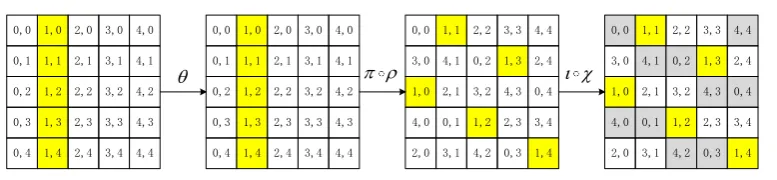
Inspired by Dinuret al.’s work [8], Guo, Liu and Song [14] developed a new technique named linear structure, that allows linearization of the underlying permutation of Keccak for up to 3 rounds. After that, a series of distinguishers and preimage attacks were launched by this technique. LetA[1, i], i={0,1,2,3}be variables andA[1,4] =⊕3
i=0A[1, i], then the sum of variables in each column is zero. How these variables affect the
internal state under the transformation of Keccak-f round functionRis shown in Figure 3. The algebraic degree of all the yellow lanes is 1, and the light grey’s is at most 1, the other lanes are all constants. In fact, only the non-linear operationχcan increase the algebraic degree through two neighbouring bits due to the term (ai+1⊕1)·ai+2. Hence, the algebraic degree of the state bits remains at most 1 after one round
functionR. We denote the linear structure as 1-round linear structure. The size of free variables can be at most 4 lanes. If we use the 1-round linear structure as a cube, then the cube variables will not multiply with each other after 1 round.
3.5 Huanget al.Conditional Cube Attack
In [15], Huang et al.developed the Conditional cube attack and applied to Keccak keyed mode including the Lake Keyak and accomplished the 8-round key-recovery attack on Lake Keyak. By introducing some bit conditions in the first round, Huang et al. found 64-dimension cubes which do not multiply in the first round and have one variable does not multiply others in the second round. They achieved 8-round key-recovery attack with the time complexity 274. We quote some definitions and theorems in [15] here.
Definition 1 Cube variables that have propagation controlled in the first round and are not multiplied with each other after the second round of Keccak are calledconditional cube variables. Cube variables that are not multiplied with each other after the first round and are not multiplied with any conditional cube variable after the second round are calledordinary cube variables.
Definition 2 Given a Boolean functionf(x0, x1, ..., xn−1), the bitwise derivative off with respect to the
variablexm is defined as
Table 3: Five derivation cases ofχin Keccak-p
Input/Output Bitwise Derivative(Difference) Conditions (1,0,0,0,0)→(1,0,0,0,0) f1= 0, f4= 1
(0,1,0,0,0)→(0,1,0,0,0) f2= 0, f0= 1
(0,0,1,0,0)→(0,0,1,0,0) f3= 0, f1= 1
(0,0,0,1,0)→(0,0,0,1,0) f4= 0, f2= 1
(0,0,0,0,1)→(0,0,0,0,1) f0= 0, f3= 1
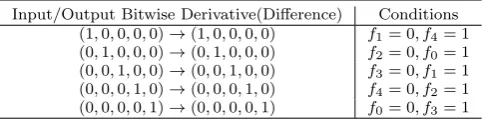
Property 1 [15] (Bit Conditions) Write the input ofχoperation to be boolean functionF = (f0, f1, f2, f3, f4)
and the corresponding output as G = (g0, g1, g2, g3, g4), denote the conditional cube variable as v0, if
δv0F = (1,0,0,0,0), thenδv0G= (1,0,0,0,0) if and only iff1= 0 andf4= 1.
From the view of the differential characteristic, if f1 = 0 and f4 = 1, then the differential characteristic
(1,0,0,0,0)→(1,0,0,0,0) holds with probability 1. The all of the five derivation cases shown in table 3 where each input bitwise derivative has only one non-zero bit.
Theorem 2 ( [15]) For (n+ 2)-round Keccak sponge function(n >0), if there are p (0≤ p < 2n+ 1) conditional cube variablesv0, ..., vp−1, andq= 2n+1−2p+ 1ordinary cube variables,u0, ..., uq−1 (Ifq= 0,
we setp= 2n+ 1), the termv0v1...vp−1u0...uq−1 will not appear in the output polynomials of(n+ 2)-round
Keccak sponge function.
Actually, we use the special case of the above theorem when p = 1. We describe it as a corollary for clearness.
Corollary 1 For(n+ 2)-round Keccak sponge function(n >0), if there is one conditional cube variable v0, andq = 2n+1−1 ordinary cube variables, u0, ..., uq−1, the term v0...u0...uq−1 will not appear in the
output polynomials of(n+ 2)-round Keccak sponge function. For more details and proofs you can refer to [15].
4 Conditional Cube Attack on 6/7-round River Keyak
In this section, we present our key recovery attack results on 6/7-round River Keyak, including the at-tack process, complexity analysis and experimental results. First, we describe a few property of Keccak permutation as follows:
Property 2 [13] If the sum of the cube variables in one column is zero, these variables will not diffuse to other bits afterθoperation.
Property 3 In χoperation, one bitA[i][j][k] only multiplies withA[i−1][j][k]⊕1 andA[i+ 1][j][k], when A[i][j][k] is cube variablev0andA[i−1][j][k]⊕1 =A[i+ 1][j][k] = 0, thenv0does not multiply with other
bits afterχoperation.
Property 4 [15] If we set two equal conditional variablesv0 in one column which both meet the condition
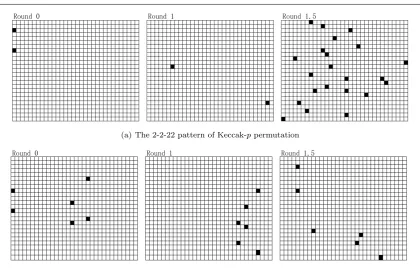
in Property 3 inχoperation will affect 22 variables after 1.5-round Keccak internal permutation as shown in Figure 4(a), called 2-2-22 pattern.
Property 5 [5, 6] Six equal conditional variablesv0 shown in Figure 4(b) which all meet the condition in
Property 3 inχoperation will affect 6 variables only after 1.5-round Keccak internal permutation as shown in Figure 4(b), called 6-6-6 pattern.
Comparing with Huang et al.’s conditioal cube attack. As shown in Figure 4(a), if select two conditional variablesv0 in the same column, after 1.5-round the conditional variablesv0 are diffused to as
more as 22 bits. For 1600-bit state used in Lake Keyak, it is relatively sparse to find enough cube variables which do not multiply withv0after the second round. However, for River Keyak’s 800-bit state, the effective
bits are too densely to find 32-dimension ordinary cube variables even. In fact, one could find at most 25 ordinary variables using the search algorithm by Huanget al.’s. In order to solve this problem, we find a new conditional variable which follows the 6-6-6 pattern as shown in Figure 4(b). We select these six bits A[0][0][0],A[1][0][31],A[0][1][0],A[2][1][30],A[1][2][31] and A[2][2][30] as conditional cube variablesv0, and use
the bit conditions as follows:
A0.5[4][0][0] = 1;A0.5[1][0][0] = 0
A0.5[1][0][9] = 1;A0.5[3][0][9] = 0
A0.5[4][2][0] = 1;A0.5[1][2][0] = 0
A0.5[0][2][4] = 1;A0.5[2][2][4] = 0
A0.5[0][3][4] = 1;A0.5[2][3][4] = 0
Round 0 Round 1 Round 1.5
0 0 0 0 0 0 0 0 0 0 0 0 0 0 0 0 0 0 0 0 0 0 0 0 0 0 0 0 0 0 0 0 0 0 0 0 0 0 0 0 0 0 0 0 0 0 0 0 0 0 0 0 0 0 0 0 0 0 0 0 0 0 0 0 0 0 0 0 0 0 010 0 0 0 0 0 0 0 0 0 0 0 0 0 0 0 0 0 0 0 0 0 0 0 0 0 0 0 0 0 0 0 0 0 0 0 0 0 0 0 0 0 0 0 0 0 0 0 0 0 0 0 0 0 0 0 0 0 0 0 0 0 0 0 0 0 0 0 0 0 0 0 0 0 0 0 0 0 0 0 0 0 0 0 0 0 0 0 0 0 0 0 0 0 0 0 0 010 0 0 0 0 0 0 0 0 0 0 0 0 0 0 0 0 0 0 0 0
10 0 0 0 0 0 0 0 0 0 0 0 0 0 0 0 0 0 0 0 0 0 0 0 0 0 0 0 0 0 0 0 0 0 0 0 0 0 0 0 0 0 0 0 0 0 0 0 0 0 0 0 0 0 0 0 0 0 0 0 0 0 0 0 0 0 0 0 0 0 0 0 0 0 0 0 0 0 0 010 0 0 0 0 0 0 0 0 0 0 0 0 0 0 0 0 0 0 0 0 0 0 0 0 0 0 0 0 0 0 0 0 0 0 0 0 0 0 0 0 0 0 0 0 0 0 0 0 0 0 0 0 0 0 0 0 0 0 0 0 0 0 0 0 0 0 0 0 0 0 0 0 0 0 0 0 0 0 0 0 0 0 0 0 0 0 0 0 0 0 0 0 0 0 0 0 0 0 0 0 0 0 0 0 0 0 0 0 0 0 0 0 0 0 0 0 0 0 0 0 0 0 0 0 0 0 0 0 0 0 0 0 0 0 0 0 0 0 0 0 0 0 0 0 0 0 0 0 0 0 0 0 0 0 0 0 0 0 0 0 0 0 0 0 0 0 0 0 0 0 0 0 0 0 0 0 0 0 0 0 0 0 0 0 0 010 0 0 0 0 0 0 0 0 0 0 0 0 0 0 0 0 0 0 0 0 0 0 0 0 0 0 0 0 0 0 0 0 0 0 0 0 0 0 0 0 0 0 0 0 0 0 0 0 0 0 0 0 0 0 0 0 0 0 0 0 0 0 0 0 0 0 0 0 0 0 0 0 0 0 0 0 0 0 0 0 0 0 0 0 0 0 0 0 0 0 0 0 0 0 0 0 0 0 0 0 0 0 0 0 0 0 0 0 0 0 0 0 0 0 0 0 0 0 0 0 0 0 0 0 0 0 0 0 0 0 0 0 0 0 0 0 0 0 0 0 0 0 0 0 0 0 0 0 0 0 0 0 0 0 0 0 0 0 0 0 0 0 0 0 0 0 0 0 0 0 0 0 0 0 0 0 0 0 0 0 0 0 0 0 0 0 0 0 0 0 0 0 0 0 0 010 0 0 0 0 0 0 0 0 0 0 0
10 0 0 0 0 0 0 0 0 0 0 0 0 0 0 0 0 0 0 0 0 0 0 0 0 0 0 0 0 0 0 0 0 0 0 0 0 0 0 0 0 0 0 0 0 0 0 0 0 0 0 0 0 0 0 0 0 0 0 0 0 0 0 0 0 0 0 0 0 0 0 0 010 0 0 0 0 0 0 0 0 0 0 0 0 0 0 0 0 0 0 0 0 0 0 0 0 0 0 0 0 0 0 0 0 0 0 0 0 0 0 0 0 0 0 0 0 0 0 0 0 0 0 0 0 0 0 0 0 0 0 0 0 0 0 0 0 0 0 0 0 0 0 0 0 0 0 0 0 0 0 0 0 0 0 0 0 0 0 0 0 0 0 0 0 0 0 010 0 0 0 0 0 0 0 0 0 0 0 0 0 0 0 0 0 0 0 0 0 0 0 0 0 0 0 0 0 0 0 0 0 0 0 0 0 0 0 0 0 0 0 0 0 0 0 0 0 0 0 0 0 0 0 0 0 0 0 0 0 0 0 0 0 0 0 0 0 0 0 0 0 0 0 0 0 0 0 0 0 0 0 0 0 010 0 0 0 0 0 0 0 0 0 0 0 0 0 0 0 0 0 0 0 0 0 0 0 0 0 0 0 0 0 0 0 0 0 0 0 0 0 0 0 0 0 0 0 0 0 0 0 0 0 0 0 0 0 0 0 0 0 0 0 0 0 0 0 0 0 0 0 0 0 0 0 0 0 0 0 0 0 0 0 0 0 0 0 0 0 0 0 0 0 0 0 0 0 0 0 0 0 0 0 0 0 0 0 0 0 0 0 0 0 0 0 0 0 0 0 0 0 0 0 0 0 01
0 0 0 0 0 0 0 0 0 0 0 0 0 0 0 0 0 0 0 0 0 0 0 0 0 0 0 0 0 0 0 0 0 0 0 0 0 010 0 0 0 0 0 0 0 0 0 0 0 0 0 0 0 0 0 0 0 0 0 0 0 0 0 0 0 0 0 0 0 0 0 0 0 010 0 0 0 0 0 0 0 0 0 0 0 0 0 0 0 0 0 0 0 0 0 0 0 0 0 0 0 0 0 0 0 0 0 0 0 0 0 0 0 0 0 0 0 0 0 0 0 0 0 0 0 0 0 0 0 0 0 0 0 0 0 0 0 0 0 0 0 0 0 0 0 0 0 0 0 0 0 0 0 0 0 0 0 0 0 0 0 0 0 0 0 0 0 0 0 0 0 0 0 0 0 0 0 0 0 0 0 0 0 0 0 0 0 0 0 0 0 0 0 0 0 0 0 0 0 0 0 0 0 0 0 0 0 0 0 0 0 0 0 0 0 0 0 0 0 0 0 0 0 0 0 0 0 0 0 0 0 0 0 0 0 0 0 0 0 0 0 0 0 0 0 0 0 0 0 0 0 0 0 0 0 0 0 0 010 0 0 0 0 0 0 0 0 0 0 0 0 0 0 0 0 0 0 0 0 0 0 0 0 0 0 0 0 0 0 0 0 0 0 0 0 0 0 0 0 0 0 0 0 0 0 0 0 0 0 0 0 0 0 0 0 0 0 0 0 0 0 0 0 0 0 0 0 0 0 0 0 0 0 0 0 0 0 0 0 0 0 0 0 0 0 0 0 0 0 0 0 0 0 0 0 0 0 0 0 0 0 010 0 0 0 0 0 0 010 0 0 0 0 0 0 0 0 0 0 0 0 0 0 0 0 0 0 0 0 0 0 0 0 0 0 0 0 0 0 0 0 0 0 0 0 0 0 0 0 0 0 0 0 0 0 0 0 0 0 0 0 0 0 0 0 0 0 0 0 0 0 0 0 0 0 0 0 0 0 0 0 0 0 0 0 0 0 0 0 0 0 0 0 0 0 0 0 0 0 0 0 0 0 010 0 0 0 0 0 0 0 0 0 0 0 0 0 0 0 0 0 0 0 0 0 0 0 0 0 0 0 0 0 0 0 0 0 0 0 0 0 0 0 0 0 0 0 0 0 0 0 0 0 0 0 0 0 0 0 0 0 0 0 0 0 0 0 0 0 0 0 0 0 0 0 0 0 0 0 0 0 0 010 0 0 0 0 0 0 0 0 0 0 0 0 0 0 0 0 0 0 0 0 0 0 0 0 0 0 0 0 0 0 0 0 0 0 0 0 0 0 0 0 0 0 0 0 0 0 0 0 0 0 0 0 0 0 0 0 0 0 0 0 0 0 0 0 0 0 0 0 0 0 0 0 0 0 0 0 0 0 0 0 0 0 0 0 0 0 0 0 0 0 010 0 0 0 0 0 010 0 0 0 0 0 0 0 0 0 0 0 0 0 0 0 0 0 0 0 0 0 0 0 0 0 0 0 0 0 0 0 0 0 0 0 0 0 0 0 0 0 0 0 0 0 0 0 0 0 0 0 0 0 0 0 0 0 0 0 0 0 0 0 0 0 0 0 0 0 0 0 0 0 0 0 0 0 0 0 0 0 0 0 0 0 0 0 0 0 0 0 0 0 0 0 0 0 0 010 0 0 0 0 0 0 0 0 0 0 0 0 0 0 0 0 0 0 0 0 0 0 0 0 0 0 0 0 0 0 0 0 0 0 0 0 0 0 0 0 0 0 0 0 0 0 0 0 0 0 0 0 0 0 0 0 0 0 0 0 0 0 0 0 0 0 0 0 0 0 0 0 0 0 0 0 0 0 0 0 0 0 0 0 0 0 0 0 0 0 0 0 0 0 0 0 0 0 0 0 0 0 0 0 0 0 0 0 0 0 0 0 0 0 0 0 0 0 0 0 0 0 0 0 0 0 0 0 0 0 0 0 0 0 0 0 0 0 0 0 0 0 0 0 0 0 0 0 0 0 0 0 0 0 0 0 0 0 0 0 0 0 0 0 0 0 010 0 0 0 010 0 0 0 0 0 0 0 0 0 0 0 0 0 0 0 0 0 0 0 0 0 0 0 0 0 0 0 0 0 0 0 0 0 0 0 0 0 0 0 0 0 0 0 0 0 0 0 0 0 0 0 0 0 0 0 0 0 0 0 0 0 0 0 0 0 0 0 0 0 0 0 0 0 0 0 0 0 0 0 0 0 0 0 0 0 0 0 0 0 0 0 0 0 0 0 0 0 0 0 0 0 0 0 0 0 0 0 0 0 0 0 0 0 0 0 0 0 0 0 0 0 0 0 0 0 0 0 0 0 0 0 0 0 0 0 0 0 0 0 0 0 0 0 0 0 0 0 0 0 0 0 0 0 0 0 0 0 0 0 0 0 0 0 0 0 0 0 0 0 0 0 0 0 0 0 0 0 0 0 0 0 0 0 0 0 0 0 0 0 0 0 010 0 0 0 0 0 0 0 0 0 0 0 0 0 0 0 0 0 0 0 0 0 0 0 0 0 0 0 0 0 0 0 0 0 0 0 0 0 0 0 0 0 0 0 0 0 0 0 0 0 0 0 0 0 0 0 0 0 0 0 0 0 0 0 0 0 0 0 0 0 0 0 0 0 0 0 0 0 0 0 0 0 0 0 0 0 0 0 0 0 0 0 0 0 0 0 0 0 0 0 0 0 0 0 010 0 0 0 0 0 0 0 0 0 0 0 0 0 0 0 0 0 0 0 0 0 0 0 0 0 0 0 0 0 0 0 0 0 0 0 0 0 0 0 0 0 0 0 0 0 0 0 0 0 0 0 0 0 0 0 0 0 0 0 0 0 0 0 0 0 0 0 0 0 0 0 0 0 0 0 0 0 0 10 0 0 0 0 0 0 0 0 0 0 0 0 0 0 0 0 0 0 0 0 0 0 0 0 0 0 0 0 0 0
(a) The 2-2-22 pattern of Keccak-ppermutation
Round 0 Round 1 Round 1.5
0 0 0 0 0 0 0 0 0 0 0 0 0 0 0 0 0 0 0 0 0 0 0 0 0 0 0 0 0 0 0 0 0 0 0 0 0 0 0 0 0 0 0 0 0 0 0 0 0 0 0 0 0 0 0 0 0 0 0 0 0 0 0 0 0 0 0 0 0 0 0 0 0 0 0 0 0 0 0 0 0 0 0 0 0 0 0 0 0 0 0 0 0 0 0 0 0 0 0 0 0 0 0 0 0 0 0 0 0 0 0 0 0 0 0 0 0 0 0 0 0 0 0 0 0 0 0 0 0 0 0 0 0 0 0 0 0 0 0 0 0 0 0 0 0 0 0 0 0 0 0 0 0 0 0 0 0 0 0 0 0 0 0 0 0 0 0 0 0 0 0 0 0 0 0 0 0 0 0 0 0 0 0 0 0 0 0 0 0 0 0 0 0 0 0 0 0 0 0 0 0 0 0 0 0 0 0 0 0 0 0 0 0 0 0 0 0 0 0 0 0 0 0 0 0 0 0 0 0 0 0 0 0 0 0 0 0 0 0 0 0 0 0 0 0 0 0 0 0 0 0 0 0 0 0 0 0 0 0 010 0 0 0 0 0 0 0 0 0 0 0 0 0 0 0 0 0 0 0 0 0 0 0 0 0 0 0 0 0 0 0 0 0 0 0 0 0 0 0 0 0 0 0 0 0 0 0 0 0 0 0 0 0 0 0 0 0 0 0 0 0 0 0 0 0 0 0 0 0 0 0 0 0 0 0 0 0 0 0 0 0 0 0 0 0 0 0 0 0 0 0 0 0 0 0 0 0 0 0 0 0 0 0 0 0 0 0 0 0 0 0 0 0 0 0 0 0 0 0 0 0 0 0 0 0 0 0 0 0 0 0 0 0 0 0 0 0 0 0 0 0 0 0 0 0 0 0 0 0 0 0 0 0 0 0 0 0 0 0 0 0 0 0 0 0 0 0 0 0 0 0 0 0 0 0 0 0 0 0 0 0 0 0 0 0 0 0 0 0 0 0 0 0 0 0 0 0 0 0 0 0 0 0 0 0 0 0 0 0 0 0 0 0 0 0 0 0 0 0 0 0 0 0 0 0 0 0 0 0 0 0 0 0 0 0 0 010 0 0 0 0 0 0 0 0 0 0 0 0 0 0 0 0 0 0 0 0 0 0 0 0 0 0 0 0 0 0 0 0 0 0 0 0 0 0 0 0 0 0 0 0 0 0 0 0 0 0 0 0 0 0 0 0 0 0 0 0 0 0 0 0 0 0 0 0 0 0 0 0 0 0 0 0 0 0 0 0 0 0 0 0 0 0 0 0 0 0 0 0 0 0 0 0 0 0 0 0 0 0 0 0 0 0 0 0 0 0 0 0 0 0 0 0 0 0 0 0 0 0 0 0 0 0 0 0 0 0 0 0 0 0 0 0 0 0 0 0 0 0 0 0 0 0 0 0 0 0 0 0 0 0 0 0 0 0 0 0 0 0 0 0 0 0 0 0 0 0 0 0 0 0 0 0 0 0 0 0 0 0 0 0 0 0 0 0 0 0 0 0 0 0 0 0 0 0 0 0 0 0 0 0 0 0 0 0 0 0 0 0 0 0 0 0 0 0 0 0 0 0 0 0 0 0 0 0 0 0 0 0 0 0 0 0 0 0 0 0 0 0 0 0 0 0 0 0 0 0 0 0 0 0 0 0 0 0 0 0 0 0 0 0 0 0 0 10 0 0 0 0 0 0 0 0 0 0 0 0 0 0 0 0 0 0 0 0 0 0 0 0 0 0 0 0 0 0 0 0 0 0 0 0 0 0 0 0 0 0 0 0 0 0 0 0 0 0 0 0 0 0 0 0 0 010 0 0 0 0 0 010 0 0 0 0 0 0 0 0 0 0 0 0 0 0 0 0 0 0 0 0 0 0 0 0 0 0 0 0 0 0 0 0 0 0 0 0 0 0 0 0 0 0 0 0 0 0 0 0 0 0 0 0 0 0 0 0 0 0 0 0 0 0 0 0 0 0 0 0 0 0 0 0 0 0 0 0 0 0 0 0 0 0 0 0 0 0 0 0 0 0 0 0 0 0 0 0 0 0 0 0 0 0 0 0 0 0 0 0 0 0 0 0 0 0 0 0 0 0 0 0 0 0 0 0 0 0 0 0 0 0 0 0 0 0 0 0 0 0 0 0 0 0 0 0 0 0 0 0 0 0 0 0 0 0 0 0 0 0 0 0 0 0 0 0 0 0 0 0 0 0 0 0 0 0 0 0 0 0 0 0 0 0 0 0 0 0 0 0 0 0 0 0 0 0 0 0 0 0 0 0 0 0 0 0 0 0 0 0 0 0 0 0 0 0 0 0 0 0 0 0 0 0 0 0 0 0 0 0 0 0 0 0 010 0 0 0 0 0 0 0 0 0 0 0 0 0 0 0 0 0 0 0 0 0 0 0 0 0 0 0 0 0 0 0 0 0 0 0 0 0 0 0 0 0 0 0 0 0 0 0 0 0 0 0 0 0 0 0 0 0 0 0 0 0 0 0 0 0 0 0 0 0 0 0 0 0 0 0 0 0 0 0 0 0 0 0 0 0 0 0 0 0 0 0 0 0 0 0 0 0 0 0 0 0 0 0 0 0 0 0 0 0 0 0 0 0 0 0 0 0 0 0 0 0 0 0 0 0 0 0 0 0 0 0 0 0 0 0 010 0 0 0 0 0 0 0 0 0 0 0 0 0 0 0 0 0 0 0 0 0 0 0 0 0 0 0 0 0 0 0 0 0 0 0 0 0 10 0 0 0 0 0 0 0 0 0 0 0 0 0 0 0 0 0 0 0 0 0 0 0 0 0 0 0 0 0 0 0 0 0 0 0 0 0 0 0 0 0 0 0 0 0 0 0 0 0 0 0 0 0 0 0 0 0 0 0 0 0 0 0 0 0 0 0 0 0 0 0 0 0 0 0 0 0 0 0 0 0 0 0 0 0 0 0 0 0 0 0 0 0 0 0 0 0 0 0 0 0 0 0 0 0 0 0 0 0 0 0 0 0 0 0 0 0 0 0 0 0 0 0 0 0 0 0 0 0 0 0 0 0 0 0 0 0 0 0 0 0 0 0 0 0 0 0 0 0 0 0 0 0 0 0 0 0 0 0 0 0 0 0 0 0 0 0 0 0 0 0 0 0 0 0 0 0 0 0 0 0 0 0 0 0 0 0 0 0 0 0 0 0 0 0 0 0 0 0 0 0 0 0 0 0 0 0 0 010 0 0 0 0 0 0 0 0 0 0 0 0 0 0 0 0 0 0 0 0 0 0 0 0 0 0 0 0 0 0 0 0 0 0 0 0 0 0 0 0 0 0 0 0 0 0 0 0 0 0 0 0 0 0 0 0 0 0 0 0 0 0 0 0 0 0 0 0 0 0 0 0 0 0 0 0 0 0 0 0 0 0 0 0 0 0 0 0 0 010 0 0 0 0 0 0 0 0 0 0 0 0 0 0 0 0 0 0 0 0 0 0 0 0 0 0 0 0 0 0 0 0 0 0 0 0 0 010 0 0 0 0 0 0 0 0 0 0 0 0 0 0 0 0 0 0 0 0 0 0 0 0 0 0 0 0 0 0 0 0 0 0 0 0 0 0 0 0 0 0 0 0 0 0 0 0 0 0 0 0 0 0 0 0 0 0 0 0 0 0 0 0 0 0 0 0 0 0 0 0 0 0 0 0 0 0 0 0 0 0 0 0 0 0 0 0 0 0 0 0 0 0 0 010 0 0 0 0 0 0 0 0 0 0 0 0 0 0 0 0 0 0 0 0 0 0 0 0 0 0 0 0 0 0 0 0 0 0 0 0 0 0 0 0 0 0 0 0 0 0 0 0 0 0 0 0 0 0 0 0 0 0 0 0 0 0 0 0 0 0 0 0 0 0 0 0 0 0 0 0 0 0 0 0 0 0 0 0 0 0 0 0 0 0 0 0 0 0 0 0 0 0 0 0 0 0 0 0 0 0 0 0 010 0 0 0 0 0 0 0 0 0 0 0 0 0 0 0 0 0 0 0 0 0 0 0 0 0 0 0 0 0 0 0 0 0 0 0 0 0 0 0 0 0 0 0 0 0 0 0 0 0 0 0 0 0 0 0 0 0 0 0 0 0 0 0 0 0 0 0 0 0 0 0 0 0 0 0 0 0 0 0 0 0 0 0 0 0 0 0 0 0 0 0 0 0 0 0 0 0 0 0 0 0 0 0 0 0 010 0 0 0 0 0 0 0 0 0 0 0 0 0 0 0 0 0 0 0 0 0 0 0 0 0 0 0 0 0 0 0 0 0 0 0 0 0 0 0 0 0 0 0 0 0 0 0 0 0 0 0 0 0 0 0 0 0 0 0 0 0 0 0 0 0 0 0 0 0 0 0 0 0 0 0 0 0 0 0 0 0 0 0 0 0 0 0 0 0 0 0 0 0 0 0 0 0 0 0 0 0 0 0 0 0 0 0 0 0 0 0 0 0 0 0 0 0 0 0 0 0 0 0 0 0 0 0 0 0 0 0 0 0 0 0 0 0 0 0 0 0 0 0 0 0 0 0 0 0 0 0 0 0 0 0 0 0 0 0 0 010 0 0 0 0 0 0 0 0 0 0 0 0 0 0 0 0 0 0 0 0 0 0 0 0 0 010 0 0 0 0 0 0 0 0 0 0 0 0 0 0 0 0 0 0 0 0 0 0 0 0 0 0 0 0 0 0 0 0 0 0 0 0 0 0 0 0 0 0 0 0 0 0 0 0 0 0 0 0 0 0 0 0 0 0 0 0 0 0 0 0 0 0 0 0 0 0 0 0 0 0 0 0 0 0 0 0 0 0 0 0 0 0 0 0 0 0 0 0 0 0 0 0 0 0 0 0 0 0 0 0 0 0 0 0 0 0 0 0 0 0 0 0 0 0 0 0 0 0 0 0 0 0 0 0 0 0 0 0 0 0 0 0 0 0 0 0 0 0 0 0 0 0 0 0 0 0 0 0 0 0 0 0 0 0 0 0 0 0 0 0 0 0 010 0 0 0 0 0 0 0 0 0 0 0 0 0 0 0 0 0 0 0 0 0 0 0 0 0 0 0 0 0 0 0 0 0 0 0 0 0 0 0 0 0 0 0 0 0 0 0 0 0 0 0 0 0 0 0 0 0 0 0 0 0 0 0 0 0 0 0 0 0 0 0 0 0 0 0 0 0 0 0 0 0 0 0 0 0 0 0 0 0 0 0 0 0 0 0 0 0 0 0 0 0 0 0 0 0 0 0 0 0 0 0 0 0 0 0 0 0 0 0 0 0 0 010 0 0 0 0 0
(b) The 6-6-6 pattern of Keccak-ppermutation
Fig. 4: The 2-2-2 pattern and 6-6-6 pattern of Keccak-ppermutation
TheA0.5 is the state beforeχoperation in the first round, thus the conditional variables are only six bits
which are so sparse that we could find enough ordinary variables to launch the attack for 800-bit River Keyak.
4.1 Conditional Cube Attack on 6-Round River Keyak
We use the 16-dimension cube variables denoted asv0, v1, ...v15to implement the conditional cube attack on
6-round River Keyak. As discussed above, we take six bits as the conditional cube variablesv0which follow
the 6-6-6 pattern in Property 5. These six bits impact only six bits after 1.5-round Keyak permutation. Then we take the corresponding bit conditions and the cube variables following these requirements:
(1) v0, v1, ...v15do not multiply with each other in the first round;
(2) v0does not multiply with any ofv1, ...v15in the second round.
The item (1) guarantees the algebraic degree of the first round is only 1 and of the first two rounds is 2 at most. Under item (2), the term v0v1...v15 would not appear in A5 which means after five rounds
the algebraic degree overv0, v1, ...v15 is at most 15 not 16. Thus the cube sums of the output of 5-round
River Keyak overv0, v1, ...v15 are all zero. On the other hand, we have as more as 800−256 = 544 known
output bits, as the θ, ρand π are linear operations, the ANF of A5.5 and A5 are of the same algebraic
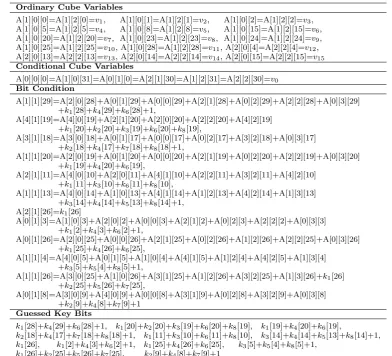
degree over cube variables, we could compute backward for one round (especially over the χ operation) of first 15 lanes. That is, we could extend the attack to 6 rounds with these 16-dimension cube variables. The conditional and ordinary cube variables are listed in the Table 4 as well as the bit conditions. By controlling the bit conditions and guess the 12-bit equivalent key listed in Table 4, we compute the cube sums for 216 different messages which take all possible values in the cube bits. When the equivalent key guesses are right, the propagation of the conditional cube variablev0 follows the 6-6-6 pattern and both
the above two requirements are met, which makes cube sums to be all zeros.
The conditional cube attack procedure, complexity analysis and experimental result are presented as follows:
Attack Procedure
Table 4: Parameters set for attack on 6-round River Keyak
Ordinary Cube Variables
A[1][0][0]=A[1][2][0]=v1, A[1][0][1]=A[1][2][1]=v2, A[1][0][2]=A[1][2][2]=v3,
A[1][0][5]=A[1][2][5]=v4, A[1][0][8]=A[1][2][8]=v5, A[1][0][15]=A[1][2][15]=v6,
A[1][0][20]=A[1][2][20]=v7, A[1][0][23]=A[1][2][23]=v8, A[1][0][24]=A[1][2][24]=v9,
A[1][0][25]=A[1][2][25]=v10, A[1][0][28]=A[1][2][28]=v11, A[2][0][4]=A[2][2][4]=v12,
A[2][0][13]=A[2][2][13]=v13, A[2][0][14]=A[2][2][14]=v14, A[2][0][15]=A[2][2][15]=v15 Conditional Cube Variables
A[0][0][0]=A[1][0][31]=A[0][1][0]=A[2][1][30]=A[1][2][31]=A[2][2][30]=v0 Bit Condition
A[1][1][29]=A[2][0][28]+A[0][1][29]+A[0][0][29]+A[2][1][28]+A[0][2][29]+A[2][2][28]+A[0][3][29] +k1[28]+k4[29]+k6[28]+1,
A[4][1][19]=A[4][0][19]+A[2][1][20]+A[2][0][20]+A[2][2][20]+A[4][2][19] +k1[20]+k2[20]+k3[19]+k6[20]+k8[19],
A[3][1][18]=A[3][0][18]+A[0][1][17]+A[0][0][17]+A[0][2][17]+A[3][2][18]+A[0][3][17] +k2[18]+k4[17]+k7[18]+k8[18]+1,
A[1][1][20]=A[2][0][19]+A[0][1][20]+A[0][0][20]+A[2][1][19]+A[0][2][20]+A[2][2][19]+A[0][3][20] +k1[19]+k4[20]+k6[19],
A[2][1][11]=A[4][0][10]+A[2][0][11]+A[4][1][10]+A[2][2][11]+A[3][2][11]+A[4][2][10] +k1[11]+k3[10]+k6[11]+k8[10],
A[1][1][13]=A[4][0][14]+A[1][0][13]+A[4][1][14]+A[1][2][13]+A[4][2][14]+A[1][3][13] +k3[14]+k4[14]+k5[13]+k8[14]+1,
A[2][1][26]=k1[26]
A[0][1][3]=A[1][0][3]+A[2][0][2]+A[0][0][3]+A[2][1][2]+A[0][2][3]+A[2][2][2]+A[0][3][3] +k1[2]+k4[3]+k6[2]+1,
A[0][1][26]=A[2][0][25]+A[0][0][26]+A[2][1][25]+A[0][2][26]+A[1][2][26]+A[2][2][25]+A[0][3][26] +k1[25]+k4[26]+k6[25],
A[1][1][4]=A[4][0][5]+A[0][1][5]+A[1][0][4]+A[4][1][5]+A[1][2][4]+A[4][2][5]+A[1][3][4] +k3[5]+k5[4]+k8[5]+1,
A[1][1][26]=A[3][0][25]+A[1][0][26]+A[3][1][25]+A[1][2][26]+A[3][2][25]+A[1][3][26]+k1[26]
+k2[25]+k5[26]+k7[25],
A[0][1][8]=A[3][0][9]+A[4][0][9]+A[0][0][8]+A[3][1][9]+A[0][2][8]+A[3][2][9]+A[0][3][8] +k2[9]+k4[8]+k7[9]+1
Guessed Key Bits
k1[28]+k4[29]+k6[28]+1, k1[20]+k2[20]+k3[19]+k6[20]+k8[19], k1[19]+k4[20]+k6[19],
k2[18]+k4[17]+k7[18]+k8[18]+1, k1[11]+k3[10]+k6[11]+k8[10], k3[14]+k4[14]+k5[13]+k8[14]+1,
k1[26], k1[2]+k4[3]+k6[2]+1, k1[25]+k4[26]+k6[25], k3[5]+k5[4]+k8[5]+1,
k1[26]+k2[25]+k5[26]+k7[25], k2[9]+k4[8]+k7[9]+1
– Step 2Move the cube variables to the other 31 different depth inzaxis and repeat step 1 for 31 times with the new cube variables and bit conditions, then get another 12×31 = 372 key bits relations, however, there are four guessed key relations would be repeated with each other pairwise and only ten effective equations remained in each attack. In total, there are 10×32 = 320 key bits relations which are enough to get all the 256-bit equivalent key and just compute backward the Keccak permutation to get the initial real 128-bit keyK.
Complexity Analysis
For each of the 212 possible equivalent key, we compute 216 encryption for 6-round River Keyak, and repeat for 32 times in total. So the complexity for our attack is 212×216×32 = 233. Our attack can be implemented in several minutes on a laptop for one cube attack, so we just need several hours to recover the right key. We present a experiment result of random key and a right key in Table 5. We should note that this complexity is so low enough so reducing it is no more significance. In fact, we use the 2-2-22 patten used by Huanget al.could reduce a few complexity.
Experimental Result
We present a simple experimental result in Table 5. In our experiment, we choose messages to make the first 544 bits of the second Keccak internal permutation’s input to be zeros (which could be any other arbitrary constants). The equivalent 256-bit key (capacity) is 0x724aa646 07a2f7ae 29063398 b972526e 5e0c0988 7c634775 0711c592b39481dc, and the right guessed key bits listed in the Table 4 are 100001011011, for all possible 212guessed keys we compute the cube sums and present in the Table 5, only when the guessed key matches the right 12-bit equivalent key, the cube sums are all zeros.
4.2 Conditional Cube Attack on 7-Round River Keyak
Table 5: examples of test result of 6-round attack
Guessed Values Cube Sums
000000 000000 0xcb84f226 16c557f8 c34b83bf 13ca478d 000000 000001 0xade38cde 03efa194 f3626098 2b9d71de
· · ·
011001 111100 0x00000000 00000000 00000000 00000000
· · ·
111111 111110 0xb82ea8ca ab719819 cbc44f46 d1230742 111111 111111 0xb7143bec ee410854 db23fad0 2f176599
Table 6: Parameters set for attack on 7-round River Keyak
Ordinary Cube Variables
A[1][0][0] =A[1][2][0] =v1,A[1][0][1] =A[1][2][1] =v2,A[1][0][2] =A[1][2][2] =v3,
A[1][0][5] =A[1][2][5] =v4,A[1][0][8] =A[1][2][8] =v5,A[1][0][15]=A[1][2][15]=v6,
A[1][0][20]=A[1][2][20] =v7,A[1][0][23]=A[1][2][23] =v8,A[1][0][24]=A[1][2][24]=v9,
A[1][0][25]=A[1][2][25]=v10,A[1][0][28]=A[1][2][28]=v11,A[2][0][4] =A[2][2][4] =v12,
A[2][0][13]=A[2][2][13]=v13,A[2][0][14]=A[2][2][14]=v14,A[2][0][15]=A[2][2][15]=v15,
A[2][0][18]=A[2][2][18]=v16,A[2][0][23]=A[2][2][23]=v17,A[2][0][27]=A[2][2][27]=v18,
A[2][0][28]=A[2][2][28]=v19,A[2][0][29]=A[2][2][29]=v20,A[3][0][0] =A[3][2][0] =v21,
A[3][0][1] =A[3][2][1] =v22,A[3][0][4] =A[3][2][4] =v23,A[3][0][5] =A[3][2][5] =v24,
A[3][0][8] =A[3][2][8] =v25,A[3][0][10]=A[3][2][10]=v26,A[3][0][13]=A[3][2][13]=v27,
A[3][0][15]=A[3][2][15]=v28,A[3][0][17]=A[3][2][17]=v29,A[3][0][25]=A[3][2][25]=v30,
A[3][0][30]=A[3][2][30]=v31 Conditional Cube Variables
A[0][0][0]=A[1][0][31]=A[0][1][0]=A[2][1][30]=A[1][2][31]=A[2][2][30]=v0 Bit Condition
A[1][1][29]=A[0][1][29]+A[0][0][29]+A[2][1][28]+A[0][2][29]+A[0][3][29] +k1[28]+k4[29]+k6[28]+1,
A[4][1][19]=A[4][0][19]+A[2][1][20]+A[2][0][20]+A[2][2][20]+A[4][2][19] +k1[20]+k2[20]+k3[19]+k6[20]+k8[19],
A[3][1][18]=A[3][0][18]+A[0][1][17]+A[0][0][17]+A[0][2][17]+A[3][2][18] +A[0][3][17]+k2[18]+k4[17]+k7[18]+k8[18]+1,
A[1][1][20]=A[2][0][19]+A[0][1][20]+A[0][0][20]+A[2][1][19]+A[0][2][20] +A[2][2][19]+A[0][3][20]+k1[19]+k4[20]+k6[19],
A[2][1][11]=A[4][0][10]+A[2][0][11]+A[4][1][10]+A[2][2][11]+A[3][2][11] +A[4][2][10]+k1[11]+k3[10]+k6[11]+k8[10],
A[1][1][13]=A[4][0][14]+A[1][0][13]+A[4][1][14]+A[1][2][13]+A[4][2][14] +A[1][3][13]+k3[14]+k4[14]+k5[13]+k8[14]+1,
A[2][1][26]=k1[26],
A[0][1][3]=A[1][0][3]+A[2][0][2]+A[0][0][3]+A[2][1][2]+A[0][2][3]+A[2][2][2] +A[0][3][3]+k1[2]+k4[3]+k6[2]+1,
A[0][1][26]=A[2][0][25]+A[0][0][26]+A[2][1][25]+A[0][2][26]+A[1][2][26] +A[2][2][25]+A[0][3][26]+k1[25]+k4[26]+k6[25],
A[1][1][4]=A[4][0][5]+A[0][1][5]+A[1][0][4]+A[4][1][5]+A[1][2][4] +A[4][2][5]+A[1][3][4]+k3[5]+k5[4]+k8[5]+1,
A[1][1][26]=A[1][0][26]+A[3][1][25]+A[1][2][26]+A[1][3][26] +k1[26]+k2[25]+k5[26]+k7[25],
A[0][1][8]=A[3][0][9]+A[4][0][9]+A[0][0][8]+A[3][1][9]+A[0][2][8] +A[3][2][9]+A[0][3][8]+k2[9]+k4[8]+k7[9]+1 Guessed Key Bits
k1[28]+k4[29]+k6[28]+1, k1[20]+k2[20]+k3[19]+k6[20]+k8[19],
k2[18]+k4[17]+k7[18]+k8[18]+1, k1[19]+k4[20]+k6[19],
k1[11]+k3[10]+k6[11]+k8[10], k3[14]+k4[14]+k5[13]+k8[14]+1, k1[26],
k1[2]+k4[3]+k6[2]+1, k1[25]+k4[26]+k6[25], k3[5]+k5[4]+k8[5]+1,
k1[26]+k2[25]+k5[26]+k7[25], k2[9]+k4[8]+k7[9]+1
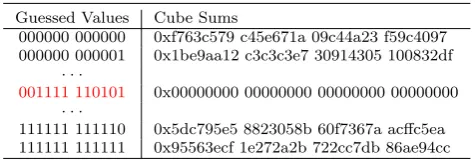
Table 7: examples of test result of 7-round attack
Guessed Values Cube Sums
000000 000000 0xf763c579 c45e671a 09c44a23 f59c4097 000000 000001 0x1be9aa12 c3c3c3e7 30914305 100832df
· · ·
001111 110101 0x00000000 00000000 00000000 00000000
· · ·
0,0 1,0 2,0 3,0 4,0
0,1 1,1 2,1 3,1 4,1
0,2 1,2 2,2 3,2 4,2
0,3 1,3 2,3 3,3 4,3
0,4 1,4 2,4 3,4 4,4
0,0 1,0 2,0 3,0 4,0
0,1 1,1 2,1 3,1 4,1
0,2 1,2 2,2 3,2 4,2
0,3 1,3 2,3 3,3 4,3
0,4 1,4 2,4 3,4 4,4
0,0 1,1 2,2 3,3 4,4
3,0 4,1 0,2 1,3 2,4
1,0 2,1 3,2 4,3 0,4
4,0 0,1 1,2 2,3 3,4
2,0 3,1 4,2 0,3 1,4
ordinary cube variables secret variables
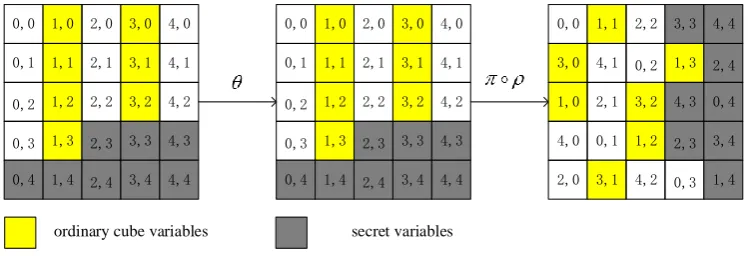
Fig. 5: linear structure of cube variables for 8-round attack
conditions are also similar to conditions presented in Section 4.1 (they are same when the 800−256−32 = 512 bits are constrained to be zeros). For all possible 212 equivalent keys, we compute the 232 cube sums of the first 5 lanes of the output after 6.5-round Keyak round functions, if the sums are all zeros, then we treat the 12 bits are the right key guesses. By shifting the cube variables along thezaxis rotational for 31 times, we could use as more as 320 bit relations get all the 256-bit equivalent key (capacity) and compute backward the first Keccak internal permutation to get the real key K. The time complexity of 7-round attack is 212×232×25 = 249. Respect to experiment, we use the right 12-bit equivalent key and some random equivalent keys to compute the cube sums in several hours on a laptop, the experiment results are listed in Table 7. Like the experiment in Section 4.1, in this experiment we use the equivalent 256-bit key (capacity) 0xef4bdf f3 6ebf27ce49b01de8 ac1e40c6a47af7c9 35dc18cc cf42d588 5df5c110, and the right 12-bit guessed key bits are 001111110101.
5 Conditional Cube Attack on 8-Round River Keyak Using Linear Structure Technique
When we attack the 8-round River Keyak using the conditional cube attack we need to find 64-dimension cube variables. However, it is so complex to search for 64 variables which meet the condition that these cube variables do not multiply with each other in theχoperation of the first round and the condition that there is one variable v0 does not multiply with other cube variables in the second round. The probability is a
little high for ordinary variables which do not multiply with each other in the first round, but in the second round, most of them would multiply with v0. In order to solve this problem, we use the linear structure
technique to find enough conditional cube variables for our 8-round attack.
We use the same conditional cube variables with that in the Section 4.1, as shown in Figure 5, we choose the second column and the fourth column in yellow color to search the ordinary variables. Firstly, we letA[1][3] =⊕2i=0A[1][i] andA[3][2] =⊕1i=0A[1][i], and we could note afterθ,ρandπ operations, these
variables do not multiply with each other in theχoperation in the first round. Then, what we need to do is filtering the variables which do not multiply withv0 in the second round. For each column, the bits which
meet the second condition would be remained when the bits (do not multiply withv0) equal or more than
2 in the same column. Following this method, the freedom degree for cube variables increase greatly, we could find more than 64 ordinary cube variables easily. We use the 64-dimension conditional cube variables listed in Table 8 to launch the 8-round conditional cube attack for River Keyak. The attack procedure is very similar to the 6/7-round attack. The complexity of our key-recovery attack is 212×264×32 = 281.
6 Conclusion
Table 8: Parameters set for attack on 8-round River Keyak
Ordinary Cube Variables
A[1][0][0]=v1, A[1][2][0]=v2, A[1][1][0]=v1+v2, A[1][0][1]=v3, A[1][2][1]=v4,A[1][3][1]=v3+v4,
A[1][0][2]=A[1][2][2]=v5, A[1][1][4]=A[1][3][4]=v6, A[1][0][5]=A[1][2][5]=v7,
A[3][1][9]=A[3][2][9]=v8, A[1][0][7]=A[1][1][7]=v9, A[1][0][8]=A[1][2][8]=v10,
A[1][1][9]=A[1][3][9]=v11, A[1][0][10]=A[1][3][10]=v12, A[1][0][11]=v13, A[1][3][11]=v14,
A[1][1][11]=v13+v14, A[1][0][12]=v15, A[1][3][12]=v16, A[1][1][12]=v15+v16, A[1][2][13]=v17,
A[1][3][13]=v18, A[1][1][13]=v17+v18, A[1][2][14]=v19, A[1][3][14]=v20, A[1][1][14]=v19+v20,
A[1][0][15]=v21, A[1][2][15]=v22, A[1][3][15]=v23, A[1][1][15]=v21+v22+v23, A[1][2][16]=v24,
A[1][3][16]=v25, A[1][1][16]=v24+v25,A[1][1][17]=A[1][2][17]=v26, A[1][1][18]=A[1][2][18]=v27,
A[1][0][20]=v28, A[1][2][20]=v29, A[1][3][20]=v28+v29, A[3][0][6]=A[3][1][6]=v30,
A[3][1][9]=A[3][2][9]=v31, A[1][0][22]=v32, A[1][3][22]=v33, A[1][1][22]=v32+v33,
A[1][2][23]=v35, A[1][1][23]=v34+v35, A[1][0][24]=v36, A[1][2][24]=v37, A[1][3][24]=v38,
A[1][1][24]=v36+v37+v38, A[1][0][25]=v39, A[1][2][25]=v40, A[1][3][25]=v39+v40,
A[1][0][26]=v41, A[1][3][26]=v42, A[1][1][26]=v41+v42, A[3][0][7]=A[3][1][7]=v43,
A[1][0][27]=v44, A[1][3][27]=v45, A[1][1][27]=v44+v45, A[1][0][28]=v46, A[1][2][28]=v47,
A[1][1][28]=v46+v47, A[1][2][29]=A[1][3][29]=v48, A[3][0][8]=A[3][2][8]=v49,
A[1][2][30]=A[1][3][30]=v50, A[3][0][15]=v51, A[3][1][15]=v52, A[3][2][15]=v51+v52,
A[1][1][31]=A[1][3][31]=v53, A[3][0][0]=v54, A[3][1][0]=v55, A[3][2][0]=v54+v55,
A[3][0][1]=v56, A[3][1][1]=v57, A[3][2][1]=v56+v57, A[3][1][2]=A[3][2][2]=v58,
A[3][1][3]=A[3][2][3]=v59, A[3][0][4]=v60, A[3][1][4]=v61, A[3][2][4]=v60+v61,
A[3][0][5]=v62, A[3][1][5]=v63, A[3][2][5]=v62+v63 Conditional Cube Variables
A[0][0][0]=A[1][0][31]=A[0][1][0]=A[2][1][30]=A[1][2][31]=A[2][2][30]=v0 Bit Condition
A[0][0][29]=A[2][0][28]+A[0][1][29]+A[1][1][29]+A[2][1][28]+A[0][2][29] + A[2][2][28]+A[0][3][29]+k1[28]+k4[29]+k6[28]+1,
A[2][0][20]=A[4][0][19]+A[2][1][20]+A[4][1][19]+A[2][2][20]+A[4][2][19] +k1[20]+k2[20]+k3[19]+k6[20]+k8[19],
A[0][0][17]=A[3][0][18]+A[0][1][17]+A[3][1][18]+A[0][2][17]+A[3][2][18] + A[0][3][17]+k2[18]+k4[17]+k7[18]+k8[18]+1,
A[0][0][20]=A[2][0][19]+A[0][1][20]+A[1][1][20]+A[2][1][19]+A[0][2][20] + A[2][2][19]+A[0][3][20]+k1[19]+k4[20]+k6[19],
A[2][0][11]=A[4][0][10]+A[2][1][11]+A[4][1][10]+A[2][2][11]+A[3][2][11] + A[4][2][10]+k1[11]+k3[10]+k6[11]+k8[10],
A[4][0][14]=A[1][0][13]+A[4][1][14]+A[4][2][14]+k3[14]+k4[14]+k5[13]+k8[14]+1,
A[2][1][26]=k1[26],
A[0][0][3]=A[1][0][3]+A[2][0][2]+A[0][1][3]+A[2][1][2]+A[0][2][3] + A[2][2][2]+A[0][3][3]+k1[2]+k4[3]+k6[2]+1,
A[0][0][26]=A[2][0][25]+A[0][1][26]+A[2][1][25]+A[0][2][26]+A[1][2][26] + A[2][2][25]+A[0][3][26]+k1[25]+k4[26]+k6[25],
A[4][0][5]=A[1][0][4]+A[0][1][5]+A[4][1][5]+A[1][2][4]+A[4][2][5]+k3[5]+k5[4]+k8[5]+1,
A[3][0][25]=A[3][1][25]+A[1][2][26]+A[3][2][25]+k1[26]+k2[25]+k5[26]+k7[25],
A[0][0][8]=A[3][0][9]+A[4][0][9]+A[0][1][8]+A[0][2][8]+ A[0][3][8]+k2[9]+k4[8]+k7[9]+1 Guessed Key Bits
k1[28]+k4[29]+k6[28]+1, k1[20]+k2[20]+k3[19]+k6[20]+k8[19],
k2[18]+k4[17]+k7[18]+k8[18]+1, k1[19]+k4[20]+k6[19],
k1[11]+k3[10]+k6[11]+k8[10], k3[14]+k4[14]+k5[13]+k8[14]+1, k1[26],
k1[2]+k4[3]+k6[2]+1, k1[25]+k4[26]+k6[25], k3[5]+k5[4]+k8[5]+1,
k1[26]+k2[25]+k5[26]+k7[25], k2[9]+k4[8]+k7[9]+1
Acknowledgements
This work is supported by China’s 973 Program (No. 2013CB834205), the National Key Research and Development Program of China (No. 2017YFA0303903), the National Natural Science Foundation of China (No. 61672019), the Fundamental Research Funds of Shandong University (No. 2016JC029).
References
1. Aumasson, J.P., Dinur, I., Meier, W., Shamir, A. : Cube testers and key recovery attacks on reduced-round MD6 and trivium. FSE 2009, LNCS 5665, pp. 1-22. Springer, Heidelberg (2009)
2. Bertoni G., Daemen J., Peeters M., Van Assche G.: Keccak sponge function family. http://keccak.noekeon.org/. 3. CAESAR: Competition for Authenticated Encryption: Security, Applicability, and Robustness.
http://competitions.cr.yp.to/caesar.html.
4. Chaigneau C., Fuhr T., Gilbert H., Jean J., Reinhard J.R. :Cryptanalysis of NORX v2. 0. IACR Transactions on Symmetric Cryptology, pp. 156-174. (2017)
5. Das S., Meier W.: Differential biases in reduced-round Keccak. AFRICACRYPT 2014, LNCS 8469, pp. 69-87. Springer, Heidelberg (2014)
7. Dinur I., Shamir A.: Cube attacks on tweakable black box polynomials. EUROCRYPT 2009, LNCS 5479, pp. 278-299. Springer, Heidelberg (2009)
8. Dinur I., Shamir A. : Breaking Grain-128 with dynamic cube attacks. FSE 2011, LNCS 6733, pp. 167-187. Springer, Heidelberg (2011)
9. Dinur I., Morawiecki P., Pieprzyk J., Srebrny M., Straus M. :Cube attacks and cube-attack-like cryptanalysis on the round-reduced Keccak sponge function. EUROCRYPT 2015, Part I, LNCS 9056, pp. 733-761. Springer, Heidelberg (2015)
10. Dong X., Li Z., Wang X., Qin L. :Cube-like attack on round-reduced initialization of Ketje Sr. IACR Transactions on Symmetric Cryptology, pp. 259-280. (2017)
11. Fouque P. A., Vannet T. : Improving key recovery to 784 and 799 rounds of trivium using optimized cube attacks. FSE 2013, LNCS 8424, pp. 502-517. Springer, Heidelberg (2014)
12. Guido B., Joan D., Micha¨el P., Assche G.V. : Keyak. http://keyak.noekeon.org
13. Guido B., Joan D., Micha¨el P., Assche G.V. : The keccak SHA-3 submission. Submission to NIST (Round 3)(2011). 14. Guo J., Liu M., Song L.: Linear Structures: Applications to Cryptanalysis of Round-Reduced Keccak. ASIACRYPT
2016, Part I, LNCS 10031, pp. 249-274. Springer, Heidelberg (2016)
15. Huang S., Wang X., Xu G., Wang M., Zhao J. :Conditional Cube Attack on Reduced-Round Keccak Sponge Function. EUROCRYPT 2017, Part II, LNCS 10211, pp. 259-288. Springer (2017)
16. Li Z., Dong X., Wang X. :Conditional cube attack on round-reduced ascon. IACR Transactions on Symmetric Cryp-tology, pp. 175-202. (2017)