University of South Carolina
Scholar Commons
Theses and Dissertations
2017
April 26th.
Carin BendasUniversity of South Carolina
Follow this and additional works at:https://scholarcommons.sc.edu/etd Part of theTheatre and Performance Studies Commons
This Open Access Thesis is brought to you by Scholar Commons. It has been accepted for inclusion in Theses and Dissertations by an authorized administrator of Scholar Commons. For more information, please [email protected].
Recommended Citation
!!
!!
!!
!
A
PRIL26
TH.
!
by
!
Carin Bendas
!
Bachelor of Arts
University of South Carolina, 2008
!
!
!
Submitted in Partial Fulfillment of the Requirements
!
For the Degree of Master of Fine Arts in
!
Theatre
!
College of Arts and Sciences
!
University of South Carolina
!
2017
!
Accepted by:
!
J. Steven Pearson, Director of Thesis
!
Robyn Hunt, Reader
!
Cheryl L. Addy, Vice Provost and Dean of the Graduate School
DEDICATION
A
CKNOWLEDGEMENTSEternally grateful for the love and support of my family: my dearest love, Ben
Blazer; Neila and Danny Bendas; Alon Bendas; Gilit, Pete, and Milo James; Dayna
Greenfield; Rebecca Dealy; Kaitlin Genovese; Caulder Tempel; Martha Hearn. And to
my mentors and co-conspirators, without whom this work never would have been
realized: Robyn Hunt, Steve Pearson, Nicole Dietze, Candace Thomas, Rachel Kuhnle,
Josh Jeffers, Matthew Cavender, Dimitri Woods, Benjamin Roberts, Neda Spalajkovic,
Tamara Joksimovic, Baxter Engle, and Jane Hearn. This piece would be impossible
ABSTRACT
April 26th. is a solo theatre piece that takes the audience on a journey through a
few moments in the lives of seven Jewish individuals across space and time. It is
inspired by the struggles and survival of the Jewish people throughout history, with
T
ABLEOFC
ONTENTSDEDICATION...iii
ACKNOWLEDGEMENTS...iv
ABSTRACT...v
LISTOF FIGURES...vii
THE SCRIPT...1
INSPIRATION, RESEARCH, AND PREPARATION...12
LIST OF FIGURES
Figure 2.1 Zadie’s Letter to Bubie p. 1 ...17
Figure 2.2 Zadie’s Letter to Bubie p. 2 ...18
Figure 2.3 Zadie’s Letter to Bubie p. 3 ...19
Figure 2.4 Zadie’s Letter to Bubie p. 4 ...20
Figure 2.5 Zadie’s Letter to Bubie p. 5 ...21
Figure 2.6 Zadie Serving in the South Pacific ...22
Figure 2.7 Bubie Posing in Frick Park ...23
Figure 2.8 Zadie’s Poem p. 1 ...24
T
HES
CRIPT!
April 26th.
!
DSR is a red folding chair and an open army trunk.
!
DSL is a wooden folding chair, makeshift “table” (a stack of three wooden crates). On the table is a 1940’s-style typewriter. Behind/ beside the “table” is a wooden crate standing on its end. A khaki army shirt is hanging over the back of the folding chair.
!
There is a scrim US
!
HOUSELIGHTS/ STAGELIGHTS FADE TO BLACK.
!
SCENE 1.
!
In the darkness, the sound of a typewriter clacking. The clacking coincides with the words appearing on the projection.
!
PROJECTION: Somewhere in the South Pacific. April 26th, 1944.
!
A SOLDIER in a green WWII Army jacket and khaki Army “hard” hat stands beside the typewriter DSL
!
SOLDIER. Somewhere in the South Pacific, where they say the trade winds blow; Where your thoughts are always drifting to the ones you used to know. Where the moon shines down so brightly Where stars twinkle in the sky; Where eyes well up so quickly, full of tears, yet you don’t cry.
!
Somewhere in the South Pacific, where we seldom hear the news; Where the stories that we hear are mostly fables, someone’s views. Where you hear that you’ll be home ‘ere long, you know it can’t be right; Yet it lifts your hopes like opium, makes you pray with all your might.
!
SCENE 2.
In the darkness, the sound of a typewriter clacking. The clacking coincides with the words appearing on the projection.
!
PROJECTION: Somewhere in the Negev Desert.
April 26th, 73 A.D.
!
A minimal amount of side lighting fades up, revealing a huddled mass behind the scrim
USL of C. The lighting should be so that the audience can’t really see the actor. Just a
general shape. The woman is wearing a scarf over her head.
!
YOUNG WOMAN. Hush, baby.
CHILD. But mama…
YOUNG WOMAN. HUSH BABY.
CHILD. But…why?
YOUNG WOMAN. I said hush.
CHILD. But…
YOUNG WOMAN. Let’s play a game, ok baby?
CHILD. Ok, mama. What game?
YOUNG WOMAN. Let’s pretend there’s a big dragon and he’s trying to find us so we
have to hide from him.
CHILD. But I like dragons.
YOUNG WOMAN. But this one is a mean dragon. He wants to blow fire in our faces
until we are turned to ash.
CHILD. …sort of like Lot’s wife?
YOUNG WOMAN. Yes, baby. Sort of. (silence)
CHILD. Mama?
YOUNG WOMAN. Hush, baby.
YOUNG WOMAN. I know, baby.
CHILD. Mama?
YOUNG WOMAN. Yes, baby.
CHILD. Why are we here?
YOUNG WOMAN. Don’t ask questions, baby. Just stay quiet.
CHILD. …but…why?
YOUNG WOMAN. Because if the dragon sees us, we will die.
!
3 second fade to black.
!
!
SCENE 3.
In the darkness, the sound of a typewriter clacking. The clacking coincides with the words appearing on the projection.
!
PROJECTION: Somewhere in Poland.
April 26th, 1941.
!
A small strip of white light (as if it is coming from under a closet door) reveals a pile of
coats behind the scrim USR of center. The audience should not be able to make out any
details; only a general shape.
YOUNG WOMAN. Hush, baby.
CHILD. But Mama…
YOUNG WOMAN. I said HUSH, child. Hush.
CHILD. But mama…please. I have to pee.
YOUNG WOMAN. Hold it. And hush.
CHILD. But I really really really need to go.
YOUNG WOMAN. Think of something else.
YOUNG WOMAN. Hush, baby. Please.
CHILD. Mama…
YOUNG WOMAN. Let’s play a game, okay baby?
CHILD. Ok Mama.
YOUNG WOMAN. Let’s pretend we’re playing hide and seek with a big scary monster.
And if we make a peep, the monster will find us.
CHILD. Ok Mama. (silence) Mama?
YOUNG WOMAN. Hush, baby.
CHILD. But it’s dark in here. And too small. And it’s hot under all these coats. I can’t
breathe.
YOUNG WOMAN. I know, baby. Hush now. We don’t want the monster to find us.
CHILD. But mama…
YOUNG WOMAN. What, baby?
CHILD. If we’re hiding from a monster, why are we in the closet?
YOUNG WOMAN. (becoming exasperated) Because we don’t want him to find us,
baby.
CHILD. But monsters live in the closet. And under the bed. Everybody knows that.
YOUNG WOMAN. I know, baby.
CHILD. And monsters only come out at night. It’s lunchtime.
YOUNG WOMAN. You’re right, baby. Usually they do. But this monster is different.
CHILD. Why?
YOUNG WOMAN. He just is. Hush now.
CHILD. Mama?
YOUNG WOMAN. What, baby.
CHILD. When is Papa coming home?
YOUNG WOMAN. I don’t know, baby. I don’t know…
!
SCENE 5.
In the darkness, the sound of a typewriter clacking. The clacking coincides with the words appearing on the projection.
!
PROJECTION: Somewhere in the Negev Desert.
April 26th, 73 A.D.
Dim light fades up behind scrim USL of center
CHILD. Mama?
YOUNG WOMAN. Yes, baby.
CHILD. What does the dragon look like?
YOUNG WOMAN. He is the largest thing you have ever seen. Larger than our whole
town. He looks like ten thousand men. Each man is a scale on the dragon’s
back.
CHILD. Hm…
YOUNG WOMAN. Sounds like a pretty scary dragon, doesn’t it?
CHILD. Yes, mama.
YOUNG WOMAN. That’s why we need to be very quiet.
CHILD. Yes, mama. (pause) Mama?
YOUNG WOMAN. Yes, baby.
CHILD. Where is Papa? (her mother doesn’t answer) Mama?
YOUNG WOMAN. He’s gone, baby.
CHILD. Did the dragon get him?
YOUNG WOMAN. No, baby.
CHILD. Then where is he? (her mother doesn’t answer) Mama?
YOUNG WOMAN. He’s gone.
CHILD. Dead? (her mother doesn’t answer) Mama?
YOUNG WOMAN. Yes, baby.
CHILD. And Uncle Joseph?
YOUNG WOMAN. Yes, baby.
YOUNG WOMAN. (cuts her off. but not harshly) Everyone we know.
CHILD. Oh. (her lip begins to quiver as she realizes this truth)
YOUNG WOMAN. Now hush, baby.
CHILD. (pause) Mama?
YOUNG WOMAN. Yes, baby?
CHILD. How long do we have to hide here?
YOUNG WOMAN. I don’t know, baby.
CHILD. Mama?
YOUNG WOMAN. Yes, baby?
CHILD. It’s cold, mama.
YOUNG WOMAN. I know, baby. I know…
!
3 second fade to black.
!
!
SCENE 6.
In the darkness, the sound of a typewriter clacking. The clacking coincides with the words appearing on the projection.
!
PROJECTION: Somewhere in Poland.
April 26th, 1941.
Closet light fades up USR of C
CHILD. Mama?
YOUNG WOMAN. Yes, baby?
CHILD. I still have to pee.
YOUNG WOMAN. I know, baby.
CHILD. (pause) Mama?
YOUNG WOMAN. Yes, baby.
CHILD. (tears in her voice) I’m sorry.
CHILD. I couldn’t hold it anymore.
YOUNG WOMAN. (pause) It’s ok, baby.
CHILD. Mama?
YOUNG WOMAN. Yes, baby?
CHILD. I love you.
!
3 second fade to black.
!
SCENE 7.
In the darkness, the sound of a typewriter clacking. The clacking coincides with the words appearing on the projection.
!
PROJECTION: Somewhere in the South Pacific. April 26th, 1944.
!
Lights fade up on YOUNG WOMAN crossing from USL truss to typewriter
!
SOLDIER. Somewhere in the South Pacific, where you have a million friends,
Yet loneliness consumes you and hurts worse than the bends. Where time has lost its meaning and to pass a single day Makes the tortures of the damned seem so easy, light, and gay.
!
Somewhere in the South Pacific, sounds like a pleasant spot, You’ve seen it in the movies, ads for cruises plug it a lot.
With saronged gals, the Southern Cross, and whiskey by the case, The Goddamn fool that wrote that shit should be here in my place.
!
3 second fade to black.
!
!
SCENE 8.
In the darkness, the sound of a typewriter clacking. The clacking coincides with the words appearing on the projection.
!
!
Lights fade up on a YOUNG WOMAN by the army trunk DSR.
!
YOUNG WOMAN. When I was really little, I wanted to be a meter maid. It didn’t work out that way. My illustrious career instead began at Victoria’s Secret. And at night I counted rows of panties instead of sheep. Teenage boys giggling like teenage girls. Asking what Victoria’s Secret is. “If I told you, it wouldn’t be a secret, now would it?” Nannying- parks and playgrounds in good weather; TV on the couch in bad. Teaching Hebrew School. Teaching Sunday School. Bar-Mitzvah tutor and once I almost missed a kid’s final dress rehearsal because I was in my apartment eating brie and smoking a bong. Hebrew tutor for a pair of brothers with behavior problems explained by their parents’ battlefield divorce. Lots of shaking fists from the very wealthy father. A traveling children’s show about eating right and exercising. We drank coffee and smoked cigarettes in the van, then got out, loaded meadowland into the cafetorium, turned into forest animals, and preached “Moooooooderation!” to a room stinking of deep fried dreams.
I spent a few months working for KOOL Cigarettes in loud crowded bars and dark thumping clubs, giving out two free packs of cancer to any idiot drunk enough to actually smoke KOOLS. I wore a wedding ring to keep the creeps away. All it did was keep the nice guys away. The creeps pressed in closer, breathing hot beer and tequila into my neck. “So? Husband ain’t here, is he.”
My first modeling job was a nude shoot for an international shower and jacuzzi company. They slathered me in baby oil and sprayed me with water droplets to make it look like I was really in the shower. A quarterly fashion magazine. We shot the cover photo in a greenhouse. I’m squinting. Price photo studios; an ad for
fancy office downtown. A four-part mud-slinging ad campaign for Lt. Governor of Texas. Seven more jobs for Fisher Price. 8ft Print Ads in my favorite discount clothing store. A promotional job for a huge oil company where I had to pretend to be French. A promotional job for a huge fracking company where I had to pretend to be from
Kentucky. A promotional job for a huge British fabric company where I scared the shit out of people as a living mannequin. A series of commercials for Dolby that aired in the U.K. An ongoing camera gig for a car dealership.
After a few years, my agent started submitting me for jobs with the last two letters of my last name changed to “ez.” He marketed me as a Latina, and my bookings tripled.
!
The last photo I have of my grandmother was taken the night before she died. Her glowing face is inches away from my computer screen. She is watching my newest car commercial. It is the happiest she has been since losing my grandfather. He was her everything. Always.
!
3 second fade to black.
!
!
SCENE 9.
In the darkness, the sound of a typewriter clacking. The clacking coincides with the words appearing on the projection.
PROJECTION: Somewhere in the U.S. April 26th, 1945.
!
Lights fade up as the YOUNG WOMAN transitions into the 1940’s sweetheart, who reads a letter standing CS.
!
My dearest,
He started his first fight when some unfortunate individual standing beside him was talking to his friend. They had some words at first about him talking so this
unfortunate individual moved away. Then about three minutes later the goon gets up and dashes at the unfortunate character and starts slugging him. Nobody attempts to end hostilities so being the only officer in the car I feel that it’s my duty. So up I gets and with my superman strength I grab the goon from the rear and calm him down until he goes back to his seat.
Thought nothing more of it until a sailor comes walking by on his way to the Men’s room and trips over the goon’s feet. Well up he goes again and jumps the sailor. This time I had about half a dozen servicemen help me and they beat him to submission. The conductor was warned about him and he made arrangements to have him placed in irons when we arrived at the station.
The third incident occurred when he flew out of his seat at a startled Marine who happened to flush the toilet. He missed his first attack and the sailor behind me began pounding the daylights out of him. Observing that the goon was badly battered I slugged him once myself because I had the thirst for blood in that cold heart of mine. Couldn’t have hit him too hard because he woke up ten minutes later and was meek as a kitten. Anyhow the Civil authorities took him in hand when we arrived at the station, so all’s well that ends well.
My two hour jaw breaker today went off fairly well and I managed to keep the men awake, which surprised me because it was right after chow and held indoors. Maybe I should be a teacher, huh?
Don’t think I’ll prepare tomorrow’s lesson now because it’s now after 11 and I have to get some shut eye some time. Give the folks my best and tell mom that I won’t write until Thursday, that goes for you too doll. Good night and don’t dream about any sailors.
My love Always.
!
3 second fade to black.
!
!
SCENE 10.
In the darkness, the sound of a typewriter clacking. The clacking coincides with the words appearing on the projection.
PROJECTION: Everywhere.
Lights fade up (just barely) on all acting areas
YOUNG WOMAN, SINGING. Ani Ma’amin, Ani Ma’amin, Ani Ma’amin.
B’emunah shlemah. B’viat HaMashiach,
b’viat HaMashiach Ani Ma’amin.
V’af al pi, sh’hitmameah,
b’viat HaMashiach, Ani Ma’amin…
!
3 second fade to black.
!
!
SCENE 11.
In the darkness, the sound of a typewriter clacking. The clacking coincides with the words appearing on the projection.
!
PROJECTION: Here. Now.
!
Lights fade up as the YOUNG WOMAN removes the poem from the typewriter and crosses to the army trunk SR, reading the poem.
!
YOUNG WOMAN. Somewhere in the South Pacific, where a battle has been won; Where the Stars and Stripes Forever will be flying in the sun. Where you talk about the future, planning things that you will do, And then you stop and wonder—when will these dreams come true?
!
Somewhere in the Southern Ocean where the sea-birds moan and cry, Where the lumbering deep sea turtle comes up on the beach to die. Please God take me back to the U.S.A., the place I love so well; For the South Sea Island Paradise is awfully close to Hell.
!
The YOUNG WOMANreaches into the army trunk and pulls out another letter. She sits on the floor and begins to read…, as lights fade out and the final PROJECTION appears, coinciding with the final sound cue, “Don’t Fence Me In,” performed by Roy Rogers. The music fades up as the YOUNG WOMAN’s reading fades out…
!
I
NSPIRATION, R
ESEARCH,
ANDP
REPARATIONThe idea of writing a solo performance piece was terrifying to me. While I’ve
always loved writing, I hadn’t written anything in years, and I’d certainly never written
anything for the stage. Add in the challenge of writing for only one actor, with no budget
for anything flashy, like a hologram with which to interact, and I was completely lost.
The bigger question, however, was: “What do I want to say?” I made lists of subjects and
ideas that interest or are important to me. It was a good, mathematical way to begin.
Math isn’t always the answer to a question about creativity, but there’s no wrong way to
create art. I dug into the list.
I’ve always had a (horrified) fascination with the WWII era, and the Holocaust
was a subject that topped my list. I wasn’t sure if or how it would be involved in the solo
piece, but I did know that I had to explore it. I decided not to push anything and to let the
idea do its thing, floating through conscious, subconscious, and unconscious thoughts.
An early in-class writing prompt brought about a hastily-written dialogue between
a young Jewish woman and her child as they hid in a water cistern at Masada in the
Negev Desert on April 26th, 73 A.D. The story of Masada, in the briefest of terms, is that
the community of Jews living there committed mass suicide rather than be captured and
slaughtered or forced into slavery by the Roman Army. It is said that a woman and her
imagined words of this young woman and her child so closely reflected the experiences
of so many Jews during the Holocaust that I immediately wrote a mirrored dialogue for a
young Jewish woman and her child in Poland in 1941. The original, unedited script of
this hastily-written dialogue became a part of the final script of April 26th. I didn’t know
it at the time, but the play had officially begun.
I’ve always had a strong and powerful personal connection to Masada. In 1997, I
had the honor and good fortune to have a Bat Mitzvah on Masada- in the ruins of the
original synagogue of the Jewish people who had lived and died there. I returned in 1998
with my classmates and teachers and watched in awe as the sun rose over the Dead Sea as
we said our morning prayers, just as our ancestors likely did. In 2011, my husband and I
climbed Masada together as part of our honeymoon, and I got to share this incredibly
special and personal place with him, as well. Although it wasn’t planned, it made a lot of
sense that Masada found its way into my piece. Not only did it find its way in, but it was
truly the cornerstone and foundation of the piece. The title of the play itself comes from
the date of the siege: April 26th.
Over the course of the next month, I wrote fragments of several other plays. In
reading and re-reading all of these fragments, and trying to figure out where to go next, I
discovered that some of these seemingly unrelated fragments could actually be sewn
together into one theatrical piece. Others may turn into full pieces of their own one day.
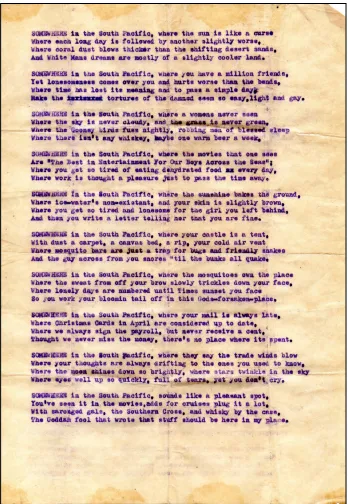
In early 2012, I came across a poem, typewritten on two crumbling sheets of
onionskin paper and sitting on top of a pile of things in an old WWII army trunk in my
grandfather had passed away a few months earlier and never spoke of his time in the
army. We knew only that he served in the South Pacific during WWII and had spent part
of his time at camp doing clerical work. The poem made me cry, and I read it over and
over again. I closed my eyes and imagined him hunched over a typewriter in the
cramped tent that functioned as the field office. I imagine that the words are his own: art
created out of the mixture of anger and exhaustion and hurt and love and betrayal and
desperation that must be war. The jaded tone of the poem speaks volumes about the
morale of our soldiers, and it touched me in ways I still cannot describe. Fragments of
that poem found their way into the piece, and the role of the Soldier began to take shape.
Farther down into the trunk, but not touched until a year after my grandmother’s
death in 2014, were bundles of love letters wrapped in string. It was my grandparents’
wish that no one read their love letters until after they were both gone. I instantly
regretted respecting their wishes. As I began the long and wonderful journey through
their brief, but beautifully endearing and passionate WWII courtship, I had hundreds of
questions whose answers were no longer in this world. I knew that Bubie and Zadie
needed to be a part of the piece, and the love letters were the key. The most difficult part
was choosing one letter out of the hundreds. In the end, I chose a light one from my
Zadie with a funny story and some dreams about the future. Both the poem and the love
letters had to be slightly adjusted for performance in front of a modern-day audience;
some words that were considered the norm in the 1940’s are no longer acceptable today.
The idea was for the original words to make the audience think, not to distract them with
words I had inherited, but a few changes were unavoidably necessary. The essence and
feelings behind the words remained the same.
The last character to become a part of the piece was the present-day Young
Woman. I vacillated for a while on the decision of whether or not to include a part of my
own personal life in the piece. Would it be/ seem too arrogant and self-centered to think
anyone would care or want to hear about my own life when they came to the theatre?
After sharing what has come to be called the Jobs Monologue with several colleagues and
friends, I was finally convinced that this section about my own life needed to be a part of
the piece. In addition to tying in the story of a Young Jewish Woman in 2015 in the
United States with a Young Jewish Woman in 73 in the Middle East, a Young Jewish
Woman in 1941 in Eastern Europe, and a Young Jewish Woman in 1945 in the United
States, it was a light and somewhat humorous break for the audience amidst an otherwise
very heavy and sobering historical piece.
With the text mostly written, I turned my attention to the question of how to keep
the audience informed and clear on where and when each scene was taking place.
Switching back and forth between several different locations and times (and characters)
was a problem I had created for myself, and I knew that I wanted to use projections to
solve it. I got to work designing and creating a series of projections that guided the
audience on their journey, all typewritten to match the style of the original poem found in
Zadie’s army chest. The projections solved another technical problem as well: they
covered the time it took for me to change from one character/ location without an
After many drafts, edits, and re-writes, I faced another seemingly-insurmountable
challenge: designing, memorizing, staging, directing, embodying, breathing, living, and
becoming April 26th. I don’t actually remember too much about this whirlwind period.
It was so intense that there was no time to even think; only to do. There was no room for
stress or anxieties because the piece was every part of my life, and nothing else existed in
the short days leading up to production. Then, suddenly, it was happening. One soldier,
REFLECTION AND THE FUTURE
Once the houselights went down and the sound of a typewriter began clacking in
the dark, a new leg of my journey began. The writer, designer, and director of the play
disappeared, and there was only the actor. The Young Woman giving voice to millions of
Jews throughout history. A simple, tiny peep, but a voice. The beginning of something.
Something important.
As discussed in the Jobs Monologue, I’ve taught Hebrew School and Sunday
School. There is a synagogue in Columbia, SC where I taught from 2008-2009, and a
young Rabbi and I started there at the same time. When I moved back to Columbia in
pursuit of my MFA, my husband and I reconnected with this Rabbi, and he and his wife
came to see a performance of April 26th. After the show, they waited teary-eyed by the
door. They asked if I would perform a slightly modified version of the piece at the
synagogue on Shabbat in a few weeks in honor of Chanukah.
I never could’ve imagined that April 26th. would be remounted so soon. I made
some changes in the script because of both language and content, but mostly the text
remained largely unchanged. In this new version, however, the role of the Soldier was
played by my husband. Having another actor there was a relief for my voice and my
psyche. The fact that the Soldier was played by my real-life husband added a fascinating
The great thing about remounting so quickly was that April 26th. immediately had
a larger scope than the thesis project. I had figured out how to adapt the piece for a
completely different environment with no scrim, no projections, no lights, no sound, and
no real stage. I now have two versions of the script, appropriate for different types of
audiences. If the opportunity to re-mount April 26th presented itself in the future, I
would jump on it. After some time away, I think I could look at the piece with fresh eyes
and make a lot of new discoveries. I’d like to let the piece tell me what it wants to be.
Looking back on the project as a whole, my biggest wish is that I had more time.
During the writing process, the rehearsal process, the performance process…I wish I had
more time during which to explore each and every part of the journey. However, I don’t
mind that the last thing I’m left feeling is hunger. I want more time with the piece. So