Approximation of fixed points for Suzuki’s generalized
non-expansive mappings
Javid Ali1, Faeem Ali1 and Puneet Kumar2
1Department of Mathematics, Aligarh Muslim University, Aligarh- 202002, India 2Department of Mathematics and Statistics, Fiji National University, PO Box
3722, Samabula, Fiji
[email protected], [email protected] and [email protected]
Abstract
In this paper, we study a three step iterative scheme to approximate fixed points of Suzuki’s generalized non-expansive mappings. We establish some weak and strong convergence results for such mappings in uniformly convex Banach spaces. Further, we show numerically that iterative scheme (1.8) converges faster than some other known iterations for Suzuki’s generalized non-expansive mappings. To support our claim, we give an illustrative example and approximate fixed points of such mappings using Matlab program. Our results are new and generalize several relevant results in the literature.
Key Words: Suzuki’s generalized non-expansive mappings; iterative schemes; fixed points; weak and strong convergence results; uniformly convex Banach spaces.
Mathematics Subject Classification: 47H09; 47H10; 54H25
1. Introduction
Throughout this paper, we assume that N is the set of all positive integers. We consider that C is nonempty subset of a Banach space X and F(T), the set of all fixed points of the mapping T on C. A mapping T : C → C is said to be non-expansive if kT x−T yk ≤ kx−yk, for all x, y ∈ C. It is called quasi non-expansive if F(T) 6= ∅ and kT x−pk ≤ kx−pk, for all x ∈ C and for all p∈F(T).
We know that F(T) is nonempty when X is uniformly convex, C is bounded closed convex subset of X and T is non-expansive mapping, (cf. [2]).
In 2008, Suzuki [18] introduced the concept of generalized non-expansive map-pings which is also called condition (C) and defined as:
LetC be a nonempty subset of Banach space X. A mapping T :C →C is said to satisfy condition (C) if,
1
2kx−T xk ≤ kx−yk =⇒ kT x−T yk ≤ kx−yk, ∀x, y ∈C.
Suzuki obtained existence of fixed point and convergence theorems for such map-pings. Suzuki also showed that the notion of mappings satisfying condition (C) is weaker than non-expansiveness and stronger than quasi non-expansiveness.
The following example in support of above claim.
1
Example 1.1. [18] Define a self mapping T on [0,3] by
T(x) =
0, if x6= 3, 1, if x= 3.
HereT satisfies Suzuki’s condition (C), but T is not non-expansive.
On the other hand, Banach contraction principle states that fixed point of con-traction mappings can be approximated by Picard iteration where the sequence
{xn} is generated from an arbitrary guess x1 ∈C as follows:
x=x1 ∈C,
xn+1 =T xn, n∈N.
(1.1)
Unlike contraction mappings, Picard iteration for non-expansive mappings need not converge to a fixed point, even map has a fixed point.
Therefore, in 1953, Mann [3] introduced an iterative scheme, which has been extensively used to approximate fixed points of non-expansive mappings. In this iterative scheme the sequence{xn}is generated from an arbitrary guess x1 ∈C, in the following manner:
x=x1 ∈C,
xn+1= (1−an)xn+anT xn, n∈N,
(1.2)
where {an} is a sequence in (0,1), satisfying appropriate conditions. It is also known that Mann iteration fail to converge to fixed points of pseudo-contractive mappings.
So in 1974, Ishikawa [4] introduced a two step Mann iterative scheme to approx-imate fixed points of pseudo-contractive mappings, where the sequence {xn} is defined by
x=x1 ∈C,
xn+1 = (1−an)xn+anT yn, yn = (1−bn)xn+bnT xn , n∈N,
(1.3)
where {an} and {bn} are sequences in (0,1), satisfying appropriate conditions. Rhoades [5] made an interesting remark on the rate of convergence of these it-eration processes that: Mann itit-eration for decreasing functions converges faster than Ishikawa iteration. For increasing functions Ishikawa iteration process is better than Mann iteration process, also Mann iteration process appears to be independent of the initial guess (see also [6]).
In 2000, Noor [7] introduced the following iterative scheme for general variational inequalities, in this scheme {xn} is defined by
x=x1 ∈C,
xn+1 = (1−an)xn+anT yn, yn = (1−bn)xn+bnT zn,
zn= (1−cn)xn+cnT xn, n∈N,
where {an}, {bn} and {cn} are sequences in (0,1), satisfying satisfactory condi-tions. He also studied the convergence criteria of this scheme. After that, in 2007, Agrawal et al. [8] introduced the following two step iterative scheme for nearly asymptotically non-expansive mappings, in this scheme{xn}is defined as follows:
x=x1 ∈C,
xn+1 = (1−an)T xn+anT yn, yn = (1−bn)xn+bnT xn, n∈N,
(1.5)
where {an} and {bn} are sequences in (0,1), satisfying appropriate conditions. They claimed that, this process converges at a rate same as Picard iteration and faster than Mann iteration for contractions.
In 2014, Abbas and Nazir [1] introduced the following three step iterative scheme for non-expansive mappings in uniformly convex Banach space. The sequence
{xn} starting at initial guess x1 ∈C is defined as:
x=x1 ∈C,
xn+1 = (1−an)T yn+anT zn, yn = (1−bn)T xn+bnT zn, zn= (1−cn)xn+cnT xn, n∈N,
(1.6)
where {an}, {bn} and {cn} are sequences in (0,1). Authors showed that this process converges faster than all of Picard, Mann and Agarwal et al. processes for contractions, by giving a numerical example in support of their claim.
In 2014, Thakur et al. [9] introduced the following iterative scheme for non-expansive mappings, in this scheme the sequence{xn}is defined as:
x=x1 ∈C,
xn+1 = (1−an)T xn+anT yn, yn = (1−bn)zn+bnT zn,
zn= (1−cn)xn+cnT xn, n∈N,
(1.7)
where {an}, {bn} and {cn} are sequences in (0,1). Authors claimed that this process converges faster than all of Picard, Mann, Ishikawa, Noor, Agarwal et al., Abbas and Nazir iteration processes for contractions in the sense of Berinde [21].
Recently, Sahu et al. [10] and Thakur et al. [11] introduced the following same iterative scheme for non-expansive mappings in uniformly convex Banach space:
x=x1 ∈C,
xn+1 = (1−an)T zn+anT yn, yn = (1−bn)zn+bnT zn,
zn= (1−cn)xn+cnT xn, n∈N,
(1.8)
In 2011, Phuengrattana [15] proved convergence theorems for mappings satisfying condition (C) using the Ishikawa iteration in uniformly convex Banach spaces. Recently, fixed point theorems for Suzuki’s generalized non expansive mappings and nonlinear mappings have been studied by a large number of researchers, e.g. see [14,16, 17, 20].
Motivated by the above, we prove some weak and strong convergence results using iterative scheme (1.8) for Suzuki’s generalized non-expansive mappings in uniformly convex Banach space. Our results generalize and extend the corre-sponding results of Sahu et al. [10], Thakur et al. [11] and many others in the literature.
2. Preliminaries
We now recall some definitions, propositions and lemmas to be use in the main results.
Definition 2.1. Let C be a nonempty, closed and convex subset of a Banach space X. A mapping T : C → X is called demiclosed with respect to y ∈ X, if for each sequence {xn} in C and each x ∈ C, {xn} converges weakly at x and
{T xn} converges strongly at y imply that T x=y.
Definition 2.2. A Banach space X is said to satisfy Opial’s property [12] if for each weakly convergent sequence {xn} in X with weak limit x,
lim
n→∞supkxn−xk<nlim→∞supkxn−yk
holds, for all y∈X, with y6=x.
Definition 2.3. Let C be a nonempty, closed and convex subset of a Banach space X and let{xn} be a bounded sequence in X. For x∈X, we set
r(x,{xn}) = lim
n→∞supkxn−xk.
The asymptotic radius of {xn} relative to C is given by r(C,{xn}) = inf{r(x,{xn}) :x∈C}. The asymptotic center of{xn} relative to C is the set
A(C,{xn}) = {x∈C :r(x,{xn}) =r(C,{xn})}.
It is well known that, A(C,{xn}) consists exactly one point, in the case whenX is uniformly convex Banach space.
Proposition 2.4. [18] Let C be a nonempty subset of a Banach space X and
T :C →C be a mapping.
(i) If T is non-expansive then T satisfies the condition (C).
(ii) If T satisfies condition (C) and has a fixed point, then T is quasi non-expansive mapping.
(iii) If T satisfies condition (C), then
Lemma 2.5. [18]LetT be a self mapping on a subsetC of a Banach spaceX with the Opial’s property. Assume that T satisfies condition (C). If {xn} converges
weakly to z and lim
n→∞kxn−T xnk= 0, then T z=z. That is, I−T is demiclosed
at zero.
Lemma 2.6. [18]Let C be a weakly compact convex subset of a uniformly convex Banach spaceX andT be a self mapping onC. Assume thatT satisfies condition
(C), then T has a fixed point.
Lemma 2.7. [19] Suppose X is uniformly convex Banach space and 0 < p ≤
tn ≤ q < 1 for all n ≥ 1. Let {xn} and {yn} be two sequences in X such that lim
n→∞supkxnk ≤d, nlim→∞supkynk ≤d and nlim→∞supktnxn+ (1−tn)ynk=d holds,
for some d≥0. Then lim
n→∞kxn−ynk= 0.
3. Main Results
In this section, we prove some weak and strong convergence theorems using iterative scheme (1.8) for Suzuki’s generalized non-expansive mappings in uni-formly convex Banach spaces. First, we obtain following useful lemmas to be use in our main results:
Lemma 3.1. LetC be a nonempty, closed and convex subset of a uniformly con-vex Banach space X and let T :C →C be a Suzuki’s generalized non-expansive mapping withF(T)6=∅andp∈F(T). Let{xn}be a sequence defined by iterative
scheme (1.8), then lim
n→∞kxn−pk exists for all p∈F(T).
Proof. Let p ∈ F(T) and z ∈ C. Since T satisfies condition (C), therefore by Proposition2.4,T is quasi non-expansive mapping. That is,
kT x−pk ≤ kx−pk, f or all x∈C and f or all p∈F(T). Now from iterative scheme (1.8), we get
kzn−pk = k(1−cn)xn+cnT xn−pk
≤ (1−cn)kxn−pk+cnkT xn−pk
≤ (1−cn)kxn−pk+cnkxn−pk
= kxn−pk. (3.1)
And
kyn−pk = k(1−bn)zn+bnT zn−pk
≤ (1−bn)kzn−pk+bnkT zn−pk
≤ (1−bn)kzn−pk+bnkzn−pk
= kzn−pk
Using (3.1) and (3.2), we have
kxn+1−pk = k(1−an)T zn+anT yn−pk
≤ (1−an)kT zn−pk+ankT yn−pk ≤ (1−an)kxn−pk+ankxn−pk
= kxn−pk. (3.3)
=⇒ The sequence {kxn − pk} is non-increasing and bounded below for all p∈F(T). Hence, lim
n→∞kxn−pk exists.
Lemma 3.2. Let C be a nonempty, closed and convex subset of a uniformly convex Banach space X and let T : C → C be a Suzuki’s generalized non-expansive mapping. Let {xn} be a sequence defined by iterative scheme (1.8).
Then F(T)6=∅ if and only if {xn} is bounded and lim
n→∞kxn−T xnk= 0.
Proof. Suppose F(T)6=∅ and let p∈F(T). Then by Lemma 3.1, lim
n→∞kxn−pk
exists and{xn} is bounded. Put lim
n→∞kxn−pk=α. (3.4)
From (3.1), (3.2) and (3.4), we have
lim
n→∞supkzn−pk ≤nlim→∞supkxn−pk ≤α. (3.5)
lim
n→∞supkyn−pk ≤nlim→∞supkxn−pk ≤α. (3.6)
Since T satisfies condition (C), we have
kT xn−pk=kT xn−T pk ≤ kxn−pk
=⇒ lim
n→∞supkT xn−pk ≤ nlim→∞supkxn−pk ≤α. (3.7)
Similarly,
lim
n→∞supkT yn−pk ≤nlim→∞supkyn−pk ≤α. (3.8)
lim
n→∞supkT zn−pk ≤nlim→∞supkzn−pk ≤α. (3.9)
Again,
α = lim
n→∞kxn+1−pk= limn→∞k(1−an)T zn+anT yn−pk
= lim
n→∞k(1−an)(T zn−p) +an(T yn−p)k. (3.10)
From (3.8), (3.9), (3.10) and using Lemma2.7, we have
lim
n→∞kT zn−T ynk= 0. (3.11)
Now,
kxn+1−pk=k(1−an)T zn+anT yn−pk ≤ kT zn−pk+ankT yn−T znk. Taking the lim inf on both sides, we get
α = lim
n→∞infkxn+1−pk ≤nlim→∞infkT zn−pk
=⇒ α ≤ lim
So that, (3.5) and (3.12) give,
lim
n→∞kzn−pk=α.
Thus,
α = lim
n→∞kzn−pk= limn→∞k(1−cn)xn+cnT xn−pk
= lim
n→∞k(1−cn)(xn−p) +cn(T xn−p)k. (3.13)
From (3.4), (3.7), (3.13) and using Lemma2.7, we have
lim
n→∞kxn−T xnk= 0.
Conversely, assume that {xn} is bounded and lim
n→∞kxn−T xnk = 0. Let p ∈
A(C,{xn}), by Proposition2.4, we have r(T p,{xn}) = lim
n→∞supkxn−T pk
≤ lim
n→∞sup(3kT xn−xn)k+kxn−pk)
= lim
n→∞supkxn−pk
= r(p,{xn}) = r(C,{xn}).
=⇒ T p ∈ A(C,{xn}). Since X is uniformly convex, A(C,{xn}) is singleton, hence we have T p=p. This completes the proof.
Theorem 3.3. LetC be a nonempty, closed and convex subset of a uniformly con-vex Banach space X and let T :C →C be a Suzuki’s generalized non-expansive mapping with F(T)6=∅ and p∈ F(T). Let {xn} be a sequence defined by
itera-tive scheme (1.8). Assume thatX satisfies Opial’s condition, then{xn}converges
weakly to a point of F(T). Proof. Let p ∈ F(T), then lim
n→∞kxn−pk exists by Lemma 3.1. Now we prove
that {xn} has unique weak sub-sequential limit in F(T). Let x and y be weak limits of the subsequences {xnj} and {xnk} of {xn} respectively. From Lemma
3.2, lim
n→∞kxn−T xnk = 0 and I−T is demiclosed at zero by Lemma 2.5. This
implies that (I−T)x= 0 =⇒ x=T x, similarlyT y =y.
Next we show that uniqueness. If x6=y, then by using Opial’s condition, lim
n→∞kxn−xk = nlimj→∞
kxnj−xk
< lim
nj→∞kxnj−yk
= lim
n→∞kxn−yk
= lim nk→∞
kxnk−yk
< lim
nk→∞kxnk−xk
= lim
n→∞kxn−xk.
This is a contradiction, sox=y. Consequently,{xn}converges weakly to a point
Theorem 3.4. LetC be a nonempty, closed and convex subset of a uniformly con-vex Banach space X and let T :C →C be a Suzuki’s generalized non-expansive mapping. Let {xn} be a sequence defined by iterative scheme (1.8). Suppose F(T) 6= ∅ and p ∈ F(T). Then {xn} converges to a point of F(T) if and only
if lim
n→∞infd(xn, F(T)) = 0 or nlim→∞supd(xn, F(T)) = 0, where d(xn, F(T)) =
inf{kxn−pk:p∈F(T)}.
Proof. Necessity is obvious. Conversely, assume that lim
n→∞infd(xn, F(T)) = 0 and p ∈ F(T). From Lemma
3.1, lim
n→∞kxn−pk exists, for all p ∈ F(T) therefore limn→∞d(xn, F(T)) = 0 by
as-sumption. We show that{xn}is a Cauchy sequence in C. As lim
n→∞d(xn, F(T)) =
0, for given >0, there exists m0 ∈N such that for all n≥m0, d(xn, F(T)) <
2
=⇒ inf{kxn−pk:p∈F(T)} < 2. In particular, inf{kxm0 −pk : p ∈ F(T)} <
2. Therefore there exists p ∈ F(T) such that
kxm0 −pk<
2. Now for m, n≥m0,
kxn+m−xnk ≤ kxn+m−pk+kxn−pk ≤ kxm0 −pk+kxm0 −pk
= 2kxm0 −pk< .
=⇒ {xn}is a Cauchy sequence inC. AsCis closed subset of a Banach spaceX, so that there exists a pointq∈C such that lim
n→∞xn =q. Now limn→∞d(xn, F(T)) =
0 gives thatd(q, F(T)) = 0 =⇒ q∈F(T).
Theorem 3.5. Let C be a nonempty, compact and convex subset of a uniformly convex Banach spaceX, and letT and{xn}be as in Lemma3.2, then the sequence
{xn} converges strongly to a fixed point of T.
Proof. By Lemma2.6,F(T)6=∅, so by Lemma3.2, we have lim
n→∞kT xn−xnk= 0.
Since C is compact, there exists a subsequence{xnj} of {xn} such that xnj → p
strongly for some p∈C. By Proposition 2.4, we have
kxnj−T pk ≤3kT xnj −xnjk+kxnj −pk, ∀ n≥1.
Letting j → ∞, we get that xnj →T p. This implies that T p=p i.e. p∈F(T).
Also, lim
n→∞kxn−pkexists by Lemma3.1. Thuspis the strong limit of the sequence
{xn} itself.
p∈F(T)}.
Now we also prove a strong convergence result using condition (I).
Theorem 3.6. LetC be a nonempty, closed and convex subset of a uniformly con-vex Banach space X and let T :C →C be a Suzuki’s generalized non-expansive mapping satisfying condition (I). Let {xn} be a sequence defined by iterative
scheme (1.8), where{an}, {bn} and{cn} are real sequences in[,1−], for≤ 12
and for all n ≥ 1. Suppose F(T) 6= ∅, then {xn} converges strongly to a fixed
point of T.
Proof. We proved in Lemma 3.2 that
lim
n→∞kxn−T xnk= 0. (3.14)
From condition (I) and (3.14), we get
0≤ lim
n→∞f(d(xn, F(T))) ≤ nlim→∞kxn−T xnk= 0
=⇒ lim
n→∞f(d(xn, F(T))) = 0.
Since f : [0,∞)→[0,∞) is a nondecreasing function satisfying f(0) = 0, f(r)> 0,∀ r >0, hence we have
lim
n→∞(d(xn, F(T))) = 0.
Now all the conditions of Theorem 3.4 are satisfied, therefore by its conclusion
{xn} converges strongly to a fixed point of T.
Remark 3.7. All the results in this paper generalize the corresponding results of Sahu et al. [10], Thakur et al. [11] and many others due to following reason: (1) Mappings are generalized non-expansive.
Now we give the following example for comparison of above iteration process with proposed algorithm for Suzuki’s generalized non-expansive mapping.
Example 3.8. Define a self mapping T on [1,2] by
T(x) =
3−x, if x ∈[1,109), x+16
9 , if x∈[ 10
9,2].
HereT is Suzuki’s generalized non-expansive mapping, butT is not non-expansive.
Verification. Takex= 111100 and y= 109, then
kx−yk=k111
100 − 10
9 k= 1 900. And.
kT x−T yk = k3− 111
100 − 154
81 k
= 91 8100 >
1
900 =kx−yk. Hence T is not non-expansive mapping.
Here following cases arise:
Case I.If either x, y ∈ [1,109 ) or x, y ∈ [109 ,2]. Then in both the cases T is non-expansive mapping and hence T is Suzuki’s generalized non-expansive mapping.
Case II.Letx∈[1,109). Then 12kx−T xk= 12kx−(3−x)k= 12k2x−3k ∈(187 ,12]. For 12kx−T xk ≤ 1
2kx−yk, we must have 2x−3
2 ≤x−y =⇒ y ≥ 3
2 and hence y∈[32,2]. We have,
kT x−T yk=ky+ 16
9 −3 +xk=k
y+ 9x−11 9 k<
1 9. And.
kx−yk=|x−y|>|10
9 − 3 2|=|
20−27 18 |=
7 18 >
1 9. Hence 12kx−T xk ≤ kx−yk =⇒ kT x−T yk ≤ kx−yk.
Case III.Letx∈[109 ,2]. Then 21kx−T xk= 12kx+16
9 −xk=k 16−8x
18 k ∈[0, 64 162]. For 1
2kx−T xk ≤ 1
2kx−yk, we must have 16−8x
18 ≤ |x−y|, which gives two possibilities:
(a) Let x < y, then 1618−8x ≤y−x, i.e. 10x+1618 ≤y =⇒ y∈[244162,2]⊂[109,2]. So
kT x−T yk=kx+ 16
9 −
y+ 16 9 k=
1
9kx−yk ≤ kx−yk. Hence 12kx−T xk ≤ kx−yk =⇒ kT x−T yk ≤ kx−yk.
(b) Letx > y, then 1618−8x ≤x−y, i.e. y ≤ 26x−16
18 =⇒ y≤ 116
162 and y≤2 =⇒ y∈ [1,2]. Since y ∈[1,2] and y ≤ 26x−16
18 =⇒
18y+16
26 ≤x =⇒ x∈ [ 34 26,2]. Since x∈[3426,2] andy∈[109 ,2] is already included in Case I. Therefore consider, x∈[3426,2] andy ∈[1,109). Then
kT x−T yk=kx+ 16
9 −3 +yk=k
x+ 9y−11 9 k<
1 9. And.
kx−yk=|x−y|>|34
6 − 10
9 |=|
306−260 234 |=
46 234 >
1 9. Hence 12kx−T xk ≤ kx−yk =⇒ kT x−T yk ≤ kx−yk.
ThusT is Suzuki’s generalized non-expansive mapping.
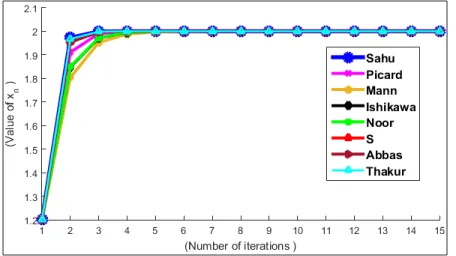
Now for this Example, we construct the following comparison table and graph for various iterations with control sequencesan= 0.85, bn = 0.65, cn = 0.45 and initial guess x1 = 1.2 with the help of Matlab program 2015a.
Item Picard Mann Ishikawa Noor Agarwal Abbas Thakur Sahu, Thakur 1 1.200000 1.200000 1.200000 1.200000 1.200000 1.200000 1.200000 1.200000 2 1.911111 1.804444 1.848099 1.850281 1.954765 1.953570 1.967526 1.972859 3 1.990123 1.952198 1.971158 1.971980 1.997442 1.997305 1.998682 1.999079 4 1.998903 1.988315 1.994523 1.994756 1.999855 1.999844 1.999946 1.999969 5 1.999878 1.997144 1.998960 1.999019 1.999992 1.999991 1.999998 1.999999 6 1.999986 1.999302 1.999803 1.999816 2.000000 1.999999 2.000000 2.000000
7 1.999998 1.999829 1.999963 1.999966 2.000000 2.000000 2.000000 2.000000 8 2.000000 1.999958 1.999993 1.999994 2.000000 2.000000 2.000000 2.000000 9 2.000000 1.999990 1.999999 1.999999 2.000000 2.000000 2.000000 2.000000 10 2.000000 1.999998 2.000000 2.000000 2.000000 2.000000 2.000000 2.000000 11 2.000000 1.999999 2.000000 2.000000 2.000000 2.000000 2.000000 2.000000 12 2.000000 2.000000 2.000000 2.000000 2.000000 2.000000 2.000000 2.000000
Table 1. A comparison table of iterative schemes.
Figure 1. Convergence behavior of Sahu iterative scheme with
other iterative schemes.
Author Contributions: All authors contributed equally and significantly in writing this paper. All authors read and approved the final manuscript.
Funding: This research received no external funding.
Conflicts of Interest: The authors declare no conflict of interest.
Acknowledgment: The second author is grateful to Council of Scientific and Industrial Research (CSIR), India, for providing the Senior Research Fellowship under the grant (09/112(0536)/2016-EMR-I).
References
[1] M. Abbas and T. Nazir, A new faster iteration process applied to constrained minimization and feasibility problems, Mat. Vesn. 66 (2) (2014), 223-234.
[3] W. R. Mann, Mean value methods in iteration, Proc. Amer. Math. Soc. 4 (1953), 506-510. [4] S. Ishikawa, Fixed points by a new iteration method, proc. Amer. Math. Soc. 44 (1974),
147-150.
[5] B. Rhoades, Some fixed point iteration procedures, Int. J. Math. Math. Sci. 14 (1) (1991), 1-16.
[6] B. Rhoades, Some fixed point iterations using infinite matrices, III, Fixed Points, Algo-rithms and Applications, Academic Press Inc. (1977), 337-347.
[7] M. A. Noor, New approximation schemes for general variational inequalities, J. Math. Anal. Appl. 251 (1) (2000), 217-229.
[8] R. P. Agrawal, D. O’Regan and D. R. Sahu, Iterative construction of fixed points of nearly asymptotically non-expansive mappings, J. Nonlinear Convex Anal. 8 (1) (2007), 61-79. [9] D. Thakur, B. S. Thakur and M. Postolache, New iteration scheme for numerical reckoning
fixed points of non-expansive mappings, J. Inequal. Appl. 328 (2014).
[10] V. K. sahu, H. K. Pathak and R. Tiwari, Convergence theorems for new iteration scheme and comparison results, Aligarh Bull. Math. 35 (1-2) (2016), 19-42.
[11] B. S. Thakur, D. Thakur and M. Postolache, New iteration scheme for approximating fixed point of non-expansive mappings, Filomat 30 (10) (2016), 2711-2720.
[12] Z. Opial, Weak convergence of the sequence of successive approximations for non-expansive mappings, Bull. Amer. Math. Soc. 73 (1967), 595-597.
[13] H. F. Senter and W. G. Dotson, Approximating fixed points of non-expansive mappings, Proc. Amer. Math. Soc. 44 (2) (1974), 375-380.
[14] W. Kassab and T. Turcanu, Numerical reckoning fixed points of (ρE)-type mappings in modular vector spaces, Mathematics 7 (2019), 390.
[15] W. Phuengrattana, Approximating fixed points of Suzuki’s generalized non-expansive map-pings, Nonlinear Anal. Hybrid Syst. 5 (3) (2011), 583-590.
[16] S. Dhomphongsa, W. Inthakon and A. Kaewkhao, Edelstein’s method and fixed point theorems for some generalized non-expansive mappings, J. Math. Anal. Appl. 350 (1) (2009), 12-17.
[17] J. Garcia-Falset, E. Llorens-Fuster and T. Suzuki, Fixed point theory for a class of gener-alized non-expansive mappings, J. Math. Anal. Appl. 375 (1) (2011), 185-195.
[18] T. Suzuki, Fixed point theorems and convergence theorems for some generalized non-expansive mappings, J. Math. Anal. Appl. 340 (2) (2008), 1088-1095.
[19] J. Schu, Weak and strong convergence to fixed points of asymptotically non-expansive mappings, Bull. Aust. Math. Soc. 43 (1) (1991), 153-159.
[20] Izhar Uddin, M. Imdad and Javid Ali, Convergence theorems for a hybrid pair of gen-eralized non-expansive mappings in Banach spaces, Bull. Malay. Math. Sci. 38 (2015), 695-705.