IJEDR1504023
International Journal of Engineering Development and Research (www.ijedr.org)144
Design and Analysis of Honey Comb Structures with
Different Cases
1Shaik.Nazeer 2Shaik Allabakshu 1Post Graduate Student 2Assistant Professor
Dept. of Aerospace Engineering, Nimra Institute of Science & Technology,Vijayawada-521456
________________________________________________________________________________________________________
Abstract - Honeycomb structures are natural or man-made structures that have the geometry of a honeycomb to allow the
minimization of the amount of used material to reach minimal weight and minimal material cost. Types of honeycomb structures are depend upon the geometrical shape. There are different types of honeycomb core structures like square, hexagonal, pentagonal, tetrahedral, pyramidal etc. In this project we are comparing the structural analysis for square and hexagonal honeycomb structures and thermal analysis of square and hexagonal honeycomb structures. Structural analysis is the determination of the effects of loads on physical structure. To perform an accurate analysis an engineer must determine such information as structural loads, geometry, support conditions, and materials properties. The results of such an analysis typically include deformation, stresses and displacements. This information is then compared to criteria that indicate the conditions of failure. Thermal analysis calculates the temperature distribution and related thermal quantities in the system or component. Typical thermal quantities of interest are: The temperature distributions:(a) The time to reach steady state,(b) The steady state temperature distribution (using a transient analysis),(c) The temperature distribution after 50 seconds;The amount of heat lost or gained; Thermal gradients; Thermal fluxes.
Key words - CATIA modelling of the product, static analysis, Structural Analysis, Thermal analysis, strength
________________________________________________________________________________________________________
Nomenclature -
1. CATIA Computer Aided Three-dimensional Interactive Application 2. DOF Degree of freedom
3. UDL Uniform Distributed Load 4. ANSYS Analysis of Systems
I.INRODUCTION
What is a honeycomb structure?
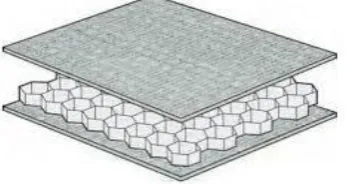
Honeycomb structures are natural or man-made structures that have the geometry of a honeycomb to allow the minimization of the amount of used material to reach minimal weight and minimal material cost. The geometry of honeycomb structures can vary widely but the common feature of all such structures is an array of hollow cells formed between thin vertical walls. The cells are often columnar and hexagonal in shape. A honeycomb shaped structure provides a material with minimal density and relative high out-of-plane compression properties and out-of-plane shear properties.
Fig 1 Honeycomb structure
Man-made honeycomb structural materials are commonly made by layering a honeycomb material between two thin layers that provide strength in tension. This forms a plate-like assembly. Honeycomb materials are widely used where flat or slightly curved surfaces are needed and their high strength is valuable. They are widely used in the aerospace industry for this reason, and honeycomb materials in aluminium, fibreglass and advanced composite materials have been featured in aircraft and rockets since the 1950s. They can also be found in many other fields, from packaging materials in the form of paper-based honeycomb cardboard, to sporting goods like skis and snowboards.
IJEDR1504023
International Journal of Engineering Development and Research (www.ijedr.org)145
Honeycomb compositesNatural honeycomb structures occur in many different environments, from beehives to honeycomb weathering in rocks. Based on these, man-made honeycomb structures have been built with similar geometry to allow the reduction of the quantity of material used, and thereby realizing minimal weight and material cost.
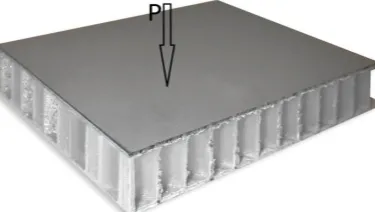
Fig 2 Honeycomb structure with panels
Man-made honeycomb structures have an array of hollow cells formed between thin vertical walls, so that the material has minimal density, strength in tension and high out-of-plane compression properties.
Geometric types of honeycomb structures
In geometry, a honeycomb is a space filling or close packing of polyhedral or higher-dimensional cells, so that there are no gaps. It is an example of the more general mathematical tiling or tessellation in any number of dimensions.
Honeycombs are usually constructed in ordinary Euclidean ("flat") space. They may also be constructed in non-Euclidean spaces, such as hyperbolic honeycombs. Any finite uniform polytope can be projected to its circumsphere to form a uniform honeycomb in spherical space.
II.EXPERIMENTAL DETAILS
A. Design Methodology
First level or preliminary analysis of design uses tools that have to be simple to design the Hexagonal cell structure and then extrude. After that Assembly of group of Hexagonal cells will be generated for some cases for analysis
Second level is level of design of panel of the rectangle .Computer codes are based on finite difference methods or finite element methods, with 1D, 2D or 3D models of physical phenomena (internal ballistics, fluid dynamics, continuum mechanics structural analysis). They allow precise calculations, or optimization up to defining final geometry.
B. Problem Definition
To perform an accurate analysis an engineer must determine such information as structural loads, geometry, support conditions, and materials properties. The results of such an analysis typically include deformation, stresses and displacements. This information is then compared to criteria that indicate the conditions of failure.
C. Material Selection
On the key design of the structure we are analyzed with different type of material like Aluminum, Titanium and have an clear over view on all categories and make an clear results
Type of material Deflection values(meters) CASE-1
Apply pressure on one side by keeping other side DOF as zero
Aluminum 0.118E-05
Titanium 0.730E-06
CASE-2
Cantilever beam with point load
Aluminum 1.701
Titanium 1.044
CASE-3
Cantilever beam with uniformly distributing load
Aluminum 27.468
Titanium 16.853
CASE-4
Fixed beam with point load
Aluminum 0.216734
Titanium 0.148801
D. Phases of design
IJEDR1504023
International Journal of Engineering Development and Research (www.ijedr.org)146
Aerospace: The Boeing Company used CATIA V3 to develop its 777 airliner and used CATIA V5 for the 787 series aircraft. They have employed the full range of DassaultSystem’s' 3D PLM products — CATIA, DELMIA, and ENOVIA LCA — supplemented by Boeing-developed applications. The development of the Indian Light Combat Aircraft has been using CATIA V5.
Chinese Xian JH-7A was the first aircraft developed by CATIA V5 when the design was completed on September 26, 2000.
European aerospace giant Airbus has been using CATIA since 2001.
Canadian aircraft maker Bombardier Aerospace has done all of its aircraft design on CATIA. The Brazilian aircraft company EMBRAER uses Catia V4 and V5 to build all airplanes. Vought Aircraft Industries uses CATIA V4 and V5 to produce its parts.
The Anglo/Italian Helicopter Company Augusta Westland uses CATIA V4 and V5 to design their full range of aircraft. The Eurofighter Typhoon has been designed using both CATIA V4 and V5.
The main supplier of helicopters to the U.S Military forces, Sikorsky Aircraft Corp., uses CATIA as well. Bell Helicopter, the creator of the Bell Boeing V-22 Osprey, has used CATIA V4, V5, and now V6. III.MODELLING
Here we are used the Catia software to have a three-dimensional overview and make the use of some types of features representation of a person or thing or of a proposed structure, typically on a smaller scale than the
Modelling in the Catia Software
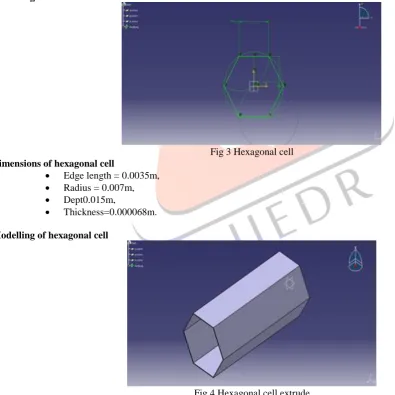
Fig 3 Hexagonal cell
Dimensions of hexagonal cell
Edge length = 0.0035m, Radius = 0.007m, Dept0.015m,
Thickness=0.000068m.
Modelling of hexagonal cell
IJEDR1504023
International Journal of Engineering Development and Research (www.ijedr.org)147
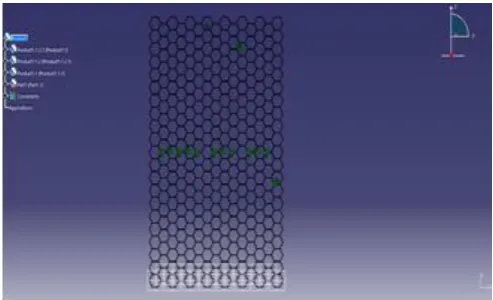
Assembly of Hexagonal cellsFig 5 Assembly of hexagonal cell Modelling of panel
Fig 6 Rectangle plate Dimensions of panel
Length= 0.085m Width = 0.115m Thickness= 0.0007m
Here above we have designed the different phases and shapes of the honey comb for our analysis of the four different cases for a better case and we analyze these structures in the software called Ansys as structural, thermal and strength as follows
E. Ansys Analysis
ANSYS is engineering simulation software (computer-aided engineering, or CAE). The company was founded in 1970 by Dr. John A. Swanson as Swanson Analysis Systems, Inc. SASI. Its primary purpose was to develop and market finite element analysis software for structural physics that could simulate static (stationary), dynamic (moving) and thermal (heat transfer) problems.
ANSYS is a general-purpose finite-element modelling package for numerically solving a wide variety of mechanical problems. These problems include static/dynamic, structural analysis (both linear and nonlinear), heat transfer, and fluid problems, as well as acoustic and electromagnetic problems.
In general, a finite-element solution may be broken into the following three stages. (1) Pre-processing: defining the problem
The major steps in pre-processing are (i) Define key points/lines/areas/volumes, (ii) Define element type and material/geometric properties, and (iii) mesh lines/areas/ volumes as required. The amount of detail required will depend on the dimensionality of the analysis, i.e., 1D, 2D, axisymmetric, and 3D.
(2)Solution: assigning loads, constraints, and solving Here, it is necessary to specify the loads (point or pressure), constraints (translational and rotational), and finally solve the resulting set of equations.
(3) Post processing: further processing and viewing of the results in this stage one may wish to see (i) lists of nodal displacements, (ii) element forces and moments, (iii) deflection plots, and (iv) stress contour diagrams ortemperature maps. Honeycomb structural analysis:
The structural analysis will be done in 4 cases, in every case we consider deformation, stress and strain (Von Mises’s). Also, we are comparing the deflection values between aluminium and titanium.
IJEDR1504023
International Journal of Engineering Development and Research (www.ijedr.org)148
Fig 7 Pressure applying on the panel, by keeping other side DOF as zeroIn case-1, we apply pressure on one side by keeping other side DOF as zero. And as results we have generated the results of deformation of aluminium and titanium, Von misses stresses, strain’s for aluminium and titanium and analysed the stress and strain and strength of the component and make view that which have capable
Here we have step by step process, how to do the structural analysis (for aluminium, titanium)
Fig 8 Deformation for aluminium
Fig 9 Von Misses stress for aluminium
IJEDR1504023
International Journal of Engineering Development and Research (www.ijedr.org)149
Fig 11 Deformation for titaniumFig 12 Von Misses stress for titanium
Fig 13 Von Misses strain for titanium Tabulate the values of deflections, stress and strain for aluminium and titanium.
Table 1
Aluminium Titanium
Deflection (m) 0.118E-05 0.730E-06
Stress (N/m2 ) 0.569E+07 0.569E+07
Strain 0.813E-04 0.500E-04
The results shows that titanium has the less deflection compared to aluminium, even stress and strain values also. CASE-2
Fig 14 Cantilever beam with point load
In case, consider whole structure as cantilever beam. We know that cantilever beam have one fixed end and one free end. We are applying force at free end, in downwards.
The use of the cantilever is in fixed-wing aircraft design, pioneered by Hugo Junkers in 1915. Early aircraft wings typically bore their loads by using two (or more) wings in a biplane configuration braced with wires and struts.
IJEDR1504023
International Journal of Engineering Development and Research (www.ijedr.org)150
Fig 15 Beam deflection (aluminium) with point loadFig 16 Beam deflection (titanium) with point load Deflections for
Aluminium =1.701 Titanium =1.044
Here also, titanium has less deflection. CASE-3
Consider the whole structure as cantilever beam, now apply the load uniformly.
Fig 17 Cantilever beam with UDL Here we have step by step process, how to do the structural analysis (for aluminium)
IJEDR1504023
International Journal of Engineering Development and Research (www.ijedr.org)151
Fig 19 Beam deflection (titanium) with UDLResulting deflection values are Aluminium =27.468 Titanium =16.853
In this case also, titanium has less deflection. Case-4
In this case, consider the structure as fixed beam with point load that means keep right and left sides DOF as zero.
Fig 20 Fixed beam
Here we have step by step process, how to do the structural analysis (for aluminium)
Fig 21 Fixed Beam deflection (aluminium)
Fig 22 Fixed Beam deflection (titanium) Resulting deflection values are
Aluminium =0.216734 Titanium =0.148801
IJEDR1504023
International Journal of Engineering Development and Research (www.ijedr.org)152
Table 2Type of material Deflection values(meters) CASE-1
Apply pressure on one side by keeping other side DOF as zero
Aluminum 0.118E-05
Titanium 0.730E-06
CASE-2
Cantilever beam with point load
Aluminum 1.701
Titanium 1.044
CASE-3
Cantilever beam with uniformly distributing load
Aluminum 27.468
Titanium 16.853
CASE-4
Fixed beam with point load
Aluminum 0.216734
Titanium 0.148801
Thermal analysis:
A thermal analysis calculates the temperature distribution and related thermal quantities in a system or component. Typical thermal quantities of interest are:
The temperature distributions The amount of heat lost or gained Thermal gradients
Thermal fluxes.
Thermal simulations play an important role in the design of many engineering applications, including internal combustion engines, turbines, heat exchangers, piping systems, and electronic components. In many cases, engineers follow a thermal analysis with a stress analysis to calculate thermal stresses (that is, stresses caused by thermal expansions or contractions). Only the ANSYS Multi-physics, ANSYS Mechanical, ANSYS Professional, and ANSYS FLOTRAN programs support thermal analyses. The basis for thermal analysis in ANSYS is a heat balance equation obtained from the principle of conservation of energy. The finite element solution you perform via Mechanical APDL calculates nodal temperatures, and then uses the nodal temperatures to obtain other thermal quantities.
The ANSYS program handles all three primary modes of heat transfer: conduction, convection, and radiation. Convection:-
You specify convection as a surface load on conducting solid elements or shell elements. You specify the convection film coefficient and the bulk fluid temperature at a surface; ANSYS then calculates the appropriate heat transfer across that surface. If the film coefficient depends upon temperature, you specify a table of temperatures along with the corresponding values of fil m coefficient at each temperature.
Transient Thermal Analysis
The ANSYS Multi-physics, ANSYS Mechanical, ANSYS Professional, and ANSYS FLOTRAN products support transient thermal analysis. Transient thermal analysis determines temperatures and other thermal quantities that vary over time. Engineers commonly use temperatures that a transient thermal analysis calculates as input to structural analyses for thermal stress evaluations. Many heat transfer applications - heat treatment problems, nozzles, engine blocks, piping systems, pressure vessels, etc. - involve transient thermal analyses.
A transient thermal analysis follows basically the same procedures as a steady-state thermal analysis. The main difference is that most applied loads in a transient analysis are functions of time, specify time-dependent loads, you can either use the Function tool to define an equation or function describing the curve and then apply the function as a boundary condition, or you can divide the load-versus-time curve into load steps.
Honeycomb thermal analysis
An aluminium honeycomb sandwich structure conducts heat away from its one panel at 100oC and transfers it to a surrounding fluid at 25oC through convection.
The convection heat transfer coefficient is 10 w/ m2.k The copper has a thermal conductivity (k) of 310 W/m.K, a specific heat (Cp) of 910 J/kg K,
a density of 2699 kg/m3. Determine the following: (a) The time to reach steady state
(b) The steady state temperature distribution (using a transient analysis) (c) The temperature distribution after 50 seconds
(d) The animated history of temperature in the fin over time
(e) The steady state heat transfer rate through the base of the fin (using a transient analysis)
(f) The steady state temperature distribution and heat transfer rate through the base using a steady state thermal analysis
IJEDR1504023
International Journal of Engineering Development and Research (www.ijedr.org)153
solution for each time step. For example, ANSYS will determine the temperature distribution at t=10 s based on the initial conditions. Next, ANSYS will determine the temperature distribution at t = 20 s based on the temperature distribution at t=10 s (and so on). Solution accuracy is a function of the size of the time steps as well as characteristics of the mesh.IV.TRANSIENT SOLUTION
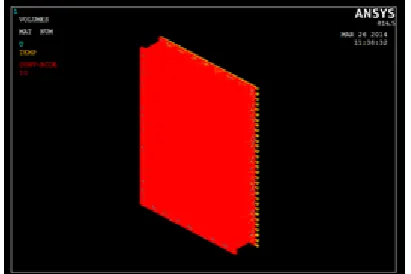
Fig 23 Convection heat flow in panels
Fig 24 Time history post processing for aluminium Table 3
Time 10 20 30 40 50 60 70 80 90
Temperature 87.0285 93.4566 95.3333 95.9841 96.2120 96.2920 96.3201 96.3299 96.3334 General Post Processing:
Fig 25 Aluminium transient solution (t=90sec)
IJEDR1504023
International Journal of Engineering Development and Research (www.ijedr.org)154
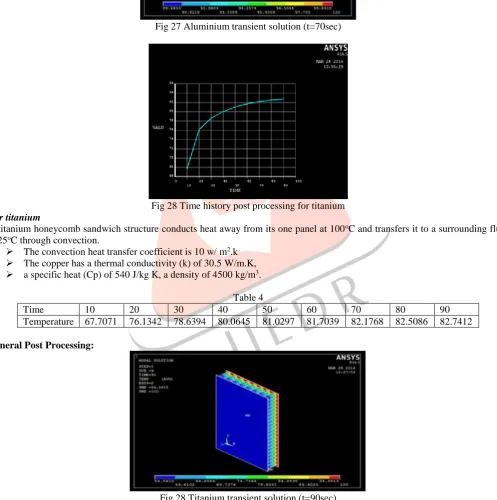
Fig 27 Aluminium transient solution (t=70sec)Fig 28 Time history post processing for titanium For titanium
A titanium honeycomb sandwich structure conducts heat away from its one panel at 100oC and transfers it to a surrounding fluid at 25oC through convection.
The convection heat transfer coefficient is 10 w/ m2.k The copper has a thermal conductivity (k) of 30.5 W/m.K, a specific heat (Cp) of 540 J/kg K, a density of 4500 kg/m3.
Table 4
Time 10 20 30 40 50 60 70 80 90
Temperature 67.7071 76.1342 78.6394 80.0645 81.0297 81.7039 82.1768 82.5086 82.7412 General Post Processing:
IJEDR1504023
International Journal of Engineering Development and Research (www.ijedr.org)155
Fig 29 Titanium transient solution (t=30sec)Fig 30 Titanium transient solution (t=70sec)
Result: from the transient analysis, we can say that titanium is more thermally stable compared to aluminium.
Steady State Solution
The transient solution must converge to the steady state solution. It is important to check the transient solution using a steady state analysis. The steady state model does not rely on the heat capacity, density, or initial conditions.
Fig 31 Aluminium steady state solution
IJEDR1504023
International Journal of Engineering Development and Research (www.ijedr.org)156
Table 5Steady state temperatures(oC)
Aluminium 89.7173
Titanium 57.6615
From the above result, titanium is thermally more stable compared to aluminium V.SCOPE OF THE PROJECT
An engineering design process is a process used by engineers to help develop products. This project has the wide range of scope. The capability of this honeycomb structure is being exploited with new uses and materials being developed regularly. Sheets of honeycomb can be profiled before covering. This tailors its limited flexibility properties and with modern laser cutting technology this technique is in the early days of development.
The aluminium honeycomb for instance is available in different aluminium grades with specific material properties and thus can be applied as required. However, the material used has a significant effect on the price. The possibility of adapting the grades to required output is a tremendous advantage in diverse markets. The trend of its usage in the Formula one is increasing as well as for the aerospace segment for aircraft components.
General Dynamics has announced an external airplane fuel tank design which uses a honeycomb core made of urethane foam-filled aramid and an all composite shell. This all-composite construction delivers the structural stiffness needed for aircraft carrier survivability requirements and will replace the metal honeycomb tanks which came into use following a disastrous fire on the USS Forrestal.
VI.CONCLUSION
From the analysis, we can conclude that titanium is the suitable material, due to its less deflection and high thermal stability. But titanium had more weight compared to aluminum. Also titanium is expensive material.
When we are comparing with other materials except titanium, aluminium has less deflection values. Aluminium is weight less, fewer in cost. This properties are very good turn in aerospace industries. But aircraft industries necessitate a lesser amount of deflection materials. According to this case, titanium is suitable. To a way from this perplexity, we are using composite materials. These materials are compositions of aluminium and titanium, which have less deflection as well as less amount of the weight. As a result honeycomb is a preferred core material that is advantageous because of:
High strength to weight ratio Good compressive strength Lightweight
VII.REFERENCES
[1] http://www.continuummechanics.org/cm/vonmisesstress.html
[2] http://www.facweb.iitkgp.ernet.in/~baidurya/ce21004/online_lecture_notes/m1l1.pdf
[3] http://www.facweb.iitkgp.ernet.in/~baidurya/ce21004/online_lecture_notes/m1l1.pdf
[4] Engineering analysis with ansys software by t.stalroski.
[5] International journal of engineering science & advanced technology volume-2, issue-5, 1402 – 1409 ijesat | sep-oct 2012(thermo structural analysis of honeycomb sandwichpanels by k. kantha rao, k. Jayathirtha rao).
[6] The use of honeycomb sandwich panels in the engineering applications by d n cross.
[7] http://books.google.co.in/books?id=obnsddn84hic&printsec=frontcover&source=gbs_ge_summary_r&cad=0#v=onepag e&q&f=false.