a
Corresponding author: [email protected]
Effect of plasma actuator and splitter plate on drag coefficient of a circular
cylinder
Hürrem Akbyk1,a, Yahya Erkan Akansu2, Hakan Yavuz1,and Ahmet Erturul Bay3
1
Cukurova University, Mechanical Engineering Department, 01380 Adana, Turkey 2Nigde University, Mechanical Engineering Department, 51200 Nide, Turkey
3
Gaziantep University, Electrical and Electronics Engineering Department, 27310 Gaziantep, Turkey
Abstract.In this paper, an experimental study on flow control around a circular cylinder with splitter plate and plasma actuator is investigated. The study is performed in wind tunnel for Reynolds numbers at 4000 and 8000. The wake region of circular cylinder with a splitter plate is analyzed at different angles between 0 and 180 degrees. In this the study, not only plasma actuators are activated but also splitter plate is placed behind the cylinder. A couple electrodes are mounted on circular cylinder at ±90 degrees. Also, flow visualization is achieved by using smoke wire method. Drag coefficient of the circular cylinder with splitter plate and the plasma actuator are obtained for different angles and compared with the plain circular cylinder. While attack angle is 0 degree, drag coefficient is decreased about 20% by using the splitter plate behind the circular cylinder. However, when the plasma actuators are activated, the improvement of the drag reduction is measured to be 50%.
1 Introduction
A circular cylinder has been studied by many researchers due to the fact that it underlies in flow around bluff body. There are many researches reporting on reduction of drag and wake region, vortex strength etc. and increase lift coefficient by using flow control methods.
As a passive flow control method, splitter plate can be used to reduce drag coefficient and vortex strength when it is placed behind the circular cylinder. Apelt et al. reported that they examined splitter plate behind circular cylinder in range of L/D2 at Reynolds numbers between 104 and 5x10⁴. They depicted that using a splitter plate reduces drag and produces narrower wake than that of bare cylinder. This means approximately 31% reduction in drag when L/D=1 [1]. Cimbala and Garg investigated plain circular cylinder, fixed/free rotatable splitter plate behind circular cylinder models in range of L/D=5 at 5x10³<Re<2x10⁴. They reported that wake of free rotatable cylinder/splitter plate model is nearly same with plain cylinder. However, when the splitter plate was fixed at the 0 degree, the splitter plate changed wake. They also compared cylinder/rigid splitter plate with cylinder/free splitter plate in near wake about vortex formation length and Karman vortex street shedding frequency [2]. At 2x10⁴<Re<8x10⁴ Cimbala and Leon exhibited that the change of drag coefficient of plain cylinder, cylinder/rigid splitter plate and cylinder/free splitter plate depending on L/D ratio. The change in drag was observed nearly the same in both splitter plate cases. However,
when the splitter plate length was increased then drag was reduced [3]. Akansu et al. experimented the effect of the circular cylinder with splitter plate from 0 to 180 degree to observe pressure distribution, vortex shedding, drag and lift coefficient at 8x10³<Re<6x10⁴. Drag coefficients were found at maximum and minimum values at 75 and 15 degree, respectively. While lift coefficient was observed to have two maximum values at the 15 and 165 degrees and minimum values were 0, 45, 158 and 180 degree [4].
As an active flow control method, plasma actuators are used to control flow around a circular cylinder on which they are mounted. A typical plasma actuator consists of two electrodes and a dielectric material between of them. One electrode is grounded and another one is connected to the high voltage. In literature, researchers widely used this application to reduce drag coefficient, noise level, wake region and vortex shedding. Thomas et al. mounted plasma actuators on a circular cylinder at ±90º and ±135º degrees for noise reduction and eliminating Karman shedding. They performed experiments at Re=3.3x10⁴ [5]. Sung et al. altered flow separation point and flow field in the wake by using plasma actuators on a circular cylinder. At Re=104 -4x10⁴, six electrode pairs which were activated were placed on ±90º, ±120º and ±150º degrees of circular cylinder. They used forward and reversed electrode configuration to analyze flow around circular cylinder. When the forward electrode configuration was used, wake is reduced, whereas when reverse electrode
DOI: 10.1051/
C
Owned by the authors, published byEDP Sciences, 201 /201
epjconf 61
6
configuration was used, the wake significantly increased [6]. Tabatabaeian et al. demonstrated that the effects of electrodes were different configuration on flow structure around circular cylinder. Electrodes placed on 0 and 180 degree as first configuration. Then, they changed the position of electrodes on the rotating cylinder to different angles. They observed that using electrode changed pressure coefficient distribution, drag and lift coefficient of the flow around the cylinder [7].
In this study, in order to monitor the effects of flow around the circular cylinder, both flow control methods active (plasma actuator) and passive (splitter plate), is used. Force measurements are used to show the changes in drag and lift effects on a circular cylinder at Re=4x10³ and 8x10³. Wake region is also discussed for the experimental model’s angle changed in every 15 degree. Flow visualization is made by using smoke-wire method.
2 Experimental setup
Experiments are conducted on an open loop suction type wind tunnel with a test section of 570x570x1000 mm3. As seen in Figure 1, test model consist of circular cylinder, splitter plate, and plasma actuator. Circular cylinder which has 40 mm diameter and it is made of plexiglass. The length of the model is 400 mm. The splitter plate is also made from plexiglass. Length of splitter plate is 1D and thickness of splitter plate is about 4 mm. In order to produce the plasma one electrode is grounded and the other one is connected to a high voltage. Both electrodes have a width of 5mm. A kapton layer is placed between the two electrodes as a dielectric material. Symmetric electrode pairs are placed on the circular cylinder at ±90º degree angles. Homemade high voltage power supply was used for driving high voltage source. Plasma excitation frequency was set at 3500 Hz. Applied voltage was set at 6.5kV. Blockage ratio of model was 5% in the wind tunnel.
To measure drag and lift forces, ATI model six axis load cell is used. Measurements are taken 400 Hz sampling frequency and 50 values were averaged during 8 second. Therefore, 160 values were taken for each measurement every second and it has been repeated two times. Due to drag and lift forces of circular cylinder, it is examined in 2D: Drag and lift forces of endplates, holder rod, connector between model and holder rod are exiled from total drag and lift forces. In this way, the net drag forces are calculated.
Figure 1. Schematic of the model.
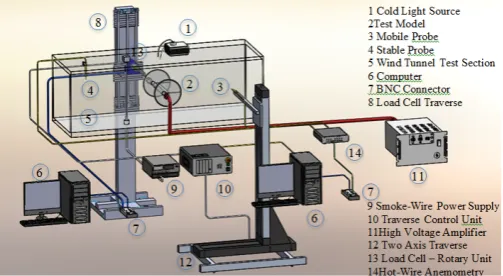
Smoke wire method is used for monitoring the flow around the circular cylinder. Figure 2 show that the experimental setup model, connections of opponents of system and the wind tunnel. Home made two axis traverse system was used for positioning the rotary unit. ISEL rotary unit is used to set the angle of model.
Figure 2. Schematic diagram of the experimental setup.
Multichannel CTA Dantec 54N81 model hot-wire anemometry is used to obtain free stream velocity. A stable hot-wire probe (55P16) is positioned 6D distance from front side of test model.
3
Results
3.1. Force measurement
In Figure 3, the drag coefficient versus attack angle is presented. Induced flow by means of the plasma is in the same direction via stream wise flow direction when the attack angle is between 0 and 90 degree. Thus, flow separation around circular cylinder is delayed by using plasma actuator. Also, the narrower wake region was observed and the reduction in drag was investigated. Induced flow by means of the plasma is reversed according to stream wise depending on the position of the placed electrodes when the attack angle is changed between 90 and 180. Therefore, wake region is widened and the drag coefficient of the circular cylinder is increased.
0 30 60 90 120 150 180
0,0 0,3 0,6 0,9 1,2 1,5 1,8 2,1
2,4 Re = 4000
V= 6.5 kV f = 3.5 kHz
Uoo
θΟ
θ ( o )
CD : with splitter plate
CD : with splitter plate and plasma CD : Plain Cylinder
CD
In Figure 4, there is a very little change in drag coefficient. Because of increasing the effect of the plasma at the high Reynolds numbers, the voltage is needed to be increased [8].
0 30 60 90 120 150 180
0,0 0,3 0,6 0,9 1,2 1,5 1,8 2,1 2,4
Re = 8000 V= 6.5 kV f = 3.5 kHz Uoo
θΟ
θ ( o ) CD : with splitter plate
CD : with splitter plate and plasma
CD : Plain Cylinder
CD
Figure 4. At Re=8000, different attack angle versus drag coefficient of circular cylinder with both plasma actuator and splitter plate.
3.2. Flow visualization
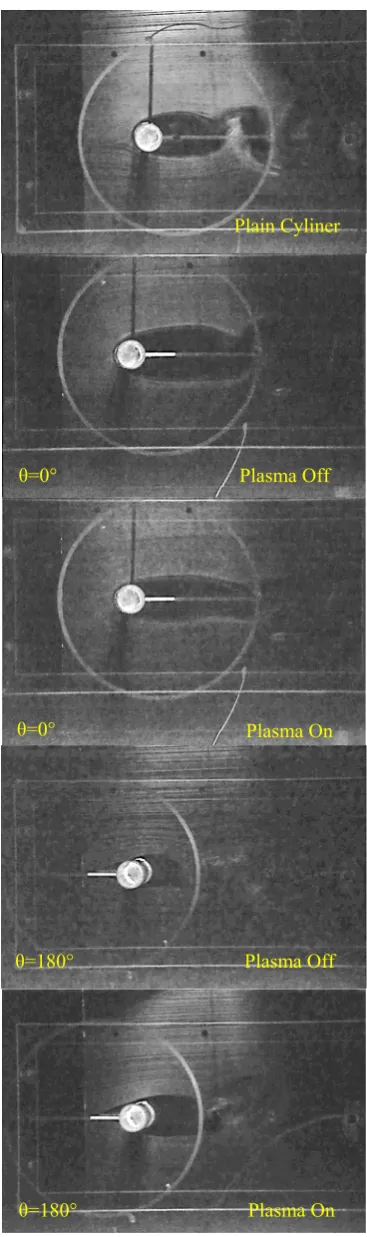
As it can be seen Figure 5, vortexes behind the circular cylinder are occurred regularly when the angle of attack is zero. If a splitter plate is placed behind the circular cylinder, vortex shedding behind the cylinder is occurred at a more far distance and in a smaller size. If both plasma actuators are placed on circular cylinder and splitter plate is used behind the circular cylinder, then both creations of vortexes are eliminated and shrinking of the wake region is observed.
If attack of angle is set to 180 degree, circular cylinder behind the splitter plate has narrower wake region than plain cylinder but vortexes are occurred more near at circular cylinder with splitter plate. When both plasma actuators are placed on circular cylinder and splitter plate is behind the circular cylinder, wake region is occurred that it is expanding. The reason of this is if circular cylinder’s angle is changed, induced flow occurred by plasma actuators effect opposite direction to the flow. But, using plasma actuator, it is observed that it prevents occurrence of the vortex shedding.
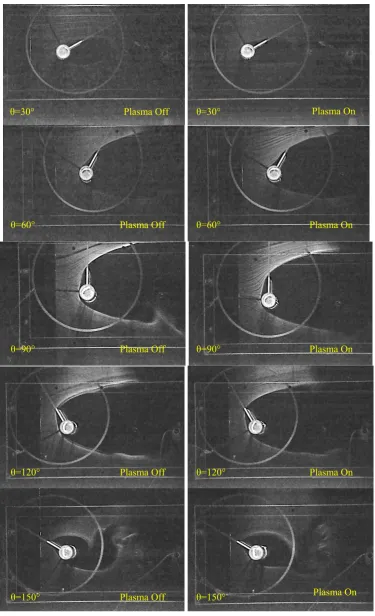
As can be seen in Figure 6, for the angle of attack angle 30, 60, 90, 120, and 150, flow around the circular cylinder is experimented. When the angle of attack is 30 degrees, flow separation from the lower side of the cylinder delayed. Therefore, vortex shedding axis was deviated.
Figure 5. Visualized wake flows with applied flow control methods for V=6.5 kVpp and f=3.5 kHz at Re=4000.
Plain Cyliner
=0° Plasma Off
=0°
=180° Plasma Off
=180° Plasma On
Figure 5. Visualized wake flows with applied flow control methods for V=6.5 kVpp and f=3.5 kHz at Re=4000.
=30° Plasma Off =30° Plasma On
=60° Plasma Off =60° Plasma On
=90° Plasma Off =90° Plasma On
=120° Plasma Off =120° Plasma On
4 Conclusions
The flow around circular cylinder has been investigated experimentally by using both active and passive flow control method. At different angles of , between 0 and 180, the effects of plasma actuator and splitter plate were examined by considering the change of drag coefficient and flow visualization around the circular cylinder. As it can be seen from force measurement, there is a significant change depending on different angle of in drag at Re=4000. For =0, reduction in drag is %27 when the splitter plate was used behind the circular cylinder. But, reduction in drag is %56 when both splitter plate and plasma actuator are used together. Reduction in drag is more significant when both splitter plate and plasma actuator were used together than circular cylinder via splitter plate. For =0, 30, 60, reduction in drag are respectively %40, %36, and %17 when the splitter plate and plasma used together. But the same situation drag was increased %6, %10, %9, and %37 when the angle of was changed as 90, 120, 150, and 180, respectively. Effects of the using plasma actuator and splitter plate together give raise to narrower wake while circular cylinder with plasma actuator and splitter plate at 0 degree angle. But, circular cylinder wake region becomes larger while circular cylinder with splitter plate and plasma actuator at 180 degree angle. By using flow visualization, particularly wake region and vortex shedding are observed.
Acknowledgements
The authors would like to acknowledge the financial support of this work by the Scientific Research Projects (BAP) of the Çukurova University under the ID number of 5026.
Nomenclature
Re Reynolds number attack angle V applied plasma voltage f applied plasma frequency CD drag coefficient
U freestream velocity D diameter of the cylinder L length of the splitter plate
References
1. C.J. Apelt, G.S. West, A.A. Szewczyk, 1973, J. Fluid Mech., 61, 187-198 (1973)
2. J.M. Cimbala, S. Garg , AIAA Journal, 29, 6 (1990)
3. J.M. Cimbala, J. Leon, AIAA Journal, 34, 11 (1996)
4. Y.E. Akansu, M. Sarioglu, T. Yavuz, AIAA Journal, 42, 6 (2004)
5. F.O. Thomas, A. Kozlov, T.C. Corke, AIAA Journal, 46, 8 (2008)
6. Y. Sung, W. Kim, M.G. Mungal, M.A. Cappelli, Exp. Fluids, 41, 479-486 (2006)
7. S. Tabatabaeian, M. Mirzaei, A. Sadighzadeh, V. Damideh, A. Shadaram, Chinese J. of Aeronaut.,
25, 311-324 (2012)