Atomistic
Simulation
for
Rejuvenation
of
Cu-Zr
Metallic
Glasses
by
Strain
Eunsung Jekal
Deparment of materials, ETH Z¨urich, Z¨urich, Switzerland
Abstract: Moleculardynamicssimulations werecarriedout toinvestigatethe atomicstructureofa modelCu64Zr36bulkmetallicglass(BMG).Itisfoundthattheamountoficosahedralcontentofthe
systemissignificantlyincreasedinawellrelaxedstructure.Whileweconsideredfourconnectiontypes ofvertex-,edge-,face-,andvolume-sharing,thehugeclusterintherelaxedsamplesmainlyinvolve volume-typeconnectionandexhibitsaremarkableathermalplasticitythatgreatstiffnessandgreat yield strength compared to the as-quenched samples. Inaddition, the bond-angle distribution of annealedsampleshowssharppeaksatspecificbondangleswhichisanevidenceofcrystallized Laves-phase formed by icosahedral atoms, however the peaks are to be broaden after loading, which indicatesdecreasingamountoficosahedralcontentandtheirshapedistortion.Theseresultssuggest that icosahedral content in a bulk metallic glasses plays a key role to determine the mechanical propertiessuchasrigidityandmaximumstresscarryingcapacity.
Keywords: Bulk metallic glass; molecular dynamic simulation
I. INTRODUCTION
A. Bulk Metallic Glasses
Bulk metallic glasses (BMGs) with a disordered atomic-scale structure exhibit interesting mechanical properties such as extraordinary elastic strain limits and a high tensile yield stress [1–3]. However, their poor ductility is obstructing commercial use of BMGs[4, 5]. To improve it, many efforts are under way, especially in trying to understand the underlying plastic deformation mechanisms in a micro-regime as well as macro-regime. It is generally believed that deformation of amorphous materials such as BMGs depends on emergent processes arising from localized plastic mechanisms. However, how such localized plasticity leads collectively to global fail-ure is still a contemporary topic in the eld of BMGs research[6–8].
B. Current state of BMGs research
Experimentally, structural glasses are produced by the extremely rapid cooling of an under-cooled liquid to avoid formation of long range order and a crystalline phase. As the temperature decreases well below the melting tem-peratures, a glass transition temperature regime is en-tered in which atomic motion is exponentially reduced to produce a “frozen” conguration referred to as an amor-phous solid. It remains an open question as to how liquid-like this solid structure is. When the initial melt con-sists of metallic atoms, the resulting amorphous struc-ture is referred to as a BMG. Sizes of the order of a few centimeters can now be created[1–3]. Unlike crystalline solids, plastic deformation mechanisms of amorphous solids are treated by number of local atomic plasticity mechanisms. Spaepen proposed a free-volume model that
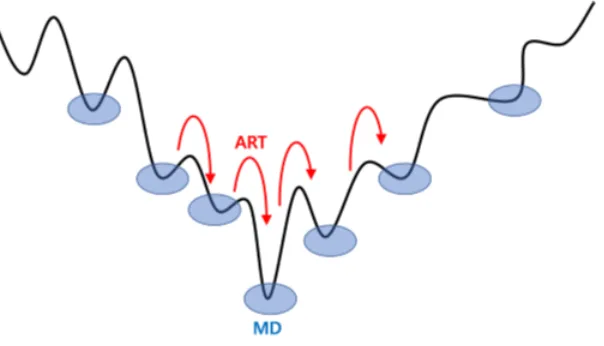
single atoms would migrate to a neighboring free-volume region. Later, Argon suggested that several atoms un-dergo a structural transformation which can modify the local shear stress state [6]. This local plastic process is re-ferred to as a Shear Transformation (ST). In both works of Spaepen and Argon, the proposed local plastic mecha-nism was assumed to be thermally activated. Such a local mechanism has been observed in several atomistic simu-lations which studied high-strain rate plasticity in model glass systems [8–11]. These simulation works have in-spired the development of the shear transformation zone (STZ) theory. Generally, the STZ theory is considered to be an athermal description of plasticity, where an effec-tive temperature characterizes the structural atomic scale inhomogeneities, which control the STZ activity[12–14]. Experimental results have however suggested thermally activated processes can underly the observed plasticity. For example, Prof. Lofer’s group at ETH Zurich experi-mentally demonstrated that both propagation and arrest of shear bands are thermally activated processes. Further experimental and theoretical insight into local micro-scopic plastic processes has been gained within the frame-work of the under-cooled liquid terminology of alpha- and beta-relaxation[15–17]. According to the description of relaxation processes in under-cooled liquids introduced by Goldstein,alpha-processes(megabasin in Fig. 1) are considered to be slow and irreversible reorganizations of the undercooled liquid structure which are mediated by the faster and reversible beta-processes. In the Potential Energy Landscape (PEL) picture developed by Goldstein for the under-cooled liquid regime, such alpha processes represent the traversal from one deep potential energy valley (referred to as a mega-basin) to another, whereas the beta process represent the traversal between shal-low potential energy valleys that overlay the mega-basin structure. Within this context, the slower alpha pro-cesses represent the collective effect of many faster beta processes. It is however generally believed that as the temperature passes the glass transition regime, the al-pha processes freeze out to be replaced by a new irre-versible mechanism which mediates plasticity at
2
atures well below the glass transition [18].
Over the past few years experimental investigations of BMGs using mechanical spectroscopy methods have become popular. Mechanical spectroscopy is a method which probes relaxation time-scales via the measurement of the frequency dependent storage and loss modulus — probing respectively the elastic and plastic response of the material. Interestingly, such works reveal that either a low temperature tail or a secondary peak in the relax-ation modulus exist, both of which have been interpreted as evidence for beta-like relaxation. For example, Fig. 2 shows the temperatureT-dependent loss modulus E” of the three MG systems.
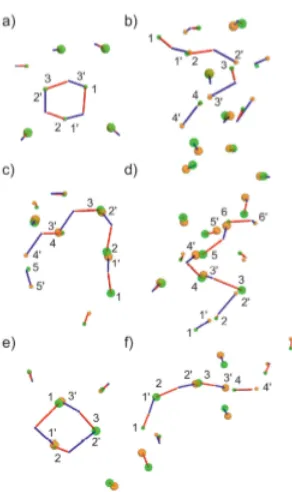
In Fig. 2, besides the usual α-relaxation around Tg, a pronounced E” peak is observed in the temperature range 0.60-0.80Tg, corresponding to theβ-relaxation in the deep glassy state of Ref. [19], it was hypothesized that the smaller atoms are mainly involved in beta re-laxation, whilst collective structural transformations in-volving the larger atoms were assumed to be necessar-ily less localized, and those responsible for the primary loss modulus peak (the alpha processes), and therefore macroscopic plasticity. Using the Activation Relaxation Technique nouveau (ARTn) method, Ref. [[20, 21],] in-vestigated the atomic structure of the local structural ex-citations (LSEs) in model glass with Lennard-Jones (LJ) potential. The ARTn method is a PEL exploration al-gorithm which identies transitions between nearby meta-stable structural states, and has been used in the past to investigate structural transitions in glasses. Inspec-tion of the atomic displacement vector between the two considered meta-stable states, reveals the corresponding structural transformation to be localized, involving only a few atoms, and hence the terminology of the LSE. This work found that the smaller and more weakly bonded atoms are dominantly involved in LSEs, which often oc-curred near regions of excess free volume. Furthermore, the LSEs (in terms of atomic displacement) were string-like mainly involving less than six atoms, each with a displacement generally comparable to the bond length shown in Fig. 3.
Such string-like local structural excitations have also been observed in the under-cooled liquid regimeas the temperature approaches(from above) the glass transi-tion regime, and have been associated with the emerging slower structural relaxation processes of growing struc-tural dynamical heterogeneities. The consequence of such dynamics on structure close too (and below) the glass transition regime remains an active topic of research — posing the question of how different the amorphous struc-ture is to that of a liquid. In fact from a static per-spective, the structure of a glass forming liquid does not show any strong structural change as the system passes through the glass transition. Clearly new length and time-scale correlations grow and some form of medium range order emerges. The project is interested in simi-lar questions, but rather from the amorphous solid per-spective, that is, at temperatures well below the glass
transition regime.
For example, how does collective LSE activity affect structure and underly plasticity? In the 1980s, Nel-son and co-workers considered the amorphous solid in terms of local icosahedral structure, demonstrating that the transition to a glass(from an under-cooled liquid)is characterized by an increasing number of local atomic environments with an approximate icosahedral symme-try. This is driven by the desire of the system to op-timally minimize bond energy and therefore bond frus-tration. Indeed the work of Nelson demonstrated the rigidity of the amorphous material may be related to the topological nature of how such structures are connected with each other. These ideas naturally led to topic of the connectivity of local icosahedrally cooredinated en-vironments. Since then some work has been done in at-tempting to understand both structure and deformation in terms of such local order (short-range) and its con-necting (medium range). Recently, Ma and co-workers published a paper which includes a detailed analysis of atomic packing of ab initio molecular dynamics data bi-nary systems. They found that for bibi-nary BMGs, where the solute species is in a minority, a wide range of local Kasper polyhedra as well as icosahedra describe the lo-cal environment of the solute atom. This work also found that the packing behaviours of such polyhedra which can gives geometrical insight into the medium range order of BMGs. Such phenomena with respect to tempera-ture, time, and athermal plastic evolution, can be stud-ied using atomistic simulation methods. In fact, a di-rect correlation between quenching rate and icosahedral content, where the slower quench makes the larger the fraction of icosahedral order within the sample. The general nding is that the higher the icosahedral content is in an amorphous sample, the more relaxed the sam-ple is. Furthermore, simulations conrmed that maximal icosahedral content leads to maximal plastic localization and the athermal formation of shear bands. Moreover, in the atomic scale regions where the shear banding oc-curs, the icosahedral content reduces. In this regime of plastic activity, the full-icosahedral content is partially destroyed with the geometric structures becoming frag-mented. Such a picture was recently used to discuss de-formation experiments performed in Prof. Lofer group in ETH Zurich investigating shear band velocities.
The present work’s central goal is to investigate how such LSE structural excitations collectively affect struc-ture. In particular, how do they modify icosahedral con-tent and possible induce medium range order from the perspective of icosahedral structure packing? How is such short and long range correlations affected by high-strain rate plasticity will also constitute a large part of this work. To do this, a more realistic metallic force model, representing the binary Cu-Zr BMG system, will be in-vestigated as a function of atomic fraction.
FIG. 1. Schematic of the potential energy landscape for a metallic glass.[26]
FIG. 2. Six examples of LSEs. In each case, the initial atomic positions are visualized by green balls and the nal ones by orange balls. The atomic displacements from the initial to activated and activated to nal states are visualized by red and blue arrows, respectively.
II. METHODS
A. Atomistic simulation methods
Molecular dynamics (MD) simulation[22] and activation-relaxation technique (ART) method would be mainly used in this study. Even though glass samples are produced by MD, only a few s of simulation time are routinely accessible. To overcome time scale problem, ART method is applied to investigate atomic activity in perspective of potential energy landscape (PEL). As shown in Fig. 2 which represents PEL, ART is used to explore the potential energy landscape around a local
minimum energy conguration, and the properties of local minimums and their surroundings are investigated by MD.
Molecular Dynamics To investigate local structures and mechanical properties of Cu-Zr binary alloys, the molecular dynamic simulation has been carried out us-ing the Large-scaleAtomic/Molecular Massively Parallel Simulator(LAMMPS) package [64]. For empirical poten-tial the embedded-atom (EAM) potenpoten-tial developed by Mendelev et al. is adapted. In an EAM potential, the potential energy of a particular atom, i, is given as
Vi=Fα[ X
i6=]j
λβ(rij)] + 12 X
i6=]j
Φαβ(rij) (1)
where Fα is an embedding function which represents the energy required to place atomi in the host electron cloud of the metal,ρβ is the electron density at the sitei due to the surrounding atoms. Here,αandβcorrespond to the species type of atomsiandj, respectively. Φαβ is a pairwise potential function, and lastly rijis the distance between atomsiand j. Compare to LJ potential which considers only the distance between the particles, EAM potential is particularly appropriate for metallic systems.
B. Activation-Relaxation Technique (ART)
4
FIG. 3. Schematic diagram of ARTs and MD methods.
point. Once a direction of negative curvature is identied, the system is pushed along this direction. Finally they are relaxed into a new minimum. To nd the new mini-mum, it pushes the conguration over the transition state and relax the total energy. These steps form an event, a set of three related congurations: the initial minimum, the transition state, and the nal minimum. The event can be used to characterize the local energy landscape. However, there are currently limitations since it can not measure beta-relaxation processes which have a impor-tant correlation with properties of BMGs, such as aging, diffusion and plastic deformation.
C. Preliminary results
The preliminary results represent a part of the famil-iarization phase of the project. In particular, focused knowledge and experience of the LAMMPS package and the ARTn modication is gained for the creation and re-laxation of a model binary Cu-Zr glass systems.
D. preparation + analysis of atomic structure/activity
Here,the sample preparation procedure developed in ref.[40] for the Lennard Jones model potential is applied to the CuZr EAM potential system. This will be done for a variety of stoichometric combinations.
1. Quench/Anneal protocol
Amorphous Cu50Zr50, Cu64Zr36, and Cu75Zr25
sam-ples, with a total number of 3000 and 24’000 atoms, were prepared. Starting from a cubic crystallized ar-rangement with a random chemical arar-rangement, sam-ples were melted at 4000 K and equilibrated during 10 ns using an NVT ensemble (xed volume conditions). Tem-perature control was done via a Nose-Hoover method. Then, using an NPT ensemble (xed pressure conditions) they were quenched to a temperature of 50 K, using a cooling rate of 1.95×10¹⁰ K/s. We refer to these samples
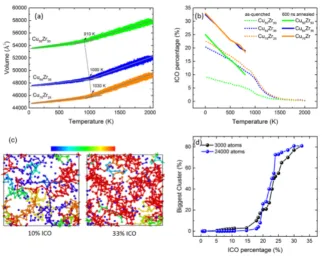
as ”as-quenched”. Such quenches were also interrupted, and held at chosen xed temperatures for chosen time pe-riods, after which the quench was continued down to a temperature of 50 K. These samples as referred to as “annealed” samples. The chosen temperatures (in terms of the glass transition temperatureTg — to be dened) are 0.9 Tg, 0.5 Tg, and 0.1 Tg and the time period is 600 ns. Fig. 5(a) displays system volume per atom as a function of temperature for the uninterrupted quench, for three different chemical compositions. Such a proto-col produces the as-quenched samples. Inspection of this gure reveals a change in slope of two approximately lin-ear regimes and indicates a transition from a liquid-like to a glass-like structure. The intersection of these two lines is dened as the ctive glass transition temperature and throughout this work will be referred to as the glass transition temperatureTg. There is volume contraction. Gray lines represent a linear tting to clarify a ctive glass transition temperature. As shown in Fig. 5(a) the ctive
FIG. 4. (a) Temperature dependencies of system volume with dierent amount of Cu. Gray solid lines represent a linear tting to clarify a ctive glass transition temperature. (b) Percentage of icosahedra as a function of temperature. Dotted and solid lines represent as-quenched and 600 ns annealed samples, respectively. (c) Illustrative simulation snapshots depicting the icosahedra networks. While coloring indicates a size of cluster, blue and red color correspond with the smallest and the biggest clusters, respectively. (d) Percolation of icosahedra network. Black and blue lines correspond samples with 3000 and 24000 atoms, respectively.
becomes apparent, is the growth of a single icosahedral cluster that percolates the entire simulation cell. Fig. 5(d) plots the largest cluster of a conguration as a func-tion of that congurafunc-tion’s icosahedral content. Here the congurations are taken from the quench protocol used to produce the nal sample. Thus, via Fig. 5(b), the icosa-hedral content represents a temperature. Two different sample sizes are shown. It demonstrates that during the quench protocol, as the temperature reduces and enters the glass transition regime, a single large connected clus-ter of icoshadral atoms rapidly emerges to percolate the system. Fig. 5(d) indicates a sharpening of the transition and might suggest a percolation transition — this aspect will be investigated in more detail in future work. Such a percolating structure, which is known to be more relaxed than the remainder of the material can have important consequences for the rigidity and also material strength.
2. LSEs observed from MD
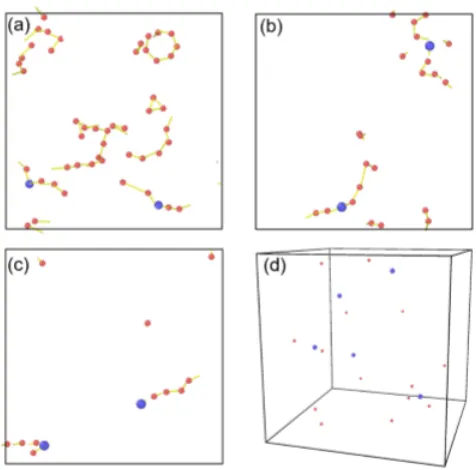
Here thermally activated atomic displacements, cor-responding to structural transformations occurring at niteT during sample preparation are investigated. Such displacements are studied by investigating the atomic motion between two congurations which have been re-laxed to their local minimum via a conjugate gradi-ent method. Any observed displacemgradi-ent represgradi-ents the structural change needed to go from one local minimum to another. Fig. 6 presents LSEs arising from a Cu64Zr36
conguration which are formed at different annealing tem-peratures of (a)Tg, (b) 0.9Tg, (c) 0.5Tg, and (d) 0.1Tg. In Figs. 6(a-c), there are several local displacements in the form of sequential string-like motion in which the position
of one atom is replaced by another neighbouring atom. structures. Whilst both Cu and Zu can be involved in the LSE activity, Cu is more often seen to participate in this string-like activity. This trend is also observed in samples containing more Cu,where in the Cu75Zr25
sam-ple the LSEs are comsam-pletely dominated by the Cu. Only short atomic displacements less than 0.5 ˚A are found in Fig. 6(d). These results are similar to what was seen for a Lennard Jones model binary glass, where at low temper-atures the LSE are found to be less local and consisting of sub-bond length displacements.
3. LSEs observed from ARTn
6
FIG. 5. Atomic displacement map at (a) theTg, (b)∼0.9Tg, (c)∼0.5Tg, and (d)∼0.1Tg. Red and blue balls correspond to the Cu and Zr atoms, respectively. Each vector indicates the atomic displacement from the initial position to nal position during 1 ps. Only atoms whose displacement is greater than 1.3 ˚A and 0.5 ˚A are shown in (a-c) and (d), respectively. Figures are visualized via OVITO with 24000 number of atoms.
MD work and also accords with ref.[24]. Fig. 7(b) shows an LSE of Cu50Zr50with a barrier energy of 5.2 eV.
Al-though smaller atoms are more involved in the formation of the string, two Zr atoms contribute are involved in this structural excitation. Fig. 7(c) represents an LSE of Cu64Zr36with a barrier energy of 4.0 eV and also shows
a string-like atomic reconguration with now only one Zr atom. Finally, an LSE of Cu75Zr25 with a relatively low
barrier energy of 3.85 eV is depicted in Fig. 7(d) now containing only Cu atoms. Thus, for this more realis-tic CuZr alloy systems, both the ARTn and direct MD at nite temperature display similar LSE structures and trends.
4. Connectivity of icosahedra
In Fig. 5, we observed the percentage of icosahedrally coordinated atoms greatly increases when the system is annealing process at 0.9Tgfor 600 ns. In this present sec-tion, we demonstrate preliminary work investigating the nearest neighbour connectivity of the developing icosa-hedral structure using a classication scheme proposed in Ref. [25]. In Ref. [25] icosahedrally coordinated atoms are classied as vertex (sharing one common nearest neigh-bour atom), edge (sharing two atoms), face (sharing three atoms) and volume(sharing vea toms)—see the upper
panel of Fig. 8 taken directly from Ref.[25]. Here, we investigate the creation of these icosahedra connections with respect to the annealing time to understand in more detail how the icosahedral structure percolates through the system. Fig. 8 quanties the connections between icosahedra as a function of time, as the Cu-Zr alloys are annealed at 800 K. Plotted, is the percentage break-down of connectivity types of the increasing population of icosahedrally coordinated atoms. Note that the absolute percentage of icoshaedrally coordinated atoms is in the range of 10% for the Cu50Zr50sample and up to 20% for
the samples with higher Cu content. Fig. 8 shows that for the Cu64Zr36and Cu75Zr25samples, there are no
dis-connected icosahedral atoms, whereas in the Cu50Zr50
sample there is constant population. Since icosahedral content scales with Cu content, this result demonstrates that when the Cu content is low enough there will al-ways exist isolated icosahedral environments. As struc-tural relaxation proceeds volume connectivity eventually dominates in the Cu64Zr36and Cu75Zr25samples. This is
plausible because of the higher aboslute density of icosa-hedral content in these samples. For the Cu50Zr50sample
face connectivity remains slightly dominant over volume connectivity, a result that is compatible with the lower absolute icosahedral content of this Cu composition. It is emphasized that these results are valid only for the sub-microsecond relaxation time-scale.
FIG. 6. (a)Histogram of participation number. (b) LSEs of Cu64Zr36.
E. Mechanical properties
Because of the short time-scale restriction of the MD method, nite temperature atomistic simulations of de-formation can mainly probe the highstrain rate athermal limit of plasticity. In this section we investigate the effect different chemical composition and degree of relaxation has on athermal plasticity, and study how such plasticity affects the underlying icosahedral structure. To do this, the three samples of Cu50Zr50, Cu64Zr36, and Cu75Zr25
were subjected to uniaxial tensile loading at a constant strain rate on the order of 109s1 at a temperature ofTg.
The resulting stress-versus-strain graphs for the three samples are plotted in Fig. 9(a) and reveal an initial elastic response, followed by a peak stress response at elevated stresses, and nally a ow stress response at re-duced stresses. Inspection of this gure demonstrates the peak yield stress and subsequent ow stress increase with increased Cu concentration. The results are in agree-ment with previously reported simulation work. Fig. 9(b) shows the stress-strain curves for the as-cast and annealed samples. The annealed samples show a greater initial peak stress (which increases with annealing sim-ulation time) than that of the as-cast sample. At large enough strains the subsequent ow stress is found to be independent of the degree of relaxation.
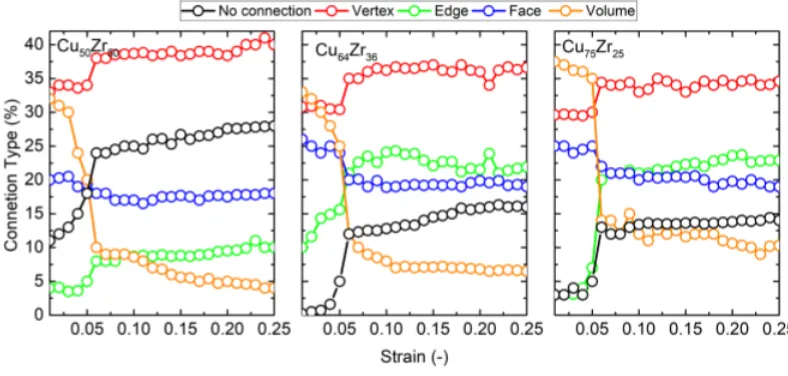
As the plastic strain evolves beyond the peak stress response, the icosahedral content drops in all samples in-dicating structural excitation — rejuvenation. Using the nearest neighbour connectivity classication scheme this break up of the icosahedral structure can now be better
understood. Fig. 10 plots the percentage breakdown of the icosahedral connectivity as a function of strain for the three considered compositions. Inspection of this data re-veals a change in all types of connectivity as the absolute population of icosahedral content reduces (not shown). The percentage of isolated icosahedral environments in-creases, as does the vertex and edge connectivity types. On the other hand the face and volume connectivity types decrease for all chemical concentrations. Interestingly, the volume connectivity which is the only type to show an increase with annealing reveals the most rapid de-cline. Together this suggests that as athermal plasticity proceeds and the structural state is excited (rejuvenated) the initial percolated icosahedral cluster undergoes frag-mentation. This process occurs mainly in the transition regime from elasticity to plasticity, when the system’s stress is at its maximum. Together, these results imply a central role for icosahedral content in an amorphous structure (as alluded to in past works [58]), in relation to its rigidity and maximum stress carrying capacity. The present preliminary work goes one step further in quan-tifying how the icosahedral backbone is broken up in the limit of anthermal plasticity, and will form the basis of the rst manuscript of the project intended for submission to a referred journal.
III. OPEN QUESTION AND PLAN
From the current state of research and the prelimi-nary work this project will address a number of open questions and issues. These are
1. Both MD and the ARTn method reveal localized structural excitations taking the form of extended string-like atomic displacements. The structural envi-ronment around such LSEs has yet to be investigated in terms of icosahedral content and connectivity. This will be done in the present project. In particular, does the extended string-like geometry of the LSE correlate with the surrounding icosahedral structure? Is there a statistical difference in the energy landscape for LSEs associated with the creation of icosahedral structures?
2. How does collective LSE activity lead to the medium range order associated with icosahedral con-nectivity? This focus will try to gain a microscopic understanding of how emergent processes occur leading to signicant structural relaxation and plasticity. It is en-visioned that such work will give a better understanding of the analogy to the under-cooled liquid terminology of alpha and beta processes.
8
FIG. 7. (a)Histogram of participation number. (b) LSEs of Cu64Zr36.
FIG. 8. The percent of connection types between icosahedra in Cu50Zr50, Cu64Zr36, and Cu75Zr25. The dierent types of
connections between icosahedra is depicted on top.
FIG. 10. The percent of connection types between icosahedra in Cu50Zr50, Cu64Zr36, and Cu75Zr25as a function of strain.
plastic ow regime (after yield), how does the icosahrdal structure evolve? In particular what aspects of its (bro-ken) connectivity dominate the rejuvination of the struc-ture? Although the athermal plastic limit is far from ex-periment, such work can give upper limits to how much energy can be stored (and how) in an amorphous struc-ture via mechanical work. Points 1 and 2 will exploit both direct MD at nite temperature and the PEL explo-ration method of ARTn, whereas point 3 will rely on di-rect MD to probe athermal plasticity. In the rst instance, the approach taken will be related to earlier works, which
investigated how such icosahedra may evolve depending on atomic composition, temperature, and annealing time. Analysis of icosahedral structure with respect to relax-ation and plasticity will rstly employ the past work of Ref. [25], using the nearest neighbour connection types of vertex-, edge-, face-, and volume-sharing. As done in the case of Figs. 0.8 and 0.10. It is however antici-pated that a new analysis method will be developed with respect to the “disclination” bond defect originally intro-duced by David Nelson. Such an approach will allow for more distant connectivity to be investigated and classied.
[1] D. V. Louzguine, A. R. Yavari, and A. Inoue, Devitrifi-cation behaviour of cu-zr-ti-pd bulk glassy alloys, Philo-sophical Magazine83, 2989 (2003).
[2] A. Inoue, B. Shen, H. Koshiba, H. Kato, and A. R. Yavari, Cobalt-based bulk glassy alloy with ultrahigh strength and soft magnetic properties, Nature materials 2, 661 (2003).
[3] X. Gu, A. McDermott, S. J. Poon, and G. J. Shiflet, Crit-ical poisson’s ratio for plasticity in fe–mo–c–b–ln bulk amorphous steel, Applied Physics Letters 88, 211905 (2006).
[4] H. Bruck, T. Christman, A. Rosakis, and W. John-son, Quasi-static constitutive behavior of zr41. 25ti13. 75ni10cu12. 5be22. 5 bulk amorphous alloys, Scripta Met-allurgica et Materialia30, 429 (1994).
[5] C. Barrett and T. Massalski, Structure of metals 3rd re-vised edition: Crystallographic methods, principles, and data, international series on materials science and tech-nology, 35 (1987).
[6] S. Jekal, P. Derlet, and J. L¨offler, Geometrical character-ization of atomic structure of cu-zr bulk metallic glasses, (2018).
[7] F. Albano and M. L. Falk, Shear softening and struc-ture in a simulated three-dimensional binary glass, The
Journal of chemical physics122, 154508 (2005). [8] K.-W. Park, C.-M. Lee, M. Wakeda, Y. Shibutani, M. L.
Falk, and J.-C. Lee, Elastostatically induced structural disordering in amorphous alloys, Acta Materialia 56, 5440 (2008).
[9] K.-W. Park, i. Jang, M. Wakeda, Y. Shibutani, and J.-C. Lee, Atomic packing density and its influence on the properties of cu–zr amorphous alloys, Scripta Materialia 57, 805 (2007).
[10] S. M. Foiles, M. Baskes, and M. S. Daw, Embedded-atom-method functions for the fcc metals Cu, Ag, Au, Ni, Pd, Pt, and their alloys, Physical review B33, 7983 (1986). [11] M. W. Finnis and J. E. Sinclair, A simple empirical
n-body potential for transition metals, Philosophical Mag-azine A50, 45 (1984).
[12] D. J. Evans and B. L. Holian, The nose–hoover thermo-stat, The Journal of chemical physics83, 4069 (1985). [13] D. Xu, B. Lohwongwatana, G. Duan, W. L. Johnson, and
C. Garland, Bulk metallic glass formation in binary cu-rich alloy series–cu100- xzrx (x= 34, 36, 38.2, 40 at.%) and mechanical properties of bulk cu64zr36 glass, Acta Materialia52, 2621 (2004).
10
[15] C. A. Schuh, T. C. Hufnagel, and U. Ramamurty, Me-chanical behavior of amorphous alloys, Acta Materialia 55, 4067 (2007).
[16] M. F. Ashby and A. L. Greer, Metallic glasses as struc-tural materials, Scripta Materialia54, 321 (2006). [17] W.-H. Wang, C. Dong, and C. H. Shek, Bulk metallic
glasses, Materials Science and Engineering: R: Reports 44, 45 (2004).
[18] C. Maloney and A. Lemaitre, Subextensive scaling in the athermal, quasistatic limit of amorphous matter in plas-tic shear flow, Physical review letters93, 016001 (2004). [19] A. Inoue, Stabilization of metallic supercooled liquid and bulk amorphous alloys, Acta materialia48, 279 (2000). [20] S. Swayamjyoti, J. F. L¨offler, and P. Derlet, Local
struc-tural excitations in model glasses, Physical Review B89, 224201 (2014).
[21] S. Swayamjyoti, J. F. L¨offler, and P. Derlet, Local struc-tural excitations in model glass systems under applied load, Physical Review B93, 144202 (2016).
[22] S. Plimpton, P. Crozier, and A. Thompson, Lammps-large-scale atomic/molecular massively parallel simula-tor, Sandia National Laboratories18(2007).
[23] A. Stukowski, Visualization and analysis of atomistic simulation data with OVITO–the open visualization tool, Modelling and Simulation in Materials Science and En-gineering18, 015012 (2009).
[24] A. J. Cao, Y. Q. Cheng, and E. Ma, Structural processes that initiate shear localization in metallic glass, Acta Ma-terialia57, 5146 (2009).
[25] M. Lee, C.-M. Lee, K.-R. Lee, E. Ma, and J.-C. Lee, Net-worked interpenetrating connections of icosahedra: Ef-fects on shear transformations in metallic glass, Acta Ma-terialia59, 159 (2011).
![FIG. 1. Schematic of the potential energy landscape for a metallic glass.[26]](https://thumb-us.123doks.com/thumbv2/123dok_us/7998519.1328370/3.612.65.289.296.474/fig-schematic-potential-energy-landscape-metallic-glass.webp)