Exam ple-based
C om puter-
G enerated Facial
Mimicry
by Glyn Cowe
BSc Mathematics, University of Bath (1997)
Submitted to the Department of Psychology University College London
In partial fulfilment of the requirements for the Degree of Doctorate of Philosophy
ProQuest Number: U643864
All rights reserved
INFORMATION TO ALL USERS
The quality of this reproduction is dependent upon the quality of the copy submitted. In the unlikely event that the author did not send a complete manuscript and there are missing pages, these will be noted. Also, if material had to be removed,
a note will indicate the deletion.
uest.
ProQuest U643864
Published by ProQuest LLC(2016). Copyright of the Dissertation is held by the Author. All rights reserved.
This work is protected against unauthorized copying under Title 17, United States Code. Microform Edition © ProQuest LLC.
ProQuest LLC
789 East Eisenhower Parkway P.O. Box 1346
A bstract
C ontents
Example-based Computer-Generated Facial Mimicry... 1
Abstract... 2
Contents... 3
Chapter 1- introduction... 8
1.1 - Applications for Photo-realistic Computer-Generated Facial Mimicry 9 1.2 - History of Facial Animation...10
1.3 - Computer-Generated Facial Anim ation... 12
1.4 - Example-based Facial Mimicry... 12
Chapter 2- Modelling the face... 14
2.1 - Computer-Generated Models of Faces... 14
2.1.1 Surface representations...14
2.1.2 Volume representations...17
2.1.3 Dynamic Representations...18
2.1.4 Summary... 19
2.2 - Biological Representations of Faces... 20
2.2.1 Specialist Mechanisms...20
2.2.2 Separate Modules... 21
2.2.3 3D Representation... 22
2.2.4 Invariance... 23
2.2.5 Features or configuration?... 25
2.2.6 Principal sources of variance in the face... 28
2.2.7 Encoding of M otion... 29
2.3 - Biologically Inspired Facial Representation...31
2.3.1 Eigenfaces... 31
2.3.2 Conclusion...33
Chapter 3- Related Work... 35
3.1 - Motion Capture...35
3.1.1 Key-framing...36
3.1.2 Dot tracking...36
3.1.3 Deformable contours... 37
3.1.4 Feature tracking... 37
3.1.5 Optic flo w ... 39
3.1.6 3D tracking...40
3.1.7 Muscle Tracking... 41
3.2.1 Example-based modelling... 41
3.2.2 Prototyping...42
3.2.3 Videoconferencing...43
3.2.4 Lip-synching...43
3.3 - Principal Components Analysis on Faces...45
3.3.1 Images of Faces... 45
3.3.2 Separated Shape and Texture... 46
3.3.3 Laser Scanned Heads... 47
3.3.4 Dot Tracking D ata... 47
3.3.5 Dynamic Laser-scanned Heads... 47
3.3.6 Facial Motion from Optic Flow... 48
3.4 - Summary... 48
Chapter 4- Example-based Generation of Facial Avatars
...50
4.1 - An Example-based Approach to Modelling Faces... 50
4.1.1 Facial motion as pixel-wise intensity variations... 50
4.1.2 Centring the Examples... 51
4.1.3 Principal Components Analysis... 52
4.1.4 First principal component...53
4.1.5 Second principal component... 54
4.1.6 The remaining principal components... 55
4.1.7 Reducing computation... 57
4.2 - Vectorising Faces by W arping... 57
4.2.1 Warping a reference... 58
4.2.2 The Multi-channel Gradient Model (McGM)... 61
4.2.3 Results...64
4.3 - Vectorising Faces by Morphing... 66
4.3.1 Image Morphing...67
4.3.2 Morph Vectorisation Procedure... 70
4.3.3 Results...74
4.4 - Summary... 76
Chapter 5- Facial Movement Analysis... 77
5.1 - Existing Facial Action Coding Schem es... 77
5.1.1 The Facial Action Coding Scheme (FACS)... 77
5.1.2 FACS+...77
5.1.3 MPEG-4... 78
5.2 - PCA for Coding Facial A ction... 78
5.2.1 Previous Applications of PCA in Facial Motion Analysis...78
5.2.2 Methods... 79
5.2.3 Comparison of results... 79
5.3 - PCA and the human visual system...80
5.3.1 PCA on a corpus of sequences... 81
5.3.2 Results...85
Chapter 6- Facial Mimicry... 87
6.1 - Mimicry by Projection... 87
6.1.1 The Topography of the Face...87
6.1.2 Projecting actions into face space...89
6.1.3 Summary of procedure...90
6.1.4 Results... 91
6.2 - Caricaturing and Rescaling... 94
6.2.1 Exaggerating Vectors... 94
6.2.2 Rescaling the Distribution... 95
6.3 - Mimicry Across Vectorisations... 96
6.3.1 Creating a Related Basis S e t... 96
6.3.2 Hand-coding a Related Basis S e t...100
6.4 - Discussion... 102
Chapter 7- Conclusions... 104
7.1 - Summary of Contributions...104
7.1.1 The Typical Approach to Performance-driven Facial Animation 104 7.1.2 Contributions to Modelling the Face... 105
7.1.3 Contributions to Performance-driven Facial Animation... 106
7.1.4 Contributions to the Analysis of Facial Movement... 106
7.2 - Critical Assessment... 107
7.2.1 Modelling the face... 107
7.2.2 Performance-driven Animation... 107
7.3 - Future Research...109
References...112
Appendix A- Flow Field Operations... 126
A.1 - Bilinear Interpolation... 126
A.2 - Concatenating flow fie ld s...127
A.3 - Warping by Forward Mapping... 129
A.4 - Reversing flow fie ld s... 131
Appendix B- Results: PCA of Morph Vectors... 133
B.1 - Explanation... 133
Appendix C- Commercialisation... 147
C.1 - Introduction... 147
C.1.1 Commercial Applications... 147
C.1.2 Steps Taken towards Commercialisation at Present...148
C.2 - Current Providers of Similar Technology... 148
C.2.1 Performance-driven Facial Animation... 149
C.2.2 Text-driven Facial Anim ation... 149
C.3 - Television, Film and Advertising... 150
C.3.1 Introduction...151
C.3.2 The Post-Production Industry... 151
C.3.3 Performance-Driven Facial Animation in the Post-Production Industry ... 152
0.3.4 Critical Assessment of the Technology... 152
C.3.5 Commercial Attractiveness... 153
C.3.6 Market Challenges... 154
C.3.7 Summary... 154
C.4 - Computer Games... 155
C.4.1 Introduction...155
C.4.2 The Computer Game Production Industry...156
C.4.3 Commercial Attractiveness... 156
C.4.4 Market Challenges... 156
C.4.5 Sum m ary...157
C.5 - Telecommunications... 157
C.5.1 Introduction...157
C.5.2 The Telecommunications Industry... 158
C.5.3 MEDUSA... 158
C.5.4 Commercial Attractiveness... 159
C.5.5 Market Challenges... 160
C.5.6 Summary... 160
C.6 - Conclusions... 160
0.1 - References... 161
Appendix D- Glossary... 163
D.1 - Abbreviations...163
D.2 - Glossary of Terms... 164
D.3 - Glossary of Mathematical Terms and Symbols... 167
D.4 - References... 169
Appendix E- Animations (see attached CD)
E.1- Pixel-wise Intensity Vectorisation
E.1.1- PCA on a Pixel-wise Intensity Vectorisation
E.1.2- Mimicry by Adding Variations to a Second Person's Mean
E.1.3- Mimicry by Projecting Variations onto a Second Person's Basis Set E.2- Warp Vectorisation
E.2.1- Original Sequence Reconstructed by Warping a Single Reference Image
E.2.2- PCA on Frames Vectorised as Warps from a Single Reference Image
E.2.3- Mimicry by Projecting Warp Variations onto a Second Person's Basis Set
E.3- Morph Vectorisation
E.3.3- Mimicry by Projecting Morph Variations onto a Second Person's Basis Set
E.4- Relating Vectorisations E.4.1- Related Basis Set
E.4.2- Mimicry by Projecting onto a Related Basis Set E.4.3- Handcrafted Basis Movements
C hapter 1- In tro d u c tio n
For most of us, faces play an integral role in identification and communication each day of our lives. We can easily and robustly recognise our friends, family and colleagues from the visual information contained within their faces, yet these faces are dynamic in nature and their frequent configurai perturbations yield important cues for social interaction, without disturbing our perception of the subject’s identity (Bruce & Green, 1990). The face is an intriguing and complex stimulus and its synthesis is a challenging task not to be underestimated.
This thesis concerns the computer-generated synthesis of human faces and their movements, focussing on realism. Novel techniques are introduced for the automatic generation of photo-realistic, moveable facial models, or avatars,
from standard video footage. The models are automatically parameterised by a small set of basis movements, which can be linearly combined to produce a broad range of gestures. Given a second video sequence of another individual (or the same, if required) their movements can then be projected onto the generated model, empowering the model to convincingly mimic the original footage. The work has resulted in a patent application (Cowe & Johnston, 2001).
1.1 - Applications for Photo-realistic
Computer-Generated Faciai Mimicry
An immediately obvious theatre of application for the realistic synthesis of human motion is the entertainment industry. Some faces in films, television and computer-games cannot physically be portrayed by human actors, such as those of animals or non-human characters, and necessitate artificial manipulation, but it could be asked; Why there is a need for artificially manipulating real human faces? Surely it is easier, less time consuming and consequently cheaper just to hire genuine actors?
A number of scenarios can be envisaged where a particular personality is required, but is not available for filming. The protagonist of a film could be injured or die before it is finished, for example. This would necessitate starting again from the beginning, or finding another way of finishing off the film without them. An appearance by a well known, but long-dead political figure or celebrity may be required, where a sufficiently convincing double is not available. Alternatively, again, it may not be appropriate to use the actual individual portrayed, for example in satirical productions. In these situations, it can be seen how computer-generated mimicry could be applied.
Industry techniques for computer generated facial animation are indeed currently time-consuming and expensive, but with advances in automation with acceptable output, it is not unrealistic to imagine scenarios where it could be cheaper to artificially manipulate the face of a celebrity in high demand than to pay for their time. A good application for this could be in film dubbing, where a new audio track, usually in another language, is played over the original footage. It is impractical to get the actors to re-enact all of their scenes so lips often do not match the dialogue, but computerised techniques could be used to correct this.
developed here reduce faces into high-quality models that can be manipulated with a small number of parameters. Given that the recipient is provided with such a model in advance, only the parameters need be sent for every frame for a high quality reconstruction, rather than the full image, reducing the quantity of information for transmission drastically, whilst increasing the quality of the reconstructed sequence.
The facility to realistically transfer the motion from one face to another is also useful for investigation into human face perception. Separating facial motion from other cues has long posed a problem for its analysis and only recently has it been possible to do this with facial animation techniques (Hill & Johnston, 2001; Knappmeyer, Thornton, & Bdlthoff, 2001).
1.2 - History of Facial Animation
Replicating faces is far from new. For examples of synthetic faces in static pose, we need only consider the great works of art in sculpture and portraiture, with some evidence dating back to the very beginnings of civilisation.
The synthesis of moving people, however, is the art of the puppeteer, arising across many cultures, throughout human history, as an age-old tool for storytelling and entertainment. Egypt and India have the oldest string operated puppets ever found. In 1934, ancient Egyptian string operated figurines from the twelfth dynasty (circa. 1991 BC - 1786 BC) were discovered amongst the treasures in the excavation of a tomb at Lisht by the Metropolitan Museum of Art, New York (Mattil, 1971). Such early puppets had static faces and just their bodies alone could be manipulated, serving as further testament to the complexity of facial motion.
The ancient Greeks certainly had puppets, with numerous references to them in their literature (Speaight, 1955). From writings by Horace from 30BC, we have:
“you are moved like a wooden puppet by wires that others pull”
“all these as in marionette shows, are drawn with strings... each in the attitudes and with the movements appropriated to it”
And from Apuleius around 200AD:
“those who impart gestures to the wooden figures of men, when they draw a string to the limb that they wish to move, the neck turns, the head nods, the eyes roll, the hands are ready for every purpose, and the whole is seen, not ungracefully, to live”
Again, little reference is made to moving faces, apart from rolling of eyes, but an artist and puppeteer, R. Bruce Inverarity, following his visit to the Queen Charlotte Islands in 1932, described traditional string-controlled masks that had been used before the arrival of the Europeans by the aborigines in fire-lit performances for showing the bonds between the human and spirit worlds (McPharlin, 1949).
Medieval puppets from England are described with moveable faces (Speaight, 1955). The Rood of Grace at Boxley, Kent, a crucifix preserved from medieval England, was said to have been made by an English carpenter whilst imprisoned in France. It is reported that the eyes did
“move and stare in the head like unto a living thing, and also the nether lip likewise to move, as though it would speak”.
A similar French example is held in the Cluny Museum.
allowed a progression into the virtual world, removing all previous physical barriers, granting almost limitless power to the animator.
In computer graphics, much effort has been recently applied in the pursuit of creating convincing synthetic face models capable of fooling the viewer. However, the human visual system is expert in the processing of faces and has proven exceptionally difficult to deceive.
1.3 - Computer-Generated Facial Animation
In order to produce compelling facial animation, actions must be faithful to the audience’s daily experiences of faces in motion. Mimicry is thus always the basis of facial animation.
In filmmaking, where realism is vital, faces are currently animated almost entirely by hand. The voice-track is normally recorded first, and the animator manually manipulates the model with his own face in a mirror as a reference, or occasionally with the footage of the original actor accompanying the vocal track. All facial animation in the pioneering all-computer-generated 2001 movie. Final Fantasy, was executed entirely by hand (Final Fantasy, 2001).
Techniques for automating this process by tracking the movements of an actor’s face have been developed, generally either by tracking markers physically attached to the actor’s face, or by tracking prominent facial features. However, animations generated using this information alone have not been sufficiently compelling for its adoption into the industry, with its application seen generally only in low budget television productions, although Famous Faces, a commercial dot-tracking facial animation system boasts its application in the recent Lord of the Rings movie (Lord of the Rings, 2001 ).
1.4 - Example-based Facial Mimicry
C hapter 2- M odelling th e face
The first step in computer animation is building the model. It is important to choose a representation that is sufficiently powerful to successfully produce the full range of movements required, without being too complex for efficient animation. A variety of representations can be used for computer modelling of the face and here the more common are discussed. Inspiration is then gathered from the human brain. Not only is it the most powerful face processing system at our disposal, but it is also important to understand the very system photo realistic facial animation strives to fool. This chapter concludes, showing how this information can be used, motivating a representation inspired by knowledge of our own visual systems.
2.1 - Computer-Generated Models of Faces
Although artificial facial animation is rarely viewed in conditions other than through a projection onto a two dimensional surface, the face is inherently three-dimensional in structure, so previous approaches have generally involved representing it in 3D. The scene is later projected from 3D to a 2D image for viewing, a process commonly known as rendering, by setting up virtual light sources and a viewpoint and tracing the path of light to that viewpoint.
2.1.1 Surface representations
Parke initiated work on computer-generated facial animation with a crude polygonal model of the head (Parke, 1972). The position of each vertex in three- dimensional space was derived from real faces using a photogrammetric
technique. A mesh was painted onto one side of a face that was then photographed from two viewpoints, frontal and profile, as shown in Figure 2.1. Co-ordinates of vertices were measured in 2D, and the 3D co-ordinates were geometrically recovered. The mesh was then constructed and the polygon faces were coloured.
Figure 2.1- Example image pair for Parke’s photogrammetric method (reproduced with permission from (Parke, 1972))
Williams demonstrated how a more accurate polygonal mesh could be acquired by laser scanning a plaster cast of a human model’s head (Williams, 1990). The scanned data was in cylindrical co-ordinates, with missing data (lost due to occlusions) mapped to the origin, so discontinuities needed to be smoothed by interpolating over the surrounding data. Photographs were taken of the model’s head and painstakingly aligned and registered with the scanned data to map onto the computer head. It is now possible to scan real heads with custom- made laser scanners, such as Cyberware’s, and simultaneously capture the localised texture map as the scanner rotates around the head, eliminating the need for the time-consuming alignment stage (see Figure 2.2).
Figure 2.2- Range data and texture map from a Cyberware laser-scan (courtesy of Max Planck Institute for Biological Cybernetics, Germany)
Other surface representations include implicit surfaces and parametric surfaces. Implicit surfaces are defined by a single equation, f { x , y , z ) = i). Any point satisfying that equation will be on the surface. A simple example of this would be a sphere of radius r , centred at {a,b,c).
f { x , y , z ) = (.%' — (IŸ {y — b f + (z — c f — = 0 (2.1)
Although these implicit surfaces can be used to model shapes that can otherwise only be crudely approximated in alternative representations, and produce smooth shapes without polygonal edges, they are difficult to interact with since equations become unwieldy for complex surfaces, such as the face, and require much more processing. They are hence not a good choice for modelling the head.
Parametric surfaces are similar to implicit surfaces, but are defined instead by three functions of two parametric variables, typically based on cubic equations, with one for each spatial dimension, y and z . Parametric surface patches are much more efficient for approximating a curved surface than polygons, with far fewer needed to satisfy a particular error threshold and they do not suffer from polygonal edge effects. However, they are much more expensive to process than the simpler polygon. It is also difficult to seal up a surface using these surface patches; it is not possible, for example, to represent a sphere in this form without encountering the “north-pole problem”, at least one point always exists where there is an irresolvable discontinuity. This can be
countered by basing the head model on a torus (which does not suffer this problem), since
“A human or animal figure is essentially a torus where the hole of the torus extends from the mouth to the anus as the alimentary canal” (Forsey, 1990).
An extension of parametric surfaces is hierarchical splines (Forsey & Bartels, 1988). Extra surface detail is added where necessary, by overlaying a more detailed surface with control points defined relative to the underlying surface, so that when this primary mesh deforms, the additional surfaces deform consistently. The facial animation system, Langwidere, was developed using hierarchical splines (Wang, 1993).
2.1.2 Volume representations
Three-dimensional objects can be represented by combining building block primitives such as spheres, cylinders, cuboids, etc. These primitives can be deformed and merged to build elaborate three-dimensional structures, a process known as constructive solid geometry (CSG).
2.1.3 Dynamic Representations
An important consideration in choosing a representation for facial animation is the matter of control. It is necessary to be able to produce any natural movements with simple manipulations of the model’s parameters. This is not an easy task, since three-dimensional computer graphics is ideally suited for modelling rigid movements and biological movement is often non-rigid, particularly in the expressive movements of the face.
The complexity of Parke’s polygonal model meant there were too many parameters to animate the mesh manually, so he was prompted to revise his model by parameterisation (Parke, 1974). In this new parametric model, numerical weights controlled subsets of vertices, representing specific facial features, such as the mouth opening height, width and protrusion, allowing for fast, easy animation.
With aspirations to more accurately model the control of the face to deal with the difficulties encountered with differing face topologies, research moved on to modelling facial muscles. This is now a common approach in facial animation and improves on Parke’s first parameterised head model by simulating muscle actions rather than hard-coding performable actions. Since muscle models are still parameterised, they can easily be controlled by adjusting a small number of parameters, and movement can be restricted to reasonable muscle actuations. Platt and Badler introduced the first muscle model for facial animation (Platt & Badler, 1981). They modelled muscles as springs obeying Hookes law:
d; = ^ (2.2)
k
Where the displacement of a point, d l, is given in terms of the force, d f, and the sum of the spring constants at that point, k. They demonstrated their system on a polygonal mesh with a few simple muscle actuations in the forehead region.
action units (AU’s). Fifty A ll’s are specified, each representing a muscle or a small group of muscles. Waters modelled ten of these to control a polygonal model. By locating approximately the key nodes of muscle attachment and extremes of displacement from the examination of faces, Waters modelled movement due to a particular muscle by moving the points of attachment maximally and the neighbouring points with diminishing strength as distance from the node increased. He modelled these effective zones of influence with a
Hanning window (a 2D window based on the cosine function between
-
t t/ 2and 7t
/
2,
with its maximum at the centre) (Figure 2.3).Figure 2.3- A Hanning Window
Many improvements have been made to these preliminary muscle models. Terzopoulos and Waters enhanced Water’s original model with human facial tissue modelled as a deformable lattice of point masses connected with biphasic elastic springs (Terzopoulos & Waters, 1993). In analogy to real dermal tissue, the biphasic springs allowed the synthetic surface tissue to initially readily extend under low strain up to some threshold (1st phase), and then exert rapidly increasing restoring forces beyond this (2nd phase). Underlying this surface layer was a muscle actuator model that reduced the set of voluntary facial muscles (in excess of 200) to a smaller set of about 20 muscle actuators. Again, a radial cosine blend function (as in Figure 2.3) described the zone of influence for each muscle fibre.
2.1.4 Summary
In realistic computer-generated animation, faces are usually modelled in three- dimensions with high-resolution polygonal mesh surfaces, generated either with the talent of highly skilled artists, or with expensive equipment such as laser
scanners. The sheer number of vertices makes them effectively uncontrollable, so intricate underlying muscle models are commonly implemented to constrain and parameterise movements. These methods are, in general, complex, time- consuming and often require the skills of experienced and talented artists, and, even then, results are still not sufficiently compelling to fool the human visual system. It thus seems appropriate to consider the internal processes involved in the perception of faces.
2.2 - Biological Representations of Faces
Perception can be thought of as computer rendering’s complementary inverse. Rather than creating a scene from a set of known parameters, perception involves the extraction of unknown causal parameters from the retinal image. The human visual system seems to be specifically tuned for the processing of faces. Babies only a few minutes old have been found to show a preference for face-like patterns, indicating some degree of hard wiring for facial processing before birth (Johnson & Morton, 1991; Mondloch et al., 1999).
Facial animations are almost exclusively created for the human visual system, so it is important to understand it. Also, given its success in everyday processing of faces, it also seems only appropriate to study it for inspiration. Some of the known properties of the mechanisms involved are now discussed in the following sections.
2.2.1 Specialist Mechanisms
This could occur because our visual systems are hard-wired to process faces differently, but it has been postulated that this effect occurs simply because of our disproportionate exposure to upright faces. Indeed, for example, inversion has been shown to have more of an impairing effect on the recognition of pedigree dogs for experts over non-experts (Diamond & Carey, 1986). Similar results have also been found in the context of handwriting (Bruyer & Crispeels, 1992) and a specifically designed set of novel objects called greebles, which, like faces, share a common spatial configuration, (Gauthier & Tarr, 2002; Gauthier, Williams, Tarr, & Tanaka, 1998).
Experiments on the recognition of faces of other races, however, have presented a surprising result, seeming to contradict the hypothesis that disproportionate exposure of an object in a particular orientation leads to this excessive impairment of recognition when inverted. Valentine and Bruce tested Caucasian subjects on a recognition task with Caucasian and Black faces (Valentine & Bruce, 1986). Caucasian subjects were found to be not as good at recognising Black faces, arguably because they have less exposure to them, yet inversion was shown to have a greater detrimental effect on recognition of Black faces over Caucasian faces. It would appear, from this result, that other- race faces are encoded in a less efficient manner, and inversion further hinders their decoding. We are generally much worse in the processing of unfamiliar faces (Hancock, Bruce, & Burton, 2000), so it seems likely that encoding improves with familiarity in a constant learning process.
2.2.2 Separate Modules
prosopagnosics suffer also from deficits in general object recognition. Kanwisher counter-argues that
“the chances that a stroke or head trauma to visual cortex will obliterate all of the hypothesized face-processing region of cortex without affecting nearby cortical areas is similar to the chance that an asteroid hitting New England would obliterate all of the state of Rhode Island without affecting Massachusetts or Connecticut” (Kanwisher, 2000).
Studies on these face areas in primates, however, demonstrate that it is unlikely that they are uniquely dedicated to face processing; of cells in these locations responsive to stationary stimuli, in fact, at most 20% have been found to be responsive to faces (Rolls, 1992; Wallis & Rolls, 1997). This suggests instead that these regions are dedicated to a more general expert processing of highly familiar stimuli.
Domain specificity for faces is under debate, but evidence also exists for independent processing routes within face processing. Patients have been documented who lose the ability to recognise faces whilst retaining the facility to interpret facial expressions (Bruyer et al., 1983; Shuttleworth, Syring, & Allen, 1982) and, conversely, patients have been reported without the ability to interpret emotion in faces, but no deficit in recognition (Kurucz & Feldmar, 1979; Kurucz, Feldmar, & Werner, 1979). This double-dissociation suggests that recognition of identity and expression are processed independently of each other. Psychophysics also provides evidence for the independence of sex judgements and expression judgements. Although facial expressions were found to affect subjects’ ratings of masculinity and femininity of faces, it was found, in a speeded classification task, that they could attend selectively to either dimension without interference from the other (Le Gal & Bruce, 2002).
2.2.3 3D Representation
system. For example, Marr and Nishihara argued for volumetric representations with generalised cones as primitives (Marr & Nishihara, 1978). These are solids swept out by a curve in 3D space (see Figure 2.4). Pentland suggested a more flexible scheme consisting of deformable geometric solid primitives, such as cones, cubes, spheres, etc, called superquadrics (Pentland, 1986). Biedermann suggested an alternative scheme again, but with reference to the image plane. He proposed a set of 36 primitive 2D object shapes, or geons, with properties that are invariant over different views (Biederman, 1987). The advantage of these schemes is that the complex volume of the face can be reduced to a set of parameters describing each primitive, i.e.- the volume of a cone need only be described by the radius of its base, its height and its relative position. All these suggestions are analogous to schemes discussed in the previous section. Building shapes out of primitives, however, does not allow for high levels of surface detail. Bruce and Young also argue that faces have generally very similar underlying volumes, so a representation of this form allows little detail for distinguishing between them (Bruce & Young, 1986).
Figure 2.4- Generalised cone
2.2.4 Invariance
Invariant representation of objects is an attractive proposal since the visual system can robustly deal with changes in view and lighting, but surprisingly, evidence seems to show, certainly for faces, that this is not entirely the case for biological vision.
The principal evidence for view dependency in face processing is the previously mentioned inversion effect. Faces are much harder to recognise when inverted, rather than upright (Valentine, 1988; Yin, 1969, 1970).
Faces are rarely seen inverted, but it should be noted that even regularly experienced changes in viewpoint have a substantial effect. Hill et al.
demonstrated how subjects performed poorly in a recognition task where viewing conditions were altered (Hill, Schyns, & Akamatsu, 1997). Although all views were equally well recognised when they all had been learned, participants were shown to be surprisingly poor at generalising to novel views when given a single view of a face, with performance decreasing as the difference in viewing angle increased. Generalisation between views has also been shown to be significantly worse when faces are inverted (Moses, Ullman, & Edelman, 1996). Lighting invariance has also been investigated. In same-or-different comparison tasks with pairs of laser-scanned heads presented from varying views and under varying lighting conditions. Hill and Bruce found that variations in lighting posed difficulties as great as variations in view (Hill & Bruce, 1996). An advantage for illumination from above was found, with better performance in a matching task under this condition. This finding is consistent with evidence that the visual system employs an assumption of illumination from above with a single light source, when interpreting simple shading patterns (Ramachandran, 1988a, 1988b). By illuminating faces from below, then inverting, Johnston, et al. demonstrated that the face inversion effect could be significantly reduced, or even eliminated (Johnston, Hill, & Carman, 1990). They took this as evidence for a surface based code for faces, but subsequent evidence illustrates that further information must be employed by the visual system. The hollow face illusion, in which a concave model of a face is perceived to be convex, demonstrates that this is not the only constraint in the recovery of shape from shading (Hill & Bruce, 1993, 1994). Familiarity with the three-dimensional structure of the face still seems to play some part in the process.
of views encoded separately in order to attain recognition from a variety of viewpoints (Wallis & Bülthoff, 1999). Psychophysical evidence supports this hypothesis with demonstrations that, having learned two views of an object, subjects perform better when tested on views between them, rather than outside (Bülthoff & Edelman, 1992; Tarr & Pinker, 1989). This can be explained in the view-based context by considering interpolated views to partially excite cells responsive to both learned views, whilst extrapolated views partially excite cells responsive to only one of the learned views. Wallis and Bülthoff propose that these invariant representations, based on individual views, can be learned by experience through temporal coupling as well as physical similarity of views (Wallis & Bülthoff, 1999). The importance of the temporal aspect in learning invariant models has been powerfully demonstrated in an experiment in which viewing position and identity of a face were simultaneously altered (Wallis & Bülthoff, 2001). In these circumstances, subjects showed a tendency to treat the views as though they were of the same person.
2.2.5 Features or configuration?
Photofit is a facial reconstruction tool used by the police, consisting of many variations of individual facial features that can be combined by a witness to form a composite face. Penry, the inventor of Photofit, wrote,
“because each facial part is the sum of its individual details and the whole face is the sum of its sections, the total assessment of it requires careful visual addition” (Penry, 1971).
Laughery found similarly disappointing results testing the American equivalent,
Identikit (Laugheiy, Duval, & Fowler, 1977; Laughery & Fowler, 1980).
These reconstruction kits fail, not only because of their limited set of features, but because people do not appear to store faces solely in this way. One need only consider linguistic terms defining facial features, vague regions of the face with no clear boundaries, shrouded in fuzziness. Where exactly do the cheeks begin and end, for example? Whether faces are stored as a collection of features, or not, was investigated by Sergent (Sergent, 1984). She argued that, if faces are stored by individual features alone, it should not be possible to identify two faces as being different any faster than the time taken to identify a change in the most salient feature. She found that correct judgements for faces with several differing features were made faster than for changes in any single feature. The contrary was found for inverted faces, suggesting that inverted faces are processed on a feature-based level, whereas a different approach is undertaken for upright faces. Featural information is still clearly retained. When subjects were shown photo-fit pictures of unknown faces in a learning phase, Solso and McCarthy demonstrated that novel faces containing features present in the learning task rated high in familiarity, despite their novelty, not only in comparison to wholly novel faces, but in comparison to the learned set as well (Solso & McCarthy, 1981).
So when faces are not processed by their individual features, how are they processed? In a review, Maurer, et al. distinguish three types of configurai processing:
“detecting the first order relations that define faces (i.e. two eyes above a nose and mouth), holistic processing (glueing the features together into a gestalt), and processing second-order relations (i.e. the spacing among features)” (Maurer, Le Grand, & Mondloch, 2002).
Kemp, McManus, & Pigott, 1990; Le Grand, Mondloch, Maurer, & Brent, 2001; Leder, Candrian, Huber, & Bruce, 2001). Extreme alterations in positioning of features also appear less grotesque when the face is inverted (Bartlett & Searcy, 1993). This suggests that it is this configurai information that is key to the inversion effect. It seems that upright faces are encoded effectively in a configurai manner, but this information is degraded when inverted and subjects have to resort to less efficient feature-based processing.
Leder et al. argue, however, that this configurai information used in face processing consists at least partly of locally processed relations (Leder et al., 2001). They found that in inter-ocular distance judgements, inversion effects occurred strongly whether the eyes, nose and mouth were all presented, just the eyes and nose, or even just the eyes alone. Additionally, when testing these judgements with upright faces against inverted faces that had been altered by inverting the eye region, as in the Thatcher illusion (Thompson, 1980), they found no effect of inversion.
Powerful configurational effects have been found with faces. Interchanging upper and lower halves of faces between individuals produces composite faces with new identities independent of their components. Young and Hay found pronounced latencies in identification of top and bottom halves when aligned to form a new face (Young & Hay, 1986). Subjects found it much easier to identify each half when they were misaligned, suggesting that that the configurational effect of faces makes it difficult to consider each half individually. They did find, however, that subjects found recognition of top halves easier when the aligned composites were inverted.
Studies of babies present strong evidence for early processing of subtle configurational information. Infants of 5-6 months have been shown to be able to distinguish male from female and young from old, yet have not been able to distinguish between individuals until 7 months old (Fagan & Singer, 1979). Similar pairs were used for testing, such as twin brothers and sisters for testing discrimination of gender and bald men compared to baby faces for age, yet the infants were able to distinguish between them. Comparatively different faces were used within age and gender groups, yet the infants were not able to distinguish between these.
All this evidence strongly suggests that the visual system does not store a face just in terms of its individual features, but rather as a more general configuration, where spatial inter-relations play a crucial part.
2.2.6 Principal sources of variance in the face
Johnston suggested a parameterised representation of a face, described in terms of its major sources of variation (Johnston, 1992). This model could be analogous to common simple geometric solids such as spheres, cuboids, etc, which can be described with a small number of parameters, such as radius, and width and height. Parke’s 3D parameterised head model reduces the 3D surface geometry of the face to a comparatively small set of parameters, but Johnston’s parameterisation would seek to more efficiently encode the information with factors directly related to the principal variations in faces.
Varying a prototype in terms of facial features affects only local structure and does not capture the essence of the parameterisation suggested. The evidence above shows that, when not testing specific features, principal sources of variation appear to be more subtle and global, such as face shape and age. It seems more appropriate to consider a holistic representation in which the face varies in terms of pseudo-features that affect the configuration of the face as a whole.
By considering faces to be parameterised by a set of features, regardless of their local or global nature, a face space can be envisaged in which dimensions are composed of the parameters and the average of all faces lies at the centre. This approach for representing faces has proved useful in accounting for several findings in the literature. The fact that caricaturing enhances recognition for both line drawings of faces (Rhodes, Brennan, & Carey, 1987) and of photographs of faces (Benson & Perrett, 1991), can be explained by considering distinctiveness as distance from the centre of face space and a caricature to be an extrapolation along the vector from the centre to the original, thus accentuating the distinctive parameters. Moving along that same vector towards the centre of the space instead, a process termed anti-caricaturing, would be expected then to reduce distinctiveness, thus impairing recognition and this is consistent with psychophysical findings (Stevenage, 1995). Leopold et al. recently demonstrated powerful after-effects in the context of the face- space paradigm (Leopold, O'Toole, Vetter, & Blanz, 2001). By adapting subjects to a particular face, they showed how recognition tasks for faces situated along that identity vector in face space were facilitated, whilst recognition was impaired for other faces.
2.2.7 Encoding of Motion
experiments with faces by blacking out the face and teeth with makeup and scattering white circular labels over the surface (Bassili, 1978, 1979). He found that naïve subjects were able to recognise the sequences as faces from the movement of the point light sources alone, leading him to postulate that facial motion was sufficient information for the recognition of an object as a face. He found that subjects were also still able to identify emotions being expressed in these conditions, to some extent, and that errors in judgement correlated with errors encountered in full-face display conditions. Bruce and Valentine used this technique to investigate whether individuals could be recognised on the basis of their facial motion alone (Bruce & Valentine, 1988). They found that subjects achieved above chance results in recognition of emotions and of individuals from a small set, but performance was very poor.
Point light displays only offer motion information at the location of each point light source, so it is unsurprising that subjects find recognition tasks difficult in these conditions. Since recognition of faces, whether still or moving, is generally performed at ceiling, it is not easy to show a benefit of moving faces over still faces without somehow degrading the stimuli. Knight and Johnston did just this by degrading image sequences with photographic negation, arguing that this maintains the full motion field rather than offering a discretised sample of point light sources (Knight & Johnston, 1997). Their subjects found famous faces in moving sequences of negated images significantly easier to recognise than stills, reinforcing the hypothesis that motion cues do provide useful information in face processing tasks. Lander et al. furthered this work by countering the argument that a dynamic sequence simply provides more views of the face by comparing performance on similarly degraded dynamic sequences to performance on the same frames simultaneously presented (Lander, Christie, & Bruce, 1999). Subjects again found it significantly easier to recognise moving sequences.
motion (Knappmeyer et al., 2001). Judgements of identity, whilst viewing morphs between the two faces, were shown to be influenced by the motion the face was undergoing.
2.3 - Biologically Inspired Facial Representation
In both psychology and computer graphics, practical representations for facial geometry have been carefully considered. Marr and Nishihara’s generalised cones, Pentland’s superquadrics and Biederman’s geons were proposed to account for the human visual system’s facility for identifying familiar objects, regardless of position or orientation (Biederman, 1987; Marr & Nishihara, 1978; Pentland, 1986). This also needed to be considered in computer graphics, where an efficient representation is paramount for fast rendering and storage. A single representation of an object is generally preferable over the alternative, storing a 2D image of every configuration of a scene that is likely to be encountered in the particular application.
It is thus not surprising that these volumetric primitives find an analogue in computer graphics’ CSG, and generalised cones form a subset of implicit surfaces. Evidence of view dependency in the human visual system suggests an alternative representation, however. Representations of faces other than three-dimensional have rarely been considered in computer graphics.
In perception, many have considered whether the visual system represents faces, locally as a set of individual features, or more globally, as a configuration. Psychophysical evidence, however, strongly suggests that faces are not processed merely as a set of building-block features. A more global configurai approach is suggested.
2.3.1 Eigenfaces
in the samples. This allows a more efficient coding system, since less important dimensions can be ignored, thus reducing the dimensionality of the space.
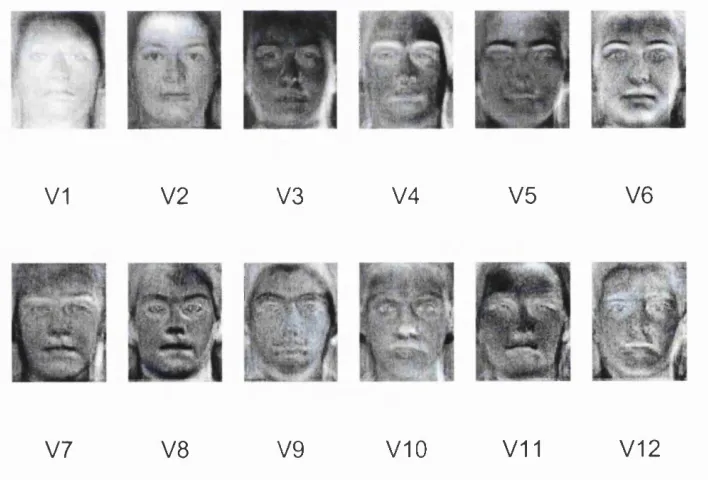
After converting two-dimensional arrays of facial images into long vectors, Sirovich and Kirby showed that PCA could be used to extract the principal components of this face set, so-called eigenfaces (Sirovich & Kirby, 1987). Figure 2.5 shows the first 12 principal components resulting from PCA on 80 photographs of faces. The images were taken from the Nottingham face database (Hancock: http://pics.psych.stir.ac.uk/cgi-bin/PICS/New/pics.cgi) and were first aligned with a scale, rotation and translation so that the eye positions were aligned, and then were cropped. Any face from that set can then be reconstructed (with some residual error) as a linear combination of the first N eigenfaces, with increasing precision for larger N. For large face databases, reasonable reconstructions can be made of faces outside of the training set (see Figure 2.6).
VI V2 V3 V4 V5 V6
V7 V8 V9 V10 V II V12
Figure 2.5- the first 12 eigenfaces of a database of 80 images
Original Reconstruction Original Reconstruction
Figure 2.6- Two novel faces reconstructed with 80 eigenfaces
PCA effectively reduces the amount of information that needs to be stored in order to recognise individuals, since only one weight for each principal component is needed. The result is a representation parameterised in terms of the largest sources of variance. Recognition experiments with eigenfaces show impressive results for faces captured under the same conditions as the training set, but slight variations in lighting, orientation, scale and position quickly degrade performance, although this is consistent with some psychophysical results discussed earlier.
PCA has almost entirely been applied for encoding identity in faces, rather than facial movements. An exception is Calder, et al.’s work in analysis of facial expressions (Calder, Burton, Miller, Young, & Akamatsu, 2001). Principal components analysis was applied to Ekman and Friesen’s face database (Ekman & Friesen, 1976), containing a variety of people, demonstrating a variety of expressions. They found that their PCA-based system was capable of supporting facial expression recognition and noted a natural separation of identity and expression, with components tending to code for either just expression, or just identity. This is consistent with the observations of the independence of expression and identity discussed in 2.2.2.
2.3.2 Conclusion
To conclude, computer-generated models of faces have previously generally been three-dimensional with complex hard-coded underlying muscle models employed for their control. Psychophysical and neurophysiological evidence, however, indicates that we store faces in a more two-dimensional manner. Two- dimensional, or image-based, approaches have rarely been considered in this context, but previous work with principal components analysis has demonstrated its effectiveness in efficiently encoding facial identity, with
C hapter 3- R elated W ork
The focus of this thesis is on the development of techniques for transferring motion from one face onto another in a convincing, photo-realistic manner. In the previous chapter it was shown how the problem of modelling faces has been approached generally with three-dimensional polygonal models, with movements constrained by underlying muscular models. An alternative image- based approach was suggested with movements constrained by example, rather than explicit knowledge of muscle structure.
Performance-driven animation requires tracking an actor’s movements and relating those movements to the model. This chapter of related work begins by examining previous approaches to capturing facial motion. Previous two- dimensional image-based approaches in facial animation are then discussed, followed by past applications of principal components analysis in the context of faces.
3.1 - Motion Capture
Given a computer model of a face, a procedure is required for animating it. A mechanical analogue for computer-generated facial animation is animatronics. In situations where the puppeteer would otherwise be impossible to conceal, puppets are manipulated remotely using motors within their structure, usually via radio control. A puppeteer works with an interface, often just a wire frame skeleton of the puppet’s structure known as a Waldo, and the target moves appropriately.
When animating a computer-generated face, abstract control devices with sufficiently many degrees of freedom have previously been applied, such as a musical keyboard in Sony’s System G, however, if realistic facial motion is required, where better to get it from than a genuine face?
form suitable for projecting onto the model. A fundamental difficulty is the
correspondence problem, registering the actor’s face with the geometric model, such that every moving point has a unique analogue in the model’s face. This section discusses several methods that have previously been applied in the tracking of facial motion and how they approach the correspondence problem.
3.1.1 Key-framing
As discussed in the previous chapter, Parke introduced the first computer generated facial model (Parke, 1972, 1974). A polygonal mesh was painted onto a face, then the face was photographed from two angles and the 3d location of each vertex calculated by measurement and geometry. This technique was applied for extracting meshes in a variety of face poses to provide key-frames. By taking two key-frames as extremes, the model could then be animated smoothly between these by calculating the linear path for each vertex and filling in intermediate frames by simply interpolating along these paths. This interpolation process is known as keyframing and is still often used to avoid having to calculate the 3D locations of the vertices for every frame of a facial sequence.
3.1.2 Dot tracking
Markers have been used often since for tracking facial motion. The introduction of automated dot tracking techniques and multiple cameras for 3-d motion estimation has led to high quality results (Guenter, Grimm, Wood, Malvar, & Pighin, 1998). Commercial packages are even available with automated dot tracking (eg. Famous Faces (www.famous3d.com)).
3.1.3 Deformable contours
Terzopoulos and Waters approached facial motion capture by using deformable contour models (also known as snakes) to track non-rigid motion of the face (Terzopoulos & Waters, 1993). These snakes are energy-minimising splines in the x-y plane that are attracted to and settle in valleys in 2D potential functions: the first derivative of the Gaussian-smoothed image in this case. They thus gravitate towards contours of high contrast, such as the eyebrows or lips, if sufficiently enhanced with make-up. Manual initialisation was necessary, but by incorporating visco-elasticity and rigidity properties, snakes proved to be robust contour trackers so long as displacements were not too extreme, since points that escape from the attractive zone of the valley are generally pulled back in by those that are still within.
3.1.4 Feature tracking
Dot tracking and deformable contour tracking can capture useful motion information, but these require the face to be highlighted in some way. Some of the more prominent facial features can be tracked without needing to do this. Deformable templates have been applied for specific feature location (Hallinan, Gordon, Yuille, Giblin, & Mumford, 1999). For example, a template for eyes was described with a set of nine parameters, g = (x^,x^,r,a,b,c,9), where x^ = {x^,yj
Figure 3.1- Deformable eye template
The upper and lower curves bounding the eye are approximated as parabolas and the iris is modelled as a circle. It is known that the whites of the eyes must be at high intensity peaks and the iris will be at a low intensity valley, so an iterative steepest descent process was used to steer the template parameters towards the target eye.
This procedure was principally designed for locating facial features in images and representing them in a form that can be used for geometrical comparison. It is easy to see, however, how it could be applied for feature tracking.
In working on performance-driven animation of cartoons. Buck et al. needed only the positions of the principal features for each frame and used non- intrusive methods to find them (Buck et al., 2000). A colour-based tracker was applied in the method described by the authors to extract the positions of features in a face. Ten parameters in total were extracted:
• The X and y values of the midpoint of the line segment I connecting the two pupils (2)
• The angle of I with respect to the horizontal axis (1 )
• The distance between the upper and lower eyelids of each eye (2) • The height of each eyebrow relative to the pupil (2)
• The distance between the left and right corners of the mouth (1 ) • The height of the upper and lower lips, relative to the mouth centre (2)
The tracker found these features by comparing colour data in each frame with template data for each feature stored during a user calibration session. They found that sequences could not be tracked, however, if there was insufficient colour contrast between the user’s skin and lips or if there was too much rigid motion.
These techniques require the handcrafting of templates, but Cootes and Taylor demonstrated a method for generating a more general class of templates, which they refer to as active shape models or smart snakes (Cootes, Taylor, Cooper, & Graham, 1995). The user delineates feature points for objects in a set of example images and, given a novel case, their technique iteratively adapts the template for a best fit.
3.1.5 Optic flow
There are a variety of definitions of optic flow. In psychology, for example, it is often referred to as the retinal velocity field induced by a moving observer (Marr, 1982). Simoncelli, however, describes optic flow as the measurement of
“the apparent motion of local regions of the image brightness pattern from one frame to the next. In doing this, one is assuming that these intensity patterns are preserved from frame to frame.” (Simoncelli, 1993) This is the definition that will be used throughout this thesis. Optic flow algorithms can provide an estimate of speed and direction for locations in a frame of an image sequence. It should be noted, however, that optic flow and image motion, the true movement of objects within the scene, are not always the same (Verri & Poggio, 1989).
Optic flow was calculated using Simoncelli’s (Simoncelli, 1993) coarse-to-fine, Kalman filtering-based algorithm, then canonical points were extracted using view-based and modular eigenspace methods (Pentland, Moghaddam, & Starner, 1994). A geometric mesh was then adjusted in order to align it with these canonical points, and a mapping function applied to the motion data to compute an estimate of the velocities at each vertex of the mesh. A control loop was used to refine the input vector until it was consistent with a permissible muscle-based deformation of the geometric model.
Black and Yacoob used parameterised optic flow to track regions in face sequences (Black & Yacoob, 1995). They defined areas around the mouth, eyes, brows and the head, and tracked them with an optic flow algorithm to extract measures for each region for translation, divergence (isotropic expansion), curl (rotation) and deformation (squashing and stretching). They then showed how these could be applied to recognise expression. A method by Fleet, Black, Yacoob and Jepson for parameterising optic flow from examples, using PCA, is also discussed later in 3.3.6 (Fleet, Black, Yacoob, & Jepson, 2000).
3.1.6 3D tracking
There are fundamental problems with tracking motion in 2D and using this information to drive a 3D model. If 3D data could be captured, it would be much more appropriate to utilise this in these circumstances. Williams suggested using a mirror positioned next to the performer’s face in order to recover the 3D Cartesian co-ordinates of each point in every frame by calculating depth from stereo (Williams, 1990). Using a mirror or multiple cameras is equally as appropriate for all these methods, but another correspondence problem consequently arises that must be dealt with.
packages on the market can track motion of 3D optical markers, such as
Famous3D.
3.1.7 Muscle Tracking
It is also possible to drive a muscle model with muscle actuations from a real actor. This bypasses the problem of having to register the actor’s features with the model’s. Muscle actuations have previously been captured for this purpose with intramuscular electromyography, or EMG, recordings (Lucero & Munhall, 1999). Once signals have been recorded from sensors on the actor’s face, the corresponding muscles can be activated on the model in order to mimic their movements. This is an effective solution, but requires expensive specialist equipment.
3.2 - Two-dimensional Facial Animation
Most work in realistic facial animation has previously involved three-dimensional models, but it is very difficult to produce a 3D model of sufficient quality to fool a human observer in believing it to be a real face. Although two-dimensional models have often been previously used for cartoon animation (Buck et al., 2000), they have rarely been applied in animations striving for realism. Presented here, are examples of realistic image-based animation techniques.
3.2.1 Example-based modelling
Ezzat and Poggio employed this technique along with radial basis functions to model simple rigid and non-rigid facial motion by associating flow fields between example images and a reference image with user-defined high-level parameters (Ezzat & Poggio, 1996). Their approach for parameter estimation differed by basing an error-metric on flow fields rather than images, since flow fields are unaffected by lighting artefacts. Once the initial frame of a sequence was in correspondence with the reference, the high level parameters of the sequence could be extracted by iteratively perturbing the parameters and comparing the flow fields until a threshold was reached.
Fidaleo and Neumann recently introduced a methodology for generating an example-based virtual puppet from images (Fidaleo & Neumann, 2002). The face was split up into a small set of local regions, referred to as co-articulated regions (CRs), representative of small groups of muscles. A set of basic facial movements were chosen, which activated movements independently in each CR, and sequences were recorded in which an actor performed each of these movements individually. Markers were attached to an empty glasses frame in order to warp the sequences onto a standard position. Muscle actuations were separated using independent components analysis. Independent components analysis (ICA), is similar to PCA, but seeks to maximise independence between components, rather than variance (Bell & Sejnowski, 1995). The face could then be parameterised and new footage of the same actor could be analysed in real time to extract the high-level parameters. Those same parameters could then be used to drive that model, or a cartoon character, handcrafted under the same parameterisation. This effectively enables photo-realistic performance- driven facial animation, but is limited to the one actor.
3.2.2 Prototyping
1995), a set of examples must first be delineated; so manual intervention cannot be avoided. Although this is not technically performance-driven facial animation, a new face is generated driven by the original motion and results are of realistic quality.
3.2.3 Videoconferencing
Compactly modelling the face at high quality with the minimal number of parameters is paramount for videoconferencing, where bandwidth is limited. Koufakis and Buxton presented an image-based method for encoding an individual’s face for this purpose (Koufakis & Buxton, 1999). Assuming that a set of landmark points could automatically be extracted from images of faces, they showed how static face pose could be modelled by linearly combining warps of three manually selected basis faces. By then extracting three sets of image patches, one for each of the eyes and one for the mouth, over a corpus of aligned example frames of that person, they then applied PCA to those patches to model their dynamics as a small number of the most important principal component basis images. Although they only tested their scheme on single static frames, so were unable to test for smoothness of transitions between frames and other temporal artefacts, they demonstrated how high quality reconstruction could be achieved in this manner at very low bit rates.
3.2.4 Lip-synching
There are some examples of photo-realistic image-based techniques used for synchronising the movement of the mouth with an audio track, or lip-synching.
By considering a one-to-one mapping between phonemes and visemes, however, coarticulation effects are ignored; for example, the “t” in “beet” looks very different from in “boot”. Video Rewrite, a system developed by Bregler et al., also automatically lip-synchs existing footage to a new audio track, but deals with coarticulation effects by considering triplets of phonemes, or triphones,
instead (Bregler, Covell, & Slaney, 1997). The movements associated with each triphone available in example footage are extracted and lips are tracked using
eigenpoints (Covell & Bregler, 1996). Mouth movements are predicted for each triphone from the new audio track, with the best approximation used if the required triphone is not available, and these are incorporated into the existing sequence and merged by warping and blending. Since triplets of phonemes need to be stored, rather than single phonemes, an enormous database with considerable storage is consequently required. Cosatto and Graf demonstrated a similar image-based system, but split the face into features and modelled it as a small set of quadrilateral planar surfaces in 3D in order to deal better with rigid head movements (Cosatto & Graf, 2000). They handled coarticulation by using the generative footage to build a space relating phonemic information to their image-based model. For a novel timeline of phonemes, a cost function was minimised to calculate the best trajectory in this space through the target phonemes. A minimal amount of expressive detail could also be added by animating around the eyes and eyebrows for emphasis.


![Figure 4.4 - Representing an example frame, T , as a warp, [U, V ], from a reference, R](https://thumb-us.123doks.com/thumbv2/123dok_us/8224934.1373533/61.595.61.477.68.279/figure-representing-example-frame-t-warp-u-reference.webp)