Zero-Shot Learning of Language Models for Describing Human Actions
Based on Semantic Compositionality of Actions
Hideki ASOH
National Institute of
Advanced Industrial Science and Technology
Tsukuba, Ibaraki 305-8568 Japan
[email protected]
Ichiro KOBAYASHI
Graduate School of Humanities and Sciences,
Ochanomizu University
Bunkyo-ku, Tokyo 112-8610 Japan
[email protected]
Abstract
We propose a novel framework for zero-shot learning of topic-dependent language models, which enables the learning of language mod-els corresponding to specific topics for which no language data is available. To realize zero-shot learning, we exploit the semantic compo-sitionality of the target topics. Complex topics are normally composed of several elementary semantic components. We found that the lan-guage model that corresponds to a particular topic can be approximated with a linear com-bination of language models corresponding to elementary components of the target topics. On the basis of the findings, we propose sim-ple methods of zero-shot learning. To confirm the effectiveness of the proposed framework, we apply the methods to the problem of gen-erating natural language descriptions of short Kinect videos of simple human actions.
1
Introduction
Constructing topic-dependent language models is useful for many applications such as text mining, speech recognition, statistical machine translation, natural language interfaces, and textual descrip-tion of images or video contents. In most meth-ods of topic-dependent language model construc-tion, one general model is first constructed from a large amount of language data, and then the general model is modified with a small amount of language data regarding the target topic. The technique of taking the weighted sum of language models is of-ten used for the modification (Bacchiani and Roark,
2003; Jelinek and Mercer, 1980). However, correct-ing language data for all target topics is demandcorrect-ing and difficult. In particular, when each target topic becomes narrower and the number of target topics increases, it becomes impractical to correct language data for all topics.
In this paper, we propose a novel framework for zero-shot learning of topic-dependent language models, which enables the learning of language models corresponding to specific topics without ob-serving language data regarding the topics on the basis of the semantic compositionality of the target topics.
In the following, we consider rather fine-grained topics such as human activities. Such detailed top-ics are normally composed of several elementary se-mantic components. For example, a human action “raising left leg in the forward direction” is consid-ered as a topic. The action includes components such as “up (raise)”, “left”, “leg”, and “in the for-ward direction”. Another action “raising left hand in the side direction” shares the common elements “up” and “left” with the previous action. In this way, actions are related to each other through com-mon components. Hence, the language models gen-erated from natural language sentences describing those actions are also expected to be related to each other. We will show that using this kind of compo-sitionality, we can generate language models corre-sponding to actions for which we do not have natural language data.
Kinect videos.
In summary, the original contributions of this work are as follows: 1) the problem of zero-shot learning of topic-dependent language models is newly formulated, 2) novel simple methods for zero-shot learning are proposed, and 3) the effectiveness of the methods is confirmed with real data.
The remainder of the paper is organized as fol-lows: The problem is formalized and solutions are proposed in Section 2, Section 3 discusses re-lated works, Section 4 presents application to the video description problem including experimental setup and results of the experiments, and Section 5 presents the conclusion and discusses future work.
2 Zero-Shot Learning of Language Models
In this section we formalize the problem of zero-shot learning of topic-dependent language models, and propose methods to solve the problem.
2.1 Problem Formalization
As described above, we are interested in the problem of learning multiple topic-dependent language mod-elsMi(i= 1, ..., N), each of which corresponds to a complex fine-grained topic such as human action
xi. When we have a language dataSi i.e. a set of sentences describing the topicxi for all topics, we can simply calculateMifromSi.
The problem we will treat in this paper is estimat-ing language modelsMicorresponding to topicsxi for which we do not have language dataSi. Such estimation becomes possible on the basis of the se-mantic compositionality of topics. We assume that each topic is composed of several semantic com-ponents. We denote the semantic components as
yj(j= 1, ..., K).
For example, in the experiments described in Sec-tion 4, we useN = 20human actions such as “rais-ing left leg in the forward direction” and “rais“rais-ing both hands in the side direction”. Each action is composed by combining some ofK = 9 compo-nents such as “up”, “down”, “front” (front direc-tion), “side” (side direcdirec-tion), “hand”, “leg”, “right”, “left”, and “both”.
The relation between topics and components can be described by a matrixA = (aij). Whenaij= 1 then theith topic includes thejth component, and
whenaij = 0then otherwise. In the following sec-tion, we assume thataijis known for all topics. We also assume that the number of topicsN is larger than the number of componentsK.
As for the language model, we consider the
n-gram model. An n-gram language model is normally defined by the conditional probabili-ties p(wi|wi−1, ..., wi−n+1) for a word sequence
(wi−n+1, ..., wi−1, wi). Here we use the joint prob-abilitiesp(wi, wi−1, ..., wi−n+1)instead of the
con-ditional probabilities because the joint probabilities are suit for the linear decomposition described be-low. Hence the conditional probabilities can be cal-culated from the joint probabilities, this does not re-duce the generality and usefulness of the framework. We denote a vector composed of the joint prob-ability values calculated from language dataSi as ψi, and assume that the probability vectorψifor the
ith topic can be approximately decomposed as the weighted sum of probability vectorsφj correspond-ing to thejth components included in the topic as
ψi= !
j
aij "
jaij
φj+εi,
whereεiis a vector of the noise term.
Because we consider N topics and K compo-nents, the relation can be written with matrices as
Ψ= ˜AΦ+E, (1)
whereΨis anN ×W matrix whoseith row isψi andΦis aK×Wmatrix whosejth row isφj, andA˜
is aN×Kmatrix whose element isaij/"jaij.W is the dimension of the probability vector of the lan-guage model, i.e. the number of ordered word pairs appear in the language data.Eis a matrix composed of noise terms. We use this linear relation for zero-shot learning.
2.2 Methods of Zero-Shot Learning
Let us assume we have language data Si for only
N′(N′< N)topics. The set of topics for which we have language data is denoted byT. From the partial language data, we can compute theN′×W proba-bility vector matrixΨ′by the same way as the ma-trixΨ. A row ofΨ′is the probability vector which corresponds to a topic inT.
using the relation of equation (1). This means that we can estimate language modelsψi for topics for which we have no language data.
We assume that each ofK componentsyj is in-cluded at least once in theN′ topics. Then a naive method of computingΦis to compute the language model φj from the language data of all topics that include thejth component.
We merge the sentences regarding the topics with thejth component. Then from the merged data we compute the probability vectorφjfor thejth compo-nent. This method has been designated as “Method 1” in this study.
Another method of estimatingΦis to exploit the least-square estimation to estimateΦfromΨ′as
ˆ
Φ= arg min Φ ||
Ψ′−A˜′Φ||2
whereA˜′is anN′×Kmatrix made by extractingN′ rows corresponding toΨ′fromA˜. This optimization problem can be easily solved as
ˆ
Φ= ˜A′+Ψ′,
where A˜′+ is the generalized inverse of matrixA˜′. Then fromΦˆ we can estimate the language models for topics without language data. This method has been designated as ”Method 2”.
3
Related Work
Zero-shot learning has recently become a popular research topic in machine learning, in particular in the domain of large scale visual object recognition and image tagging. Because the number of classes is large, it is difficult to collect true labels for the problems. Hence zero-shot learning is useful in the domain. Palatucci et al. (2009) proposed a method of zero-shot learning and applied to decod-ing fMRI data from subjects thinkdecod-ing about certain words based on the semantic representation of the target classes. They also gave theoretical analy-sis of the zero-shot learning framework. Lampert et al. (2009) proposed a method of visual object classification where training and test classes are dis-joint. They also exploited semantic attributes of tar-get classes. Farhadi et al. (2009) also proposed rather similar idea.
More recently, Cheng et al. (2013) applied the idea of zero-shot learning to human activity recog-nition task. They mapped sequence of images to category labels. Socher et al. (2013) proposed a method for zero-shot learning of object recognition using deep neural networks. Frome et al. (2014) improved the model with a larger scale dataset.
All of the previous studies treat zero-shot learn-ing of class labels on the basis of the similarity be-tween input information and also bebe-tween semantic attribute of the classes. Our work extends the idea of zero-shot learning to language models, which have more complex structure than class labels by exploit-ing the semantic compositionality of complex top-ics. In other words, our work goes beyond the word level and treats the sentence level structure. As far as we know, this is the first work which applies the idea of zero-shot learning to topic-dependent lan-guage model learning.
The idea of linearly decomposing language mod-els is strongly related to latent topic extraction in text mining. In the latent semantic analysis (LSA), the word frequency vector (unigram probability vec-tor) of a document is linearly decomposed into a weighted sum of latent topic vectors (Deerwester et al., 1990). In topic extraction, the aim of the data analysis is to extract latent topics. On the contrary, in this work, the aim of zero-shot learning is to con-struct language models for which no language data is available.
In this paper, we assume that the latent topics (= components) are known, and we decompose the lan-guage models on the basis of the known combination of components (information of matrixA). However, we can also consider another problem setting where matrix Ais unknown. In the setting, the problem is mathematically equivalent with the LSA, and sin-gular value decomposition of the language model matrixΨcan be used to estimate latent components and language models for the components simultane-ously. Various matrix factorization algorithms such as non-negative matrix factorization (Lee and Se-ung, 1999; Xu et al., 2003), or other probabilis-tic topic extraction methods such as probabilisprobabilis-tic la-tent semantic analysis (Hofmann, 1999) and lala-tent Dirichlet allocation (Blei et al., 2003) may also be applicable.
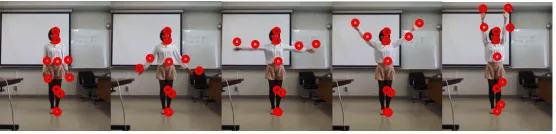
in-Figure 1: An example of human action (action 11)
teresting from the viewpoint of modeling the nat-ural language acquisition process of humans. Hu-mans are believed to acquire language capability from a rather small amount of observations of lan-guage data. To cope with this problem of the poverty of stimuli, certain kinds of zero-shot learning may be exploited. As an example, Sugita and Tani (2005) proposes a model of language acquisition with re-current neural networks. The robot they constructed can generate sentences describing actions that the robot has not yet experienced on the basis of the se-mantic compositionality of the actions.
4
Application to Video Content
Description System
To demonstrate the effectiveness of the proposed methods, we applied the methods to the problem of generating natural language description of short Kinect videos.
Obtaining a huge amount of video data is be-coming easier recently. Whereas we agree with the fact that fully utilization of the data has not been achieved yet. For example, to grasp the con-tent of videos recorded by surveillance cameras, or videos of recorded meetings, we need to watch through the entire videos, which is considerably time-consuming work. If the contents of a video can be recognized and be described with natural language sentences, it will become easier to mine the content of the video data and to achieve various applications such as scene retrieval through natural language queries, etc.
On the basis of such needs, research of the learn-ing relation between natural language and multi-media information has recently been becoming pop-ular in the areas of both natural language process-ing and multi-media information processprocess-ing. Many studies have been conducted to generate sentences to explain human behaviors in a video (Barbu et
al., 2012; Ding et al., 2012a; Ding et al., 2012b; Kobayashi et al., 2010; Kojima et al., 2002; Rohrbach et al., 2013; Tan et al., 2011). As representative studies, Yu and Siskind (2013) pro-pose a method that learns representations of word meanings from short video clips paired with sen-tences. Regneri et al. (2013) consider the prob-lem of grounding sentences describing actions in vi-sual information extracted from videos. Takano and Nakamura (2008, 2009) propose incremental learn-ing of association between motion symbols and nat-ural language. Ushiku et al. (2011, 2012) propose a method to create a caption for a still picture, by learning n-gram models for describing picture from pairs of still pictures and their explanation sentences. Among these works, Kobayashi et al. (2013) are constructing a system for generating natural lan-guage description of short Kinect videos of several kinds of human actions. From the pairs of video data of an action taken by the Kinect and Japanese sen-tences describing the action, the system learns mod-els of observed human actions and language modmod-els of the sentences. Using the two models and the cor-respondence between them, the system can recog-nizes an action in a new video of a leaned action and outputs Japanese sentences describing the action.
In the work, they assumed that they could col-lect natural language sentences describing all target actions and construct language models correspond-ing to all actions from the data. However, when the number of target actions increases, it becomes im-practical to prepare natural language descriptions for all actions. Here, we apply our zero-shot learning method to learn the language models of actions for which we do not have language data.
4.1 Experimental Setup
Table 1: Examples of collected sentenses
1 hidari te wo ageru. (raise left hand.) 2 hidari te wo ue ni ageru.
(raise left hand upward.) 4 hidari te wo mae kara ageru.
(raise left hand to the front direction) 3 hidari te wo shita kara ue ni ageru.
(raise left hand upward from below.) 4 hidari te wo mae no hou kara ue ni ageru.
(raise left hand upward from the front direction)
the actions, and collect several Japanese sentences that describe the actions. Figure 1 shows an exam-ple of an action (“raising both hand through the side direction”). For each action, around 15 sentences describing the action are collected. Table 1 shows some sentences describing the action of raising left hand in the front direction. The collected sentences are segmented into words and bi-gram joint proba-bilitiesp(wi, wi−1)are computed from the data for each action. The number of word pairs that appeared in the data is 360.
We set the number of componentsK = 9: i.e., “up”, “down”, “front” (front direction), “side” (side direction), “hand”, “leg”, “right”, “left”, and “both” (only for hands). The combinatorial relationship be-tween the actions and the elements is illustrated in Figure 2. “L”, “R”, and “B” in the figure denotes “left”, “right”, and “both” respectively. The figure shows that each human action includes four com-ponents in this experiment. For example, Action 3 (ACT 3) is composed of the components “up”, “front”, “hand”, and “left”, and Action 18 (ACT 18) is composed of “down”, “side”, “leg”, and “right”.
Figure 2: Combinatorial relationship between human ac-tions and components
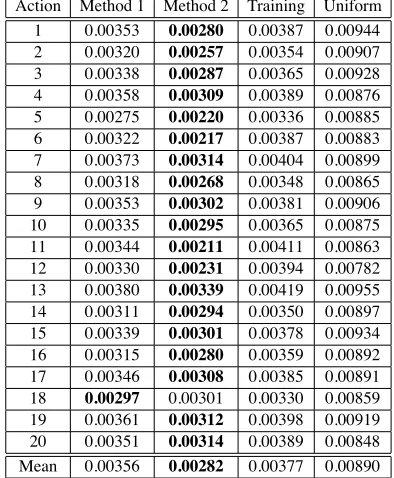
Table 2: Root mean squared error of the estimated values
Action Method 1 Method 2 Training Uniform 1 0.00353 0.00280 0.00387 0.00944 2 0.00320 0.00257 0.00354 0.00907 3 0.00338 0.00287 0.00365 0.00928 4 0.00358 0.00309 0.00389 0.00876 5 0.00275 0.00220 0.00336 0.00885 6 0.00322 0.00217 0.00387 0.00883 7 0.00373 0.00314 0.00404 0.00899 8 0.00318 0.00268 0.00348 0.00865 9 0.00353 0.00302 0.00381 0.00906 10 0.00335 0.00295 0.00365 0.00875 11 0.00344 0.00211 0.00411 0.00863 12 0.00330 0.00231 0.00394 0.00782 13 0.00380 0.00339 0.00419 0.00955 14 0.00311 0.00294 0.00350 0.00897 15 0.00339 0.00301 0.00378 0.00934 16 0.00315 0.00280 0.00359 0.00892 17 0.00346 0.00308 0.00385 0.00891
18 0.00297 0.00301 0.00330 0.00859
19 0.00361 0.00312 0.00398 0.00919 20 0.00351 0.00314 0.00389 0.00848 Mean 0.00356 0.00282 0.00377 0.00890
4.2 Result of Experiment
To evaluate the effectiveness of the proposed zero-shot learning methods, sentences describing one of the 20 human actions are omitted from the training data. Then we estimate Φ for components using
(M −1)×W matrixΨ′ and(M −1)×K ma-trixA′. From the estimated Φˆ we can recover the
language model of the sentences omitted from the training data.
Table 1 shows the root mean squared error (RMSE) of the estimated probability values. The column “Action” denotes the target action for which the language data is omitted and the probability vec-tor is estimated with the zero-shot learning meth-ods. The column “Training” means that the lan-guage model is estimate using all the sentences in the training data. This is a baseline. Another base-line “Uniform” means that the estimated probability vector is uniform distribution, that is, all probability values are equal to1/(# of word pairs). The mini-mum RMSE value for each action is shown in bold face.
Table 3: Comparisons of the top two most probable sentences
action With language data Without language data 1 migi te wo ageru. migi te wo ageru.
(raise right hand.) (raise right hand.) migi te wo ue ni ageru. migi te wo ue ni ageru. (move right hand upward.) (move right hand upward.) 2 migi te wo sageru. migi te wo sageru.
(lower right hand.) (lower right hand.) migi te wo shita ni sageru. migi te wo uekara sageru.
(move right hand downward.) (lower right hand from upper position.) 3 hidari te wo ageru. hidari te wo ue ni ageru.
(raise left hand.) (move left hand upward.) hidari te wo ue ni ageru. hidari te wo ageru. (move left hand upward.) (raise left hand.) 5 ryou te wo ageru. ryou te wo ue ni ageru.
(raise both hands.) (move both hands upward.) ryou te wo mae kara ageru. ryou te wo ageru
(raise both hands in the forward direction.) (raise both hands.) 18 migi ashi wo orosu. migi ashi wo sageru.
(lower right leg.) (lower right leg.)
migi ashi wo yoko kara orosu. migi ashi wo yoko ni sageru. (lower right leg from the side direction.) (lower right leg in the side direction.) 20 hidari ashi wo orosu. hidari ashi wo orosu.
(lower left leg.) (lower left leg.)
hidari ashi wo yoko ni orosu. hidari ashi wo yoko ni orosu. (lower left leg in the side direction.) (lower left leg in the side direction.)
RMSE values obtained from our two methods are small enough. The result demonstrates that Method 2 performs better than other methods for allmost all removed topics. However, in Method 2, the esti-mated values of φj and ψi do not become proba-bilities, that is, some values may become below zero and the sum of the values slightly differ from one. Hence, it becomes a bit difficult to interpret the val-ues. Although this is not so serious problem in prac-tice, this can be considered as a kind of tradeoff be-tween the accuracy and the interpretability.
We also evaluate the RMSE values when we omit language data for more than one actions from the training data. The results strongly depend on the data which are omitted. For example, when we omit language data regarding actions 1, 2, 7, and 8, then the RMSE value of the estimated language model for Action 1 is degraded to 0.00469. However when we omit language data regarding actions 1, 3, 5, and 13, then the RMSE keeps low value 0.00223.
This difference comes from the components in-cluded in the remaining actions. The Action 1 is composed of “raise”, “front”, “right”, “hand”. When
we omitted actions 1, 2, 7, and 8, no actions includ-ing components “right” and “hand” is remained in the training data. Hence this causes rather serious effect to the accuracy of the zero-shot estimation. However, when we omitted actions 1, 3, 5, and 13, all component pairs are still included in the training data. Hence this does not cause serious damage to the estimated language model.
Through the analysis of various cases, we con-firmed that if the choice of omitted data is bal-anced to keep all semantic components remained in the training data, then the performance of zero-shot learning is not degraded so much even though lan-guage data regarding several actions are omitted.
Finally we evaluate the text generation capabil-ity of the estimated language models. Here we use the language models estimated by Method 2. We generate Japanese sentences of high likelihood value in the same way as in the work of Kobayashi et al. (2013), i.e. with the Viterbi algorithm using the lan-guage model of each action.
bi-T. Hofmann. 1999. Probabilistic Latent Semantic
Anal-ysis. Proceedings of the 15th Conference on
Uncer-tainty in Artificial Intelligence, 289-296.
F. Jelinek and R. L. Mercer. 1980. Interpolated Estima-tion of Markov Source Parameters from Sparse Data. Proceedings of the Workshop on Pattern Recognition in Practice.
I. Kobayashi, M. Noumi, and A. Hiyama. 2010. A Study
on Verbalization of Human Behaviors in a Room.
Pro-ceedings of the 2010 IEEE International Conference on Fuzzy Systems.
M. Kobayashi, I. Kobayash, H. Asoh, and S. Guadarrama. 2013. A Probabilistic Approach to Text Generation of
Human Motions Extracted from Kinect Videos.
Pro-ceedings of the World Congress on Engineering and Computer Science 2013.
A. Kojima, T. Tamura, and K. Fukunaga. 2002. Nat-ural Language Description of Human Activities from Video Images Based on Concept Hierarchy of Actions. International Journal of Computer Vision, 50 (2):171– 184.
C. H. Lambert, H. Nickisch, and S. Harmeling.
2009. Learning to Detect Unseen Object Classes
by Between-Class Attribute Transfer. Proceedings of
CVPR 2009.
D. D. Lee and H. S. Seung. 1999. Learning the Parts of
Objects with Nonnegative Matrix Factorization.
Na-ture, 401, 788–791.
M. Palatucci, D. Pomerleau, G. Hinton, and T. M. Mitchell. 2009. Zero-shot Learning with Semantic
Output Codes.Proceedings of NIPS 2009.
M. Regneri, M. Rohrbach, D. Wetzel, S. Thater, B. Schiele, and M. Pinkal. 2013. Grounding Action
De-scriptions in Videos. Proceedings of the 51st Annual
Meeting of the Association for Computational Linguis-tics.
M. Rohrbach, W. Qiu, I. Titov, S. Thater, M. Pinkal, and B. Schiele. 2013. Translating Video Content to
Natural Language Descriptions.Proceedings of ICCV
2013, 433-440.
R. Socher, M. Ganjoo, C. D, Manning, and A. Y. Ng. 2013. Zero-shot learning through cross-modal
trans-fer.Proceedings of NIPS 2013.
Y. Sugita and J. Tani. 2005. Learning Semantic Com-binatoriality from the Interaction between Linguistic
and Behavioral Processes. Adaptive Behaviour, 3 (1):
33–52.
W. Takano and Y. Nakamura. 2008. Integrating Whole Body Action Primitives and Natural Language for
Hu-manoid Robots.Proceedings of 2008 IEEE-RAS
Inter-national Conference on Humanoid Robots, 708–713. W. Takano and Y. Nakamura. 2009. Incremental
Learn-ing of Integrated Semiotics based on LLearn-inguistic and
Behavioral Symbols. Proceedings of 2009 IEEE/RSJ
International Conference on Intelligent Robots and Systems, 1780–1785.
C. C. Tan, Y.-G. Jiang and C.-W. Ngo. 2011.
To-wards Textually Describing Complex Video Contents
with Audio-Visual Concept Classifiers. Proceedings
of the 19th ACM international conference on Multime-dia, 655–658.
Y. Ushiku, T. Harada, and Y. Kuniyoshi. 2011. A
Under-standing Images with Natural Sentences.Proceedings
of the 19th Annual ACM International Conference on Multimedia, 679–682.
Y. Ushiku, T. Harada, and Y. Kuniyoshi. 2012. Effi-cient Image Annotation for Automatic Sentence
Gen-eration.Proceedings of the 20th Annual ACM
Interna-tional Conference on Multimedia, 549–558.
W. Xu, X. Liu, and Y. Gong. 2003. Document Clustering
based on Non-negative Matrix Factorization.
Proceed-ings of 26th Annual International ACM SIGIR Confer-ence, 267–273.
H. Yu, and J. M. Siskind. 2013. Grounded Language
Learning from Video Described with Sentences.