Incorporating Functional Design Patterns
In Software Development
Master Thesis
Business Information Technology
Yoran Maxim Bosman 31.08.2007
Under supervision of University of Twente Maria Laura Ponisio Jos van Hillegersberg
Revision History
Date Description 28.03.2007 - Basic template
16.05.2007 - Concept/work in progress for review by Quinity supervisor 24.05.2007 - Concept/work in progress for review by University supervisors 01.06.2007 - Completely rewritten structure
- Shortened introduction
- Processed other comments and suggestions.
15.06.2007 - First step to incorporate Laura’s feedback, making the thesis more scientific instead of a tutorial
20.06.2007 - Textual improvements - Started with conclusion
- Removed some literature appendices 02.07.2007 - Laura’s comments on the method.
- Quinity’s comments on the thesis.
- Moved several steps from requirements to functional design phase
12.07.2007 - Lots of textual improvements (spelling, grammar) - Added case studies
23.08.2007 - Method in dependency graph form - Case studies revamped
- Designer opinions - Discussion on case studies
- Removed figure “distribute functional design document 31.08.2007 - Textual improvements (spelling, grammar)
- Fixed errors in figures
Summary
When developing software, clients often ask for the same kind of functionality which solves a certain problem they are faced with. Reuse of solutions for recurring problems is possible at many levels. The functional level has not been given as much attention as the technical level. It is wasteful to engineer similar functionality from scratch every time it is required. Therefore the concept of Functional Design Patterns was identified to describe recurring problems and solutions of applications.
From interviews it became clear that currently there is no unified way in which the Functional Design Patterns are applied during the software development process. Although a small library of Functional Design Patterns exist, it is not clear how to integrate them in the development process. Every functional designer decides for himself how and when the pattern repository is consulted and which parts to use.
This thesis proposes a method for the incorporation of Functional Design Patterns in the software development process. The goal of the method is to enable functional and technical designers to make more efficient use of Functional Design Patterns at different phases of development. The method does not focus solely on functional design but ranges from acquisition all the way to maintenance.
The method was developed by combining the state of the practice with an analysis of the state of the literature regarding the integration of design patterns. It provides guidelines for recognizing the applicability of patterns using conceptual decomposition, pattern selection, the combination of multiple patterns in a functional design, the transition to technical design and defines the responsible persons. The result is a systematic method that clarifies the when, where, how and what questions regarding Functional Design Patterns and software development for all parties involved.
This systematic approach to develop software using Functional Design Patterns is explored and demonstrated with an example.
Application of the method in real world projects was not feasible during the execution of this research, therefore empirical evaluation of the presented method remains future work. The method is validated by matching it against the functional reuse approaches of other organisations and a review by designers which showed their support for the method.
We believe that the use of the presented method to incorporate Functional Design Patterns in software development will lead to an improved and more efficient use of Functional Design Patterns in particular at Quinity. Novice designers will know when, where and how to use Functional Design Patterns in the development process thereby bridging a large gap between them and more experienced designers.
Acknowledgements
“and times move so fast, now there does not seem to be any and once it felt that there was more than plenty” I Am Kloot – Astray
First and foremost I would like to express my gratitude to my parents who made it possible to attend University and always stood behind me and my decisions.
I would like to thank all my supervisors, especially Laura who very patiently spent hours answering questions and giving feedback.
My sincere appreciation goes to Quinity for providing a very pleasant work environment and all the great colleagues I have had the opportunity to meet, in particular Fleur, Jacob and Wouter; I wish you all the best. Huge thanks to all my friends, in no particular order... Tom, Hugo, Stephan, Jos, Rutger, Mike, Sjoerd, Dian, Frank, Ron and the ones I forgot. We always have a great time whatever we do.
Table Of Contents
2. State Of The Practice ... 11
2.1 Software Development At Quinity ... 11
2.1.1 Requirements ... 12
2.3 Link Between Process And Patterns ... 17
2.4 Conclusion ... 19
3. Existing Pattern Integration Methods ... 21
3.1 Pattern Oriented Analysis And Design ... 21
3.2 Software Reuse With Analysis Patterns ... 23
3.3 Pattern Driven Analysis And Design ... 23
3.4 Building Software With Patterns ... 24
3.5 Discussion ... 26
3.6 Criteria ... 28
4. Systematic Reuse Of Functional Design Patterns ... 30
4.1 Prerequisites ... 30
4.2 Outline ... 31
4.3 Visualising The Method ... 32
4.4 Acquisition ... 36
4.4.1 Gather Requirements ... 37
4.4.2 Establish A Common Vocabulary ... 38
4.4.3 Create A Conceptual Architecture ... 38
4.4.4 Find Solutions For Conceptual Architecture ... 39
4.5 Functional Design ... 40
4.5.1 Decide Between Candidates And Variants ... 41
4.5.2 Copy And Refine Core Concepts ... 41
4.5.3 Use Prescribed Diagram Style ... 41
4.5.4 Copy, Combine And Refine Information Function Segments ... 42
4.5.5 Develop Data Model... 43
4.5.6 Mock-up Development ... 44
4.6.1 Divide Functional Design ... 46
4.6.2 Write Technical Design ... 46
4.6.3 Develop Software Using Implementation Details ... 47
4.6.4 Merge Technical Design Parts ... 47
4.7 Acceptance Testing ... 47
4.8 Usage And Maintenance ... 48
4.8.1 Update the pattern repository with project experience ... 48
4.9 Example Of An Online Banking System... 49
4.9.1 Acquisition ... 49
5.5.1 The Risks Of Tacit Knowledge ... 69
5.5.2 Service Specifications Are Similar Functional Design Patterns ... 70
5.5.3 Possible Additions ... 70
5.5.4 Problems With Functional Reuse ... 70
5.5.5 Expected Organisational Characteristics ... 71
7.2 POAD Pattern Diagram Examples ... 86
1.
Introduction
1.1
Background
“A pattern is an idea that has been useful in one practical context and will probably be useful in others” [11] 1
Patterns make it easier to reuse successful designs and expressing these techniques allows other developers to make use of proven solutions [12].
Reuse of solutions is possible at different levels of abstraction and many different types of patterns have emerged in the past [2] [12] [13] [41] [11]. The technical level gained a lot of popularity through the book of Gamma et al. [12]. Reuse of functionality on the other hand has not been given as much attention.
Recurring problems can be identified when developing custom software systems. Clients often demand similar types of functionality. Until recently there were no patterns that allowed the description of recurring functionality in applications. Administrative software for banking and insurance organisations for example share many of the same functions for working with personal records and time dependent loans and insurance policies [17] This is the reason Functional Design Patterns were introduced by Guitink [17] and described in detail by Snijders [37].
Functional Design Patterns describe recurring functionality of applications where functionality is defined as:
“All behaviour of an information system concerning the storage, manipulation and display of data”
In previous studies the foundation for Functional Design Patterns were laid out. The reasoning behind Functional Design Patterns, their notation and relation were all explored [37][34][26]. The most important reasons behind Functional Design Patterns are the improvement of the predictability of the software development process and the delivery of high quality software [34]. Because patterns are proven solutions, quality can be improved. The risk of creating something new and forgetting a critical component is lower. Predictability increases because the complexity of the functionality and the time it takes to implement are already known due to past experience. In [26] an approach to implementing the patterns in technical design documents and programming code is presented.
The research is conducted at Quinity B.V. located in Utrecht, The Netherlands. Quinity is a supplier of custom software applications based on internet technology. Quinity’s focus lies with applications in the insurance and banking domain. The software Quinity designs and builds is partly based on a framework. The framework is extended with custom parts and components, which are developed for each client separately. The design process is streamlined by using their own development method
1
which amongst other techniques includes reuse of software and automatic code generation.
The development method is a combination of Linear Application development (LAD) [10] and Dynamic Systems Development Method (DSDM) [38]. Quinity uses the clearly phased structure of LAD but also design and build iterations as proposed by DSDM.
1.2
Problem Statement
Although patterns in essence already capture reusable solutions and have been around for years, less devotion has been given to develop methods to truly integrate (functional) design patterns throughout the software development life cycle.
After Snijders [37] there have been a handful of other researchers [34][26][27] who attempted to broaden the knowledge of Functional Design Patterns. As for the reuse of Functional Design Patterns in software development the work of Van Helden en Reyngoud [34] further specified introduced specialisation and generalisation of similar patterns. Next to this, they also made a head start with describing the use of Functional Design Patterns in the functional design phase and a possible method to combine multiple patterns.
They noted that one of the most important questions left unanswered is how to allow the use of Functional Design Patterns in software development.
Even though a catalogue of smaller Functional Design Patterns has been described in [32] and well-documented domain level Functional Design Patterns exist in various internal Quinity documents, the fundamental problem Quinity is experiencing lies in the fact that at this moment there is no structured way of reusing the developed Functional Design Patterns. Both designers and application developers do not know how to make optimal use of Functional Design Patterns during software development.
1.3
Research Questions
In the context of making the best use of Functional Design Patterns, the problem statement leads to the following main question:
“How can reuse of Functional Design Patterns be incorporated in the software development process?”
To discover a satisfying answer to the research subject the following research questions were developed:
• What is the current way Quinity uses Functional Design Patterns in software
To be able to define what should be improved, it is a requisite to find out the current state of the practice.
• To what extent and in which way is pattern reuse implemented in current
software development methods?
• How can the current Quinity Method be extended with Functional Design
Patterns?
• When should the patterns be applied? • Which elements should be used?
• How do we recognise the possibilities for reuse of Functional Design Patterns? • How can we combine multiple patterns?
• In which context can Functional Design Patterns be used?
1.4
Contribution
The contribution of this thesis can be summarised as follows:
• An analysis of existing methods to integrate design patterns in software
development.
• A systematic and practical method for the incorporation of Functional Design
Patterns in the software development process.
• A survey of the state of the practice regarding functional reuse at external
organisations.
1.5
Approach
To engineer a method for the incorporation of Functional Design Patterns in the software development process the following steps were taken.
To fully understand Functional Design Patterns we attend review sessions for the pattern “time dependence of data” [6] and create new Functional Design Pattern for Authorisation ourselves [3].
The desired state of the practice is found by enquiring functional designers at Quinity on their expectations and experiences with Functional Design Patterns and by means of a thorough literature study on current pattern integration methods. These will lead to criteria the method for incorporating Functional Design Patterns should meet.
The results from the interviews and the literature study are merged to establish a theoretical method for making more efficient use of Functional Design Patterns in software development.
1.6
Thesis Structure
The structure of the thesis is as follows:
Chapter 2 (p. 11) provides an extensive overview of the development method at Quinity. It describes Functional Design Patterns in detail, the process and the link between these two. It lists the criteria a development method for the incorporation of Functional Design Patterns in the development process needs to adhere to.
Chapter 3 (p. 21) analyses existing methods that attempt to systematically reuse patterns in the software development process. To the best of our knowledge no earlier research exists in this area.
Chapter 4 (p. 30) contains a specifically engineered development method with guidelines to incorporate Functional Design Patterns in software development.
Chapter 5 (p. 57 ) validates the developed method in various ways.
Chapter 6 (p. 75) contains the conclusion of the thesis. It presents the results, practical implications and ends with new research questions that are currently left unanswered.
The Appendices (p. 85) contain examples of Pattern Oriented Analysis And Design’s diagrams, the case study interviews and an example of visual Functional Design Pattern composition 0
2.
State Of The Practice
This chapter introduces the state of the practice concerning Quinity’s current view on software development, Functional Design Patterns and the link between them. First Quinity’s development method and phased approach is described. After that, Functional Design Patterns are explored and in the last part the current link between Functional Design Patterns and software development is discussed, which leads to criteria for a new method.
2.1
Software Development At Quinity
A myriad of different software development methods exists. Quinity’s development method is based on a combination of the Linear Application Development [10] and iterative Dynamic Systems Development Method [38].
Linear Application Development is a methodology based on the System Development Method. LAD is a method very suitable for the development of complex administrative systems. It is essentially a waterfall model consisting of five phases; definition study, basic design, detailed design, realisation and implementation. In all these phases there are linear and parallel tracks which together result in the completed information system. LAD does not feature iteration. The next phase only begins after the preceding phase is completed.
Fig. 2 LAD overview
The Dynamic Systems Development Method is an agile development method originally based on Rapid Application Development. DSDM is meant to iteratively and incrementally develop interactive information systems that meet the business needs. It makes use of continuous user involvement and allows requirements to change over time. DSDM works with time boxes to prevent projects going over budget and exceeding their expected development time. DSDM stresses that nothing is built perfectly the first time, but states that early delivery to end-users can improve the quality in the end [38].
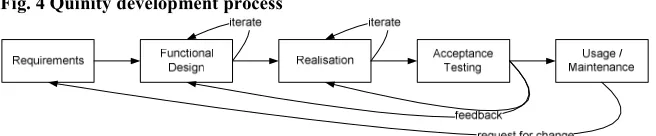
Quinity uses the clear phases from LAD, but also adds business analysis, functional and technical design iteration and implementation from DSDM. The process is depicted Fig. 3.
Fig. 4 Quinity development process
2.1.1 Requirements
In this phase all requirements are gathered from and with clients. The client also prioritises the requirements according to the MoSCoW rules from DSDM. (Must have, should have, Could have and Won’t have) [38]. This phase also includes business analysis as specified by DSDM, which gives insight in business processes that have to be automated. The requirements documented states what an information system will deliver.
2.1.2 Functional Design
Functional design as defined by Quinity [9] is a phase during software development in which documents are created that elaborate on how the information system will fulfil its requirements. The functional design phase delivers:
• The functional description
This describes the information functions the system will support.
• Mock-ups
A graphical representation of the user interface which gives an idea how the end users will interact with the system.
• Data model
Entity Relationship Diagram [7] of the conceptual data structure, which later will make up the system’s database.
2.1.3 Realisation
The realisation phase consists of creating the technical design document and implementing this. The technical design document as defined by Quinity [31] explains the way the functional design should be realised. All design decisions are made explicit in a technical design. This includes the memory model. Class diagrams, exception handling, core algorithms which require explanation.
2.1.4 Acceptance Testing
After the realisation phase the information system is deployed and the client tests if all functionality works like it should according to the functional design. The Acceptance tests provide feedback to the designers and as such the functional design and realisation phase are repeated.
2.1.5 Usage And Maintenance
When the client approves all functionality, the software will go live. The development now enters a maintenance state. Maintenance is done via request for change proposals, which brings development back in the requirements phase.
2.2
Functional Design Patterns
When developing multiple applications for several clients, there is functionality that is desired by more than one client, this can be captured in a Functional Design Pattern.
“Functional Design Patterns describe recurring functionality problems in (domain specific) applications”[37]
Functional Design Patterns capture domain knowledge and define structure on an abstract level. The main motives of Functional Design Patterns are:
• Transfer knowledge
Functional Design Patterns contain knowledge how to solve functional problems. The advantage is that new functional designers have a quick way of getting a grasp on the way functionality problems are solved instead of having to rely on more experienced designers to help them.
• Increase predictability
It is believed that using Functional Design Patterns makes it possible to improve the predictability of the software development process. Predictability increases because the complexity of the functionality and the time it takes to implement are already known due to past experience.
• Improve quality
Because Functional Design Patterns describe proven solutions for recurring problems, the risk of developing a new untested solution is lower.
• Save time and cost
Reusing solutions in functional and technical designs is expected to save time and cost.
• Increase maintainability
Reusing functional and technical designs will ultimately create similar code, which increases maintainability.
In essence Functional Design Patterns combine analysis patterns with interaction [41] and data patterns.
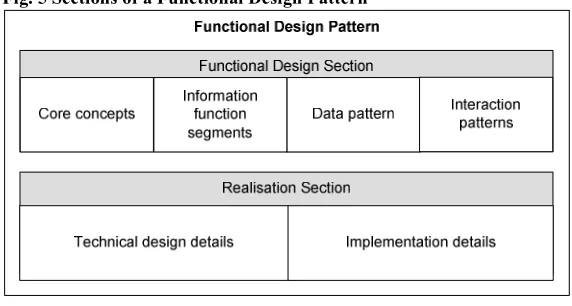
A Functional Design pattern consists of a functional design section and a realisation section. Both sections are explained below. Fig. 5 shows the composition of a single Functional Design Pattern.
Fig. 5 Sections of a Functional Design Pattern
Functional Design Section
• Core concepts
Core concepts describe the most important constructs and definitions used. The core concepts allow a common vocabulary to be used amongst designers.
• Information function segments
Information function segments are the building blocks for information functions. Multiple segments can be combined to form one Information Function but the can also be used separately. Information functions are functions in an information system executed by either a human or computer that display and or manipulate data. [17]. Examples of information functions are “order item”, “print quotation” and “edit person information”.
• Interaction patterns
Interaction patterns show the way users interact with the system [41]. These consist of a mock-up with a description of the interaction.
• Data pattern
Realisation Section
• Technical design details
The patterns feature technical details, such as class diagrams that should be used when writing a technical design.
• Implementation details
Some patterns have small code snippets that show how to solve a particular functional problem with code. These code snippets can be used when implementing the Functional Design Pattern in a project.
Some Functional Design Patterns also define extensions to the basic pattern, which might only be applicable in certain situations, with certain requirements. Other patterns may define variants when it is not clear yet which is the superior solution.
Functional Design Patterns can be categorised in aspect level and domain level patterns. Design Patterns at the aspect level describe functionality which is the same for all administrative applications independently of their domain, they are domain transcending.
Thus, patterns at the aspect level do not capture domain knowledge. They describe standard implementations for information functions. Examples of aspect level design patterns include browsing entities and Entity Management [17]. Domain level Design Patterns describe abstract functionality for a specific domain or problem area. Examples of domain level design patterns are pension calculations and chain integration in the insurance field [17].
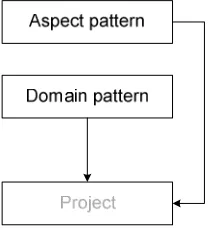
When Functional Design Patterns are used in a functional design they will be altered to the project’s context, this is the lowest level. Domain level patterns are used in projects. When no domain level pattern is available, an aspect level pattern is directly applied in a project. The design pattern applied at the project level is not really a pattern, that is why it is greyed out in the figures. The arrows represent can be used in.
To create domain patterns, the Functional Design Patterns from the aspect level are made specific using knowledge from executed projects.
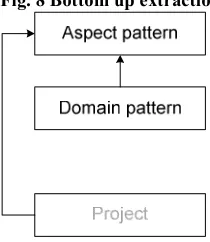
Fig. 7 Bottom up and top-down development of Domain level pattern
When functional problems occur in multiple projects, they are abstracted to either the domain or the aspect level. It is also possible to further abstract from a domain level pattern to the aspect level when similar functionality is identified across domains is discovered later on.
2.3
Link Between Process And Patterns
This section describes the current link between Quinity’s software development method and Functional Design Patterns. To engineer a method for the incorporation of Functional Design Patterns preliminary interview session were organised to enquire about the way these patterns are used right now.
These interviews with functional designers at Quinity showed that the overall feeling is that the usage of Functional Design Patterns is not standardised. Apart from small Functional Design Patterns which are already embedded in components, the experience in applying Functional Design Patterns is limited.
Practitioners know the definition and there also appears to be a consensus on the advantages of Functional Design Patterns. Designers are convinced that Functional Design Patterns help to comprehend subject matters more rapid, reduce complexity and improve the overall quality of delivered software.
Following is a list with the most important points extracted from the interviews.
Important Phases
The phases of development in which Functional Design Patterns play an important role are the requirements, functional design and realisation phase. After the technical design phase, the usage of Functional Design Patterns decreases. Instead the effort that goes into creating Functional Design Patterns and updating the repository increases. Feedback from implementing a pattern in a project is used to update the pattern documentation and new patterns are derived. This is implicit; it is assumed people will act on their own. When a Functional Design Pattern at the aspect level exists without technical details Quinity assumes that developers which implemented the pattern will have the discipline to update the pattern.
Cost Estimation
Experienced functional designers identified that it would be helpful if Functional Design Patterns could be used in the acquisition phase to support the creation of more accurate time and cost estimations. Because the patterns are created from existing projects it is already known approximately how much time their implementation takes.
Common Vocabulary
Some designers already use Functional Design Patterns as a structuring mechanism in interviews and design sessions with clients. The core concepts that are explained in each Functional Design Pattern give designers and clients a common vocabulary.
functional designers agree that the core concepts from a Functional Design Pattern should be communicated to the client. Quinity also encountered occasions where the client had already made an analysis of their own product workflow, presenting fifteen different states the product could be in. Without the guidance of a Functional Design Pattern they might have thought that the analysis the client came up with was correct, but due to experience and the core concepts described in the Functional Design Pattern it could be discovered that there were in fact only three states which carried along five process dimensions [30].
Some functional designers believe it may cause confusion because the concepts can be quite difficult to understand and in the end the customer is interested solely in a working product, how problems are solved is not there concern. Therefore they feel it would be wise for the designer to just keep the concepts in his head, using the Functional Design Pattern as a tool.
Guide Technical Design
Furthermore an important role of Functional Design Patterns is defining the mapping from functional design to technical implementation. When a Functional Design Pattern is distilled from a successfully executed development project, the creator of the Functional Design Pattern is already intensely submerged in the subject matter that it would be wasteful to neglect writing down hints for the actual implementation of the described functionality. Therefore, current Functional Design Patterns also contain technical documentation that is used by technical designers in the creation of a technical design in the implementation phase.
Unclear Usage Of Parts
Which parts of Functional Design Patterns should be transferred to a functional design document and how this should be done is acknowledged by practitioners to be ambiguous. Mostly the diagram styles used in the Functional Design Pattern are used. The text is not directly usable in the functional design document. Thus it is not a matter of copy and pasting Functional Design Patterns from their document to the functional design.
Pattern Recognition
Recognizing patterns is not a mechanical task. The knowledge of patterns is currently located in the designers head. When they encounter requirements which seem to be very generic they check if members of other projects may have defined usable patterns. The lack of a knowledgebase or pattern repository which can be consulted to search for patterns is recognised by the designers. The current tactic is to come up with a keyword for the problem and search for documents describing these.
Domain level patterns are occasionally fully shown to clients, but no guidelines exist which parts should explicitly be shown or when a designer should refrain from showing documentation.
Pattern Documentation
The way patterns are documented was said to slightly vary between patterns. Not all patterns use the same structure, which sometimes makes them difficult to read. The documentation is very extensive which makes it necessary to read the entire pattern to get a good grasp of the concept.
Pattern Combining
When multiple patterns are found which could possibly be of use in the functional design, designers admit that a structured way of combining the patterns is not available. No real order exists in applying the patterns. One designer noted that it is probably best to start with the pattern which has the most significant impact on the design.
Pattern Repository Growth
The functional designers identify that in the future a lot more patterns will be developed and when that growth is achieved it would be beneficial if a structured approach was available to make optimal reuse of developed patterns. The future as envisioned by Quinity’s management is the total incorporation of Functional Design Patterns in software development. This will hopefully allow them to maintain their competitive edge.
2.4
Conclusion
In this section we showed the software development process at Quinity, Functional Design Patterns and the current link between the development process and patterns.
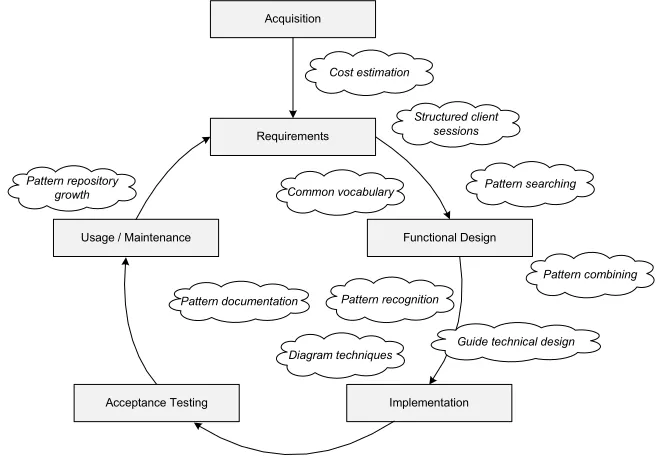
Summarizing, the state of the practice shows that functional designers see a bright future for Functional Design Patterns but a standardised way of putting them to use is missing. Not all functional designers agree on the precise incorporation of Functional Design Patterns in the development process. Fig. 9 represents the current state of the practice, a semi structured approach with uncertainty and ambiguity. This is the way a new functional designer would feel when starting at Quinity.
Fig. 9 Semi structured approach to Functional Design Patterns
Requirements
Functional Design
Implementation Acceptance Testing
Usage / Maintenance
Pattern combining
Guide technical design Cost estimation
Pattern recognition Structured client
sessions
Diagram techniques Pattern documentation
Common vocabulary
Acquisition
Pattern repository growth
3.
Existing Pattern Integration Methods
This chapter presents an analysis of the existing methods to integrate the use of patterns into software development. The purpose of the analysis is to find ideas from integrating design patterns in development which are also applicable to Functional Design Patterns.
The methods were chosen because they attempt to integrate patterns in a systematic way. First off the Pattern Oriented Analysis And Design method from Yacoub and Ammar [2] is explained. Software reuse with analysis patterns is covered in 3.2, after which a small extension to POAD is shown [18] that makes use of analysis patterns as well. An alternative, building software with patterns [4] is presented in paragraph 3.4.
3.1
Pattern Oriented Analysis And Design
Yacoub and Ammar [2] state that designing applications by deploying technical design patterns is not a straightforward task. Although several pattern composition techniques have been proposed, they do not have a systematic process, which is what POAD proposes. Fig. 10 presents the POAD process overview.
POAD uses so called constructional design patterns. They represent design components in the application design. Constructional design patterns can be glued together because they are object oriented patterns, have interfaces for composition and their solution has a class model of collaborating classes. This thus excludes the composition of patterns which do not have a class diagram.
Yacoub and Ammar view technical design patterns as building blocks that solve a particular problem. The requirements of an application are transformed into conceptual components. Once the problems of the applications have been written down and assigned to conceptual components the patterns are applied like building blocks. A system in POAD consists entirely of technical design patterns.
POAD presents pattern diagrams at different levels, allowing tracing back and forth between diagrams at a higher or lower level. The visual representation is viewed as essential to understand the role patterns play in development. Examples of these pattern diagrams can be found in appendix 7.2.
Yacoub states that although they describe their process in a linear fashion, incremental and iterative development is encouraged. Iteration is made possible because POAD documents all steps.
After the design process POAD follows a traditional object oriented detailed design process and implementation.
Two interesting additions are
• the identification of an acquaintance process
• merging similar responsibilities
The initial class diagram is transformed into an optimised diagram. Because all patterns are selected and instantiated without looking into details, it is probable that there is some overlap. Designers might implement Observer patterns multiple times. The abstract Observer class can thus be shared. Next to overlap there will be classes which are very trivial responsibilities. These can be merged. Using either pattern documentation, application specific documentation or by studying pattern relationships the designer finds classes that can be merged.
3.2
Software Reuse With Analysis Patterns
Geyer-Schultz and Hahsler [13] suggest using patterns in the analysis phase of software development because it has the potential to reduce development time significantly because reuse is introduced early on in the process and the interface between the analysis and design phase is improved.
Fig. 11 Analysis patterns in the software development process
Fig. 11 shows the main tasks where analysis patterns contribute to software development.
• Analysis patterns speed up modelling of abstract analysis models by providing
base models with examples and their limitations
• Analysis patterns facilitate the transformation of the analysis model to the design
model.
Geyer-Schulz stresses a consistent format for describing analysis patterns, in contrast to Fowler’s free form [11].
They also mention that a key challenge is establishing a common vocabulary between authors and users of patterns. A common vocabulary is important to achieve efficient communication.
Geyer-Schulz start off with a desire to create a simple application. This application is turned into an analysis pattern. At the beginning of each new project the analysis pattern is used as the base. Gradually the analysis pattern is extended because the bigger projects need more functionality.
The abstraction of an analysis pattern from an executed project so it can be reused in subsequent projects after which the original pattern is updated is very similar to Functional Design Patterns. The challenge of a common vocabulary was also mentioned in the interviews with Quinity designers.
3.3
Pattern Driven Analysis And Design
transformed into a design model using design patterns. This is the basic idea which was explained in the previous section.
Fig. 12 PAD Design method
The problem the software should solve is decomposed into sub problem using existing analysis techniques. A solution for every sub problem is sought for in an Analysis patterns repository. These analysis patterns are integrated to an analysis model. Details on how this is achieved are not given. The relations between classes in the analysis model are annotated and based on these relations design patterns groups are selected from a design pattern repository. Patterns within groups are studied to select the best suitable ones. From this a so called Analysis-Design diagram is developed. The design model can be obtained by adding the detailed design of the design patterns to the model.
Hamza does not elaborate on the proposed method in detail. The essence is that the transformation from problem decomposition to design model is aided by using core concepts from analysis patterns. This is a useful idea in the light of Functional Design Patterns.
3.4
Building Software With Patterns
Buschmann [4] states that next to pattern specific implementation details we need general guidelines to construct pattern based software. What is lacking in the current software architecture field is the answer to the question how we can combine technical design patterns into partial or larger structures.
The application of patterns he says, is not a mechanical task. Experience is needed to compose them to large structures in a meaningful way. Guidelines to help us do this cannot be simple two-line answers, they need structure. Every guideline describes its context, the problem, a solution and a clear example. This structure makes the guidelines patterns themselves.
that precedes it or the one that it completes and are overall very dependent on each other. Therefore the eleven patterns together form a pattern language.
Fig. 13 Pattern language of pattern based software development
The most important pattern is Piecemeal growth. This outlines the overall process for the construction of software using patterns. The software architecture grows by using top-down refinement and bottom-up refactoring until it is complete and consistent.
Architectural vision defines the systems baseline architecture, this step uses analysis- and architectural patterns that help with the specification.
Step-wise refinement describes how to resolve design problems by detailing and extending a given software architecture. This is the top-down process from piecemeal growth.
Refactor instead of large lump design elaborates on how to continue when a design solution does not fit with part of an existing design. This is the bottom-up process of piecemeal growth.
Stable design center talks about specifying an extensible design with the help of patterns.
Plan for growth describes how we can prepare a software architecture for its own evolution.
Component-oriented legacy integration shows how to take advantage of design patterns when 3rd party components have to be integrated in the software architecture.
Enforce architectural vision supports the application of global design principles in every part of the software architecture.
One pattern at a time helps with combining several patterns which together should define the design of a specific part of the system
Design integration precedes implementation introduces a way to implement a pattern in a given architecture.
Merge similar responsibilities combines multiple patterns which have similar responsibilities.
Buschmann [5] states that patterns can be stabilised further by extending the list of known uses whenever it is applied successfully. The more known uses, the higher the chance a functional designer will identify it in the analysis phase of a subsequent project.
The overall pattern based development process presented by Buschmann is an evolutionary process and he states that it will not work in a waterfall-like process model. It is not an entirely new way of development; instead it complements existing approaches with respect to the use of patterns. The only really new addition to existing models is the definition of a baseline architecture at the start of development, even before the specification of the detailed domain model. To integrate this into software development models we can simply add the creation of a baseline architecture right after the requirements analysis phase.
Another condition introduced by Buschmann is the need for a software architect. The Architectural vision cannot be defined by all developers; rather it is to be thought up by one individual with vision. This has to be an experienced developer with overview of the entire system as well as insight into specific needs. The defined baseline architecture and vision need to be communicated to the developers that develop individual parts and in the end integrate them to a consistent whole.
3.5
Discussion
The presented integration methods all provide valuable insights to reuse patterns in software development. Although different in their setup there are a few common elements and features of the methods that we will keep in mind for the design of the method for incorporating Functional Design Patterns in the software development process.
Focus On Technical Aspects
The presented methods heavily focus on technical aspects of design. They go directly to class diagrams from requirements without creating a functional design. Class diagrams seem to be the desired end result, this only partially holds for development using Functional Design Patterns.
Acquaintance
Yacoub identified a process in which the designer gains knowledge about existing patterns and the presented solutions. We feel this is important for Functional Design Patterns as well.
Visual Representation
diagram of the entire system does not seem as useful. Instead, difficult parts of the system may be elaborated on in more detail.
Another reason why the visual representation of pattern composition is not applicable to Functional Design Patterns is because these patterns are not black boxes. It is not possible to accurately define their input and output. We actually tried this during our research but found that composing Functional Design Patterns is different from applying multiple patterns. This is demonstrated in Appendix 7.3.
No Influence After Requirements And Design Phase
Most methods stop after the design phase this means that no hints concerning the rest of the phases can be extracted.
Merge Pattern Responsibilities After Applying
Both POAD and “Building software with pattern” show that patterns can be merged to reduce overall complexity of class diagrams.
Incremental Design
All approaches reviewed show that reuse is an incremental and iterative process, nothing is built perfectly in the first attempt and during development unforeseen requirements will certainly arise.
Common Vocabulary
The importance of a common vocabulary is stressed solely by Geyer-Schultz [13]. We think this is because technical design is closer to code, where analysis patterns are closer to natural language.
Minimal Impact On Current Development Methods
Currently existing development methods can largely stay intact in all cases. Pattern integration although difficult, in essence just introduces a few more steps in the software development process. This is something we also want to achieve. Radically changing the current development process is not desired and not feasible.
Conceptual Decomposition
All methods decompose problems into smaller concepts. This helps when tackling difficult issues and shows where reuse is possible. Hamza and Geyer-Schultz use analysis patterns to transform the problems into a design model. This idea is applicable to Functional Design Patterns as it will probably be easier to recognise patterns when the problems are clearly divided.
Systematic But Not Mechanical
A Complementary Process
POAD build software systems from patterns only, they seem to forget that occasionally patterns are not applicable at all. POAD assumes all the conceptual problems we decompose the system in can be solved by patterns. We do not think a system can be built entirely from Functional Design Patterns, especially when the pattern repository, which at the time of writing is not that extensive, does not cover all domains. Therefore the method should be complementary to the existing process.
Pattern Selection
Buschmann [4] refers to himself [5] for pattern selection techniques. The general guideline is to pick the pattern that best matches the problem description with the least liabilities. A mathematical approach to decide between patterns has been proposed by McPhail and Deugo [24]. This is a method which uses weighted criteria to evaluate which pattern deserves preference over another pattern. In a real life situation however finding criteria to evaluate on is as hard as selecting the right pattern.
Intrinsic Analysis Patterns
Analysis patterns are already contained in Functional Design Patterns because the core concepts together with the data model are in fact analysis patterns.
3.6
Criteria
Resulting from the discussion and state of the practice we can state the desired properties and criteria a method to incorporate Functional Design Patterns in software development should fulfil.
C1. Clearly phased
Because the method will be integrated into the existing development method, which is divided in clear phases, the new method should also have this property. It should be clear which contribution Functional Design Patterns have in which phase.
C2. Systematic but not mechanical
Although it should be clear which parts of a Functional Design Pattern can be used; developers should retain a certain amount of design freedom, they are not robots.
C3. Clear division of tasks
To avoid confusion about responsibilities the new method should clearly define who is responsible for which activities.
C4. Facilitate communication
as designers and clients easier. In this thesis we will solely focus on the common vocabulary.
C5. Systematic pattern recognition
The method should support systematic pattern recognition. To apply patterns we first have to be able to recognise them. A systematic way of doing this is necessary to allow even novice functional designer to recognise them, albeit somewhat slower.
C6. Pattern combining
A structured approach to combining multiple patterns should be included. Currently such an approach is identified as lacking by functional designers. C7. Complementary method
4.
Systematic Reuse Of Functional Design Patterns
This chapter defines a systematic approach to reuse Functional Design Patterns in software development. The method we present is developed with the criteria from chapter 3 in mind. The first section explains the prerequisites that we assume for the method to be applied successfully. Next we give a short overview and a graphical representation of the method. The fourth section describes the process of developing information systems with the incorporation of Functional Design Patterns in detail. The process is demonstrated using a fictional case depicting the development of an online banking system in the last section.
4.1
Prerequisites
For the method to be applied successfully the following assumptions are made.
• A pattern library with Functional Design Patterns is available.
This can be anything from a book with patterns, to a folder with documents. In the described process any of the above is called a pattern library to keep things generic.
• It is known how patterns are created and supported. The focus of the method that
is defined in this chapter is on the reuse of patterns. The creating and supporting activities are thought of as the basic building blocks for the described process to work.
• A standardised pattern structure. The assumed setup of the structure of a
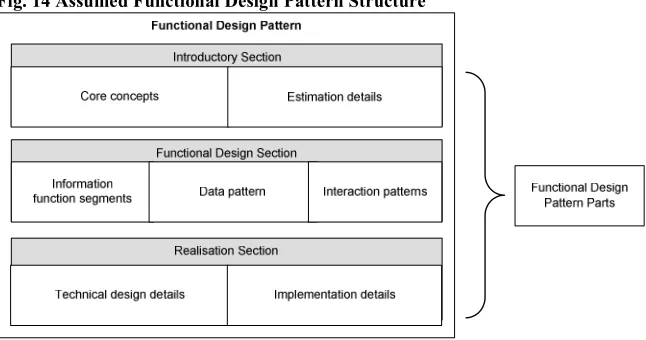
Functional Design Pattern is the following.
4.2
Outline
The overall process is based on the current Quinity development method, with the addition of the acquisition phase. Each phase is introduced here briefly. Functional Design Pattern parts (from Fig. 14) are written in an oblique font.
Acquisition
In the acquisition phase we try to detect Functional Design Patterns as early as possible so we can adjust the quotation based on Estimation details. The recognition of patterns in this stage is solely for those with plenty experience in the use of Functional Design Patterns. When the acquisition phase has been completed the next step is the requirements phase.
Requirements
This phase is divided in the actual gathering of requirements in client sessions where we make use of the Core concepts of Functional Design Patterns to streamline communication with the customer. From the requirements we distil the information functions the system will support. We group these into conceptual problems which together make up the conceptual architecture. Each conceptual problem is matched against the pattern repository to find applicable patterns.
Functional Design
In the Functional Design phase we deliver a document which contains a description of the information functions, the way end-users will interact with these and the conceptual data model. We copy the applicable Information function segments parts of Functional Design Patterns to the functional design document and adjust them where needed. The data model is obtained by applying the Data patterns from Functional Design Patterns. Interaction patterns are applied on the mock-up to show the way users will interact with the system.
Realisation
The Technical details given in Functional Design Patterns are integrated in the technical design. When the technical design is completed the system is implemented, making use of the Implementation details in the patterns.
Usage And Maintenance
4.3
Visualising The Method
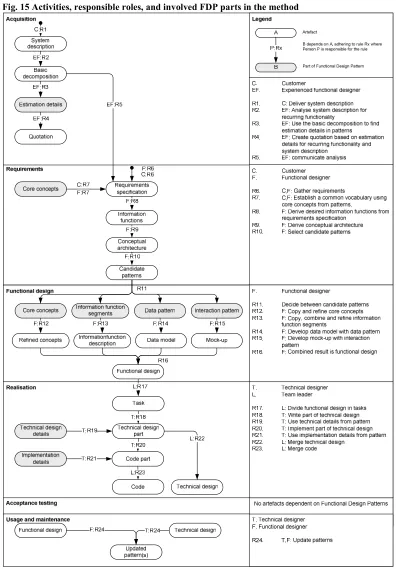
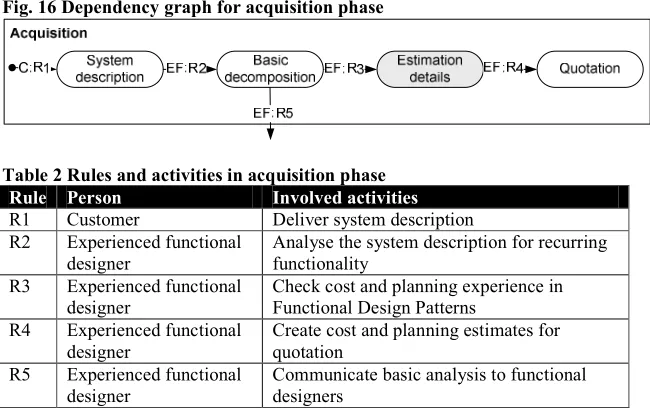
To visualise the process we use the Artefact Dependency Graph notation as presented by Tekinerdoğan [39]. This model shows the dependencies of the artefacts developed during the execution of the software development process.
The entire process is graphically represented in Fig. 15. In the graph every node represents an artefact and every arrow a dependency. Node A Node B means that B needs A, or can only be produced after B. Every dependency has an accompanying rule associated with it. Every rule has one or more persons responsible for the rule. This is denoted as Person : Rx.
The gray nodes represent the parts from Functional Design Patterns as shown in Fig. 14.
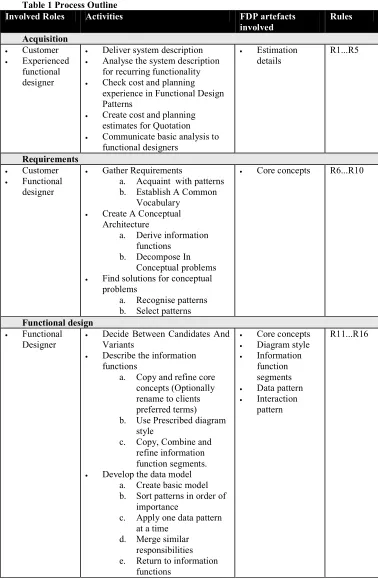
Table 1 Process Outline
Involved Roles Activities FDP artefacts involved b. Sort patterns in order of
f. Extend with pattern
• Deal with open issues in patterns. • Document used patterns for • Write the technical design for a
specific part
• Merge the technical design parts
• Technical
• Evaluate on the use of patterns in
this project
• Update the pattern library
• Modified
sections
4.4
Acquisition
The starting point of any project is its acquisition. Recognition of Functional Design Patterns is reserved to experienced functional designers who already have the knowledge and know-how to recognise the patterns from only a basic description of the systems purpose.
Fig. 16 Dependency graph for acquisition phase
Table 2 Rules and activities in acquisition phase Rule Person Involved activities
R1 Customer Deliver system description
R2 Experienced functional designer
Analyse the system description for recurring functionality
R3 Experienced functional designer
Check cost and planning experience in Functional Design Patterns
R4 Experienced functional designer
Create cost and planning estimates for quotation recent cost and planning estimates and accompanying real figures and results. Comparing the estimates with the results to adjust the new estimate allows for more accurate cost and planning estimate. This will position the organisation better in the eyes of the customer.
It is important that this basic analysis is not lost between this phase and the next when we continue with the next step because obviously we want to optimise efficiency.
Requirements
In the requirements phase the use of Functional Design Patterns is intertwined with gathering the requirements, analysing these and determining the Functional Design Patterns that will be used in the functional design. This section explains the steps to take.
Fig. 17 Dependency graph for requirements phase
Table 3 Rules and activities in requirements phase Rule Person Involved activities
R6
Derive desired information functions from requirements specification
R9 Functional designer
Decompose in conceptual problems to create a conceptual architecture
We will now discuss these activities in detail. 4.4.1 Gather Requirements
The first step in the analysis phase is obtaining the requirements from the client.
Acquaint With Patterns
Before diving in to the requirements gathering sessions at a client a functional designer should at least get himself acquainted with the patterns that:
• were discovered in the acquisition phase • available patterns in the clients domain
Due to the fact that a pattern library is always under development it would be a good ideas to revisit the acquaintance process for every new project, just to be sure the designers are equipped with the latest information. Although a quick grasp of the pattern library is useful, it is not desirable to study each and every pattern in the entire library [2].
4.4.2 Establish A Common Vocabulary
At this point the functional designer has basic knowledge of the patterns and has studied the core concepts. It is exactly these concepts that help to structure the requirements and design sessions at a client. The usage of the core concept section of Functional Design Patterns gives the functional designer the ability to detect concepts in the current project and at the same time prevent us from drawing the wrong conclusions. The result is a better analysis that will result in a better design as well.
There are two options; both with their own trade-offs.
• Option A Explain Functional Design Patterns and the used core concepts
In this case the designer explains the client about the existence of Functional Design Patterns and the core concepts discovered in previous projects.
At the time of writing it is not clear when to use a term from the client’s vocabulary and when to use the developers preferred term. In practice a common vocabulary evolves from combining client terms and developer terms.
• Option B Refrain to tell clients about Functional Design Patterns
In this case the designer adapts to using the preferred terms of the client and later on in the functional design document create notes and references to the core concepts of a Functional Design Pattern that were actually meant. This could possibly result in miscommunication later on in the project.
Option A is the preferred option, because it lowers the risk of miscommunication. Although there might be times that a client is not willing to cooperate.
4.4.3 Create A Conceptual Architecture
To discover Functional Design Patterns to be applied we first need to define a conceptual architecture of functional problems the information systems is made up of.
The functional designer should create the conceptual architecture by:
• Derive information functions from requirements • Decompose the system in conceptual problems
Derive Information Functions
Deriving information functions is done by analysing every requirement for verbs and nouns which indicate actions to be taken by end-users of the system. Obviously deriving information functions is not totally straightforward, it takes experience to find all information functions.
Decompose In Conceptual Problems
4.4.4 Find Solutions For Conceptual Architecture
At this phase of development we have the conceptual components and want to select patterns that will solve our functional problems.
Recognise Patterns
Not all conceptual components may correspond to a Functional Design Pattern. Some components might capture functionality which is encountered very rarely, thus no pattern is available. Other components might easily be recognizable as suitable for Functional Design Patterns. Recognizing that a pattern might be applicable is made easier by translating our requirements into the conceptual architecture. Luckily we can also systematically query the pattern repository for each conceptual component to find Functional Design Patterns, although slower it is a sure and safe path to succeed.
Select Candidate Patterns
The steps to select a candidate pattern are the following:
• Specify the problem
We have already done these steps in the previous section where the main problems were captured in the baseline architecture.
• Select the pattern level and domain
Functional Design Patterns are defined at multiple levels. Determine if the conceptual component is an aspect or domain level pattern. Ask the questions:
a. What do I want to do? This is the aspect level b. Where do I want to do this? The answer is the domain
• Select the sub domain
Selecting the problem’s domain narrows the scope and also ensures that the patterns are made more specific for the current problem. When selecting the domain “insurance” for example, there may also be sub domain patterns defined like “car insurance” and “life insurance”. When hesitant about including a pattern in the candidate set, just add it. It can always be discarded later. Compare problem descriptions
With the set of candidate patterns, the designer should compare the core concepts of the Functional Design Pattern with the problem description to determine if the pattern matches the problem at hand. This process can be sped up if a special tool is available that supports searching and matching problems descriptions with problems.
• Expand search domain
4.5
Functional Design
The purpose of the functional design phase is to develop a functional design of the information system. In this step in the design we not only regard the candidate patterns as black boxes that solve a functional problem but also open it to see the pattern internals.
The Functional Design section of a Functional Design Pattern, Fig. 5 (p. 14) is divided in multiple sections itself. These sections will also be reflected in the functional design. In short the actions to take are shown in Table 4.
Table 4 How elements of a Functional Design Patterns should be used
Element Action
Core concepts Copy & refine
Diagram style Use
Data model Copy & refine
Information function segments Copy, Combine & refine Interaction diagrams Apply in design, no direct copy
Fig. 18 Dependency graph for functional design phase
Table 5 Rules and activities in requirements phase Rule Person Involved activities
R11 Functional designer
Decide between candidates and variants R12 Functional
designer
• Copy core concepts, refine when needed • Optionally rename to clients preferred terms • Use prescribed diagram style
R13 Functional designer
Copy, combine and refine information function segments R14 Functional
designer
Develop the data model
• Create basic model
• Return to information functions • Extend with pattern independent entities
R15 Functional designer
Develop the mock-up
• List information functions to be supported visually • Check Functional Design Patterns for interaction
patterns
• Apply interaction patterns during design
R16 - Combined result is functional design
- - • Deal with open issues in patterns.
• Document the used patterns for the technical designer
We will now discuss the activities in detail. 4.5.1 Decide Between Candidates And Variants
If multiple patterns are recognised to be applicable to a single functional problem we have to evaluate each candidate pattern. The general guideline is to pick the pattern that best solves the problem. By comparing Pick a pattern that has the most benefits and least liabilities. Obviously if a pattern does not define its liabilities then it is up to the analytical skills of the functional designer.
Functional Design Patterns may define variants and extensions to the basic pattern. In particular situations some solution may be more applicable than in others. The variants are described in the patterns and the functional designer should choose the one that is most applicable in the current project.
4.5.2 Copy And Refine Core Concepts
A functional design needs to be a complete document that should be readable without other documents; this is not possible without a clear description of the core concepts. Therefore the definitions of the core concepts should be copied to the functional design document.
If we have chosen not to enlighten the client with the core concepts, rename the core concepts to the clients preferred term.
Not every pattern has core concepts which are “complete”. Some patterns have core concepts that cannot be applied without defining them further. An example of this is the workflow pattern at the aspect level [30] that defines the subject of workflow. The project specific subject of workflow needs to be defined as a new core concept. Furthermore the new concept might also need to be defined in the data model.
4.5.3 Use Prescribed Diagram Style
to come up with a way of representing the model with while a sufficient way has already been developed.
4.5.4 Copy, Combine And Refine Information Function Segments
We already have the ingredients to describe our information functions in detail:
• A list of information functions • Applicable patterns
In the functional design these need to be combined. Because the information functions needed in the information system may consist of several information function segments we recommend the following approach.
• Copy the list of information functions to functional design document
• Read the selected patterns to define the mapping them and the information
functions
• Copy, combine and refine information function segments
Every applicable information function provided in the pattern needs to be copied. Because an information function is built out of information segments, we combine information function segments from multiple patterns into a single information function. This is shown schematically in Fig. 19.
Fig. 19 Combining information function segments
Functional Design Functional Design Pattern X
Information function A Information function
segments
Functional Design Pattern Y
Information function segments
Functional Design Pattern Z
Information function segments
Information function B
Information function Z ... R
P
V S
4.5.5 Develop Data Model
An important part of the functional design is the data model. This section explains step by step how Functional Design Patterns are integrated in the data model.
Create Basic Model
Every information system has a few entities which are the most important. Most information functions will perform operations on the data of these entities. These entities make up our basic model. Entities from conceptual problems for which we did not select a pattern should also be added to the basic model. It is wise to think of future requirements when developing the data model. Prepare the data model for extensibility by introducing subtypes for example. A detailed explanation on how to create the basic data model is not part of this thesis.
Sort Patterns In Order Of Importance
Patterns are applied in order of importance. Starting with the most important pattern we incrementally refine and complete the design by replacing all conceptual problems in our conceptual architecture one by one with the data patterns from the Functional Design Patterns. The “most important” pattern is obviously an ambiguous statement, open to interpretation. Guidelines for this sorting process are out of the scope of this thesis and remain future work.
Apply One Data Pattern At A Time
We incrementally apply the Functional Design Patterns that were selected in the requirements phase. By applying the patterns stepwise to the data model we ensure that we only deal with one problem at a time and that the design adheres to the most important structures the best.
Merge Similar Responsibilities
When multiple patterns are applied, overlap might occur in their objects. The authorisation pattern and the workflow pattern both define “User”. These responsibilities need to be merged so only one User object remains.
Return To Information Functions
The pattern internals might show concepts we did not address yet. For example, in the authorisation pattern the users have access to information functions but the authorisation pattern also defines “restrictions”. Restrictions define that although a role in principle has access to an information function, there are certain conditions under which this access does not hold. The same principle applies to the Workflow pattern which exposes “dimensions” and “process dimensions”.
Extend With Pattern Independent Entities
In the previous section we found solutions for our conceptual architecture, unfortunately there were also problems that could not be solved via Functional Design Patterns. We should not forget to implement these pattern independent entities.
4.5.6 Mock-up Development
Functional Design Patterns should be applied during the development of a mock-up. Functional Design Patterns define interaction patterns that should be incorporated into the design because they give a good example of the way end-users will interact with the system.
The functional designer should:
• List information functions to be supported visually • Check Functional Design Patterns for interaction patterns • Apply interaction patterns during design
List Information Functions To Be Visually Supported
Before applying the interaction patterns from Functional Design Patterns we decide which information functions should have their information functions supported visually by basic screen examples.
Check Functional Design Patterns For Interaction Patterns
For every information function selected the Functional Design Patterns should be checked for interaction patterns.
Apply Interaction Pattern During Design
For every information function for which a mock-up screen is created the defined interaction pattern is applied.
There are two types of description formats for interaction patterns
• Text
Sometimes the interaction pattern just consists of text. It is the responsibility of the f