DOI : https://doi.org/10.32628/CSEIT1952176
Age Group Classification of Facial Images Using Rank Based Edge Texture Unit
(RETU) and Fuzzy Texture
Jammula Nimitha1, Kuraganti Nukeswari2, Kuraganti Sudha3, Kurapati Sumithra4, Rama Devi Gunnam*5 1,2,3,4 Student, Computer Science and Engineering, Vasireddy Venkatadri Institute of Technology, Guntur,
Andhra Pradesh, India
5 Faculty, Computer Science and Engineering, Vasireddy Venkatadri Institute of Technology, Guntur, Andhra
Pradesh, India ABSTRACT
We as human beings can estimate the age of a person based on his facial features but there are situations where there is a need for the computers to determine the age of a person based on the picture or photograph. Here comes the situation to teach a machine to determine the age group of a person with his picture. This is applicable in the fields like determining the age of a criminal with his picture or determining the age of a patient when he has undergone an accident and many other fields. To address this problem the paper proposed a technique of finding the age with Rank Based Edge Texture Unit (RETU). The uniqueness of this method is that it divides the age group into 7 classes i.e. the age groups are 1-10, 11-20, 21-30,31-0,41-50,51-60,>60 . With this method, the results cope up to 97.16% and to slightly increase the efficiency the present paper proposes to add Fuzzy Texton features.
Keywords : Rank Based Edge Texture Unit (RETU), Fuzzy Texton
I. INTRODUCTION
Generally we can gather the human information like the gender, age, health, emotion and so on by observer with constant observation on particular individual. The main aim of information technology is to achieve the automatic human identification using computer systems with a human face database in such applications. Here the main problem is to solve the issue of age growth of human face.
Nabil Hewahi [1] considered in the first stage, age is classified into four categories. The four categories are child, young, youth, and old. In the second stage of the process we classify each age category into two more specific ranges. The uniqueness in this research paper that most of the previous research work do not consider the fine tuning of age as we are presenting
in our research. This project has been developed, tested and trained using the Easy NN tool. Two public data sets were used to test the system, these are FG-NET and MORPH. Overall identification rate is 82.3%.
geometric features (eyes to nose, nose to mouth) are used to calculate age of babies. Three wrinkle features (forehead, two eyes corners, two cheeks )are used to calculate age of other three groups of adults. The identification rate achieves 90.52% for the training images and 81.58% for the test images. Overall identification rate is 85.96%.
Kwon, Y.H.,[3] An age groups are classified into one of three age groups: babies, young adults, and senior adults. The computations are based on cranio-facial development theory and skin wrinkle analysis. In the implementation, there are two features primary, secondary features. The primary features are the eyes, nose, mouth, chin, virtual-top of the head and the sides of the face. From these features, ratios that distinguish babies from young adults and seniors are computed. In secondary feature analysis, a wrinkle geography map is used to guide the detection and measurement of wrinkles.
Murty, G.S.[4] An age group classification of facial images five age groups as child(0-12),young adults(13-25),middle-aged adults (26-45), senior adults(46-60) and Senior citizens(>60). LD,RD,LV,RV,TH and BH patterns are used.Grey beings can easily categorize a person’s age group from a facial image but, computer vision cannot recognize the persons age group from facial images. The present paper proposes a novel scheme of age classification system using features derived from co-occurrence parameters using Rank based Edge Texture Unit (RETU).The RETU is used reduces each image is 3x3 sub image into 2x2 sub image. The co-occurrence features extracted from the RETU
provide complete facial image information for age classification purpose. The main aim of information technology is to achieve the automatic human identification using computer systems with a human face database in such applications.it is required to solve the issue of age growth of human face by using RETU algorithm we can get efficient results, in order to get more efficient result (approximately 99.99%)we use Fuzzy Texton in our proposed system. Traditional age classification methods consists of several algorithms and methods to classify age in [6] the ages are classified into two stages based n user requirement and 5 neural networks are used in this for age group classification and the accuracy is 82.3%. In [7] the age is classified into 3 age groups based on primary and secondary features with the help of features extraction. In [8] sobel edge operator is used and 2 back propagation neural networks are used, here the overall identification accuracy is 85.96%. The present system efficieny copes upto 97.16%. With the help of Fuzzy Texton the efficiency can be increased.
II. PROPOSED METHOD
The proposed system comprises of seven steps right from color image cropping to age group classification. The block diagram for the proposed system is shown in Fig 1.
facial image and the resultant cropped image. In the step 2, if the facial image is a color image then it is converted into a gray level facial image by using HSV color model. In the third step, edge image is obtained by converting a 3 × 3 sub image into a 2 × 2 sub image by using Robinson compass masks. In the fourth step, rank values are assigned on the obtained edge image. In the fifth step, RETU are evaluated. In the sixth step co-occurrence matrix (CM) is formed on RETU. In the seventh step, statistical features are evaluated on the new RETU-CM for age group classification. In the last step a new algorithm is derived for an efficient age classification system based on the feature set derived from the proposed RETU-CM features.
RGB to HSV color model conversion
The color image is represented in RGB(Red Green Blue) color model and the aim is to convert this into HSV( Hue Saturation Value) model and extract the ‘h’ values of the facial image and the task is to process this ‘hue’ value to obtain the results. The range of Hue is in the range [0=255]. The process of conversion is as follows,
𝑉 = max(𝑅, 𝐺, 𝐵) (1)
𝑆 =𝑉−min(𝑅,𝐺,𝐵)
𝑉 (2)
𝐻 =[𝐺−𝐵]
6𝑆 𝑖𝑓𝑉 = 𝑅 (3)
𝐻 =1
3+ [𝐵−𝑅]
6𝑆 𝑖𝑓𝑉 = 𝐺 (4)
𝐻 =13+[𝑅−𝐺]6𝑆 𝑖𝑓𝑉 = 𝐵 (5)
Extraction of Edge Information from the facial image
Image edges give information about the image content. Edge detection is a fundamental tool used to obtain information from images in image processing. In this method uses local edge features as preprocessing step. In this method gets information about cropped facial image by using Robinson Compass edge operator. Edge detection masks can be extended by rotating them like compass masks these masks allow explicit information about edges in any direction. When we apply the Robinson compass edge detection on image to segment it enhance the borders from the background image .
By taking single mask and is rotating it to eight major compass orientations they are, North, Northwest, West, Southwest, South, Southeast and Northeast these are represented in fig .3 .
Generation of RETU from Edge matrix
In this method from the obtained 2×2 edge matrix local information is extracted in the form of Texture Unit is represented in Fig. 5. In proposed method 2×2 edge image is decomposed into set of small units is Texture Unit (TU).Which defines the local edge texture information. The following process used to derive RETU of the TU values and to evaluate RETU from edge information .Sorting the each element in 2×2 edge matrix. Sort the elements in 2×2 edge matrix (E0(r0) ,E1(r1) ,E2(r2) ,E3(r3 )) and assign rank values (0, 1, 2 or 3) to sorted elements . If ,the value in 2×2 matrix is same then assign the same rank value .After assigning the rank values to sorted elements we will get the elements of TU (R1, R2 ,R3 ,R4 ). From this TU value is calculated by using the equations 5 and 6 will get Rank based Edge Texture Unit ( (RETU ).
TU= ∑3𝑘=0𝑝𝑜𝑤𝑒𝑟(4, (𝑘 − 1)/2) ∗ 𝑥𝑖 (i=1,2,3,4) (6)
Generation of Co-occurrence Matrices on RETU Matrix
Grey level co – occurrence matrices (GLCM ) introduced by Haralick .It is introduced to describe texture by statistically how certain grey levels occur in relation to other grey level .The major disadvantage of Co-occurrence Matrix (CM ) is large
number of possible values (256 values ) but these values are not correlated and requires more computation time .Size of CM is depend on grey level range of image . To reduce grey level values and overall dimension of image, the proposed method used CM. A set of RETU -CM features are extracted on image defined by Haralick .This method describes both statistical and structural information of images . The features used in this method are energy , entropy ,inertia ,local homogeneity , correlation and cluster shade .They are represented from equations 7 to 12.
Entropy=∑𝑁−1𝑖,𝑗=0− ln(𝑃𝑖𝑗)𝑃𝑖𝑗 (7)
Energy=∑𝑁−1𝑖,𝑗=0− ln(𝑃𝑖𝑗)2 (8)
Inertia=∑𝑁−1𝑖,𝑗=0𝑃𝑖𝑗(i-j)2 (9)
Local Homogeneity=∑ 𝑃𝑖𝑗 1+(𝑖−𝑗)2 𝑁−1
𝑖,𝑗=0 (10)
Correlation=∑𝑁−1𝑖,𝑗=0𝑃𝑖𝑗
(𝑖−µ)(𝑗−µ)
𝜎2 (11)
Cluster Shade (cs) = ∑𝑁−1𝑖,𝑗=0(𝑖 − 𝑀𝑥+ 𝑗 − 𝑀𝑦)3 ∗ 𝑃𝑖𝑗
(12)
The above equations from 7 to 12 are used for calculating the global features(energy, entropty, inertia, localhomogenity, correlation, clustershade). In HSV color conversion if color is not clear then these equations are used.
Fuzzy Texton Algorithm
III. RESULTS AND DISCUSSION
The sample proposed scheme established a database collected from the scanned photographs.These are the sample facial images. Sample images from three age groups are shown in Fig.6.The RETU features are extracted from total images the statistical features are extracted from RETU-CM of different age groups of facial images and the results are stored in the database.
Age Group Classification by the proposed Algorithm Using RETU-CM Features and Fuzzy Texon
The suggested method classifies the facial images into seven age clusters 1–10,11–20, 21–30, 31–40, 41– 50, 51–60 and greater than 60. The statistical features are mined from RETU-CM of different age groups of facial images and the results are stored in the feature database. Feature set leads to depiction of the training images. From the above reflection, we originate an algorithm for the classification of human facial image based on the RETU-CM features. The classification is listed in algorithm 3.1. robe or test images are taken to show the significance of the proposed RETU-CM method. On probe image, RETU-CM features are evaluated on the facial image. Based on RETU-CM features, the probe images are tested. 15 probe images
are collected randomly from various databases, belonging to various age groups and results are given
Fig 7. Input Image
Fig 8. edge detection image
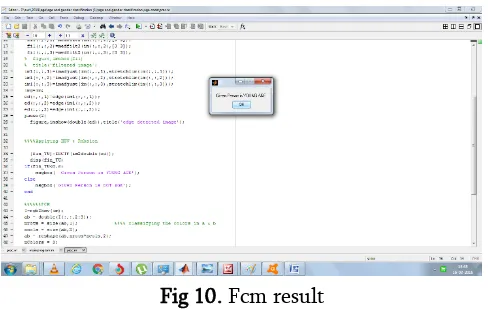
Fig 10. Fcm result
Comparison with Other Methods
The proposed classification algorithm based on RETU-CM and FCM are powerful methods when compare to existing algorithm . In this algorithm RETU-CM classifies seven age groups. When compare to other existing methods the proposed method gives better results. The percentage Classification results of the newly proposed methods is 97%.
IV. CONCLUSION
The proposed method derived a new age group classification feature using rank based edge texture units. The novelty of the proposed method is, that reduces the overall dimension of the image by three times while preserving the local features. The other benefit of the derived RETU features is, it abridge the TU size from 0 to 6,561 and 0 to 79 to 0 to 17 as in the case of original TU and fuzzy texture units one-to-one. That is why the proposed RETU is more suitable for the evaluation of Co-occurrence features and it reduced greatly the overall complexity. The proposed method does not need a specific standard classification procedure. When associated with other methodologies, the proposed system is more effective and exhibiting effective and significant classification ability by using minimum subset of co-occurrence features (i.e., energy, entropy and contrast). The experimental results openly specify the efficacy of the proposed RETU-CM over the various the other
further explored. The problem of varying orientation of the face needs to be addressed. The overall percentage of classification rate is 97.
V. REFERENCES
[1]. Nabil Hewahi, Aya Olwan, Nebal Tubeel, Salha EL-Asar, Zeinab Abu-Sultan “Age Estimation Based on Neural Networks”2009-2010 CIS Journal
[2]. Wen-Bing Horng, Cheng-Ping Lee and Chun-Wen Chen “Classification of Age Groups Based on Facial Features “ 183-191 (2001)
[3]. Kwon, Y.H., da Vitoria Lobo, N.: “Age classification from facial images. Comput. Vis. Image Underst”. 74(1), 1–21 (1999)
[4]. Murty, G.S., Vijaya Kumar, V., Obulesu, A.: “Age classification based on simple LBP transition”s. Int. J. Comput. Sci. Eng. (IJCSE) 5(10) (2013)
[5]. Ch Rajendra Babu, E. Sreenivasa Reddy and B. Prabhakara Rao “Age Group Classification of Facial Images Using Rank Based Edge Texture Unit(RETU) and Fuzzy Texton”.
[6]. Hasegawa, H., Simizu, E.: Discrimination of facial age generation using neural networks. T. IEE Jpn. 117-C(12), 1897–1898 (1997)
[7]. Kwon, Y.H., da Vitoria Lobo, N.: Age classification from facial images. In: Proceedings of IEEE Conference on Computer Vision and Pattern Recognition, pp. 762–767,
classification from facial images. Comput. Vis. Image
[11]. Ueki, K., Hayashida, T., Kobayashi, T.: Subspace-based age-group classification using facial images under various lighting conditions. In: Proceedings of the 7th International Automatic Face and Gesture Recognition (FGR '06). IEEE 0-7695-2503-2/06 (2006)
[12]. Vijaya Kumar, V., Sasi Kiran, J., Hari Chandana, V.V.: An effective age classification using topological features based on comprσσessed and reduced grey level model of the facial skin: Int.J. Image Graphics Signal Process. 6(1), 9–17 (2014)
Cite this article as :