Available online:
https://edupediapublications.org/journals/index.php/IJR/
P a g e | 948Implementing Multiple Security for
Audio Steganography
Reena Antil
& Dr. Mamta Sachdeva
1Department of Computer Science
South Point Institute of Technology and Management (SITM),
Deenbandhu Chhotu Ram University of Science & Technology (DCRUST), Sonepat
2Department of Computer Science
South Point Institute of Technology and Management (SITM),
Deenbandhu Chhotu Ram University of Science & Technology (DCRUST), Sonepat
Abstract—Cryptography is being used by organization in order to transmit a secret message successfully without being caught up by the enemies. Cryptography has evolved rapidly from the ancient times to the modern world. The information which is being transmitted from one place to another is vulnerable to various types of active and passive attacks. Therefore, the security of the information is one of the most challenging aspects of communication in today’ time. Steganography is the process of hiding information which are need to be transferred on insure transmission medium (e.g., Internet) so that no one except sender or receiver can know the very existence of information. As the message is not visible so it does not get any attention of unauthorized users which safeguard the secret message. A hybrid method for audio steganography (using modified Direct Sequence Spread spectrum) and cryptography (using advanced random permutation with multiple key applications) has been proposed in this paper
.
Keywords— Audio Watermarking, Spread Spectrum, Encryption coding
I. INTRODUCTION
Both cryptography and steganography ensure secret transfer of data and information over the insecure communication medium. Some of the techniques employed in early days are writing with an invisible ink, drawing a standard painting with some small modifications, combining two images to create a new image, shaving the head of the messenger in the form of a message, tattooing the message on the scalp and so on [1].
Generally applications are developed by teams of limited members but they are used by large group of users. There are some persons called hackers that modify by original applications a little bit & make profit without giving any benefits to their original creators. It is obvious that hackers are more in number
compared to those who create. Therefore we must assign high priority for protection of applications. Protection techniques have to be efficient, robust and unique to restrict malicious users. The development of technology has increased the scope of steganography and at the same time decreased its efficiency since the medium is relatively insecure. This lead to the development of the new but related technology called “Watermarking”. Some of the applications of watermarking include ownership protection, proof for authentication, air traffic monitoring, medical applications etc [2]. Watermarking for audio signal has greater importance because the music industry is one of the leading businesses in the world.
Steganography [3] works by replacing bits of useless or unused data in regular computer files such as graphics, sound, text, HTML, or even video with bits of different, invisible information. This hidden information can be plain text, cipher text, or even images. In a computer-based audio Steganography system, secret messages are embedded in digital sound. The secret message is embedded by slightly altering the binary sequence of a sound file. Existing audio Steganography software can embed messages in WAV, AU, and even MP3 sound files. Embedding secret messages in digital sound is usually a more difficult process than embedding messages in other media, such as digital images. These methods range from rather simple algorithms that insert information in the form of signal noise to more powerful methods that exploit sophisticated signal processing techniques to hide information.
In this paper we propose a hybrid approach for audio steganography (using modified Direct Sequence Spread spectrum) and cryptography (using advanced random permutation with multiple key applications).
II. OVERVIEW OF WORK
Available online:
https://edupediapublications.org/journals/index.php/IJR/
P a g e | 949One type is time domain technique and the other is
transformation based method. The time domain
techniques include methods where the embedding is performed without any transformation. Watermarking is employed on the original samples of the audio signal. One of the examples of time domain watermarking technique is the least significant bit
(LSB) method. In LSB method the watermark is embedded into the least significant bits of the host signal. As against these techniques, the transformation based watermarking methods perform watermarking in the transformation domain [4][5].
In general, the time domain techniques provide least robustness as a simple low pass filtering can remove the watermark. Hence time domain techniques are not advisable for the applications such as copyright protection and airline traffic monitoring; however, it can be used in applications like proving ownership and medical applications.
A. LSB Coding
This technique is one of the common techniques employed in signal processing applications. It is based on the substitution of the LSB of the carrier signal with the bit pattern from the watermark noise. The robustness depends on the number of bits that are being replaced in the host signal [6][8]. This type of technique is commonly used in image watermarking because, each pixel is represented as an integer hence it will be easy to replace the bits. The audio signal has real values as samples, if converted to an integer will degrade the quality of the signal to a great extent. The operation of the 2-bit LSB coding is shown in Figure 3 below.
Figure 3: LSB Coding
B. Spread Spectrum Technique
These techniques are derived from the concepts used in spread spectrum communication [7]. The basic
approach is that a narrow band signal is transmitted over the large bandwidth signal which makes them undetectable as the energy of the signal is overlapped. In the similar way the watermark is spread over multiple frequency bins so that the energy in any one bin is very small and certainly undetectable.
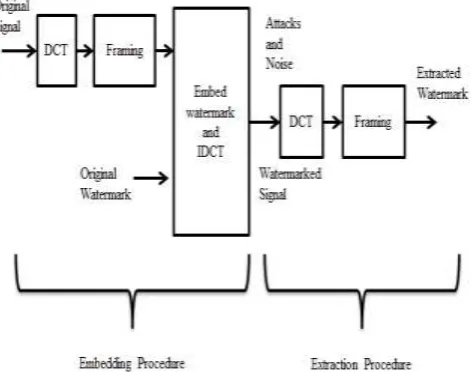
In spread spectrum technique [10][11], the original signal is first transformed to another domain using domain transformation techniques. The embedding technique can use any type of approach for example quantization. Zhou et al. proposed an algorithm embedding watermark in 0th DCT coefficient and 4th DCT coefficients which are obtained by applying DCT on the original signal. Both embedding and extraction procedure can be interpreted using Figure 4. The original signal is transformed into frequency domain using DCT. Then watermark is embedded to the sample values in that domain. Reverse procedure is followed to obtain the watermarked signal. This process of generating embedded signal is shown as embedding procedure in Figure 4 below.
Figure 4: Example for spread spectrum technique
III. PROPOSED WORK
Available online:
https://edupediapublications.org/journals/index.php/IJR/
P a g e | 950Two versions of SS can be used in audio steganography: the direct-sequence and frequency-hopping schemes. In direct-sequence SS, the secret message is spread out by a constant called the chip rate and then modulated with a pseudorandom signal. It is then interleaved with the cover-signal. In frequency-hopping SS, the audio file's frequency spectrum is altered so that it hops rapidly between frequencies.
The steps for implementation of proposed method are as follows:
A. AUDIO WATERMARKING
A1. EMBEDDING OF WATERMARK
First of all read cover audio signal and get equivalent 2D matrix & calculate size of matrix i.e. rows and column. Read watermark image and get equivalent 2D matrix & calculate size of matrix i.e. rows and column. Convert watermark matrix into binary matrix & reshape binary matrix into row matrix.
Get spreading size by multiplying spreading factor i.e. 2 with total number of elements of binary watermark matrix and generate a random binary key sequence according to spreading size, so as to provide security. Encode watermark matrix by Binary XOR-ing of row vector watermark matrix with key sequence. Now, encoded watermark matrix has a double size as compared to that of original.
If cover image is too big then divide cover image matrix into two parts. Select a block size, which must be suitable to the size of first part of cover image matrix & divide cover image matrix into first and second part.
Segmentation of first part matrix into an array of matrix is given below. Each sub-matrix has a specific number of elements which depends upon block size. Application of Discrete Cosine Transform (DCT) on each element of all the sub-matrices. Embedding of watermark by multiplication of encoded watermark matrix with cosine transform matrix. Join reconstructed matrix with second part of cover image matrix and getting of embedded image and resize embedded image according to original audio cover signal. Plot frequency coefficients of both audio cover signals, so as to make comparison.
A2. EXTRACTION OF WATERMARK
Read audio cover signal and audio watermarked signal & calculate size of cover audio signal. Read watermark image and calculate size of watermark image. Also calculate number of elements in watermark image.
Select block size of 10 so as to increase the spreading and divide both images i.e. cover and marked audio into two parts. Declare empty cell having array of empty matrices so as to fill these with first part of both matrices.
Also declare threshold value so as to fill the empty cell up to a certain limit. Application of discrete cosine transform on both cell. Division of 3rd element of each matrix of watermarked signal by that of original audio cover signal.
Decoding of watermark components or removal of key sequence. Reconstruction of extracted watermark according to size of original watermark image .Plotting of both watermark images i.e. original and extracted.
B. AUDIO STEGANOGRAPHY
B1. ENCRYPTION PART
1. Inputting and reading of secret audio data.
2. Checking of length and sampling frequency of audio data
3. If sampling frequency > 44100 than cut down the length and sampling frequency of secret audio.
4. Conversion of row vector audio to column vector audio.
5. Calculation of size of column vector.
6. Generation of 1st random row vector of a fixed length and seed value.
7. Generation of 2nd random row vector according to number of elements of audio column vector.
Available online:
https://edupediapublications.org/journals/index.php/IJR/
P a g e | 9519. Random permutation of audio or
rearrangement of elements of audio matrix according to 3rd random row vector.
10. Updation and modification of 1st random row vector.
11. Generation of empty row cell according to the seed value.
12. Allotment and division of random permuted audio into empty cells with fast Fourier transform of each elements.
13. Allotment of rest of the audio part into last cell.
14. Conversion of cell into matrix.
15. Again application of random permutation on updated audio matrix according to 2nd random row vector.
16. Normalization of updated and permuted audio matrix elements (real and imaginary separately).
17. Saving of all 3 random vector and maximum value of real and imaginary parts as key for decryption.
18. Joining of both part (real and imaginary) of normalized audio.
19. Saving of the new encrypted audio.
B2. DECRYPTION PART
1. Reading of encrypted audio file.
2. Conversion of row vector audio to column vector audio.
3. Calculation of size of column vector audio.
4. Loading of key matrix.
5. Estimation of all 3 random vectors and maximum values of real and imaginary parts.
6. Estimation of seed value.
7. Combining of real and imaginary parts of encrypted audio with their maximum values.
8. Rearranging of encrypted audio according to 2nd random vector.
9. Generation of empty row cell according to the seed value.
10. Allotment and division of encrypted audio into empty cells with inverse fast Fourier transform of each elements.
11. Conversion of cell into matrix.
12. Rearranging of encrypted audio according to 3rd random vector.
13. Saving of new decrypted audio.
Figure 5 below shows the Comparison of watermarked audio and recovered watermarked audio
Figure 5: The Comparison of watermarked audio and recovered watermarked audio
IV. CONCLUSION
Steganography is the art and science of writing hidden messages in such a way that no one, apart from the sender and intended recipient, suspects the existence of the message, a form of security through obscurity. Steganography is not a new form of science. With Steganography process we replace the unused bits of data of different regular files such as text, graphics, sound, HTML, and video with the bits of different unseen or invisible data or information. The hidden data or information can be plain text, cipher text, images or audio. In an audio Steganography system, secret messages are embedded in digital sound. Existing audio Steganography software can embed messages in WAV, AU, and even MP3 sound files. The information which is being transmitted from one place to another is vulnerable to various types of active and passive attacks. Therefore, the security of the information is one of the most challenging aspects of communication in today’ time. A hybrid method for audio steganography (using modified Direct Sequence Spread spectrum) and cryptography (using advanced random permutation with multiple key applications) has been proposed in this paper
.
Available online:
https://edupediapublications.org/journals/index.php/IJR/
P a g e | 952[1]. Prabhsimran Singh, Sukhmanjit Kaur, SabiaSingh , “Cryptography: An Art of Data Hiding”. Prabhsimran et al, / International Journal of Computer and Communication System Engineering (IJCCSE), Vol. 2 (1), 2015, 117-120. ISSN: 2312-7694
[2]. Darko Kirovski and Henrique S. Malvar, Fellow, IEEE, “Spread-Spectrum Watermarking of Audio Signals”. IEEE Transactions On Signal Processing: Special Issue On Data Hiding.
[3]. Parul Shah, PranaliChoudhari and Suresh Sivaraman, “Adaptive Wavelet Packet Based Audio Steganography using Data History”. 2008 IEEE Region 10 Colloquium and the Third ICIIS, Kharagpur, INDIA December 8-10. 286.
[4]. Jisna Antony, Sobin C. Sherly A. P, “Audio Steganography in Wavelet Domain – A Survey”. International Journal of Computer Applications (0975 – 8887) Volume 52– No.13, August 2012.
[5]. Cairong Li, Wei Zeng, Haojun Ai, RuiminHu, “Steganalysis of Spread Spectrum Hiding Based on DWT and GMM”. 2009 International Conference on Networks Security, Wireless Communications and Trusted Computing.
[6]. Bhagyashri A. Patil, Vrishali A. Chakkarwar, “Review of an Improved Audio Steganographic Technique over LSB through Random Based Approach”. IOSR Journal of Computer Engineering (IOSR-JCE) e-ISSN: 2278-0661, p-ISSN: 2278-8727 Volume 9, Issue 1 (Jan. - Feb. 2013), PP 30-34
www.iosrjournals.org.
[7]. Mark Sterling, Edward L. Titlebaum, Xiaoxiao Dong, Mark F. Bocko, “An Adaptive Spread Spectrum Data Hiding Technique For Digital Audio”. 0-7803-8874-7/05/$20.00 ©2005 IEEE, V – 685, ICASSP 2005.
[8]. Muhammad Asad, Junaid Gilani, Adnan Khalid, “An Enhanced Least Significant Bit Modification Technique for Audio Steganography”. 978-1-61284-941-6/111$26.00 ©2011 IEEE.
[9]. Pooja P. Balgurgi, Prof. Sonal K. Jagtap, “Intelligent Processing : An Approach of Audio Steganography”.2012 International Conference on Communication, Information & Computing Technology (ICCICT), Oct. 19-20, Mumbai, India.
[10]. Ming Li,, Michel K. Kulhandjian, Dimitris A. Pados, E, Stella N. Batalama and Michael J. Medley, “Extracting Spread-Spectrum Hidden Data From Digital Media”, IEEE Transactions On Information Forensics And Security, VOL. 8, NO. 7, JULY 2013.
[11]. Mark Sterling, Edward L. Titlebaum, Xiaoxiao Dong, Mark F. Bocko, “An Adaptive Spread Spectrum Data Hiding Technique For Digital Audio”. 0-7803-8874-7/05/$20.00 ©2005 IEEE, V – 685, ICASSP 2005.
[12] Ramandeep Kaur, Amandeep Kaur, “Hiding Copyright Mark in Images using Watermarking Technique”, International Journal of Advance Research in Computer Science and Management Studies, Volume 2, Issue 10, October 2014
[13]. S. Gao, R.M. Hu, W. Zeng, H.j. Ai, and C.R. Li , “A Detection Algorithm of Audio Spread Spectrum Data Hiding”, National Engineering Research Center for Multimedia Software Wuhan University :XKDQ, China [email protected] . 978-1-4244-2108-4/08/$25.00 © 2008 IEEE.
[14]. Bhagyashri A. Patil, Vrishali A. Chakkarwar, “Review of an Improved Audio Steganographic Technique over LSB through Random Based Approach”. IOSR Journal of Computer Engineering (IOSR-JCE) e-ISSN: 2278-0661, p-ISSN: 2278-8727 Volume 9, Issue 1 (Jan. - Feb. 2013), PP 30-34