Available Online atwww.ijcsmc.com
International Journal of Computer Science and Mobile Computing
A Monthly Journal of Computer Science and Information Technology
ISSN 2320–088X
IMPACT FACTOR: 6.017
IJCSMC, Vol. 7, Issue. 9, September 2018, pg.49 – 54
A REVIEW ON TASK
SCHEDULING IN MOBILE CLOUD
COMPUTING ENVIRONMENT
Mr. C.Arun
1, Dr. K.Prabu
21
Research Scholar, PG & Research Department of Computer Science Sudharsan College of Arts & Science, Pudukkottai, Tamil Nadu, India
2
Assistant Professor, PG & Research Department of Computer Science, Sudharsan College of Arts & Science, Pudukkottai, Tamil Nadu, India
1
[email protected], 2 [email protected]
ABSTRACT: Cloud computing is a recent and upcoming technology which includes various areas. Due to some inherent defects of mobile devices, such as limited battery energy, insufficient storage space, mobile applications are confronted with many challenges in mobility management, quality of service (QoS) insurance, energy management and security issues, which has stimulated the emergence of many computing paradigms, such as Mobile Cloud Computing (MCC), Fog Computing, etc. Mostly one network application can be decomposed into fine-grained tasks which consist of sequential tasks and parallel tasks. With the assistance of mobile cloud computing, some tasks could be offloaded to the cloud for speeding up executions and saving energy. Maintaining energy conservation the efficiency of energy has become a major problem with increased usage of devices consuming more energy due to MCC paradigms allow to offload some tasks to the cloud for execution. To manage this problem task are schedule in both at the mobile device and in the mobile cloud. Task scheduling is taken as the factor to reduce consumption of energy. Tasks can be assigned and scheduled based on the algorithms and so energy can be conserved.
Keywords: Cloud computing, mobility management, quality of service (QoS) insurance, energy management, Task scheduling, security.
I.
INTRODUCTION
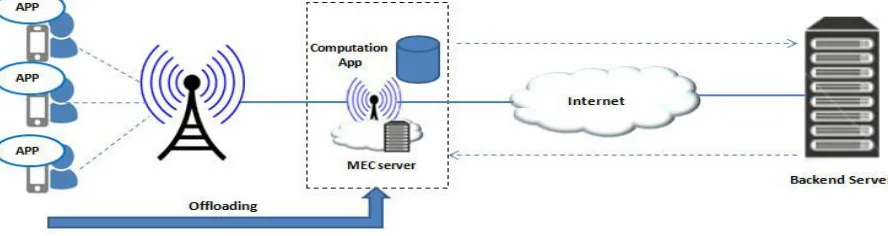
dynamic services over the Internet, such as data, applications, bandwidth, memory and IT services. Mobile cloud computing (MCC), which combines cloud computing and wireless network and aims at improving the performance of mobile applications hosted at mobile devices such as smartphones and PDAs, has developed very fast in the past few years [1]. Due to some inherent faults of mobile devices, e.g. limited battery energy, low CPU speed, inadequate sensing capacities and insufficient storage space [2], mobile applications are challenged with many challenges in quality of service (QoS) insurance, mobility management, security issues and energy management. As an answer to these weaknesses, MCC succeeds in offloading some computing modules to be executed on powerful nodes in the cloud (e.g. cloudlet [4] [5] [6]), which brings a few benefits against the traditional mobile services [3]. For example, with regards to some resource-intensive mobile applications or energy hosted in the smart phone, offloading some parts of them to the remote cloud protects energy consumption greatly for the devices in fig1. There are two kinds of mobile cloud architectures nowadays. One is the remote cloud, which is well-defined as a powerful server or a cluster of software and computer hardware that offer the services to the mobile device through WAN connection. This architecture, mobile devices typically access cloud services through access points or the cellular network. However, recent research shows that, the remote cloud is unsuitable for complex time applications with real-time constraints due to the high communication latency.
Figure 1: Mobile cloud Architecture
time. Task scheduling reports the tasks provided by cloud users to the cloud provider, who will assign them to available resources. Some of existing task scheduling works are reviewed here.
X.Wu et. al., [9] presented a task scheduling algorithm based on QoS-driven for cloud computing. Firstly, in order to reflect the priority relation of tasks, the algorithm computes the priority of tasks according to the unusual qualities of tasks, and then sorts tasks by priority. Secondly, the algorithm assesses the completion time of each task on different services, and schedules each task onto a service which can complete the task as soon as conceivable according to the sorted task queue.
S. Jain et. al., [10] analyzed various scheduling algorithm which efficiently schedules the computational tasks in cloud environment and created FCFS, Round robin scheduling Algorithm and new planned Scheduling algorithm is (GPA) generalized priority algorithm. A Generalized Priority algorithm is used for efficient execution of task and comparison with FCFS and Round Robin Scheduling. Priority is an important problem of job scheduling in cloud environments.
Task scheduling is one of the fundamental issues in cloud environment. K.Li et. al., [11] proposed a cloud task scheduling policy based on Load Balancing Ant Colony Optimization (LBACO) algorithm.. A good task scheduler should adjust its scheduling plan to the moving environment and the kinds of tasks. The main contribution is to balance the entire system load while trying to minimizing the makespan of a given tasks set.
R K Jena et. al., [12] designed task scheduling using a multi-objective nested Particle Swarm Optimization(TSPSO) to optimize energy and processing time. Finally, the results were compared to existing scheduling algorithms and found that TSPSO provide an optimal balance results for multiple objectives.
U.Bhoi et. al., [13] designed, developed, proposed a scheduling algorithm to overtake appropriate allocation map of tasks on resources. A unique modification of Improved Max-min task scheduling algorithm is proposed. The algorithm is based on complete study of the impact of Improved Max-min task scheduling algorithm in cloud. Better Max-min is based on the expected execution time instead of completion time as a selection. Improved Max-min is also based on the expected execution time instead of completion time as a selection basis but the only difference is that Improved Max-min algorithm assign task with Maximum execution time to resource produces Minimum completion time while Enhanced Max-min assign task with average execution time to resource produces Minimum completion time.
Q.Cao et. al., [14] proposed a new method with an optimized algorithm based on ABC algorithm. Activity Based Costing in cloud computing Compared with the traditional methods of task scheduling Activity-based costing is a way of measuring both the cost of the objects and the performances of activities and it can measure the cost more accurate than traditional ones in cloud computing.
S.Devi et. al., [15] modified of Max-min algorithm. This algorithm is constructed based on RASA algorithm and the concept of Max-min strategy. An Enhanced Max-min algorithm is advanced to outperform scheduling process of RASA in case of total complete time for all submitted jobs. Max-Min algorithm is based on expected execution time instead of complete time. So the scheduling tasks within cloud environment using Enhanced Max-min can achieve lower makespan rather than original Max-min.
D.Ergu et. al., [16] proposed a model for task-oriented resource allocation in a cloud computing environment. Resource allocation task is ranked by the pairwise comparison matrix technique and the Analytic Hierarchy Process giving the available resources and user preferences. The computing resources can be allocated according to the rank of tasks. Furthermore, an induced bias matrix is further used to identify the inconsistent elements and improve the consistency ratio when conflicting weights in various tasks are assigned. Two illustrative examples are introduced to validate the method.
S.Kaur et. al., [18] improved genetic algorithm is developed by merging two existing scheduling algorithms for scheduling tasks taking into consideration their computational complexity and computing capacity of processing elements. A meta-heuristic based scheduling, which minimizes execution time and execution cost as well.
A.I.Awad et. al., [19] proposed mathematical model using Load Balancing Mutation a particle swarm optimization based schedule and allocation for cloud computing that takes into execution time, account reliability, make span, transmission time, transmission cost , round trip time and load balancing between tasks and virtual machine. LBMPSO can play a role in achieving reliability of cloud computing environment by considering the resources available and reschedule task that failure to allocate. LBMPSO compared with standard PSO, random algorithm and Longest Cloudlet to Fastest Processor (LCFP) algorithm to show that LBMPSO can save in make span, execution time, round trip time, transmission cost.
S.Guo et. al., [20] provided an energy-efficient dynamic offloading and resource scheduling policy to decrease energy consumption and shorten application completion time. First [20] formulated the eDors problem into the energy-efficiency cost (EEC) minimization problem while satisfying the task-dependency requirements and the completion time deadline constraint. To answer the optimization problem, [20] proposed a distributed eDors algorithm consisting of three sub algorithms of computation offloading selection, transmission power allocation and clock frequency control. Computation offloading selection depends on not only the computing workload of a task, but also the maximum completion time of its immediate predecessors and the clock frequency and transmission power of the mobile device.
M.A. Tawfeek et. al., [21] presented a cloud task scheduling policy based on ant colony optimization algorithm compared with different scheduling algorithms FCFS and round-robin. The main goal of these algorithms is reducing the makespan of a given tasks set. Ant colony optimization is random optimization search approach that will be used for allocating the incoming jobs to the virtual machines.
Yibin Li et. al., [22] proposed a novel Energy-aware Dynamic Task Scheduling algorithm to minimize the total energy consumption for smartphones, while satisfying stringent time constraints and the probability constraint for applications. EDTS algorithm can significantly reduce energy consumption for CPS, as compared to the critical path scheduling method and the parallelism-based scheduling algorithm.
X.Lin et. al., [23] investigated the problem of scheduling tasks which belong to the same or possibly different applications in an MCC environment and presented a novel algorithm, which starts from a minimal-delay scheduling solution and subsequently performs energy reduction by migrating tasks among the local cores or between the local cores and the cloud.. The scheduling problem involves the following steps: (i) determining the tasks to be offloaded on to the cloud, (ii) mapping the remaining tasks onto cores in the mobile device, and (iii) scheduling all tasks on the cores (for in-house tasks) or the wireless communication channels such that the task-precedence requirements and the application completion time constraint are satisfied while the total energy dissipation in the mobile device is minimized. A linear-time rescheduling algorithm is proposed for the task migration.
W.Zhang et. al., [24] investigated the scheduling rule for joint execution in mobile cloud computing. A mobile application is represented by a sequence of fine-grained tasks formulating a linear topology, and each of them is executed either on the mobile device or offloaded onto the cloud side for execution. The design objective is to minimize the energy consumed by the mobile device, while meeting a time deadline and formulated this minimum-energy task scheduling problem as a constrained shortest path problem on a directed acyclic graph, and adapt the canonical “LARAC” algorithm to solving this problem approximately. One-climb offloading policy is energy efficient for the Markovian stochastic channel, in which at most one migration from mobile device to the cloud is taken place for the collaborative task execution.
D.Yao et al., [25] proposed an energy efficient task scheduling strategy (EETS) to determine what kind of task with certain amount of data should be chosen to be offloaded under different environment. Cloud computing can enhance the computing capability of mobile systems by offloading.
II. CONCLUSION
Efficient scheduling algorithms play a important role in the performance of a cloud computing system. This paper reviews the existing task scheduling algorithms and briefly analyzes. first task scheduling work that minimizes energy consumption under a hard completion time constraint for the task graph in the MCC environment, taking into account the joint task scheduling on the local cores in the mobile device, the wireless communication channels, and the cloud. Most algorithms perform scheduling based on few parameters. An enhanced scheduling algorithm can be developed from existing methods by including more metrics, which can result in good performance and outputs that can be installed in a cloud environment in the future. This paper summarizes some existing energy scheduling algorithms used in a cloud environment and the power saving percentage in existing energy-efficient scheduling algorithms.
REFERENCES
[1]. C.Arun and K.Prabu,” Overview on Mobile Cloud Computing” , International Journal of Advanced Research in Computer Science and Software Engineering, May- 2017, pp. 396-398.
[2]. Conti, Marco, et al,” Research challenges towards the Future Internet”, Computer Communications, 34(18), 2115–2134 (2011).
[3]. Kumar, Karthik, and Y. H. Lu,”Cloud Computing for Mobile Users: Can Offloading Computation Save Energy? ” Computer , 43(4), 51-56 (2010).
[4]. Satyanarayanan, Mahadev, et al,”The Case for VM-Based Cloudlets in Mobile Computing”, IEEE Pervasive Computing, 8(4), 14-23(2009).
[5]. Xia, Qiufen, W. Liang, and W. Xu,” Throughput maximization for online request admissions in mobile cloudlets”, In: the 38th IEEE Conference on Local Computer Networks (LCN), pp. 589-596, Sydney(2013).
[6]. C.Arun and K.Prabu, “Survey on Three Components of Mobile Cloud Computing: Mobile Cloudlets, Context Aware Service and Privacy”, International Journal of Computer Engineering and Applications, Volume XII, Issue I, Jan. 18 PP: 188-212.
[7]. C.Arun and K.Prabu, “Applications of Mobile Cloud Computing: A Survey”, IEEE International Conference on Intelligent Computing and Control Systems 2017, pp.1037-1041.
[8]. C. Arun and K. Prabu,” Performance Analysis on Resource Allocation, Task Scheduling and Offloading Strategies in Mobile Cloud Computing”, International Journal of Engineering Sciences & Research Technology, (2018)7(8), 133-145.
[9].X.Wu, M.Denga, R.Zhang, B.Zeng and S.Zhou, “A Task Scheduling Algorithm based on QoS-Driven in Cloud Computing”, Procedia Computer Science, Vol 17, 2013, Pages 1162-1169.
[10].S. Jain and A.Agarwal ,” Efficient Optimal Algorithm of Task Scheduling in Cloud Computing Environment” International Journal of Computer Trends and Technology, Vol: 9 no: 7, Mar 2014 PP344-349.
[11]. K.Li, G.Xu, G.Zhao, Y.Dong and D.Wang,” Cloud Task scheduling based on Load Balancing Ant Colony Optimization”, 8th International Conference on Computer Engineering & Systems, DOI10.1109/ICCES.2013.6707172.
[12].R K Jena,” Multi objective Task Scheduling in Cloud Environment Using Nested PSO Framework”, Procedia Computer Science 57 ( 2015 ) 1219 – 1227.
[13].U.Bhoi and P. Ramanuj,” Enhanced Max-min Task Scheduling Algorithm in Cloud Computing”International journal of application on innovation in engineering and management, Volume 2, Issue 4, April 2013,PP: 259-264.
[14].Q.Cao, Z.Wei and W.Gong,” An Optimized Algorithm for Task Scheduling Based On Activity Based Costing in Cloud Computing”, 3rd International Conference on Bioinformatics and Biomedical Engineering, DOI: 10.1109/ICBBE.2009.5162336
[15].S.Devi and C.Ramesh,”Improved Max-Min Heuristic Model For Task Scheduling In Cloud”, International Conference on Green Computing, Communication and Conservation of Energy,PP: 883-888.
[16].D.Ergu,G.Kou,Y.Peng,Y.Shi and Y.Shi,” The Analytic Hierarchy Process: Task Scheduling And Resource Allocation In Cloud Computing Environment”, The Journal of Supercomputing ,June 2013, Volume 64, Issue 3, PP: 835–848.
[18].S.Kaur and A.Verma,” An Efficient Approach to Genetic Algorithm for Task Scheduling in Cloud Computing Environment”, I.J. Information Technology and Computer Science, 2012, 10, PP:74-79. [19]. A.I.Awad, N.A. Hefnawy and H.M.Abdel,” Enhanced Particle Swarm Optimization For Task Scheduling
In Cloud Computing Environments ", International Conference on Communication, Management and Information Technology,2015.
[20].S.Guo, B.Xiao, Y.Yang and Y.Yang,” Energy-Efficient Dynamic Offloading and Resource Scheduling in Mobile Cloud Computing”, 35th Annual IEEE International Conference on Computer Communications,DOI: 10.1109/INFOCOM.2016.7524497.
[21].M.A. Tawfeek and A.E.Sisi,”Cloud Task Scheduling Based on Ant Colony Optimization”, 8th International Conference on Computer Engineering & Systems, DOI: 10.1109/ICCES.2013.6707172 [22].Y.Li, M.Chen,” Energy Optimization With Dynamic Task Scheduling Mobile Cloud Computing”,IEEE
Systems Journal ( Volume: 11, Issue: 1, March 2017 ), DOI: 10.1109/JSYST.2015.2442994.
[23].X.Lin, Y.Wang, Q.Xie and M.Pedram ,” Energy and Performance-Aware Task Scheduling in a Mobile Cloud Computing Environment”, IEEE 7th International Conference on Cloud Computing , 2014, DOI: 10.1109/CLOUD.2014.35.
[24].W.Zhang, Y.Wen and D. Wu,” Energy-efficient Scheduling Policy for Collaborative Execution in Mobile Cloud Computing”, Proceedings IEEE INFOCOM,2013, DOI: 10.1109/INFCOM.2013.6566761.