On the Security of ID Based Signcryption Schemes
S. Sharmila Deva Selvi1, S. Sree Vivek1, Dhinakaran Vinayagamurthy2, and C. Pandu Rangan1
1
Theoretical Computer Science Lab, Department of Computer Science and Engineering, Indian Institute of Technology, Madras, India.
{sharmila,svivek,rangan}@cse.iitm.ac.in
2 Department of Computer Science and Engineering, College of Engineering, Guindy,
Anna University, Chennai, India.
Abstract. A signcryption scheme is secure only if it satisfies both the confidentiality and the unforge-ability properties. All the ID based signcryption schemes presented in the standard model till now do not have either the confidentiality or the unforgeability or both of these properties. Cryptanalysis of some of the schemes have been proposed already. In this work, we present the security attacks on ‘Secure ID based signcryption in the standard model’ proposed by Li-Takagi and ‘Further improve-ment of an identity-based signcryption scheme in the standard model’ by Li et al. and the flaws in the proof of security of ‘Efficient ID based signcryption in the standard model’ proposed by Li et al., which are the recently proposed ID based signcryption schemes in the standard model. We also present the cryptanalysis of ‘Construction of identity based signcryption schemes’ proposed by Pandey-Barua and the cryptanalysis of ‘Identity-Based Signcryption from Identity-Based Cryptography’ proposed by Lee-Seo-Lee. These schemes present the methods of constructing an ID based signcryption scheme in the random oracle model from an ID based signature scheme and an ID based encryption scheme. Since none of the existing schemes in the standard model are found to be provably secure, we analyse the security of signcryption schemes got by directly combining an ID based signature scheme and an ID based encryption scheme in the standard model.
Keywords: Provable Security, ID-based signcryption, Cryptanalysis
1
Introduction
The aim of signcryption is to provide simultaneously, the confidentiality property of encryption and au-thentication and non-repudiation properties of signature, with a cost significantly lower than the cost of performing encryption and signature separately. The reduction in the computational cost makes a signcryp-tion scheme more practical to be implemented in the areas like e-commerce and authenticated email. Zheng [25] introduced this notion in 1997.
Shamir [17] introduced the notion of ID based cryptography suggesting the use of an user’s identity such as his email address or telephone number as his public key. Malone-Lee [14] proposed the first ID based signcryption scheme and he proved its security in the random oracle model. Many ID based signcryption schemes were proposed after [14] in the random oracle model including [3], [5], [13], [4], [1].
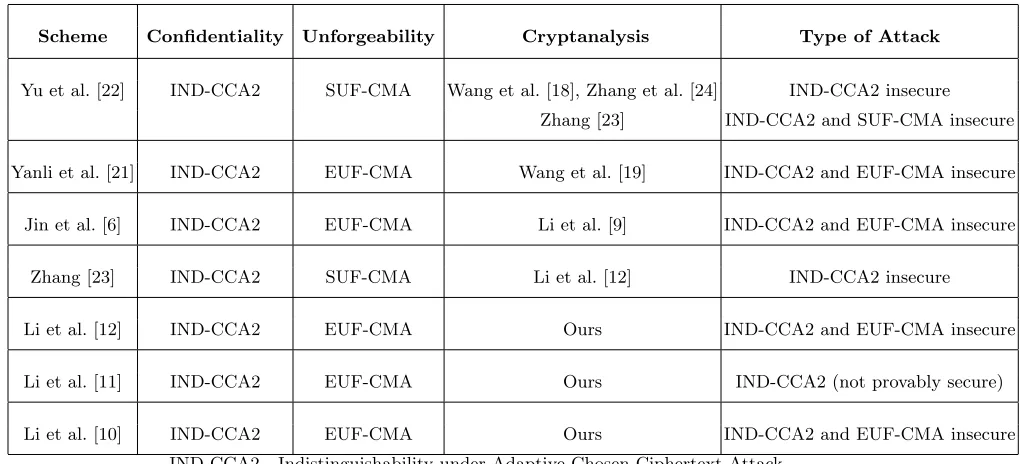
In 2009, Yu et al. [22] proposed the first ID based signcryption scheme in the standard model. But it was shown to be insecure by [18], [24] and [23]. Many such schemes [[22], [21], [6], [23]] were proposed after this, which were later shown to be insecure. The security notions claimed by various ID based signcryption schemes in the standard model and the type of cryptanalysis of those schemes that were proposed are tabu-lated in Table 1.
This paper is organized as follows. First, we present the cryptanalysis ofSecure identity-based signcryption in the standard model proposed by Li et al. [12]. Then, we analyze the inconsistencies in the proof of security of Efficient identity-based signcryption in the standard model by Li et al. [11] and the cryptanalysis of
and the cryptanalysis ofIdentity-Based Signcryption from Identity-Based Cryptography proposed by Lee et al. [8]. Finally, we present our analysis on the security of signcryption schemes got by various methods of direct combination of an IBE and an IBS in the standard model.
Table 1.Existing ID based signcryption schemes in the standard model and their cryptanalysis
Scheme Confidentiality Unforgeability Cryptanalysis Type of Attack
Yu et al. [22] IND-CCA2 SUF-CMA Wang et al. [18], Zhang et al. [24] IND-CCA2 insecure Zhang [23] IND-CCA2 and SUF-CMA insecure
Yanli et al. [21] IND-CCA2 EUF-CMA Wang et al. [19] IND-CCA2 and EUF-CMA insecure
Jin et al. [6] IND-CCA2 EUF-CMA Li et al. [9] IND-CCA2 and EUF-CMA insecure
Zhang [23] IND-CCA2 SUF-CMA Li et al. [12] IND-CCA2 insecure
Li et al. [12] IND-CCA2 EUF-CMA Ours IND-CCA2 and EUF-CMA insecure
Li et al. [11] IND-CCA2 EUF-CMA Ours IND-CCA2 (not provably secure)
Li et al. [10] IND-CCA2 EUF-CMA Ours IND-CCA2 and EUF-CMA insecure IND-CCA2 - Indistinguishability under Adaptive Chosen Ciphertext Attack
EUF-CMA - Existential Unforgeability under Chosen Message Attack SUF-CMA - Strong Existential Unforgeability under Chosen Message Attack
2
Cryptanalysis of Li et al.’s Scheme[12]
As mentioned in Table 1, Li et al. [12] have shown that the signcryption scheme proposed by Zhang [23] is IND-CCA2 insecure and proposed a new scheme that they claimed it to be existentially unforgeable and IND-CCA2 secure. But, here we show that [12] has neither the IND-CCA2 property nor the EUF-CMA property.
2.1 Review of Li et al.’s Scheme [12]
Setup
Given a security parameter, the PKG chooses groupsGandGT of prime orderp, a generatorg ofGand a bilinear map ˆe:G×G→GT. The PKG chooses a secret keyα∈Zp randomly and computes g1=gα and
choosesg2, h∈Grandomly. The PKG chooses random valuesu0, m0 ∈Gand vectorsU = (ui), M = (mi) of
lengthnuandnmrespectively, whose elements are chosen at random fromG. There are two hash functions defined asH1 : {0,1}∗→
Z∗p andH2:G→ {0,1}nm. The PKG publishes the system parametersparams=
{G,GT,e, g, g1, g2, h, uˆ 0, U, m0, M, H1, H2}and keeps the master secret keyg2αto itself.
Extract
Letube a nu bit string representing an identity and u[i] be the ith bit ofu. Define Ωu ⊆ {1,2, ..., nu} to
ru∈Zp randomly and computes
du= (du1, du2) = (g2α(u0 Y
i∈Ωu
ui)ru, gru)
Let uA be the nu bit string representing Alice’s identity and uB be the nu bit string representing Bob’s
identity. LetΩA⊆ {1,2, ..., nu}be the set of indicesisuch thatuA[i] = 1. So, the private key of Alice is
dA= (dA1, dA2) = (gα2(u0 Y
i∈ΩA
ui)rA, grA)
And, the private key of Bob is
dB= (dB1, dB2) = (g2α(u0 Y
i∈ΩB
ui)rB, grB)
whereΩB⊆ {1,2, ..., nu}be the set of indicesi such thatuB[i] = 1.
Signcrypt
To send a messagem∈GT to Bob, Alice follows the steps below.
– Chooser, s∈Zprandomly.
– Computeσ1=m·eˆ(g1, g2)r. – Computeσ2=gr.
– Computeσ3= (u0Q
i∈ΩBui)
r.
– Computeσ4=dA2.
– Computet=H1(σ1, σ2, σ4, u0Q
i∈ΩAui, u
0Q
i∈ΩBui). – Computemh=H2(gths).
– Compute σ5 = dA1(m0Qj∈Mhmj)
r, where M
h ⊆ {1,2, ..., nm} denotes the set of indices j such that
mh[j] = 1.
– Computeσ6=s.
The ciphertext isσ=hσ1, σ2, σ3, σ4, σ5, σ6i.
Unsigncrypt
When receivingσ=hσ1, σ2, σ3, σ4, σ5, σ6i, Bob follows the steps below.
– Computet=H1(σ1, σ2, σ4, u0Qi∈ΩAui, u
0Q
i∈ΩBui). – Computemh=H2(gthσ6).
– LetMh⊆ {1,2, ..., nm} denotes the set of indicesj such thatmh[j] = 1.
– Check if the following equation holds:
ˆ
e(σ5, g)= ˆ? e(g1, g2) ˆe(u0 Y
i∈ΩA
ui, σ4) ˆe(m0
Y
j∈Mh
mj, σ2) (1)
If Eq.(1) holds, return
m=σ1ˆe(dB2, σ3) ˆ
2.2 Attack on existential unforgeability
LetAbe an adversary. On receiving the public parameters, Acan generate a forgery by making use of the Signcrypt oracle as demonstrated below.
– LetIDA be the identity for whichAis going to generate the forgery.
– Aqueries the Signcrypt oracle for the signcryption ofmfromIDAto IDB (OSigncrypt(m, IDA, IDB)).
– Letσ= (σ1, σ2, σ3, σ4, σ5, σ6) be the output of the signcrypt oracle.
– Now, Ageneratesσ∗= (σ1∗, σ2∗, σ3∗, σ4∗, σ∗5, σ6∗) whereσ3∗∈RGandσ∗i =σi, fori= 1,2,4,5,6.
– Here, σ∗ is a valid forgery by Asince it is a signcryption of some message m∗ (not known to A) from IDAtoIDB which is not the output of the signcrypt oracle.
Thus, we have shown thatAcan generate a valid forgery by querying the signcrypt oracle once and hence [12] is not existentially unforgeable.
Correctness of the attack
We now show thatσ∗ is indeed a valid signcryption of some messagem∗ from IDAto IDB.
During the Unsigncrypt ofσ∗,
– t∗=H1(σ1∗, σ∗2, σ4∗, u0Q
i∈ΩAui, u
0Q
i∈ΩBui) =H1(σ1, σ2, σ4, u
0Q
i∈ΩAui, u
0Q
i∈ΩBui) =t, where tis the value generated during the execution ofOSigncrypt(m, IDA, IDB).
– mh∗=H2(gt
∗
hσ∗6) =H2(gthσ6) =m
h, as inOSigncrypt(m, IDA, IDB).
– Therefore the test
ˆ
e(σ5∗, g)= ˆ? e(g1, g2) ˆe(u0 Y
i∈ΩA
ui, σ4∗) ˆe(m
0 Y
j∈Mh
mj, σ2∗) (2)
is identical to the test for validity ofσ=hσ1, σ2, σ3, σ4, σ5, σ6i,
ˆ e(σ5, g)
?
= ˆe(g1, g2) ˆe(u0 Y
i∈ΩA
ui, σ4) ˆe(m0 Y
j∈Mh
mj, σ2)
and hence equation (2) will hold true.
Thus it is clear thatσ∗ is a valid forgery of some messagem∗ fromIDAto IDB.
2.3 Attack on Confidentiality
Let us assumeAto be an adversary to the signcryption scheme andCbe the challenger providing training toA. We now show here, an attack on the confidentiality property of the signcryption scheme by using the Unsigncrypt oracle. The attack is described below.
– Let (m0, m1) be two equal length messages chosen by Aand given to Cduring the challenge phase. – Let σ=hσ1, σ2, σ3, σ4, σ5, σ6ibe the challenge signcryption generated by C by querying the Signcrypt
oracle asOSigncrypt(mb, IDA, IDB) withb∈R{0,1}. This σis given toAas challenge ciphertext. – Now, A generates σ∗ = hσ1∗, σ2∗, σ3∗, σ4∗, σ∗5, σ6∗i where σ3∗ = σ3β with β ∈R G and σi∗ = σi for i =
1,2,4,5,6.
– Now, Aqueries the Unsigncrypt oracle withσ∗ as input i.e.OU nsigncrypt(σ∗, IDA, IDB). This query is
legal since σ∗6=σi.e theσ∗ queried to the Unsigncrypt oracle is different from the challenge ciphertext σ.
– Now, A queries the signcrypt oracle with some message m and sender as IDB and receiver as IDA
i.e. OSigncrypt(m, IDB, IDA)→ σ0 to get the value dB2 (since by definition of signcrypt algorithm, in σ0 =hσ0
1, σ02, σ03, σ04, σ50, σ60i,σ04will bedB2). – Now, Acan get mb fromm∗ asmb=
m∗ ˆ
e(dB2, β)
. Here,Aknowsm∗,dB2 andβ generated byC. – Thus,Acan find the exact mb ofσ(the challenge ciphertext).
Lemma 1. Letσ=hσ1, σ2, σ3, σ4, σ5, σ6ibe the output of the Signcrypt algorithm in [12] for a messagem, from a sender with identityIDAto a receiver with identity IDB. Letσ∗=hσ1∗, σ∗2, σ3∗, σ4∗, σ∗5, σ6∗ibe another
signcryption from the same sender IDA to the same receiver IDB, with σ∗i = σi for i = 1,2,4,5,6 and
σ∗3=σ3β, whereβ ∈RG. Then,σ∗is valid and the message signcrypted byσ∗ism∗wherem∗=meˆ(dB2, β).
Proof. Whenσ∗ is given as input to the Unsigncrypt algorithm, equation (1) will hold good sinceσ1∗=σ1, σ∗
2 = σ2, σ4∗ = σ4, σ5∗ = σ5 and since mh of σ and σ∗ are the same (∵ σ6∗ = σ6), as explained in the correctness of the attack on the existential unforgeability property of [12].
Hence, the Unsigncrypt of σ∗returnsm∗, where
m∗=σ∗1eˆ(dB2, σ
∗
3) ˆ
e(dB1, σ2∗) =σ1ˆe(dB2, σ3β)
ˆ
e(dB1, σ2)
(∵σ1∗=σ1, σ2∗=σ2, σ∗3=σ3β)
=σ1 ˆ
e(dB2, u0Qi∈ΩBui r
β) ˆ
e(dB1, gr)
= [m(ˆe(g1, g2))
r
]eˆ(grB, u0Q
i∈ΩBui r
β) ˆ
e(gα
2 u0 Q
i∈ΩBui rB
, gr)
= m(ˆe(g1, g2))
r ˆ
e(grB, u0Q
i∈ΩBui r
) ˆe(grB, β) ˆ
e(g2, gα)rˆe( u0Q
i∈ΩBui rB
, g)r
= m(ˆe(g1, g2))
r ˆ
e(g, u0Q
i∈ΩBui rB
)reˆ(d B2, β)
ˆ
e(g2, g1)reˆ( u0Q
i∈ΩBui rB
, g)r
=mˆe(dB2, β)
Thus,σ∗is valid signcryption ofm∗from a sender with identityIDAto a receiver with identityIDB, where
m∗=mˆe(d
B2, β).
3
Analysis of Inconsistencies in the proof of ‘Efficient Identity-Based
Signcryption in the Standard Model’ scheme proposed by Li et al. [11]
In 2011, Li et al. [11] have proposed a signcryption scheme in the ID based setting. This scheme is shown to be secure in the standard model. Here, we show that the proof given for the scheme in [11] has some flaws.
3.1 Review of the scheme
This section reviews Li et al.’sEfficient Identity-Based Signcryption in the Standard Model [11].
Setup
Given a security parameterk, the PKG chooses two multiplicative cyclic groupsGandGT of prime orderp,
a generatorgofGand a bilinear map ˆe:G×G→GT. The PKG choosesα, w∈Grandomly and computes z = ˆe(α, g). The PKG chooses random valuesu0, v0 ∈G and vectorsU = (ui), V = (vi) of length nid and
H1 :G→Z∗p and H2 : {0,1}∗ → {0,1}nm . There is a secure one time symmetric key encryption scheme
SE = (E, D) with key space κ=GT. There are another two hash functions defined asH3 :{0,1}nid →G andH4 :{0,1}nm →G.
H3(id) =u0
nid Y
i=1 uidi
i H4(π) =v
0
nm Y
i=1 vπi
i
These are the kind of functions that are used to construct IBE scheme by Waters [20], where πis the output of the hashH2 with lengthnm. The PKG publishes the system parameters
params={G,GT,e, g, w, z, uˆ 0, U, v0, V, H1, H2, H3, H4, SE} and keeps the master secret keyαto itself.
Extract
To construct the private keyskid of the identityid, PKG choosess∈Z∗p randomly and computes
skid= (sk1, sk2, sk3) = (α·H3(id)s, gs, ws)
LetidAbe Alice’s identity and idB be Bob’s identity. The private key of Alice is,
skA= (skA1, skA2, skA3) = (α·H3(idA)sA, gsA, wsA)
The private key of Bob is
skB = (skB1, skB2, skB3) = (α·H3(idB)sB, gsB, wsB)
Signcrypt
To send a messagem∈GT to Bob, Alice follows the steps below.
– Chooser∈Z∗p randomly.
– Computec1=gr. – Computet=H1(c1). – Setc2=skA2. – ComputeK=zr
– Computec3=EK(m).
– Computec4= (H3(idB)·wt) r
. – Computeπ=H2(c1, c2, c3, c4). – Computec5=skA1H4(π)rc4
The ciphertext isc= (c1, c2, c3, c4, c5).
Unsigncrypt
When receivingc= (c1, c2, c3, c4, c5), Bob follows the steps below. – Computeπ=H2(c1, c2, c3, c4) andt=H1(c1).
– Check if the following equation holds:
ˆ
e(c5, g)=? z·ˆe(H3(idA), c2)·eˆ(H4(π)·H3(idB)·wt, c1) (3)
If Eq.(3) holds, compute
K= ˆe(c1, skB1·sk
t B3) ˆ
e(c4, skB2)
3.2 Analysis of the inconsistencies in the security proof
The flaws in the proof of IND-CCA2 property are
– According to the definition of the Signcrypt protocol, the signcryption c = (c1, c2, c3, c4, c5) on any message from a sender idA to any receiver will always have the same c2 =skA2. But in the simulation of the Signcrypt oracle, a Signcrypt query will output a differentc2=gri,r
i∈RZp∗each time when the
oracle is invoked withidAas sender, for whichJ(idA) = 0modZfu, wherefu= 4luandluis the length of any identity.
– Also, the signcryption c = (c1, c2, c3, c4, c5) fromidA to idB satisfies that (g, H3(idB), c1, c4) is a valid Diffie-Hellman tuple i.e it always passes the following test,
ˆ e(c4, g)
?
= ˆe(c1, H3(idB)wt) (4)
where t=H1(c1).
But, the valuesc01andc04in the output of the Signcryption oraclec0 = (c10, c02, c03, c04, c05) will be simulated as follows.
c01=skB2
c04=gr. skB1. sktB3
This c0 fails to satisfy Eq. 4 for any sender with identity idA and receiver with identity idB, having
J(idA) = 0modZfu andJ(idB)6= 0mod Zfu as shown below. ˆ
e(c04, g) = ˆe(grskB1sktB3, g)
= ˆe(gr, g) ˆe(α H3(idB)s, g) ˆe(wst, g)
= ˆe(gr, g) ˆe(α, g) ˆe(H3(idB)s, g) ˆe(wst, g)
= ˆe(gr, g) ˆe(α, g) ˆe(H3(idB), gs) ˆe(wt, gs)
= ˆe(gr, g) ˆe(α, g) ˆe(H3(idB)wt, gs)
ˆ
e(c04, g) = ˆe(gr, g) ˆe(α, g) ˆe(H3(idB)wt, c01) ˆ
e(c04, g)6= ˆe(c01, H3(idB)wt)
Here, the probability forα=g−r is negligible.
These make the simulation imperfect i.e the simulation is different from the real protocol.
Here, for the challenge phase to succeed without aborting,J(id∗A)6= 0modZfu andJ(id
∗
B) = 0modZfu. But, during theP hase2 of training the adversary, the Signcrypt oracle will abort for all queries with receiver identity asid∗B. And also, for the Signcrypt queries with sender identity asid∗B and receiver identity asid∗A, the difference in the simulation from the real protocol can be easily distinguished by the adversary.
4
Cryptanalysis of the improved Identity based Signcryption scheme in the
Standard Model by Li et al. [10]
In this section, we review the scheme proposed by Li et al. [10] and then show its security weaknesses.
4.1 Review of the scheme
Setup
Given a security parameter, the PKG chooses groups G and GT of prime order p, a generator g of G, and a bilinear map ˆe: G×G →GT. The PKG chooses α, µ, v ∈ Grandomly and computes z = ˆe(α, g). Additionally, the PKG chooses random valuesu0, m0∈Gand vectorsU = (ui), M = (mi) of lengthnu and
nm, respectively, whose elements are chosen at random fromG. We also need a hash function H1:G→ Zp∗
and a secure one-time symmetric key encryption scheme (E, D) with key spaceκ=GT. The PKG publishes
system parametersparams={G,GT,e, g, µ, v, z, u0, U, m0, M, H1, E, Dˆ } and keeps the master secretα to
Extract
Letube anu bit string representing an identity andu[i] be theith bit ofu. DefineΩu⊆ {1, ...., nu}to be
the set of indices isuch that u[i] = 1. To construct the private keydu of the identityu. The PKG chooses
ru∈Zp randomly and computes
du= (du1, du2) = (gα2(u0 Y
i∈Ωu
ui)ru, gru)
Let uA be the nu bit string representing Alice’s identity and uB be the nu bit string representing Bob’s
identity. LetΩA⊆ {1,2, ..., nu}be the set of indicesisuch thatuA[i] = 1. So, the private key of Alice is
dA= (dA1, dA2) = (gα2(u0 Y
i∈ΩA
ui)rA, grA)
And, the private key of Bob is
dB= (dB1, dB2) = (g2α(u0 Y
i∈ΩB
ui)rB, grB)
whereΩB⊆ {1,2, ..., nu}be the set of indicesi such thatuB[i] = 1.
Signcrypt
To send a message to Bob, Alice follows the following steps. LetM ⊆ {1, ...., nm}is the set of indicesjsuch
thatm[j] = 1, wherem[j] is thejth bit ofm.
– Chooser∈ Zp∗ randomly and computeσ1=gr – Computet=H1(σ1)
– Computeσ2= (u0Qi∈ΩBui)
r
– Computeσ3= (µtv)r
– ComputeV =dA1(m0Qj∈Mmj)r
– ComputeX =dA2 – ComputeK=zr
– Computeσ4=EK(V||X||m)
The ciphertext isσ= (σ1, σ2, σ3, σ4).
Unsigncrypt
When receivingσ= (σ1, σ2, σ3, σ4), Bob follows the following steps.
– Compute
K= ˆe(dB1, σ1) ˆ
e(dB2, σ2)
= ˆe(α(u0 Q
i∈ΩBui)
rB, σ1) ˆ
e(grB, σ2) – ComputeV||X||m=DK(σ4)
– Verify if the following equation holds.
ˆ
e(V, g)=? zeˆ(u0 Y
i∈ΩA
ui, X) ˆe(m0 Y
j∈M
mj, σ1)
4.2 Flaws in the scheme
1. The componentσ3 of the ciphertextσis not verified of its consistency in the Unsigncrypt phase. In this case, an adversary in the EUF-CMA game, can produce a valid forgery through the following steps.
– The adversary makes a Signcrypt query for anyhIDA, IDB, mituple and gets σ0 = (σ01, σ02, σ03, σ40) as the output of the query, which is a valid signcryption onm byIDA forIDB.
– Now, the adversary can produce a valid forgeryσ∗ = (σ1∗, σ∗2, σ3∗, σ∗4), whereσ∗3 is randomly chosen fromZ∗
p− {σ30}and σ1∗=σ01, σ∗2=σ02, σ∗4=σ40. – Thisσ∗ is a valid signcryption onm byID
A and withIDB as the receiver.
Also, an adversary in the IND-CCA2 game can distinguish the challenge ciphertext whether it is the signcryption of m∗
0 orm∗1 through the following steps (which are similar to the steps above). – The adversary after getting the challenge ciphertextσ∗ = (σ∗
1, σ2∗, σ3∗, σ∗4), queries the Unsigncrypt oracle with hσ0, ID∗
A, ID∗Bi as input, where σ0 = (σ01, σ02, σ30, σ40), with σ03 randomly chosen from Zp∗− {σ3∗} andσ10 =σ1∗, σ20 =σ2∗, σ04=σ4∗.
– The output of the Unsigncrypt oracle for this query revealsm∗β to the adversary, from which it can outputβ∈ {0,1} successfully with probability 1.
2. Now, we consider the security of the scheme [10] including the following verification step in the Unsign-crypt oracle.
ˆ
e(σ3, g)= ˆ? e(µt0v, σ1) (5) where t0=H1(σ1).
When this verification step is included, the scheme becomes secure against the security game proposed in Step 1. But the simulation of the Signcrypt oracle provided by [10] becomes inconsistent with respect to this verification step, making the scheme provably insecure.
3. When we analyze this scheme further, we find out that even if proper signcrypt and unsigncrypt oracles were provided, the security of this scheme is susceptible to the EUF-CMA security game, which is described below.
– The adversaryAqueries the tuplehIDA, IDB, mito the signcrypt oracle and getsσ0 = (σ01, σ02, σ03, σ40) as output.
– Aalso queries the extract oracle for the secret keys ofIDB, IDC. These two extract queries are legal,
since the forgery to be produced byAis withIDA as sender. And hence,Acan query for the secret
key of any identity other thanIDA.
– Now, having the secret key of IDB, A can find the key K used in the one-time symmetric key
encryption algorithm, by following the first step of the Unsigncrypt algorithm of [10].
– By using thisK, A can find the componentsV, X, m obtained during the generation of σ0 by per-formingDK(σ40).
– A can now generate a valid signcryption on m by IDA with IDC as the receiver by encrypting
V, X, mwith a different key K0= ˆe(dC1, σ1) ˆ
e(dC2, σ2) .
– Thus, A outputs a valid forgery σ∗ = (σ1∗, σ∗2, σ3∗, σ4∗), where σ1∗ = σ10, σ2∗ = σ20, σ3∗ = σ30, σ4∗ = EK0(V||X||m).
4. The real-world insecurity of the scheme which is captured by the above security game is explained below. In this scheme,IDB andIDC can collude to convert a valid signcryption fromIDA to IDB to a valid
signcryption fromIDA toIDC without solving any hard problem.
– IDA creates a signcryption σ= (σ1, σ2, σ3, σ4) on messagem and sends it to the intended receiver
IDB.
– IDBfinds the keyKused in the one-time symmetric key encryption schemeE, during the generation
ofσ, by performing the first step of the unsigncrypt algorithm of [10].
– Now, using K, IDB can get V, X, m that are obtained during the generation of σ by performing
DK(σ4).
– WhenIDB passes these valueshV, X, mitoIDC,IDC can computeK0 =
ˆ
e(dC1, σ1)
ˆ
e(dC2, σ2) . – Thenσ40 =EK0(V||X||m) can be computed byIDC.
– Now σ0 = (σ01, σ02, σ30, σ04) is a valid signcryption on m by IDA withIDC as the intended receiver,
Thus any two users (receivers) can collude to transform a signcryption on a message by a sender for one receiver to a valid signcryption for another receiver on the same message, without the knowledge of the sender or the sender’s secret key.
Thus, we show that the scheme proposed in [10] is insecure.
5
Cryptanalysis of Pandey et al.’s signcryption scheme [15]
Here, we reviewConstruction of ID based signcryption schemes proposed by Pandey et al. [15].
Setup(SecP aram)
Let H1 : {0,1}∗ → {0,1}l1, H2 : {0,1}∗ → {0,1}l2, H3 :{0,1}∗ → {0,1}l1 be secure hash functions. The public parameters, P arams, consist of (P aramsIBE, P aramsIBS, H1, H2, H3) and the master secret key mskis (mskIBE, mskIBS).
Key Generation(ID)
LetskIBE ←KeyGenIBE(ID) andskIBS ←KeyGenIBS(ID). The private key corresponding to identity
ID will be (skIBE, skIBS).
Signcryption(m,IDRec, IDSen,skIDSen,P arams) 1. Chooser randomly fromR.
2. Letc0←EN C.SIBE(r, IDRec, P aramsIBE).
3. Computeh1=H1(r, c0, IDSen).
4. Computeh2=H2(m, c0, h1, IDRec, IDSen).
5. Computec=H3(h1, IDSen)⊕m.
6. LetskIDSen = (skIDSenIBE, skIDRecIBS) and let (m, s)←SIG.SIBS(m, skIDSenIBS, P aramsIBS). 7. Computed=h2⊕s.
The cipher-text will beC≡(c0, c, d).
Here,SIBE is an identity based encryption that is IND-CCA2 secure andSIBSis an identity based signature
that is existentially unforgeable against chosen message attacks.
Designcryption(C,IDRec,IDSen,P arams)
1. LetskIDRec= (skIDRecIBE, skIDRecIBS).
Letr0 ←DEC.SIBE(c0, skIDRecIBE, P aramsIBE). 2. Computeh01=H1(r0, c0, IDSen).
3. Computem0 =H3(h01, IDSen)⊕c.
4. Computeh02=H2(m0, c0, h01, IDSen, IDRec).
5. Computes0 =h02⊕d.
6. Letx←V ER.SIBS(m0, s0, IDSen, P aramsIBS).
– If above step is correctly verified, thenV ER.SIBS(., ..., .) returns m0, else⊥.
7. Returnx.
5.1 Attack on Unforgeability
In this section we show that the scheme proposed in [15] does not provide the unforgeability property. During the unforgeability game, the adversaryAcan generate a valid forgery (which is a signcryption of messagem with sender asIDA and receiver asIDB) by making use of the Signcryption and Key Generation oracles as
– LetIDA,IDB,IDD be three identities.
– A queries the private key of IDD to the Key Generation oracle. This query is legal since IDD is the
identity of neither the sender nor the receiver, involved in the forgery which is going to be produced. – Aalso queries the signcryption of a messagemfrom IDA toIDD to the Signcryption oracle.
– LetC be the signcryption ofmoutput by the Signcryption oracle.
– Now,AdesigncryptsC≡(c01, c1, d1), since it knows the private key ofIDD, by performing the following
steps.
1. r1←DEC.SIBE(c01, skIDBIBE, P aramsIBE). 2. h1=H1(r1, c01, IDA).
3. m=H3(h1, IDA)⊕c1.
4. h2=H2(m, c01, h1, IDA, IDD).
5. s1=h2⊕d1.
– We now show howAcan produce the signcryption ofmfrom IDA toIDB, without knowing the secret
key ofIDA. This will prove the ability ofAto produce forgery.
– The only step where the secret key ofIDAis involved in generating the signcryption is the Step 6 of the
Signcryption algorithm where one should compute (m, s)←SIG.SIBS(m, skIDAIBS, P aramsIBS). – However, the value of s1 obtained in Step 5 of the Designcryption of hC, IDA, IDDi shown above is
precisely the value ofSIG.SIBS(m, skIDAIBS, P aramsIBS). – That is,s∗=s1=SIG.SIBS(m, skIDAIBS, P aramsIBS). – Thus,s∗ can be obtained by
Awithout even knowing the secret key ofIDA.
– NowAhas no problems in executing the steps of Signcryption(m,IDB,IDA,skIDA,P arams). Specifically,
1. ris chosen randomly fromR 2. c0
2←EN C.SIBE(r, IDB, params)
3. h∗1=H1(r, c02, IDA)
4. h∗2=H2(m, c20, h∗1, IDB, IDA)
5. c2=m⊕H3(h∗1, IDA)
6. d2=s∗⊕h∗2=s1⊕h∗2
– Now, AsubmitsC∗≡(c20, c2, d2), which is a valid forgery of messagemfrom IDAto IDB.
Thus, [15] is not outsider secure since a valid forgery is produced without involving the private key of the sender or the receiver.
6
Cryptanalysis of Lee et al.’s signcryption scheme [8]
Lee et al. [8] improved Pandey et al.’s signcryption scheme [15] and claimed to achieve additional security notions, ciphertext anonymity and ciphertext authentication along with the message confidentiality and sig-nature non-repudiation properties claimed by [15]. But here we show that the signcryption scheme proposed by Lee et al. [8] is not even IND-CPA secure.
6.1 Review of the scheme
Notation
Let H1 : {0,1}l1 → {0,1}l2 and H2 : {0,1}l3 → {0,1}l4 are hash functions. We assume that e1 is the
bit-length of outputs ofEIBE, lete2be the bit-length of an identity and letl4be the bit-length of signature
swherel1=l2+e1+e2andl3= 2l2+e2. Moreover, we assume thatparamIBETparamIBS =Φ.
Construction
This IBSC scheme is based on the ordinary IBE and IBS schemes.
– Setup(1k)→(mskIBE,paramIBE,mskIBS,paramIBS,H1,H2): Given a security parameter 1k, output
(mskIBE, paramIBE, mskIBS, paramIBS, H1, H2) where the master secret key is msk = (mskIBE,
– KeyGen(msk, ID) →SKID: Given master secret keymsk and an identity ID, output the private key
SKID for ID. The private key is computed as follows:
1. SKIBE.ID←KeyGenIBE(ID);
2. SKIBS.ID←KeyGenIBS(ID);
3. SKID= (SKIBE.ID, SKIBS.ID).
– Signcryption(m, IDS,IDR, SKIDS)→C : Given a message m, a sender’s identity IDS, a recipient’s identity IDR, and a sender’s private key SKIDS, output a ciphertextC = (c1, c2, d). The computation is as follows:
1. r← {0,1}l2;
2. c1←EIBE((r||IDS), IDR);
3. t1←H1(r||c1||IDS);
4. t2←H2(m||t1||IDR);
5. c2=t1⊕m;
6. s←SIBS((m||IDR), SKIBS.IDS); 7. d=t2⊕s.
– Designcryption(C, IDR, SKIDR) → m or ⊥: Given a ciphertext C, a recipient’s identity IDR, and a recipient’s private key SKIDR, output a message m or ⊥ indicating an error. The computation is as follows:
1. r||IDS =DIBE(c1, SKIBE.IDR); 2. t1←H1(r||c1||IDS);
3. m=t1⊕c2;
4. t2←H2(m||t1||IDR);
5. s=t2⊕d;
6. mor⊥=VIBS((m||IDR), s, IDS).
6.2 Attack on message confidentiality
The authors have claimed that the scheme proposed in [8] is IND-IBSC-CCA secure. But here we show that it is IND-IBSC-CPA insecure as follows.
– During the IND-CPA game, the adversary Arandomly chooses two messages, say m∗
0 andm∗1, sender identity ID∗S and receiver identity ID∗Rand gives them to the challenger.
– The challenger randomly choosesβ ∈R{0,1}and givesC∗←Signcryption(mβ, ID∗S, IDR∗) toA.
– Now, Acan find out whetherC∗= (c∗1, c2∗, d∗) is a valid signcryption ofm∗0 or m∗1 as shown below. • Ainitially guesses mβ to be m∗0 and hence calculatest∗1 =c∗2⊕m∗0. Thus, the value oft∗1 is got by
Awithout the knowledge of the secret key of the receiverSKIBE.IDR. • Still assuming thatmβ=m∗0,Acalculatest∗2 as t∗2=H2(m∗0||t∗1||ID∗R).
• Now,s∗ can be got byAass∗=d∗⊕t∗2.
• The guess thatmβ=m∗0 can be validated by the verification algorithm of the underlying signature scheme IBS i.eVIBS((m∗0,||ID∗R), s∗, ID∗S).
• If VIBS((m∗0,||IDR∗), s∗, IDS∗) returns V alid, then C∗ is a valid signcryption on m∗0 and hence the guess made byAis correct i.emβ =m∗0.
Otherwise,mβ=m∗1, sinceC∗ is a valid signcryption of eitherm∗0 or m∗1.
Thus, the adversaryAcan always distinguish whether the challenge signcryptionC∗is a valid signcryption onm∗0 orm∗1, proving that the signcryption scheme in [8] is not even IND-IBSC-CPA secure.
6.3 Absence of Ciphertext anonymity
Lee et al. [8] have also claimed that the signcryption scheme proposed by them has the property of ciphertext anonymity. But during ANON-IBSC-CCA game defined by [8], the adversary can always distinguish the sender and receiver identities as shown below.
2. The challenger now chooses two bitsa, b∈R{0,1}and computes the challenge ciphertextC∗=hc∗1, c∗2, d∗i which is a signcryption on the message m∗ with the sender identity as IDSa and receiver identity as
IDRb and returnsC∗ toA.
3. Now, Acan obtaint∗
1 that would have been obtained during the generation of the challenge ciphertext C∗ ast∗1=c∗2⊕m∗.
4. Having obtained the values oft∗1andm∗,Aguesses the receiver identityIDRb to beIDR0and calculates t02=H2(m∗||t∗1||IDR0).
5. A then calculatess0 =d∗⊕t02. Note that the values t02 ands0 got here are based on the guess that the receiver identity is IDR0. Hence, only if b= 0, t∗2 would bet02 ands∗ would bes0.
6. The adversaryAcan now verify its guess regarding the receiver identity and identify the sender identity from the following steps.
– IfVIBS((m||IDR0), s0, IDS0) returnsm∗, then the sender identity is IDS0 and the receiver identity isIDR0 i.ea= 0 andb= 0 respectively.
– Else,
• IfVIBS((m||IDR0), s0, IDS1) returnsm∗, then the sender identity isIDS1and the receiver iden-tity isIDR0i.ea= 1 and b= 0. respectively.
• Else,Aoutputs the receiver identity to beIDB1i.eb= 1. In order to find the sender identity,A repeats this process from Step 4, with the receiver identity asIDR1. Now, thet02 ands0 got here are respectively equal tot∗2 ands∗ got during the generation of the challenge ciphertextC∗. So,
* IfVIBS((m||IDR1), s0, IDS0) returnsm∗, then the sender identity isIDS0i.ea= 0.
* Else, the sender identity isIDS1 i.ea= 1.
Thus, the identities of the sender and the receiver can always be distinguished by the adversary during the ANON-IBSC-CCA game, after the challenge ciphertext is given to it, refuting the claim of the authors of [8] that the signcryption scheme proposed in [8] provides ciphertext anonymity.
6.4 Attack on unforgeability
In the AUTH-IBSC-CMA security game, the adversaryAcan produce a valid forgeryC∗on messagemwith sender and receiver identities asIDS∗ andIDR∗ respectively, as follows.
– Initially, A obtains a valid signatures on the message m by IDS∗ with IDR∗ as the intended receiver, through the following steps.
• Amakes a signcryption query to the challenger withhm, ID∗S, ID∗Rias input. The challenger returns the output of the signcryption oracleC=hc1, c2, dito A.
• From this valid signcryptionC onmgot from the signcryption query mentioned above,Acan find the value oft1that is obtained during the execution of this signcryption query ast1=c2⊕m.
• Athen can calculate the value oft2obtained during the same signcryption query ast2←H2(m||t1||IDR∗). • Now,Acan obtainsass=d⊕t2.
• Thus the adversary A could obtain s which is a valid signature on the message m intended for the receiverIDR∗, without the knowledge of the secret key of the sender involved in generating the signature i.eSKIBS.ID∗
S.
– Now, with the value of s,Acan produce another valid signcryption on the messagem with the sender and receiver identities asIDS∗ andID∗R respectively as shown below.
– Arandomly choosesr← {0,1}l2 and calculatesc∗
1←EIBE((r||ID∗S), ID∗R).
– Athen calculates t∗1 andt∗2 ast∗1←H1(r||c1||ID∗S) andt∗2←H2(m||t∗1||ID∗R).
– Now,Acomputesc∗2=t∗1⊕mandd∗=t∗2⊕s, wheresis the valid signature got from the steps explained above.
– The tuplehc∗1, c∗2, d∗iis output as forgery by the adversaryA.
7
Security of Direct Combination of IBE and IBS
Now, all the ID based signcryption schemes proposed in the standard model are not provably secure. This has motivated us to analyse the security of getting a provably secure scheme by the direct combination of an ID based signature scheme and an ID based encryption scheme both in the standard model.
The design of a strongly unforgeable IND-CCA2 secure signcryption scheme can be attempted by com-bining a strongly unforgeable ID based signature scheme and an IND-CCA2 secure ID based encryption scheme based on three approaches.
– Sign then Encrypt – Encrypt then Sign
– Sign and Encrypt (done in parallel)
Insider security is an important property of signcryption schemes, which ensures that a scheme offers confidentiality even if the private key of the sender is compromised. Similarly the unforgeability property is preserved even if the private key of the receiver is compromised. This is the strongest notion of security for signcryption primitive.
LetSignskA(m, IDA)→ hσ, miandV erif yIDA(σ, m)→V alid/Invalidform a strongly unforgeable sig-nature scheme and letEncryptIDB(m)→C andDecryptskB(C, IDB)→m/⊥form an IND-CCA2 secure encryption scheme, whereIDA andIDB are the identities of sender and receiver respectively.
7.1 Encrypt then sign approach
Signcrypt(m, IDA, IDB)= (EncryptIDB(m||IDA)→C,SignskA(C||IDB, IDA)→ hσ, Ci). The tuple∆=hσ, Ciis the output of the resulting Signcrypt algorithm.
Unsigncrypt(∆, IDA, IDB)= (V erif yIDA(σ, C, IDB)→V alid/Invalid, ifV alidperform (DecryptskB(C, IDB)→m/⊥)).
Them/⊥obtained is the output of the Unsigncrypt algorithm.
Security
During the proof of the IND-CCA2 property of the above signcryption scheme, the adversary A sends hm0, m1ito the challengerC after phase 1 of training.
Then, C randomly chooses β ∈R {0,1} and performs Signcrypt(mβ∗, IDA, IDB) =∆∗ and sends ∆∗ to A.
Note thatA has access to the secret key skA of the sender for the scheme to satisfy insider security. Now,
the adversary finds whetherβ is 0 or 1 as follows. – Agenerates∆0=hC∗, σ0i, whereσ0 =SignskA(C
∗||ID
B, IDA). Note thatσ0 6=σ∗with high probability
since Sign is a probabilistic algorithm.
– Now, ∆ is a valid signcryption and can be queried to the Unsigncrypt oracle. This query is legal since ∆06=∆.
– The unsigncryption query returnsm∗β to the adversary.
Thus, the adversary directly gets message that is signcrypted in the challenge ciphertext without having any knowledge about the secret key of the receiver, making the signcryption scheme IND-CCA2 insecure.
7.2 Sign and Encrypt approach
Signcrypt(m, IDA, IDB)= (SignskA(m||IDB, IDA)→σ,EncryptIDB(m||IDA)→C). The tuple∆=hσ, Ciis the output of the resulting Signcrypt algorithm.
Unsigncrypt(∆, IDA, IDB)= (DecryptskB(C, IDB)→m/⊥, and ifmis returned,V erif yIDA(m, IDB)→ V alid/Invalid).
Themobtained is the output of the Unsigncrypt algorithm, ifV alidis returned.
Security
In the proof of the IND-CCA2 property of the above signcryption scheme, after phase 1 of training, the adversary is given the challenge signcryption∆∗, where ∆∗ is the signcryption of m∗
β. Here, the adversary
can always differentiate betweenm∗0 andm∗1 as follows. – The adversary takes the componentσ∗.
– It then performsV erif y(σ∗, m∗0, IDA, IDB) .
– If the above step returns V alid, thenβ = 0, otherwiseβ= 1. This makes the signcryption scheme IND-CCA2 insecure.
In the unforgeability game, the adversary produces a forgery as follows.
– The adversary querieshm, IDA, IDBito the Signcrypt oracle and gets∆=hσ, Ci.
– Now, it runsEncryptIDB(m) again, wheremis a message that has already been queried to the Signcrypt oracle.
– Being a randomized algorithm,EncryptIDB(m) produces a different encryptionC
0on the same message
and intended for the same receiverIDB.
– ThisC0 when combined withσfrom the output of the Signcrypt query, gives another valid signcryption ∆0=hσ, C0ion the messagem.
This∆0 is a valid forgery since∆06=∆, making the signcryption scheme SUF-CMA insecure.
Thus, the resulting signcryption scheme is not outsider secure, since the secret key of the sender(receiver) is not involved in the IND-CCA2(SUF-CMA) game.
7.3 Sign then encrypt approach
Signcrypt(m, IDA, IDB)= (SignskA(m||IDB, IDA)→σ, thenEncryptIDB(σ||m||IDA)→C). The tuple∆=hCiis the output of the resulting Signcrypt algorithm.
Unsigncrypt(∆, IDA, IDB)= (DecryptskB(C, IDB)→ hσ||mi/⊥, if⊥is not returned,V erif yIDA(σ, m, IDB)→ V alid/Invalid).
Themobtained is the output of the Unsigncrypt algorithm, ifV alidis returned.
Security
The above signcryption scheme is strongly unforgeable with insider security, because even if the secret key of the receiver skB is compromised, Acannot generate another valid signcryption of m due to the strong
unforgeability property of the underlying signature schemeSignskA(m||IDB, IDA).
Also, the confidentiality of the resulting signcryption scheme Signcrypt(m, IDA, IDB)→∆ can be reduced
directly to the confidentiality of the underlying encryption scheme, since the output ∆ = hCi is just the output ofEncryptIDB(σ||m||IDA). Since the encryption scheme used is IND-CCA2 secure, the signcryption scheme is also IND-CCA2 secure.
Table 2.Security of signcryption schemes got by the direct combination of IBE and IBS
Approach Confidentiality(IND-CCA2) Unforgeability(SUF-CMA)
Sign then Encrypt Yes Yes
Encrypt then Sign No Yes
Sign and Encrypt No No
7.4 Scheme obtained by Direct Combination
From Table 2, we can find that a signcryption scheme obtained by a direct combination of a signature and an encryption scheme is SUF-CMA and IND-CCA2 secure only when a strongly unforgeable signature scheme and an IND-CCA2 secure encryption scheme are combined by Sign then Encrypt approach. The most efficient ID based signature scheme without random oracles is the one proposed by Paterson et al. [16]. But it is only EUF-CMA secure. To make it strongly unforgeable, we apply the transformation suggested by Boneh et al. [2]. And we take the IND-CCA2 secure ID based encryption scheme in the standard model proposed by Kiltz-Vahlis [7]. Using these as basic building blocks, let us conceptually formulate a scheme which we refer as schemeπ. The schemeπis obtained by combining these schemes in a direct way as follows.
Signcrypt
Setup
Choose groups GandGT of prime orderp. Letg be the generator of group G. And the bilinear pairing e : G×G → GT is admissible. Choose g2, gu, gα ∈R G and compute z = ˆe(g, gα). Also pick α ∈R Z∗p.
Compute g1 =gα. Then pick elements u0, m0 ∈
R G and vectorsU= (ui),M = (mi) of lengthnu and nm
respectively. The elements of these vectors are randomly picked fromG. There are two cryptographic hash functionsH1:{0,1}nm+nu+2|p|→
Z∗p andH2:G→ {0,1}
l, where l is large enough that the hash functions
are collision resistant. LetT CR:G→Z∗p be a target collision-resistant hash function andSE = (E, D) be
a symmetric encryption scheme with key-spaceκ=GT.
Extract
For an identityurepresented by a string of bits of lengthnu, defineΩu⊆ {1, ..., nu}as the set of indices
ifor whichu[i] = 1. The secret key of a user is
h(du1, du2),(du3, du4, du5)i=h(gα2(u0 Y
i∈Ωu
ui)ru, gru),(gα(u0
Y
i∈Ωu
ui)s, g−s, gsu)i
wheres, ru←RZ∗p. (du1, du2) form the signing key and (du3, du4, du5) form the decryption key.
Sign
The signing key of the senderIDA is
hdu1, du2i=hg2α(u0 Y
i∈Ωu
ui)ru, grui
σ2=grm, where r
m∈RZ∗p
ht=H1(M||IDB||σ1||σ2), whereM is the message for which signcryption is produced and IDB is the
identity of the receiver of the ciphertext
β =H2(ghthrs), wherers∈Z∗p
σ3=dA1(m0Qj∈βmj)rm, where β⊆ {1,2, ..., l} be the set of indicesi such thatβ[i] = 1
The signature isσ0=hσ1, σ2, σ3, rsi.
Encrypt
This algorithm receives hσ0, M, IDA, IDBifrom the Sign algorithm.
σ4=gr, wherer∈RZ∗p
t=T CR(σ4);σ5= ((u0Qi∈ΩBui)g
t
u)r, whereΩB⊆ {1, ..., nB}is the set of indicesiwith IDB[i] = 1
K=zr;σ
6=EK(M||σ0||IDA)
The signcryption produced is σ=hσ4, σ5, σ6i.
Unsigncrypt
On receivingσ=hσ4, σ5, σ6i, the Unsigncrypt algorithm performs the following two algorithms.
Decrypt
The decryption key for the receiverIDB is
hdu3, du4, du5i=hgα(u0
Y
i∈Ωu
ui)s, g−s, gusi
t=T CR(σ4)
K= ˆe(σ4, dB3.dBt5) ˆe(σ5, dB4)
(M||σ0||IDA) =DK(σ6)
ReturnM ifσ0 satisfies the followingV erif yalgorithm.
Verify
Parsingσ0 =hσ1, σ2, σ3, rsi, calculateht=H(M||IDA||σ1||σ2) and thenβ=ghthrs. Then the following check is performed.
ˆ
e(σ3, g)= ˆ? e(g1, g2) ˆe(u0 Y
i∈ΩA
ui, σ1) ˆe(m0
Y
j∈β
mj, σ2)
whereΩA⊆ {1, ..., nA}is the set of indicesi withIDA[i] = 1.
Efficiency
Table 3.Computational Complexity of π
Scheme Secret key size Ciphertext size #pairings #exponentiations Signcrypt, Unsigncrypt Signcrypt, Unsigncrypt
π(Direct combination) 5|p| 2|p|+nm 0(+1), 5(+1) 8, 3
The numbers shown in the brackets indicate the values that can be precomputed before the algorithm begins (and they remain same for all runs of the protocol)
We may refer πas a scheme obtained by naive or straightforward combination of an encryption scheme and a signature scheme because the secret key ofπis nothing but component-wise concatenation of the secret key of the schemes in [16] and [7] and the Sign/Encrypt and Decrypt/Verify algorithms are independent and sequential.
8
Conclusion
Thus, all the ID based signcryption schemes proposed in the standard model are not provably secure. And, by analyzing the various types of direct combination, we conclude that a strongly unforgeable, IND-CCA2 secure ID based signcryption scheme in the standard model can be obtained through direct combination of an IBE and an IBS only by the Sign then Encrypt approach. But the scheme obtained through this approach is not efficient. Other than the approaches used for direct combination, obtaining an efficient provably secure ID based signcryption scheme in the standard model still remains an open problem.
References
1. Paulo S. L. M. Barreto, Benoˆıt Libert, Noel McCullagh, and Jean-Jacques Quisquater. Efficient and provably-secure identity-based signatures and signcryption from bilinear maps. InASIACRYPT, pages 515–532, 2005. 2. Dan Boneh, Emily Shen, and Brent Waters. Strongly unforgeable signatures based on computational
diffie-hellman. InPublic Key Cryptography, pages 229–240, 2006.
3. Xavier Boyen. Multipurpose identity-based signcryption (a swiss army knife for identity-based cryptography). InCRYPTO, pages 383–399, 2003.
4. Liqun Chen and John Malone-Lee. Improved identity-based signcryption. InPublic Key Cryptography, pages 362–379, 2005.
5. Sherman S. M. Chow, Siu-Ming Yiu, Lucas Chi Kwong Hui, and K. P. Chow. Efficient forward and provably secure id-based signcryption scheme with public verifiability and public ciphertext authenticity. InICISC, pages 352–369, 2003.
6. Zhengping Jin, Qiaoyan Wen, and Hongzhen Du. An improved semantically-secure identity-based signcryption scheme in the standard model. Computers&Electrical Engineering, 36(3):545–552, 2010.
7. Eike Kiltz and Yevgeniy Vahlis. Cca2 secure ibe: Standard model efficiency through authenticated symmetric encryption. InCT-RSA, pages 221–238, 2008.
8. Woomyo Lee, Jae Woo Seo, and Pil Joong Lee. Identity-based signcryption from identity-based cryptography. InProceedings of the 12th international workshop on Information security applications, WISA’11, pages 70–83. Springer-Verlag, 2011.
9. Fagen Li, Yongjian Liao, and Zhiguang Qin. Analysis of an identity-based signcryption scheme in the standard model. IEICE Transactions, 94-A(1):268–269, 2011.
10. Fagen Li, Yongjian Liao, Zhiguang Qin, and Tsuyoshi Takagi. Further improvement of an identity-based sign-cryption scheme in the standard model. Comput. Electr. Eng., 38(2):413–421, March 2012.
11. Fagen Li, Fahad Bin Muhaya, Mingwu Zhang, and Tsuyoshi Takagi. Efficient identity-based signcryption in the standard model. InProvSec, pages 120–137, 2011.
12. Fagen Li and Tsuyoshi Takagi. Secure identity-based signcryption in the standard model. Mathematical and Computer Modelling, 2011. http://www.sciencedirect.com/science/article/pii/S0895717711003840.
14. John Malone-Lee. Identity-based signcryption. Cryptology ePrint Archive, Report 2002/098, 2002. http://eprint.iacr.org/.
15. Sumit Kumar Pandey and Rana Barua. Construction of identity based signcryption schemes. In Proceedings of the 11th international workshop on Information security applications, WISA’10, pages 1–14. Springer-Verlag, 2011.
16. Kenneth G. Paterson and Jacob C. N. Schuldt. Efficient identity-based signatures secure in the standard model. InACISP, pages 207–222, 2006.
17. Adi Shamir. Identity-based cryptosystems and signature schemes. InCRYPTO, pages 47–53, 1984.
18. Xing Wang and Hai feng Qian. Attacks against two identity-based signcryption schemes. InSecond International Conference on Networks Security Wireless Communications and Trusted Computing (NSWCTC), volume 1, pages 24 –27, april 2010.
19. Xu An Wang, Weidong Zhong, and Haining Luo. Cryptanalysis of efficient identity based signature/signcryption schemes in the standard model. In Intelligence Information Processing and Trusted Computing (IPTC), 2010 International Symposium on, pages 622 –625, oct. 2010.
20. Brent Waters. Efficient identity-based encryption without random oracles. In EUROCRYPT, pages 114–127, 2005.
21. Ren Yanli and Gu Dawu. Efficient identity based signature/signcryption scheme in the standard model. InThe First International Symposium on Data, Privacy, and E-Commerce, 2007. ISDPE 2007., pages 133 –137, 2007. 22. Yong Yu, Bo Yang, Ying Sun, and Shenglin Zhu. Identity based signcryption scheme without random oracles.
Computer Standards&Interfaces, 31(1):56–62, 2009.
23. Bo Zhang. Cryptanalysis of an identity based signcryption scheme without random oracles. Journal of Compu-tational Information Systems, 6(6):1923–1931, 2010.
24. Mingwu Zhang, Pengcheng Li, Bo Yang, Hao Wang, and Tsuyoshi Takagi. Towards confidentiality of id-based signcryption schemes under without random oracle model. In Hsinchun Chen, Michael Chau, Shu-hsing Li, Shalini Urs, Srinath Srinivasa, and G. Wang, editors,Intelligence and Security Informatics, volume 6122 ofLecture Notes in Computer Science, pages 98–104. Springer Berlin / Heidelberg.