Fastplay: A Parallelization Model and Implementation of SMC on CUDA Based
GPU Cluster Architecture
Shi Pu, Pu Duan, Jyh-Charn Liu
Department of Computer Science and Engineering, University of Texas A&M University,
College Station, TX, United States shipu, dp1979, [email protected]
Abstract— We propose a four-tiered parallelization model for acceleration of the secure multiparty computation (SMC) on the CUDA based Graphic Processing Unit (GPU) cluster architecture. Specification layer is the top layer, which adopts the SFDL of Fairplay for specification of secure computations. The SHDL file generated by the SFDL compiler of Fairplay is used as inputs to the function layer, for which we developed both multi-core and GPU based control functions for garbling of various types of Boolean gates, and ECC-based 1-out-of-2 Oblivious Transfer (OT). These high level control functions invoke computation of 3-DGG (3-DES gate garbling), EGG (ECC based gate garbling), and ECC based OT that run at the secure protocol layer. An ECC Arithmetic GPU Library (EAGL), which co-run on the GPU cluster and its host, manages utilization of GPUs in parallel computing of ECC arithmetic. Experimental results show highly linear acceleration of ECC related computations when the system is not overloaded; When running on a GPU cluster consisted of 6 Tesla C870 devices, with GPU devices fully loaded with over 3000 execution threads, Fastplay achieved 35~40 times of acceleration over a serial implementation running on a 2.53GHz duo core CPU and 4GB memory. When the execution thread count exceeds this number, the speed up factor remains fairly constant, yet slightly increased.
Keywords- secure multiparty computation (SMC), Oblivious Transfer (OT), ECC, Graphic Processing Unit (GPU)
I. INTRODUCTION
Since publication of the seminal work of the Millionaire’s problem [8] two decades ago, the secure multiparty computation (SMC) paradigm has been widely recognized as a general framework for design of privacy-preserving protocols. In the Millionaires problem, two principals Alice and Bob want to know who has more wealth without telling each other their own amounts. A generalization of this problem, called secure function evaluation (SFE), was further proposed in [6]. In SFE, two or more parties perform a joint computing function, e.g., ordering of inputs, matching of inputs, addition, etc., so that specific inputs and outputs are unveiled or protected under controlled conditions. The integration of the oblivious transfer (OT) protocol [18] and garbled circuit is a time proven architecture to implement different SMC based computing functions.
SMC provides strong privacy protection but it incurs significant computations and bandwidth costs. To meet the performance needs of real world applications, there is a strong need to accelerate SMC computations for large scale
privacy preserving applications, e.g., DNA based biometrics [27][28], information queries [29], auctions [30], network security alert correlation [31], etc. Some systems directly customized the secure functions to fit certain specialized functionality, for example, auction or edit distance computation [28, 30, 32]. On the other hand, Fairplay [33] and its variations proposed in [27, 34, 35, 37] emerge as a general framework for specification of secure functions, based on the secure function definition language (SFDL). An compiler parses an application specified in SFDL to generate a net-list of gates and their interconnection topology based on the secure hardware definition language (SHDL). Fairplay uses Java crypto packages for run-time execution.
In SMC based computations, OT has the highest cost, both for computations and communications, while other crypto related functions also incur non-trivial computing costs. Noting that because all data bits can be processed independently, based on identical computing steps, we observe that they are ideal applications for acceleration based on the SIMD parallel architectures.
Based on the above observation, the main objective of this paper is aimed at exploring system design issues related to parallelization of large scale SMC applications. Our system, called Fastplay, has its foundation on the Fairplay for specification of applications and compilation of an SFDL program into SHDL. For ECC arithmetic operations on GPU, we reengineered a portion of MIRACL [5] to fit them into the restricted resource environments on GPU. Furthermore, we developed a full suite of GPU resource management functions, CPU-GPU co-run controls, and various Boolean gates used in SMC.
For performance benchmarking, we dissected the complete execution process of an SMC circuit into several computing parts and compare the execution time of each part with a serial version. We also benchmarked the bandwidth for EGG, 3-DGG, and ECC-based 1-out-of-2 OT protocols respectively. When running on a GPU cluster consisted of 6 Tesla C870 devices, with GPU devices fully loaded with over 3000 execution threads, Fastplay achieved 35~40 times of acceleration over a serial implementation running on a 2.53GHz duo core CPU and 4GB memory. When the execution thread count exceeds this number, the speed up factor remains fairly constant, yet slightly increased.
Main designs to achieve the performance goal are summarized as follows:
Sender side
SFDL compiler
SHDL parser
offline
online
OT
(sender side)
Socket connection SFDL
program
input y Input x
kc0, kc1 ε
Java VM java bigint, security...packages
various DLP-based OT derivations
OT protocol communication
gate garbling mechanism sender circuit
garbler
circuit engine
GGF gates net-list
gate info
OT type
Chooser side
SHDL circuit file
chooser circuit garbler
circuit engine
GDF gate info gates
net-list
OT (chooser side)
kcy
Java VM java bigint, security...packages
various DLP-based OT derivations gate garbling
mechanism Specification
Layer
Function Layer
Secure Protocol Layer
Arithmetic Layer
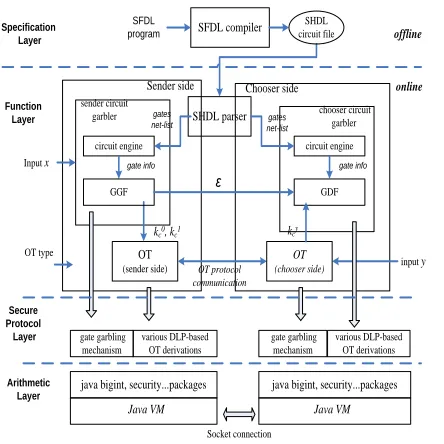
Figure 1. The programming model of Fairplay
supported. A caching technique was developed The ECC based protocol is well suited for GPU cluster architecture because most of its point multiplications can share the unique and constant public point P. For case studies, we tested “equality checking” and “minimum of two” circuits.
[2]. The ECC Arithmetic GPU Library (EAGL) is designed to minimize the context switching overhead of GPU execution and full utilization of GPU devices. We streamlined synchronization and execution control threads between GPUs and the host CPU.
The rest of this paper is organized as follow: section 2 presents the foundation work of Fastplay. Section 3 discusses secure protocol layer. Section 4 extends the prototype of gate garbling protocol to various types of gate garbling functions and circuit connection issues. The ECC Arithmetic GPU Library is presented in section 5. Experimental results and evaluation are illustrated in section 6. Section 7 discusses related work. Conclusions are drawn in section 8.
II. FUNOUNDATIONAL WORK
The objective of Fastplay is to replicate the single-bit Boolean secure function evaluation [9] onto the massive number of execution threads available on a GPU cluster to achieve the goal of acceleration for large scale applications. Fastplay is an ECC-based implementation for the Boolean secure function evaluation. For ECC-based arithmetic computations, we made extensive modifications to some portion of the MIRACL code base for optimal execution on the GPU architecture. Moreover, we adopt the Fairplay [33] as the programming model to achieve compatibility with existing serial solutions.
In the Boolean secure function evaluation problem A secure function f(x, y) has 1-bit input x from a sender, 1-bit input y from a chooser, and one 4-entry truth table. The sender and the chooser are not allowed to learn about each other’s input during the protocol execution. To achieve this goal, sender generates two random N-bit integers ks0 and ks1
mapping to x’s potential values 0 and 1, kc0 and kc1 mapping
to y’s potential values, ko 0
and ko 1
mapping to potential output values 0 and 1. Sender holds the plain truth table, which saves plain output values 0 or 1, indexed by its corresponding input values (00, 01, 10, 11). For each plain truth table entry Tij that saves output value z, sender encrypts
it as E(Tij) = E_ks i
(E_kc j
(ko z
)), where E_ks i
means encryption using key ksi that represent sender’s input value i. After
encrypting all four truth table entries (ij = 00, 01, 10 and 11), sender transfers message ε = {{E(Tij)}, ksx that maps x’s real
value, pre-defined unique characteristic of ko0 and ko1} to
Bob, and delivers kc y
to chooser via OT. Finally, chooser can successfully decrypt one of four E(Tij) = koz that maps the
output value z = f(x, y).
Fairplay system is the first general software suite that supports implementation of the general SMC scheme based on SFDL and its compiler tools. The programming model of Fairplay system is illustrated in Fig. 1. The programming model can be modeled into four layers: specification layer,
function layer, secure protocol layer, and arithmetic layer.
We adopted the SFDL compiler in specification layer for Fastplay, but we developed our own implementations for remaining layers.
At the specification layer, SFDL supports specification of a general secure function f(x,y) as a circuit that includes customized multi-bit I/O from two parties, and the function body describing the functionality of the circuit. An offline SFDL compiler is employed to convert a circuit program into a gates-level hierarchy file written in SHDL. Function layer includes an online SHDL parser that generates a net-list of gates based on the SHDL file, a circuit engine that collects each gate’s information and invokes a pair-wise gate garbling/de-garbling function (GGF/GDF) on each side respectively, and a pair-wise sender/chooser 1-out-of-2 OT instances that are invoked by GGF/GDF. The gate garbling schemes and various DLP-based OT implementation derivations can be summarized as the secure protocol layer. The arithmetic layer is composed of interfaces in java large integer, security and associated packages. At runtime, the sender/chooser side independently runs on a Java virtual machine, and connects with the other side via socket.
MIRACL [5] contains comprehensive elliptic curve point arithmetic routines, e.g., point multiplication, point addition, subtraction, doubling, normalization and so on. Our initial attempts to port MIRACL directly to the CUDA environment proved to be virtually impossible due to numerous challenges in buffer management, memory access model, and execution control, etc.
Sender side Chooser side
kc0, kc1
εg or εm
ECC-based 1-out-of-2 OT instance (chooser side)
input y
kcy
ECC-based 1-out-of-2 OT instance
(sender side) ECC-based OT protocol
communication
SHDL circuit file
SHDL circuit file
sender
circuit engine SHDL parser
gates net-list
gate garbling task dispatcher
GPU-based GGFs CS
type II type gate info &
func type
3-arity type Multicore-based GGFs
CS type
II type
3-arity type input x
chooser circuit engine
SHDL parser
gates net-list
gate de-garbling task dispatcher
gate info & func type
3-DGG Protocol
EGG
Protocol ProtocolEGG
3-DGG Protocol mode
selection
mode selection
ECC-based 1-out-of-2 OT
protocol ECC-based 1-out-of-2 OT protocol
Function Layer
Secure Protocol
Layer
GPU-based GDFs Multicore-based GDFs
Specification Layer
Arithmetic
Layer GPU execution control interfaces
EAGL Arithmetic Cells (EAC) ECC Arithmetic GPU Library (EAGL)
host
device
GPU execution control interface
EAC
ECC Arithmetic GPU Library (EAGL) host
device
... ... ... ... CS
type II type
3-arity type
... ... CS
type II type
3-arity type
... ...
Figure 2. The high-level programming model of Fastplay
Sender Chooser
OT-S1: generate s in Zq, pt mul: [s] P, sends it to chooser
Public Knowledge: P - a point on the public curve
q is large prime integer Zq = big integers in (0, q) OT-C1:
generate k in Zq. if chooser input y is 0, PKy = [k] P if y is 1, PKy = [s] P – [k] P Send PKy to sender
OT-S2: generate r0 & r1 in Zq, pts mul: [r0] P, [r1] P,
pt sub: PK1-σ =[s] P - PKy
pt mul: [r0] PKy
pt mul: [r1] PK1-y
pt add: [Ic0] P + ([r0] PKy)
pt add: [Ic1] P + ( [r1] PK1-y)
send C0={[r0] P, ([Ic0] P + [r0] PKy)} and
C1={[r1] P, ([Ic1] P + ( [r1] PK1-y)} to chooser generate 2 random large integer Ic0 & Ic1 in Zq,
pts mul: kc0 = [Ic0] P, kc1 = [Ic1] P, è chooser input y = 0/1
OT-C2:
If y = 0, (implies PKy = [k] P) pt mul: [k] ([r0] P); pt sub: ([Ic0] P + [r0] PKσ) –
[k] ([r0] P) = [v0] P
If y =1, (implies PKy = [s] P – [k] P)
pt mul: [k] ([r1] P); pt sub: ([Ic1] P + [r1] PK1-y) – [k] ([r1] P) = [v1] P
In the end, chooser knows either kc0=[Ic0] P or kc1=[Ic1] P, denoted as kcy
EGG Protocol ECC-based
1-out-of-2 OT protocol 3-DGG
Protocol
Secure Protocol Layer
EGG Protocol ECC-based
1-out-of-2 OT protocol 3-DGG
Protocol
C0 & C1
PKy
[s] P
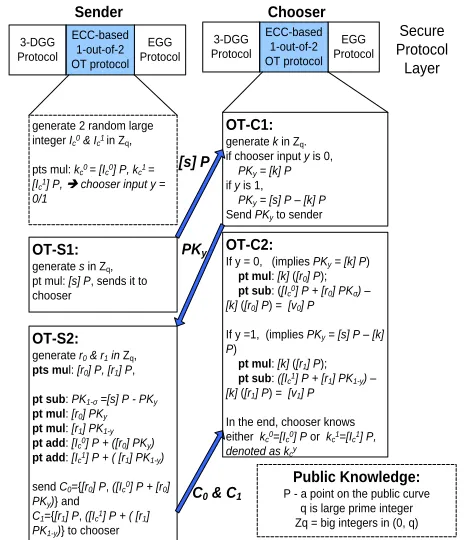
Figure 3. ECC-based 1-out-of-2 Oblivious Transfer Protocol
allows the chooser to decrypt successor circuit based on the predecessor circuit’s SMC result.
Fastplay supports both multicore-based and GPU-based GGFs/GDFs. Triple-DES is used for gate garbling protocol (3-DGG protocol) in the multicore implementation, and the encryption messages εm = ε. On the other hand, an ECC-based gate garbling protocol (EGG protocol) was implemented for the GPU-based GGFs/GDFs. The 3rd component of their encryption messages εg uses {kO0, kO1}
directly, without leaking any sensitive data. We further note that the gate’s arity and types of gate inputs can determine details of a garbling function, such as whether or not OT needs to be involved. As a result, we implemented one type of GGF/GDF for each type of gate so that the synchronization mechanism can be greatly simplified.
For the secure protocol layer, Fastplay consists of three secure protocols: ECC-based gate garbling protocol (EGG
protocol), triple-DES based gate garbling protocol (3-DGG
protocol), and ECC-based 1-out-of-2 OT protocol. Both EGG and 3-DGG protocols need to use the ECC-based 1-out-of-2 OT protocol for the secure transferring of kc0 (or kc1)
that will be needed for decryption of the truth table.
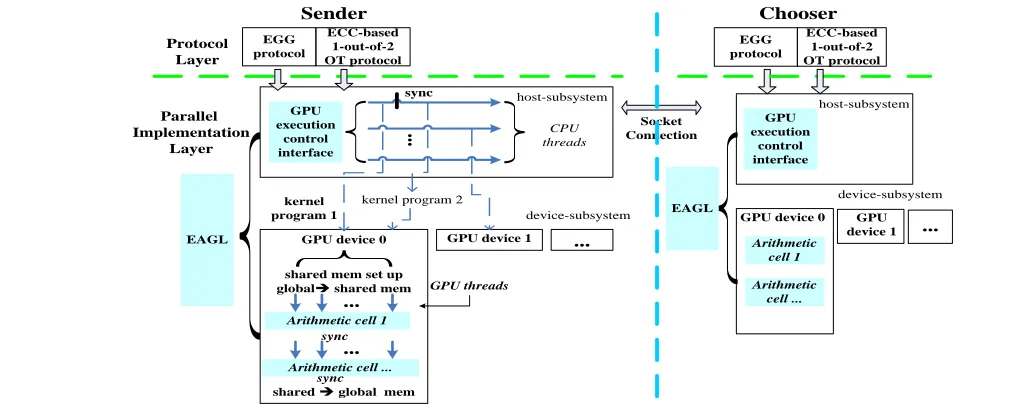
The arithmetic layer of Fastplay, the ECC Arithmetic GPU Library (EAGL), consists of two major modules for control and interfaces between the host and GPU devices. The GPU execution control interface runs on host and manages synchronization of GPU-host threads, their data movements. It is also responsible for configuration, initialization and destroying of GPU context, and exception handling. A massive number of instances can be dispatched to GPU threads for parallel executions. Major reengineering
Sender Chooser
chooser now obtains:
E(T00), E(T01), E(T10), E(T11), ksx, and two points representing output value
kO1, kO2
C1: chooser invokes a 1-out-of-2 OT instance (chooser side), given chooser’s input y,
if y=0, chooser knows kc0 if y=1, chooser knows kc1 denoting it by kcy.
S1. generate 4 large int:
Is0, Is1, IO0, IO1 in Zq Pts mul: ks0= [I
s0] P, ks1= [Is1] P; {ks0 &ks1} è x=0 or 1; kO0= [I
O0] P, kO1= [Ic1] P; {kO0 &kO1} è output value z = 0 or 1.
generate two random large integers: Ic0, Ic1 in Zq
calculate points kc0= [Ic0] P, kc1= [Ic1]P, representing the chooser’s input value y = 0 or 1
S2. encrypt four truth table entry T00, T01, T10, T11: E(T00) = kOz + ks0 + kc0 E(T01) = kOz + ks0 + kc1 E(T10) = kOz + ks1 + kc0 E(T11) = kOz + ks1 + kc1 randomly re-order E(T00), E(T01), E(T10), E(T11) è{E(Tij)} Disorder{kO0, kO1}
S3. invoke a 1-out-of-2 OT instance (sender side), in order to transfer kc0/kc1 to chooser.
C2: decrypt every true table entry: for each i and j = 0, 1: D(E(Tij)) = E(Tij) - Psx – Pcy
compare each D(E(Tij)) with kO1 and kO2, only one entry’s decryption result D(E(Txy)) can match kO1 or kO2.
Public Knowledge:
P a point on the curve q is large prime integer Zq = large integers in (0, q)
ε
gkcy
EGG Protocol ECC-based
1-out-of-2 OT protocol 3-DGG
Protocol
Secure Protocol Layer EGG Protocol ECC-based
1-out-of-2 OT protocol 3-DGG
Protocol
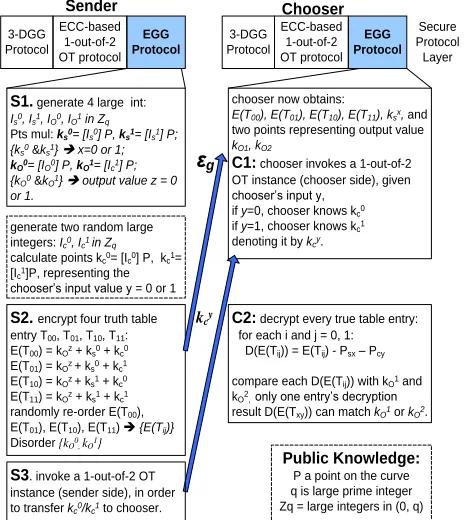
Figure 4. Prototype of EGG protocol
III. SECUREPROTOCOLLAYER
A. ECC-based 1-out-of-2 OT protocol
In the literature, oblivious transfer (OT) [18] can be conceptually understood as sender controls the garbling parameters I0 and I1for the plaintext message of M0 and M1
at each transaction, and chooser can choose between one of the two input values 0 or 1. M0 and M1 can be published after
they are encrypted by a well known encryption scheme using
[I0]P and [I1]P as their keys, respectively. Generation of the M0 and M1 is domain dependent, and therefore not
considered as a part of the OT. In the context of the EGG and 3-DGG protocol, the output value 0 and 1 of a gate’s plain truth table entries are M0 and M1, whose decryption keys Ic
0
and Ic1 plays the role of garbling parameters I0 and I1 in the
general OT paradigm. For consistency, we use Ic0 and Ic1 in
the following descriptions of our ECC-based 1-out-of-2 OT protocol.
The ECC-based 1-out-of-2 OT protocol is illustrated in Fig. 3. At first, with no knowledge of the chooser’s privacy
y, the sender generates two keys kc0 = [Ic0]P and kc1 = [Ic1]P,
where Ic 0
and Ic 1
are two large integers and P is a base ECC point of a chosen elliptic curve. Here [Ic0]P and [Ic1]P are
standard point multiplication method in ECC. Then, the sender starts transferring a randomized point [s]P to the chooser. After receiving [s]P, chooser generates another random point PKy=[k]P if the chooser’s input value y=0,
otherwise PKy=([s]P - [k]P). In this step, the chooser
associates its privacy y with PKy and transfers PKy back to
sender. Then the sender generates two random points [r0]P
and [r1]P, and seals the garbling parameters Ic0 and Ic1
through point multiplication and point addition as the homomorphic operation. The encrypted messages are denoted by C0 and C1. Finally, the chooser can only correctly
decrypt either C0 or C1 according to his original privacy y.
As a result, chooser will hold either [Ic0]P (if y=0) or kc
1
=[Ic 1
]P (if y=1). In the whole process, generating
kc0=[Ic0]P, [Ic1]P, [s]P, [k]P, [r0]P and [r1]P are usually
viewed as sender’s initialization phase [42], so is the [k]P
for the chooser side.
In terms of computing cost, the sender needs five point multiplications in his initialization phase. In his online execution phase, he needs two point multiplications and three point additions/subtractions in step OT-S2. For the chooser, there is one point multiplication in his initialization phase, two point multiplications, and two or three point subtractions in his online execution phase.
As seen later, the size of an elliptic curve point is 320 bits. In terms of bandwidth, the communications cost from sender to chooser is 320 bits in pre-computing phase ( OT-S1), and 4*sizeof(point) = 4*320 bits = 1280 bits in the computation phase (OT-S2), and that from chooser to sender is 320bits.
The security of the ECC-based 1-out-of-2 OT protocol is based on the well-known ECDLP. For outside adversaries, an eavesdropper Eve cannot use P, [s]P and PKy to find s
and k to discover Ic0 and Ic1 if he cannot calculate discrete
logs on an elliptic curve. Similarly, Eve cannot use [r0]P, [r1]P, [r0]PKy and [r1]PK1-y to find k to discover Ic0and Ic1 if
she cannot calculate discrete logs. In other words, Eve cannot obtain the key kc0=[Ic0]P or kc1=[Ic1]P that must be
uniquely acquired by the chooser to decrypt a certain entry of a truth table later in the EGG protocol and the 3-DGG protocol. For inside adversaries, we use [r0]PKy + [Ic
0
]P/[r1]PK1-y + [Ic 1
]P to protect Ic 0
/Ic 1
. Since r0 and r1 are
two randomly chosen large integers, a malicious chooser cannot use [r0]P/[r1]P and [r0]PKy /[r1]PK1-y to derive PKy/PK1-y in {[r0]P, [Ic0]P+[r0]PKy} and {[r1]P, [Ic1]P+[r1]PK1-y} so that Ic0 and Ic1 are protected unless he
can solve ECDLP. In other words, the chooser cannot have both kc0 and kc1 simultaneously so he cannot to decrypt
entries of the truth table that are not indexed by his real input value. Similarly, a malicious sender cannot know the results of the chooser’s selection (Ic0 or Ic1)since k cannot be derived
from PKy and P.
B. ECC-based Gate Garbling Protocol (EGG Protocol)
[1]. The chooser is able to decrypt only one of the four entries, which is indexed by the inputs from both sides;
[2]. Neither the chooser nor the sender knows the other’s input value;
[3]. Any third-party adversary cannot decrypt the truth table entry;
To achieve Property 1, garbling/de-garbling needs to utilize the standard ECC point addition and subtraction (i.e. given point P and Q, P+Q-Q=P). To achieve Property 2 and 3, one 1-out-of-2 OT instance is invoked to transfer the key determined by the chooser’s input. Fig. 4 illustrates the encryption/decryption scheme. The EGG protocol can be described as follows:
(1)Step S1: the sender generates two 160-bit large integers, Is
0
and Is 1
, and another two 160-bit large integers IO 0
and IO1. Then the sender calculates ECC points ks0, ks1, kO0
and kO1following the formula that ksi = [Isi]P, kOz = [IOz]P,
here i, z = 0 or 1, and P is one public point on the pre-selected curve. Points ks0 and ks1 are used to map the possible
value 0 and 1 of sender’s 1-bit input x. Similarly, kO 0
and kO 1
map to the possible value 0, 1 of output z.
Preparation for 1-out-of-2 OT: Although we mentioned the generation of kc
0
and kc 1
in ECC-based 1-out-of-2 OT protocol, they were actually generated kc0 and kc1. Sender
generates kc0 and kc1 that map to the possible values 0 and 1
of the chooser’s 1-bit input y. As we will see later, generation of kc0 and kc1 is counted as the execution of the
1-out-of-2 OT instance in benchmarking.
(2)Step S2: we denote the four entries of plain truth table as T00, T01, T10, and T11 respectively, where the subscripts of
T are actually specified by the gate description in the circuit list file. For convenience, T’s 1st subscript represents the
sender’s input bit, and T’s 2nd
subscript representing the chooser’s input bit. For each truth table entry, the sender encrypts it as: E(Tij) = kOz + ksi + kcj. Here, kozis the point
that maps to the output value z as the result of corresponding truth table entry Tij. By denoting the sender’s real input value
as x, x = 0 or 1, the sender transfers εg ={randomly
disordered {E(Tij)}, ksx, and randomly disordered {kO0, kO1}}
to the chooser.
(3)Step S3: The sender invokes an ECC-based 1-out-of-2 OT instance (sender side) so that the chooser can select to know either kc0or kc1 based on the value of his 1-bit input y.
The key the chooser finally obtained is denoted by kcy.
(4)Step C1: The chooser invokes an ECC-based 1-out-of-2 OT instance (chooser side) and gets kc
y
. The chooser also receives εg.
(5)Step C2: For each encrypted truth table entry E(Tij),
the chooser tries to decrypt it as: D(E(Tij)) = E(Tij) – ksx – kcy.
Although he gets four different points as computation results, only one of them matches the kO
z
generated by sender. The chooser takes kOz as the computing results.
The size of the data transferred from the sender to the chooser is 2arity*320+320*2+320. Given that a gate’s arity is 2, the total size is 2240bit. Since our protocol follows the standard SMC architecture [6] and elliptic curve discrete logarithm problem (ECDLP) [1], the proofs of all the three security properties are obvious and omitted here.
In terms of computing cost, the sender needs four scalar point multiplications in its key generation phase ([Isi]P, [IOz]P, i,z=0,1), and 2arity*2 point additions for online
encryption. The chooser only needs 2arity*2 point subtractions for online decryption, and (2arity+2) point normalizations to normalize the decryption results D(E(Tij)) and {kO1, kO2} to
affine co-ordinates for point equality checking. In the EGG protocol, the most expensive computation is the sender’s key generation operations, since it needs expensive point multiplication operations. However, random point generation is independent of the truth table encryption/decryption process, and the number of random points N needed to be generated for each gate is fixed. Pre-computation of random points when computation resources are free is an optional way to reduce the computing cost.
C. 3-DES-based Gate Garbling Protocol (3-DGG Protocol)
Based on the 2-arity CS type gate, the 3-DGG protocolis as follows:
(1)Step 3D-S1: The sender generates four 160-bit random integers ks0, ks1, IO0, IO1, and then generates a set of three
different 64-bit keys Ks0 = {key1s0, key2s0, key3s0} from ks0,
and another set Ks1 = {key1s1, ke2s1, key3s1} from ks1.
Like the EGG protocol, the sender prepares point kc 0
and
kc1 for the 1-out-of-2 OT that will be invoked in step 3D-S4.
(2)Step 3D-S2: The sender generates a set of 64-bit keys
Kc0 = {key1c0, key2c0, key3c0} from ECC points kc0, and
another set Kc1 = {key1c1, key2c1, key3c1} from kc1. All the
keys are generated based on different segments of the point’s
X and Y co-ordinates.
(3)Step 3D-S3: For each truth table entry Tij, the index i
and j represent the input value from the sender and the chooser, respectively. Suppose the plain output value of this entry is z, z is 0 or 1, then Tij = IO
z
<< 32 + 0x0000, so that the chooser can easily identify which entry is decrypted successfully because the probability of generating a 32-bit consecutive 0 using two levels of 192-bit triple-DES with incorrect keys is very low. Encryption of entry Tij is E(Tij) = 3-des(Kcj, (3-des(Ksi, Tij, ENCRYPT), ENCRYPT). Sender
sends εm={randomly re-ordered {E(Tij)}, ksx} to the chooser.
(4)Step 3D-S4: The sender invokes a 1-out-of-2 OT instance (sender side) in order to transfer either kc
0
or kc 1
to chooser, the point chooser finally gets is denoted by kcy.
(5)Step 3D-C1: The chooser invokes a 1-out-of-2 OT instance (chooser side) to receive kcy. The chooser also
receives εm.
(6)Step 3D-C2: The chooser generates Ksx = {key1sx, key2sx, key3sx} from ksx, and generates Kcy from ECC point kcy.
(7)Step 3D-C3: The chooser decrypts truth table entries as D(E(Tij)) = 3-des(Ksx, (3-des(Kcy, E(Tij), DECRYPT), DECRYPT). In the end, only D(E(Tij)) that has the last 32-bit
as 0x0000 is the correct decryption result. The chooser stores
Ioz = D(E(Tij)) >> 32.
The size of data transfer from the sender to the chooser is
Gate 1
Gate 2 sender’s
input
chooser’s input
sender’s input
chooser’s input
Gate 3
k1S0, k1S1
k1C0, k1C1
chooser holds
k1O0 / k1O1
k2S0, k2S1
k2C0, k2C1
sender holds
k1O0and k1O1
sender holds
k2O0and k2O1
sender generate
k3O0 , k3O1
chooser holds
k2O0 / k2O1
chooser holds
k3O0 / k3O1 CS type GGF/GDF
CS type GGF/GDF
II type GGF/GDF
...
...
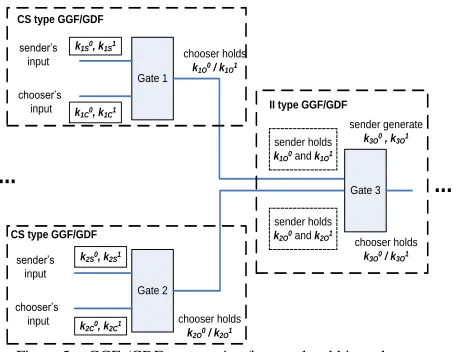
Figure 5. GGFs/GDFs connection for gate-level hierarchy
IV. FUNCTIONLAYER
The task of the gate garbling task dispatcher is to extract information about the gates and identifying the type of GGFs/GDFs needed to be invoked. Although all the GGFs/GDFs in the GPU-based/multicore-based groups follow the prototype of EGG /3-DGG protocols respectively, there are slight differences in certain steps. Taking the 3-arity gate as an example, its three 1-bit inputs may come from sender, chooser or predecessor gate(s): if a gate’s input is from the sender or the chooser, the sender needs to one pair of points/large integers for itself in step S1/3D-S1. If one gate itself and all its predecessor gates only take the sender’s inputs, this gate can be treated as an input wire from the sender, because the sender himself can decide the output value of this gate. For the gate that does not directly get input from the chooser, OT can be ignored.
Besides invoking various types of GGFs/GDFs, the gate garbling task dispatcher need to fetches the encryption keys/secure computing results from predecessor gates’ GGFs/GDFs for each gate, so that gates and circuits with interdependency can be connected. The key issue for gate connection and circuit connection is key re-using. Taking the gate-level hierarchy as an example, when a complex circuit contains hundreds or thousands of gates, it is possible that some gates’ input(s) are not from the sender or chooser, but from intermediate results of their predecessor(s). For succinctness, we still assume all gates are 2-arity, and show one example of gate connection:
As shown in Fig. 5, two CS type GGFs/GDFs are invoked for gates 1 and 2, and an II type ( Intermediate-Intermediate) of GGF/GDF are invoked for gate 3. Taking the GPU-based GGFs/GDFs as an example, gate 3’s GGF does not need to generate the four random points k3s0, k3s1, k3c0 and k3c1 that are used to encrypt Gate 3’s truth table.
Instead, its GGF encrypts gate 3’s truth table entries by using the points k1O0, k1O1, k2O0and k2O1that represent the possible
output of gates 1 and 2. In Step S1, the sender only needs to generate k3O0 and k3O1 that represents to gate 3’s possible
output values 0 and 1. When gate 1 and 2 complete their garbling processes, the sender holds the four points k1O
0
,
k1O1, k2O0and k2O1; the chooser holds either k1O0 or k1O1, and
either k2O 0
or k2O 1
, denoting by k1o z
, and k2o w
. Similar with S2
in Fig. 4, the sender encrypts gate 3’s truth table entries by adding k1O0 or k1O1, and k2O0or k2O1, to k3O0 or k3O1. On the
other hand, since the chooser has already known k1oz, and k2ow, he uses these two points to decrypt the truth table
entries, described as C2 Fig. 4. In the end, he can only successfully decrypt one of four entries. In such a process described above, security property 1 is held because the chooser does not fully hold the two keys to obtain the other three plain truth table entries. Property 2 is true because gate 1 and gate 2 hold property 2 and gate 3 inherits these inputs from gate 1 and 2, and does not accept extra inputs. Property 3 holds because gate 1 and gate 2 hold property 3, so that a 3rd party adversary cannot decrypt gate 1’s and 2’s truth table and thus them do not know k1oz, and k2ow. Consequently, they
cannot decrypt gate 3’s truth table. The multicore-based GGFs/GDFs follow the same idea and are omitted here.
Furthermore, such a gate connection scheme also supports the multi-level circuit hierarchy if several circuits are combined together to form a more complicated computation logic. Supposing circuit A provides 1-bit output to circuit B. When secure computing of A is done, the sender holds the two points kAo0 and kAo1, meanwhile the chooser
saves the point kAo z
as the secure computing result of A. In the secure computing of B, The sender will use kAo0 and kAo1
to encrypt the truth table entries of the gate that accepts A’s output. As a result, the chooser can only decrypt one entry successfully because he only knows one of kAo0 and kAo1
exclusively.
V. ARITHMETIC LAYER
A. GPGPU Parallel Computing Architecture
The architecture of GPGPU follows the SIMD (single instruction multiple data) architecture. That is, all processing unit executes the same instruction with various operands. Currently, two of the most popular GPGPU architectures are NVIDIA CUDA (Compute Unified Device Architecture) and ATI Stream. The CUDA architecture includes two parts: host
host-subsystem
ECC-based 1-out-of-2 OT protocol EGG
protocol
GPU execution
control interface
...
CPUthreads
...
GPU device1
ECC-based 1-out-of-2 OT protocol EGG
protocol
Socket Connection
Parallel Implementation
Layer
Sender Chooser
Protocol Layer
GPU device 0
GPU threads
...
globalè shared mem
Arithmetic cell 1
...
Arithmetic cell ... sync
shared è global mem
sync
EAGL
host-subsystem
GPU execution
control interface
Arithmetic cell 1
Arithmetic cell ...
EAGL kernel
program 1 device-subsystem
device-subsystem
GPU device0
...
GPU device1
kernel program 2
sync
shared mem set up
Figure 6. The execution process of GPU execution control interface
runs, its parallelism parameters – number of blocks and
number of threads per block are specified. One SM can only concurrently run one block and threads in this block is organized as one or multiple warps. In sum, the parallelism that one GPU board provides equals to (number of blocks *
number of threads per block). More details are referred to [42].
Our motivation for parallel execution of ECC arithmetic on a GPU platform is based on two observations. First, one of the most frequent ECC arithmetic operations in the EGG protocol and the ECC-based 1-out-of-2 OT protocol is point multiplication [k]P, where P is a fixed unique base point and can be shared by all threads. Consequently, part of point multiplication can be moved to offline pre-computing, and the shared memory space is saved by maintaining one copy of P for all threads on the same SM. Furthermore, as we will show later, the size of the ECC point (320 bit) is small and thus ECC arithmetic is suitable for porting to a computation platform with constrained fast-accessing memory resource.
Porting a complicated system from CPU-based programming model to a GPGPU based model is challenging. For example, SMs on most GPGPU platforms do not have a branch predictor, threads in the same warp have to wait until all members calculate their jump address and finish the IF (instruction fetch) phase when they meet a branch. Identifying the potential write conflicts is another critical issue. The constrained fast-accessing memory resource requires highly efficient space utilization mechanism for buffering intermediate results, i.e. buffer re-using and dynamic data structure size optimization, etc.. The accessing of slow local memory and global memory has to be minimized in usual case, however, sometimes there is a tradeoff between accessing high delay memory and maintaining a high degree of parallelism. For complicated programs, it is critical to identify which part of code is most suitable to run on a CPU, and which part is better for GPGPU-based execution. In the end, most CUDA platforms
only support debugging in simulation mode, not real-time debugging.
The rest of this section presents the two part of ECC Arithmetic GPU Library (EAGL): GPU execution control interfaces running on the host sub-system, and the EAGL arithmetic cells running on device sub-system.
B. ECC Arithmetic GPU Library (EAGL)
In the secure protocol layer, any operation that uses elliptic curve cryptography arithmetic needs EAGL to be involved in the parallel implementation layer. The theory of
Elliptic Curve Cryptography (ECC) was first proposed by Koblitz [1] and Miller [2]. Let K be a finite field, and suppose E(K) is an additive group of points on an elliptic curve E over K, E(K) is defined as the set of points (x, y), x, y K, (x, y) satisfy y2 = x3 + ax + b (the curve used in our implementation). Here we took K as Fp - as a finite prime
field, where p is a large prime number. Here we use P, Q, R
to denote points in E(K), and k to denote a large integer, The regular elliptic curve arithmetic operations are point addition (R=P+Q), point subtraction (R=P-Q), point doubling, (Q = [2]P), and point multiplication (Q = [k]P). Given certain elliptic curve E(Fp), the arithmetic routines of all the
operations discussed above can be computed on projective coordinates [23]. The main reason is that elliptic curve group operations on projective coordinates do not need inversions and are more efficient that those on affine coordinates. Before running these ECC arithmetic routines on GPU platforms, GPU execution control interface need to set up an execution environment, and then these routines are fulfilled by one or several EAGL arithmetic cells.
1) GPU Execution control Interfaces
struct large_int{ unsigned int array[k]; unsigned in length; }
struct Point{ struct large_int X; struct large_int Y; struct large_int Z; unsigned int marker; }
Figure 7. Data structures of large integer and ECC point
rand() initial parameters
point
P
large int q
CPU division
normalization
norm q
compute (m’)*P
(m’)*P table
rand() parameter Global Mem (-m’)*P
table q
norm q 0
work space 0 Y of (-m’)*P
table (m’)*P
table
norm q 1 ...
work space 1
...
random large int generation
reuse norm q to save result
fast point mul for base point P: result=[k]P
Pre-computing
0 1 ... seeds
G*b*n-1
GPU Device 0
0 1 ... b*n-1 ([k] P) array
... b*n-1
CPU thread 0
CPU thread (G-1)
GPU device (G-1) Host
Mem
0 1 ... b*n-1 seeds
Seed generation
G*b*n-1 ...
Shared Mem
q
0 1 ... b*n-1 ([k] P) array
norm q n-1
SM 0
work space n-1
Arithmetic cell 1
... ... ...
GPU threads: n threads per SM
0 1 n-1
0 1 ... n-1 seeds
0 1 ... n-1 point array n-1
...
SM (b-1)
n-1 ...
... ... ...
0 1 n-1
Arithmetic cell 2
no need for sync when n <=32
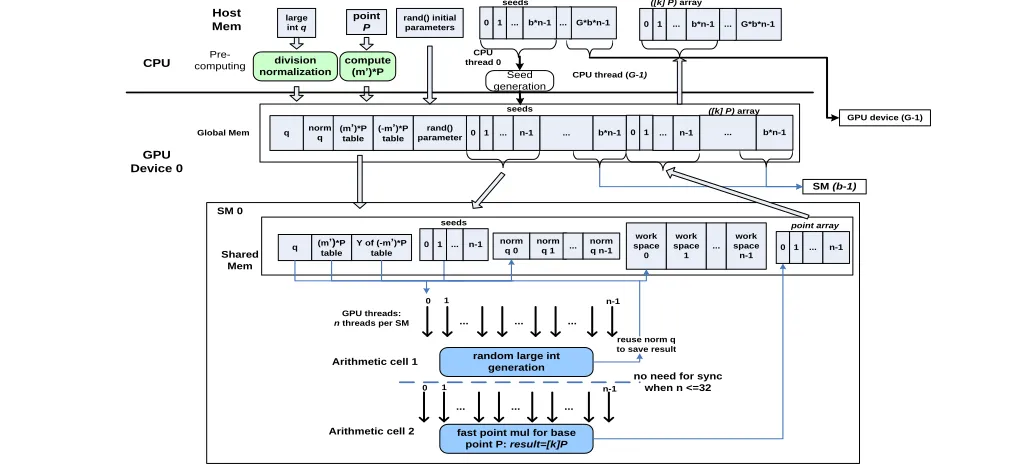
Figure 8. The online data flow of EAGL’s arithmetic cell rand+pt mul
available GPU device. As CPU threads start to execute, the GPU execution control interface takes the charge of runtime synchronization of GPU and CPU threads and their data movement, GPU context initialization and destroying, GPU parallelism configuration, GPU execution runtime exception handling. To minimize the overheads on GPU context initiation and device memory allocation, the GPU execution interface always stays in the same GPU context as long as it is not interrupted by necessary data communication, and always allocates a large chunk of device memory and partitions it for all the EAGL arithmetic cells invoked in its life time.
The GGFs/GDFs in the multicore-based group do not depend on GPU execution control interfaces as much as those in GPU-based group. The GPU execution interface is invoked only in step 3D-S1 for parallel generation of a large volume of random large integers, and in step 3D-S4 and 3D-C1 where ECC-based 1-out-of-2 OT instances are called.
2) EAGL Arithmetic cells (EAC)
When the GPU execution control interface dispatches kernel programs to GPU devices, the kernel programs’ programming model generally follows a 3-step scheme, including (1) setting up shared memory space and moving data from global to shared memory, (2) calling certain arithmetic cell, and (3) updating the result back to global memory.
The basic data structures in EAC are shown in Fig. 7 – the large integer and ECCpoint. Large integer precision is 32*k bits. Although 160-bit keys are secure enough as the key length in ECC, k is set as 7 in EAC for preventing possible overflow. In certain arithmetic cell like large integer modular multiplication, k temporarily grows to 11 and recovers back to 7 after it completes. However, points are normalized and k is cut to 5, Z coordinate and the marker are removed in protocol communication messages for saving
bandwidth.
All EAGL’s arithmetic cells share public knowledge {a point P, a large prime integer q, and the set Zq = [0,q)}. The
public q is used in the generating random large integer k up bound by q. As shown in Fig. 8, this paper uses two of the most frequently invoked arithmetic cells – random large integer generation and point multiplication [k]P to illustrate how a cell interacts with its peer, how the offline and online part are split in original code base, and how the shared memory space is organized, given the parallelism environment as G available GPU devices, each device runs b
blocks, and there are n threads per block.
The random large integer generation adopts the
Marsaglia & Zaman random number generator [43, 44], where mod q is involved. According with [45], mod q needs to compute q’s division normalized form. Since q is fixed, q’s division normalized form can be pre-computed. So does
Table 1. Execution time (unit: ms) of GGFs (sender side)
GGFs used & input circuit
(1) key
gen (2) GCID
(3) ENC (4) OT
DMA KPE Sum INIT ONLINE Sum
GPU GGFs +
equality check 133146 2328.9 3863.0 2996.7 6859.8 48190.4 24414.1 72604.5
Multicore GGFs+
eq check 1304.6 2.4 4790.0 47764.3 24323.2 72087.5
serial 3-DES
GGFs+OT+eqcheck 24201 -- 12333.8 2588.3*10
3
GPU-based GGFs
& min of 2 23008.9 369.1 687.1 521.2 1208.3 12177.0 5388.8 17565.8
multicore-based
GGFs & min of 2 267.5 3.5 838.8 12269.0 5398.4 17667.4
serial 3-DES
GGFs+OT&minof2 4699 -- 2017.3 612.1*10
3
Host
data bus Memory
Memory Bridge
Intel i7 @ 2.67GHz
Intel i7 @ 2.67GHz Intel i7 @ 2.67GHz
Intel i7 @ 2.67GHz
Intel Xeon 5500
Intel i7 @ 2.67GHz
Intel i7 @ 2.67GHz Intel i7 @ 2.67GHz
Intel i7 @ 2.67GHz
Intel Xeon 5500
Tesla C870 Device: Tesla S870
1.5 GB DDR3 RAM
Tesla C870
Tesla C870
1.5 GB DDR3 RAM Tesla
C870 Work distribution
switch
PCIe Host Adapter Card
PCIe Host Adapter Card
PCI Express 1.0
Work distribution
switch
1.5 GB DDR3 RAM
1.5 GB DDR3 RAM
Tesla C870 Device: Tesla S870
1.5 GB DDR3 RAM
Tesla C870 Work distribution
switch 1.5 GB
DDR3 RAM
PCIe Host Adapter Card
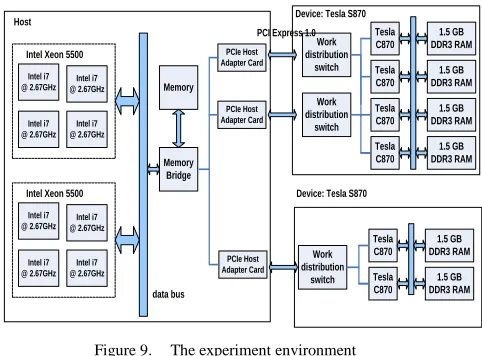
Figure 9. The experiment environment
memory, each RW data is split into G equal pieces, each piece is assigned to one GPU device, as shown in the middle row in Fig. 8. Then, the RW data in the middle row is divided into n equal parts, each part is copied to one block owns by a SM on the GPU device. When n <=32, all threads are in the 1st warp, and concurrently runs the same cell, which leads to no need of thread-level synchronization. Overall, the parallelism on each GPU device = b*n. Denoted the size of shared memory consumed by each thread as x, then n equals to . By minimizing the temporary variable saving in the work space and reducing the space waste in point and integer structure, most of EACs support the configuration of a full warp as the size of shared memory per SM = 16384 Bytes, so that the SM is fully loaded in these EACs.
However, [k]P is not the only type of point multiplication utilized in the ECC 1-out-of-2 OT protocol. As part of the homomorphic operations, the sender side needs to compute [r0]PKy and [r1]PK1-y and the chooser side
needs to compute [k]([r0]P) or [k]([r1]P). In any one of
these four point multiplications, each thread's curve points
PKy, PK1-y, ([r0]P) or ([r1]P) are different, and thus each
thread needs to compute the sliding window table of these point and maintain a unique table for each point online. In these four point multiplications, we found that it is impossible to save all threads' sliding window tables in the shared memory. There are two alternative solutions to solve this problem: either reducing the number of thread per block from n to n/4 so that all the sliding window tables can still be saved in the shared memory, or putting the slide window tables [m']P in global memory and loads the specific table entry into the shared memory when necessary so that n keeps to be the size of a full warp. The latter one is preferred because it saves the time of launching and exiting kernel function, synchronization in EAC. And Fastplay selects the latter solution in [r0]PKσ, [r1]PK1-σ, [k]([r0]P) and [k]([r1]P)
to keep the parallelism. However, we choose the former solution in computation of PKσ’s, PK1-σ’s, ([r0]P)’s and
([r1]P)’s sliding window tables because there would be large
number of if-else branches if the form solution is adopted.
And this reduction on parallelism degree is hidden for GPU execution control interfaces.
VI. PERFORMANCE EVALUATION
The elliptic curve E used in the experiment is E: y2 = x3 + ax + bmod p,where a = -3, b = 157. The large prime modular p and the order of the curve q are:
p=1461501637330897725906826297907101233233312874 497, and
q=1461501637330897725906824301401491257823677986 243, respectively.
The affine coordinate (x, y) of the base point P is
x=1285014020286381351588483375298861384381400195 358, and
y=4968485340331732032416985889023918384206262119 36, respectively.
The parameters are chosen to construct an ordinary elliptic curve with sufficient protection strength of ECDLP. We do not choose other elliptic curves in MIRACL [5] because they are either super-singular elliptic curves, which are known to have some security weakness [21][22], or have larger parameters.
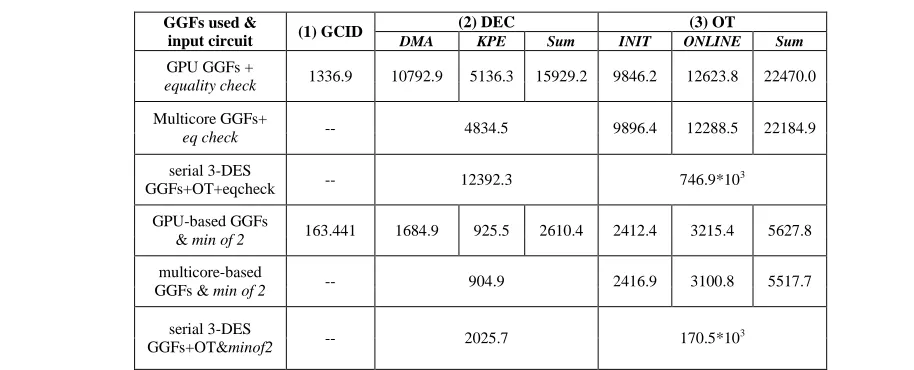
Table 2. Execution time (unit: ms) of GDFs (chooser side)
GGFs used &
input circuit (1) GCID
(2) DEC (3) OT
DMA KPE Sum INIT ONLINE Sum
GPU GGFs +
equality check 1336.9 10792.9 5136.3 15929.2 9846.2 12623.8 22470.0
Multicore GGFs+
eq check -- 4834.5 9896.4 12288.5 22184.9
serial 3-DES
GGFs+OT+eqcheck -- 12392.3 746.9*10
3
GPU-based GGFs
& min of 2 163.441 1684.9 925.5 2610.4 2412.4 3215.4 5627.8
multicore-based
GGFs & min of 2 -- 904.9 2416.9 3100.8 5517.7
serial 3-DES
GGFs+OT&minof2 -- 2025.7 170.5*10
3 sub-system has two Intel Xeon 5500 quad-core processors
with 12GB host memory. The device sub-system is consisted of one and a half Tesla S870 cards that contain 6 Tesla C870 units, or G=6. Each Tesla C870 has 16 streaming multiprocessors (SM), which support concurrent running of 16 blocks of threads (b=16). Each SM has 16k bytes of shared memory. Every two C870 chips share a PCI-Express v1.0 to communicate with the host.
Let the native parallelism degree (n-degree) denote the maximum number of thread that a GPU cluster can run concurrently. N-degree is equal to 6*16*32=3072 in our experiment. Let the actual parallelism degree (a-degree) denote the number of actual threads assigned to be run on the cluster. In other words, a-degree = G’* b’* n’, where G’ is the actual number of GPU device utilized, b’ the actual number of blocks, and n’ the actual number of threads per block. Given G’ = G, when a-degree is greater than n-degree, context switching occurs in order for a device run multiple tasks.
As for the multicore-based GGFs/GDFs on the host, the degree of parallelism is 6.
A. Execution Time and Bandwidth
The goal of the first experiment is to evaluate the acceleration benefits of GPU cluster based SMC parallelization. For the multicore implementation, we built a serial version of 3-DES based GGFs/GDFs, and ECC-based OT protocol. The program was tested on a system with 2.53GHz duo core CPU and 4GB memory. All the ECC-based computations in this serial program are ECC-based on the MIRACL [5]. The a-degree is made equal to n-degree in all GPU based experiments. Due to the simplicity of the 3-DES operations, and its minor computing costs, we did not implement it on GPU, but run it on the multicore host for both the sender side, and the chooser side. Effectiveness on acceleration of OT by GPU is the primary design concern.
The circuits used in this experiment are the equality check circuit with 32-bit from each party, which has 190 gates, and the minimum of 2 circuit with 8-bit from each party, which has 30 gates. The gate net-lists are generated by
SFDL compiler. In the experiment, 3072 equality check
circuits and 3072 minimum of 2 circuits are parallel executed The results shown in the OT column of Table 1 and Table 2 show that the speed up on the GPU-based version is generally achieves 35~40 times of acceleration over the serial version, with both the INIT (which was often excluded as off-line preparation in some evaluations) and ONLINE computations included. Details on breakdowns of different computing elements are discussed next.
The execution time for each sub-task in sender side and chooser side is shown in Table 1 and Table 2. Each reported result is the average of 20 runs. More details on four types of measurements in Table 1 are discussed follows:
(1) key ks 0
, ks 1
, ko 0
, ko 1
generation (key gen) for all gates in the gates net-list. These keys are ECC points in EGG protocol and 160-bit data for 3-DGG protocol. This part is traditionally counted as the initialization phase of gate garbling protocol. Key generation has the highest computing cost, when points are used as keys based on point multiplication. For each gate, GPU-based GGF needs to construct at least two random points kO
0
and kO 1
, and may also need to construct ks0 and ks1. Our experiments showed
that the average execution time of point multiplication is around 280~310ms, but the point addition and doubling usually takes several milliseconds.
(2) The GPU context initialization and destroying
(GCID) when GGFs/GDFs re-enter and leave the GPU execution environment. Multiple entering and leaving of GPU by 1-out-of-2 OT instances are accounted for separately.
0 2000 4000 6000 8000 10000 12000
Scalar Point Multiplication Sender OT Chooser OT complete OT
b'=16 b'=24 b'=32 b'=64
e
x
e
c
u
ti
o
n
t
im
e
(
m
s
)
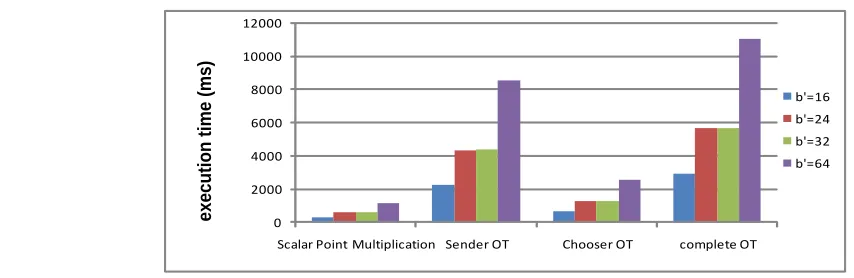
Figure 10. The execution time of point multiplication and 1-out-of-2 OT with various b’
Table 3. Bandwidth (unit: MB) of EGG, 3-DGG and ECC-based ½-OT protocols
bandwidth ECC
½-OT EGG 3-DGG
equality
check 22.5 133.6 60.6
min of 2 5.6 20.5 9.7
configurations, because of the substantial DMA overheads. (4) The sender side’s 1-out-of-2 OT instance execution phase (OT) invoked by all GPU-based GGFs when necessary. OT part is divided into two sub-parts -- INIT sub-part that generates key kc
0
, kc 1
, [r0]P, [r1]P, [s]P, and the ONLINE sub-part that performs the rest in step OT-S2.
For this part of experiments, a total number of 3072*32 1-out-of-2 OT instances are executed for an equality check
circuit, and a total number of 3072*8 1-out-of-2 OT for a
min of 2 circuit. The OT time in min of 2 is three to four times smaller than that in equality check. A large proportion of time is occupied by INIT. The average execution time of one ECC-based 1-out-of-2 OT instance is 2226.75ms, of which around 1470ms are spent in generating random points
[Ic0]P,[Ic1]P, [r0]P, [r1]P, [s]P.
The chooser side exhibited similar performance characteristics as the sender side. The three parts of measurements report in Table 2 are summarized as follows:
(1) GCID is similar to that of the sender side. It has relatively small running time. (2) Decryption (DEC) in GPU-based GDFs, or chooser’s C3 step in Fig. 4. Similarly, this part can be divided into DMA and KPE as in the sender side; The DEC time grows linearly with the circuit size. (3) The chooser side’s 1-out-of-2 OT instance execution phase (OT part) invoked by all GPU-based GDFs when necessary. Generation of [k]P in step OT-C1 is counted as INIT, and the rests as ONLINE in OT related evaluation.
There are several ways to optimize the cost of key generation phase. For example, if the n-degree is much larger than the number of circuit simultaneously requested to execute, then generating kc
0 , kc
1
in sender side’s OT does not fully utilized the parallelism, and thus, the rest of random
key generated in this phase can be assigned to ks0, ks1, ko0,or ko1. Some other methods are like maintaining a large pool of
random key for ks0, ks1, ko0, ko1 if it is allowed, or generating ks0, ks1, ko0, ko1 for first several gates in the circuit so that the
SFE process can start, and generating them for the rest of gates when GPU platform is free, such as the interval of data communication between two parties. And the multicore-based GGFs/GDFs are an alternative heuristic for the cases when these optimization methods are infeasible.
Table 3 illustrates the bandwidth of data communication generated by EGG, 3-DGG, and ECC-based 1-out-of-2 OT protocols respectively in this experiment. Comparing with EGG protocol, 3-DGG protocol needs fewer bandwidths because of shorter truth table entries. In the basic 1-out-of-2 OT protocol presented in [3][42], the size of data communication between sender and chooser is 5*1024 bit, given the fact that DLP requires 1024 bit group element for maintaining sufficient security. For comparison, that in the ECC-based 1-out-of-2 OT protocol is 5*320bit. As a result, the bandwidth of this part is cut to about 1/3 of the previous OT implementation by utilizing ECC. The bandwidth would be further decreased by applying point compression technique that represents a point in the form of its X coordinate only, and computes its Y coordinate on the fly.
B. Overloading Effect
This experiment is going to explore the effect on the execution time of various parts when a-degree exceeds the n-degree. Similar to previous experiment, the execution time of OT is also concerned in this experiment.
block. It is not clear whether the performance benchmark will be hurt to overheads of block switching or be improved because of the reduction on times of kernel launching/exiting and the augmentation of the a-degree. It is unknown which factor plays a heavier role. We tests three various cases of overloading by increasing number of blocks from 16 to 24, 32, and 64, and the a-degree grows from 3072 to 4068, 6144, and 12288.
Fig. 10 illustrates the effect on execution time. When b’ increases from 16 to 24, the execution time is nearly doubled. It is because that the newly increased 8 blocks are suspended until first 16 blocks completes. When b’ increases from 16 to 32, the newly created 16 blocks can be executed on 16 SMs simultaneously. As a result, enlarging b’ from 24 to 32 does not bring significant growth on execution time. The experiment results illustrate when the a-degree is doubled by doubling b’, the corresponding execution time of a full ECC-based 1-out-of-2 OT instance grows 1.93 times, and when the number of blocks is enlarged 4 times, the execution time of a full ECC-based 1-out-of-2 OT instance grows 3.78 times. The low overhead on system overloading further proves that speeding up by enlarging the a-degree is highly efficient.
VII. RELATED WORK
The idea of oblivious transfer was first proposed in [18]. In its initial form [18] the sender sent a message to the chooser with probability 1/2, and he does not know whether or not the chooser received the message. A more useful form known as 1-out-of-2 was proposed in [3][17]. It allowed a chooser to choose one secret from any two secrets generated by a sender, without knowing the other one. During the process the sender could not know which secret the chooser chose. It was then generalized to 1-out-of-n oblivious transfer [19], where the chooser got exactly one secret from a sender’s n secrets without disclosing which secret was chosen to the sender. A more recent OT protocol was proposed in [20], which was universally composable in the common reference string model.
The idea of secure multi-party computation (SMC) was first proposed by Yao [8] based on the solutions to the Millionaire’s Problem. A general secure two-party computation model was later presented in [6]. The idea of SMC was to enable multiple untrusting parties to compute certain common function based on their own private inputs. After a successful secure multi-party computation each party only knows the output of the function based on their inputs and does not know other’s inputs. For example, a secure two-party computation protocol enables two parties P1 and P2 to compute a function f based on their inputs x and y.
During the interaction P1 and P2 learn the output f(x, y) but
nothing else. The main framework of two-party SMC [6] [9] was to allow one party (sender) to build circuits that can fulfill a function f with inputs from him and the other party (chooser). An important issue in SMC protocols is the classification of adversaries. The two most studied models are the semi-honest model (where an adversary follows the protocol but tries to learn more than he should by launching passive attacks like eavesdropping) and the malicious model
(where an adversary can behave arbitrarily). It was proven that any probabilistic polynomial time functionality can be securely computed under the semi-honest adversary model [6] and malicious adversary model [10]. Different SMC protocols have been proposed based on different designs. One secure two-party computation protocol proposed in [11] was based on the construction of a single circuit. This solution only needed a constant number of exponentiations per gate of the circuit. It was very efficient when the circuit size is small. The SMC protocol in [15] adopted the cut-and-choose methodology to build circuits. Its computational complexity was linear to the input length with respect to the number of oblivious transfers. Their protocol was then improved in [16] with less computing cost based on decisional Diffie-Hellman (DDH) assumption. The LEGO protocol [12] also followed the cut-and-choose methodology. In their design the sender first sent the chooser many gates, and then the chooser asked the sender to open some of them to check whether they were correctly constructed. Then the two parties interacted to securely combine the separate circuits into a complete one for secure computation. The methods proposed in [13][14] allowed the parties to simulate a virtual multi-party protocol with an honest majority. The cost of the protocols basically consisted of running a semi-honest protocol for computing the multiplication of additive shares. In [38] an OT protocol was also proposed based on ECC. Both our solution and their solution followed the standard framework of the original OT protocol. The difference is that our protocols used point addition to hide the sender’s inputs and was fully implemented on GPU with dedicatedly chosen parameters.
VIII. CONCLUSION
In this paper we propose a parallelization model, named as Fastplay, for implementation of secure multi-party computation on GPU cluster architecture. More specifically, Fastplay is partitioned into 4 layers: the specification layer adopts SFDL for specification of applications and compilation of an SFDL program into SHDL; the function layer contains the high-level control functions for gate garbling and 1-out-of-2 oblivious transfer; the protocols layer specifies how gate garbling and 1-out-of-2 OT are fulfilled based on ECC arithmetic operations, and the lowest parallel implementation layer provides support for high parallel implementation of ECC arithmetic on CUDA based GPU cluster architecture. The performance benchmarking results illustrate that the ECC-based OT on the GPU cluster is accelerated 35~40 times faster than its serial version. The experiment results further demonstrate that the fine-grained and large scale parallelization architecture is able to achieve significant acceleration improvement for SMC.
REFERENCES
[1] N. Koblitz, “Elliptic curve cryptosystems.” Mathematics of Computation, Vol.48, No.5, pp.203-209, 1987.
[2] V. Miller, “Use of elliptic curves in cryptography.” Proceedings of CRYPTO'85, LNCS 218, pp.417-426, Springer-Verlag, 1986. [3] Mihir Bellare, Silvio Micali, “Non-interactive oblivious transfer and