All-or-Nothing Transforms as a Countermeasure
to Differential Side-Channel Analysis
Robert P. McEvoy1
, Michael Tunstall2
, Claire Whelan3 , Colin C. Murphy1
, and William P. Marnane1
1
Department of Electrical & Electronic Engineering, University College Cork, Cork, Ireland. {robertmce,cmurphy,liam}@eleceng.ucc.ie 2 Department of Computer Science, University of Bristol,
Merchant Venturers Building, Woodland Road, Bristol BS8 1UB, United Kingdom.
Department of Computer Science, Trinity College Dublin, Ireland.
Abstract. All-or-Nothing Encryption was introduced by Rivest as a countermeasure to brute force key search attacks. This work identifies a new application for All-or-Nothing Transforms, as a protocol-level coun-termeasure to Differential Side-Channel Analysis (DSCA). We describe an extension to the All-or-Nothing protocol, that strengthens the DCSA resistance of the cryptosystem. The resultant scheme is a practical alter-native to Boolean and arithmetic masking, used to protect implementa-tions of encryption and decryption operaimplementa-tions on electronic devices.
Keywords:Side-Channel Analysis, DSCA, DPA, Masking, All-or-Nothing Transforms.
1 Introduction
All-or-Nothing Transforms (AONTs) are unkeyed probabilistic trans-formations, with numerous applications in cryptography. They were orig-inally proposed by Rivest [9], as a means of hindering brute force key searches on block ciphers with short key lengths. By applying an AONT to a plaintext message, a ‘pseudo-message’ is formed. In order to in-vert the AONT, possession of the entire pseudo-message is required. This pre-processing stage is not considered encryption, however, as the AONT does not use a secret key. An All-or-Nothing Encryption (AONE) mode is formed when a pseudo-message is encrypted using a symmetric or asym-metric cipher.
In this paper, we consider All-or-Nothing cryptosystems from the point of view of side-channel attacks. We demonstrate that AONE pos-sesses properties that inherently deter first-order Differential Side-Channel Analysis (DSCA). The AONE mode is extended, to further strengthen encryption systems against attacks based on either the plaintext or the ciphertext. The proposed system provides protection against DSCA while maintaining efficiency, in contrast to current DSCA countermeasures, which are often inefficient from the perspectives of speed and area.
This paper is organised as follows. Section 2 provides background on Differential Side-Channel Analysis, whilst Section 3 discusses the use of masking transformations as a DSCA countermeasure. In Section 4, we consider All-or-Nothing Transforms, and describe the DSCA resistance that is inherent to All-or-Nothing Encryption. Section 5 proposes an ex-tension to the All-or-Nothing Encryption protocol to complete its DSCA resistance. Section 6 describes how the performance of the new encryp-tion mode can be enhanced, by using the properties of the All-or-Nothing Transform. Finally, Section 7 presents further considerations, and we con-clude in Section 8.
2 Differential Side-Channel Analysis
DSCA involves identifying an intermediate operation in a computa-tion involving data that is known to an adversary (e.g. the plaintext or ciphertext), and data that is related to the secret (e.g. a portion of the secret key). This operation is referred to as a selection function. For exam-ple, letβi =S(αi, K) denote a selection function, where αi is known by the adversary, andK is related to the secret. The algorithm is executed a number of times on the target device, with input αi, where 1≤i≤T. For each execution, a traceti of the side-channel information (e.g. power consumption) is captured. In general, the selection function acceptsn-bit inputs, wherenmay be the target device processor word size, or the num-ber of bits input to an S-box, in the case of a symmetric-key algorithm. Therefore, it is feasible to calculate 2n hypotheses β
i,j = S(αi, Kj) for 0≤Kj <2n, sinceK only relates to ann-bit portion of the secret.
The process of determining which hypothesis Kj corresponds to the actual secretK depends on the attack. For example, classical DPA cate-gorises the power traces into two sets depending on a single bitb of βi,j, where the same bit is used to categorise the power traces for all hypotheses of Kj, then calculates the distance of means between the two sets [2]. In contrast, Correlation Power Analysis (CPA) considers a processor’s en-tire word [11]. CPA estimates the power consumption of βi,j, which is calculated depending on a power model, where the power model is chosen to most accurately describe the target device’s underlying architecture. The estimated power consumption is then compared to the actual power consumption, using a correlation test. Attacks such as these are termed first-order DSCA attacks, since the side-channel leakage from a single operation within the target device is exploited.
3 Masking as a DSCA Countermeasure
3.1 Boolean and Arithmetic Masking
Masking countermeasures work by rendering the intermediate variables processed within a device independent of the intermediate variables in a cryptographic algorithm, so that the intermediate variable βi processed by the device is not equal toS(ai, K) [4, 5]. This independence is achieved by combining each intermediate variable in the cryptographic algorithm with a random value (a ‘mask’), which changes on each execution of the algorithm. For example, an intermediate variablexcan be masked with a random valuervia:xr=x⊕r. This is termed Boolean masking, since the masking operation is Boolean XOR, denoted by⊕. Similarly, arithmetic masking applies a mask using an arithmetic function, such as modular addition or modular multiplication. Subsequently, it is the masked value xrthat appears on the device during the execution of an algorithm, rather thanx. Sincexris unpredictable to an attacker, first-order DSCA attacks are prevented.
Masking can be applied at the architecture level, where random masks are incorporated into high-level functions, such as multiplication or key addition [12]. Masking can also be implemented at the gate level, where basic cells, such as AND and OR gates, are modified to incorporate ran-dom inputs as well as masked inputs [13]. When classical masking is applied at either the architecture or the gate level, the implementation should also include mask correction circuitry. This circuitry tracks the modifications to the mask that happen when the masked data is processed by the cryptographic algorithm, so that the mask can be removed at the end of the cryptographic computation. Mask correction typically leads to increases in the implementation area and execution time of the device.
3.2 Masking using Cryptographic Transformations
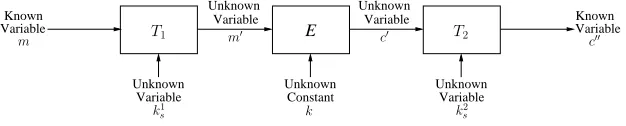
To date, few publications in the literature have considered using cryp-tographic transformations to protect encryption (and decryption) algo-rithms against DSCA [7, 8, 14]. As illustrated in Figure 1, such counter-measures operate by applying cryptographic transformations T1 and T2
Unknown
E
Variable Unknown
Unknown Constant Known
Variable Variable
Unknown
Known Variable
Variable Unknown Variable
k2 s k1
s
m m′
k
c′
c′′
T1 T2
before and after the encryption operationE(·, k), respectively. The cryp-tographic transformations are such that the inputm′ and outputc′of the encryption function are obscured from a side-channel attacker. Therefore, hypotheses for the value of an intermediate variable βi cannot be com-puted based on knowledge of the plaintext m or the ciphertext c′′, and first-order DSCA is prevented. Since the transformations use additional variables k1
s and k 2
s unknown to the attacker (e.g. random strings), this countermeasure may be considered to be a type of protocol level masking. Giraud and Prouff proposed a construction of this countermeasure, to counteract DSCA of block ciphers [7]. Their solution was to add a layer P0
k′ before the encryption operation and a layer P 1
k′ after, parameterised by a shared secret key k′. Each layer consisted of a fixed, linear, invo-lutive diffusion function L and a non-linear permutation πk′. However, the countermeasure proposed by Giraud and Prouff was withdrawn, after weaknesses were discovered in the design. In particular, the output of the P0
k′ layer (i.e. m′, the input to the encryption function) was found to be predictable by an attacker, for inputs of low Hamming weight.
In [8], Tiri, Schaumont and Verbauwhede proposed two ‘side-channel leakage tolerant architectures’. As in [7], the aim of these designs was to provide DSCA protection, whilst leaving the encryption and decryption operations unmodified. The first architecture proposed the application of permutationsP1 andP2 before and after encryption, respectively. These permutations are dependent on secret permutation keys Kp1 and Kp2. However, specific constructions of the permutations P1 and P2 were not provided. Furthermore, the problem of distributing the secret permuta-tion keysKp1andKp2was not discussed, nor how often these keys should be updated. The second architecture considered in [8] uses two intertwined Cipher Block Chaining (CBC) mode encryptions to prevent DSCA based on knowledge of the plaintext or the ciphertext. A disadvantage of this scheme is that the encryption function must be invoked twice for each message block that is to be encrypted.
Recently, Coron proposed the use of permutation tables as a DSCA countermeasure [14]. A randomised permutationP is applied to the mes-sage and the key prior to encryption, and it is these permuted variables that are used by the encryption algorithm. At each stage of the encryption algorithm, the intermediate variables are corrected, so that they remain in the permuted form described byP. This correction is time-consuming; the permutation table countermeasure is approximately four times slower than classical masking [14]. Once the encryption algorithm has completed, the inverse permutationP−1
described by [7] and [8] do not implement correction; therefore, the re-sultant ciphertext differs from that which would have been produced by an unprotected implementation. It is this type of scheme, with no mask correction, that is the focus of this paper. In a sense, the ‘mask correction’ required to retrieve the message mfrom the schemes of [7] and [8] is ap-plied at the receiver side. The receiver uses the corresponding decryption protocol to invert T2, decrypt with secret key k, and invert T1, thereby retrieving the messagem.
3.3 Properties of Masking Transformations
In general, cryptographic transformations T1 and T2 should possess cer-tain properties, if they are to be used in the DSCA countermeasure shown in Figure 1. These properties are listed below.
Property 1:Pre-encryption transformationT1and post-encryption
trans-formation T2 should be dependent on randomly chosen inputs k
1 s and k
2 s,
respectively.
If k1
s is a random string generated within the device, then the input m′ to the encryption function is rendered unpredictable to an attacker. Sim-ilarly, the entropy of k2
s ensures that c′ is unpredictable, and ‘reverse’ DSCA cannot be mounted.
Property 2: Post-encryption transformation T2 should be dependent on
a shared secret k2
s.
TransformationT2 should only be invertible to the legitimate receiver, so that it cannot be inverted by an attacker. This requires that T2 should include some element, k2
s, known exclusively to the sender and receiver. For example, k2s could be equal to, or derived from, the shared secret key k. As will be shown in the following section, it is not required that a receiver must possessk1
sin order to invertT1and recover the messagem.
Property 3:Post-encryption transformationT2 should not linearly
com-bine the output of the encryption stage c′ with a constant.
All-or-Nothing Encryption All-or-Nothing Decryption
Inputs: plaintextm, random valuerInputs: ciphertextc′
1.m′= AONT
r(m); 1.m′=Dk(c′);
2.c′=Ek(m′); 2. (m, r) = Inv-AONT(m′);
Table 1.All-or-Nothing Encryption and Decryption
Property 4: Pre- and post-encryption transformationsT1 andT2 should
themselves be DSCA-resistant.
This final property may seem obvious; however, it is important to empha-sise. When constructingT2, it may seem reasonable to combine the shared secret k2
s (required by Property 2) with some variable data d. However, if this data is known to an attacker, then the focus of the DSCA attack shifts from the encryption operationE to the transformationT2. Ideally, Property 4 can be attained by using random values for k1
s and k 2 s, that change for each new message mthat is encrypted.
In the following section, we present new constructions for transforma-tionsT1 andT2 based on All-or-Nothing Transforms, that fulfil all of the above properties.
4 All-or-Nothing Transforms
All-or-Nothing Transforms (AONTs) were proposed by Rivest [9] in 1997, for the purpose of deterring exhaustive key searches on block ciphers. An All-or-Nothing Transform uses a random string r to map a plaintext message m (of variable bit length) to a pseudo-messagem′. The pseudo-message can, subsequently, be encrypted with an encryption function E and keyk; for example, using a symmetric block cipher such as AES [15]. The entire process is referred to as All-or-Nothing Encryption (AONE).
All-or-Nothing Decryption allows the receiver to recover the message mfrom the transmitted ciphertextc′. The receiver applies the decryption functionD with keyk to recoverm′. Subsequently, the inverse AONT is applied, to recoverr andm. The All-or-Nothing Encryption and Decryp-tion protocols are described in Table 1.
4.1 AONT Properties and Constructions
As put forward in [9], AONTs should possess four properties:
1. The transformation should be invertible. Given the entire pseudo-message, one can invert the transformation to retrieve the plaintext. 2. Both the AONT and its inverse should be efficiently computable. 3. All AONTs should be randomised, in order to avoid chosen-message
and known-message attacks on the encryption mode.
4. If anyl (or more) bits of the pseudo-message are unknown, it should be computationally infeasible to invert the AONT, or determine any function of the plaintext bits. This is called the “All-or-Nothing” prop-erty. The value of l is AONT-dependent, but large enough to deter brute force attacks on the unknown bits of the pseudo-message.
Property 3 implies that pseudo-messagem′ is not a deterministic function of the plaintextm. In order to fulfil this requirement, an AONT requires a user-generated random string r when computing m′ fromm.
Many candidate AONT constructions have been proposed in the lit-erature. In this paper, we focus on OAEP (Optimal Asymmetric En-cryption Padding) [16, 17] and the CTR Transform [18] as case studies. Other proposed transforms include: Package Transform [9], Exposure-Resilient Function-based Transforms [19], Quasigroup-based AONTs [20], ‘Extended-Indistinguishable’ AONTs [21], and Error-Correcting Code-based AONTs [22].
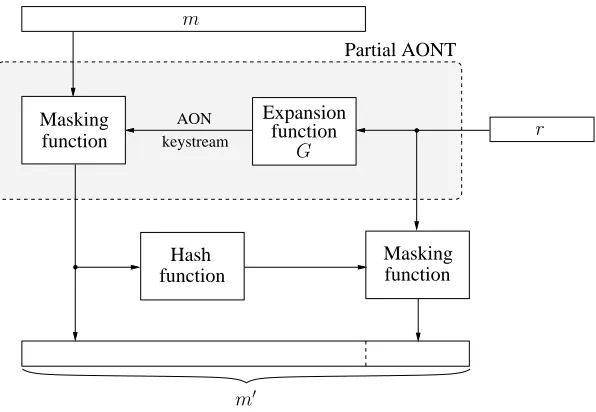
Both OAEP and CTRT conform to a general model for AONTs, shown in Figure 2. In our general AONT model, an expansion function G uses the random value r to produce an “All-or-Nothing keystream”, having the same bit length as the message m. Since r changes for each new message m, the AON keystream G(r) can be viewed as a type of one-time pad [23]. Subsequently, this AON keystream is used to mask the message m. In both OAEP and CTRT, the masking function is simply a Boolean XOR. This generates the majority of the pseudo-message bits. We refer to this sequence of operations as a “partial AONT”, which is effectively equivalent to Boolean or arithmetic masking.
function Masking AON
keystream Masking
function
Partial AONT
function Hash
Expansion function
m′
G
r m
Fig. 2.General model for All-or-Nothing Transforms
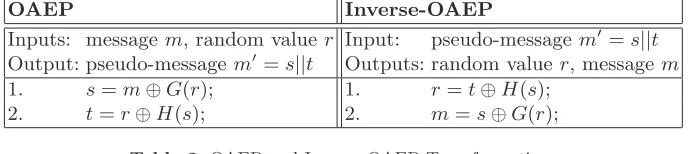
The operations used by OAEP are recalled in Table 2, wheres||t de-notes concatenation of the stringssandt. FunctionsGandH are defined as random oracles [16, 17]. OAEP forms the basis of a routine called En-coding Method for Encryption #1 (EME1), which is standardised in [24]. According to the standard, functions G and H should be instantiated using mask generation function MGF1, which has a user-specified out-put length. MGF1 is based on repeated iterations of a secure one-way hash function, such as SHA-256 [25]. In general, G can be regarded as expanding its input, whilst H compresses its input. The CTR Trans-form (CTRT) is described in Table 3. In CTRT, the expansion function is instantiated using a block cipher in CTR mode, essentially turning the block cipher E into a stream cipher, using random keyk′. The final pseudo-message block is formed by simply XOR-ing together all of the other pseudo-message blocks, along with the random key.
4.2 DSCA Resistance of AONE systems
OAEP Inverse-OAEP
Inputs: messagem, random valuer Input: pseudo-messagem′=s||t
Output: pseudo-messagem′=s||t Outputs: random value r, messagem
1. s=m⊕G(r); 1. r=t⊕H(s); 2. t=r⊕H(s); 2. m=s⊕G(r);
Table 2.OAEP and Inverse-OAEP Transformations
CTRT Inv-CTRT
Inputs: message blocksmi, 1≤i≤n Inputs: pseudo-message blocksm′i, 1≤i≤n+ 1
random keyk′ Outputs: random keyk′
Outputs: pseudo-message blocksm′
i, 1≤i≤n+ 1 message blocksmi, 1≤i≤n
1. m′
i=mi⊕Ek′(i); 1≤i≤n 1. k′=m′1⊕m′2⊕ · · · ⊕m′n+1;
2. m′
n+1=k′⊕m1′⊕m′2⊕ · · · ⊕m′n; 2. mi=m′i⊕Ek′(i); 1≤i≤n
Table 3.CTR Transform (CTRT) and Inverse CTRT
it is shown that All-or-Nothing Encryption can be used to protect against Differential Side-Channel Attacks.
As described in Section 2, to perform DSCA on an encryption al-gorithm, an attacker is required to predict an intermediate state within the algorithm. In All-or-Nothing Encryption, however, the plaintext mis pre-processed along with a random stringr. It is the resultingm′ that is operated upon by the encryption algorithm E and key k. The attacker cannot predict m′, without knowing r. Moreover, the random input r changes on each application of the AONT, mapping m to a different m′ each time. Therefore, the hypothesis phase of the attack cannot be performed. Hence, All-or-Nothing Encryption (AONE) exhibits inherent resistance to DSCA. With reference to Figure 1, it can be seen that the AONT is equivalent to applying a pre-encryption transformationT1. The random input r to the AONT is equivalent to the parameter k1
s ofT1.
5 Extended All-or-Nothing Encryption
AONT m E AONTPartial ′
j
mj c′′j
k
rj rj−1
c′
j
Fig. 3.Extended All-or-Nothing Encryption protocol, with Partial AONT.
Encryption protocol
1. At the beginning of the communication session, the sender and re-ceiver must agree on a secret keyk and a secret initial random value r0. This part of the protocol is discussed later in this section.
2. The messagemto be transmitted is divided into packets mj, 1≤j≤ N. The size of the packets is arbitrary and may, for example, depend on the particular transmission protocol in use by the communications system.
3. The value ofj is set to 1.
4. Packetmj is transformed using an AONT with random valuerj, pro-ducing a pseudo-message packetm′
j. 5. The pseudo-message packetm′
j is encrypted with the encryption al-gorithm E and secret key k. If E is a block cipher, then it may be applied several times, as the length ofm′
j may exceed the block size of the cipher. The result is an encrypted pseudo-message packetc′
j. 6. A partial AONT is then applied toc′
j. However, a new random value is not used; instead, the random value rj−1 is re-used. Clearly, it is advantageous to base the partial AONT on the same AONT that is used in the pre-encryption transformation. In this way (for 2 ≤
j ≤ N), the sender does not need to fully re-compute G(rj−1), the All-or-Nothing keystream that was generated by using the expansion function on rj−1, because it was already computed while m′j−1 was being generated. An extra block ofG(rj−1) does need to be generated, however, since the bit length ofm′ is greater than that of m.
7. The output of this post-encryption transformation is ciphertext packet c′′
j, which is transmitted to the receiver. The value ofjis incremented. 8. Steps 4 – 7 are repeated, until allN blocks in the message have been
processed.
Decryption protocol
1. The secret key k and secret initial random valuer0 are agreed upon with the sender at the start of the communications session.
2. The value ofj is set to 1. 3. Packet c′′
j is received, and is processed using the (inverse) partial AONT with random valuerj−1, to produce c′j.
4. Packetc′
j is decrypted using secret keykand D, the decryption algo-rithm corresponding toE. Depending on the size ofc′
j, several calls to Dmay be required. The result of the decryption stage is packet m′
j. 5. Once all of the bits ofm′
j have been determined, the inverse AONT is applied to it, generatingmj andrj. The value of j is incremented. 6. Steps 3 – 5 are repeated, until allN packets of the received message have been processed. Finally, themj blocks are reassembled to form the messagem.
Establishing the initial random value r0
It is important that the initial random value r0 is not made public, otherwise an attacker could usec′′
1 to retrievec′1. By continually resetting a target device, the attacker could gather many different values of c′1, and use this knowledge and corresponding side-channel information to conduct a differential side-channel attack on the encryption algorithm.
In public-key cryptosystems,r0 can be determined as part of the nor-mal key setup phase, e.g. using a protocol based on Diffie-Hellman key exchange [28]. However, ubiquitous cryptographic devices such as smart cards are often not part of a public-key infrastructure. Instead, these devices are often configured with secret keys at the time of their manu-facture. The secret key value can only be accessed by the device itself, and by trusted entities such as banks. In this type of symmetric-key scenario, it is more difficult to exchange an initial random valuer0 securely.
nature of the sender and receiver (e.g. smart cards, card readers, crypto-graphic processors etc.), their computational capabilities and the security protocols for key setup that already exist within the cryptosystem.
6 Combining with Efficient Encryption
In the previous section, we described how Extended All-or-Nothing En-cryption can be used as a DSCA countermeasure. The performance of the Extended AONE scheme can be enhanced by combining it with an-other application of AONTs, namely “Efficient Encryption” [27, 29]. In the Efficient Encryption scheme, an AONT is applied to a plaintext mes-sage, but only some (as opposed to all) of the pseudo-message blocks are subsequently encrypted. The AONT ensures that all of the pseudo-message blocks are required in order to invert the transformation and regain the plaintext. Therefore, fewer secret-key encryptions and decryp-tions are required. The transmitted ciphertext comprises both encrypted and unencrypted pseudo-message blocks.
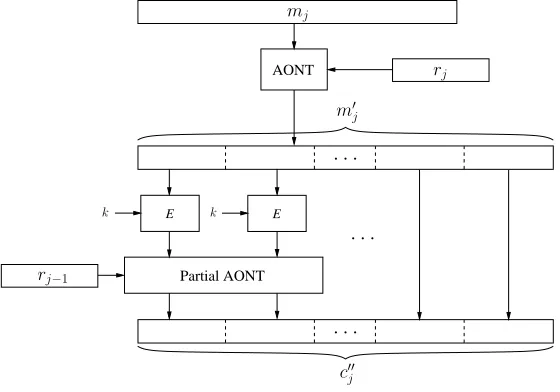
To combine the Efficient Encryption with the Extended AONE scheme, the plaintext message packet mj is transformed with an AONT, as de-scribed above. A certain set of pseudo-message blocks is chosen to be en-crypted with encryption functionEand secret keyk; knowledge of which blocks are in the set can be made public. The presence of the AONT
E E
Partial AONT
. . .
. . . . . .
AONT
c′′j
rj mj
m′ j
k k
rj−1
as a pre-encryption transformation T1 prevents DSCA of the encryption function, based on known plaintext messages. A post-encryption trans-formation T2 (in the form of a partial AONT) must then be applied to those blocks that were encrypted, to prevent reverse DSCA. The transmit-ted ciphertext packet c′′
j consists of unencrypted pseudo-message blocks, alongside blocks that are output from T2. An example of the combined scheme is shown in the block diagram in Figure 4. The system has the advantage of being resistant to DSCA, whilst requiring fewer encryption operations to be performed with the secret key. Therefore, depending on the particular constructions used for the AONT and partial AONT, and the message size, the overall latency and power consumption of the cryptosystem may be reduced.
In ordinary encryption modes (including AONE), the security of the ciphertext blocks relies on the security of the encryption function E, which, in turn, relies on the secrecy of the key k. However, in this Ef-ficient Encryption mode, not all of the transmitted ciphertext blocks are operated on by the encryption functionE. The encryption functionE im-parts security to the encrypted ciphertext block(s). If one has confidence in the security of the encryption function, then one can be confident that the missing pseudo-message block(s) cannot be recovered without knowl-edge of the secret key k. Because of the All-or-Nothing property of the pseudo-message, the security properties of E are bestowed on the entire pseudo-message. If the AONT is not invertible without possession of the missing pseudo-message block(s), the plaintext should not be recoverable by an attacker. Therefore, the security of the scheme shifts from relying entirely on the encryption function E when all blocks are encrypted, to relying almost entirely on the AONT when fewer blocks are encrypted.
7 Further Considerations
pseudo-message block is encrypted, then the latency of the encryption protocol approaches the latency of the AONT.
In describing our general AONT model, it was noted that application of the partial AONT may be regarded as Boolean or arithmetic masking. This implies that the new countermeasure is susceptible to the same types of strong side-channel attacks as the first-order masking countermeasure, namely higher-order DSCA [31] and template attacks [32]. It has been shown that significant protection against these attacks can be achieved by combining first-order masking with a hiding countermeasure such as randomisation of the order of operations (‘shuffling’) in the encryption function [33]. Therefore, Extended All-or-Nothing Encryption should be combined with shuffling, to deter stronger side-channel attacks.
Extended All-or-Nothing Encryption does not have the same weak-ness as the scheme of Giraud and Prouff [7], regarding inputs of low Hamming weight. The AONT input m is combined with the pseudo-random sequence G(r) before being operated upon by the encryption function. Even ifmis of low Hamming weight, the pseudo-randomness of the pseudo-message m′ is unaffected.
Extended AONE is comparable to a side-channel leakage tolerant ar-chitecture of Tiri et al. [8]. Here, we instantiateP1andP2using an AONT and partial AONT. The session keysKp1 andKp2 correspond to the ran-dom inputsrj and rj−1, which update for each new message packet that is encrypted. Once the initial ‘session key’ r0 has been securely shared between the sender and receiver, subsequent session keys (for subsequent packets) do not need to be explicitly relayed to the receiver. Because the pre- and post encryption transformations are based on AONTs, the receiver uncovers the value ofrj when decoding packetmj. Therefore, up-dates of the session keys happen as a by-product of the usage of AONTs.
8 Conclusion
In this paper, we presented a novel countermeasure to first-order Differ-ential Side-Channel Analysis, based on All-or-Nothing Transforms. The proposed countermeasure can be viewed as a type of masking counter-measure at the protocol level, since for each message packet mj to be encrypted, the AONT uses a new random ‘mask’rj. The AONT expands the random valuerj, and uses it to mask all of the bits of the messagemj. Therefore, the masked message m′
j cannot be predicted by an attacker. Similarly, the output of the encryption operation c′
partial AONT. This DSCA countermeasure differs from previously pro-posed masking schemes in the literature, because a mask correction is not applied. By using fast AONT constructions (e.g. hash function based), the new countermeasure can out-perform the classical masking countermea-sure. In conjunction with the Efficient Encryption technique of [29], the latency of a DSCA-protected encryption can be reduced to the latency of the All-or-Nothing Transform. Future work will evaluate the performance of this new countermeasure on the smart card platform, for various AONT constructions, and compare it with the masking countermeasure, which is currently widely used in the electronic payments industry.
Acknowledgements
The authors would like to thank Emmanuel Prouff and Christophe Giraud of Oberthur Card Systems, for the helpful discussions on their work [7]. This research was supported in part by the Embark Initiative, operated by the Irish Research Council for Science, Engineering and Technology (IRCSET), and the support of the Informatics Commercialisation Initia-tive of Enterprise Ireland is gratefully acknowledged.
References
1. Paul Kocher. Timing attacks on implementations of Diffie-Hellman, RSA, DSS and other systems. In Neal Koblitz, editor,Advances in Cryptology — CRYPTO ’96,
16th Annual International Cryptology Conference, volume 1109 of Lecture Notes
in Computer Science, pages 104–113. Springer, 1996.
2. Paul Kocher, Joshua Jaffe, and Benjamin Jun. Differential power analysis. In Michael Wiener, editor, Advances in Cryptology — CRYPTO ’99, 19th Annual
International Cryptology Conference, volume 1666 ofLecture Notes in Computer
Science, pages 388–397. Springer, 1999.
3. Karine Gandolfi, Christophe Mourtel, and Francis Olivier. Electromagnetic analy-sis: Concrete results. In C¸ etin Kaya Ko¸c, David Naccache, and Christof Paar, editors,Cryptographic Hardware and Embedded Systems — CHES 2001, Third
In-ternational Workshop, volume 2162 ofLecture Notes in Computer Science, pages
251–261. Springer, 2001.
4. Suresh Chari, Charanjit S. Jutla, Josyula R. Rao, and Pankaj Rohatgi. Towards sound approaches to counteract power-analysis attacks. In Michael J. Wiener,
edi-tor,Advances in Cryptology — CRYPTO ’99, 19th Annual International
Cryptol-ogy Conference, volume 1666 ofLecture Notes in Computer Science, pages 398–412.
Springer, 1999.
5. Louis Goubin and Jacques Patarin. DES and differential power analysis — the duplication method. In C¸ etin Kaya Ko¸c and Christof Paar, editors,Cryptographic
Hardware and Embedded Systems — CHES 1999, First International Workshop,
6. Kris Tiri and Ingrid Verbauwhede. A logic level design methodology for a secure DPA resistant ASIC or FPGA implementation. InDesign, Automation and Test
in Europe, DATE 2004, pages 246–251. IEEE Computer Society, 2004.
7. Christophe Giraud and Emmanuel Prouff. A new approach to counteract DPA attacks on block ciphers. Private Communication. Available online at the IACR ePrint Archive,http://eprint.iacr.org/2005/340, September 2005.
8. Kris Tiri, Patrick Schaumont, and Ingrid Verbauwhede. Side-channel leakage tol-erant architectures. InThird International Conference on Information Technology:
New Generations (ITNG 2006), pages 204–209. IEEE Computer Society, 2006.
9. Ronald L. Rivest. All-or-nothing encryption and the package transform. In Eli Biham, editor,FSE ’97, 4th International Workshop on Fast Software Encryption, volume 1267 ofLecture Notes in Computer Science, pages 210–218. Springer, 1997. 10. Stefan Mangard, Elisabeth Oswald, and Thomas Popp. Power Analysis Attacks:
Revealing the Secrets of Smart Cards. Springer, 2007.
11. Eric Brier, Christophe Clavier, and Francis Olivier. Correlation power analysis with a leakage model. In Marc Joye and Jean-Jacques Quisquater, editors,Cryptographic
Hardware and Embedded Systems — CHES 2004, 6th International Workshop,
volume 3156 ofLecture Notes in Computer Science, pages 16–29. Springer, 2004. 12. Johannes Bl¨omer, Jorge Guajardo, and Volker Krummel. Provably secure masking
of AES. In Helena Handschuh and M. Anwar Hasan, editors, Selected Areas in
Cryptography, 11th International Workshop, SAC 2004, volume 3357 ofLecture
Notes in Computer Science, pages 69–83. Springer, 2004.
13. Jovan Dj. Goli´c. Techniques for random masking in hardware. IEEE Transactions
on Circuits and Systems — I, 54(2):291–300, February 2007.
14. Jean-S´ebastien Coron. A new DPA countermeasure based on permutation tables. In Rafail Ostrovsky, Roberto De Prisco, and Ivan Visconti, editors,Security and
Cryptography for Networks, 6th International Conference, SCN 2008, volume 5229
ofLecture Notes in Computer Science, pages 278–292. Springer, 2008.
15. National Institute of Standards and Technology. FIPS PUB 197. Advanced En-cryption Standard, November 2001.
16. Mihir Bellare and Phillip Rogaway. Optimal asymmetric encryption. In Alfredo De Santis, editor, Advances in Cryptology — EUROCRYPT ’94, Workshop on the
Theory and Application of Cryptographic Techniques, volume 950 ofLecture Notes
in Computer Science, pages 92–111. Springer, 1994.
17. Victor Boyko. On All-or-Nothing Transforms and Password-Authenticated Key
Exchange Protocols. PhD thesis, Massachusetts Institute of Technology, June 2000.
18. Anand Desai. The security of all-or-nothing encryption: Protecting against ex-haustive key search. In Mihir Bellare, editor,Advances in Cryptology — CRYPTO
2000, 20th Annual International Cryptology Conference, volume 1880 ofLecture
Notes in Computer Science, pages 359–375. Springer, 2000.
19. Yevgeniy Dodis, Amit Sahai, and Adam Smith. On perfect and adaptive secu-rity in exposure-resilient cryptography. In Birgit Pfitzmann, editor,Advances in Cryptology — EUROCRYPT 2001, International Conference on the Theory and
Application of Cryptographic Techniques, volume 2045 ofLecture Notes in
Com-puter Science, pages 301–324. Springer, 2001.
20. Stelios I. Marnas, Lefteris Angelis, and George L. Bleris. All-or-nothing transforms using quasigroups. InProceedings of 1st Balkan Conference on Informatics, pages 183–191, November 2003.
Zhou, editors,Applied Cryptography and Network Security, Second International
Conference, ACNS 2004, volume 3089 ofLecture Notes in Computer Science, pages
76–90. Springer, 2004.
22. John Byers, Jeffrey Considine, Gene Itkis, Mei Chin Cheng, and Alex Yeung. Securing Bulk Content Almost for Free. Journal of Computer Communications,
Special Issue on Internet Security, 29:290–290, Feb 2006.
23. Alfred J. Menezes, Paul C. van Oorschot, and Scott A. Vanstone. Handbook of
Applied Cryptography. CRC Press, 1996.
24. IEEE. 1363a IEEE Standard Specifications for Public-Key Cryptography— Amendment 1: Additional Techniques, 2004.
25. National Institute of Standards and Technology. FIPS PUB 180-2. Secure Hash Standard, August 2002.
26. Matt Blaze. High-bandwidth encryption with low-bandwidth smartcards. In Dieter Gollmann, editor,Fast Software Encryption, 3rd International Workshop, volume 1039 ofLecture Notes in Computer Science, pages 33–40. Springer, 1996.
27. Donald B. Johnson, Stephen M. Matyas, and Mohammad Peyravian. Encryption of long blocks using a short-block encryption procedure. Submitted for inclusion in the IEEE P1363a standard, November 1996.
28. Whitfield Diffie and Martin Edward Hellman. New directions in cryptography.
IEEE Transactions on Information Theory, IT-22(6):644–654, November 1976.
29. Donald Byron Johnson and Stephen Michael Matyas, Jr. (IBM). Method and apparatus for encrypting long blocks using a short-block encryption procedure. US Patent # 5,870,470, February 1999.
30. Elisabeth Oswald, Stefan Mangard, and Norbert Pramstaller. Secure and efficient masking of AES — a mission impossible? IACR ePrint Archive,http://eprint. iacr.org/2004/134, June 2004.
31. Thomas S. Messerges. Using second-order power analysis to attack DPA resistant software. In C¸ etin Kaya Ko¸c and Christof Paar, editors,Cryptographic Hardware
and Embedded Systems — CHES 2000, Second International Workshop, volume
1965 ofLecture Notes in Computer Science, pages 238–251. Springer, 2000. 32. Suresh Chari, Josyula R. Rao, and Pankaj Rohatgi. Template attacks. In Burton
S. Kaliski Jr., C¸ etin Kaya Ko¸c, and Christof Paar, editors,Cryptographic Hardware
and Embedded Systems — CHES 2002, 4th International Workshop, volume 2523
ofLecture Notes in Computer Science, pages 13–28. Springer, 2002.
33. Stefan Tillich and Christoph Herbst. Attacking state-of-the-art software counter-measures — a case study for AES. In Elisabeth Oswald and Pankaj Rohatgi, editors,Cryptographic Hardware and Embedded Systems — CHES 2008, 10th
In-ternational Workshop, volume 5154 ofLecture Notes in Computer Science, pages