UDK.632.937.
Assessment of Under-Ground Pests’ Density in Potatoes and
Legumes Grow After Winter Wheat
Khudaykulov Azamjon Mirzakulovich, doctorate,
Anorbayev Azimjon Raimkulovich, doctor of agriculture science,
Kholliev Assomiddin Turaevich, candidate of agricultural sciences,
Sobirov Bekzod Bekmurod ugli,master degree,
Tashkent state agrarian university
Annotation: The results of held
researchers in determining percentage
of underground pests spread, winter
phases, biological indexes in the fields
of rotation croppotatoand win wheat
were discussed in the article. According
to that, soil layer of potato and winter
wheat fields which were taken for
experiments should be dug to 5, 10, 15,
20, 25 sm and all kinds of underground
pests, fall armywarm (Agrotis segitum
Den. Et Shiff), may bugs (Melolontha
melolontha), click beetles (Elateridae)
larvae will bedetermined. Every found
soil pests in the fields of the potatoes
and win wheat are compared, they are
analyzed on the base of common
methods. Practical conclusions and
recommendations were given based on
results.
Key words: Underground pests,
the field of rotation crop potato and win
wheat, root neck, seedlings, buds, leaf
and stalk pests.
Introduction. The resolution of
the President of the Republic of
Uzbekistan from the 1st of June, 2017
“About measurements to deliver
material- technical resources in time
required to place and grow rotation
crops on the fields which are freed from
winter wheat in 2017” is very important.
Potato was planted on the fields of main
and rotation crops and total yield was
2.9 million tons of potato was harvested
crop in 37 thousand hectares of field and
3.5 million tons of potato was harvested
in 2017. [8].
Specific natural climate conditions
of Uzbekistan as well as favorable
weather temperature during plant
vegetation periods create advantageous
condition to develop pests of agricultural
crops. That is why thousands of pests
and diseases develop in the agricultural
crops and they affect on the both quality
and quantity of the yield.
Unique political forming and
realizing it to increase productivity of
agricultural crops and protect them from
decreasing must be based on protection
them from pests, diseases and weeds
effectively using less poisoning,
ecologically safety chemical and
biological means15-20% of harvests are
lost because of harmful impact of under
soil pests of grain, rotated carrots and
potatoes.From these pests armywarm
(Agrotissegitum Den. Et shiff), click
beetles, calf headbugs, march beetle
(Melolontha afflicta Ball), marble
beetle(Polyphylla adspersa), May
cochchafer (Melolontha melolontha,) eat
roots stalk and leaves of main and
rotated agricultural crops and make
significant harm to the yield. Most of
these under soil pests have several years
of vegetation period and they place in
the soil carefully and it will be main
factor to damage 25-30% of plants of
rotated crops [4] 51kinds of pests
belonged to 15 families are found in the
crops of Solanaceousfamily. Out of 51
identified pests40 of them are found in
tomatoes and egg plants, and 48 of pests
are in potato[3].
The importance of preparation
period in winter for winter period of
cutworms on the field, favorable weather
condition years will be convenient to
increase more pests.
Wintering cutworms as well as
control types of pests in fall army warm
is useful for them from the second
decade of August because of
accumulated degree days [7].
In this reason researchers were
held to assess density and determine
winter stages, biological indexes in
wheat and rotated potatoes.
The object and methods of the
research. 2 hectors of rotation crop
potato fields are chosen for researchers
in farm “Salim Bakhabov”, in the
district of Bulugur, Samarkand province.
First of all, 25x25sm of soil
examples were taken in diagonal (chess)
methods from 5, 10, 15, 20 and 25 sm
dug layer fromthis fields and soil were
passed through entomological sieve in
different measures. (Polyakov,1980).
Examples were taken from 10
places in winter wheat and rotation crop
potato fields, in a average 1m2 (inside
and round of field were calculated), the
density in the grain and rotated potato
were determined.
Taken results were analyzed on
the base of common methods [1; 5;]
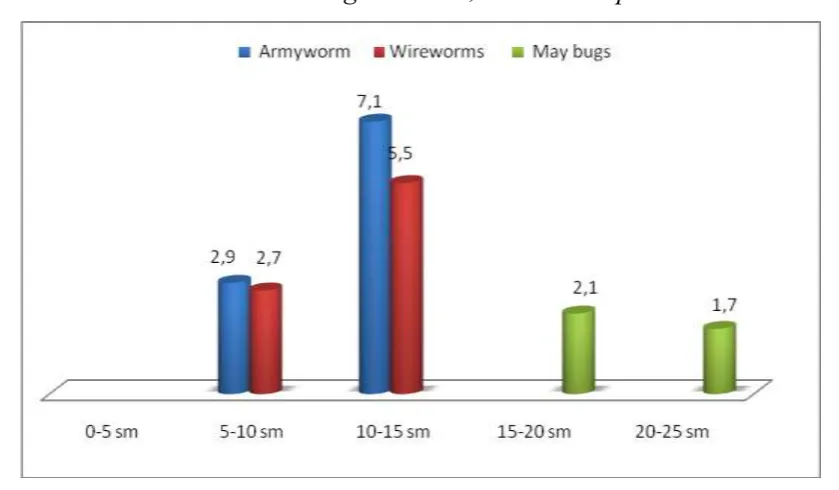
Results. During held researches
5sm of soil layer in 1m2 (in chess
method) taken from 2 hectors of potato
field which were planted after winter
and after checking pests were not found.
1.7 units of fall army worm larva, 1.3
units of wire worm larvas were found in
the 5-10sm of soil layer in experiment
field 10-15sm of soil was dug in this
way and taken soil was passed through
sieve. According to this the number of
fall army warm larva was 4.7, wire
worm larva 3.7. 15-20 and 20-25sm of
soil layer were checked in this field and
only 1.3 and 1.2 units of may bugs were
found in worm phase.
When 5sm of soil layer was
checked in 7 hectors of winter wheat
field any pests weren’t found. When soil
layer was dug till 5-10 and 10-15sm
1.2-2.6 units of fall army worm larvas were
found. 1,4-1,8 units of wire worm larvas
were determined.
Also, when soil layer was dug till
15-20 and 20-25sm and soil was passed
through sieve, 0,8-0,5 units of may bugs
in worm phase were found. The results
of this research are given in (Diagrams
1).
Assessment of density of under soil pest population in winter wheat and rotation crop
potato and legumes fields.
(Farm “Salim Bakhabov” in Bulungur district, Samarkand province. 2016-2017.)
Every found pests from the soil layer in the fields of wheat and potato were
compared on the base of held researches, variation coefficients were analyzed in
percentage. Results are given in the following table 1.
Table 1
Assessment of density of under soil pest population in the fields of winter and rotated
potato and legumes(Farm “Salim Bakhabov” in Bulungur district, Samarkand
province 2016-2017).
Expriment area Limit m±m σ Cv,% t(1-11)
The number of pests in the
rotated potato and legumes
after winter wheat
0.5-1.6 1.08±0.15 0.42 39.45 7.32
winter wheat fields
Note: Limit- number vibration;
m±m- overage index and its errors; σ-
standard limits (average square limit);
Cv- variation coefficients, in percentage;
student coefficient.
According to that when the
number of pests in rotation crop potato
fields after winter wheat in Experiment 1
are was analyzed, Limit- number
variation consists of 0.5-1.6, m±m –
average index and its errors reached
1.08±0.15. σ- standard limit ( average
square limit ) consisted of 0.42 and Cv –
variation coefficient was 39.45% (in
Experiment 2) or limit – number
vibration of the pests in winter wheat
field was 1.2-2.1 average index and its
errors was 1.66±0.12. In this version
standard limit (average square limit) was
0.35 and the percentage of variation
coefficient in rotation crop potato field
was much lower or it was 21.55%.
According to the analysis of experiment
the fact that number of pests in potato
fields were more than in wheat fields
was proved, or it consisted of t=
7.32(p≥0.05).
Conclusion and
recommendation. The conclusion of
taken results are the followings: Pests
can feed in potato fields with leaves and
stalk, they can winter under the soil and
they can increase potato field than in the
cultivated fields of winter wheat. This
under soil pests can damage main and
rotation c vegetable crops and potatoes
seriously in the next year. Taking these
facts into consideration, introducing
effective measurements against under
soil pests in time, planting rotated
vegetables, if the number of pests`
increase using poisoning chemical
pesticides are recommended.
The list of used literature.
[1]. Voronin K.E, Shapiro V.A,
[2]. Rokitskiy P.F “Biological
statistics”. Pub, 3rd. cor. Minsk. At
school. 1973, 320p.
[3]. Rashidov M.I “Biological bases of
integrated protection of after flax crops
from pests” Auto thesis. Diss. Doct.
Boil. Science- Tashkent. 200-47p.
[4]. Pulatov Z.A, Khudaykulov A. M “
Efficiency of some insecticides against
autumn tunlam of vegetables”.
Agroscience. Tashkent. 2017, 82-83pp.
[5]. Polyakov. I. Y, PersovM.P,
SmirnovV.A “Prediction of developing
pests and diseases of agricultural crops
(with practice)”. M. “Kolos” 1984.
78-81p.
[6]. Chenkin A.F, Dyachenko.V.F,
Belozerova.G .S. “Prediction for 1989”.
Plant protection – 1983-№3
[7]. KhujayevSh.T “Protection of
plants from pests and the basis of
agrotechnology” – Tashkent: “Navruz”
2014, 4-5p