HAMIZER BIN MOHD SUKOR
A thesis submitted in fulfilment of the requirements for the award of the degree of
Doctor of Philosophy
Faculty of Education Universiti Teknologi Malaysia
ABSTRACT
ABSTRAK
Kajian ini bertujuan untuk membina dan menilai keberkesanan satu pakej multimedia interaktif, berasaskan reka bentuk yang dicadangkan pelajar yang merangkumi bidang di luar domain akademik dalam mempertingkatkan keupayaan pelajar dalam pemikiran analitikal secara divergen di dalam suasana pembelajaran kolaboratif. Pemikiran analitikal secara divergen didefinisikan sebagai mengenalpasti dan menganalisis pernyataan dengan mengambil kira pelbagai perspektif. Modus operandi pakej ini adalah perkongsian bebas fail teks di dalam mod asynchronous di mana segala respon pelajar boleh diakses dan dipertimbangkan oleh rakan mereka dengan memanfaatkan infrastruktur IT yang sedia ada di sekolah-sekolah bestari di Johor. Kajian bercorak kuasi-eksperimental jenis non randomized control group, pre-test-post-test design digunakan. Sampel pelajar adalah terdiri daripada 233 orang dalam
TABLE OF CONTENTS
CHAPTER TITLE PAGE
DECLARATION ii
DEDICATION iii
ACKNOWLEDGEMENTS iv
ABSTRACT v
ABSTRAK vi
TABLE OF CONTENTS vii
LIST OF TABLES xvii
LIST OF FIGURES xxvii
LIST OF APPENDICES xxxi
1 INTRODUCTION TO THE RESEARCH PROJECT 1
1.1 Introductory Remarks 1
1.2 The Background to the Research Project 2
1.3 The Statement of the Problem 9
1.4 The Objectives of the Research Project 9
1.5 The Specific Questions to be Addressed 10
1.6 Theoretical Framework of the Study 14
1.7 Operational Framework 17
1.8 The Rationale of the Research Project 20
1.9 The Significance of the Research Project 21
1.10 Limitations of the Study 22
1.11 Definition of Some of the Main Terms Used 23
1.12 Summary 27
2 REVIEW OF RELATED LITERATURE 28
2.2 Types of Thinking Skills 29
2.3 Conceptions of Divergent Analytical Thinking 31
2.4 Direct Teaching of Thinking Skills 34
2.5 Formation of Thinking Skills within the Zone of Proximal Development
35
2.6 Teaching Divergent Analytical Thinking Skills in a Non-academic Context
37
2.7 Using Cognitive Apprenticeship Model to Simulate Divergent Analytical Thinking Strategies
39
2.8 Use of Collaborative Learning to Enhance Divergent Analytical Thinking
43
2.9 The Role of Graphic and Verbal Organizers and CoRT1 Techniques as Cognitive Tools
44
2.10 Divergent Analytical Thinking and Self-Paced Learning Using an Interactive Multimedia Package
50
2.11 Group Brainstorming in Computer- mediated-Communication (CMC)
53
2.12 Constructivist Approach to the Design of the Package
2.13 Correlation between Gender and Divergent Analytical Thinking Performance
56
2.14 Studies on Students’ Level of Contentment towards Different Aspects of the Design of the Package
57
2.15 Some Issues in Instructional Design Principles 58
2.15.1 Interactivity as an Instructional Strategy 59
2.15.2 Screen Design 59
2.16 Summary 61
3 RESEARCH METHODOLOGY 62
3.1 Introduction 62
3.2 The Research Methodology 63
3.2.1 Phase 1 (The Analysis Phase) 64
3.2.2 Phase 2A (Design Phase-The Construction of the Treatment Instrument)
65
3.2.3 Phase 2B (Design Phase-The Construction of the Research Instruments)
3.2.4 Phase 3A (Development Phase-Storyboarding)
68
3.2.5 Phase 3B (Development Phase-Formative Evaluation)
69
3.2.6 Phase 3C (Modification and Completion of Package )
75
3.2.7 Phase 4 (Implementation Phase) 76
3.2.8 Phase 5 (Evaluation Phase) 79
3.3 Sampling 88
3.4 Research Instruments 92
3.4.1 The Analytical Thinking Skills Inventory for Module 1, Module 2 and Module 3 (Pre-test and First Post-(Pre-test)
93
3.4.2 The Questionnaire on Students’ Preferences in an Educational Multimedia Package
93
3.4.3 The Package Evaluation Form (for students) 93
3.4.4 The Package Evaluation Form ( for thinking skills and instructional design experts)
94
3.4.6 Interview Questions for Respondents 95
3.5 The Analytical Rubric Used to Measure Performance Scores
96
3.6 Summary 100
4 DESIGN FEATURES OF THE PACKAGE 101
4.1 Introduction 101
4.2 The Authoring Software Used for the Development of the Package
102
4.3 The Purpose and Content of Package 102
4.4 The General Structure of the Design of the Package 103
4.5 Accommodating Students’ Preferences into the Design of the Package
106
4.6 Results of Experts’ Formative Evaluation on the Design of the Package
111
4.7 Incorporating the Principles of Cognitive Apprenticeship Model into the Design
112
4.8 Elements of Instruction Used in the Design 118
4.8.2 Computer Graphics 120
4.8.3 Computer Animation 120
4.8.4 Digital Audio 121
4.8.5 Digital Video 122
4.9 Summary 123
5 RESULTS AND DATA ANALYSIS 124
5.1 Introduction 124
5.2 Students’ Performances in Divergent Analytical Thinking in Preliminary Study
125
5.3 Students’ Preference in an Educational Multimedia Package
126
5.4 Quantitative Analysis of the Impact of CADATS on Students’ Divergent Analytical Thinking Performance In Accordance With Modules
130
5.4.1 Module 1 (COMPARE AND CONTRAST)
130
5.4.2 Module 2 (PARTS OF A WHOLE)
5.4.3 Module 3 (PROPOSAL PONDER)
141
5.5 Quantitative Analysis of Gender and Initial Gain in Performance Score on Students’ Level of Contentment towards Different Aspects of the Design of the Package
147
5.6 Quantitative Analysis of the Effects of Gender and Initial Gain in Performance Score on the Enhancements of Divergent Analytical Thinking
151
5.7 Patterns of Students’ Performance for each Module Based on Categories of Students
153
5.8 The Extent of Success of the Module in the Package in Enhancing Students’ Divergent Analytical Thinking Skills
156
5.9 Results from Qualitative Analysis 157
5.10 Summary of Analyses of Results 166
6 DISCUSSION OF THE FINDINGS 170
6.1 Introduction 170
6.2 OBJECTIVE 1: The Impact of CADATS on Students’ Performance in Divergent Analytical Thinking Skills
6.3 OBJECTIVE 2: Factors and Features of the Design That Contributed to the Enhancement of Divergent Analytical Thinking Performance Scores
174
6.3.1 Features of Design Used in the Package that Stimulated Enhancements in Students’ Performance
178
6.4 OBJECTIVE 3: Correlation between Students’ Level of Contentment on the Design of CADATS and the Enhancement of their Performance Scores
182
6.5 OBJECTIVE 4: Attitudinal Transformation in Students’ Outlook on Thinking
184
6.5.1 Students’ Perception on the Effectiveness of Meta-cognitive Instruction Used in CADATS via Graphic and Verbal Organizers
185
6.5.2 Students’ Perception on the Effectiveness of Group Brainstorming Approach Used in CADATS
188
6.5 Conclusion 191
7 CONCLUSIONS AND RECOMMENDATIONS 192
7.1 Introduction 192
7.2.1 Students’ Divergent Analytical Thinking Performance in Computer-supported Environment
194
7.2.2 Implications of an Asynchronous Computer Mediated Communication (CMC)
Environment on Students’ Disposition
195
7.3 Outcomes of the Research Project 197
7.4 Contributions of the Research Study to the Advancement and Application of Knowledge
200
7.5 Recommendations for Future Research 200
7.6 Final Remarks 201
LIST OF REFERENCES 202
LIST OF TABLES
TABLE NO. TITLE PAGE
2.1 Four levels of questioning to promote analytical thinking skills 32
2.2 The differences between real- life and school-based problems 38
2.3 Oral (verbal) organizers used in ‘Compare and Contrast’ (Module 1)
50
2.4 Oral (verbal) organizers used in ‘Parts of a Whole’ (Module 2) 50
3.1 Pearson’s correlation coefficient for Analytical Thinking Skills’ Inventory between the first and second pilot study
68
3.2 Category of items in Package Evaluation Form (for students) 72
3.3 Bivariate correlation analysis of items of ‘Ease of Use’ to the total score in the category in Package Evaluation Form (for students)
72
3.4 Bivariate correlation analysis of items of ‘Design of Thinking Activity’ to the total score in the category in Package
Evaluation Form (for students)
3.5 Bivariate correlation analysis of items of ‘Design of Motivational Elements’ to the total score in the category in Package Evaluation Form (for students)
73
3.6 Bivariate correlation analysis of items of ‘Design of User Interface’ to the total score in the category in Package Evaluation Form (for students)
74
3.7 Bivariate correlation analysis of items of ‘Navigational Design’ to the total score in the category in Package Evaluation Form (for students)
74
3.8 Bivariate correlation analysis of total score for each category to overall total score in Package Evaluation Form (for students)
75
3.9 Summary of statistical analysis used in relation to the research questions in the study
81
3.10 Breakdown of samples in experimental group according to classes
91
3.11 Distribution of the number of experts used in the study 92
3.12 Example of recoded response for Module 1 to illustrate scoring rubric
96
3.13 Example of recoded response for Module 2 to illustrate scoring rubric
3.14 Example of recoded response for Module 3 to illustrate scoring rubric
99
5.1 Participants in study of students’ preferences in an educational multimedia package according to gender
127
5.2 Mean scores recorded for items in study of students’ preferences in an educational multimedia package
127
5.3 Students’ comments attached to questionnaire in the study of students’ preferences in an educational multimedia package
129
5.4 Independent samples T- Test analysis on pre-test means of experimental and control group for Module 1
131
5.5 Independent samples T-test analysis on pre-test means of experimental and control groups with respect to gender for Module 1
132
5.6 Paired sample T-Test analysis on pre-test and first post-test means of experimental and control group for Module 1
132
5.7 Independent samples T- Test analysis on first post-test means of experimental and control group for Module 1
133
5.8 Independent samples T-test analysis on first post-test means of experimental and control groups with respect to gender for Module 1
5.9 Independent samples T-test analysis on initial gain in performance score of experimental and control groups with respect to gender (pre-test scores as covariate) for Module 1
134
5.10 Independent samples T-test analysis on second post-test means of experimental group with respect to gender for Module 1
135
5.11 Independent samples T-Test analysis on pre-test means of experimental and control group for Module 2
137
5.12 Independent samples T-test analysis on pre-test means of experimental and control groups with respect to gender for Module 2
138
5.13 Paired sample T-Test analysis on pre-test and post-test means for experimental and control group for Module 2
138
5.14 Independent samples T-test analysis on first post-test means of experimental and control groups with respect to gender for Module 2
139
5.15 Independent samples T-test analysis on initial gain in performance score of experimental and control groups with respect to gender (pre-test scores as covariate) for Module 2
140
5.16 Independent samples T-test analysis on second post-test means of experimental group with respect to gender for Module 2
141
5.17 Independent samples T-Test analysis on pre-test means of experimental and control groups for Module 3
5.18 Independent samples T-test analysis on pre-test means of control and experimental groups with respect to gender for Module 3
143
5.19 Paired sample T-Test analysis on pre-test and post-test means of experimental and control groups for Module 3
144
5.20 Independent samples T-Test analysis on post-test means of experimental and control group for Module 3
144
5.21 Independent samples T-test analysis on post-test means of experimental and control groups with respect to gender for Module 3
145
5.22 Independent samples T-test analysis on initial gain in performance score of experimental and control groups with respect to gender (pre-test scores as covariate) for Module 3
146
5.23 Independent samples T-test analysis on second post-test means of Experimental group with respect to gender for Module 3
147
5.24 Analysis of variance of students’ level of contentment towards different aspects of the design of the package between categories of students
149
5.25 To probe the effectiveness of each module by comparing means of difference between second post-test and pre-test performance scores between categories of students using analysis of variance
5.26 Analysis of variance of mean difference of second post-test scores and pre-test scores of students to reveal the most effective module in the package
156
5.27 General students’ responses from group interviews related to the use of collaborative learning techniques in the package
157
5.28 Quantity of collaborative participation amongst student respondents
159
5.29 General students’ responses from group interviews related to the effectiveness of thinking tools used in the package
160
5.30 General students’ responses from group interviews related to the instructional design of the package
162
5.31 General students’ responses from group interviews related to the elements of motivational aspects incorporated into the package
164
A1 List of problem scenarios posed to the participants of the preliminary study
221
A2 Students’ answer sheet for Module 1 (Compare and Contrast) 222
A3 Students’ answer sheet for Module 2 (Parts of a Whole) 222
A4 Students’ responses to inventory used in the preliminary study for Module 1 (Compare and Contrast)
A5 Students’ responses from inventory used in the preliminary study using Module 2 (Parts of a Whole)
229
C1 Students ‘think aloud’ responses for items in Module 1 (Compare and Contrast) in first pilot test
270
C2 Students ‘think aloud’ responses for items in Module 2 (Parts of a Whole) in first pilot test
273
C3 Students ‘think aloud’ responses for items in Module 3 (Proposal Ponder) in first pilot test
276
C4 Calculation of Ind ex of Difficulty and Index of Discrimination for items in Analytical Thinking Skills Inventory for Module 1 (Compare and Contrast) after second pilot study
279
C5 Calculation of Index of Difficulty and Index of Discrimination for items in Analytical Thinking Skills Inventory for Module 2 (Parts of a Whole) after second pilot study
280
C6 Calculation of Index of Difficulty and Index of Discrimination for items in Analytical Thinking Skills Inventory for Module 3 (Proposal Ponder) after second pilot study
281
D1 Package evaluation results by students 282
D2 Comments made by students in formative evaluation of prototype
283
D3 Results of formative evaluation of prototype by Instruction Design Expert
D4
General comments made by Instructional Design Expert on prototype.
287
D5 Results of formative evaluation of prototype by content experts 288 D6 General comments made by content experts on prototype 289
D7 Results of formative evaluation of prototype by content expert: Professor Abdullah b Hassan (Universiti Pendidikan Sultan Idris)
290
E1 Score distribution of pre-test and post-test of control group for Module 1
291
E2 Score distribution of pre-test, first test and second post-test for experimental group of Module 1
292
E3 Score distribution of pre-test and post-test for control group of Module 2
294
E4 Score distribution of pre-test, first test and second post-test for experimental group of Module 2
295
E5 Score distribution of pre-test and post-test for control group of Module 3
297
E6 Score distribution of pre-test, first test and second post-test for experimental group of Module 3
F1 Summary of students’ responses from interview questions after exploring Module 1 (Compare and Contrast)
300
F2 Summary of students’ responses from interview questions after exploring Module 2 (Parts of a Whole)
304
F3 Summary of students’ responses from interview questions after exploring Module 3 (Proposal Ponder)
308
G1 Sample of top five recoded students’ responses from pre-test of Module 1 (Compare and Contrast) in Bahasa Melayu
312
G2 Sample of top five recoded students’ responses from pre-test of Module 2 (Parts of a Whole) in Bahasa Melayu
314
G3 Sample of top five recoded students’ responses from pre-test of Module 3 (Proposal Ponder) in Bahasa Melayu
316
G4 Sample of top five recoded students’ responses from post-test of Module 1 (Compare and Contrast) in Bahasa Melayu
318
G5 Sample of top five recoded students’ responses from post-test of Module 2 (Parts of a Whole) in Bahasa Melayu
320
G6 Sample of top five recoded students’ responses from post-test of Module 3 (Proposal Ponder) in Bahasa Melayu
322
G7 Sample of five problem scenarios created by students and responses from their peers in second post-test for Module 1 (Compare and Contrast) in Bahasa Melayu
G8 Sample of five problem scenarios created by students and responses from their peers in second post-test for Module 2 (Parts of a Whole) in Bahasa Melayu
326
G9 Sample of five problem scenarios created by students and responses from their peers in second post-test for Module 3 (Proposal Ponder) in Bahasa Melayu
LIST OF FIGURES
FIGURE NO. TITLE PAGE
1.1 The structure of the theoretical framework 14
1.2 The structure of the operational framework 17
2.1 Progression through the four phases of the ‘zone of proximal development’
36
2.2 Graphic and verbal organizers used in ‘Reason!Able’ to nurture critical thinking skills for its users
47
2.3 An examp le of a graphic organizer used for ‘Compare and Contrast’ (Module 1)
48
2.4 An example of a graphic organizer used for ‘Parts of a Whole’ (Module 2)
49
3.1 A schematic representation of the research design 77
4.2 User interface to viewing montage or direct access to modules
104
4.3 The ‘User Registration’ interface 105
4.4 An example of a video representation of a problem scenario 113
4.5 An example of an audio representation of a problem scenario 113
4.6a Verbal organizer requiring students to state their perspective in advance
114
4.6b CADATS acknowledging students’ declared perspective 115
4.7 Browsing other students’ responses for a particular problem scenario
115
4.8 An example of a graphic organizer in Module 2 (Parts of a Whole)
116
4.9 An example of a verbal organizer used in Module 3 (Proposal Ponder)
116
4.10 ‘Meter prestasi’ (Performance meter) to indicate students’ performance based on current score for the module in progress
120
5.1 Profile of students’ level of contentment towards different aspects of the design of the package
5.2 Trends of performance scores for Module 1 according to categories of students
153
5.3 Trends of performance scores for Module 2 according to categories of students
154
5.4 Trends of performance scores for Module 3 according to categories of students
155
6.1 Facility for full collaborative mode used in second posttests 173
6.2 An example of graphic organizer used in Module 3 181
6.3 Set of icons and pull-down menu for modules in CADATS 182
6.4 Meta-cognitive instructions used in Module 1 186
6.5 Meta-cognitive instructions used in Module 2 187
6.6 Meta-cognitive instructions used in Module 3 187
6.7 Example of list of students’ responses which were accessible to all users
190
H1 Overall structure of CADATS 330
H2 Structure of introductory interface of CADATS 331
H3 General structure of modules in CADATS 332
J1 User interface in ‘Kenal’ segment 334
J2 User interface in ‘Demonstrasi’ segment 334
J3 User interface in ‘Ajar’ segment 335
J4 User interface in ‘Aplikasi’ segment 335
J5 User interface displaying other users’ responses before embarking on a problem scenario
335
J6 User interface in ‘Refleksi’ segment 336
J7 User interface in online assessment of CADATS using questionnaire-type document
336
J8 Interactive chart that portray one’s assessment scores of CADATS against the average scores indicated by their peers
336
J9 User interface of free text-based feedback form on CADATS 337
J10 User interface of interactive quiz in CADATS 337
LIST OF APPENDICES
APPENDIX TITLE PAGE
A1 Divergent Analytical Thinking Inventory Used in Preliminary Study
221
A2 A Recoded Representation of Students’
Responses from Divergent Analytical Thinking Inventory Used in Preliminary Study (Set 1)
223
A3 A Recoded Representation of Students’
Responses from Divergent Analytical Thinking Inventory Used in Preliminary Study (Set 2)
229
B1 Students’ Preferences in a Multimedia Package 250
B2 Package Evaluation Form (For Students) 252
B3 Package Evaluation Form (For Thinking Skills Experts)
254
B4 Package Evaluation Form (For Instructional Design Expert)
256
B6 Interview Questions for Respondents 260
B7 Analytical Thinking Inventory For Module 1 (Pre-test)
261
B8 Analytical Thinking Inventory For Module 2 (Pre-test)
264
B9 Analytical Thinking Inventory For Module 3 (Pre-test)
267
C Results From Pilot Study 270
D Results of Formative Evaluation of Package 282
E Results of Summative Evaluation of Package 291
F Summary of Students’ Responses From Group Interviews
300
G Examples of Students’ Responses From Pre-and Post-Test Sessions
312
H1 Overall Structure of CADATS 330
H2 Structure of Introductory Interface of CADATS 331
H4 General Structure of “Collaborative Learning’ Segment
333
J User Interfaces Used in CADATS 334
K List of Related Papers Presented by Researcher 338
Confirmation Letters by Experts for Formative Evaluation of Package
LIST OF ABBREVIATIONS
CADATS - Collaborative Approach Divergent Analytical Thinking Simulator
CoRT1 - Cognitive Research Trust tools for divergent thinking
PMI - Plus, Minus, Interesting (One of the thinking tools in CoRT1)
CAF - Consider All Factors (One of the thinking tools in CoRT1)
C&S - Consequence and Sequel (One of the thinking tools in CoRT1)
OPV - Other Peoples’ Views (One of the thinking tools in CoRT1)
LAN - Local Area Network
INTRODUCTION TO THE RESEARCH PROJECT
1.1 Introductory Remarks
This chapter introduces the reader to the research project. It attempts to explain the background of the research, the statement of the problem, the research questions and the significance of the study. It then gives a description of the structure of the research, outlining the research and theoretical framework and finally, it defines some of the main terms used in the thesis.
and group dynamics in ways that are not achievable by face-to-face, although not designed to replace face-to-face communication. It was typically tailored for use by multiple learners working at the same workstation or across networked machines in asynchronous mode to support communicating ideas and information and providing access to peer group’s responses to a specific problem. Since the package developed utilized the concept of file sharing in a group brainstorming session, the study would contribute significantly in the area of direct teaching of thinking skills in a computer-supported collaborative environment.
1.2 The Background to the Research Project
As, for several reasons, divergent analytical thinking is not successfully integrated within traditional classroom instruction; it is an interesting question, whether it can be trained with computer-based instruction. In the era of the Internet and of information society, “divergent analytical thinking” represents a major qualification. Gilster (1997) regarded analytical thinking as the most important skill when using the Internet, because the Internet is full of information gathered from multiple points of views. Reinmann-Rothmeier (1998) and Mandl (1998), as quoted by Astle iner (2002), found in a Delphi-study, that experts from economy and education nominated critical and analytical thinking as the most important skill in knowledge management. Enis (2002) saw critical and analytical thinking as “an important, perhaps the most important of all present time educational tasks”. For achieving this complex goal, schools and teachers have to be assisted from educational theory and research.
instructional resources to integrate analytical thinking into their daily instruction (Astleitner, 2002). This shortcoming counts a lot, because analytical thinking is highly correla ted with students' achievements. Frisby (1992) reported correlation coefficients of about 0.40 with the US-school achievement test (SAT). Also, Yeh and Wu (1992) found similar correlation coefficients with other standardized school achievement tests and grades. Very high correlation coefficients ranging from 0.45 to 0.47, or effect sizes larger than 1 were reported for mathematics and science instruction. These correlations have to be considered in educational research, even though they can be explained to some degree with the moderating effect of student's intelligence.
In the field of education and instruction, this kind of research and related approaches were used to develop programs for promoting thinking skills in students. But, only very few of these programs realized a comprehensive “analytical thinking program” in a way that is actually suggested by educational researchers and instructional designers. According to Halpern (1998), such programs for promoting analytical thinking should have the following features: 1) they should consider a disposition or an attitude against analytical thinking; 2) they should regard analytical thinking as a general skill that must be deepened within different subject matters or contexts; 3) they should offer a segmented and instructionally fully developed training in specific skills; 4) they should focus on all (or many) relevant subskills of analytical thinking and integrate them; 5) they should include parts for stimulating the transfer of knowledge; 6) they should support meta-cognitive skills for assisting self-regulation activities; 7) they should not include formal, mathematical, etc. algorithms, but everyday language problems; 8) they should train students for a several week's or month's period; and 9) they should consider the organizational context of classroom instruction.
instruction for collaborative learning. CDROM and Internet-based instruction showed to be successful for learning in general and for lower order thinking skills in a literature review compiled by Dillon and Gabbard (1998). But, such reviews were not yet made for higher order thinking skills, like analytical thinking. It is an open question, whether CDROM and Internet-based instruction can successfully promote analytical thinking in daily instruction.
Jonassen (1996) postulated that mulimedia can be used as content and as tool (for problem solving) in order to stimulate and support analytical thinking. Duffelmeyer (2000) pointed out that relevant everyday problems infused into daily instruction could be used to teach analytical thinking and to use multimedia to deliver analytical think ing skills. Reimann and Bosnjak (1998), however, delivered some empirical data about the efficiency of computer tools for analytical thinking. They used hypertexts as a tool to stimulate and guide analytical thinking. In their study, students had to critic ize and to expand an argument structure and had free access to a content-rich hypertext. But, using the hypertext did unexpectedly not improve analytical thinking. The authors of this study concluded that it is not sufficient to offer content information, but that analytical thinking has to be supported by carefully designed instructional activities. This assumption is also confirmed by a study from Glebas (1997), in which another computer tool, a spreadsheet, was found to be ineffective for analytical thinking when it is not integrated within an instructional context. Scarce (1997) found that the use of email — as communication tool without any further instructional function — did not improve analytical thinking in comparison with traditional classroom instruction. Santos and DeOliveira (1999) found similar non-significant results when using the Internet as tool for content presentation.
Johnson, Cochrane, and Webb (1996) compared a traditional course with a course in which an Internet-based discussion forum for assisting collaborative learning was used. They found that using the discussion forum resulted in better analytical thinking, because students had more learning materials available and related more often their arguments to each other. Overall, students in the discussion forum condition experienced more learning opportunities than students in the traditional course. Despite this remarkable result, this study tells nothing about the design of learning environments for promoting analytical thinking. Bullen (1998) delivered more background knowledge about the design of learning environments based on students' surveys about using an Internet-based discussion forum. A content analysis of students' messages showed, however, that students did not acquire analytical thinking. The author gave several reasons for this finding, but without testing them in a controlled setting. Also, students missed specific instructional activities which were related to a certain teaching goal. Sloffer, Dueber, and Duffy (1999) as quoted by Astleiner (2002) implemented a synchronous and an asynchronous conferencing tool for promoting analytical thinking which considered the suggestions given by Bullen (1998). In addition, they stimulated analytical thinking by visualizing elements of the analytical thinking process. For example, students had to assign to their messages symbols indicating important elements of analytical thinking, like “hypotheses” or “evidence”. The authors also implemented a mechanism that only those students could read other messages which accomplished their own duties. Finally, a human tutor had to motivate students. Results showed that many students delivered contributions with high-quality analytical thinking content and that almost all students read the messages of the other students. However, this positive result was not confirmed by comparable research stud ies.
learning in such environments has to be managed comprehensively in respect to time, group meetings, etc. Overall, the state-of-the-art of research on collaborative learning, multimedia, and analytical thinking shows no consistent fmdings, but it shows that preparing and managing this form of learning require significant additional time resources and advanced technical skills. When having a closer look at the present situation in daily school, then it is not realistic that analytical thinking can be promoted by collaborative learning and related media, because the necessary effort in time, preparation, etc. for teachers significantly exceeds the expectable learning effects for students.
According to Chan et.al.(2001), divergent analytical thinking is vital in producing ideational fluency (capability of producing many ideas), resistant to closure (the ability to keep an ‘open mind’), flexibility (the ability to produce a large variety of ideas), originality (the ability to produce ideas that are unusual), elaboration (the ability to develop ideas) and abstractness of titles (the ability to transfer the essence of a figural into another modality). Preliminary study done by the researcher revealed that students did not give much importance to this aspect.
According to Astleiner (2002), analytical thinking consists of identifying and analyzing diverse arguments and of logical reasoning. Paul (1997) defined analytical thinking as “to break up a whole into its parts, to examine in detail so as to determine the nature of, to look more deeply into an issue or situation. Students should continually be asked to analyze their ideas, claims, experiences, interpretations, judgments, and theories and those they hear and read." Analytical thinking forms the core of analytical thinking which constitute a higher-order thinking skill mainly consisting of evaluating arguments (Astleiner, 2002).
hurry to discuss alternatives in and during time devoted to thinking (3) Students do not wish to take time to deliberate on ideas presented (4) Students fail to engage in depth thinking when coming up with alternative ideas (5) Students lack background information and mind models to do analytical and ana lytical thinking. Thus, according to Gifford (2000), a positive attitude as well as competence to be able to think enthusiastically, methodically and successfully need to be inculcated amongst students. The package is an attempt by the researcher to alleviate these problems amongst Malaysian Form Four students, particularly in fully residential smart schools in the state of Johore.
Past researches done in Malaysia seem to point out the lack of success in propagating analytical and analytical thinking in schools. Asmah (1994) conducted a survey of teachers’ knowledge, skills and attitudes in secondary schools in Kuching, Sarawak. Results of the study include: (a) teachers have a minimal knowledge of basic skills and tasks emphasized in analytical thinking. (b) a course on analytical thinking had an effects on teachers' skills and attitudes towards analytical thinking. The findings of this study suggested that analytical thinking instruction is best achieved by incorporating it into present subjects but the delivery and effectiveness is wanting. This phenomena was echoed in the research done by Lam (1994) which indicated a general lack of analytical and analytical thinking skills amongst teachers and students.
Sadhna Nair (1998) conducted a case study on the thinking skills in a Malaysian ESL (English as Second Language) context. The findings of this study indicated that although teachers are aware of the importance of integrating thinking skills into the English Language curriculum, they do not seem to have the appropriate knowledge and skills needed to assist them in their attempts at integrating these thinking skills into lessons successfully.
innovation in their own classrooms. Teachers also lack the attributes to construct the pedagogical content knowledge. The number of years teachers have been teaching significantly influenced their perceptions of their knowledge and skills. (2). Many factors such as teachers' own orientations towards teaching, curricular requirements, and myths about teaching thinking inhibit the teaching of higher-order thinking skills. (3). There is a dissonance between what teachers believe and carry out and the kind of teaching recommended by reformers. Their own orientations towards teaching are often not changed by their pre-service and in-service training. (4). All the four language components are underutilized in promoting higher-order thinking skills. There is a serious need for teachers to understand the importance of active student participation and encourage it in their own classrooms. Some strategies, such as the problem solving strategy, have the potential to promote higher-order thinking skills in language classrooms. Teachers are not adequately prepared to use the infusion approach.
1.3 The Statement of the Problem
The primary focus of this research was to
1. analyse the difference in levels of proficiency in divergent analytical thinking skills before and after exposure to an interactive multimedia courseware specially developed for that purpose with regards to gender and level of contentment towards the instructional design used in the package
2. examine students’ perception towards the instructional techniques adopted by the courseware to upgrade divergent analytical thinking.
3. analyse the features in an interactive multimedia courseware that can contribute to the enhancement of divergent analytical thinking skills of students
1.4 The Objectives of the Research Project
1. To conduct a quasi-experimental study to measure quantitatively any significant improvement in students’ performance in divergent analytical thinking after exposure to the developed interactive multimedia package with respect to
(i) control and experimental groups (ii) gender
2. To investigate features of an interactive multimedia courseware package that could contribute to the enhancement of divergent analytical thinking skills amongst it s users
4. To investigate students’ perception on the instructional design adopted by the package that would contribute to a positive change to divergent analytical thinking.
In order to achieve the objectives stated above, the researcher has to
a. To conduct a preliminary study of the adeptness of students of Form Four in fully residential smart schools in Johore towards divergent analytical thinking skills using real- life ill-structured problems.
b. To develop an interactive multimedia package prototype using group brainstorming technique in a networked environment based on meta-cognitive model through the usage of graphic and verbal organizer and several CoRT1 tools. Three modules were developed to represent three different facets of analytical thinking namely: Module 1: Compare and Contrast; Module 2: Parts of a Whole and Module 3: Proposal Ponder. This package is entitled ‘Collaborative-Approach Divergent Analytical Thinking Simulator’ (CADATS).
c. To conduct formative and summative evaluation in order to produce a fully- tested interactive multimedia package.
d. To conduct quantitative and qualitative analyses on students’ performance scores and students’ perception of instructional methodologies adopted by the package.
1.5 The Specific Questions to be Addressed
(A) To test whether male and female students were equally competent in control and
experimental group in the pre-test:
Q2 Were there any statistically significant differences in performance in divergent analytical thinking before exposure to the package for each of the three modules in the package between male and female respondents in the control group?
Q3. Were there any statistically significant differences in performance in divergent analytical thinking before exposure to the package for each of the three modules in the package between male and female respondents in the experimental group?
(B) To ascertain whether the package did significantly affect performance in
analytical thinking skills
Q4. Were there any statistically significant differences in performance in divergent analytical thinking scores for each of the three modules in the package between the pre-test and first post-pre-test scores for the experimental and control groups?
Q5. Were there any statistically significant differences in performance in divergent analytical thinking for each of the three modules in the package between male and female respondents in the first post-test scores for the control group?
Q6. Were there any statistically significant differences in performance in divergent analytical thinking after exposure to the package (first post-test) for each of the three modules in the package between male and female respondents in the experimental group?
(C) To investigate whether any of the gender groups showed significant improvement
in first post-test performance scores with pre-test scores as covariate (initial
performance score gain) in the experimental and control groups:
Q7. Were there any statistically significant differences in initial performance gain in divergent analytical thinking in first post-test for each of the three modules in the package shown by the male and female respondents in the control group?
(D) To test whether any significant difference was shown by male and female
students on the second post-test in the experimental group:
Q9. Were there any statistically significant differences in performance on second post-test scores (full collaborative mode) with respect to gender for experimental group?
For the next batch of research questions, students were categorized into 4 groups based on gender and initial level of gain in performance score (first post-test minus pre-test
scores)
(1) Male-Low Gain (2) Male-High Gain (3) Female-Low Gain (4) Female-High Gain
Low and High Gain were determined by the students’ rank in initial gain in performance score with respect to the overall mean gain in performance score in the experimental group only.
(E) To depict the level of contentment shown by different categories of students
towards different aspects of the design of the package:
Q10. What were the profiles of the level of contentment indicated by the different categories of students in the experimental group after exposure to the package in terms of the factors below:
a. Ease of use
b. Design of thinking activity c. Design of motivational elements d. Design of user interface
(F) To test whether any statistically significant difference was indicated by different
categories of students on their level of contentment towards different aspects of design of
the package:
Q11. For each category of students, was there any statistically significant difference in the level of contentment indicated for each module in terms of the factors below:
a. Ease of use
b. Design of thinking activity c. Design of motivational elements d. Design of user interface
e. Navigational design of the interactive multimedia package
(G) To compare efficiency of the three modules in enhancing performance of students
in divergent analytical thinking capabilities:
Q12. Which category of students benefited the least and the most from exposure to the interactive multimedia package based on the second post-test performance score for each module?
Q13. Which one of the three modules was the most effective in terms of enhancing students’ performance scores in divergent analytical thinking based on the second post-test scores?
(H) Qualitative data to probe performance of different categories of students in using
the package:
Q14. How did students with different gender and levels of initial performance gain in divergent analytical thinking scores view the group brainstorming techniques as well as the graphical and verbal organizers employed in the interactive multimedia package?
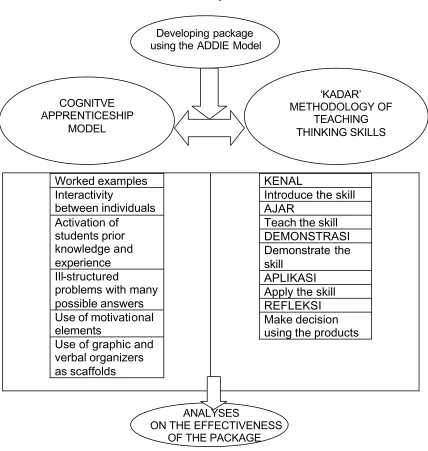
‘KADAR’ METHODOLOGY OF TEACHING THINKING SKILLS COGNITVE APPRENTICESHIP MODEL
1.6 Theoretical Framework of the Study
Developing package using the ADDIE Model
Worked examples Interactivity between individuals Activation of students prior knowledge and experience Ill-structured
problems with many possible answers Use of motivational elements
Use of graphic and verbal organizers as scaffolds
KENAL
Introduce the skill AJAR
Teach the skill DEMONSTRASI Demonstrate the skill
APLIKASI Apply the skill REFLEKSI Make decision using the products
ANALYSES
ON THE EFFECTIVENESS OF THE PACKAGE
Figure 1.1 The structure of the theoretical framework
The methodology adopted in developing the interactive multimedia package was based on the ADDIE model as shown in Figure 1.2 in the operational framework. The framework for the development of the multimedia prototype consisted of the five developmental stages of the ADDIE model, namely:
• Development • Implementation • Evaluation
The research project involved the preliminary needs analysis, exploring methods for direct teaching of thinking skills, constructing instruments to divulge divergent analytical thinking skills of respondents and checking for validity and reliability, design and development of prototype, content validation by experts, implementation and evaluation of an interactive multimedia package in analytical thinking skills using three techniques; verbal and graphic organisers and several CoRT1 tools. These are strategies adopted by local experts in thinking skills and are found in numerous documents published by the Ministry of Education (Som and Mohd Dahlan, 1998 and Poh, 2000).
The underlying concepts that served as underpinnings for this study are namely: • Cognitive Apprenticeship Model
• KADAR methodology of direct teaching of thinking skills
a. Cognitive Apprenticeship Model
in one domain can be used to learn and solve problems in another domain (teaching for transfer).
Cognitive apprenticeship model demand that student tasks to be slightly more difficult than students can manage independently, requiring the aid of their peers and instructor to succeed (Collins, Brown and Holum, 1991). Gilliani (2000) outlined the phases that would lead to a student achieving his full potential, which included ‘reliance on others’, ‘collaborate with others’, ‘self-reliance’ and lastly ‘internalization’ of knowledge and skills. These phases formed the basis of the instructional design of the interactive multimedia package.
Proponents of collaborative learning claim that the active exchange of ideas within small groups not only increases interest among the participants but also promotes thinking. According to Gokhale (1995), there was evidence that collaborative teams achieve at higher levels of thought and retain information longer than students who work quietly as individuals. The shared learning gives students an opportunity to engage in discussion, take responsibility for their own learning, and thus become ana lytical and analytical thinkers (Gokhale, 1995).
b. KADAR methodology of direct teaching of thinking skills
1.7
Operational
Framework
A
n
alysis Phase Performed tests to investigate divergent analytical thinking pattern and
performance level
of Form Four students (34 students)
Results obtained from tests and interviews tabulated and conclusions drawn Students’ preferences in an educational multimedia courseware
package
explored
Design Phase
Prepared storyboard Integrate
d
relevant theories
and strategies as
design platform
Use of tools for delive
ring
content: Graphic and
Verbal
Organizers
,
CoRT1
Preparing
media elements such as audio
and animations
Development Phase
U
s
e
d
of Authorware 6 as platform for implementing storyboard and
compil
in
g
package
Content validation by experts
on three separate modules of analytical
thinking Formative evaluation by respondents
;
implement results of evaluation on
package development Implementation Pre-test, Post-test and Second Post -test on
And Evaluation Phase
divergent analytical thinking skill levels o f respondents
on three separate
modules Quantitative evaluation of package by respondents Qualitative case studies (structured
group interview s , i n -depth interviews
and observation checklist)
t
o
probe
attitudinal transformation after
exposure to package
Figure 1.2
conducted in which the members were picked based on types of modules exposed. The transcripts were then recoded and summarize to include all the respondents’ experiences and perceptions towards the package based on their responses from the pre-determined interview questions. Another session of a smaller scale in-depth group interviews was conducted in which the members were picked from different groups of respondents based on gender and level of gain in performance scores after the first post-tests were conducted. The transcripts were then analyzed qualitatively by cross-checking responses from different categories of students with the previous larger-scale group interviews’ feedbacks to explore in-depth their personal experiences and any contrasting outlook on the effectiveness of the package.
1.8 The Rationale of the Research Project
Many important aspects of school life and home learning climate were predominantly motivated by the need to do well in examinations which curtailed students’ mental process to conforming to ideas presented to them from the textbooks and other main stream resources (Nickerson, 1988). In addition, Kartini (1998) deliberated on the lack of emphasis given by trainee teachers on thinking skills’ instructions in teaching colleges in the country. Results from other studies done locally exposed a low command of analytical thinking skills amongst Malaysian students (Safiah, 1996; Ravi, 1999; Razali, 1999).
which involves the inclusion of thinking skills instruction within the subject matter ever since. Thus, the need to inculcate the culture and skills in thinking is ranked highly in the educational achievements of Malaysian students. Roman (2003) deliberated the skills that the 21st century worker will need and amongst them are logical and intuitive analytical skills.
Evidence that is available from the literature on scientific reasoning suggests significant weakness in methodical thinking within school students that have implications on their thinking skills (Beyer, 1987). Cognitive strategies, even though they have been the focus of attention in scientific reasoning research, may sadly be the most analytical element that is lacking in our student s’ forte. This fact became apparent from the pre-test results administered in this study. The researcher thus raised the possibility that students at the middle school level have a non-existent mental model that underlies weakness in methodical thinking, and that impedes the ir analytical thinking capability.
Why should we be concerned about students’ adeptness in divergent analytical thinking in our classrooms? Obviously we want to educate citizens of Malaysia whose decisions and choices will be based upon a multitude of ideas that span across a wide ranging school of thought. Maintaining a high level of productivity in today’s modern society requires one to be analytical and analytical in processing ideas as well as capability in utilizing a number of different strategies of thinking.
1.9 The Significance of the Research Project
is still very much an emerging field of study in Malaysia. Since the aim of the current research project was to develop multimedia technology to meet the needs of Malaysian students and teachers, it was felt that the project would contribute to the literature on the teaching of thinking skills using interactive multimedia technology. The correlation between students’ degree of contentment towards different aspects of design used in the package and their improvements in performance would also throw some light on issues regarding factors that could influence students’ readiness and acceptance to use a new medium of instruction.
1.10 Limitations of the Study
Some of the limitations of the study will now be reviewed.
The first limitation of the study is the lack of generalization. The results could not be generalized outside fully residential smart schools in Johore, since the study only involved students of those schools. Entry requirements and socio-cultural background of these schools are not representative of day schools in the country. Superior academic excellence is a dominant factor of the respondents involved in the study. Limited exposure to social environment might have inhibited diversity in students’ responses. Although variance was homogeneous in this study through the method of sample selection, it would be interesting to look into a more heterogeneous population.
Thirdly, the effects of the package on enhancing students’ performance and any attitudinal change that followed would be seen as short term effect. This is due to the short length of exposure time for respondents to explore the package.
1.11 Definition of Some of the Main Terms Used
1. Divergent Analytical Thinking Skills
It is regarded as a thinking exercise in which students generate as much verbal ideas as possible on a task based divergent thinking paradigm, universally known as ideational fluency. Since the scope of this project is focussed on analytical thinking based on peer group’s views as the knowledge base and involved only verbal tasks, the term divergent analytical thinking was coined. Ainon and Abdullah (1995) pointed out that analytical thinking is an effort to perceive a situation in detail, breaking up entities into its components, to compare and contrast, to find the root cause of a problem and to find correlations between facts and situations. Modules in the package facilitate the generation of ideas either from one’s own thought or reproduce ideas generated from his/her peers. The performance score would take into account the number of ideas generated by a student (ideational fluency) and the number of view points taken (ideational flexibility). The quality of ideas generated is not judged.
The elements in the interactive multimedia package are comprised of three modules on analytical thinking skills namely: Comparing and Contrasting, Relationship between Parts to a Whole and Proposal Ponder. It is an endeavor to cover some and not all aspects of analytical thinking skills.
statements through the use of graphic and verbal organizers with the utilization of CoRT1 techniques and peers’ responses as knowledge base to proliferate these ideas will be the success indicator of the multimedia package.
The analytical rubric used to measure divergent analytical thinking performance scores are illustrated in Section 3.5.
2. Graphic organizers
It is defined as a mapping framework or symbolic guidelines to organize factual data and highlight relationships between them (Poh, 2000). Module 1 (Compare and Contrast) and Module 2 (Relationship between Parts to a Whole) of the developed package made use of graphic organizers taken from Poh Swee Hiang’s (2000) “KBKK: Kemahiran Berfikir Secara Kritis dan Kreatif” and Som and Mohd Dahlan’s (1998) book of the same name with a slight modification by the researcher of this study. The graphic organizer used in Module 3 (Proposal Ponder) is constructed specially for this study by the researcher. Please refer to Figures 2.3, 2.4 and 4.9 for diagrammatic illustrations.
3. Verbal organizers
4. Interactive multimedia
Interactive multimedia refers to an interactive learning material incorporating different, integrated types of media which is interactive in nature. Hofstetter (1995) defined multimedia as “a computer to present and combine text, graphics, audio, and video.” Hofstetter also maintained: “If one of these components is missing, you do not have multimedia. For example, if a computer does not provide interactivity, you have mixed media, not multimedia”. Vaughan (1999) further strengthened the definition of multimedia, and described it as “woven combinations of text, graphic art, sound, animation, and video elements. When you allow an end user – the viewer of a multimedia project – to control what elements are delivered, and when, it is called interactive multimedia.” The use of audio and video materials as well as appropriate Flash animations and helpful navigational buttons will be highlighted in the package.
5. Analytical thinking skills performance score and initial performance score gain
The respondents’ performance in the pre-test, first post-test and second post-test sessions are based upon the total number of statements produced by the respondents for the module that they worked on. These scores will be further amplified if the responses given are categorically different or from different view points. This is to cater for ideational fluency and flexibility of the responses key- in. This analytical rubric used will be further elaborated in Chapter 4. The initial gain in performance score would constitute the difference between first post-test and pre-test scores to indicate the extent of initial impact of the package and used later to correlate with students’ level of contentment on the design of the package.
6. CoRT1 tools
techniques but only PMI (Plus, Minus, Interesting), CAF (Consider All Factors), C&S (Consequence and Sequel) and OPV (Other Peoples’ Views) were used in this study. These tools constitute the ‘divergent’ factor of the package.
7. Collaborative approach in an intranetworked environment
Students are individually involved in authentic inquiry such as organizing ideas and resources, questioning and interpreting responses and decision making. Responses and feedbacks by peers are open to free access by all the members of the group through the sharing of text files stored on the network server in asynchronous mode. Thus, each and every member in the Local Area Network would collaboratively contribute ideas towards the problems at hand.
8. Problem scenarios
1.12 Summary
List of References
Ainon Mohd and Abdullah Hassan (1995). Kepintaran Daya Cipta & Kemahiran Berfikir. Kuala Lumpur: Utusan Publications.
Albion, P. R. and Gibson, I. W. (1998). Designing Problem- Based Learning Multimedia for Teacher Education. In S. Mcneil et al. (eds) Technology and Teacher Education Annual 1998. 1240-1244.
Arburn, T. M., and Bethel, L. J. (1999). Assisting At-risk Community College Students Acquisition of Critical Thinking Learning Strategies. Paper presented at the Annual Conference of the National Association for Research in Science Teaching, Boston, 1999. In Astleiner, H. (2002). Teaching Critical Thinking Online. Journal of Instructional Psychology. 29 (2): 53-75.
Asmah Omar (1994). Critical Thinking Skills Across the Curriculum. A Survey of the Teachers’ Knowledge, Skills and Attitudes in Secondary Schools in Kuching,
Sarawak. University of Houston, Texas: M.Ed. Thesis.
Aspillaga, M. (1991). Screen Design – Location of Information and Its Effects on Learning.Journal of Computer-Based Instruction. 18(3): 89-92.
Baharuddin Aris. (1999). The Use of Information Technology in Education: Using an Interactive Multimedia Courseware Package to Upgrade Teachers’ Knowledge
and Change Their Attitudes. The Robert Gordon University, UK: Ph.D.
Dissertation.
Bailey, D. H. (1996). Constructivism and Multimedia: Theory and Application; Innovation and Transformation. International Journal of Instructional Media. 23(2): 161-166.
Bandura, A. (1997). Self- efficacy: The Exercise of Control. New York: W.H. Freeman. In Solvberg, A.M. (2002). Computer-related Control Beliefs and Motivation: A Panel Study. Journal of Research on Technology in Education .35(4): 473-487.
Barrett, E. and Lally, V. (1999). Gender Differences in an On-line Environment. Journal of Computer-Assisted Learning. 15: 48-60.
Barron, A. and Baumbach, D. (1990). A CD-ROM Tutorial : Training for a New Technology.Educational Technology.30 (6): 20-23.
Beyer, B. (1987). Practical Strategies for the Teaching of Thinking. Boston: Ally and Bacon Inc.
Black, J. B, et al. (1994). Constructivist Design of Graphic Computer Simulations. Proceedings of Selected Research and Development Presentations at the
National Convention of the Association for Educational Communications and
Technology. 1994. Nashville, TN.
Brookfield, S. (1997). Developing Critical Thinkers. San Francisco, CA: Jossey-Bass.
Brown, R.G. (1991). Schools of Thought. San Francisco: Jossey-Bass. Cited in Rojewski, J and Schell, J.W. (1994). Cognitive Apprenticeship for Learners with Special Needs. Remedial & Special Education. 15(4): 234-244.
Brown, J. S., Collins, A., and Duguid, P. (1989). Situated Cognition and the Culture of Learning.Educational Researcher.18 (1): 32-42.
Bullen,M.(1998). Participation and Critical Thinking in Online, University Distance Education. [WWW document] URL: http://cade.athabascau.ca/voll13.2/bullen.html
Caine, R., and Caine, G. (1991). Making Connections: Teaching and the Human Brain. Alexandria, VA: Association for Supervision and Curriculum Development.
Cairncross, S. and Mannion, M. (2001). Interactive Multimedia and Learning: Realizing the Benefits. Innovations in Education and Teaching International. 28(2). 156-165.
Cervero, R. M. (1992). Professional Practice, Learning, and Continuing Education: An Integrated Perspective. International Journal of Lifelong Education. 11(2): 91-101.
Chan, D.W. et al. (2001). Assessing Ideational Fluency in Primary Students in Hong Kong.Creativity Research Journal. 13(3): 359-365.
Collins, A. (1991). Cognitive Apprenticeship and Instructional Technology. Summary by Laconya Ruby: ForEducational Technology, Winter 1994.
Collins, A., Brown, J.S. and Holum, A. (1991). Cognitive Apprenticeship: Making Thinking Visible.American Educator. 6(46).
Crook, C. (1991). Computers for Pre-School Children: The Role of Direct Manipulation Interface.Early Child Development and Care. 69: 5-18.
Crowe, H. A. and Palmera-Leynes, A. T. (1995). Computers in the Classroom – Learning Goals and Learning Theories. Presented at the SEAMEO INNOTECH International Conference, 1995, Manila, Philippines. In Baharuddin,A. (1999). The Use of Information Technology in Education: Using an Interactive
Multimedia Courseware Package to Upgrade Teachers’ Knowledge and Change
Their Attitudes. The Robert Gordon University, UK: Ph.D. Dissertation.
Crowl, T. K. (1996). Fundamentals of Educational Research. Madison, WI: Brown & Benchmark.
De Corte, E. (1990). Towards Powerful Learning Environments for the Acquisition of Problem Solving Skills. European Journal of Psychology of Education. 5: 5–19.
De Jong, T.and Van Joolingen, W. R. (1998). Scientific Discovery Learning With Computer Simulations Of Conceptual Domains. Review of Educational Research. 68: 179-201.
Delcloss, V. R. and Hartman, A. (1993). The Impact of an Interactive Multimedia System on the Quality of Learning in Educational Psychology: An Exploratory Study.Journal of Research on Computing in Education. 26(1): 83-94.
D'Ignazio, F. (1992). Multimedia Sandbox: Teaching, Learning, and the Transformation of Knowledge. The Computing Teacher. 54-55.
Dillon, A.and Gabbard, R.(1998). Hypermedia as an Educational Technology. A Review of the Quantitative Reseach Literature on Leraner Comprehension, Control and Style. Review of Educational Research. 68: 322-349.
Donnely, R. and Patterson, G. (1997). The Planning and Development of an Interactive Computerized Information Technology Tutor for Postgraduate Students. Innovations in Education and Training International. 34 (3): 194-199.
Duffelmeyer, B. B. (2000). Critical Computer Literacy: Computers In First-Year Composition As Topic And Environment. [WWW document]. URL http://corax.cwrl.utexas.edu/cac/current_issue/duffelmeyer. html
Ediger, M. (1999). The Pupil in the Rural School. Journal of Instructional Psychology. 26 (4): 280-285.
Ellington, H. I. (1997). Flexible Learning Approaches in Practice. Proceedings of Flexible Learning in Tertiary Education, Keynote presentations at Napier University, Edinburgh, Scotland. In Baharuddin, A. (1999). The Use of Information Technology in Education: Using an Interactive Multimedia
Courseware Package to Upgrade Teachers’ Knowledge and Change Their
Edwards, J. (1991). The Direct Teaching of Thinking Skills. In Evans, G. (ed.) Learning and Teaching Cognitive Skills. Victoria, Australia: ACER. 87-106.
Enis, R.H. (2002). A Super Streamlined Conception of Critical Thinking. [WWW document] URL:http://www.criticalthinking.com/articles.html
Faryniarz, J. V., and Lockwood, L.G. (1992). Effectiveness Of Microcomputer Simulations In Stimulating Environmental Problem Solving By Community College Students.Journal of Research in Science Teaching. 29: 453-470.
Ford, N. and Chen, S. Y. (2001). Matching/ mismatching Revisited: An Empirical Study of Learning and Teaching Styles. British Journal of Educational Technology. 32(1): 5-22.
Frear, V. and Hirschbuhl, J.J. (1999). Does Interactive Multimedia Promote Achievement And Higher Level Thinking Skills For Today's Science Students? British Journal of Educational Technology. 30 (4): 323-354.
Frisby, C. L. (1992). Construct Validity and Psychometric Properties of the Cornell Critical Thinking Test (Level Z): A Contrasted Groups Analysis. Psychological Reports. 71: 291-303.
Fullerton, K. (2000). The Interactive Effects of Field Dependence-Independence and Internet Document Manipulation Style on Student Achievement from
Computer-Based Instruction. University of Pittsburgh: D.Ed Dissertation.
Garcia, J. F. C. (2001). An Instrument to Help Teachers Assess Learners’ Attitudes Towards Multimedia Instruction. Education122(1): 94-101.
Ghinea, G. and Chen, S.Y. (2003). The Impact of Cognitive Styles on Perceptual Distributed Multimedia Quality. British Journal of Educational Technology. 34(4): 393-406.
Gifford, A. P. (2000). Broadening Concepts Through Vocabulary Development. Reading Improvement. 37 (1): 2-12.
Gilliani, B. B. (2000). Culturally Responsive Educational Web Sites. Media and Information Technologies. 37(3): 185-194.
Gilster, P. (1997). Digital Literacy: The Thinking and Survival Skills New Users Need to Make the Internet Personally and Professionally Meaningful. New York: Wiley.
Glebas, G. J. (1997). Evaluating the Effectiveness of Using the Spreadsheet Application as a Cognitive Tool to Increase Mathematics Achievement. [WWW document].
URLhttp://home.att.net/tildesabelg/thesis.html
Gokhale, A.A. (1995). Collaborative Learning Enhances Critical Thinking. Journal of Technology Education. 7(22): 30-45.
Hannafin, M., Land, S., and Oliver, K. (1999). Open Learning Environments. Foundations, Methods, and Models. In C. M. Reigeluth (Ed.) Instructional-design Theories and Models. A New Paradigm of Instructional Theory.
Mahwah, NJ: Erlbaum. 115-140.
Hofstetter, F. T. (1995). Multimedia Literacy. New York : McGraw-Hill, Inc. In Baharuddin, A.(1999). The Use of Information Technology in Education : Using an Interactive Multimedia Courseware Package to Upgrade Teachers’
Knowledge and Change Their Attitudes. The Robert Gordon University, UK:
Ph.D Thesis.
Hendricks, C.C. (2001). Teaching Causal Reasoning Through Cognitive Apprenticeship: What Are Results From Situated Learning? Journal of Educational Research. 94 (5): 302-312.
Jackson, M.J. (1986). Thumbs Up for Direct Teaching of Thinking Skills.Educational Leadership. 31-36.
Jamaluddin Harun and Zaidatun, Tasir (2000). Macromedia Authorware Attain 5, Siri 1: Pengenalan. Kuala Lumpur: Venton Publishing.
Jessup, L. M. and Egbert, J. L. (1996). Understanding Computer-Supported Group Work: The Effects Of Interaction Frequency On Group Process And Outcome. Journal of Research on Computing in Education. 28 (2): 190-203.
Johnson, B. and Christensen, L. (2000). Educational Research: Qualitative and Quantitative Approaches.” Needham Heights, MA: Ally and Bacon. In Zaidatun Tasir (2002). Pembinaan dan Penilaian Keberkesanan Perisian Multimedia Interaktif Matematik Berasaskan Kecerdasan Pelbagai. Universiti Teknologi Malaysia: Ph.D Thesis.
Johnson, S. D. (1995). Transfer of Learning. The Technology Teacher. 33-34.