RAVINDRAN, PALANIKUMAR. Bayesian Analysis of Circular Data Using Wrapped
Dis-tributions. (Under the direction of Associate Professor Sujit K. Ghosh).
Circular data arise in a number of different areas such as geological,
meteorolog-ical, biological and industrial sciences. We cannot use standard statistical techniques to
model circular data, due to the circular geometry of the sample space. One of the
com-mon methods used to analyze such data is the wrapping approach. Using the wrapping
approach, we assume that, by wrapping a probability distribution from the real line onto
the circle, we obtain the probability distribution for circular data. This approach creates
a vast class of probability distributions that are flexible to account for different features of
circular data. However, the likelihood-based inference for such distributions can be very
complicated and computationally intensive. The EM algorithm used to compute the MLE is
feasible, but is computationally unsatisfactory. Instead, we use Markov Chain Monte Carlo
(MCMC) methods with a data augmentation step, to overcome such computational
difficul-ties. Given a probability distribution on the circle, we assume that the original distribution
was distributed on the real line, and then wrapped onto the circle. If we can unwrap the
distribution off the circle and obtain a distribution on the real line, then the standard
sta-tistical techniques for data on the real line can be used. Our proposed methods are flexible
and computationally efficient to fit a wide class of wrapped distributions. Furthermore, we
can easily compute the usual summary statistics. We present extensive simulation studies
to validate the performance of our method. We apply our method to several real data sets
frequentist coverage probability. We extend our method to the regression model. As an
example, we analyze the association between ozone data and wind direction. A major
con-tribution of this dissertation is to illustrate a technique to interpret the circular regression
coefficients in terms of the linear regression model setup. Regression diagnostics can be
developed after augmenting wrapping numbers to the circular data (refer Section 3.5). We
extend our method to fit time-correlated data. We can compute other statistics such as
cir-cular autocorrelation functions and their standard errors very easily. We use the Wrapped
Normal model to analyze the hourly wind directions, which is an example of the time series
by
Palanikumar Ravindran
A dissertation submitted to the Graduate Faculty of North Carolina State University
in partial satisfaction of the requirements for the Degree of
Doctor of Philosophy
Department of Statistics
Raleigh 2002
Approved By:
Dr. Peter Bloomfield Dr. Sastry Pantula
Dr. Sujit K. Ghosh Dr. John Monahan
Biography
Palanikumar Ravindran was born in Virudhunagar, India, to parents Ravindran Palanichamy
and Rajakumari Ravindran on Oct 25, 1976. He entered Indian Statistical Institute,
Cal-cutta, India in 1994 and received a B.S. and M.S. in Statistics in 1997 and 1999, respectively.
Since August 1999, he has studied for the doctoral degree in the Department of Statistics
Acknowledgements
I would like to express my deepest gratitude and appreciation to my advisor Dr. Sujit
Ghosh for his guidance, encouragement and support throughout my dissertation research.
I would also like to thank the other committee members, Dr. John Monahan, Dr. Peter
Bloomfield, Dr. Sastry Pantula and Dr. Gene Brothers for their careful reading of this
manuscript and their helpful comments.
It has been a very pleasant experience to study in this department. I would like
to convey my gratitude to the faculty and staff for their help and assistance. Thanks to my
fellow students for their help and support. I would also like to thank Dr. Kaushik Ghosh,
Contents
List of Figures vii
List of Tables viii
1 Introduction to Circular Data 1
1.1 Some real life applications of circular data . . . 1
1.2 Statistical Approaches to model circular data . . . 6
1.2.1 The Embedding Approach . . . 6
1.2.2 Intrinsic Approach . . . 8
1.2.3 Wrapping Approach . . . 9
2 Parameter Estimation for Wrapped Distributions 12 2.1 Previous Work . . . 12
2.2 The Data Augmentation Approach . . . 13
2.3 Model selection . . . 21
2.4 Simulation studies . . . 23
2.5 Validation approach for MCMC . . . 32
2.6 Wrapped Extreme Value and Bimodal distributions . . . 34
2.7 Application to real data sets . . . 38
2.7.1 Jander’s ant data . . . 38
2.7.2 Ozone data set . . . 42
2.8 Discussion . . . 43
3 Circular Regression 45 3.1 Introduction . . . 45
3.2 Previous work . . . 46
3.3 Extension of the Data Augmentation Approach for Regression . . . 48
3.4 Simulation studies . . . 53
3.5 Regression Diagnostic plots . . . 62
3.6 Application to real data sets . . . 64
4 Circular Time Series 71
4.1 Introduction . . . 71
4.2 Previous work . . . 72
4.3 Extension of the Data Augmentation Approach for Time Series . . . 73
4.4 Simulation studies . . . 78
4.5 Application to real data sets . . . 79
4.6 Discussion . . . 82
Bibliography 84 A Explicit full conditionals 90 A.1 Wrapped Normal Distribution . . . 90
A.2 Wrapped Cauchy Distribution . . . 92
A.3 Wrapped Double Exponential Distribution . . . 93
A.4 Wrapped Extreme Value Distribution . . . 95
A.5 Bimodal (Wrapped Beta) Distribution . . . 96
B Explicit full conditionals for regression 98 B.1 Wrapped Normal Distribution . . . 98
B.2 Wrapped Cauchy Distribution . . . 100
B.3 Wrapped Double Exponential Distribution . . . 102
C Explicit full conditionals for Time series 105 C.1 Wrapped Normal Distribution . . . 105
List of Figures
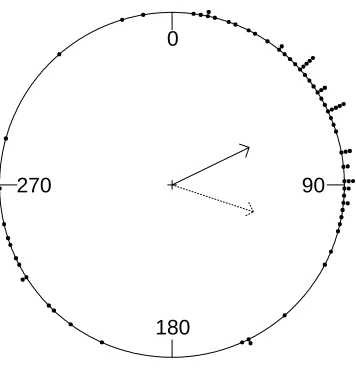
1.1 Circular histogram plot of the turtle data. Solid line indicates the circular
mean and dashed line indicates the linear mean. . . 4
2.1 Probability plot of{Hk}forµ parameter of WN model . . . 33
2.2 Plot of ρfor the bimodal distribution . . . 35
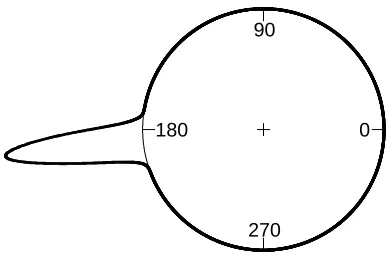
2.3 Plot of the bimodal density forρ= 0.087 . . . 36
2.4 Plot of the bimodal density forρ= 0.087 on the circle . . . 36
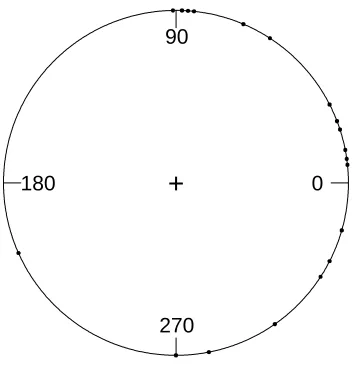
2.5 Circular plot of the Jander’s Ant data . . . 39
2.6 Trace plots while fitting WC to Ant data . . . 41
2.7 Posterior density ofµ while fitting WC to Ant data . . . 42
2.8 Plot of wind directions in the ozone data. . . 43
3.1 Joint data plot of the ozone data. The ozone concentrations are plotted as distances from the center. . . 46
3.2 Plot of the original values. . . 63
3.3 Regression Plot of the sample and fitted values. . . 63
3.4 Plot of wind directions in the ozone data. . . 65
3.5 Trace plots while fitting WN to the Ozone data . . . 68
3.6 Regression Plot of the fitted values. . . 69
3.7 Plot of the residuals. . . 69
4.1 Plot of the median direction of face cleat collected at Wallsend Boreland Colliery, NSW in Australia. . . 72
4.2 Relation between circular autocorrelation function and autocorrelation function 77 4.3 Plot of hourly wind directions collected over three days. . . 80
4.4 Trace plots while fitting WARN(1) to Wind direction data using time series model . . . 81
List of Tables
2.1 Fitting WN to WN distribution using different priors . . . 24
2.2 Fitting WC to WC distribution using different priors . . . 25
2.3 Fitting WDE to WDE distribution using different priors . . . 25
2.4 Fitting WN, WC and WDE to WN distribution with ρ∼Beta(0.5,0.5) . . 27
2.5 Fitting WN, WC and WDE to WC distribution with ρ∼Beta(0.5,0.5) . . 28
2.6 Fitting WN, WC and WDE to WDE distribution withρ∼Beta(0.5,0.5) . 29 2.7 Fitting WN, WC and WDE to VM data withρ∼Beta(0.5,0.5) . . . 31
2.8 Fitting WEV to WEV distribution . . . 37
2.9 Fitting WB to WB distribution . . . 37
2.10 Fitting WN, WC and WDE to the Ant data set withρ∼Beta(0.5,0.5) . . 40
2.11 Fitting WN, WC and WDE to the Ozone data set withρ∼Beta(0.5,0.5) . 44 3.1 Regressing WN model to WN data . . . 54
3.2 Regressing WC model to WC data . . . 55
3.3 Regressing WDE model to WDE data . . . 56
3.4 Regressing WN, WC and WDE models to WN data withβ1 = 1.5 . . . 58
3.5 Regressing WN, WC and WDE models to WC data withβ1= 1.5 . . . 59
3.6 Regressing WN, WC and WDE models to WDE data with β1= 1.5 . . . . 60
3.7 Regressing WN, WC and WDE models to VM data withβ1= 1.5 . . . 61
3.8 Regressing WN, WC and WDE models to the Ozone data set with ρ ∼ Beta(0.5,0.5) . . . 67
4.1 Regressing WARN(1) model to WARN(1) data . . . 79
Chapter 1
Introduction to Circular Data
Circular data arise from a number of sources in our daily lives, where we consider
the circle to be the sample space. Some common examples are the migration paths of birds
and animals, wind directions, ocean current directions and patients’ arrival times in an
emergency ward of a hospital. Many examples of circular data are found in various scientific
fields such as earth sciences, meteorology, biology, physics, psychology and medicine. To
motivate the use of circular data, we present a brief description of some examples from
these fields.
1.1
Some real life applications of circular data
The study of earth sciences yields two good examples of circular data - The
orien-tation of cross-bedding structures and the orienorien-tation of the long axis of unbroken sediment
particles. Orientation of the cross-bedding structures gives us information about the
has proved to be useful in the study of glacial deposits and direction of ice movement.
Pincus (1953) presents several such examples.
In meteorology, wind directions and ocean current directions give rise to circular
data. Johnson and Wehrly (1977) did some analysis of wind directions. Seasonal weather
changes such as the propensity for rainfall during the monsoon season is another example
of circular data.
In the field of physics, before the discovery of isotopes, Von Mises (1918) proposed
testing the hypothesis that atomic weights are integers subject to error. He converted the
fractional parts of the atomic weights to angles. He regarded these angles as a random
sample from a circular distribution with mean zero and tested for uniformity. He also
introduced Von Mises distribution, a popular distribution on the circle. In another study,
Rayleigh (1919) worked with a representation of sound waves. He was interested in the
resultant of unit vectors and its distribution. He considered the unit vectors as points on
the circle.
In psychology, circular data arises from experiments to study the behavior of the
human mind. Consider the simulated tests of zero gravity. Scuba divers were required to
turn somersault and reorient themselves to the vertical under various circumstances (for
example, blindfolded or looking through a translucent faceplate, see Ross et al., 1969).
The angles from the vertical were measured and analyzed. Circular data also occur in the
studies of mental maps, which are used to represent surroundings. Individual subjects were
led past a series of sites. They were asked at each site to point to the direction, and guess
In medicine, circular data arises as the time of onset of a particular disease at
various times of the year (Lee, 1962). Another example is circadian rhythms, which is the
time of adverse event occurrences throughout the day. Circadian rhythms are analyzed
because it has been found that adverse events (for example, deaths, myocardial infarctions)
do not occur randomly throughout the day but cluster at certain points in the day (Proschan
and Follmann, 1997).
A very good source of circular data is the field of biology. Migration path of birds
and animals has been the subject of many studies. The objective of these studies is to
ascertain whether the direction of migration is uniform. An example of the migration of
turtles is given in Figure 1.1. In the figure, we present the circular histogram plot of the
data collected by Dr. E. Gould from John Hopkins University School of Hygiene and first
cited by Stephens (1969). The data represents the directions taken by the sea turtles after
laying their eggs. The predominant direction is 64◦, which is the direction the turtles took
to return to the sea (Fraser, 1979).
Standard statistical techniques cannot be used to analyze circular data. This is due
to the circular geometry of the sample space. For example, the sample mean of a data set
on the circle is not the usual sample mean. Let y1, y2, . . . , yn be independent observations
on the unit circle, such that 0 ≤ yj < 2π, j = 1,2, . . . , n. The mean direction ¯y is not
given by the usual definition, 1nPnj=1yj. This is illustrated in Figure 1.1, where the dashed
arrow is the direction represented by n1Pnj=1yj and the solid arrow represents the mean
0
180
270 90
Figure 1.1: Circular histogram plot of the turtle data. Solid line indicates the circular mean and dashed line indicates the linear mean.
We considerC= n1 Pnj=1cosyj and S= 1n
Pn
i=1sinyj and define,
¯
y=
arctan(S
C) , C≥0
arctan(S
C) +π , C <0,
where arctan takes values in [−π2,π2]. In general, the pth theoretical moment of a circular
distribution is defined as E(eipY) = αp +iβp, for p = 1,2, . . .. The mean direction is
given by µ = arctan(β1/α1) and the mean resultant is defined as ρ = pα21+β12, so that
E(eiY) =ρeiµ. In most applications it is of interest to estimate the location parameterµand
the scale parameter ρ. Nonparametric methods are suitable for this purpose. However, for
the prediction problem, it would be of interest to develop parametric models. In addition,
we exemplify that the class of parametric models that we develop is robust against erroneous
models.
an emphasis on the wrapping approach. In this dissertation, we use the wrapping method
to generate a flexible class of circular distributions. In chapter 2, we discuss classical and
Bayesian methods to obtain estimates of the parameters of wrapped circular distributions.
As the Bayesian methods have the advantage of obtaining a finite sample estimate of the
variability (for example, s.e. of the estimates), we propose a data augmentation method for
parameter estimation. In Section 2.2, we present the data augmentation method to obtain
the posterior distribution of the parameters of several wrapped distributions. In Section 2.3,
we describe the possible methods for model selection. In Section 2.4, we present extensive
simulation studies to validate the frequentist performance of our method. In Section 2.6,
we discuss the Wrapped Extreme Value and bimodal distributions. In Section 2.7.1, we
apply our method to a real data set on the movement of ants. In chapter 3, we develop
some models for regression where the response variable can be circular or linear. In Section
3.3, we present the extension of the data augmentation method proposed in Section 2.2 for
regression to obtain the posterior distribution of the regression coefficients based on several
wrapped distributions. In Section 3.4, we present extensive simulation studies to validate
the performance of our method for regression. In Section 3.6, we fit a linear regression
model to explore the relation between ozone concentration and wind direction. In Section
4.3, we illustrate how the data augmentation method used for regression in Section 3.3 can
be easily extended for time series. Simulation studies with the Wrapped Normal density
for the time series model is given in Section 4.4. In Section 4.5, we analyze hourly wind
directions, which is an example of time series data. We use the Wrapped Normal model for
1.2
Statistical Approaches to model circular data
Many methods and statistical techniques have been developed to analyze and
understand circular data (see Mardia and Jupp, 1999). The popular approaches have been
theembeddingapproach, intrinsicapproach andwrapping approach. A brief description of
each of the approaches is given below.
1.2.1 The Embedding Approach
In the embedding approach, the sample space (for example, the unit circle) is
considered as a part of a larger space (for example, 2-dimensional plane). A common
example is the representation of the points of the unit circle by unit complex numbers.
There are many advantages of the embedding approach. Considering the points on the unit
circle, as a vectorx= (cosy,siny)T in the plane enables the use of the traditional definition
of expectations that is used for data in the Euclidean space. For instance, definition of the
mean µof a random variable y, defined on the unit circle is given by
kE[(cosy,siny)T]k−1 E[(cosy,siny)T] = (cosµ,sinµ)T.
Several bivariate distributions on the Euclidean space can be embedded to produce
distribution on the circle. For instance, the Projected Normal distribution is an example
of the embedding approach. In the embedding approach, we start with the larger sample
space (for example, 2-dimensional plane) and obtain the projection of this space into a
smaller sample space. For example, if X has the Bivariate Normal distribution N2(µ,Σ),
then k X k−1 X is said to have the Projected Normal distribution, P N2(µ,Σ). This is
distri-bution and the resulting marginal distridistri-bution for wind direction is the Projected Normal
distribution. The density ofP N2(µ,Σ) has been derived by Mardia (1972). The Projected
Normal distribution can be extended to p-dimensions, where the distributions on <p are
projected ontoSp−1, the unit sphere in <p. The density of the Projected Normal
distribu-tion, P Np(µ,Σ) has been derived by Bingham (Watson, 1983, pp. 226-231) and a simpler
form was derived by Pukkila & Rao (1988). However, in general, the densities obtained by
embedding a generic distribution on<p ontoSp−1, can turn out to be very complicated and
hence obtaining the likelihood-based inference can be extremely challenging. Therefore,
most of the literature is focused on developing statistical methods for the Projected Normal
distributions only, which is a significant limitation of the embedding approach.
There are some techniques for parameter estimation in the embedding approach.
Spherically projected multivariate linear (SPML) model using P N2(µ,Σ) distribution was
suggested by Presnell, Morrison and Littel (1998). They considered circular data as data
sampled from a plane and projected onto the circle. They assumed that the distance
from the center for each data point, |yi| was missing and used EM algorithm to estimate
it. Embedding technique is also very useful to perform analysis of variance (ANOVA) for
circular data. ANOVA for circular data was proposed by Harrison, Kanji and Gadsen (1986)
and Harrison and Kanji (1988). We do not pursue any analysis based on the embedding
approach in this research work, as the analysis becomes analytically and computationally
1.2.2 Intrinsic Approach
In the intrinsic approach for circular data, circle is used as the sample space. The
directions (angles) are represented as points on the circle. In intrinsic approach, probability
distributions are defined on the circle directly (for example, Von Mises and Cardioid
dis-tributions). Von Mises distribution is one of the most popular distributions that come out
of this approach. The probability density function of the Von Mises distribution is given
by fV M(y) = 2πI10(κ)eκcos(y−µ), where I0 denotes the modified Bessel function of the first
kind and order 0. I0 is defined by I0(κ) = 21π R02πeκcos(y)dy. Von Mises distribution has
been studied extensively. Mardia and Jupp (1999) give references for the genesis of the
Von Mises distribution on the circle, which is analogous to the Normal distribution on the
real line. Let y={y1, y2, y3, . . . , yn},0≤yi <2π, i= 1. . . nbe a random sample from Von
Mises distribution with location parameter µ and scale parameter κ. Define C, S and R
as C = Pni=1cosyi, S =
Pn
i=1sinyi and R2 = C2 +S2. C = Rcos ¯y and S = Rsin ¯y,
where ¯y is the mean as defined earlier (in Section 1.1). Mardia and Jupp (1999) provide
the joint distribution of ¯y andR. They give the marginal densities ofR,C andS using the
results given by Greenwood and Durand (1955). Mardia (1972) showed that the conditional
distribution of ¯y givenR is Von Mises distribution with location parameterµand scale
pa-rameter κR. Mardia and Jupp (1999) give results and references on several extensions of
these results to multi-sample Von Mises populations. The asymptotic distributions of these
statistics, as the sample size goes to infinity, are also available.
From a Bayesian perspective, the conjugate prior for the Von Mises distribution
full Bayesian analysis involving Von Mises distribution, where both the parameters are
assumed to be unknown, and used its conjugate prior proposed by Guttorp and Lockhart.
They proposed MCMC methods to simulate samples from the posterior distribution.
Mardia and Jupp (1999) describe the maximum likelihood estimates for the Von
Mises distribution and give references and results for their large-sample asymptotic
prop-erties. They also provide a good overview of the various single-sample, two-sample and
multi-sample hypothesis tests for the Von Mises distribution.
One of the main drawbacks of the intrinsic approach is that there are not many
distributions available other than the Von Mises distribution and mixture of Von Mises
distributions. Again, due to this limitation, we do not pursue any analysis using this
approach. We use wrapping approach (see next section) and illustrate how a flexible class
of models can be obtained.
1.2.3 Wrapping Approach
In the wrapping approach, given a known distribution on the real line, we wrap
it around the circumference of the circle with unit radius. Technically this implies that if
U is a random variable on the real line, then the corresponding random variable Y on the
circle is given by Y =U(mod 2π). Equivalently, the wrapped version ofU is obtained by
defining Y =U−2π£2Uπ¤, where [u] = largest integer≤u. Let the distribution function of
U on the real line be denoted byF. The distribution function ofY denoted by Fw can be
obtained as,
Fw(y) = Pr(Y ≤y) =
∞
X
k=−∞
This implies that if the densityf of U exists, then the wrapped density fw is given by
fw(y) =
∞
X
k=−∞
f(y+ 2πk),0≤y <2π.
An excellent overview of the properties of the wrapped distributions can be found
in Mardia and Jupp (1999). One of the properties of the wrapped distributions is that the
characteristic function (c.f.) ofU is same as the c.f. of theY. Thus, from the information
about U, we can obtain the information about Y. More importantly, if the c.f. of U is
integrable, then it can been shown that the density ofY,fw(y) can be represented as,
fw(y) = 21π
1 + 2
∞
X
p=1
(αpcospy+βpsinpy)
,
where E(eipY) = E(eipU) = αp +iβp This result on the unit circle is analogous to the
inversion theorem for continuous random variables on the real line. However, in most cases
the above series cannot be written in closed form except in a few cases such as the Cauchy
distribution. One of the most popular wrapped distributions is the Wrapped Cauchy
dis-tribution, introduced by L´evy (1939). This is because the density of the Wrapped Cauchy
distribution has a closed form representation. The density of the Wrapped Cauchy
dis-tribution is given by P∞k=−∞πσ1
·
1 +
³
y+2πk−µ σ
´2¸−1
, where µ is the location parameter
and σ is the scale parameter. Using the inversion theorem, this can be represented as
1
2π{1 + 2
P∞
1 (ρpcosp(y−µ))}, where ρ = e−σ. Considering this density as the real part
of the geometric series P∞1 ρpe−ip(y−µ), simplifies it to 21π1+ρ2−12−ρρcos(2 y−µ). Kent and Tyler
(1988) and Mardia (1972) have shown the relation between the Wrapped Cauchy
distribu-tion and the Projected Normal distribudistribu-tion. Mardia and Jupp (1999) describe the wrapped
This is a larger family of distributions containing the Wrapped Cauchy distribution (α= 1)
and the Wrapped Normal distribution (α= 2).
It follows that a rich class of distributions on the circle can be obtained using the
wrapping technique because we can wrap any known distribution on the real line onto the
circle. Also, by wrapping a symmetric unimodal density, it is possible to obtain a bimodal
density on the circle. An example is the Wrapped Beta distribution. We discuss this in
Section 2.6. The main difficulty in working with the wrapping approach has been that, in
most cases, the form of the densities and distribution functions are large sums, and cannot be
simplified as closed forms. Due to this complexity, maximum likelihood techniques for point
estimation and hypothesis testing cannot be easily implemented. The main contribution of
this dissertation is to present a general approach to obtain parameter estimates of a wide
class of wrapped distributions. The next paragraph outlines our approach.
For a given probability distribution on the circle, we make assumptions that the
original circular distribution was distributed on a line and was wrapped onto the circle.
Therefore if we can unwrapthe distribution on the circle and obtain a distribution on the
real line, we can use all the standard statistical techniques for data on the real line. We
propose to perform this using the data augmentation approach. We use Bayesian methods,
so that we can easily obtain parameter uncertainty estimates based on the finite sample.
In many practical problems (as discussed in Section 1.1), the sample sizes are usually small
Chapter 2
Parameter Estimation for Wrapped
Distributions
In this chapter, we consider parameter estimation for several wrapped
distribu-tions. We concentrate on symmetric unimodal and bimodal densities.
2.1
Previous Work
It was shown by Kent and Tyler (1988) that the maximum likelihood estimate for
the Wrapped Cauchy distribution exists and is unique for samples of size greater than two.
They also gave a simple iterative algorithm, which would always converge to the maximum
likelihood estimate (MLE). Calculating the MLE for the Wrapped Cauchy distribution
is possible because the density has a closed form representation. In general, wrapped
distributions do not have closed form densities and consequently, computing the MLE is
A different approach for fitting wrapped distributions was given by Fisher and
Lee (1994) who used the Expectation Maximization (EM) algorithm techniques to obtain
parameter estimates from the Wrapped Normal distribution. However, the E-step involves
ratio of large infinite sums, which needs to be approximated at each step. This makes the
algorithm computationally inefficient. In addition, the standard errors of the MLEs have to
be evaluated based on large-sample theory. We propose an alternative method that is more
computationally efficient and flexible to entertain a large class of wrapped distributions.
Also, as a by-product, we acquire finite sample interval estimates of the parameters of the
wrapped distributions. This is done using the data augmentation approach described in the
following section.
2.2
The Data Augmentation Approach
The data augmentation approach was originally proposed by Tanner and Wong
(1987). Some references for this technique can also be found in the work of Damien,
Wake-field and Walker (1999), Higdon (1998) and van Dyk and Meng (2001) and references
therein. In the context of circular data, Damien and Walker (1999) used it to study Von
Mises distribution. Coles (1998) used it to study the Wrapped Bivariate Normal
distribu-tion and wrapped autoregressive process. We present a generic approach that can be used
for a broader class of wrapped distributions.
The main idea behind the data augmentation approach is to augment the original
data with some ”additional data” that would simplify the original likelihood to a form that
U on the real line, can be represented as U =Y + 2πK, where Y is the observed data on
the circle, and K is the number of times U was wrapped to obtain Y. Therefore, in this
case if we were able to ”add” the information on K, and thus unwrap Y, then we could
observe U. However, given Y, as the value of K is not unique, we obtain the conditional
probability distribution ofK givenY. To illustrate the unwrapping method, let us consider
a location scale family σ1f(y−σµ) on the real line. Then the corresponding wrapped density
is obtained as,
fw(y) =
∞
X
k=−∞
1
σf(
y+2πk−µ σ )
= ∞
X
k=−∞
1
σf(
y+2πk−µ σ ) F(2π(k+1)σ −µ)−F(2πkσ−µ)
h
F(2π(k+1)σ −µ)−F(2πkσ−µ)
i
. (2.1)
In the above equations, we follow the convention that the location parameterµ=µ0(mod 2π),
whereµ0 is the location parameter on the real line. In order to specify the full probability
model, we consider several prior distributions for (µ, σ). In most cases the mean resultant,
ρ (defined in Section 1.1) can be expressed as a function of σ. In general, we will write
ρ = h(σ). For example, for the Wrapped Normal family, ρ = e−σ2/2. Notice that by
definition, 0< ρ≤1.A class of non-informative prior for (µ, ρ) can be specified as,
[µ, ρ] ∝ Iµ(0,2π)ρaρ−1(1−ρ)aρ−1,aρ>0, (2.2)
and hence the joint density of (µ, σ) is given by
[µ, σ] ∝ Iµ(0,2π)h(σ)aρ−1(1−h(σ))aρ−1|h0(σ)|, aρ>0.
the conditional density of Y given K =k and the parametersµ, ρis given by
fw(y|k, µ, σ) =
1
σf(
y+2πk−µ σ ) F(2π(k+1)σ −µ)−F(2πkσ−µ)
Iy(0,2π), (2.3)
which is a truncated density of a location-scale family. It also follows from (2.1) that the
marginal density ofK given the parameters (µ, σ) can be obtained as
Pr(K=k|µ, σ) = F(2π(k+1)σ −µ)−F(2πkσ−µ), k∈ Z.
Thus, we obtain a Bayesian hierarchical model by specifying the distribution ofy
givenk, µ, σ, then the conditional distribution ofkgivenµ, σ and finally the prior
distribu-tion for (µ, σ).
Given a random sample on the circle, y= {y1, y2, y3, . . . , yn},0 ≤ yj < 2π, j =
1. . . n, we unwrap the data by obtaining samples from the conditional distribution of k
given µ, σ and the observed data y, where k = {k1, k2, k3, . . . , kn}. This is referred to
as the data augmentation step. Then, conditional on the augmented data y,k, we obtain
samples from the joint posterior distribution of (µ, σ), to complete the Gibbs cycle of the
MCMC method. From these samples, we obtain the marginal posterior distribution of µ
and σ given the observed data y, using the Ergodic Theorem of Markov Chain.
We provide a generic method to implement the MCMC method for a general
class of location scale family, whose density function is invertible. A function y =f(x) is
invertible if f can be analytically or numerically inverted, or if f can be factorized into
functions, which can be analytically or numerically inverted. That is, we assume that
f(x) = QTt=1ft(x) and {ft−1(y) : j = 1. . . T} are explicitly known functions or functions
have an explicitly known inverse, but e−x and e−e−x have explicitly known inverses. It is
also possible to compute the inverse ofe−xe−e−x using numerical methods such as bisection
method. It is assumed that ρ = h(σ) is a monotone decreasing function of σ and can
be inverted. This is a reasonable assumption because in general, as σ ↓ 0, ρ ↑ 1 and as
σ ↑ ∞, ρ ↓ 0. These assumptions are satisfied for most wrapped distributions including
Wrapped Normal (WN), Wrapped Cauchy (WC) and Wrapped Double Exponential (WDE)
distributions. The general method will work even ifρ=h(σ) is not a monotone decreasing
function of σ. These wrapped distributions are all symmetric and unimodal. However, our
method is not restricted only to these distributions.
In order to specify the required conditional distributions, we use the notation
[θ1, θ2, . . . , θn] to represent the joint density ofθ1, θ2, . . . , θn and [θ1|θ2, . . . , θn] to represent
the conditional density ofθ1 givenθ2, . . . , θn. By the term full conditional density ofθ1, we
mean the conditional density ofθ1, given the rest of the parameters. We use the notation
aWbto represent max(a, b) and aVb to represent min(a, b). The notationDU[p, q] stands
for the Discrete Uniform distribution on [p, q], p∈ Z, q∈ Z, p < q. That is, ifU ∼DU[p, q],
then the p.d.f. ofU is given by
fU(u) =
1
q−p+1 u=p, p+ 1, . . . , q
0 otherwise.
The general method is as follows. As mentioned above, the joint density of (µ, σ)
is given by
[µ, σ] ∝ Iµ(0,2π)h(σ)aρ−1(1−h(σ))aρ−1|h0(σ)|, aρ>0, ρ=h(σ).
density ofy,k, µand σ is given by
[y,k, µ, σ] ∝ £y|k, µ, σ2¤ £k|µ, σ2¤ £µ, σ2¤ ∝
n
Y
j=1
³ 1
σf(
yj−µ+2πkj σ )
´
h(σ)aρ−1(1−h(σ))aρ−1|h0(σ)|I
µ(0,2π)
∝ σn1+n0
n
Y
j=1
f(yj−µσ+2πkj)h(σ)aρ−1+n1(1−h(σ))aρ−1h1(σ)I
µ(0,2π),
where |h0(σ)| can be factorized as σ1n0h(σ)n1h1(σ). It is assumed that h1(σ) is invertible.
In our examples,|h0(σ)|factorizes as σ1n0h(σ)n1 with no extra h1(σ) term. In general, this
is not true. This general technique assumes that there is an h1(σ) term. Also, in general,
h(σ)aρ−1 and (1−h(σ))aρ−1 cannot be factorized. However, we see that for the Wrapped
Double Exponential distribution, (1−h(σ))aρ−1 can be factorized as a function ofh(σ) and
σ.
The full conditional densities of k, µand σ are nonstandard densities. Therefore,
we introduce auxiliary variableszandv. Letz={z0, z1, z2, z3}andv={v1, v2, v3, . . . , vn},
such that
[y,k, µ, σ] ∝
Z
[y,k, µ,z,v, σ]dzdv.
The joint density ofy,k, µ,z,v and σ is given by
[y,k, µ,z,v, σ] ∝ Iz0
¡
0,σn+1n0
¢Yn j=1
Ivj
³
0, f(yj−µσ+2πkj)
´ Iz1
¡
0, h(σ)aρ−1+n1¢Iµ(0,2π)
© Iz2
¡
0,(1−h(σ))aρ−1¢I(aρ6= 1) +I(aρ= 1)ªIz
3(0, h1(σ)).
This data augmentation method, where we introduce auxiliary variables, is called
slice sampling. The advantage of slice sampling method over the Metropolis-Hastings
method is that we don’t have to choose a proposal density. Furthermore, it has been
We now show that all full conditional densities are standard distributions, which
can be easily sampled using subroutines available in SAS, Splus and other standard software
applications. In general, let f be a multimodal density, which is invertible. Then, given vj,
we get{(gml(vj), gMl(vj)), l= 1. . . q, q∈ Z}such that,
n
0< vj < f(yj−µ+2σ πkj)
o
=
q
[
l=1
{gml(vj)<
³y
j−µ+2πkj σ
´
< gMl(vj)}
is a union of disjoint sets because gm1(vj) < gM1(vj) < gm2(vj) < gM2(vj) < . . . <
gmq(vj)< gMq(vj).
Iff is not easily invertible, then it can be factorized into functions, which are
ana-lytically or numerically invertible. That is,f(x) =QTt=1ft(x) and{ft−1(y) :j= 1. . . T}can
be computed. In this case, instead ofQnj=1Ivj
³
0, f(yj−µ+2σ πkj)
´
, useQTt=1Qnj=1Ivtj
³
0, ft(yj−µσ+2πkj)
´
in the expression for joint density of y,k, µ,z,v and σ. Use a similar procedure as above
for all {vtj : t= 1. . . T, j = 1. . . n}.
The full conditional densities ofk,v,z and µare given by
vj|y,k, µ,z,v−j, σ ∼ U
h
0, f(yj−µ+2σ πkj)
i
kj|y,k−j, µ,z,v, σ ∼ DU
" q [
l=1
©§ 1
2π(µ−yj+σgml(vj))
¨
,¥21π(µ−yj +σgMl(vj))
¦ª# ,
whereDU stands for Discrete Uniform.
Without loss of generality, letlo∈ {1,2, . . . , q}be such that,
§ 1
2π(µ−yj+σgml0(vj))
¨
≤kj ≤
¥1
2π(µ−yj+σgMl0(vj))
¦
z2|y,k, µ,z−2,v, σ ∼
U£0,(1−h(σ))aρ−1¤, aρ6= 1
z2 is not needed, aρ= 1
z3|y,k, µ,z−3,v, σ ∼
U[0, h1(σ)], h1(σ)6≡1
z3 is not needed, h1(σ)≡1
µ|y,k,z,v, σ ∼ U[mµ, Mµ],
wheremµ =
n
max
j=1 [yj+ 2πkj −σgMl0(vj)]
_
0
Mµ = n
min
j=1 [yj+ 2πkj−σgml0(vj)]
^
(2π).
Since h(σ) is a monotone decreasing function of σ and is invertible, h−1 is also a
monotone function. This enables us invert the relationship betweenz1,z2 andσ and obtain
some parts of the distribution forσ.
Also, sinceh1(σ) is invertible, givenz3, we get{(gm∗l(z3), gMl∗(z3)), l= 1. . . q, q∈
Z}such that,{0< z3 < h1(σ)}=Sql=1{gm∗l(z3)< σ < gMl∗(z3)}is a union of disjoint sets
because gm∗1(z3)< gM1∗(z3)< gm∗2(z3)< gM2∗(z3)< . . . < gm∗q(z3)< gMq∗(z3). Ifh1(σ) is
not invertible, but can be factorized into invertible functions, then this method can also be
easily extended in a manner similar to the extension given for f.
σ|y,k, µ,z,v ∼ U "
(mσ, Mσ)
\[q l=1
{gm∗l(z3), gMl∗(z3)}
# ,
wheremσ =
maxnj=1hm
³y
j−µ+2πkj gml0(vj) ,
yj−µ+2πkj gMl0(vj)
´ W
h−1(1−z 1
aρ−1
2 ), aρ>1
maxnj=1hm
³
yj−µ+2πkj gml0(vj) ,
yj−µ+2πkj gMl0(vj)
´
Mσ =
minnj=1hM
³
yj−µ+2πkj gml0(vj) ,
yj−µ+2πkj gMl0(vj)
´ V 1
z
1
n+n0
0
V h−1(z
1
aρ−1+n1
1 ),
where (aρ≥1)
S
((aρ<1)∩(z2 ≤1))
minnj=1hM
³y
j−µ+2πkj gml0(vj) ,
yj−µ+2πkj gMl0(vj)
´ V 1
z
1
n+n0 0
V h−1(z
1
aρ−1+n1
1 )
V
h−1(1− 1
z
1 1−aρ 2
)
, where ((aρ<1)∩(z2>1)),
wherehm
³
yj−µ+2πkj gml0(vj) ,
yj−µ+2πkj gMl0(vj)
´
andhM
³
yj−µ+2πkj gml0(vj) ,
yj−µ+2πkj gMl0(vj)
´
are defined as follows.
hm
³
yj−µ+2πkj
gml0(vj) ,
yj−µ+2πkj
gMl0(vj)
´ =
yj−µ+2πkj
gMl0(vj) , gml0(vj)≥0 yj−µ+2πkj
gml0(vj) , gMl0(vj)≤0 yj−µ+2πkj
gml0(vj)
Wyj−µ+2πkj
gMl0(vj) , gml0(vj)<0< gMl0(vj)
hM
³y
j−µ+2πkj gml0(vj) ,
yj−µ+2πkj gMl0(vj)
´ =
yj−µ+2πkj
gml0(vj) , gml0(vj)≥0 yj−µ+2πkj
gMl0(vj) , gMl0(vj)≤0
hM is not needed, gml0(vj)<0< gMl0(vj).
For symmetric unimodal densities,
hm
³
yj−µ+2πkj
gml0(vj) ,
yj−µ+2πkj
gMl0(vj)
´
= |yjgM−µ+2πkj|
l0(vj)
and hM is not needed.
We illustrate the above technique for several popular distributions such as Wrapped
Normal, Wrapped Cauchy and Wrapped Double Exponential distributions. In Appendix
A, we provide more details on the exact form of the above full conditional distributions for
these three families of wrapped distributions. We study the performance of the proposed
2.3
Model selection
We now have a large class of parametric models that can be fitted to the
cir-cular data. In order to select the best fitting model, good model selection techniques
are required. A few methods for model selection are Deviance, Akaike Information Criteria
(AIC), Bayesian Information Criteria (BIC) and Gelfand and Ghosh (1998) Criteria (GGC).
Deviance (McCullagh and Nelder, 1989) is defined as twice the negative of the
log-likelihood. For example, for any wrapped location-scale density, fw() the deviance (Dev)
is,
Dev = −2log(
n
Y
i=1
fw(yi))
= −2
n
X
i=1
log( ∞
X
k=−∞
1
σf(
yi+2πk−µ σ ))
≈ −2
n
X
i=1
log(
L
X
k=−L
1
σf(
yi+2πk−µ σ )),
where L is a very large positive number. For Wrapped Normal and Wrapped Double
Exponential densities, L = 5σ and L = 10σ respectively, works well. We could not use
this approximation technique for the Wrapped Cauchy density as Cauchy is a flat density.
For the Wrapped Cauchy density, we used L = 100σ and approximated the tail with the
integral. We could have also used the closed form for the Wrapped Cauchy density.
AIC (Akaike, 1973) and BIC (Schwartz, 1978) can be calculated by adding an
appropriate penalty term to the posterior mean of the deviance. This penalty term is a
function of the dimension of the parameters and sample size, which are same for all the
wrapped densities that we have considered. That is,
BIC = Dev+m log(n),
where m = 2 is the number of parameters (µ and σ (or ρ)) and n is the sample size.
Therefore comparing AIC or BIC is the same as comparing the deviances. Therefore, we
just use the Dev to select the best fitting model.
Gelfand and Ghosh Criteria (GGC) is based on posterior predictive distribution.
Defineyobs = (y1, ..., yn) as the observed data and ypred = (y1pred, ..., ypredn ) as the predictive
data obtained from the following posterior predictive distribution,
p(ypred|yobs) =
Z Z
p(ypred|µ, ρ)p(µ, ρ|yobs)dµ dρ,
where p(ypred|µ, ρ) denotes the sampling distribution of the data, which is the wrapped
density evaluatedypred given µandρ. p(µ, ρ|yobs) denotes the posterior distribution of the
parameters (µ,ρ) given the observed datayobs. Let the loss function be the Square Predicted
Errors (SPE) function defined as,
SP E =
n
X
i=1
³
yipred−yi
´2 .
GGC is defined as,
GGC = E[SP E|yobs]
= G+P,
whereG=Pni=1
³
yi−E(yipred|yobs)
´2
and P =Pni=1V ar
³
yipred|yobs´. Gis the
goodness-of-fit term andP is the penalty term. The expectation is taken with respect to the posterior
predictive distribution defined above. As models become more complex, theGterm usually
selects a model that compromises between GandP. We use the criteria to choose a model
that minimizes GGC.
2.4
Simulation studies
For our simulation studies, we generate samples of size n = 50 from Wrapped
Normal (WN), Wrapped Cauchy (WC) and Wrapped Double Exponential (WDE)
distri-butions with parameters set at µ = π/2 = 1.5708 and ρ = 0.5. In order to study the
sensitivity of priors, we fit each of the three distributions with priors given in equation
(2.2) with aρ = 0.5,1 and 2. We compute the posterior mean, standard deviation, 2.5
percentile, median and 97.5 percentile forµ and ρ for each simulation. The percentiles are
computed with 0 radians as the reference point on the circle. Usually, the reference point
on the circle is chosen diametrically opposite the sample mean, or where the samples are
sparsely distributed. Note that, changing the reference point does not affect the circular
mean. Bayesian highest posterior density (HPD) can be used instead of percentiles. HPD
is unaffected by the change in the reference point. This is described in more detail in
Section 2.7.1. The simulation standard errors for each of these summary values are also
computed. We also compute the nominal coverage probability for the 95% posterior interval
given by the 2.5 and 97.5 percentile of the posterior distribution. In each simulation, we
choose the burn-in period to be 2000 samples (i.e. throw away first 2000 samples from the
MCMC chain) and then keep 5000 samples after burn-in, to obtain posterior summary
val-ues. The sample size was decided after some preliminary studies using Geweke diagnostics,
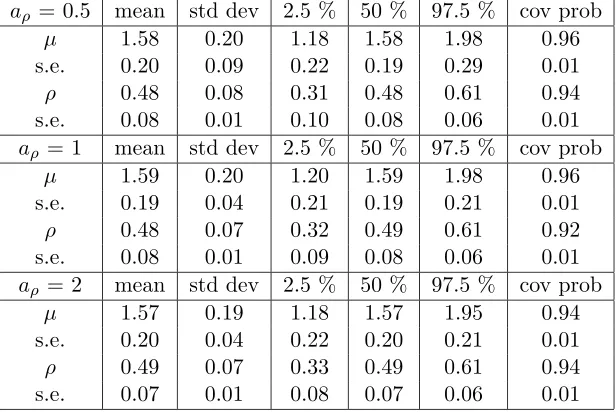
Table 2.1: Fitting WN to WN distribution using different priors
aρ= 0.5 mean std dev 2.5 % 50 % 97.5 % cov prob
µ 1.58 0.20 1.18 1.58 1.98 0.96
s.e. 0.20 0.09 0.22 0.19 0.29 0.01
ρ 0.48 0.08 0.31 0.48 0.61 0.94
s.e. 0.08 0.01 0.10 0.08 0.06 0.01
aρ = 1 mean std dev 2.5 % 50 % 97.5 % cov prob
µ 1.59 0.20 1.20 1.59 1.98 0.96
s.e. 0.19 0.04 0.21 0.19 0.21 0.01
ρ 0.48 0.07 0.32 0.49 0.61 0.92
s.e. 0.08 0.01 0.09 0.08 0.06 0.01
aρ = 2 mean std dev 2.5 % 50 % 97.5 % cov prob
µ 1.57 0.19 1.18 1.57 1.95 0.94
s.e. 0.20 0.04 0.22 0.20 0.21 0.01
ρ 0.49 0.07 0.33 0.49 0.61 0.94
s.e. 0.07 0.01 0.08 0.07 0.06 0.01
trace plots. This was done using the CODA program. Tables 2.1 through 2.7 contain all
summary values based on these final 5000 samples. We repeat the entire procedure 500
times to see the frequentist performance of the proposed Bayes method. In SAS, on a sparc
20 machine, on an average it took about 50 minutes to perform the entire simulation for a
given wrapped distribution.
Bayesian highest posterior density (HPD) can also be used instead of percentiles.
For example, in Figure 2.7, we plot the posterior density ofµwhile fitting WC to Ant data.
Since the posterior density has most its mass close to 3.24 radians (185◦), we computed the
percentiles with 0 radians as the reference point. The percentiles will change if we change
the reference point, but the change will be minimal for the Jander’s ant data set, if the
reference point is away from 3.24 radians. However, HPD is not affected by the change in
Table 2.2: Fitting WC to WC distribution using different priors
aρ= 0.5 mean std dev 2.5 % 50 % 97.5 % cov prob
µ 1.57 0.17 1.23 1.57 1.92 0.95
s.e. 0.18 0.14 0.20 0.17 0.34 0.01
ρ 0.49 0.07 0.34 0.49 0.61 0.90
s.e. 0.09 0.02 0.10 0.09 0.08 0.01
aρ = 1 mean std dev 2.5 % 50 % 97.5 % cov prob
µ 1.56 0.17 1.23 1.56 1.90 0.93
s.e. 0.17 0.05 0.20 0.17 0.19 0.01
ρ 0.48 0.07 0.33 0.49 0.61 0.94
s.e. 0.07 0.01 0.09 0.07 0.06 0.01
aρ = 2 mean std dev 2.5 % 50 % 97.5 % cov prob
µ 1.57 0.17 1.25 1.57 1.91 0.95
s.e. 0.17 0.13 0.20 0.16 0.34 0.01
ρ 0.49 0.07 0.35 0.49 0.62 0.92
s.e. 0.08 0.01 0.09 0.08 0.07 0.01
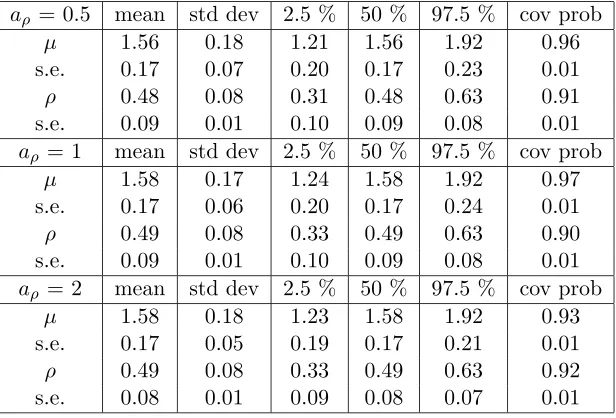
Table 2.3: Fitting WDE to WDE distribution using different priors
aρ= 0.5 mean std dev 2.5 % 50 % 97.5 % cov prob
µ 1.56 0.18 1.21 1.56 1.92 0.96
s.e. 0.17 0.07 0.20 0.17 0.23 0.01
ρ 0.48 0.08 0.31 0.48 0.63 0.91
s.e. 0.09 0.01 0.10 0.09 0.08 0.01
aρ = 1 mean std dev 2.5 % 50 % 97.5 % cov prob
µ 1.58 0.17 1.24 1.58 1.92 0.97
s.e. 0.17 0.06 0.20 0.17 0.24 0.01
ρ 0.49 0.08 0.33 0.49 0.63 0.90
s.e. 0.09 0.01 0.10 0.09 0.08 0.01
aρ = 2 mean std dev 2.5 % 50 % 97.5 % cov prob
µ 1.58 0.18 1.23 1.58 1.92 0.93
s.e. 0.17 0.05 0.19 0.17 0.21 0.01
ρ 0.49 0.08 0.33 0.49 0.63 0.92
From Table 2.1, Table 2.2 and Table 2.3, we see that the proposed method performs
very well in terms of maintaining the nominal coverage probability when the underlying
distribution is true. In addition, the posterior mean and median can serve as good point
estimates of the parameters. Although we do not see that the posterior distribution is
sensitive to the choice of the hyper parameteraρ, in general, we would recommendaρ= 0.5
for all the wrapped distributions. Therefore, we use this value for aρ for our application
and other simulations.
In order to study the sensitivity of the sampling distribution, we generated data
from Normal, Cauchy and Double Exponential distributions on the real line and wrapped
them onto the circle (0,2π). For our simulations, we fixedµ=π/2 andρ= 0.5. We
gener-ated n= 50 observations from the W N(π/2,0.5), W C(π/2,0.5) and W DE(π/2,0.5). We
then fitted Wrapped Normal, Wrapped Cauchy and Wrapped Double Exponential
distribu-tions to each of the three datasets. We repeated the method 500 times to see the frequentist
performance of the Bayes method for erroneous models. For model fitting we usedaρ= 0.5
for all priors. In our study (as shown previously in Table 2.1, Table 2.2 and Table 2.3) we
did not find the posterior summary to be very sensitive to the choice of aρ. Therefore, we
did not report the posterior summary values for other choices of aρ. As before, we report
the posterior mean, standard deviation, and two equal tail percentiles along with the Monte
Carlo standard error. Table 2.4, Table 2.5 and Table 2.6 contain the summary statistics.
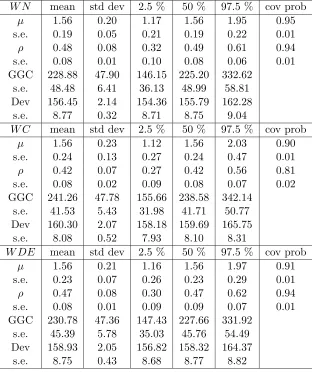
Comparing the results in Table 2.4, Table 2.5 and Table 2.6, we see that the
model selection criteria GGC and deviance work well and select the right distribution. A
Table 2.4: Fitting WN, WC and WDE to WN distribution withρ∼Beta(0.5,0.5)
W N mean std dev 2.5 % 50 % 97.5 % cov prob
µ 1.56 0.20 1.17 1.56 1.95 0.95
s.e. 0.19 0.05 0.21 0.19 0.22 0.01
ρ 0.48 0.08 0.32 0.49 0.61 0.94
s.e. 0.08 0.01 0.10 0.08 0.06 0.01
GGC 228.88 47.90 146.15 225.20 332.62
s.e. 48.48 6.41 36.13 48.99 58.81
Dev 156.45 2.14 154.36 155.79 162.28
s.e. 8.77 0.32 8.71 8.75 9.04
W C mean std dev 2.5 % 50 % 97.5 % cov prob
µ 1.56 0.23 1.12 1.56 2.03 0.90
s.e. 0.24 0.13 0.27 0.24 0.47 0.01
ρ 0.42 0.07 0.27 0.42 0.56 0.81
s.e. 0.08 0.02 0.09 0.08 0.07 0.02
GGC 241.26 47.78 155.66 238.58 342.14
s.e. 41.53 5.43 31.98 41.71 50.77
Dev 160.30 2.07 158.18 159.69 165.75
s.e. 8.08 0.52 7.93 8.10 8.31
W DE mean std dev 2.5 % 50 % 97.5 % cov prob
µ 1.56 0.21 1.16 1.56 1.97 0.91
s.e. 0.23 0.07 0.26 0.23 0.29 0.01
ρ 0.47 0.08 0.30 0.47 0.62 0.94
s.e. 0.08 0.01 0.09 0.09 0.07 0.01
GGC 230.78 47.36 147.43 227.66 331.92
s.e. 45.39 5.78 35.03 45.76 54.49
Dev 158.93 2.05 156.82 158.32 164.37
Table 2.5: Fitting WN, WC and WDE to WC distribution with ρ∼Beta(0.5,0.5)
W N mean std dev 2.5 % 50 % 97.5 % cov prob
µ 1.57 0.23 1.11 1.56 2.04 0.94
s.e. 0.22 0.10 0.25 0.22 0.36 0.01
ρ 0.45 0.08 0.29 0.46 0.59 0.87
s.e. 0.09 0.01 0.10 0.09 0.07 0.02
GGC 232.80 48.21 148.73 229.32 336.40
s.e. 47.06 5.97 35.22 47.64 56.38
Dev 158.93 2.10 156.84 158.29 164.62
s.e. 9.51 0.32 9.46 9.51 9.65
W C mean std dev 2.5 % 50 % 97.5 % cov prob
µ 1.57 0.17 1.23 1.57 1.92 0.95
s.e. 0.17 0.11 0.21 0.16 0.34 0.01
ρ 0.48 0.07 0.33 0.49 0.62 0.89
s.e. 0.09 0.02 0.10 0.09 0.07 0.01
GGC 222.66 43.76 144.79 220.00 315.54
s.e. 40.01 5.06 30.97 40.15 48.86
Dev 154.76 2.07 152.66 154.14 160.27
s.e. 10.71 0.44 10.60 10.72 10.91
W DE mean std dev 2.5 % 50 % 97.5 % cov prob
µ 1.57 0.18 1.23 1.57 1.92 0.95
s.e. 0.17 0.11 0.20 0.16 0.34 0.01
ρ 0.49 0.08 0.33 0.50 0.64 0.92
s.e. 0.09 0.01 0.10 0.09 0.08 0.01
GGC 221.19 44.46 142.90 218.25 316.11
s.e. 42.38 4.95 32.96 42.76 50.35
Dev 154.95 2.05 152.87 154.34 160.46
Table 2.6: Fitting WN, WC and WDE to WDE distribution withρ∼Beta(0.5,0.5)
W N mean std dev 2.5 % 50 % 97.5 % cov prob
µ 1.58 0.22 1.14 1.58 2.02 0.96
s.e. 0.21 0.09 0.24 0.21 0.31 0.01
ρ 0.46 0.08 0.29 0.46 0.59 0.89
s.e. 0.09 0.01 0.10 0.09 0.07 0.01
GGC 229.32 47.88 146.09 225.76 332.56
s.e. 45.60 6.24 33.76 46.08 55.58
Dev 158.08 2.13 155.99 157.43 163.88
s.e. 9.45 0.34 9.40 9.43 9.70
W C mean std dev 2.5 % 50 % 97.5 % cov prob
µ 1.56 0.18 1.22 1.56 1.92 0.96
s.e. 0.17 0.05 0.21 0.17 0.19 0.01
ρ 0.47 0.07 0.32 0.47 0.60 0.92
s.e. 0.08 0.01 0.09 0.08 0.07 0.01
GGC 225.45 44.73 145.81 222.74 320.27
s.e. 37.60 5.07 28.91 37.68 46.19
Dev 156.09 2.09 153.97 155.45 161.63
s.e. 9.32 0.44 9.25 9.30 9.55
W DE mean std dev 2.5 % 50 % 97.5 % cov prob
µ 1.57 0.17 1.22 1.57 1.91 0.96
s.e. 0.16 0.05 0.20 0.17 0.19 0.01
ρ 0.49 0.08 0.32 0.49 0.64 0.92
s.e. 0.08 0.01 0.10 0.08 0.07 0.01
GGC 221.53 44.91 142.45 218.56 317.35
s.e. 40.95 5.16 31.56 41.31 49.06
Dev 155.61 2.09 153.50 154.98 161.21
WDE distributions, the model generated from the true distribution has the lowest GGC
and Dev value. Also, both µand ρ have been well estimated, as we have fitted the correct
distribution.
From Table 2.4, Table 2.5 and Table 2.6, we see that in general, the location
parameter is estimated well, even when the models are erroneous. For WN model, coverage
probability of ρ is less than the nominal level. This indicates that WN is not robust in
estimating the mean resultant length when the distribution is not specified correctly. In the
case of fitting WC model to WN data, we see that the mean resultant is not well estimated.
However, WC model performs considerably better while fitting WDE data. This is expected
as WC is closer to WDE than WN. Finally, we see that for WDE model, the parametersµ
and ρ have been well estimated, even when the distribution is incorrect. Therefore, WDE
model is robust in estimatingµ andρ.
We generate data from Von Mises (VM) distribution on the circle(0,2π). To
gen-erate the data from Von Mises distribution, we use the algorithm given by Best and Fisher
(1978). As before we set the µ = π/2 and ρ = 0.5. We fit Wrapped Normal, Wrapped
Cauchy and Wrapped Double Exponential distributions to Von Mises data and repeat the
procedure 500 times to study frequentist performance.
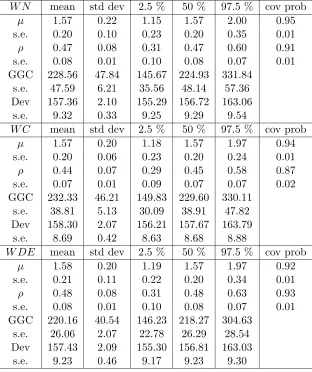
In Table 2.7, we see that WN is robust in estimating µ and ρ when they come
from a Von Mises distribution. This is expected as WN closely approximates the Von Mises
distribution. WC model does not perform well in estimating the mean resultant length. The
lower than nominal coverage probability ofρindicates that WC is not robust in estimating
Table 2.7: Fitting WN, WC and WDE to VM data with ρ∼Beta(0.5,0.5)
W N mean std dev 2.5 % 50 % 97.5 % cov prob
µ 1.57 0.22 1.15 1.57 2.00 0.95
s.e. 0.20 0.10 0.23 0.20 0.35 0.01
ρ 0.47 0.08 0.31 0.47 0.60 0.91
s.e. 0.08 0.01 0.10 0.08 0.07 0.01
GGC 228.56 47.84 145.67 224.93 331.84
s.e. 47.59 6.21 35.56 48.14 57.36
Dev 157.36 2.10 155.29 156.72 163.06
s.e. 9.32 0.33 9.25 9.29 9.54
W C mean std dev 2.5 % 50 % 97.5 % cov prob
µ 1.57 0.20 1.18 1.57 1.97 0.94
s.e. 0.20 0.06 0.23 0.20 0.24 0.01
ρ 0.44 0.07 0.29 0.45 0.58 0.87
s.e. 0.07 0.01 0.09 0.07 0.07 0.02
GGC 232.33 46.21 149.83 229.60 330.11
s.e. 38.81 5.13 30.09 38.91 47.82
Dev 158.30 2.07 156.21 157.67 163.79
s.e. 8.69 0.42 8.63 8.68 8.88
W DE mean std dev 2.5 % 50 % 97.5 % cov prob
µ 1.58 0.20 1.19 1.57 1.97 0.92
s.e. 0.21 0.11 0.22 0.20 0.34 0.01
ρ 0.48 0.08 0.31 0.48 0.63 0.93
s.e. 0.08 0.01 0.10 0.08 0.07 0.01
GGC 220.16 40.54 146.23 218.27 304.63
s.e. 26.06 2.07 22.78 26.29 28.54
Dev 157.43 2.09 155.30 156.81 163.03