This article was downloaded by: [North Carolina State University] On: 29 September 2011, At: 11:28
Publisher: Taylor & Francis
Informa Ltd Registered in England and Wales Registered Number: 1072954 Registered office: Mortimer House, 37-41 Mortimer Street, London W1T 3JH, UK
Molecular Physics
Publication details, including instructions for authors and subscription information:
http://www.tandfonline.com/loi/tmph20
Choosing the reference system for
liquid state perturbation theory
F. Lado aa
Department of Physics, North Carolina State University, Raleigh, North Carolina, 27695, U.S.A.
Available online: 22 Aug 2006
To cite this article: F. Lado (1984): Choosing the reference system for liquid state perturbation theory, Molecular Physics, 52:4, 871-876
To link to this article: http://dx.doi.org/10.1080/00268978400101621
PLEASE SCROLL DOWN FOR ARTICLE
Full terms and conditions of use: http://www.tandfonline.com/page/terms-and-conditions
Choosing the reference system for liquid state perturbation theory
by F. LADO
Department of Physics, North Carolina State University, Raleigh, North Carolina 27695, U.S.A.
(Received
20January
1984 ;accepted
10February
1984)Minimization of an approximate free energy functional yields the Andersen-Weeks-Chandler approximationy(r)
-g(r)
exp [fl~b(r)]~ya(r)
along with a new criterion for choosing the reference hard sphere diameter d. The new prescription yields thermodynamic consistency and improved numerical results.1. INTRODUCTION
The perturbation approximation for the pair distribution function
g(r)
of classical liquids proposed some time ago by Andersen, Weeks and Chandler (AWC) [1],y(r) -g(r)
exp [fie(r)] (1)--yd(r),
(2)
is especially notable for its simplicity and ease of use. T h e functiony(r) defined in (1) describes correlations between molecular pairs when the direct interaction r between them is turned off. The approximation (2) equates this correlation function to that of hard spheres of diameter d at the same density
p, ya(r),
which is assumed known. A prescription is then needed to specify the diameter d : proceeding from a perturbation expansion of the free energy, AWC proposed the conditionj {exp [ - fl4~(r)] - exp [ -
fiCa(r)]}ya(r)
dr = 0, (3)where
r
is the hard sphere potential. The combination of (2) and (3) produced remarkably good results when applied to the repulsive part of the Lennard-Jones potential [1], but was less successful with the softer inverse-12 potential [1, 2].A fundamental shortcoming inherent in this combination is the lack of thermo- dynamic consistency ; thus, the pressure p obtained from the free energy A,
tip
~(fiA/N)
- - = p - - , ( 4 )
p ~p
is not the same as that found through the usual quadrature,
3PIP
= 1
- ~pI g(r)rflr ;(r)
dr, (5) the former being more accurate [1], if more troublesome to compute. An alternative criterion for d--directly enforcing consistency of these computed results--was employed by Verlet and Weis [3].872 F. Lado
In this note, we show that the basic approximation, (2), can be obtained by minimizing an approximate expression for the free energy. A byproduct of this approach is a new criterion for choosing the hard sphere diameter, namely
~Ya(r)
dr = O, (6){exp [-/3r - exp [ -
fiO~a(r)]}
which eliminates the disagreement between (4) and (5) and leads to improve- ments in the computed results. Because it implies thermodynamic consistency, (6) is the formal implementation of the Verlet-Weis [3] criterion.
Generalized conditions for the choice of reference system, including energy as well as distance scales but still within the AWC approximation, are obtained in w 2. T h e improvement in computed results is illustrated with the inverse-12 potential.
2. THEORY AND RESULTS
We begin as in the derivation of the reference-hypernetted chain ( R H N C ) equation [4], introducing a reference potential So(r) and defining
4,(r ; A) = Co(r) + AAr (7)
with
Ar = r - Co(r). (8)
T h e Helmholtz free energy for the system with potential r (A= 1) can then be written as
1
flA/N=fiAo/N+89 f dr f aAg(r
; a)flAr (9)0
where A o is the free energy of the reference system (A=0) and
g(r
; A)=exp[-flck(r
; A ) + S ( r ; h ) + B ( r ; A)] (10)the pair distribution function for the intermediate system with potential (7). In (10), S and B are the corresponding series (or nodal) and bridge (or elementary) functions for the same generalized potential. From (10) we have immediately
o r
~g(r
Oh
; A)g(r
; A)Ar ; A)~ [S(r
; A)+B(r ; A)], (11)g(r
; h)Ar -~--~{g(r
; h ) - g ( r ; A)lng(r ; A) exp [/3r ; h)]}-[S(r"
A)+B(r" A)]~g(r;
A_____) (12)' ' ~ A '
and (9) becomes
flA/N= flAo/N-lp S dr{g(r)-g(r) In g(r)
exp [fie(r)]-go(r) +go(r)
Ingo(r)
exp [/3q~o(r)] }1
- I ar a a [ S ( r ; a ) + B ( r ; a ) ] - -0
g(r ;
~A (13)
T h e integral over A of the term involving
S(r
; A) in (13) can be evaluated exactly [4]. We shall not do so here, however, but instead follow a simpler, though approximate, procedure. T h e plausibility argument for this is that, as with the bridge functionB(r
; A) [5], the series function S(A ; r) should not be greatly sensitive to the change in potential from fo(r) to the final f(r). If we t h e n ignore such changes in both S and B, the last term in (13) becomes- 89 ~ dr[So(r) + Bo(r)][g(r)
-go(r)]= _ l p I dr{ln
go(r)
exp[flfo(r)]}[g(r)
-go(r)] (14)and (13) now reads
flA/N = flAo/N- 89 ~ dr{g(r) -g(r)
Ing(r)
exp [fir(r)]-go(r)+g(r)
lngo(r ) exp[fifo(r)]},
(15)which expresses the free energy as a functional ofy(r) andyo(r ). Requiring (15) to be extremal with respect to variations in these functions then gives
~
= lP I dr
exp [ - fir(r)] In yo(r) jy(r) ]
~y(r).
[g(r) -go(r)]~ Inyo(r)
= 0 , (16)
if
and
y(r)
=yo(r) (17)j dr[g(r)-go(r)]3
In yo(r ) = 0. (18)Equation (17) is the AWC approximation for the arbitrary reference potential ~0(r), while (18) imposes a constraint on this potential. For a specific potential 4'o( r ; ~0, %) with distance and energy scales set by % and %, we may vary these parameters to satisfy (18). With
OYo ~Yo
3yo(r ; %, %)=~--% 3%+-~% 3% (19)
and (17), we have then the conditions
S
dr{exp [ - / 3 f ( r ) ] - exp [ - fifo(r)]}~Y~
= 0, (20 a) ~ oS dr{exp [ - tiff(r)] - exp [ - fifo(r)]}
~Y~
= 0 (20 b)for determining the o p t i m u m values of % and %. Similar constraints have been obtained for the R H N C equation [6].
With (17), the approximate free energy now reads
flA/N= fiAo/N- lp ~ dr[g(r)
-go(r)]= t~Ao/N- 89 ~
dr{exp [ - fir(r)] - exp [ -flfo(r)]}yo(r),
(21 )874 F. Lado
in agreement with the first-order AWC expansion [1]. we then have
where
tip - - p ~(flAIN) -
-p ~p
By explicit differentiation,
_
flPo ~p I
drAe(r)yo(r)- 89 J drAe(r)p ~Y~p - ~p '
A e ( r ) ~ exp [ - t i f f ( r ) ] - exp [ - fl~o(r)].
But yo(r) is a dimensionless function of rlao, p%3 and fl%, so that
~Y~ = 3p ~Y~ ~Y~ a o ~tro ~ - - ~ - r ~r and (22) becomes
~P_~Po
P P
(22)
(23)
(24)
F
~yo(,)
]
~p I d, Ae(r)yo(r)--~p J d, Ae(r) L~o ~
+,y'o(r)
/
= 1 - -~p J d,yo(,) exp
[- ~(,)]r~'(,)--~p
J
d,'Ae(,)% aYo_~(%r),
(25)
after an integration by parts. It is now evident that consistency in the pressure is achiex~ed within the AWC approximation when a 0 is chosen to satisfy (20 a). In the same way, (20 b) ensures a similar consistency for the internal energy E ; explicitly, we have from (21)
f3E ~(flAIN)
N =~
~/3
= ~ + 89 J dryo(r ) exp [ - #~(r)]flf(r) - 89 j drAe(r)% 8Y~ (26)
At present, only the hard sphere model is sufficiently well known to serve as reference system. For this choice, (20 b) is trivially satisfied since there is no energy scale; the hard sphere diameter d = % is then determined by (20 a). For the calculations discussed below, ya(r) and 8ya(r)/~d were obtained using the parametrizations of Verlet-Weis [7] and H e n d e r s o n - G r u n d k e [8].
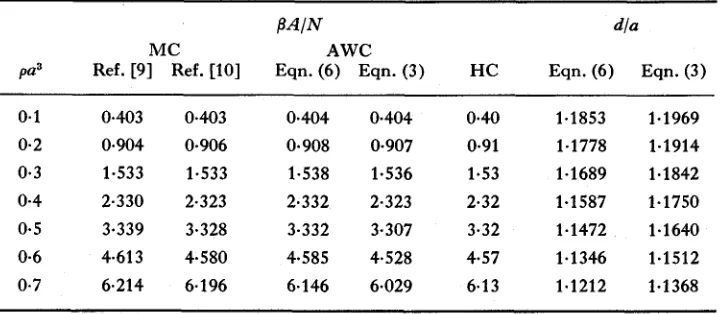
To test the effect of using condition (6) rather than (3), the original trial cases [1] have been calculated anew. T h e greatest numerical change occurs for the virial pressure, (5), of the inverse-12 potential
T h e results are shown in table 1, along with the Monte Carlo (MC) values of Hansen [9] and Hoover et al. [10], as functions of the single parameter pa 3, where
a = ~ ( ~ ) ~ . ( 2 8 )
Also shown in table 1 are the results obtained by Hutchinson and Conkie (HC) [11] from an integral equation method that imposed consistency between the virial and compressibility equations of state. T h e improvement on using (6)
Table 1. Virial pressure for the inverse-12 potential.
pa a
/~/,/p
MC AWC
Ref. [9] Ref. [10] Eqn. (6) Eqn. (3) HC
0.1 1.447 1.448 1.450 1.450 1.450 0.2 2.118 2.121 2.123 2.158 2.123 0.3 3.119 3.101 3.118 3-246 3.113 0.4 4.578 4.557 4.555 4.926 4.540 0.5 6-660 6.641 6.588 7-508 6-560 0.6 9.556 9.460 9.389 11-436 9.366 0-7 13.511 13.469 13.137 17.318 13.20
Table 2.
pa 3
Helmholtz free energy and reference hard sphere diameters for the inverse-12 potential.
[3A/N d/a
MC AWC
Ref. [9] Ref. [10] Eqn. (6) Eqn. (3) HC Eqn. (6) Eqn. (3)
0.1 0.403 0.403 0.404 0.404 0.40 1.1853 1.1969 0-2 0.904 0-906 0.908 0.907 0.91 1-1778 1-1914 0.3 1.533 1.533 1-538 1-536 1.53 1-1689 1.1842 0-4 2-330 2.323 2'332 2.323 2.32 1-1587 1.1750 0.5 3.339 3.328 3-332 3.307 3.32 1-1472 1.1640 0-6 4.613 4'580 4.585 4.528 4.57 1.1346 1.1512 0-7 6.214 6-196 6-146 6.029 6.13 1.1212 1.1368
with the A W C a p p r o x i m a t i o n is quite significant ; in fact, the new results are c o m p a r a b l e with the pressure-consistent H C calculations, t h o u g h far easier to obtain. T h e i m p r o v e m e n t in free energy, s h o w n in table 2, is less dramatic, as this q u a n t i t y is relatively insensitive to changes in the diameter d. T a b l e 2 also shows the two sets of s p h e r e sizes used in obtaining these results. In all cases studied (6) p r o d u c e s smaller diameters t h a n does (3).
Smaller diameters d in t u r n lead to r e d u c e d s t r u c t u r e in the pair distribution f u n c t i o n g(r), as illustrated in the figure. T h e i m p r o v e m e n t here, c o m p a r e d to M C results [2], is seen to be particularly significant for the main peak of
g(r) (which accounts for the good t h e r m o d y n a m i c results above) and r a t h e r
less so for the remaining structure.
A recalculation using the repulsive part of t h e L e n n a r d - J o n e s potential yields results following the same p a t t e r n as those above b u t with smaller numerical changes. T h i s was to be h o p e d for since the original A W C values were already quite good [1].
876 F. Lado
2.0
v
1.0
I It
II I I
0 00~.0 ~1 2.0 I
r / o
I I
9 " MC
Eq. (6)
- - Eq. (3)
1
4.0
Pair correlation function for the inverse-12 potential at pa3= 0-56921.
In s u m m a r y , then, we find that using (6) to fix the hard sphere diameter in the A W C approximation removes a t h e r m o d y n a m i c inconsistency and improves the c o m p u t e d results while retaining the simplicity and ease of use of the A W C approximation.
REFERENCES
[1] ANDERSEN, H. C., WEEKS, J. D., and CHANDLER, D., 1971, Phys. Rev. A, 4, 1597. [2] HANSEN, J. P., and WEIS, J. J., 1972, Molec. Phys., 23, 853.
[3] VERLET, L., and WETS, J. J., 1972, Molec. Phys., 24, 1013. [4] LADO, F., 1973, Phys. Rev. A, 8, 2548.
[5] ROSENFELD, Y., and ASHCROFr, N. W., 1979, Phys. Rev. A, 20, 1208. [6] LADO, F., 1982, Physics Lett. A, 89, 196.
[7] VERLET, L., and Wins, J. J., 1972, Phys. Rev. A, 5, 939.
[8] HENDERSON, D., and GRUNDKE, E. W., 1975, ft. chem, Phys., 63, 601. [9] HANSEN, J. P., 1970, Phys. Rev., 42, 221.
[10] HOOVER, W. G., Ross, M., JOHNSON, K. W., HENDERSON, D., BARKER, J. A., and BROWN, B. C., 1970, ft. chem. Phys., 52, 4931.
[11] HUTCHINSON, P., and CONKm, W. R., 1972, Molec. Phys., 24, 567.