FRAMEWORK AND PROTOCOLS FOR TELECARE MEDICAL INFORMATION SYSTEM
ZEESHAN SIDDIQUI
CLOUD COMPUTING THREE-FACTOR USER AUTHENTICATION FRAMEWORK AND PROTOCOLS FOR TELECARE MEDICAL
INFORMATION SYSTEM
ZEESHAN SIDDIQUI
A thesis submitted in fulfilment of the requirements for the award of the degree of
Doctor of Philosophy (Computer Science)
Faculty of Computing Universiti Teknologi Malaysia
DEDICATION
I dedicate this study to my affectionate and beloved Prophet Muhammad
(ملسوهيلع الله ىلص), his Companions (هنع اوضرو مهنع الله ىضر) and those who
followed him(هيلع الله ةمحر). Additionally, I dedicate this study to my
compassionate parents, beloved wife and enthusiastic kids for their
ACKNOWLEDGEMENT
All praises and commendations goes to the Almighty Allah (ىلاعت و هناحبس) for accepting my motivation, enthusiasm and passion to complete this astonishing study and to achieve a remarkable goal. Supreme blessings and peace of the Almighty Allah be upon Prophet Muhammad (ملسو هيلع الله ىلص), his Companions (هنع اوضرو مهنع الله ىضر) and those how followed them. I am wholeheartedly thankful to my supervisor Professor Dr. Abdul Hanan Abdullah, for his kind and humble support towards my continuous and intense research work. I am among those prosperous persons who were extremely fortunate to have such a brilliant individual as an advisor for complete guidance at each and every stage of this study. I am passionately an admirer a devotee of my co-external supervisors Dr. Muhammad Khurram Khan and Professor Abdullah Alghamdi for providing me their friendly and persistent support throughout my studies. I am so much grateful to all of my advisors for delivering their brilliance and genius to make a dream come true. A million thanks to Dr. Saqib Ali and Imran Hayat for providing their excellence, quality and support during my study. Additionally, I am thankful to my institute, faculty, staff and colleagues for providing me such a remarkable environment where I can express my abilities and deliver excellence. A sincere, explicit and emphatic word of thanks to my mother and father, my loving wife and my lively kids for their love, patience, support, prayers and understanding all the way through my study. I am short of words for their support, as without their encouragement and reassurance, this success was not achievable.
ABSTRACT
ABSTRAK
TABLE OF CONTENTS
CHAPTER TITLE PAGE
DECLARATION ii
DEDICATION iii ACKNOWLEDGEMENT iv
ABSTRACT v
ABSTRAK vi TABLE OF CONTENTS vii LIST OF TABLES xiv
LIST OF FIGURES xvi
LIST OF ABBREVIATIONS xix
LIST OF SYMBOLS xxiii
LIST OF ALGORITHMS xxv
LIST OF APPENDICES xxvi
1 INTRODUCTION 1
1.1 Overview 1
1.2 Problem Background 2
1.2.1 TMIS Architecture 2
1.2.2 Authentication Protocols and TMIS Vulnerabilities 4
1.2.3 Performance, Verification and Validation issues 6
1.2.4 Problem Statement 7
1.2.5 Research Questions 8
1.3 Research Aim 9
1.4 Research Objectives 9
1.5 Scope 9
1.7 Thesis Organization 11
2 LITERATURE REVIEW 12
2.1 Overview 12
2.2 Authentication Protocols 13
2.2.1 Autherntication Factors 13
2.2.2 Formal Analysis and Verification Methods 14
2.2.2.1 BAN Logic 15
2.2.2.2 Scyther 15
2.2.2.3 Cryptanalysis 16
2.2.2.4 Authentication Properties 16
2.3 Telecare Medical Information System 16
2.3.1 Facility 17
2.3.2 Significance of TMIS 19
2.4 TMIS Security Authentication Frameworks 20 2.4.1 Authentication Frameworks 21 2.5 Authentication Protocols and Vulnerabilities in TMIS 27
2.5.1 Authentication Attacks in Authentication Protocols 27 2.5.1.1 Wu et al Secure and Authentic Protocol
for TMIS 27
2.5.1.2 Debiao et al More Secure Authentication
Protocol for TMIS 28
2.5.1.3 Wei et al Improved TMIS Authentication
Protocol 28
2.5.1.4 Zhu et al Efficient TMIS Authentication
Protocol 29
2.5.1.5 Lee and Liu Secure Smartcard Based
MIS Key-agreement Protocol 30 2.5.1.6 Cao et al Improved Dynamic ID Based
MIS Protocol 30
2.5.1.7 Xie et al Robust Anonymous
Authentication Protocol for TMIS 31 2.5.1.8 Hao et al Chaotic Map Based
2.5.1.9 Jiang et al Robust Chaotic Map Based
Key-agreement Protocol 32
2.5.1.10 Lin et al Secure Verifier Based
Three-Party Authentication Protocol 32 2.5.1.11 Zhang et al Elliptic Curve
Authentication Protocol for TMIS 32 2.5.1.12 Awasthi et al Biometric Authentication
Protocol for TMIS 33
2.5.1.13 Yan et al 3FA Biometric-based
Authentication Protocol 34 2.5.1.14 Other Limitations of TMIS
Authentication Protocols 35 2.6 Authentication Issues in Cloud Computing Studies
Outside TMIS 36
2.6.1 Smartphone Based MFA/2FA/3FA Studies and
Authentication Issues 36
2.6.1.1 En-Nasry et al Smartphone based Digital Identity Authentication Protocol 36 2.6.1.2 Hu et al 3FA Android Mobile Payment
Authentication Framework 37 2.6.1.3 Gunther et al 2FA Protocol for Banking
Payment System 38
2.6.1.4 Honggang et al Cloud Computing 2FA Secure Protection between User
and Mobile 39
2.6.1.5 Rassan et al Mobile Cloud Computing
with Biometric (SMCBA) 40 2.6.1.6 Ziyad et al Multifactor Biometric
Authentication for Cloud 40 2.6.1.7 Aryan et al Concept for Smartphone
Service Security on Cloud 40 2.6.1.8 Dinh et al Cloud Computing Framework
for Biometrics 41 2.6.1.10 Khan et al Dynamic Credentials Generating
Protocol in Mobile Cloud Computing 42 2.6.1.11 Al-Hasan et al Security of the Data
between Cloud and Smartphone 43 2..7 Literature Review Analysis and Findings 43
2.7.1 TMIS Authentication Framework 43 2.7.2 TMIS Authentication Protocols and
Authentication Attocks 45
2.7.3 TMIS Authentication Protocols Performance and
Hardware Issues 46
2.7.4 Authentication Issues in Cloud Computing Studies
outside TMIS 47
2.8 Summary 50
3 RESEARCH METHODOLOGY 52
3.1 Overview 52
3.2 Problem Formulation and Background Analysis 54 3.3 Cloud Computing 3FA Authentication Framework and
Protocols for TMIS Facility 55
3.4 Athentication Testing, Verification and Validation 58
3.5 Assumptions 64
3.6 Summary 65
4 CLOUD COMPUTING THREE-FACTOR USER
AUTHENTICATION FRAMEWORK AND PROTOCOLS
FOR TIMIS 66
4.1 Overview 66
4.2 Cloud Computing 3FA User Authentication Framework
for TMIS (3FA-AFSCC) 67
4.2.3 Algorithms for Registration Process 71
4.2.4 Service Login Process 71
4.2.5 New Service Activation Process 72 4.2.5.1 Algorithms for New Service Activation Process 73 4.2.6 Service Reset Process 74
4.3 Cloud Computing 3FA Service Cataloguing and Initialization Protocols (3FA-SRLM) 77
4.3.1 The Basics of 3FA-SRLM 77 4.3.2 Service Cataloguing Authentication Protocol 78
4.3.3 Service Initialization Authentication Protocol 81 4.4 Cloud Computing 3FA New Service Stimulation and Reset Protocol 83
4.4.1 New Service Stimulation Protocol 83 4.4.2 Service Reset Protocol 86
4.5 Framework Validation (3FA) 89
4.5.1 Validation of Authentication Clouds 89
4.5.2 1FA Validation 91
4.5.3 2FA Validation 92
4.5.4 3FA Validation 93
4.6 Summary 94
5 AUTHENTICATION TESTING 3FA AUTHENTICATION FRAMEWORK AND PROTOCOLS FOR TMIS 95
5.1 Overview 95
5.2 Assumptions and Limitations 96
5.3 BAN Logic Verification 96
5.3.1 BAN Logic Postulates Mapping 97
5.3.1.1 Rule 1 Mapping 97
5.3.1.2 Rule 2 Mapping 98
5.3.1.3 Rule 3 Mapping 98
5.3.1.4 Rule 4 Mapping 98
5.3.2 Authentication Protocols Verification and Proofs 99
5.3.2.2 Logical Assumptions 100
5.3.2.3 Authentication Goal 100
5.3.3 Protocol Verification 101
5.4 Scyther Authentication Testing Simulation and Validation 102
5.4.1 Authentication Protocol Transformation (SPDL) 102
5.4.1.1 Transformation of 1FA 103
5.4.1.2 Transformation of 2FA 104
5.4.1.3 Transformation of 3FA 106
5.4.2 Validation of Authentication Claims 108
5.4.2.1 Validation of 1FA Transformation 108
5.4.2.2 Validation of 2FA Transformation 112
5.4.2.3 Validation of 3FA Transformation 114
5.4.3 Characterization of Attack Trace Patterns 116
5.4.4 BAN Logic and Scyther Test Discussion 119
5.5 Performance Testing 120
5.5.1 Performance Setup 121
5.5.2 Performance Testing Results 121
5.6 Summary 123
6 CRYPTANALYSIS, PERFORMANCE ANALYSIS AND DISCUSSION 125
6.1 Overview 125
6.2 Security and Performance Analysis and Discussion 126
6.2.1 Cryptanalysis 126
6.2.2 Assumptions and Limitations 126
6.2.2.1 Impersonation Attack (IPA) 127
6.2.2.2 Parallel Processing Attack (PPSA) 128
6.2.2.3 Replay Attack (RA) 129
6.2.2.4 Password Guessing Attack (Online/Offline) – (PGA) 130
6.2.2.5 Insider Attack (IA) 130
6.2.2.6 Denial-of-Service Attack (DoS 131
6.2.2.7 Forgery Attack (FA) 131
6.2.2.9 Mutual Authentication Vulnerability 132
6.2.2.10 User/Server Anonymity Resistance(UA) 133 6.2.3 Smartphone Specific Security Threats 134
6.2.3.1 Malicious SMS Threat 134
6.2.3.2 Smartphone Malware Attacks 135
6.2.3.3 Smartphone Spyware Attacks 135
6.2.4 Database and Application Level Attacks 135
6.2.4.1 SQL Injection Attacks (XSS) 136
6.2.4.2 Unauthorized Access Control (UAA) 136
6.3 Comparative Analysis of the Cryptanalysis 137
6.4 Comparative Analysis of Performance and Other Issue 141
6.5 Overall Contribution of This Study 144
6.6 Summary 147
7 CONCLUSIONS and FUTURE WORK 148
7.1 Overview 148
7.2 Contributions of this Study 149
7.2.1 Aim of This Study (3FA-AFSCC) 149
7.2.2 3FA-SRLM and 3FA-SARM Authentication Protocols on a Cloud Computing Environment 150
7.3 Overall Study Contribution 151
7.4 Future Work and Guidelines 152
7.4.1 Improved 3FA Biometrics Feature Extractions 152
7.4.2 Improved Telematics 3FA Authentication Framework using Smartphone 152
REFERENCES 153
LIST OF TABLES
TABLE NO. TITLE PAGE
2.1 Security Indices Results 28
2.2 Authentication and Performance Comparison 29 2.3 Performance and Authentication Analysis 30
2.4 Performance Analysis 32
2.5 Computational Analysis 33
2.6 Function Analysis 33
2.7 Literature Review Authentication and Other issues
Comparison 49
2.8 Authentication Attack Abbreviations 50 3.1 BAN Logic Verification Parameters and Rules 59 3.2 BAN Logic Notations and Abbreviations 59 3.3 Scyther Security Simulation Parameters 63
3.4 Security Attacks 63
3.5 Performance Parameters 64
4.1 Notations used in 3FA-AFSCC 68
5.8 BAN Scyther Test Comparison 120 6.1 Comparative Analysis of This Study with Existing Studies 146
LIST OF FIGURES
FIGURE NO. TITLE PAGE
1.1 The Basic TMIS Framework 3
1.2 Example of Registration Phase 5
1.3 Example of Password Change Phase 5
2.1 Telecare Medical Information System (TMIS) 18
2.2 The Resource CAtalog Management (RCAM) 19
2.3 Multi-agent Security Framework 21
2.4 TMIS Security and Theoretical Framework 23
2.5 Design and Knowledge Framework 24
2.6 Hospital Information System Framework 25
2.7 inCASA Proposed Architecture 26
2.8 ECG Monitoring Health Cloud Framework 26
2.9 Implementation Framework 38
2.10 Payment Scheme Steps 39
2.11 Watermarking Algorithm 39
2.12 IMS based Mobile Health Framework 41
2.13 Handwritten Cloud Computing Security Framework 42
3.1 Research Methodology (Functional Flowchart) 53
4.1 Registered Authority Step 69
4.2 Mobile Service Provider Step 70
4.3 Service Login Process 72
4.4 New Service Activation/Registration Process 73
4.5 Service Reset Process 75
4.6 Complete 3FA-AFSCC Framework 76
4.7 New User Registration on Authentication Clouds 90
4.9 Final Validation in Uhuru Cloud 91
4.10 MSP Windows 8 Phone Simulation 92
4.11 Successful and Unsuccessful Attempts (2FA) 93
4.12 MSP OTP (3FA) Validation 94
5.1 Transformation of 1FA 104
5.2 Transformation of 2FA 106
5.3 Transformation of 3FA 107
5.4 Scyther Security Attack Validation of 1FA Transformation 109
5.5 Attacks on 1FA Transformation 111
5.6 1FA Authentication Claims 112
5.7 Scyther Security Attack Validation of 2FA Transformation 113
5.8 2FA Authentication Claims 114
5.10 Scyther Security Attack Validation of 3FA Transformation 115
5.11 3FA Authentication Claims 116
5.12 1FA Roles Characterization 117
5.13 Attack Trace in peach color 117
5.14 2FA Roles Characterization 118
5.15 3FA Roles Characterization 118
5.16 Code Metrics 121
5.17 Profiler Setup of All Clouds 122
5.18 Profiler CPU Usage 122
5.19 Complete Performance Graphs of 1660 Sample Profiles 123
6.1 Parameterized SQL Queries 136
6.2 Impersonation Attack Evaluation 138
6.3 Insider Attack Evaluation 138
6.4 Online/Offline Password Attacks Evaluation 139
6.5 Replay Attack Evaluation 139
6.6 Parallel Processing Attack Evaluation 140
6.7 This Study Evaluation based on Other Attacks 140
6.8 This Study Performance Comparison 142
6.10 Performance Improvement with Existing Studies 143 6.11 Thia study Implementations Improvement with
Existing Studies 144
6.12 This Study Validation/Verification Improvement
with Existing Studies 144
LIST OF ABBREVIATIONS
1FA - First Factor Authentication 2FA - Two Factor Authentication 3FA - Three Factor Authentication
1G - First Generation
2G - Second Generation
3G - Third Generation
3DES - Triple Data Encryption Standard
2D - Two Dimensional
4FA - Fourth Factor of Authentication AHP - Analytical Hierarchy Process ATM - Automated Teller Machine
AFSCC - Authentication Framework using Smartphone on Cloud Computing
AD - Alzheimer’s disease
AES - Advance Encryption Standard BAN - Burrows Abadi Needham
CC - Cloud Computing
CoSE - Cloud Secure Element CPU - Central Processing Unit DSS - Decision Support System DLP - Discrete Logarithms Problem DoS - Denial of Service
DES - Data Encryption Standard DSP - Digital Signal Processing DFT - Discreet Fourier Transform DLL - Dynamic Link Library
ECG - Electrocardiography
EIS - Enterprise Information System ESB - Enterprise Service Bus
EE - External Event
FA - Forgery Attack
FR - Frame Rate
FFT - Fast Fourier Transformation
FFIEC - Federal Financial Institution Examination Council GPS - Global Positioning System
HTTPS - Hyper Text Transport Protocol Secure IDM - Identity Management
IMSI - International Mobile Subscriber Identity
IMEI - International Mobile Station Equipment Identity IMS - IP Multimedia Subsystem
IAAS - Infrastructure as a Service
ISO - International Organization of Standardization IEC - International Electro technical Commission
IA - Insider Attack
IMI - Implementation Issues IPA - Impersonation Attack
K2C - Key to Cloud
LUA - Least Privilege User Account LHR - Lifetime Health Record MFA - Multifactor Authentication MOHM - Ministry of Health Malaysia MCDM - Multi Criteria Decision Making MCDA - Multi Criteria Decision Analysis MD5 - Message Digest Algorithm MAC - Media Access Control
MSP - Mobile Service Provider Unit
NFCTAN - NFC ChipTAN
NGN - Next Generation Network
NSR - New Service Activation/Registration NPP - Service Password Reset Framework OTP - One Time Password
OMOS - Integrated Framework
OS - Operating System
OOS - Object Oriented Scanning
PCI-DSS - Payment Card Industry Data Security Standard PDS - Personal Digital Assistant
P2P - Peer-to-Peer
PAAS - Platform as a Service PGA - Password Guessing Attack PAA - Privilege Access Attack PCI - Performance Computing Issue RCAM - Resource CAtalog Management RFID - Radio Frequency Identification SOA - Service Oriented Architecture SHA1 - Secure Hash Algorithm
SRLM - Service Cataloguing and Initialization Protocol SARM - New Service Stimulation and Reset Protocol SSL - Secure Socket Layer
SMCBA - Secure Mobile Computing with Biometric Authentication
SDK - Software Development Kit SAAS - Software as a Service
SPDL - Standard Page Description Language SGML - Standard Generalized Markup Language SSA - Server Spoofing Attack
SA - Spyware Attack
SME - Small Medium Enterprises
TSCE - TMIS Smartphone based Cloud Environment TSP - TMIS Service Provider
URL - Universal Resource Locators UA - User/Server Anonymity
USIM - Universal Subscriber Identity Module UAA - Unauthorized Access Control
VVI - Verification Validation Issue VMS - Virtual Memory System Web2ID - Web to Identification
WSDL - Web Service Description/Definition Language
XOR - Exclusive OR
LIST OF SYMBOLS
𝐴𝑖 - Registered Authority
𝐴𝑥 - Adversary
∀ - For All (\forall)
𝛽 - Random Values
𝐶𝐴𝑖 - Registered Authority Cloud
𝐸𝑖 - Computing Variables
𝐹𝑖 - Computing Variables
𝐺𝑖 - Computing Variables
H - Secret Hash
𝑖 - Positive Integer
𝐼𝐷𝑛 - Identity
𝑉 1
𝑛 - Session Temporary Variable
𝑚𝑜 - Sent OTP Message
𝑀𝑐 - MSP Cloud
𝑀1 - Message
𝑛𝑆𝑝 - New Provider
𝑃𝑤 - Registered Password
𝑃𝑛 - Updated/New Password
𝐏 | ≡ 𝐗 - Message Meaning
𝐏 ⇒ 𝐗 - Jurisdiction/Authority
𝑝𝑤 - Password
𝑝𝑤𝑛𝑒𝑤 - New Password
R - Request
𝑅𝐵𝑖 - Biometrics-image
𝑆𝑠𝑘 - Session-Keys
𝑠𝑘 - Session Key
𝑆𝑚𝑣 - Success Message
𝑇𝑚, 𝑇ℎ - Computing Variables for Timestamps
𝑇𝑆𝐿 - TMIS Services
𝑢𝐼𝐷𝑖 - Registered User
𝑢𝑇𝑠 - Timestamp
𝑈𝑖 - User
V1, V2, V3 - Computing Variables of Server
𝑉𝑛 - Computing Variables
𝑉𝑠 - Variable
X - Unique Identifier Key
⊕ - XOR-Operator
⋕ (𝐗) - Nonce Verification
(x) - Freshness
∈ - Belongs to
⊇ - Superset of or Equals to
LIST OF ALGORITHMS
ALGORITHM NO. TITLE PAGE
1 Algorithm for Service Registration Process 167 2 Algorithm for 𝑅𝐵𝑖 enrolment using
Smartphone 168
3 Algorithm for 𝑅𝐵𝑖 recognition and TSCE 169
4 Algorithm for 𝑅𝐵𝑖 DSP Processing 170
5 Algorithm for 𝑅𝐵𝑖 recognition using
Algorithm 4 172
6 Algorithm for 𝑇𝑆𝐿 list 174
LIST OF APPENDICES
APPENDIX TITLE PAGE
CHAPTER 1
INTRODUCTION
1.1 Overview
The modern day health facilities are progressing from outdated paper based environment towards modern and smart digital environments (Pinciroli et al., 2011). Telecare Medical Information Systems (TMIS) is one of those medical systems which facilitate normal user (patient or medical practitioner) to make use of several medical amenities remotely. TMIS was initially developed for older age people, however, this facility has acquired global attention among people of all ages (Megat
Ali et al., 2008; Wortmann et al., 2009; Stowe and Harding, 2010). Medical data is
These issues, in return, have made the current authentication protocols vulnerable to number of authentication attacks, such as, insider attack, impersonation attack, replay attack, online/offline password guessing attack and more (Kim, 2006; He et al., 2013; Kumari et al., 2013; Bin Muhaya, 2014; Khan and Kumari, 2014). In addition to these authentication vulnerabilities, current TMIS authentication framework has number of performance issues, such as, memory usage, hardware support, authentication variable access, application peak time issues etc. (Debiao et al., 2012; Demirkan, 2013; Das and Goswami, 2014). Therefore, this study aims towards pointing out several authentication flaws, along with performance issues within TMIS smartcard based authentication framework.
1.2 Problem Background
While discussing the problem background in this section, a brief discussion of TMIS Architecture is conducted with general TMIS issues and problems (TeleCare, 1987; Sintonen and Immonen, 2013). Moreover, a descriptive debate is carried out to identify the actual TMIS authentication issues addressed in existing studies (Wu et al., 2012; Yan et al., 2013; Tan, 2014). A brief discussion of authentication and performance issues are explained to normalize the propose Cloud Computing (CC) based 3FA authentication framework and protocols which is the main objective of this study along with validation and verification measures (Awasthi and Srivastava, 2013; Das and Goswami, 2014).
1.2.1 TMIS Architecture
information systems, this remote monitoring facility is also transformed into a more advance platform which is widely known as Telehealth. The Telehealth facility is focused on providing more personalized and customized at-home e-health solutions (Brownsell et al., 2008; Stowe and Harding, 2010).
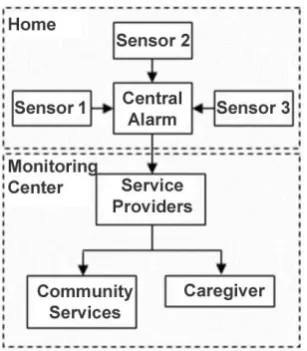
The current TMIS facility make use of modern Third Generation (3G) devices to detect and monitor medical conditions of patients residing at home. This facility is based on agile Service Oriented Architecture (SOA) environment in which patients are connected with the TMIS facility through several wireless devices. These devices are utilized to provide patient complete statistics to their medical consultants and practitioners in order to monitor the health of their patient. With the help of modern-day TMIS facility, a medical consultant can monitor the patient’s medical statistics continuously (Megat Ali et al., 2008) as shown in Figure 1.1.
Figure 1.1 The Basic Telecare Framework (Megat Ali et al., 2008)
Therefore, this information needs to be secured and completely authentic to diagnose and treat patients without any medical error (Megat Ali et al., 2008; Maarop and Win, 2012; Ghani et al., 2013).
Additionally, incurring and installing such a facility at home, require a good amount of finance to be spent. Therefore, there are many factors involved while considering the deployment of TMIS facility at both ends. Factors like, environment, sociality, easiness, customization, cost, hardware, performance, implementation and on top of all, user authentication and security (Megat Ali et al., 2008).
1.2.2 Authentication Protocols and TMIS Vulnerabilities
The purpose of an authentication protocol is to provide a secure data exchange and communication between all the entities of a system using cryptography digital rules (Liang, 2008). An authentication protocol provide assurance of key agreement, undisclosed sharing, non-denial methods and multi-party computation (Kim, 2006). An authentication protocol is based on numerous authentication factors. These authentication factors are recognized by international security standardization bodies (FFIEC, 2006; PCI-DSS, 2008). These factors are,
i. Something User Knows, e.g., username/password. This authentication factor is widely known as First Authentication Factor or 1FA (Coskun and Herley, 2008).
ii. Something User Is, e.g., user biometrics. This authentication factor is widely known as Second Authentication Factor or 2FA (Lakshmiraghavan, 2013). iii. Something User Has, e.g., a mobile device. This factor is widely known as
Third Authentication Factor or 3FA (Fierrez et al, 2010).
There is no major difference in order to authenticate a user utilizing all 3FA(s). The only dissimilarity is the different business rules of that domain. (Guevara-Masis et al., 2004; Hao et al., 2013; He et al., 2013).
Figure 1.2 Example of Registration Phase (Khan and Kumari, 2013)
Figure 1.3 Example of Password Change Phase (Khan and Kumari, 2013)
Present TMIS authentication framework is completely dependable on Smartcards. Based on the conducted reviews, current TMIS authentication protocols developed for different authentication phases have several authentication and verification loopholes (Wu et al., 2012; Zhu, 2012; Yan et al., 2013). Such as, Storage of sensitive data within Smartcard, Loss of Smartcard, Identity theft, Eavesdropping, and Operation interruption.
These issues, in return, have made the current authentication protocols vulnerable to number of authentication attacks (Kim, 2006; He et al., 2013; Kumari
Impersonation Attacks, Replay Attacks, Online/Offline Password Guessing Attacks, Parallel Processing Attacks, DOS Attacks, Forgery Attacks, User/Server Anonymity. Expensive proposals of costly TMIS hardware infrastructure is another key factor which is discussed while analysing performance issues (Kim, 2006; He et al., 2013; Kumari et al., 2013).
However, key objective of these studies is to ensure TMIS facility authentication and information security. Most of the aforementioned security threats in the TMIS facility is because of the inconvenient and invalidated implementation of the authentication factors i.e. MFA/2FA/3FA. This is due to the fact that current TMIS authentication studies are not concentrating on developing properly validated and verifiable authentication protocols with respect to the authentication factors involved in it. Most of the studies are relying on manual cryptanalysis of their complete protocol instead of analysing authentication factors by utilizing available logical or automated analysis (Bin Muhaya, 2014; Khan and Kumari, 2014; Mishra
et al., 2014a). Absence of this mechanism is making these authentication factors
vulnerable to multiple authentication attacks. The most vital and vigorous part of TMIS authentication framework is its secure and robust authentication protocols (Chen et al., 2012). In a normal medical system, patient and medical practitioner’s data is sensitive. It gets more sensitive when they are connected through a wireless and remote platform such as a TMIS facility (Chen et al., 2012; Lee, 2013). In any authentication scheme, the security and privacy of the information highly depends on the successful usage of standard factors of authentication (FFIEC, 2006; PCI-DSS, 2008). Like other sectors, healthcare sector has also emerged from 1G to third generation 3G technologies (Kwak et al., 2012; Vassis et al., 2012) and enabled the use of remote healthcare service. These evolvements have made the current TMIS facility vulnerable to number of authentication threats. (Cawley, 2013; Lin, 2013).
1.2.3 Performance, Verification and Validation Issues
Scyther. (Burrows et al., 1989; Syverson and Cervesato, 2001). These logical standards and principles are built to test and validate the reliability of authentication protocols in terms of message verification, freshness and origin trustworthiness (Burrows et al., 1989; Syverson and Cervesato, 2001)). In order to fill the performance and implementation gap, this study has also pointed out major performance and implementation issues in almost all of the proposed TMIS authentication studies. Such as, Hardware Resources, CPU usage issues, TMIS Application Response Time, Memory Consumption, Excessive use of Variables and Events.
Smartcards are less capable and lacks advance functionalities. Therefore, in order to carry out multiple authentications transactions in hospital, banks or residential premises, a normal person require number of smartcards to carry along. As a result, this has increased the security concerns of theft and loss of smartcards (Cao and Zhai, 2013; Hao et al., 2013; Jiang et al., 2014).
All of these authentication and performance issues outlined above are highly critical in nature and play a vital role during selection and adaptation process of TMIS facility worldwide. Therefore, in this study, designing and development of Cloud Computing based 3FA Authentication Framework and Protocols is presented to ensure the resistance and reliability of the TMIS authentication framework and protocols against number of authentications attacks.
1.2.4 Problem Statement
These vulnerabilities and authentication attacks are due to the continuous utilization of invalidated and fragile use of Smartcards, Smartphone and OTP as 2FA and 3FA. Numerous 2FA and 3FA based authentication protocols were presented and further extended by several researcher. However, almost all of these authentication protocols were having vulnerabilities in their registration, login and reset processes. Major vulnerabilities of these protocols include: storage of sensitive and critical data inside the user Smartcard, loss of identity during login process, multiple errors during protocol execution in login and reset processes and use of plain-text variables during login process. Smartphone based authentication protocols for TMIS were also presented in several studies, however, these studies fail to analyze authentication vulnerabilities and authentication attacks while utilizing a Smartphone as 2FA. Additionally, majority of the protocols were not verified and validated using authentication verification frameworks. Due to these vulnerabilities and attacks, existing TMIS researches fail to provide a complete authentication framework and protocols for TMIS facility.
Therefore, this study has designed and developed a Cloud Computing Three-Factor User Authentication (3FA) Framework and Protocols for TMIS facility to overcome these authentication issues, ambiguities and authentication attacks.
1.2.5 Research Questions
The above problem statement led to the following research questions:
i. How to design and develop Three-Factor Service Cataloguing and Initialization authentication protocol for TMIS in a Cloud Computing environment?
ii. How to design and develop Three-factor Service Stimulation and Reset authentication protocol for TMIS in a Cloud Computing environment?
testing standards and methods?
1.3 Research Aim
The aim of this thesis is to overcome the current TMIS authentication vulnerabilities and performance issues by designing and developing Cloud Computing Three-Factor User Authentication Framework for Telecare Medical Information System.
1.4 Research Objectives
Based on the above mentioned research questions, following are the research objectives of this thesis:
i. To design and develop Three-Factor Service Cataloguing and Initialization authentication protocol for TMIS in a Cloud Computing environment.
ii. To design and develop Three-Factor Service Stimulation and Reset authentication protocol for TMIS in a Cloud Computing environment. iii. To test and validate the authentication of the developed Cloud Computing
3FA Authentication Framework and Protocols by utilizing BAN Logic and Scyther testing standards and methods.
1.5 Scope
are not yet recognized such as Global Positioning System (GPS) based authentication are not under consideration for this thesis.
ii. This thesis is based on User Authentication Frameworks and Protocols. Biometrics authentication (2FA) can be replaced with other factors of authentication. Therefore, Biometric image processing issues and feature recognition issues are out of the scope of this thesis. iii. Means of network transformation can be LAN, WAN or any other network. Therefore, specific network protocols, network security issues and network types are not being considered in this thesis. iv. To satisfy the 3FA requirements, this study has utilized a Smartphone.
However, this study is not limited to the use of Smartphone as a 3FA. v. For concrete analysis in Chapter 2 and in Chapter 6, this study has
utilized Analytical Hierarchy Process (AHP) (Siddiqui et al., 2011). AHP compare multiple entities (frameworks/protocols) by assigning weights based on issues and benefits of those entities. To reduce the thickness, final results and charts are only illustrated and discussed.
1.6 Significance of the Study
1.7 Thesis Organization
REFERENCES
Afsarmanesh, H., Guevara-Masis, V. and Hertzberger, L. O. (2004). Federated management of information for TeleCARE. Telecare, 49-62.
Al-Hasan, M., Deb, K. and Rahman, M. O. (2013). User-authentication approach for data security between smartphone and cloud. Strategic Technology
(IFOST), 2013 8th International Forum on, June 28 2013-July 1 2013.
2-6.
Al-Qahtani, A. A. (2003). Formal approaches for specifying, enforcing, and
verifying security policies. Doctoral Dissertation. University of Idaho US
Alghamdi, A., Nasir, M., Ahmad, I. and Nafjan, K. A. (2010). An interoperability study of ESB for C4I systems. Information Technology
(ITSim), 2010 International Symposium in, 15-17 June 2010. 733-738.
Armstrong, N., Nugent, C., Moore, G. and Finlay, D. D. (2013). Smartphone Application Design and Knowledge Management for People with
Dementia. In Bali, R., Troshani, I., Goldberg, S. and Wickramasinghe, N.
(Ed.) Pervasive Health Knowledge Management. (135-153). Springer New York.
Asanin, S., Rosengren, P. and Brodén, T. (2013). Evaluating Energy Profiles as Resource of Context and as Added Value in Integrated and Pervasive
Socio-Medical Technologies using LinkSmart Middleware. In (Ed.)
Wireless Mobile Communication and Healthcare. (429-436). Springer.
Awasthi, A. and Srivastava, K. (2013). A Biometric Authentication Scheme for Telecare Medicine Information Systems with Nonce. Journal of Medical
Systems 37(5), 1-4.
Bin Muhaya, F. T. (2014). Cryptanalysis and security enhancement of Zhu's authentication scheme for Telecare medicine information system. Security
Bisong, B., Asonganyi, E., Gontarenko, A., Semenov, A. and Veijalainen, J. (2013). A Mobile Healthcare System for Sub-saharan Africa. In Godara, B. and Nikita, K. (Ed.) Wireless Mobile Communication and Healthcare. (69-78). Springer Berlin Heidelberg.
Bona, J. K. (2013). WO2012174092 A3. United States: USPTO.
Boyd, C. and Mathuria, A. (2003). Password-Based Protocols. In (Ed.)
Protocols for Authentication and Key Establishment. (247-288). Springer
Berlin Heidelberg.
Brownsell, S., Blackburn, S. and Hawley, M. S. (2008). An evaluation of second and third generation telecare services in older people's housing. Journal
of Telemedicine and Telecare 14(1), 8-12.
Burrows, M., Abadi, M. and Needham, R. M. (1989). A logic of authentication. Proceedings of the Royal Society of London. A. Mathematical and
Physical Sciences 426(1871), 233-271.
Cao, T. and Zhai, J. (2013). Improved Dynamic ID-based Authentication Scheme for Telecare Medical Information Systems. Journal of Medical Systems 37(2), 1-7.
Cawley, C. (2013, 18.01.2013). "4 Smartphone Security Risks To Be Aware Of." Retrieved 23.02.2014, 2013, from http://www.makeuseof.com/tag/4-smartphone-security-risks-to-be-aware-of/.
Chen, H.-C. and Prater, E. (2013). Information System Costs of Utilizing Electronic Product Codes in Achieving Global Data Synchronization within the Pharmaceutical Supply Chain Network. International Journal
of Information Systems and Supply Chain Management (IJISSCM) 6(1),
62-76.
Chen, H.-M., Lo, J.-W. and Yeh, C.-K. (2012). An Efficient and Secure Dynamic ID-based Authentication Scheme for Telecare Medical Information Systems. Journal of Medical Systems 36(6), 3907-3915.
Constantinescu, L., Jinman, K. and Feng, D. D. (2012). SparkMed: A Framework for Dynamic Integration of Multimedia Medical Data Into Distributed m-Health Systems. IEEE Transactions on Information Technology in
Biomedicine, 16(1), 40-52.
Coskun, B. and Herley, C. (2008). Can “Something You Know” Be Saved?.
Information Security. Springer Berlin, Heidelberg. 421-440.
Cremers, C. and Mauw, S. Operational semantics and verification of security
protocols. Springer Science and Business Media, 2012
Cremers, C. J. (2008). The Scyther Tool: Verification, falsification, and analysis of security protocols. Computer Aided Verification, 414-418.
Cremers, C. J. F. Scyther: Semantics and verification of security protocols. 68(02). Eindhoven University of Technology, 2006.
Dabiri, F., Massey, T., Noshadi, H., Hagopian, H., Lin, C. K., Tan, R., Schmidt, J. and Sarrafzadeh, M. (2009). A Telehealth Architecture for Networked Embedded Systems: A Case Study in In-Vivo Health Monitoring. IEEE
Transactions on Information Technology in Biomedicine, 13(3), 351-359.
Das, A. and Goswami, A. (2014). An Enhanced Biometric Authentication Scheme for Telecare Medicine Information Systems with Nonce Using Chaotic Hash Function. Journal of Medical Systems 38(6), 1-19.
Debiao, H., Jianhua, C. and Rui, Z. (2012). A More Secure Authentication Scheme for Telecare Medicine Information Systems. Journal of Medical
Systems 36(3), 1989-1995.
Demirkan, H. (2013). A Smart Healthcare Systems Framework. IT Professional 15(5), 38-45.
Dilmaghani, R., Ghavami, M. and Bobarshad, H. A new paradigm for telehealth implementation. Engineering in Medicine and Biology Society (EMBC),
2010 Annual International Conference of the IEEE, August 31 -
September 4. 2010. 3915-3918.
Dilmaghani, R. S., Bobarshad, H., Ghavami, M., Choobkar, S. and Wolfe, C. (2011). Wireless Sensor Networks for Monitoring Physiological Signals of Multiple Patients. IEEE Transactions on Biomedical Circuits and
Dinh, H. T., Lee, C., Niyato, D. and Wang, P. (2013). A survey of mobile cloud computing: architecture, applications, and approaches. Wireless
communications and mobile computing 13(18), 1587-1611.
Doukas, C., Pliakas, T. and Maglogiannis, I. (2010). Mobile healthcare information management utilizing Cloud Computing and Android OS. Engineering in Medicine and Biology Society (EMBC), 2010 Annual
International Conference of the IEEE, Aug. 31 2010-Sept. 4 2010.
1037-1040.
Eargle, C. B. (2012). The .Net Developer's Guide, Memory and Performance Profiling. 1(1), 02-38. Telerik
Eldefrawy, M. H., Alghathbar, K. and Khan, M. K. (2011). OTP -based two-factor authentication using mobile phones. Information Technology: New
Generations (ITNG), 2011 Eighth International Conference, 327-331.
Elmuti, D. and Topaloglu, O. (2013). ERP systems to the rescue. Industrial
Management 55(6).
EnNasry, B. and ElKettani, M. D. E.-C. (2011). Towards an Open Framework for Mobile Digital Identity Management through Strong Authentication
Methods. In (Ed.) Secure and Trust Computing, Data Management, and
Applications. (56-63). Springer.
Fan, X. and Gong, G. (2013). Securing NFC with Elliptic Curve Cryptography– Challenges and Solutions. Radio Frequency Identification System
Security: RFIDsec'13 Asia Workshop Proceedings, 97.
FFIEC (2006). FFIEC.
Fierrez, J., Galbally, J., Ortega-Garcia, J., Freire, M. R., Alonso-Fernandez, F., Ramos, D., Toledano, D. T., Gonzalez-Rodriguez, J., Siguenza, J. A., Garrido-Salas, J., Anguiano, E., Gonzalez-de-Rivera, G., Ribalda, R., Faundez-Zanuy, M., Ortega, J. A., Cardeñoso-Payo, V., Viloria, A., Vivaracho, C. E., Moro, Q. I., Igarza, J. J., Sanchez, J., Hernaez, I., Orrite-Uruñuela, C., Martinez-Contreras, F. and Gracia-Roche, J. J. (2010). BiosecurID: a multimodal biometric database. Pattern Analysis
and Applications 13(2), 235-246.
Foster, K. R. (2010). Telehealth in Sub-Saharan Africa: Lessons for Humanitarian Engineering. IEEE Technology and Society Magazine, 29(1), 42-49.
Ghani, M. K. A., Bali, R. K., Naguib, R. N. and Marshall, I. M. (2013). The Analysis and Design of a Pervasive Health Record: Perspectives From
Malaysia. In (Ed.) Pervasive Health Knowledge Management. (81-101).
Springer.
Gkatzikis, L. and Koutsopoulos, I. (2013). Migrate or not? exploiting dynamic task migration in mobile cloud computing systems. IEEE Wireless
Communications, 20(3), 24-32.
Goudar, V. A. (2014). Data-Semantics Driven Power Optimization of Wireless
Medical Monitoring Devices, Doctoral Dissertation. University of
California, Log Angeles.
Grzonkowski, S. and Corcoran, P. M. (2011). Sharing cloud services: user authentication for social enhancement of home networking. IEEE
Transactions on Consumer Electronics, 57(3), 1424-1432.
Gschwind, T., Eshghi, K., Garg, P. K. and Wurster, K. (2002). Webmon: A performance profiler for web transactions. Advanced Issues of E-Commerce and Web-Based Information Systems, 2002.(WECWIS 2002).
Proceedings. Fourth IEEE International Workshop, 171-176.
Guevara-Masis, V., Afsarmanesh, H. and Hertzberger, L. (2004).
Service-Oriented Architecture of TeleCARE. In Meersman, R., Tari, Z. and
Corsaro, A. (Ed.) On the Move to Meaningful Internet Systems 2004:
OTM 2004 Workshops. (14-16). Springer Berlin Heidelberg.
Günther, M. and Borchert, B. (2013). Online Banking with NFC-Enabled Bank
Card and NFC-Enabled Smartphone. In Cavallaro, L. and Gollmann, D.
(Ed.) Information Security Theory and Practice. Security of Mobile and
Cyber-Physical Systems. (66-81). Springer Berlin Heidelberg.
Halderman, J. A., Schoen, S. D., Heninger, N., Clarkson, W., Paul, W., Calandrino, J. A., Feldman, A. J., Appelbaum, J. and Felten, E. W. (2009). Lest we remember: cold-boot attacks on encryption keys.
Hao, X., Wang, J., Yang, Q., Yan, X. and Li, P. (2013). A Chaotic Map -based Authentication Scheme for Telecare Medicine Information Systems.
Journal of Medical Systems 37(2), 1-7.
He, D. and Wang, D. (2014). Robust Biometrics-Based Authentication Scheme for Multiserver Environment. IEEE Systems Journal, (99), 1-8.
He, D., Wang, D. and Wu, S. (2013). Cryptanalysis and improvement of a password-based remote user authentication scheme without smart cards.
Information Technology And Control 42(2), 105-112.
Honggang, W., Shaoen, W., Min, C. and Wei, W. (2014). Security protection between users and the mobile media cloud. IEEE Communications
Magazine, 52(3), 73-79.
Hu, J.-Y., Sueng, C.-C., Liao, W.-H. and Ho, C. C. (2012). Android-based mobile payment service protected by 3-factor authentication and virtual private ad hoc networking. Computing, Communications and Applications
Conference (ComComAp), 2012, 111-116.
Jiang, Q., Ma, J., Lu, X. and Tian, Y. (2014). Robust Chaotic Map-based Authentication and Key Agreement Scheme with Strong Anonymity for Telecare Medicine Information Systems. Journal of Medical Systems 38(2), 1-8.
Jiang, Q., Ma, J., Ma, Z. and Li, G. (2013). A Privacy Enhanced Authentication Scheme for Telecare Medical Information Systems. Journal of Medical
Systems 37(1), 1-8.
Jucheng, Y., Naixue, X., Vasilakos, A. V., Zhijun, F., Dongsun, P., Xianghua, X., Sook, Y., Shanjuan, X. and Yong, Y. (2011). A Fingerprint Recognition Scheme Based on Assembling Invariant Moments for Cloud Computing Communications. IEEE Systems Journal, 5(4), 574-583. Jung, I. Y., Jang, G.-J. and Kang, S.-J. (2014). Secure eHealth-care Service on
Self-organizing Software platform. Smart Computing Review 4(1), 9-18. Kao, H.-Y., Cheng, Y.-T. and Chien, Y.-K. (2014). Develop and Evaluate the
Mobile-Based Self-Management Application for Tele-Healthcare Service.
In Ali, M., Pan, J.-S., Chen, S.-M. and Horng, M.-F. (Ed.) Modern
Advances in Applied Intelligence. (460-469). Springer International
Kaufman, L. M. (2009). Data Security in the World of Cloud Computing. IEEE
Security and Privacy, 7(4), 61-64.
Khan, A., Mat Kiah, M. L., Madani, S., Khan, A. and Ali, M. (2013). Enhanced dynamic credential generation scheme for protection of user identity in mobile-cloud computing. The Journal of Supercomputing, 66(3), 1687-1706.
Khan, K. M. and Malluhi, Q. (2010). Establishing Trust in Cloud Computing. IT
Professional, 12(5), 20-27.
Khan, M. K. and Kumari, S. (2013). An Improved User Authentication Protocol for Healthcare Services via Wireless Medical Sensor Networks.
Khan, M. K. and Kumari, S. (2014). Cryptanalysis and Improvement of “An Efficient and Secure Dynamic ID-based Authentication Scheme for Telecare Medical Information Systems”. Security and Communication
Networks 7(2), 399-408.
Kim, M. (2006). Cryptanalysis and enhancement of authentication protocols. Kumari, S., Khan, M. and Kumar, R. (2013). Cryptanalysis and Improvement of
‘A Privacy Enhanced Scheme for Telecare Medical Information Systems’.
Journal of Medical Systems, 37(4), 1-11.
Kumari, S. and Khan, M. K. (2013a). Cryptanalysis and improvement of ‘a robust smart-card-based remote user password authentication scheme’.
International Journal of Communication Systems, 88-101.
Kumari, S. and Khan, M. K. (2013b). More secure smart card-based remote user password authentication scheme with user anonymity. Security and
Communication Networks, 134-148.
Kusters, R. and Truderung, T. (2009). Using ProVerif to analyze protocols with Diffie-Hellman exponentiation. 22nd IEEE Computer Security
Foundations Symposium, 2009. CSF'09, 157-171.
Kwak, Y. H., Park, J., Chung, B. Y. and Ghosh, S. (2012). Understanding End -Users Acceptance of Enterprise Resource Planning (ERP) System in Project-Based Sectors. IEEE Transactions on Engineering Management 59(2), 266-277.
Ladyzynski, P., Wojcicki, J. M. and Foltynski, P. (2012). Effectiveness of the
International Federation for Medical and Biological Engineering. (937-940). Springer Berlin Heidelberg.
Lakshmiraghavan, B. (2013). Two-Factor Authentication. In (Ed.) Pro ASP.NET
Web API Security. (319-343). Apress.
Lamprinakos, G., Asanin, S., Rosengren, P., Kaklamani, D. and Venieris, I. (2012). Using SOA for a Combined Telecare and Telehealth Platform for
Monitoring of Elderly People. In Nikita, K., Lin, J., Fotiadis, D. and
Arredondo Waldmeyer, M.-T. (Ed.) Wireless Mobile Communication and
Healthcare. (233-239). Springer Berlin Heidelberg.
Lee, H.-C. and Chang, S.-H. (2012). RBAC-Matrix-Based EMR Right Management System to Improve HIPAA Compliance. Journal of Medical
Systems 36(5), 2981-2992.
Lee, S.-W., Kim, H.-S. and Yoo, K.-Y. (2005). Efficient verifier-based key agreement protocol for three parties without server’s public key. Applied
Mathematics and Computation 167(2), 996-1003.
Lee, T.-F. (2013). An Efficient Chaotic Maps-Based Authentication and Key Agreement Scheme Using Smartcards for Telecare Medicine Information Systems. Journal of Medical Systems, 37(6), 1-9.
Lee, T.-F. and Liu, C.-M. (2013). A Secure Smart-Card Based Authentication and Key Agreement Scheme for Telecare Medicine Information Systems.
Journal of Medical Systems 37(3), 1-8.
Leicher, A., Schmidt, A. and Shah, Y. (2012). Smart OpenID: A Smart Card
Based OpenID Protocol. In Gritzalis, D., Furnell, S. and Theoharidou,
M. (Ed.) Information Security and Privacy Research. (75-86). Springer Berlin Heidelberg.
Li, S.-H., Wang, C.-Y., Lu, W.-H., Lin, Y.-Y. and Yen, D. (2012). Design and Implementation of a Telecare Information Platform. Journal of Medical
Systems, 36(3), 1629-1650.
Liang, Z. (2008). On formal methods of checking cryptographic protocols. 3346791 Ph.D., Doctoral Dissertation. University of Houston.
Lin, H.-Y. (2013). On the Security of A Dynamic ID-based Authentication Scheme for Telecare Medical Information Systems. Journal of Medical
Lin, T.-H. and Lee, T.-F. (2014). Secure Verifier-Based Three-Party Authentication Schemes without Server Public Keys for Data Exchange in Telecare Medicine Information Systems. Journal of Medical Systems, 38(5), 1-9.
Maarop, N. and Win, K. (2012). Understanding the Need of Health Care Providers for Teleconsultation and Technological Attributes in Relation to The Acceptance of Teleconsultation in Malaysia: A Mixed Methods Study. Journal of Medical Systems, 36(5), 2881-2892.
Medvedev, O., Kobelev, A., Schookin, S., Jatskovsky, M., Markarian, G. and Sergeev, I. (2007). Smartphone-based Approach for Monitoring Vital
Physiological Parameters in Humans. In Magjarevic, R. and Nagel, J. H.
(Ed.) World Congress on Medical Physics and Biomedical Engineering 2006. (4020-4022). Springer Berlin Heidelberg.
Megat Ali, M., Jahidin, A. H., Nasir, N. F. M., Saidatul, A., Zakaria, Z., Salleh, A. F. and Mustafa, N. (2008). Malaysia and Telecare — A Preliminary
Study. In Abu Osman, N., Ibrahim, F., Wan Abas, W., Abdul Rahman, H.
and Ting, H.-N. (Ed.) 4th Kuala Lumpur International Conference on
Biomedical Engineering 2008. (862-866). Springer Berlin Heidelberg.
Merkle, R. C. (1990). One way hash functions and DES. Advances in
Cryptology—CRYPTO’89 Proceedings, 428-446.
Mishra, D. (2013). A Study On ID-based Authentication Schemes for Telecare Medical Information System. arXiv preprint arXiv:1311.0151.
Mishra, D., Mukhopadhyay, S., Chaturvedi, A., Kumari, S. and Khan, M. (2014a). Cryptanalysis and Improvement of Yan et al.’s Biometric-Based Authentication Scheme for Telecare Medicine Information Systems.
Journal of Medical Systems, 38(6), 1-12.
Mishra, D., Mukhopadhyay, S., Kumari, S., Khan, M. and Chaturvedi, A. (2014b). Security Enhancement of a Biometric based Authentication Scheme for Telecare Medicine Information Systems with Nonce. Journal
of Medical Systems, 38(5), 1-11.
Mosa, A., Yoo, I. and Sheets, L. (2012). A Systematic Review o f Healthcare Applications for Smartphones. BMC Medical Informatics and Decision
Making 12(1), 1-31.
Motoyama, T. and Tsay, D. (1996).
Munkelt, T. and Völker, S. (2013). ERP systems: aspects of selection, implementation and sustainable operations. International Journal of
Information Systems and Project Management, 1(2), 25-39.
Mylonas, A., Dritsas, S., Tsoumas, B. and Gritzalis, D. (2012). On the feasibility
of malware attacks in smartphone platforms. In (Ed.) E-Business and
Telecommunications. (217-232). Springer.
Omri, F., Foufou, S., Hamila, R. and Jarraya, M. (2013). Cloud -based mobile system for biometrics authentication. ITS Telecommunications (ITST),
2013 13th International Conference on, 5-7 Nov. 2013. 325-330.
PCI-DSS (2008). 8.3. PCI Security Standard Council: PCI
Pinciroli, F., Corso, M., Fuggetta, A., Masseroli, M., Bonacina, S. and Marceglia, S. (2011). Telemedicine and E-Health. IEEE Pulse, 2(3), 62-70.
Qiang, D., Yuhong, Y. and Vasilakos, A. V. (2012). A Survey on Service -Oriented Network Virtualization Toward Convergence of Networking and Cloud Computing. IEEE Transactions on Network and Service
Management, 9(4), 373-392.
Rashid, U., Schmidtke, H. and Woo, W. (2007). Managing Disclosure of
Personal Health Information in Smart Home Healthcare. In Stephanidis,
C. (Ed.) Universal Access in Human-Computer Interaction. Ambient
Interaction. (188-197). Springer Berlin Heidelberg.
Rashvand, H. F., Salah, K., Calero, J. M. A. and Harn, L. (2010). Distributed security for multi-agent systems–review and applications. IET
information security, 4(4), 188-201.
Rassan, I. A. L. and AlShaher, H. (2014). Securing Mobile Cloud Computing Using Biometric Authentication (SMCBA). International Conference on
Computational Science and Computational Intelligence (CSCI), 2014,
Salmela, P. and Melén, J. (2007). Host Identity Protocol Proxy. In Filipe, J., Coelhas, H. and Saramago, M. (Ed.) E-business and Telecommunication
Networks. (126-138). Springer Berlin Heidelberg.
Sediyono, E., Santoso, K. I. and Suhartono (2013). Secure login by using One -time Password authentication based on MD5 Hash encrypted SMS. International Conference on Advances in Computing, Communications
and Informatics (ICACCI), 2013, 22-25 Aug. 2013. 1604-1608.
Sendra, S., Granell, E., Lloret, J. and Rodrigues, J. P. C. (2013). Smart Collaborative Mobile System for Taking Care of Disabled and Elderly People. Mobile Networks and Applications, 1-16.
Shashidhar, N. (2013). WO2013019701 A1. United States: US Patent Office. Siddiqui, Z., Abdullah, A., Khan, M. and Alghamdi, A. (2013). Smart
Environment as a Service: Three Factor Cloud Based User Authentication for Telecare Medical Information System. Journal of Medical Systems, 38(1), 1-14.
Siddiqui, Z., Abdullah, A. H., Khan, M. K. and Alghathbar, K. (2011). Analysis of enterprise service buses based on information security, interoperability and high-availability using Analytical Hierarchy Process (AHP) method.
Journal of Physical Sciences, 6(1), 35-42.
Sintonen, S. and Immonen, M. (2013). Telecare services for aging people: Assessment of critical factors influencing the adoption intention.
Computers in Human Behavior 29(4), 1307-1317.
Smyth, B. (2011). Formal verification of cryptographic protocols with
automated reasoning, University of Birmingham.
Stowe, S. and Harding, S. (2010). Telecare, telehealth and telemedicine.
European Geriatric Medicine 1(3), 193-197.
Sulaiman, R., Sharma, D., Ma, W. and Tran, D. (2007). A Multi-agent Security
Framework for e-Health Services. In Apolloni, B., Howlett, R. and Jain,
L. (Ed.) Knowledge-Based Intelligent Information and Engineering
Systems. (547-554). Springer Berlin Heidelberg.
Sundar, S. S., Bellur, S. and Jia, H. (2012). Motivational Technologies: A
Theoretical Framework for Designing Preventive Health Applications. In
Bang, M. and Ragnemalm, E. (Ed.) Persuasive Technology. Design for
Supriyanto, E. (2011). A suitable telehealth model for developing countries.
Instrumentation, Communications, Information Technology, and
Biomedical Engineering (ICICI-BME), 2011 2nd International
Conference, 8-9 Nov. 2011. 414-414.
Syverson, P. and Cervesato, I. (2001). The Logic of Authentication Protocols. In Focardi, R. and Gorrieri, R. (Ed.) Foundations of Security Analysis and
Design. (63-137). Springer Berlin Heidelberg.
Tan, Z. (2014). A User Anonymity Preserving Three-Factor Authentication Scheme for Telecare Medicine Information Systems. Journal of Medical
Systems, 38(3), 1-9.
TeleCare, G. S. (1987). "Telecare History." from http://www.telecarehomemonitoring.com/about-telecare/history/.
Tien-Ho, C., Hsiu-lien, Y. and Wei-Kuan, S. (2011). An Advanced ECC Dynamic ID-Based Remote Mutual Authentication Scheme for Cloud Computing. Multimedia and Ubiquitous Engineering (MUE), 2011 5th
FTRA International Conference, 28-30 June 2011. 155-159.
Urien, P. and Piramuthu, S. (2014). Securing NFC Mobile Services with Cloud of
Secure Elements (CoSE). In Memmi, G. and Blanke, U. (Ed.) Mobile
Computing, Applications, and Services. (322-331). Springer International
Publishing.
Vassis, D., Zafeiris, B., Skourlas, C. and Belsis, P. (2012). An Ad Hoc -Based ERP for Medical Treatment Provision in Crisis Conditions. Informatics
(PCI), 2012 16th Panhellenic Conference, 5-7 Oct. 2012. 439-444.
Wei, J., Hu, X. and Liu, W. (2012). An Improved Authentication Scheme for Telecare Medicine Information Systems. Journal of Medical Systems, 36(6), 3597-3604.
Wen, F. (2013). A Robust Uniqueness-and-Anonymity-Preserving Remote User Authentication Scheme for Connected Health Care. Journal of Medical
Systems, 37(6), 1-9.
Wortmann, J. C., Boonstra, A., Broekhuis, M., van Meurs, J., van Offenbeek, M., Westerman, W. and Wijngaard, J. (2009). Is Telecare Feasible? Lessons from an In-depth Case Study. Enabling Technologies: Infrastructures for Collaborative Enterprises, 2009. WETICE '09. 18th IEEE International
Wu, Z.-Y., Lee, Y.-C., Lai, F., Lee, H.-C. and Chung, Y. (2012). A Secure Authentication Scheme for Telecare Medicine Information Systems.
Journal of Medical Systems, 36(3), 1529-1535.
Xiaoliang, W., Qiong, G., Bingwei, L., Zhanpeng, J. and Yu, C. (2014). Enabling Smart Personalized Healthcare: A Hybrid Mobile-Cloud Approach for ECG Telemonitoring. IEEE Journal of Biomedical and Health
Informatics, 18(3), 739-745.
Xie, Q., Zhang, J. and Dong, N. (2013). Robust Anonymous Authentication Scheme for Telecare Medical Information Systems. Journal of Medical
Systems, 37(2), 1-8.
Yan, S. Y. (2012). Computational Number Theory and Modern Cryptography: John Wiley and Sons.
Yan, X., Li, W., Li, P., Wang, J., Hao, X. and Gong, P. (2013). A Secure Biometrics-based Authentication Scheme for Telecare Medicine Information Systems. Journal of Medical Systems, 37(5), 1-6.
Yau, W.-C. and Phan, R. W. (2013). Security Analysis of a Chaotic Map-based Authentication Scheme for Telecare Medicine Information Systems.
Journal of Medical Systems, 37(6), 1-9.
Yoon, E.-J., Lee, W.-S. and Yoo, K.-Y. (2007). Secure PAP-Based RADIUS
Protocol in Wireless Networks. In Huang, D.-S., Heutte, L. and Loog, M.
(Ed.) Advanced Intelligent Computing Theories and Applications. With
Aspects of Contemporary Intelligent Computing Techniques. (689-694).
Springer Berlin Heidelberg.
Zarandioon, S. (2012). Improving the security and usability of cloud services
with user-centric security models, Rutgers, The State University of New
Jersey.
Zhang, Z. and Qi, Q. (2014). An Efficient RFID Authentication Protocol to Enhance Patient Medication Safety Using Elliptic Curve Cryptography.
Journal of Medical Systems, 38(5), 1-7.
Zhu, Z. (2012). An Efficient Authentication Scheme for Telecare Medicine Information Systems. Journal of Medical Systems, 36(6), 3833-3838. Zibin, Z., Zhou, T. C., Lyu, M. R. and King, I. (2012). Component Ranking for
Fault-Tolerant Cloud Applications. IEEE Transactions on Services
Ziyad, S. and Kannammal, A. (2014). A Multifactor Biometric Authentication for
the Cloud. In Krishnan, G. S. S., Anitha, R., Lekshmi, R. S.et al (Ed.)
Computational Intelligence, Cyber Security and Computational Models.