Soft Modelling for Decision Maker: A Review
By
JamilinJais & *Abu Talib Othman
Fakulti Sains Komputer & Sistem Maklumat
Universiti Teknologi Malaysia,
Skudai, Johor DT
♦Jabatan Sains Komputer
Universiti Pertanian Malaysia
Serdang Selangor DE
Abstract
This paper discuss some of soft modelling used by decision maker to build Decision Support Systems Generator, such as mathematical or equadonal model, process model, formulae function etc. Mathematical model used in optimization, what-if, and goal-seeking mode. A process or functional model is used in the form of formal procedure to model human sense, perception and emotion.
Keywords: soft modelling, system model, decision maker, human judgement
1.0 Introduction
In modelling, people aim to produce a suitable, correct, complete and consistent representation of a real world, or a selected part of the real world- They need this representation in a manageable notation. The notation should fulfil many criteria such as communicating clearly, seeming simple, relevant and useful yet precise, processable and printable. The entire complexity of the real world can hardly be expressed in this way. So modelling language must itself have rules about representations, resulting in restrictions being imposed on the models created. The process of transforming from the informal thoughts, words and actions of the real world to a formal form with restricted representation may prevent accuracy and completeness.
Modelling is not merely representation of a situation but it also attempts to capture the value judgements and their relative importance to the problem owner. Value judgement means that a person or group of persons may agree on the modelling concept in a certain situation but not necessarily agree with all the judgements. Models of situations are normally generated through the interaction of decision-makers and the problem. A model can be in a form that most people might understand such as picture, diagram etc or it may be in the form which can only be understood by a certain group of people - such as a mathematical model.
In constructing a model, the human mind will involve itself in making mental models of the perceived objects and events in the ‘real’ world and abstractions of i t In order to make sense of perceived objects, humans perform modelling to show the logic of perception. This mental model can be roughly described as a mental representation that has the same relational structure as the situation that is being described and then reason operates by manipulating this model. Usually a mental model offers only a very simplified version of the situation.
2.0 Types of Models
A model can take many forms. Some consider it as equations, others as processes, formulae, functions, components etc. The forms of model which are most popular in model management for the purpose of decision-making are equation models or mathematical and process models.
Mathematical or equation modelling is the prevalent method in mechanistic systems. Processes and behaviour are often featured as algebraic, geometrical, differential and integral formulations. But these mechanistic systems are unable to model human senses such as perceptions and emotions. This is because humanistic systems and behaviour are often clouded by uncertainty and fuzziness. Mathematical modeling offers little reward in understanding the intricate and often complex issues inherent in humanistic systems. Moreover, when the behaviour and cognitive processes to be
27
measured are centred upon human judgement and emotions, quantification or mathematical modelling becomes incompatible.
H ie models in Decision Support System (DSS) as envisaged by Sprague (1982) are mostly of the equation type. A great number of so-called corporate models or financial models consist of definitional equations and behavioural equations (Geoffrion, 1987). Once the behavioural equations are estimated and empirically validated, one starts playing with the models, e.g, in an optimization mode, or in a what-if or goal-seeking mode. Econometric models also consist of equation models. Another category is fanned by optimization models based on linear, dynamic or stochastic programming. A first generation of so-called DSS generators focuses on equation models with (fata base and interactive facilities like data, model and text manipulation. However these models are only applicable under die assumption that the equations can be filled in and that they give a valid description of reality. A more conceptual model framework is put forward by Bonczek et al (1980) which brings Artificial Intelligence(AI) into DSS.
A process or functional model is in die form of formal procedures. We are also interested in the formal procedures because these procedures can have a great deal of influence on die behaviour o f an organization; e.g, by means o f die knowledge that is available in an organization. S adi a knowledge can be incorporated in the heuristic decision rules used in the organization or in informal procedures referring to the expertise in an organization about certain problems. In &e process or rale-based models, one does not ay to summarise a process in equation form. Instead, one tries to describe die sequence of events in a system.
Process models differ from equation models. The main differences are: the way in which the interconnection between parts or equations are defined. In equation models variables are interdependent, specified by coefficients. In process models the dependent is sequentially specified. Process models generally give a description of the way the variable is determined.
The early stages of modelling were chmcterized by heavy use o f linear and nonlinear equations, sometimes in huge sets of simultaneous equations. T h isb known assfsymbotic m odel When the computer came, its importance to modelling was as a nwnber cruncher tor& aoe large amounts o f dtfa to coefficient estimates for the equations, or as a computational engine for solving sets o f equations. Eventually the computer took on a subtly different role. Rith& tiian as devices to compute mathematical models, the computer program became the model . The computer variables become the symbols which were manipulated by program operators instead o f ma«heiiislirH oy«ritori. As the computer become more available in its time-sharing mode, intencthw iM ddSa^^tecoaie more feasible. Minicomputers and mainframes dedicated to online usage gehaM iybad librtrtSa of models which could be called to do a variety of analyses. Unfortunately, it was conaaon -forthfe models to be stand-alone programmes with different data requirements and formats add little if aiaylinkagfetietween the models.
3 .0 Model Complexity Unfolding
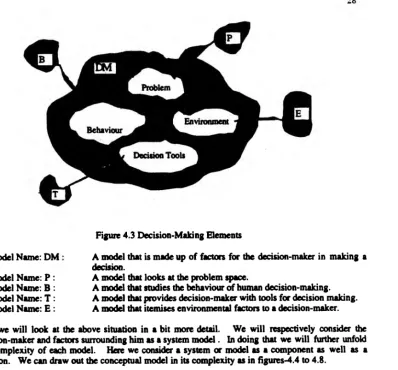
Where:
Model Name: DM :
Model Name: P Model Name: B Model Name: T Model Name: E
A model that is made up of factors for the decision-maker in making a decision.
A model that looks at the problem space.
A model that studies the behaviour of human decision-making. A model that provides decision-maker with tools for decision making. A model that itemises environmental factors to a decision-maker.
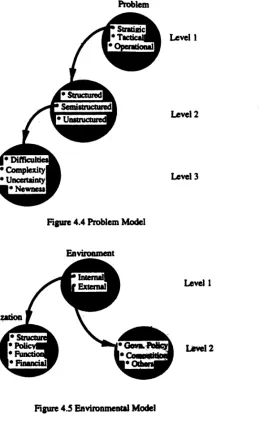
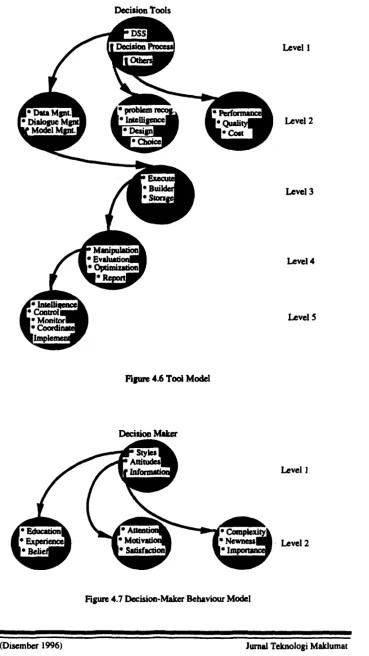
Now we will lode at the above situation in a bit more detail. We will respectively consider Aw decision-maker and factors surrounding him as a system model. In doing that we will further unfold the complexity of each model. Here we consider a system or model as a component as well as a function. We can draw out the conceptual model in its complexity as in figures-4.4 to 4.8.
The following are logical presentations of models and submodel name. DM « ( P, B, T, E )
Where:
P ■ Problem faced by decision-maker, B * Decision-maker’s behavioural styles, T ■ Tools available to decision-maker,
E * An environment that may affect decision-making.
Each element in the model may again consist of another level of models:
29
Problem
Level 1
Level 2
Level 3
Environment
Organization
Level 1
Level 2
Decision Tools
Level 1
Level 2
Level 3
Level 4
Level 5
Figure 4.6 Tool Model
Decision Maker
Level 1
Level 2
Figure 4.7 Decision-Maker Behaviour Model
31
4 .0 Regulatory System Model
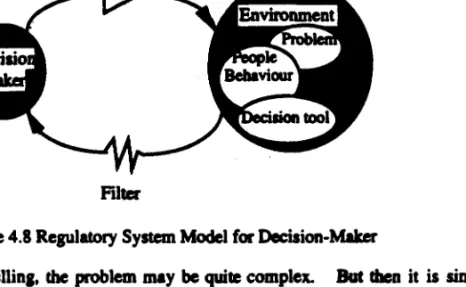
A regulatory system centred on the decision-maker can be constructed, based on factors affecting his decision. This can be seen as in the model shown in figure 4.8. It consists of a low variety bloc which is the decision-maker and a high variety bloc which is made up of certain elements for decision making such as the problem, decision-maker behaviour, decision tools and environment. The decision-maker interacts with the high variety bloc through some form of filter. This can be in the form of an attenuator or amplifier, whereas a result of this interaction will produce a certain model needed by the decision-maker for solving any problem that arises.
Amplifier
Filter
Figure 4.8 Regulatory System Model for Decision-Maker
Task/Problem
Difficulty
structured Complexity
Uncertainty semistructured Importance unstructured
Newness
Decision process
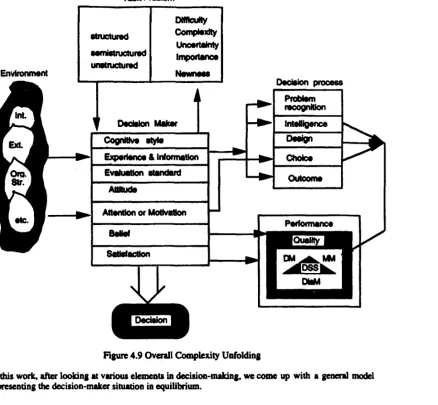
Figure 4.9 Overall Complexity Unfolding
In this work, after looking at various elements in decision-making, we come up with a general model representing the decision-maker situation in equilibrium.
5 .0 Human Judgement and Prediction
Managers being Human are disposed to limited information processing capacity, and are subject to judgemental biases and inferential shortcomings. Slovk, Fischhoff ft Lichenstein (1977), in an annual review on behavioural decision theory, describe several instances of human deviations from what is regarded as normative behaviour. Some of the more relevant weaknesses in human judgement are:
(i). Conservatism: The tendency, integrating probabilistic information, to produce posterior probability nearer to the prior probability.
(ii). Cascaded Inference (Schum in Wallsten, 1980): real life problems often have several stages, with inferences at each stage relying on data which are themselves infened from unreliable observations or reports. Subject posterior probabilities are more extreme than those prescribed by the model.
(iii). Heuristics and Biases (Tversky & Kahneman, 1974): people systematically violate the principles of rational decision-making when judging probabilities, making predictions or otherwise attempting to cope with probabilistic tasks. Representativeness, availability, and anchoring are three judgemental heuristics often used. Although they are often efficient, they oan lead to biases that are large, persistent, and serious in their implications, fc? •.'•c.dsion-makers. A better understanding of these heuristics and of the _______bt*ssi r:ou.ii improve judgement and decision in situations of uncertainty. ______
33
(iv). Choice subjects use rales and strategies en route to a decision, such as conjunctive, disjunctive, compensatory rule, and principle of dominance. In general, people appear to prefer strategies that are easy to justify md do not involve reliance on relative weights, trade-offs functions, or other numerical computations.
The tone of their summary shows that people's judgements are subject to systematic biases of limited information-processing capacity and ignorance of the rules for optimal information-processing and decision-making. Nisbett & Ross (1980) reveal human inferential shortcomings are due to two tendencies, namely: the ovenitilisation of certain generally valid intuitive, inferential strategies; n d the underutilisation of certain formal, logical, and statistical strategies.
The intuitive strategies include the application of pre-existing knowledge structure- schemas, beliefs, and theories; and the utilisation of the representativeness and availability of heuristics. The formal strategies including characterisation of events, sample and population; assessments of covariation, causal analysis, prediction, and theory testing often used by scientists.
A decision of litde consequence generally will be guided by intuitive strategies. At the other extreme, recurrent decisions with important consequences generally should be made with die aid of die best normative strategies available, even if these are relatively costly.
Hogarth’s (1981) research on judgemental evaluation and prediction, and Jacob et al (1989) on human capabilities, produced at least two firm conclusions:
(i). people have limited information-processing capacity, and
(ii). they are adaptive.
The consequences of limited human information capacity have bearings on human attributes: (i). Perception of information is not comprehensive but selective
(ii). Attention span is limited.
(iii). The nature of the processing is mainlydooe m a sequential manner.
(iv). Processing capacity: people do not possess intuitive calculators which allow them to nake what one might call optimal calculations. Rather, they use fairly simple procedures, rales or tricks in older to reduoe mental effort They i t also unable to process large volumes of information and so may ignore some important information.
(iv) People have limited memory capacity. They cannot store all the information pertinent to a problem domain. Memory also contains past experience which cannot be accessed during the required time, or it may have been distorted or simply forgotten.
In reality, human activity systems are capable of rapid response to changing circumstances. People can and do respond to the challenge of the new. They have a high capacity for learning new skills and also they can develop informal systems.
6 .0 Conclusion