Study of Characteristic Strength of M30
Grade of Concrete by Partial Replacement of
Sand with Steel Slag
Anupkala Tigga
1, C.R. Sharma
2, Dr. V. Pandey
3, Krishna Murari
4P.G. Student, Department of Civil Engineering, B.I.T. Sindri, Dhanbad, India1 Professor, Department of Civil Engineering, B.I.T. Sindri, Dhanbad, India2
H.O.D, Department of Civil Engineering, B.I.T. Sindri, Dhanbad, India3 Professor, Department of Civil Engineering, B.I.T. Sindri, Dhanbad, India4
ABSTRACT: Steel slag which can be considered as solid waste pollutant was used in concrete mixture for road bases
and surfaces, bridges, asphaltic concrete, clinker raw material and other fields, instead of cement or filling material. In the present paper work great diligence hasbeen put in the study of steel slag which has been used as apartial sand replacing material simultaneously achieving required strength, testing on M30 grade of hardened concrete.Steel slag used as partial replacement of sand because of its advantages like lower energy cost, higher abrasion resistance, lower hydration heat evolution, higher later strength development. Steel slag used in different percentage tothe weight of concrete with maintaining the water-cement ratio 0.43. The obtained results showed that, density of concrete, compressive strength, and flexural force, after 7 and 28 days were increased by increasing slag content, while water absorbed content was decreased by increasing slag content. Those results insure the importance of using steel slag not only in the modification of concrete properties, but also to save the environment from huge quantities of slag as solid waste.
KEYWORDS: Steel slag, Solid waste
I.INTRODUCTION
Since aggregates occupy 70-80 percent of the volume of concrete, their impact on various characteristics and properties of concrete is undoubtedly considerable. All along in India, we have been using natural sand and gravel in concrete manufacturing. Availability of natural aggregates is getting depleted and also it is becoming costly. Hence, there has to be an emphasis on the use of wastes and by-products in all areas including construction industry. As 75% of concrete is composed of aggregates it is imperative that we look to maximize the use of waste as aggregate input in concrete making. This research work determines the effect of partial substitution of fine aggregates by steel slag on the physical and mechanical properties of concrete.
Steel slag, a by-product of steel making, is produced during the separation of the molten steel from impurities in steel-making furnaces. The slag occurs as a molten liquid melt and is a complex solution of silicates and oxides that solidifies upon cooling. There are several different types of steel slag produced during the steel-making process. These different types are referred to as furnace or tap slag, raker slag, synthetic or ladle slags, and pit or cleanout slag.
II. RELATED WORK
Dr. KHIDHAIR J.MOHAMMED (2009) replaced coarse aggregate with steel slag, and studied the properties of
ISA YUKSEL, OMER OZKAN, TURHAN BOILER, (2006) experimented use of nonground granulated blast furnace slag as fine aggregate in concrete. The study concluded that the ratio of GGBs/sand is governing criteria for the effects on the strength and durability characteristics.
KHIDHAIR (2009) replaced fine aggregate with steel slag, and observed that the density of concrete increased by 8%.
And also the water absorption decreased by about 13%. The compressive strength of concrete with steel slag as fine aggregate increased by 42% after 28 days
.
L. ZEGHICHI, (2006) experimented on substitution of sand by GBF crystallized slag. Tests carried out on cubes of
concrete showed the effect of the substituting part of sand by granulated slag (30%, 50%) and the total substitution on the development of compressive strength. Compressive strength test results at 3, 7, 28, 60 days and 5 months of hardening concluded that the total substitution of natural coarse aggregate with crystallized slag affects positively on tensile, flexural and compressive strength of concrete. The partial substitution of natural aggregate with slag aggregates permits a gain of strength at long term but entire substitution of natural aggregates affects negatively the strength (a loss in strength of 38%).
MANSO, et.al (2004) carried out work in laboratory to produce concrete with good properties using oxidizing EAF
slag as fine and coarse aggregate. The concrete was tested for durability characteristics like soundness, leaching test, accelerated ageing test etc. The durability of the EAF slag concrete was found to be acceptable, especially in the geographical region for which its use was proposed, where the winter temperature hardly ever falls below 32˚F (0˚C).
MLADAN FISTRIC et.al (2000) experiment the properties of steel slag aggregate and steel slag asphalt concrete. In
this paper asphalt produced from 75% of steel aggregate and 25% of limestone rock aggregate. Result showed that the asphalt produced with the steel slag aggregate has good resistance to permanent, high stability with good flow properties and high stiffness modulus
.
SHEKARCHI (2004) introduced a comprehensive research on the utilization of steel slag as aggregate in concrete,
and he concluded that the comprehensive strength and tensile strength are increased by 7% and 5% respectively.
SINGH S.P. et.al (2010) experimented eco-friendly concrete using by-products of steel industry. The compressive
strength of concrete was reported to be improved when steel slag is used for low sand replacement ratio (up to 30%). The result showed that the density of concrete, compressive strength, flexural strength after 7 days and 28 days were increased by increasing slag content while water absorption was decreased by increasing slag content.
WANG CHANG LONG(2003) has studied steel slag in concrete and he found that the compressive strength of
concrete with mixture of steel slag is very similar to that of ordinary concrete
III. MATERIAL AND THEIR PROPERTIES
CEMENT - The cement used in the concrete was Portland slag cement (PSC)(IS:455:1989) with trade name
‘LAFARGE CONCRETO’ cement
.
The cement was stored in bags and kept at minimum exposure from humidity.The cement was uniform in colour i.e. light grey colour and was free from any hard lumps and was chemicallyanalysed from laboratory.The chemical composition of cement istabulated in Table 1.
Table 1: Chemical composition of cement
B) FINE AGGREGATES- SAND &STEEL SLAG
SAND-The sand used for experimental investigation was obtained from Barakar River and was confirmed to grading
zone III as per IS: 383-1970. The sand was sieved through 4.75 mm sieve to remove any particle greater than 4.75 mm.
Ingredients % content
SiO2 28.17
Al 2O3 14.10
Fe2O3 1.64
CaO 43.43
MgO 5.93
P2O5 0.03
SO3 0.67
Na2O3 0.43
STEEL SLAG-Steel Slag used was obtained from MUGMA STEEL PLANT located in Mugma, District- Dhanbad, Jharkhand.Experimental investigation was done as per IS: 383-1970.
The physical properties of sand & steel slag has been tabulated in table 2.
Table 2: Physical properties of sand & steel slag
C) COARSE AGGREGATE- Crushed Stone maximum size of 20 mm and down, 10 mm and down has been used as
coarse aggregate. The coarse aggregate used as 20 mm graded aggregate as per IS: 383-1970 specification. The properties of the coarse aggregates have been obtained from the tests carried out as per specification laid down in IS: 383-1970. Physical and mechanical properties are tabulated in table 3.
Table 3: Properties of Coarse Aggregate
Property Coarse Aggregate values
Specific Gravity 3.12
Unit Weight 1.87 gm/cc(Fraction I) 1.71 gm/cc(Fraction II)
Water Absorption 0.02%
Impact value 16%
Crushing value 23.43%
D) WATER-Generally, water that is suitable for drinking is satisfactory for use in concrete. Water from lakes and
streams that contain marine life also usually is suitable when it is suspected that water may contain sewage, mine water, or wastes from industrial plants or canneries, it should not be used in concrete unless tests indicate that it is satisfactory. Water used for making concrete is conformed to the following requirements as shown in table 4.
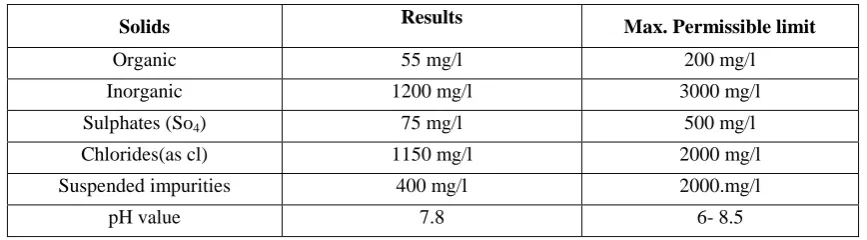
Table 4: Test result of water to be used as per IS 456:2000
IV.EXPERIMENTAL RESULTS
Slump Test
Slump test is conductedover freshly prepared concrete to be used for casting. The purpose of slump test is to determine the water content in concrete and its workability. Slump value decreased with the increasing slag content in the concrete mixture, fig. 1 below shows the graph variation of slump value.
Parameter Sand Steel slag
Specific Gravity 2.55 3.08
Bulk Density 1.62gm/cc 1.73 gm/cc
Water absorption 1.26% 0.54%
Moisture content 0.20% 0.19%
Fineness Modulus 2.21 3.2
Solids Results Max. Permissible limit
Organic 55 mg/l 200 mg/l
Inorganic 1200 mg/l 3000 mg/l
Sulphates (So4) 75 mg/l 500 mg/l
Chlorides(as cl) 1150 mg/l 2000 mg/l
Suspended impurities 400 mg/l 2000.mg/l
Fig. 1Slump value at different % of steel slag Density Calculation
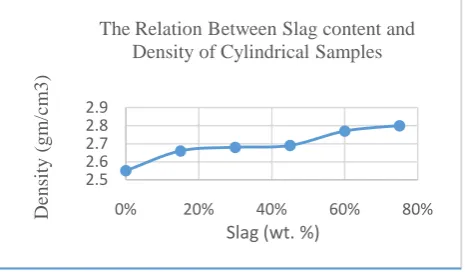
This has been done by drying the given samples in laboratory oven at (1100C) for 24 hours to insure the dryness of the samples. Dry samples were then weighed. Density has been calculated by dividing the dry weight of each sample by volume of the samples, i.e. 15X15X15 cm3 for cubic one and 15cmX30cm forcylindrical samples. Graph variation isgiven in fig. 2 & fig. 3 for cubic and cylindrical samples respectively.
Fig. 2 Relation between slag content and density of cubic samples
Fig. 3 Relation between slag content and density of cylindrical samples 2.6
2.7 2.8 2.9
0% 20% 40% 60% 80%
Den
sity
(
g
m
/cm
3
)
Slag (wt. %)
The Relation Between Slag Content and Density of Cubic Samples
2.5 2.6 2.7 2.8 2.9
0% 20% 40% 60% 80%
Den
sity
(
g
m
/cm
3
)
Slag (wt. %)
The Relation Between Slag content and Density of Cylindrical Samples 52
54 56 58 60 62 64
0% 50% 100%
Slu
m
p
v
alu
e
in
m
m
% 0f Slag
Slump value at different % of steel slag
Water absorption
It has been achieved by using the weight of oven dried samples as a base, the dried samples were then soaked completely in tap water basin for 48 hours, the samples were weighed again.The difference between the first and second weight was the weight of absorbed water. The percentage of absorbed water was calculated by dividing the absorbed water weight by the dry weight of each sample by (100) to get the value (wt.% value). Graph of water absorption for cubic and cylindrical sampleshas given in fig. 4 & fig. 5 respectively.
Fig. 4 Relation between Slag Content and Absorbed water (%) by wt. of cubic samples
Fig. 5Relation between Slag Content and Absorbed water (%) by wt. of cylindrical samples
Compressive Strength
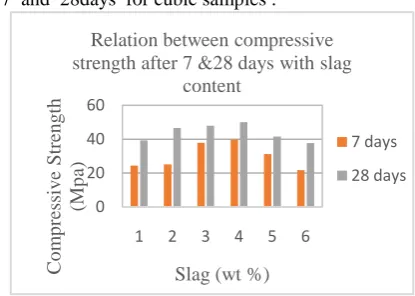
The test was carried out after 7 and 28days for cubic samples .
Fig. 6 Relation b/w Compressive Strength after 7&28 days with slag content 0.8
1
0% 20% 40% 60% 80%
A
b
so
rb
ed
w
ater
(
%)
Slag (wt. %)
Relation Between Slag Content and Absorbed water (%) by Weight of
cylindrical samples
0 20 40 60
1 2 3 4 5 6
C
o
m
p
ress
iv
e
Stre
n
g
th
(Mp
a)
Slag (wt %)
Relation between compressive strength after 7 &28 days with slag
content
7 days
28 days 0
1
0% 20% 40% 60% 80%
A
b
so
rb
ed
w
ater
(
%)
Slag (wt. %)
The Relation Between Slag Content and Absorbed Water (%) by Weight of cubic
Split Tensile Test
Cylindrical samples of 150 mm x 300 mm were used in this test in the horizontal position, on the same compression testing. The results of the tests inafter 7 days and 28 days has given in the fig. 7.
Fig. 7 Relation b/w Tensile strength after 7&28 days with slag content Flexural Force Test
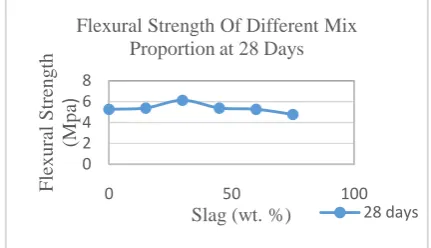
The modulus of rupture is determined by testing standard test specimens of 100mmx100mmx500mm over a span of 400mm, under symmetrical two-point loading
.
Fig. 8 represents the graph of flexural strength test.Fig. 8 Flexural Strength of Different Mix Proportion at 28 days
V.CONCLUSION
This work relates the use of steel slag, a waste cheap material used as fine aggregates in M30 grade of concrete and recommends the approval of the material for use in concrete as a replacement material for fine aggregates. The partial substitution of natural aggregates with steel slag aggregates enables a gain of compressive, tensile and flexural strength of concrete up to an optimum value of replacement.
1. Compressive strength of concrete with partial replacement of sand by steel slag increased at 7 days, also increased at 28 days up to 45% of slag. The optimum value of strength was achieved at 45% of steel slag.
2. The split tensile strength of concrete increased with partial replacement of sand by steel slag up to 30% and beyond this started to decrease.
3. The flexural strength also showed slight increase up to 30% of steel slag and beyond this slightly decreased. 4. The density of concrete increased by increasing slag content both in the case of cube and cylinder, so that high density concrete was obtained.
5. Water absorption decreased by increasing slag content both in the case of cube and cylinder. Thus, the following benefits can also be obtained:
0 2 4 6 8
0 50 100
Flex
u
ral
Stre
n
g
th
(Mp
a
)
Slag (wt. %)
Flexural Strength Of Different Mix Proportion at 28 Days
28 days 0
2 4 6
0% 15% 30% 45% 60% 75%
Sp
lit
Te
n
sile
Strengt
h
(Mp
a)
Slag (wt. %)
Relation between tensile strength after 7 & 28 days with slag content
7 days
Cost reduction Social benefits
Mass utilization of waste material in construction by using steel slag as a partial replacement material for fine aggregates in concrete.
REFERENCES
1. Deborah M. Proctor, Erinc, Shay, Kurt A. Fehling & Brent L. Finley “Assessment of human health and ecological risks posed by the uses of steel industry slag in the environment” Journal of Human Ecological and Risk Assessment, Vol.8, Issue4, pp.681-711, 2002.
2. Ibrahim M, Qasrawi, Hishma Y, Shalabi, Faisal I “Use of steel slag in asphalt concrete mixes” ASI, – Canadian Journal of Civil Engineering, Vol.34, Number 8, pp.902-911, NRC Research Press, 1stAugust 2007.
3. M. Maslehuddin, Alfarabi M. Sharif, et,al. “Comparison of properties of steel slag and crushed limestone aggregate concretes” Journal of Construction and Building Materials, Vol.17, Issue 2, pp.105-112, March 2003
4. LI Yun-feng, YAO Yan, WANG Ling “Recycling of Industrial Waste and Performance of Steel Slag green concrete” J. Cent. South Univ. Technol (2009) 16:0768-0773, 2009.
5. Baha Vural KOK, Necati Kuloglu- “ Effects of Steel Slag usage as Aggregate on indirect tensile and creep modulus of hot mix asphalt”G.U Journal of Science, 21(3): 97-103, 2008.
6. Beshr, H., Almusallam, A.A., Maslehuddin,M “Effect of Coarse Aggregate quality on the Mechanical properties of High Strength Concrete” Construction and Building Materials 17(2), pp.97-103,2003.
7. Abdulaziz I. Al-Negheimish, Faisal H. Al-Sugair and Rajeh Z. Al-Zaid “Utilization of Local Steelmaking Slag in Concrete- King SaudUniv.”, Vol. 9, Eng. Sri. (1), pp. 39 55 (A.H. 1417/1997)