ABSTRACT
BUCK, MICHAEL JOSEPH. Protein Evolution From Sequence To Structure. (Under the direction of William R. Atchley.)
The purpose of this research is to elucidate how natural selection shapes protein evolution. The question was addressed by exploring protein sequence evolution, 3D structural evolution, and analysis of the multidimensional nature of amino acid covariation. This thesis begins with a study of protein sequence evolution. 118 different bHLH genes in the completely sequenced Arabidopsis thaliana genome and 131 bHLH genes in the rice genome were identified and
characterized using phylogenetic analysis. These plant proteins were classified into 15 distinct plant clades and were under weaker selective constraints than their
animal counterparts. Additionally, it was shown that lineage specific expansions and subfunctionalization have fashioned regulatory proteins for plant specific functions.
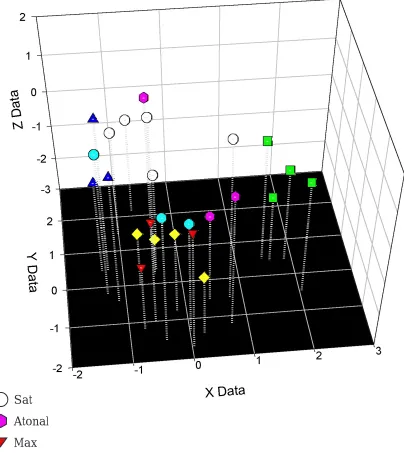
To further characterize the bHLH domain, a canonical 3D structure was created from solved structures. This canonical structure was used as a template for producing 3D models for other representative bHLH proteins, which were then compared, contrasted, and grouped based on structural characteristics. Structural similarities were discovered within the bHLH domain between three clades (Max, Myc, and PbHLH-LZ). In addition, structural models of the Sat proteins suggest a strong similarity to other bHLH proteins, which is in disagreement with previous functional characterization.
To further understand the dimensionality of protein evolution, the
matrix of pairwise normalized mutual information values were computed among amino acid sites for the serpin proteins. The normalized mutual information matrix was partitioned into orthogonal dimensions by factor analysis. Each eigenvector from the factor analysis can be interpreted as having phylogenetic or
Protein Evolution From Sequence to Structure
by
MICHAEL JOSEPH BUCK
A dissertation submitted to the Graduate Faculty of North Carolina State University
in partial fulfillment of the requirements for the Degree of
Doctor of Philosophy
DEPARTMENT OF GENETICS Raleigh
2003
APPROVED BY:
Chair of Advisory Committee
Biography
iii
Acknowledgements
There are many people who have been very helpful throughout my graduate
career. First and for most I would like to thank my advisor William R. Atchley, for
academic mentoring and for saving me from the cold north. I would like to thank all
my committee members past and present Jeff L. Thorne, Barbara Sherry, Michael
Purugganan, Jon Swaffield, and Matthew Andrews. I wish also to thank Stephen
Curtis for enormous support through trying times.
For emotional support I would like to thank my fellow graduate students
especially Amy Lawton-Rauh, Chris Halweg, and Gretchen Thornsberry. I wish to
thank my parents Carolyn and Frank Kavanaugh for emotional and financial support.
Lastly, I am indebted to my girlfriend Maria Tsompana for encouragement and a
Table of Contents
Page
List of Tables vi
List of Figures vii
Introduction 1
Chapter 1: Phylogenetic Analysis of Plant basic Helix-Loop-Helix
Proteins 7
Abstract 8
Introduction 9
Materials and Methods 12
Results 13
Discussion 19
Acknowledgements 23
Chapter 2: Structural Evolution of the Basic Helix-Loop-Helix Proteins 39
Abstract 40
Introduction 41
Materials and Methods 46
Results and Discussion 49
Conclusions 53
Chapter 3: The Sources of Amino Acid Covariation in the Serpin Proteins 59
Abstract 60
v
Materials and Methods 64
Results and Discussion 67
Conclusions 77
Conclusions 95
Literature cited 101
Appendix A: Graphical represenation of serpin cleavage 109 Appendix B: Coordinate expression of the PDK4 gene: a means
List of Tables
Page Table 1.1. Distribution of plant bHLH containing proteins in databases 24 Table 1.2. The 15 distinct bHLH families in plants 25 Supplemental Table 1.1. List of 118 bHLH protein sequences found
in the Arabidopsis thaliana genome 30
Supplemental Table 1.2. List of 177 rice bHLH proteins from the rice
genome project and genebank 33
vii
List of Figures
Page Figure 1.1. Alignment of representative bHLH proteins 26 Figure 1.2. Neighbor-joining tree showing the evolutionary relationship
of the Arabidopsis bHLH domains 27
Figure 1.3. Alignment of the leucine zipper region for members of clade
PbHLH-LZ 29
Supplemental Figure 1.1. The conserved regions within each plant clade 38 Figure 2.1. Variation in structure and sequence of bHLH proteins 55 Figure 2.2. Neighbor joining and Structural Parsimony Trees 56
Figure 2.3. Multidimensional Scaling 57
Figure 2.4. Alignment of PbHLH-LZ, Myc, and Max 58
Figure 3.1. The structure of native and cleaved α1-antitrypsin 84
Figure 3.2. Plot of Factor 1 coefficients vs phylogenetic signal 85 Figure 3.3. Factor 3 sites on the cleaved structure 86 Figure 3.4. Two views of Factor 4 highly loading sites 87 Figure 3.5. Factor 5 four interaction networks 88 Figure 3.6. Factor 7 four interaction networks 89
Figure 3.7. Factor 8 sites in the breach 90
Figure 3.8. Factor 9 hydrophobic core 91
Figure 3.9. Factor 10 two interaction networks 92
Figure 3.10. Factor 11 sites on hA 93
1
Introduction
Genome-sequencing projects provide a tremendous amount of information
about the genetic make-up of an organism. Unfortunately the billions of bases of
DNA sequence do not tell us what all genes do, how they interact, and how they
affect an organism. While sequence technology has rapidly advanced, functional
characterization of proteins still requires extensive, time-consuming examination
using biochemistry. By the end of 2002, GenBank contained over 22 million
sequences. In contrast, Swiss-Prot contained only 122,000 characterized proteins.
If Swiss-Prot database can yield an accurate estimate of the number of functionally
characterized genes, then less than 1% of all sequences have been characterized.
If computational techniques could be developed that would facilitate the functional
interpretation of raw sequence data they would greatly accelerate the biological
interpretation of sequence data. The goal of computational biology is to integrate
mathematical, statistical, and computational approaches to provide clues to the
structure and function of uncharacterized genes. Bench scientists can use the
results of these analyses to create testable hypotheses. While computational
techniques will never replace molecular experiments for determining the function of
genes, they can hasten the process by directing researchers along a faster path.
Herein, I discuss three computational techniques that show considerable
promise for quantitative analysis of protein structure and evolution. The first two
chapters of this dissertation involve genomic and structural analyses using the basic
helix-loop-helix (bHLH) proteins. bHLH is a group of functionally diverse
2
in eukaryotic cells before the split of animals and plants, but appear to function in
‘plant-specific’ or ‘animal-specific’ processes. In animals, bHLH proteins are
involved in regulation of a wide variety of essential developmental processes
(Massari and Murre 2000). In contrast, bHLH domain containing proteins have not
been extensively studied in plants; those that have been characterized function in
anthocyanin biosynthesis, phytochrome signaling, and globulin expression, fruit
dehiscence, as well as, carpel and epidermal development (Kawagoe, Campbell et
al. 1994; Kaiser, Finnegan et al. 1998; Weisshaar and Jenkins 1998; Heisler,
Atkinson et al. 2001; Rajani and Sundaresan 2001). Analysis of sequence
homology is the fastest and most widely used computational technique to estimate
protein function. The null hypothesis is that sequences with strong similarity in their
primary structure will have the same 3D structure and function. The BLAST
algorithm is commonly used to identify related sequences and subsequently to
extrapolate sequence similarity to common function (Altschul, Madden et al. 1997).
BLAST has been widely used to provide a rough functional prediction for most genes
in GenBank.
Chapter 1 describes research to expand the number of known bHLH proteins
and to explore the little studied plant bHLH proteins. More specifically, homology
searches found 118 different bHLH genes in the complete Arabidopsis thaliana
genome and 131 bHLH genes in the rice genome. Complementing the homology
searches, phylogenetic analyses were used to group sequences based on estimated
evolutionary history and phylogenetic relationship. From these results, 15 distinct
3
characterization of their common features. This work is in press in the Journal of
Molecular Evolution.
Only five plant bHLH clades (SAT, SPATULA, 7E/PG, R, GBOF) contain
proteins which have been characterized with regard to function. Consequently, the
phylogenetic approach could only provide limited extrapolation to functional
considerations, because some of the clades are not statistically well supported.
Therefore, evolutionary relationships among many plant bHLH proteins could not be
easily resolved. To further characterize these bHLH proteins, I applied some novel
3D structural comparison techniques. Generally, structure-based prediction of
protein function is preferred over sequence-based approaches. Structure is
evolutionarily more conserved and permits more accurate conclusions about
function than does analyses of sequences alone. Structural comparisons may
provide the most detailed information about shared function, but it requires solved
structures. Creating an x-ray crystallographic structure for a protein is difficult, time
consuming, and costly. For the bHLH proteins only six proteins have been solved
and one of the structures is inaccurate. Therefore, homology modeling was used to
create models for representative bHLH proteins.
In chapter 2, I created homology models from the average or “canonical”
bHLH structure for representative proteins from each bHLH clade. The resultant
homology models were compared using three structural comparison techniques: i) a
modified pairwise root mean square deviation, ii) a new structural parsimony
approach, and iii) site by site multidimensional scaling. Using these techniques
4
(Max and Myc) and one plant clade (PbHLH-LZ). Each of these clades contains a
C-terminal leucine zipper immediately following the bHLH domain. In addition,
structural models of the Sat proteins suggest a strong similarity to other bHLH
proteins, which is unexpected due to its unique function as a symbiotic ammonium
transporter.
In chapter 3, some recently developed computational and multivariate
statistical techniques were used to explore the molecular structure of the serpin
protein family. The serpins are structurally more complex than bHLH proteins and
consequently are used here to evaluate the relative efficacy of new procedures
recently developed in the William R. Atchley lab. Serpins (serine protease inhibitors)
are a super family of proteins whose membership is based on the presence of a
single common core domain consisting of three β-sheets and 8-9 α-helices (Gettins
2002). They are widely distributed among eukaryotes and in some viruses that
infect them (Irving, Pike et al. 2000). They are absent from fungi and chlorophytes,
despite being found in higher plants and recently discovered in prokaryotes (Irving,
Pike et al. 2000; Irving, Steenbakkers et al. 2002). Despite the presence of a
common fold of approximately 350 residues in all serpins, pairwise identity of
primary structures can be as low as 25 % (Gettins 2002). The majority of serpins are functionally characterized as proteinase inbibitors, for chymotrypsin like serine
proteinases, but some inhibit other types of proteinases. Serpins regulate numerous
separate cellular and extracellular processes including blood coagulation,
fibrinolysis, cell complementation, tumor suppression, and other functions. Some
5
hormone binding, as chaperones, or as storage proteins in egg albumin (Gettins
2002).
In contrast to the first two sections, which attempt to predict the function of a
protein, chapter 3 elucidates the structural/functional characteristics of regions of a
protein. The conserved complex structure of serpins and their extensive sequence
divergence make them good model proteins to study covariation among protein
residues. It is expected that the residues at certain sites of the protein will strongly
affect evolution of other sites in close three-dimensional proximity. At such sites,
residue substitutions which tend to destabilize a particular structure or function are
probably corrected or compensated for by other substitutions at neighboring sites.
For example, if a substitution causes a reduction of volume in the protein core, which
destabilizes the protein, only compensating substitutions in a few adjacent residues
would be able to fill the space. The resulting correlation between these sites should
be detectable by detailed statistical analyses. In addition to structural and functional
correlations, the evolutionary history of the proteins creates correlations between
sites.
To explore compensating substitutions, we used the multivariate statistical
technique of factor analysis to determine the common underlying “factors” which
effect variation in the residue composition among sites. These underlying factors
can be interpreted as having phylogenetic or structural/functional bases. Using this
approach we have described two underlying phylogenetic factors of covariation and
13 underlying structural/functional factors. These structural/functional factors
6
Two additional chapters are provided in the form of appendices. The first
contains a graphical representation of serpin cleavage that may be useful as a
reference for chapter 3. The second appendix contains a paper entitled “Coordinate
expression of the PDK4 gene: a means of regulating fuel selection in a hibernating
mammal”. This paper represents some of the work completed earlier with Mathew
Andrews during the first three years of my graduate studies. It has been published
in Physiological Genomics in 2002 (Buck, Squire et al. 2002).
Phylogenetic Analysis of Plant basic Helix-Loop-Helix
Proteins
by
Michael J. Buck1 and William R. Atchley1
1. Department of Genetics and The Center for Computational Biology, North
Carolina State University, Raleigh, NC 27695-7614
Michael J. Buck
North Carolina State University Department of Genetics
Campus Box 7614 Raleigh, NC 27695-7614 Tel. 919-515-5759 Fax 919-515-3355 [email protected]
8
Abstract:
The basic helix-loop-helix (bHLH) family of proteins is a group of functionally diverse
transcription factors found in both plants and animals. These proteins evolved early
in eukaryotic cells before the split of animals and plants, but appear to function in
‘plant-specific’ or ‘animal-specific’ processes. In animals, bHLH proteins are
involved in regulation of a wide variety of essential developmental processes. In
contrast, bHLH proteins have not been extensively studied in plants; those that have
been characterized function in anthocyanin biosynthesis, phytochrome signaling,
globulin expression, fruit dehiscence, carpel and epidermal development. We have
identified 118 different bHLH genes in the completely sequenced Arabidopsis
thaliana genome and 131 bHLH genes in the rice genome. Here we report a
phylogenetic analysis of these genes, including 46 genes from other plant species
and a classification of these proteins into 15 distinct plant clades. Results imply a
polyphyletic origin for the plant bHLH proteins related only by their bHLH DNA
binding motif. We suggest that plant bHLH proteins are under weaker selective
constraints than their animal counterparts and that lineage specific expansions and
subfunctionalization have fashioned regulatory proteins for plant specific functions.
Keywords: basic helix-loop-helix, Arabidopsis thaliana, rice, phylogeny,
transcription factors, G-box, R genes, E-box, genome searching, blast search,
Introduction:
The basic helix-loop-helix (bHLH) family of proteins is a group of functionally
diverse transcription factors found in both plants and animals (reviews in Garrell and
Campuzano 1991; Mol et al. 1998; Quail 2000; Wright 1992). The distinguishing
characteristic of the family is a bipartite domain consisting of approximately 60
amino acids. This bipartite domain is comprised of a DNA-binding basic region,
which binds to a consensus hexanucleotide E-box and two α-helices separated by a
variable loop region. The two α-helices promote dimerization, allowing the formation
of homo- and heterodimers between different family members. While the bHLH
domain is evolutionarily conserved (Atchley and Fitch 1997), there is little sequence
similarity between clades beyond the domain (Morgenstern and Atchley 1999).
In animals, bHLH proteins are involved in regulation of a wide variety of
developmental processes including neurogenesis, myogenesis, cell proliferation and
differentiation, cell lineage determination, sex determination, and other essential
processes (reviewed by Massari and Murre 2000). Phylogenetic analysis using only
the bHLH domain uncovered 27 evolutionary lineages or clades, that represented
groups of functionally similar proteins (Atchley and Fitch 1997). Further
phylogenetic analysis of completed animal genomes has expanded the number to
44 orthologous families (Ledent and Vervoort 2001).
These clades are classified into five major groups based on their basic
DNA-binding patterns (Atchley and Fitch 1997; Ledent and Vervoort 2001). Group A
proteins bind to the hexanucleotide CAGCTG E-box and include proteins such as
10
the CACGTG E-box, also known as G-box in plants, and include Srebp, Tfe, Myc,
Mad, Mxil, Cbf1, ESC, R, and G-box. Group C proteins, including Sim, Trh, and Ahr,
have an uncharacteristic basic region and contain a pair of PAS repeats, which
facilitates dimerization with other PAS-containing proteins. Group D proteins lack
the basic DNA binding region and act as dominant negative regulators of other
bHLH proteins and include Id and Emc. Recently an additional group E has been
described that includes Gridlock, E(spl), Hey, and Hairy (Ledent and Vervoort 2001).
This latter group contains proline or glycine residues within the basic region and
shows a preference to bind the sequence CACGNG (Steidl et al. 2000; reviewed by
Fisher and Caudy 1998).
Most bHLH proteins characterized to date have been restricted to animals
and only a few are known from plants. Those bHLH proteins previously described
from plants belong to group B (Atchley and Fitch 1997) and function in
transcriptional regulation associated with anthocyanin biosynthesis, phytochrome
signaling, globulin expression, fruit dehiscence, as well as, carpel and epidermal
development. Anthocyanin biosynthesis was first characterized in maize and is
regulated by C1 (a helix-turn-helix Myb oncogene) with four bHLH genes of the R
gene family (Mol et al. 1998; reviewed by Weisshaar and Jenkins 1998). The R
clade belongs to the DNA binding group B proteins, but has not been shown to bind
DNA directly (Sainz et al. 1997). The four R genes known from maize (R, B, Lc, Sn)
have homologs in snapdragon (delila) (Goodrich et al. 1992), petunia (an1, jaf13)
(Spelt et al. 2000), gerbera (gmyc1) (Elomaa et al. 1998), Arabidopsis (ttg) (Walker
The characterized plant bHLH proteins which have been demonstrated to
bind the specific group B type E-box, know as a G-box in plants, belong in the
clades 7E/PG and GBOF (alternatively G-box)(Kawagoe 1996; Loulergue et al.
1998). In addition, a soybean protein containing a bHLH domain has been
characterized as a symbiotic ammonium transporter (Kaiser et al. 1998). Another
family of functionally and evolutionary distinct plant bHLH proteins, belonging to the
PCF family has been described by Kosugi and Ohashi (1997). However, the
structure and DNA binding specificity of their bHLH motif is dissimilar and will not be
discussed in the present paper.
Here, we report the results of an extensive search carried out using available
protein sequence databases to locate additional bHLH genes in plants. This paper
describes 118 and 131 potentially unique bHLH proteins found in the Arabidopsis
thaliana and the Oryza sativa genomes respectively. Phylogenetic analysis of these
rice and Arabidopsis sequences together with an additional 58 bHLH sequences
from other plant and animal species permitted us to generate a classification of the
known plant bHLH sequences. More specifically, most of the proteins discovered,
93 from Arabidopsis and 64 from rice, can be clustered into distinct clades; only 29
Arabidopsis and 67 rice proteins appear as orphans (not closely related) to the other
clades. Our results imply a polyphyletic origin for the plant bHLH proteins, which are
related only by a bHLH DNA binding motif. We suggest that plant bHLH proteins are
under different evolutionary constraints compared to their animal counterparts and
12
Materials and methods
A large collection of bHLH domain containing proteins from plants were
assembled by searching three large sequence databases; TIGR Arabidopsis
thaliana genome project (http://www.tigr.org/tdb/ath1/htmls/index.html), and a
database comprised of all plant protein sequences available from NCBI. A newly
developed sequence search program ProtFamDB
(http://coltrane.gnets.ncsu.edu/ProtFamDB.html) was implemented to facilitate
database construction and to identify putative bHLH domain containing proteins.
The search was initiated using representative bHLH sequences as “seeds” for
BLASTP searches (Altschul et al. 1997). The initial seed file included the bHLH
domain for 196 proteins, previously analyzed by Atchley and Fitch (1997). A
stringent E-value (0.001) was used for the inclusion of sequences. This search
procedure was repeated using the newly available Oryzasativa predicted protein
sequences (Yu et al. 2002). The discovered predicted bHLH proteins in rice were
included in our analysis, but are not shown in the neighbor joining tree.
The bHLH domain of each resultant protein was aligned to a consensus
19-element bHLH predictive motif. This motif was previously shown by Atchley et al
(1999) to identify bHLH domain containing proteins with a high degree of accuracy.
The goodness of fit of each putative bHLH protein sequence to the predictive motif
was assessed by counting the number of mismatches between the sequences
identified and the motif. Previous analyses have shown that this predictive motif is
biased for detection of only group A and B proteins (Atchley et al. 1999). Group C
groups generate higher number of mismatches. To assure that atypical bHLH
domain proteins were not eliminated by lack of correspondence to the predictive
motif, only sequences with more than ten mismatches were discarded. This
probably results in an exhaustive collection of proteins. Further, allsequences with
more than seven mismatches were examined by eye for goodness of fit. Duplicate
sequences within the bHLH domain were discarded.
The flanking regions or non-bHLH components of the sequences were
aligned within clades using DIALIGN2 (Morgenstern 1999). Alignments were
manually improved by eye. Maximum-likelihood pairwise distances were estimated
using the Blosum 62 distance matrix (Henikoff and Henikoff 1992) implemented by
TREEPUZZLE (Strimmer and Haeseler 1996). Neighbor joining and consensus
trees were constructed using NEIGHBOR and CONSENSUS respectively from
PHYLIP (Felsenstein 1993). Sequences were bootstrapped 500 times using
SEQBOOT (Felsenstein 1993). Tree nodes with less than 35% bootstrap support
were collapsed.
Results:
A search of the sequence databases, implemented by ProtFamilyDB,
identified 118 proteins from the Arabidopsis thaliana genome and 131 proteins from
the Oryzasativa genome that contained a putative bHLH domain (See supplemental
tables at http://coltrane.gnets.ncsu.edu/plants/). A phylogenetic tree was
constructed using the neighbor joining method (Saitou and Nei 1987), which
14
and 131 riceproteins together with 46 additional domains from other plants and 12
representative animal sequences (Table 1). The relationships of lowly supported
groups, as evidenced by small bootstrap values, were further explored by examining
other conserved domains from full-length sequence alignments (See supplemental
figures at http://coltrane.gnets.ncsu.edu/plants/). Additional conserved domains
located beyond the bHLH domain are only found between sequences within the
same clade. The flanking regions for two proteins from different clades may not be
homologous, making sequence alignments inappropriate and inaccurate
(Morgenstern and Atchley 1999). Clusters of sequences from neighbor joining
analysis were considered as distinct evolutionary groups (clades), if they met three
criteria: a) contained more than four members from two or more species or the group
contained more than six distinct sequences from Arabidopsis, b) the sequences in
the group were delimited by a bootstrap value greater than 75% for either domain or
full length sequence alignments, and c) the sequences within the group contained
conserved residues beyond the bHLH domain or conserved loop length.
We suggest that of these 295 plant sequences, most can be grouped into 15
separate families or clades. The remaining sequences appear as orphans (not
closely related) to the other clades. The grouping of these plant sequences into 15
distinct families most likely underestimates the number of distinct families found in
plants. This analysis suggests the existence of as many as 13 additional plant
groups, which have not been further delimited because of low statistical support.
A set of representative sequences from each family has been aligned along
Atchley et al. (1999) is provided together with the numbering scheme for amino
acids following the structural analysis of the Max protein by Ferre-D’ Amare et al.
(1993). The plant domains have several characteristic residues for binding a group
B E-box. The glutamate at position 9 makes several contacts with the E-box and is
essential for specific DNA binding within bHLH proteins (Bacsi and Hankinson
1996). This residue is absent from sequences that do not bind DNA, whereas, it is
conserved in 13 of the 15 distinct plant families, suggesting that all of these families
bind DNA. There are three sites, which are important for distinguishing between
group A and group B DNA binding (Atchley and Fitch 1997). Group A proteins have
a configuration of xRx at sites 5, 8, and 13, where R is an arginine at site 8 and x is
another amino acid at site 5 and 13. Group B has the 5-8-13 configuration BxR with
a basic amino acid (either H or K) at site 5 and an arginine at site 13. All of these
plant sequences fit best to the group B configuration. At site 5, 71% have a basic
residue (66% H, 5% K), at site 8 less than 5% have an arginine, and at site 13 97%
of the sequences have an arginine. Alternatively, none of the plant sequences
examined appear to fit the group A DNA binding pattern of xRx. Two plants clades
(PbHLH5,6) do not appear to bind directly to an E-box, because both clades lack the
essential glutamate at position 9. These proteins may only function as heterodimers
with other bHLH proteins, or may have unique DNA binding properties.
The overall phylogeny constructed from plant bHLH domains shows extensive
sequence divergence and many groups lack strong statistical support, i.e. the deep
nodes of the tree have small bootstrap values (Fig. 1.2). In plants, most lineages
16
nodes usually have a low statistical support, due to the small size of the conserved
sequence and the existence of numerous ancient paralogs. Nevertheless, the
phylogeny provides support for 15 distinct apparently monophyletic groups (Table 2);
four previously characterized groups (7E/PG, SAT, R, GBOF) and at least 11 new
phylogenetic lineages, which probably reflect functionally distinct groups of proteins.
Table 2 describes the plant bHLH families characterized in this paper, together with
the bootstrap support for both the bHLH domain and full length alignments, the
number of Arabidopsis and rice sequences in each family, the species distribution,
and the extent of functional characterization performed on members of the family.
All animal bHLH sequences used in this study cluster within three monophyletic
groups in the tree.
The largest group of bHLH sequences in Arabidopsis belongs to the GBOF
family and includes thirteen proteins. This family was formally named the G-box
family (Kawagoe 1996); however this name can be misleading because the name
“G-box” also refers to a well-studied collection of basic-leucine zipper proteins
(Foster et al. 1994). Thus, we distinguish bHLH proteins from bZIP proteins naming
the former as GBOF. This group of proteins only exhibits sequence similarity within
the conserved bHLH domain. Since the domain is small and there is not another
conserved domain, further clarification of this group will require functional
characterization.
The R family is composed of a collection of orthologous genes found in many
species that are involved in anthocyanin regulation. For the R proteins, use of only
described above as the threshold for designating a monophyletic group, while
full-length sequence alignments are highly supported (95%). R proteins have two
additional conserved domains, a N-terminal transactivation domain and a weakly
conserved C-terminal domain, which can be used to better delimit the evolutionary
boundaries of this family.
The 7E/PG family contains three characterized members MYC7E, RAP-1,
and PG1, six uncharacterized Arabidopsis sequences and three uncharacterized
rice sequences. The characterized members of this family have varied functions,
but have been demonstrated to bind to a group B type E-box (de Pater et al. 1997;
Kawagoe 1996; Loulergue et al. 1998).
The SAT family has representatives in four plant species: soybean,
Mesembryanthemum crystallinum (common ice plant), Arabidopsis, and rice. Within
Arabidopsis the three SAT related proteins are closely linked on chromosome II and
may represent a recent duplication event. The soybean protein SAT1 has been
characterized as a symbiotic ammonium transporter, which is localized to the
peribacteroid membrane (Kaiser et al. 1998). Kaiser suggests that the bHLH
domain in this protein does not appear to function as a DNA binding domain.
Rather, the helix-loop-helix domain could mediate dimerization or could be the
hydrophilic portion that confers channel activity (Kaiser et al. 1998). This seems
unlikely since the proteins in this clade contain the conserved residues needed for
DNA binding and a potential nuclear localization sequence within the bHLH domain.
18
subsequently translocated into the nucleus where it would function as transcription
factor (Dommelen et al. 2001).
The Spatula clade contains two characterized Arabidopsis genes, SPATULA
and ALCATRAZ. The ALCATRAZ protein is required for the development of a
specialized cell layer which is nonlignifed and capable of autolysis, for fruit
dehiscence (Rajani and Sundaresan 2001). The SPATULA protein is required to
promote the growth of carpel margins and of pollen tract tissues derived from them
(Heisler et al. 2001). Spatula expression was also seen in valve dehiscence zones
indicating a possible role in abscission (Heisler et al. 2001). Both of these proteins
may share a common developmental function in abscission.
Nine new families contain sequences only from the two most sequenced plant
genomes, Arabidopsis and Oryza sativa. These families were named plant bHLH
(PbHLH1-8, LZ). One additional group contains only members from Arabidopsis and
may represent paralogous genes(AbHLH1). These ten groups contain sequences,
which have not had any functional characterization yet.
The PbHLH-LZ group contains seven sequences from Arabidopsis and five
predicted rice proteins, and involves a bHLH domain followed by a putative leucine
zipper (Fig. 1.3). In animals, there are six bHLH protein families containing a leucine
zipper dimerization motif with the bHLH motif, including Myc/Max, Mad, Srebp, Ap4,
USF, and Tfe families. They are group B proteins and bind the core CACGTG
hexanucleotide and have a specific HxR configuration for the 5-8-13 amino acid
sites (Atchley and Fitch 1997). The leucine zipper expands the dimerization surface
PbHLH-LZ proteins belong to group B, the plant PbHLH-LZ proteins do not share the
specific HxR configuration that is found in animal sequences. PbHLH-LZ has a KRR
configuration at the 5-8-13 amino acid sites. Furthermore, there is no phylogenetic
evidence for an evolutionary relationship with the animals bHLH-LZ proteins. This
group represents a distinct plant bHLH-LZ clade, which is different from other animal
bHLH-LZ groups.
Discussion:
Of the 118 Arabidopsis bHLH domains characterized in this paper 104 appear
to be group B bHLH proteins. The remaining 14 belong to PbHLH5-6 and appear to
be members of unique, uncharacterized DNA binding groups. Furthermore, group B
bHLH proteins are distributed throughout Eukaryota (Ledent and Vervoort 2001)
whereas the alternative binding groups (A, C-E) are not found within plants. This
suggests the ancestral state for both the plant and animal bHLH domains was a
group B protein.
Several striking differences occur when comparing bHLH proteins from
animals with those from plants. First, the number of bHLH proteins found in
Arabidopsis and rice far exceeds the numbers found in any other sequenced animal
genome. Second, most animal bHLH proteins appear to be essential for
development, while in plants bHLH proteins appear to be less essential or partially
redundant. Third, plant bHLH appear to be evolving faster than animal bHLH
proteins which appear to be highly conserved. These disparities suggest that the
evolutionary forces acting on bHLH proteins differ in plants and animals. This might
20
partitioned into many stages (embyrogenesis, root, shoot, leaf, flower, etc.),
whereas, animal development is one major cascade. The partitioning of
development in plants, permits duplicated regulator genes to be preserved by
subfunctionalization (Lynch and Force 2000) and diversifying selection may act to
maintain the nonredundant independent functions of both genes (Pickett and
Meeks-Wagner 1995).
In the Arabidopsis genome there is a total of 118 bHLH domain containing
proteins compared to 58 in Drosophila, 39 in C.elegans, and 125 in humans (Ledent
et al. 2002). Correcting for genome size, Arabidopsis has 1.3 to 2.7 fold more bHLH
proteins than animals. bHLH proteins appear to have been amplified within plants
by five lineage specific expansions containing 96 bHLH proteins (Lespinet et al.
2002). These results indicate that the bHLH family has been amplified to regulate
plant specific processes.
Some evidence suggests that plant bHLH are partially redundant because
mutations have limited phenotypic effects. Mutations in plant bHLH genes have
been shown to disrupt development of the pollen tract (Heisler et al. 2001),
hypocotyls elongation and cotyledon expansion (Soh et al. 2000), or to prevent
dehiscence of fruit (Rajani and Sundaresan 2001). On the contrary, in animals
nearly all bHLH genes are essential for normal development. The literature is filled
with examples of mutations of animal bHLH which have drastic effects on
development; i.e. misexpression of Hes1 causes severe affects in the brain, eye,
and pancreas (Kageyama et al. 2000), mutations in dHAND or eHAND disrupt
null mutation of Mash1 results in loss of olfactory and autonomic neurons and delays
differentiation of retinal neurons (Kageyama et al. 1997). Overall, animal bHLH
proteins appear to play important roles in regulating developmental processes;
therefore, their variability is tightly constrained by negative selection. On the other
hand, plant bHLH appear to be partially redundant, allowing diversifying selection to
transform the function of these regulatory proteins.
There is evidence that plant bHLH genes from the R clade are undergoing
rapid evolution. Purugganan and Wessler (1994) suggest that either most of the R
proteins are under little functional constraints or that selection is acting to diversify
the products of these regulatory loci. This seems contrary to the bHLH protein in
animals, which are highly conserved within clades from C. elgans to humans
(Atchley and Fitch 1997; Ledent and Vervoort 2001). These differences between
plant and animal bHLH proteins suggest that within their lineage the selective forces
are dissimilar and lineage specific expansions of the bHLH protein family in plants,
have fashioned regulatory proteins to control plants specific processes. This higher
rate of diversifing selection in plants, may be attributed to a higher occurrence of
genome duplications in plants compared to animals (Lawton-Rauh 2003; Wolfe and
Shields 1997).
The bHLH proteins are not the only family of transcription factors that have
evolved along different pathways in animal and plant lineages. The MYB proteins in
animals are helix-turn-helix proteins that function as transcriptional regulator
activators involved in the regulation of cell proliferation (proto-oncogenes). In plants,
22
specific to plants, including secondary metabolism, responses to plant hormones,
and regulating cellular morphogenesis (Martin and Paz-Ares 1997).
There are several similarities between the MYB and bHLH proteins in plants.
First of all, there are many more MYBs in plants (136) compared to 3 in flies. MYB
proteins like bHLH proteins have been greatly amplified to regulate plant specific
processes (Stracke et al. 2001) and there have been two lineage specific
expansions of these proteins in plants accounting for nearly all of the MYB proteins
(Lespinet et al. 2002). Second, both MYB and bHLH proteins have a polyphyletic
origin in plants (Rosinski and Atchley 1998). Lastly, MYB proteins interact directly
or indirectly with bHLH proteins to regulate several secondary metabolic pathways.
The bHLH protein R and the MYB gene C1 interact by an N-terminal transactivation
domain to regulate pigmentation in plant tissues (Goff et al. 1992). MYB and bHLH
proteins also, co-regulate epidermal cell patterning (Payne et al. 2000) and the
circadian clock (Martinez-Garcia et al. 2000). On the whole, the bHLH and the MYB
proteins appear to have diversified in plants.
The results reported in this paper demonstrate that the bHLH family consists
of numerous heterogeneous evolutionary lineages and there is evidence that plant
and animal lineages are unrelated beyond the conserved DNA-binding domain. Our
analysis suggests that the ancestor of plants and animals contained several group B
type bHLH proteins which, by lineage specific expansions in both lines, fashioned
Acknowledgements: Thanks to Maria Tsompana, Michael Purugganan, and two
anonymous reviewers for constructive comments. Supported by NIH grant
24
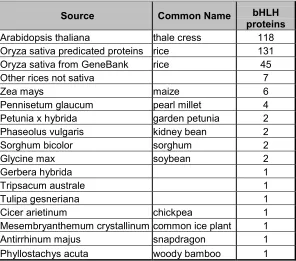
Table 1.1. Distribution of plant bHLH containing proteins in databases. Sequences from the rices Oryza australiensis, Oryza eichingeri, Oryza officinalis, and Oryza rufipogon were grouped together.
Source Common Name bHLH proteins
Arabidopsis thaliana thale cress 118 Oryza sativa predicated proteins rice 131
Oryza sativa from GeneBank rice 45
Other rices not sativa 7
Zea mays maize 6
Pennisetum glaucum pearl millet 4
Petunia x hybrida garden petunia 2
Phaseolus vulgaris kidney bean 2
Sorghum bicolor sorghum 2
Glycine max soybean 2
Gerbera hybrida 1
Tripsacum australe 1
Tulipa gesneriana 1
Cicer arietinum chickpea 1
Mesembryanthemum crystallinum common ice plant 1
Antirrhinum majus snapdragon 1
Table 1.2. The 15 distinct bHLH families in plants. Families have been named according to the name of the first discovered or best known member for the family. For uncharacterized families with members from both Arabidopsisthaliana and Oryzasativa are named with the abbreviation PbHLH for plant bHLH, families with members from just Arabidopsisthaliana are named with the abbreviation AbHLH for Arabidopsis bHLH. The plant bHLH leucine zipper family is named PbHLH-LZ. Bootstrap support has been classified as high (>75%), intermediate (50%-75%), or low (<50%). The number of members from the Arabidopsis and rice genome are indicated. The number of species is indicated by a = only in Arabidopsis; b = Arabidopsis and rice; c = three or more species. Characterization status is: none = sequence only; low = preliminary functional data exist for one member; inter = functional data for multiple members; high = exhaustive characterization has been done.
Family Name bHLH support Full length Support Arabidopsis Rice Species Characterization
PbHLH1 inter high 3 1 b none
PbHLH2 low high 4 3 b none
PbHLH3 high high 4 3 b none
PbHLH4 high inter 10 6 b none
PbHLH5 high low 4 9 b none
PbHLH6 low inter 12 12 b none
PbHLH7 low inter 9 8 b none
PbHLH8 high inter 1 2 b none
PbHLH-LZ low high 7 5 b none
AbHLH1 inter high 6 0 a none
Spatula low high 2 1 b inter
SAT low high 3 5 c low
7E/PG high inter 7 5 c inter
R low high 2 4 c high
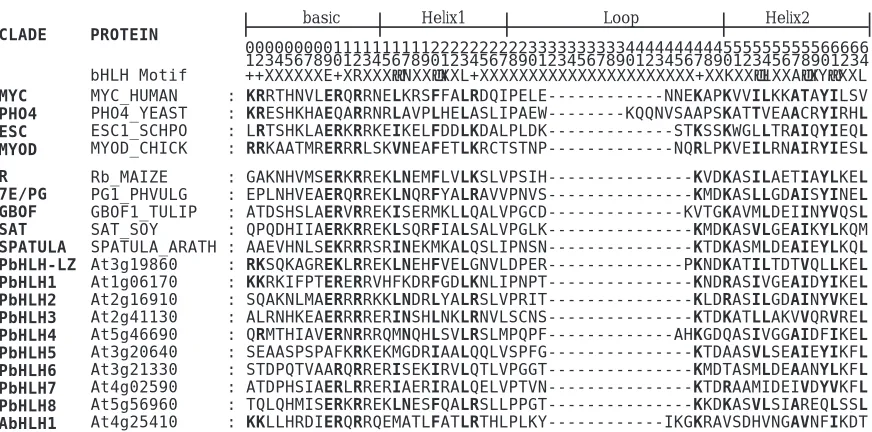
++XXXXXXE+XRXXXαNXXφXXL+XXXXXXXXXXXXXXXXXXXXXX+XXKXXδLXXAδXYαXXL Rb_MAIZE : PG1_PHVULG : GBOF1_TULIP : SAT_SOY : SPATULA_ARATH : At3g19860 : At1g06170 : At2g16910 : At2g41130 : At5g46690 : At3g20640 : At3g21330 : At4g02590 : At5g56960 : At4g25410 :
GAKNHVMSERKRREKLNEMFLVLKSLVPSIH---KVDKASILAETIAYLKEL
EPLNHVEAERQRREKLNQRFYALRAVVPNVS---KMDKASLLGDAISYINEL
ATDSHSLAERVRREKISERMKLLQALVPGCD---KVTGKAVMLDEIINYVQSL
QPQDHIIAERKRREKLSQRFIALSALVPGLK---KMDKASVLGEAIKYLKQM AAEVHNLSEKRRRSRINEKMKALQSLIPNSN---KTDKASMLDEAIEYLKQL RKSQKAGREKLRREKLNEHFVELGNVLDPER---PKNDKATILTDTVQLLKEL KKRKIFPTERERRVHFKDRFGDLKNLIPNPT---KNDRASIVGEAIDYIKEL
SQAKNLMAERRRRKKLNDRLYALRSLVPRIT---KLDRASILGDAINYVKEL
ALRNHKEAERRRRERINSHLNKLRNVLSCNS---KTDKATLLAKVVQRVREL
QRMTHIAVERNRRRQMNQHLSVLRSLMPQPF---AHKGDQASIVGGAIDFIKEL
SEAASPSPAFKRKEKMGDRIAALQQLVSPFG---KTDAASVLSEAIEYIKFL
STDPQTVAARQRRERISEKIRVLQTLVPGGT---KMDTASMLDEAANYLKFL
ATDPHSIAERLRRERIAERIRALQELVPTVN---KTDRAAMIDEIVDYVKFL
TQLQHMISERKRREKLNESFQALRSLLPPGT---KKDKASVLSIAREQLSSL KKLLHRDIERQRRQEMATLFATLRTHLPLKY---IKGKRAVSDHVNGAVNFIKDT MYC_HUMAN :
PHO4_YEAST : ESC1_SCHPO : MYOD_CHICK :
KRRTHNVLERQRRNELKRSFFALRDQIPELE---NNEKAPKVVILKKATAYILSV
KRESHKHAEQARRNRLAVPLHELASLIPAEW---KQQNVSAAPSKATTVEAACRYIRHL
LRTSHKLAERKRRKEIKELFDDLKDALPLDK---STKSSKWGLLTRAIQYIEQL RRKAATMRERRRLSKVNEAFETLKRCTSTNP---NQRLPKVEILRNAIRYIESL MYC PHO4 ESC MYOD R 7E/PG GBOF SAT SPATULA PbHLH-LZ PbHLH1 PbHLH2 PbHLH3 PbHLH4 PbHLH5 PbHLH6 PbHLH7 PbHLH8 AbHLH1 CLADE PROTEIN bHLH Motif 1234567890123456789012345678901234567890123456789012345678901234 0000000001111111111222222222233333333334444444444555555555566666
basic Helix1 Loop Helix2
Figure 1.1. Representative bHLH proteins, amino acid number scheme, and components of the bHLH domain. Designation of basic, helix, and loop regions and the numbering sequence for the individual amino acids follow Ferre-D’Amare et al. (1993). Predictive model and its relationship to the aligned bHLH domain for representative sequence for major evolutionary lineages according to Atchley and Fitch (1997). Top 3 sequence are representative group B sequences from animals and yeast, MYOD is representative group A sequence from animals, bottom 15 sequence are representative for the distinct plant clades. The predictive motif from Atchley et al. (1999) is represented above the sequences. Arabidopsis thaliana sequences are abbreviated with At. + = K, R; α = I, L V; φ = F, I, L; δ = I, V, T; and K, R, E, and N are as defined; and X = any residue. Mismatches to the bHLH motif are underlined.
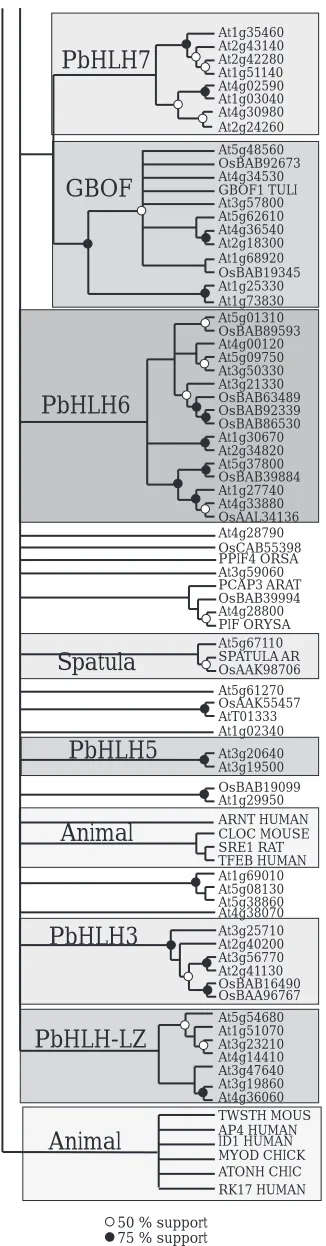
At5g48560 OsBAB92673 At4g34530 GBOF1 TULI At3g57800 At5g62610 At4g36540 At2g18300 At1g68920 OsBAB19345 At1g25330 At1g73830 At5g67110 SPATULA AR OsAAK98706 GBOF Spatula At1g35460 At2g43140 At2g42280 At1g51140 At4g02590 At1g03040 At4g30980 At2g24260 PbHLH7 At5g01310 OsBAB89593 At4g00120 At5g09750 At3g50330 At3g21330 OsBAB63489 OsBAB92339 OsBAB86530 At1g30670 At2g34820 At5g37800 OsBAB39884 At1g27740 At4g33880 OsAAL34136 PbHLH6 PPIF4 ORSA At3g59060 PCAP3 ARAT OsBAB39994 At4g28800 PIF ORYSA At4g28790 OsCAB55398 OsAAK55457 AtT01333 At3g20640 At3g19500 OsBAB19099 At1g29950 At5g61270 At1g02340 CLOC MOUSE SRE1 RAT TFEB HUMAN ARNT HUMAN PbHLH5 At1g69010 At5g08130 At5g38860 At4g38070 At3g25710 At2g40200 At3g56770 At2g41130 OsBAB16490 OsBAA96767 PbHLH3 At5g54680 At1g51070 At3g23210 At4g14410 At3g47640 At3g19860 At4g36060 PbHLH-LZ ATONH CHIC RK17 HUMAN AP4 HUMAN ID1 HUMAN MYOD CHICK TWSTH MOUS Animal Animal
50 % support 75 % support
28
Helix 2 Leucine Zipper
5555555555666666666677777777778888888888999999999900000 0123456789012345678901234567890123456789012345678901230 At4g14410 : KPAILDDAIRILNQLRDEALKLEETNQKLLEEIKSLKAEKNELREEKLVLKADKE At3g23210 : KSAILDDAIRVVNQLRGEAHELQETNQKLLEEIKSLKADKNELREEKLVLKAEKE RiceSf204_3 : KAAILSDATRMVIQLRAEAKQLKDTNESLEDKIKELKAEKDELRDEKQKLKVEKE RiceSf7393_2 : KSSILNDAIRVMAELRSEAQKLKESNESLQEKIKELKAEKNELRDEKQKLKAEKE At5g54680 : KAAILVDAVRMVTQLRGEAQKLKDSNSSLQDKIKELKTEKNELRDEKQRLKTEKE At1g51070 : KVAIINDAIRMVNQARDEAQKLKDLNSSLQEKIKELKDEKNELRDEKQKLKVEKE RiceSf6534_2 : KANILSDAARLLAELRGEAEKLKESNEKLRETIKDLKVEKNELRDEKVTLKAEKE At3g19860 : KATILTDTVQLLKELTSEVNKLKSEYTALTDESRELTQEKNDLREEKTSLKSDIE At4g36060 : KASVLTDTIQMLKDVMNQVDRLKAEYETLSQESRELIQEKSELREEKATLKSDIE RiceSf3645_3 : KACILTDTTRILRDLLSQVKSLRQENSTLQNESNYVTMERNELQDENGALRSEIS At3g47640 : KASILCEATRFLKDVFGQIESLRKEHASLLSESSYVTTEKNELKEETSVLETEIS RiceSf2825_2 : KACVLGETTRILKDLLSQVESLRKENSSLKNESHYVALERNELHDDNSMLRTEIL
30
Supplemental Table 1.1. The list of 118 bHLH protein sequences found in the Arabidopsis thaliana genome. Families have been named according to the name of the first discovered or best known member for the family. For uncharacterized families with members from both Arabidopsis thaliana and Oryza sativa are named with the abbreviation PbHLH for plant bHLH, families with members from just Arabidopsis thaliana are named with the abbreviation AbHLH for Arabidopsis bHLH. The plant bHLH leucine zipper family is named PbHLH-LZ. Name is the descriptive name for that protein if available. For uncharacterized proteins the locus is used.
LOCUS NAME CLADE
At1g12540 At1g12540 AbHLH1 At1g62975 At1g62975 AbHLH1 At4g25400 At4g25400 AbHLH1 At4g25410 At4g25410 AbHLH1 At5g51780 At5g51780 AbHLH1 At5g51790 At5g51790 AbHLH1
At1g18400 At1g18400 GBOF At1g25330 At1g25330 GBOF At1g59640 At1g59640 GBOF At1g73830 At1g73830 GBOF At2g18300 At2g18300 GBOF At3g57800 At3g57800 GBOF At4g36540 At4g36540 GBOF At5g62610 At5g62610 GBOF At1g10120 At1g10120 GBOF At1g26260 At1g26260 GBOF At1g68920 At1g68920 GBOF At3g23690 At3g23690 GBOF At4g34530 At4g34530 GBOF At5g48560 At5g48560 GBOF
At1g06170 At1g06170 PbHLH1 At2g31210 At2g31210 PbHLH1 At2g31220 At2g31220 PbHLH1
At1g12860 At1g12860 PbHLH2 At2g16910 At2g16910 PbHLH2 At5g10570 At5g10570 PbHLH2 At5g65640 At5g65640 PbHLH2
At2g40200 At2g40200 PbHLH3 At2g41130 At2g41130 PbHLH3 At3g25710 At3g25710 PbHLH3 At3g56770 At3g56770 PbHLH3
At4g01460 At4g01460 PbHLH4 At5g46690 At5g46690 PbHLH4 At5g53210 At5g53210 PbHLH4 At5g65320 At5g65320 PbHLH4
At1g27660 At1g27660 PbHLH5 At3g19500 At3g19500 PbHLH5 At3g20640 At3g20640 PbHLH5 At4g05170 At4g05170 PbHLH5
At1g27740 At1g27740 PbHLH6 At1g30670 At1g30670 PbHLH6 At1g66470 At1g66470 PbHLH6 At2g34820 At2g34820 PbHLH6 At3g21330 At3g21330 PbHLH6 At3g50330 At3g50330 PbHLH6 At4g00120 At4g00120 PbHLH6 At4g33880 At4g33880 PbHLH6 At5g01310 At5g01310 PbHLH6 At5g09750 At5g09750 PbHLH6 At5g37800 At5g37800 PbHLH6 At5g43175 At5g43175 PbHLH6
At1g03040 At1g03040 PbHLH7 At1g51140 At1g51140 PbHLH7 At2g24260 At2g24260 PbHLH7 At2g42280 At2g42280 PbHLH7 At2g43140 At2g43140 PbHLH7 At4g02590 At4g02590 PbHLH7 At4g09180 At4g09180 PbHLH7 At4g30980 At4g30980 PbHLH7 At5g58010 At5g58010 PbHLH7
At5g56960 At5g56960 PbHLH8
At1g51070 At1g51070 PBHLH-LZ At3g19860 At3g19860 PBHLH-LZ At3g23210 At3g23210 PBHLH-LZ At3g47640 At3g47640 PBHLH-LZ At4g14410 At4g14410 PBHLH-LZ At4g36060 At4g36060 PBHLH-LZ At5g54680 At5g54680 PBHLH-LZ
At4g00870 At4g00870 PG At5g46830 At5g46830 PG At1g01260 At1g01260 PG At1g32640 RAP1_ARATH PG At2g46510 At2g46510 PG At4g16430 At4g16430 PG At5g46760 At5g46760 PG
32
At4g00480 At4g00480 R At5g41315 At5g41315 R At4g09820 TRT8_ARATH R
At2g22750 At2g22750 SAT At2g22760 At2g22760 SAT At2g22770 At2g22770 SAT
At4g36930 SPATULA_ARATH SPATULA At5g67110 ALCATRAZ_ARATH SPATULA
Supplemental Table 1.2. The list of 177 rice bHLH proteins from the rice genome project and genebank. Families have been named according to the name of the first discovered or best known member for the family. For uncharacterized families with members from both Arabidopsis thaliana and Oryza sativa are named with the abbreviation PbHLH for plant bHLH, families with members from just Arabidopsis thaliana are named with the abbreviation AbHLH for Arabidopsis bHLH. The plant bHLH leucine zipper family is named PbHLH-LZ. For predict proteins from the rice genome project, the scaffold number and location is used for the accession and name. Name is the descriptive name for that protein if available. For uncharacterized proteins the accession is used.
ACCESSION NAME CLADE OTHER NAMES
Scaffold3741_2 Scaffold3741_2 GBOF Scaffold5384_2 Scaffold5384_2 GBOF Scaffold11264_1 Scaffold11264_1 GBOF Scaffold1853_1 Scaffold1853_1 GBOF Scaffold1424_4 Scaffold1424_4 GBOF BAB92673 OsBAB92673 GBOF Scaffold6057_1 Scaffold6057_1 GBOF Scaffold736_2 Scaffold736_2 GBOF Scaffold4152_1 Scaffold4152_1 GBOF Scaffold4582_1 Scaffold4582_1 GBOF BAB19345 OsBAB19345 GBOF
BAA96639 OsBAA96639 PbHLH1
Scaffold1855_1 Scaffold1855_1 PbHLH2 AAN05491 OsAAN05491 PbHLH2 Scaffold490_1 Scaffold490_1 PbHLH2 AAG13585 OsAAG13585 PbHLH2 BAB92907 OsBAB90745 PbHLH2
BAA96767 OsBAA96767 PbHLH3 BAB16490 OsBAB16490 PbHLH3 Scaffold686_1 Scaffold686_1 PbHLH3 Scaffold5425_1 Scaffold5425_1 PbHLH3
Scaffold2928_4 Scaffold2928_4 PbHLH4 Scaffold3094_1 Scaffold3094_1 PbHLH4 Scaffold1168_5 Scaffold1168_5 PbHLH4 AAN74827 OsAAN74827 PbHLH4 Scaffold4022_1 Scaffold4022_1 PbHLH4 AAN64142 OsAAN64142 PbHLH4 Scaffold2332_4 Scaffold2332_4 PbHLH4 Scaffold2297_4 Scaffold2297_4 PbHLH4 AAM08539 OsAAM08539 PbHLH4
34
Scaffold3783_1 Scaffold3783_1 PbHLH5 Scaffold830_4 Scaffold830_4 PbHLH5 Scaffold11851_1 Scaffold11851_1 PbHLH5 Scaffold7728_3 Scaffold7728_3 PbHLH5 Scaffold1479_3 Scaffold1479_3 PbHLH5 Scaffold1500_2 Scaffold1500_2 PbHLH5 Scaffold9728_2 Scaffold9728_2 PbHLH5
Scaffold6870_1 Scaffold6870_1 PbHLH6
Scaffold6833_1 Scaffold6833_1 PbHLH6 BAB923391, BAB865301 Scaffold3243_4 Scaffold3243_4 PbHLH6
BAB39884 OsBAB39884 PbHLH6
Scaffold3354_1 Scaffold3354_1 PbHLH6 AAN641421 Scaffold3485_3 Scaffold3485_3 PbHLH6
BAB92339 OsBAB92339 PbHLH6 Scaffold10_4 Scaffold10_4 PbHLH6 Scaffold639_1 Scaffold639_1 PbHLH6 Scaffold1122_4 Scaffold1122_4 PbHLH6 BAB86530 OsBAB86530 PbHLH6 Scaffold336_2 Scaffold336_2 PbHLH6 Scaffold7394_3 Scaffold7394_3 PbHLH6 BAB89593 OsBAB89593 PbHLH6 BAB63489 OsBAB63489 PbHLH6 AAL34136 OsAAL34136 PbHLH6 Scaffold16392_1 Scaffold16392_1 PbHLH6 Scaffold306_6 Scaffold306_6 PbHLH6
Scaffold8328_1 Scaffold8328_1 PbHLH7 Scaffold3229_3 Scaffold3229_3 PbHLH7 Scaffold571_1 Scaffold571_1 PbHLH7 Scaffold1780_4 Scaffold1780_4 PbHLH7 Scaffold936_5 Scaffold936_5 PbHLH7 Scaffold493_4 Scaffold493_4 PbHLH7
Scaffold9048_1 Scaffold9048_1 PbHLH7 BAB89954
Scaffold4484_1 Scaffold4484_1 PbHLH7
BAB61947 OsBAB61947 PbHLH8 BAB61952 OsBAB61952 PbHLH8 Scaffold13760_1 Scaffold13760_1 PbHLH8 BAB61944 OsBAB61944 PbHLH8 BAB90265 OsBAB90265 PbHLH8
Scaffold1113_3 Scaffold1113_3 PbHLH8
Scaffold6534_2 Scaffold6534_2 PBHLH-LZ Scaffold3645_3 Scaffold3645_3 PBHLH-LZ
Scaffold2825_2 Scaffold2825_2 PBHLH-LZ BAC20669 Scaffold204_3 Scaffold204_3 PBHLH-LZ
Scaffold7393_2 Scaffold7393_2 PBHLH-LZ
BAB44034 OsBAB44034 PG
BAA92907 OsBAA92907 PG
BAB64302 OsBAB64302 R
Scaffold8031_1 Scaffold8031_1 R
BAB32928 OsBAB32928 R
Scaffold6437_2 Scaffold6437_2 R
BAB91797 PRa_ORSA R
BAB91807 OsBAB91807 R
AAC49220 Rb_ORYSA R
Scaffold5346_1 Scaffold5346_1 SAT Scaffold9570_1 Scaffold9570_1 SAT Scaffold9071_3 Scaffold9071_3 SAT Scaffold416_6 Scaffold416_6 SAT
AAM27466 OsAAM27466 SAT
AAK00421 OsAAK00421 SAT
AAK98706 OsAAK98706 SPATULA Scaffold472_4 Scaffold472_4 SPATULA
Scaffold1314_2 Scaffold1314_2 AAK554671 Scaffold134_2 Scaffold134_2
Scaffold135_7 Scaffold135_7 BAB199531, BAC214081 Scaffold1815_2 Scaffold1815_2
Scaffold11107_2 Scaffold11107_2 Scaffold10872_1 Scaffold10872_1
Scaffold13369_2 Scaffold13369_2 OsBAB39994 Scaffold13763_1 Scaffold13763_1
Scaffold1390_4 Scaffold1390_4 Scaffold10825_1 Scaffold10825_1
Scaffold104_6 Scaffold104_6 CAB55398 BAB19099 OsBAB19099
Scaffold1034_3 Scaffold1034_3 Scaffold10266_2 Scaffold10266_2
Scaffold10260_1 Scaffold10260_1 AAN054911 Scaffold12525_2 Scaffold12525_2
Scaffold1929_3 Scaffold1929_3 BAA96639 Scaffold10116_1 Scaffold10116_1 OsBAB39884 Scaffold1127_2 Scaffold1127_2 BAB902651 Scaffold1462_2 Scaffold1462_2
Scaffold8702_1 Scaffold8702_1
Scaffold5684_1 Scaffold5684_1 AAM274661 Scaffold589_6 Scaffold589_6 AAM085391 Scaffold634_1 Scaffold634_1 BAA92907 Scaffold6620_1 Scaffold6620_1 AAN748271 Scaffold7164_3 Scaffold7164_3
36
Scaffold7575_1 Scaffold7575_1 BAB643021 Scaffold763_2 Scaffold763_2 BAB619521 Scaffold7838_2 Scaffold7838_2
Scaffold4220_2 Scaffold4220_2
Scaffold8122_2 Scaffold8122_2 AAK987061 Scaffold5049_1 Scaffold5049_1
Scaffold8739_3 Scaffold8739_3 BAB19099 Scaffold9973_1 Scaffold9973_1
Scaffold9993_1 Scaffold9993_1 OsS65802 AAC49219 OsAAC49219 BAB08206 BAB08206 BAB64301 OsBAB64301 BAB64689 OsBAB64689 BAB86512 OsBAB86512 BAB90745 BAB90745 BAC00537 BAC00537 BAC21408 BAC21408 Scaffold81206_1 Scaffold81206_1 Scaffold3635_2 Scaffold3635_2 Scaffold1981_2 Scaffold1981_2
Scaffold20214_1 Scaffold20214_1 BAB16490, BAC005371 Scaffold2032_4 Scaffold2032_4
Scaffold21450_1 Scaffold21450_1 BAB619441 Scaffold2174_1 Scaffold2174_1
Scaffold2423_1 Scaffold2423_1 BAB926731 Scaffold2528_1 Scaffold2528_1
Scaffold261_5 Scaffold261_5 Scaffold3009_2 Scaffold3009_2
Scaffold307_6 Scaffold307_6 OsBAA96767, BAB08206 Scaffold3215_1 Scaffold3215_1 Scaffold5425_2 Scaffold5425_2 Scaffold3345_1 Scaffold3345_1 Scaffold5360_2 Scaffold5360_2 Scaffold4451_1 Scaffold4451_1 CAD41010 OsCAD41010 Scaffold4606_2 Scaffold4606_2
Scaffold4766_2 Scaffold4766_2 OsAAG13585 Scaffold4862_2 Scaffold4862_2
Scaffold4870_2 Scaffold4870_2 Scaffold492_6 Scaffold492_6
Scaffold493_7 Scaffold493_7 SCAFFOLD493_4 Scaffold4999_4 Scaffold4999_4 OsBAB44034, BAB865121 Scaffold5031_2 Scaffold5031_2 BAB895931
Scaffold19496_1 Scaffold19496_1 BAB32928, BAB918071 Scaffold32398_1 Scaffold32398_1
R Group MID 612
7E/PG MID? 642
321
GBOF
347
SAT MSD
PbHLH1 420
PbHLH2 350
PbHLH3 253
PbHLH4 371
AbHLH1 221
PbHLH5 296
PbHLH6 298
466
PbHLH8
373
Spatula
PbHLH7 378
PbHLH-LZ 272
L-zip
bHLH domain
Supplemental Figure 1.1. The conserved regions within each clade are shown in boxes, bHLH domains are shaded, average protein size on right. Most of the domains have unknown function. R has a Myb interaction domain (MID), 7E/PG has a possible Myb interaction domain, SAT has predicted membrane spanning domain (MSD), and PbHLH-LZ contains a leucine zipper (L-zip).
Structural Evolution of the Basic Helix-Loop-Helix Proteins
By
Michael J. Buck1 and William R. Atchley1
1. Department of Genetics and the Center for Computational Biology, North Carolina
State University, Raleigh, NC 27695-7614
Michael J. Buck
North Carolina State University Department of Genetics
Campus Box 7614 Raleigh, NC 27695-7614 Tel. 919-515-5759 Fax 919-515-3355 [email protected]
40 Abstract
Motivation: Recently, there has been a tremendous influx of biological sequence
data, with little accompanying information about structural attributes. This deficiency
argues for the development of objective techniques able to facilitate obtaining
protein structural data from sequences. Characterization of unknown proteins using
computational methods has been limited to sequence-based homology predictions
among closely related sequences. Generally, structure-based prediction of protein
function is preferred over sequence-based approaches because structure is
evolutionarily more conserved and permits more accurate conclusions about
function than does analysis of sequences alone. The lack of available structural
templates and the paucity of rigorous statistical techniques for comparing structures,
limits the use of structure-based homologies to characterize new sequences.
Herein, we use homology modeling and three novel techniques to compare 3D
structures within the basic helix-loop-helix proteins (bHLH). We are interested in
uncovering the biological function and structure, of poorly understood members of
the basic helix-loop-helix (bHLH) protein super-family of transcriptional regulators.
bHLH proteins have evolved along many different lineages suggesting considerable
functional divergence. A number of divergent bHLH clades have been well
characterized in terms of structure and function, but some clades discovered in
genome sequencing projects have unknown functions and have ambiguous
relationships to known clades. Although the primary sequence of these proteins has
Results: In our investigations, we defined four residue types based on sequence
and structural diversity from an average bHLH protein. We compared a number of
3D structural models of well-characterized members of the bHLH family to bHLH
proteins whose function has not been characterized. We utilized three structural
comparison techniques: i) a modified pairwise root mean square deviation, ii) a new
structural parsimony approach, and iii) site by site multidimensional scaling. Using
these approaches we have discovered structural similarity within the bHLH domain
between three clades (Max, Myc, and PbHLH-LZ). Each of these clades contains a
C-terminal leucine zipper immediately following the bHLH domain. In addition,
structural models of the Sat proteins suggest a strong similarity to other bHLH
proteins, which is unexpected due to it unique functional characterization as a
symbiotic ammonium transporter.
Availability: Perl scripts available, contact author.
Contact: [email protected]
Keywords: basic helix-loop-helix; homology modeling; structural parsimony; root
mean square deviation.
Introduction:
The basic helix-loop-helix (bHLH) family of proteins is a large group of
functionally diverse transcription factors that function in the control of a number of
important developmental processes in both plants and animals (Garrell and
Campuzano 1991; Quail 2000; Wright 1992). The distinguishing structural
42
This bipartite domain is comprised of a DNA-binding basic region, which binds to a
consensus hexanucleotide E-box (CANNTG) and two α-helices separated by a
variable loop region. The two α-helices promote dimerization, allowing the formation
of homo- and heterodimers between different bHLH family members. While the
bHLH domain is evolutionarily conserved (Atchley and Fitch 1997), there is little
sequence similarity between clades beyond the bHLH domain (Morgenstern and
Atchley 1999).
In animals, bHLH proteins are involved in regulation of a wide variety of
developmental processes including neurogenesis, myogenesis, cell proliferation and
differentiation, cell lineage determination, sex determination, and other essential
processes (reviewed by Massari and Murre 2000). In plants, bHLH proteins function
in transcriptional regulation associated with anthocyanin biosynthesis, phytochrome
signaling, and globulin expression. Phylogenetic analysis using only the bHLH
domain uncovered 44 orthologous clades in animals (Atchley and Fitch 1997; Ledent
and Vervoort 2001) and 15 in plants (Buck and Atchley 2003). Of these 15 plant
clades only six have been functionally characterized.
There are six solved 3D structures for the bHLH proteins including: Pho4
(Shimizu et al. 1997), MyoD (Ma et al. 1994), USF (Ferre-D'Amare et al. 1994), Max
(Brownlie et al. 1997), E47 (Ellenberger et al. 1994), and SREBP1 (Parraga et al.
1998). All of the solved structures share a common globular, parallel, left-handed,
four-helix bundle, which is stabilized by a well-defined hydrophobic core
(Ferre-D'Amare and Burley 1995). Several clades of bHLH proteins contain a C-terminal
dimerization surface. Removal of the LZ domain in USF, giving the minimal bHLH
consensus results in a proteins that retains wild-type DNA specificity. However, the
LZ deficient form has a equilibrium dissociation constant as much as 1000 fold
higher then the intact bHLH-LZ protein (Ferre-D'Amare et al. 1994). Absence of the
LZ domain can be compensated by the presence of a few amino acid substitutions in
the 2nd helix (Ferre-D'Amare and Burley 1995).
There are a limited number of techniques for the comparison of protein
structures. Traditionally the most widely used measure, is a root-mean squared
distance (RMSD) calculated between equivalent atoms in two separate proteins.
RMSD is 0 for identical structures and its value increases as the two structures
diverge. Although, RMSD is a reliable indicator of similarity for closely related
proteins, there are several disadvantages with this measure. First, RMSD is an
average distance. Each site is given equal weight and, as a result, a few poorly
fitting atoms can inflate the overall RMSD value. Second, the distance is only
calculated between equivalent atoms in two structures and the choice of the
equivalent atoms is usually automatic and based on the structural alignment.
Therefore, two RMSD from different pairs of structures may not be comparable,
because of unequal number of atoms or selection of non-homologous atoms
between the pairs. For example, a multi-domain protein may share certain
equivalent atoms from its first domain with protein A and other equivalent atoms
from its second domain with protein B. Thus, the resultant two RMSD values are not
equivalent and distance based trees constructed from such data are inaccurate.