Design and Implementation of Smart Home
System
D.Prasad
1Professor, Department of ECE, Ramanandatirtha Engineering College, Nalgonda, India1
ABSTRACT: The approach of the paper is to design and advance reliable, efficient, flexible, economical, real-time and realistic wireless sensor networks for smart home systems. Primarily, this paper analyzes the features of ZigBee technology, device types, network topologies and ZigBee protocol specification. Furthermore, a design scheme of smart home system based on ZigBee technology is placed forward and deliberated. Then, the hardware design of ZigBee nodes based on CC2530 chip is given. Smart home services using proposed effective methods diminish energy consumption. To support multi-hop communication improved routing algorithm based on Dijkstra algorithm is presented.
KEYWORDS: Smart home; ZigBee; WSN, GPRS, Dijkstra Algorithm.
I. INTRODUCTION
A wireless sensor network is aassembly of nodes that intermingle with each other in order to form a network. Each node comprises of processing capability, memory, an RF transceiver, power source and various sensors depending on the application. There are several application areas that wireless sensor networks are used in including environmental, military, medical, building automation, entertainment and many others.With the quick development of technology and the enhancement of living standards, the ultimatum of people for home environment is also growing. As anoutcome, the technology of smart home turns out, and progresses quickly as the network growths. Smart home is a grouping of modern computer technology, control technology and information technology. The development of smart home technology has undertaken wired and wireless stages [1].
Due to the cable constraint and poor scalability of wired network, wireless technology will be an unavoidabletendency for home network. ZigBee is a recently developed wireless communication technology in short range, which has numerous features, such as short range, low-power, low-rate and low-cost. ZigBee technology can deliver users with a mobile, flexible networking and is very suitable for home control [2, 3].
In order to take the compensations of the characteristics of ZigBee technology and applications in the controlling network, we put presumptuous a smart home system based on ZigBee technology in this paper. The smart home system based on ZigBee technology in this paper does not need wiring and can be installed directly in the home. The system can realize home monitoring and terminal nodes supervisory by user management platform. What's more, in this smart home system, each sensor terminal node can collect environment data in home, such as brightness, temperature, humidity, security state, and each supervisory terminal node can be connected with some home devices, such as light, air condition, electric curtain, alarm, etc.
Table 1 Comparison of ZigBee, Bluetooth and Wi-Fi technologies
Technical indicators
Zigbee Bluetooth Wi-Fi
Number of
network nodes
65536 7 32
Power consumption
Low Medium High
Transmission rate/bps
250M 1M 1M
Transmission distance/m
10~75 10 100
Frequency/GHz 2.4 2.4 2.4
II. RELATEDWORK
Relating to the communication protocols like Bluetooth, IrDA, GPRS and ZigBee, several possibilities exist. Each of them has some benefits and shortcomings. To pick good one from them, their pros and cons have to be weighted. The different protocols are compared considering the application requirements including data transmission rate, range, battery life and cost [4].
Home Security with Messaging System, Security & Control System, and Remote and Security Control via SMS were the three alarm system that were designed using SMS application to securely monitor the home condition when the owner are away or at night. The system described in [5], is also based on GSM technology. The system is wireless and it provides security against intrusion as well as automates various home appliances using SMS. The system uses GSM technology thus providing universal access to the system for security and automated appliance control.
Liang et al [6] developed a system of wireless smart home sensor network based on ZigBee and PSTN (Public Switched Telephone Network) technologies. To overcome the problems in traditional designs we presented GPRS instead of PSTN technology for better system performance.
Rendering to their supposition it is beneficiary that ZigBee communication protocol is appropriate one which gives advantages like high range, very low power consumption and low cost.
III.SYSTEMDESIGN
Fig.1. Overall Framework of Smart Home System Fig.2 Design Structure of Smart Home System
A. Design of Smart Home System
The smart home system intended in this paper uses the star network topology and emphases on the internal network, which mainly comprises the user management platform, ZigBee coordinator and ZigBee terminal nodes, as showed in Fig.2. Due to the smart home system based on ZigBee technology is reinforced by computer technology, sensor network technology and control technology, so the design of smart home can be divided into three blocks [9].
1) Smart home user management platform: Smart home user management platform is achieved on PC, which realizes the home network management and controlling through the simple man-machine interface.
2) Smart home sensor network: The sensor network is based on the ZigBee protocol stack. Users can control wireless nodes distributed indoor. The sensor network is primarily composed by the ZigBee coordinator, ZigBee sensor terminal nodes and ZigBee controlling terminal nodes.
3) Smart home control technology: CC2530 is the core chip of each node in this system. The control technology mainly contains the process of data collecting by ZigBee sensor terminal nodes and the management of the controlling terminal nodes by the coordinator.
B. Monitoring system using GPRStechnology
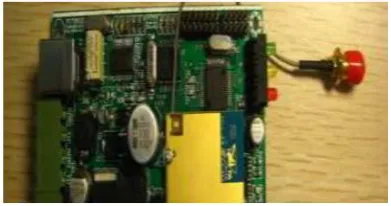
Fig. 3. Coordinator node developed
C. Routing algorithm
The smart home system using the WSN establishedcan be demonstrated as a (wireless) network, and the routingpoint is the node in the network. The conventional Dijkstraalgorithm [7] produces the shortest path rendering to theorder of increasing path length, and insatiably quests pathbased on the edges connected with nodes. On the other hand, there isno edge in the wireless network. Consequently in this paper, weadvise an improved Dijkstra algorithm for the WSN,which attains the shortest path in the network.
Assume that there are n nodes in a wirelessnetwork, and the location of each node is available. Formerly wecan get table of distances between nodes by using thefollowing algorithm [8]:
(1) A node is randomly selected as the root node. Afterinitialized, it will send messages to enclosed nodes requesting for their IDs and location information.
(2) In reply to Step (1), the residual n-1 nodes sendtheir IDs and location information to the root node.
(3) The distance table is produced after the root node hasacknowledged all the information of remaining n -1 nodes. For instance, Table II distance table taken using a simplewireless network sample of 10 nodes from figure 4.
Fig. 4. An Example Network of 10 Nodes Table II
The corresponding distance table is shown in Table I and here, we practice an improved Dijkstra algorithm to assume theoptimal path. Some symbols and notations used in thealgorithm are listed in Table III.
Node ID
1 2 3 4 5 6 7 8 9 10
1 0 4 2 5 5 7 6 8 9 9
2 4 0 2 7 6 5 5 7 7 8
3 2 2 0 5 4 5 4 6 7 8
4 5 7 5 0 3 8 7 7 9 8
5 5 6 4 3 0 6 5 2 7 5
6 7 5 5 8 6 0 3 8 2 5
7 6 5 4 7 4 3 0 5 4 4
8 8 7 6 7 2 8 5 0 6 4
9 9 7 7 9 7 2 4 6 0 4
Table III
Symbol Description
N Number of network nodes
v Sending node
w Receiving node
k Transmission radius
u Relay node
s[i] Visit mark(if not visited, set [i]=0; else set s[i]=1) Cost[i][j] Distance between node i and node j Dist to w Distance corresponding to the optimal path from v
The improved Dijkstra algorithm is described in the following: (1) Initialization: num=0, dist=+∞, s[i] =0, (i=0, 1,…n); (2) If cost[v][i] ≤k, then set s[i]=1, (i=0,1,…n);
(3) If s[w] =1, then dist=cost[v][w]; otherwise go to step (4);
(4) ∀ i ∈ {s[i]=1}, u[num]=1, set s[j]=1 when j∈{cost[u[num]][j] ≤k}, (j=0,1,…n);
(5) If s[w] ≠ 1, then num++, repeat step (4); otherwise record the path that fulfills s[w]=1, and dist[num] = cost [ v][ u[0]] num-1+Σ cos [ u[j ]][u [j + 1]] + cost [u [num]] [ w]; J=0
(6) For num=num+1, repeat steps (4) and (5) until all the paths that fulfil s[w]=1 are obtained; (7) Set dist=min{dist[i], i=0,1…num}, and output the corresponding path.
To calculate the performance of routing algorithms, a general apprehension would be the energy consumption of the network nodes. If a node is put into sleep as long as it has no data to receive or send (and all state switching overheads are negligible), its energy consumption will be approximately proportional to the number of times it is visited (i.e. the number of packets it has transferred).
IV.SOFTWARE DESIGN OF THE SYSTEM
Fig.5. Workflow of ZigBee Coordinator
V. CONCLUSION
The smart home system based on ZigBee technology is a new solution that used to meet the demand of high automation and intelligent home. In this paper, we introduce the advantages of ZigBee technology, architecture of ZigBee protocol, topologies and device type of ZigBee network. Then we put forward and discuss a design structure of smart home system. After that, the details of hardware and software design in smart home system are also given, which include the design of coordinator, terminal nodes and user management platform.Also, this paper presents Dijkstra shortest path routing algorithm along with evaluation of performance which give energy consumption of network nodes.Because of the prominent advantages of low cost, low power and flexibility, and as the further development of wireless network technology, ZigBee technology will become a foreseeable trend in the development of smart home.
REFERENCES
[1] W. Liu and Y. Yan, “Application of ZigBee wireless sensor network in smart home system”, InternationalJournal of Advancements in Computing Technology, vol. 3, no. 5, (2011), pp. 154-160.
[2] L. Li, W. Xie, Z. He, X. Xu, C. Chen, and X. Cui, “Design of smart home control system based on ZigBee and embedded web technology”, Proceedings of International Conference on Artificial Intelligence andComputational Intelligence, (2012) October 26-28, Chengdu, China.11, 2010
[3] C. Gao, Z. Ling, and Y. Yuan, “The research and implement of smart home system based on internet of things”, Proceedings of International Conference on Electronics, Communications and Control, (2011) September 9-11, Ningbo, China.
[5] Chetana Sarode, Prof.Mr.H.S.Thakar,” Intelligent Home monitoring system”, International Journal of Engineering Research and Applications (IJERA) ISSN: 2248-9622 www.ijera.com Vol. 3, Issue 1, January -February 2013, pp.1446-1450.
[6] L.L. Liang, L.F. Huang, X.Y. Jiang, V. Yao, “Design and implementation of wireless smart-home sensor network based on ZigBee protocol,” International Conference on Communications, Circuits and Systems, 2008, pp. 434-438.
[7] C.P. Liu, “Mathematical Modeling,” High Education Press, 2002.
[8] L. Liang, L. Huang, X. Jiang, and Y. Yao, “Design and implementation of wireless smart-home sensor network based on ZigBee protocol”, Proceedings of International Conference on Communications, Circuits and Systems, (2008) May 25-27, Xiamen, China.
[9] Z. Zou, K. Li, R. Li, and S. Wu, “Smart home system based on IPV6 and ZigBee technology”, Proceedings of International Conference on Advanced in Control Engineering and Information Science, (2011) August 18-19,Dali, China.
[10] Y. Wu, T. Wu, and P. Liu, “Smart home system based on ZigBee and ARM”, Proceedings of IEEE International Conference on Electronic Measurement and Instruments, (2013) August 16-18, Harbin, China.
BIOGRAPHY