ISSN: 2319-8753
International Journal of Innovative Research in Science,
Engineering and Technology
(An ISO 3297: 2007 Certified Organization)
Vol. 3, Issue 1, January 2014
Influence of Source of Fly Ash on Compressive
Strength of Concretes
Satyanarayana Ch.G.
1, Kishore Kumar M
2M.Tech Scholar, Department of Civil Engineering, Pydah College of Engineering, Visakhapatnam, India
Associate Professor, Department of Civil Engineering, GVP College of Engineering, Visakhapatnam, India
Abstract: In this paper, research has been carried out pertaining to the influence of source of fly ash on compressive strength of concrete, due to the change in source both physical and chemical properties of fly ash has been carried out. It was found that the there was no influence of source on the three fly ashes collected for this investigation. The compressive strength of concretes in which cement was partially replaced with fly ash is presented.
Keywords: Fly ash, properties, workability, Compressive Strength
I. INTRODUCTION
Fly ash has been procured from three different thermal power plants in India. The Fly ash samples collected were tested for their physical and chemical properties to identify the Class of Fly ash as per ASTM. The compressive strength of concretes made with fly ash is compared with the control concrete. The results pertaining to the compressive strength have been shown in table no. 5 & 6.
II. MATERIALS USED
A. Cement
Ordinary Portland cement of 53 grade with specific gravity of 3.15 has been used. The initial setting time and final setting time were found to be 33min and 315min respectively.
B. Fine Aggregate
Locally available natural river sand passing through 4.75 mm I.S. Sieve with a fineness modulus of 2.97, and water absorption of 1.5% in saturated surface dry (SSD) condition was used. The specific gravity of the sand is found to be 2.57 and was confining to ZONE-III.
C. Natural coarse aggregate
Crushed granite metal from local sources, passing through 20 mm and retained on 4.75 mm sieve was used as natural coarse aggregate. The fineness modulus of Natural Coarse Aggregate (NCA) is 6.48 and its water absorption is 0.94% in SSD condition. The specific gravity of coarse aggregate is found to be 2.65.
E. Water
Potable fresh water available from local sources free from deleterious materials was used for mixing and curing of all the mixes tried in this investigation. W/C ratio is taken as 0.47 for M25 and 0.45 for M30 concrete.
F. Fly Ash
ISSN: 2319-8753
International Journal of Innovative Research in Science,
Engineering and Technology
(An ISO 3297: 2007 Certified Organization)
Vol. 3, Issue 1, January 2014
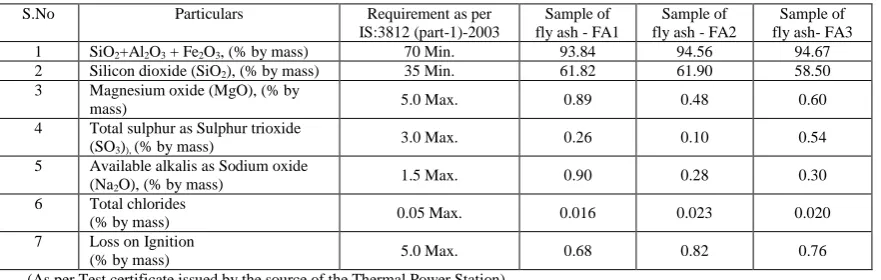
tested samples of fly ash as per IS 3812-Part 1, 2003 are given in table 1. The chemical properties of the tested samples of fly ash as per IS 3812-Part 1, 2003 are given in table 2. The collected fly ash samples represent the Class F Fly ash as per ASTM classification of fly ashes.
Table: 1 Test results of Physical Properties of collected samples of fly ash tested as per IS:3812 (part-1) -2003
S.No Particulars Requirement as per
IS:3812 (part-1)-2003
Sample of fly ash - FA1
Sample of fly ash- FA2
Sample of fly ash- FA3
1 Fineness (cm2/Kg)
Blain’s permeability method 3200 Minimum 3900 4120 4030
2 Lime Reactivity
Average compressive strength,
N/mm2
4.5 Minimum 5.4 4.8 5.2
3 compressive strength at 28 days,
N/mm2 strength of corresponding Not less than 80% of the
plain cement mortar cubes
85 90 89
4 Soundness by auto clave (%) 0.8 Maximum 0.10 0.11 0.10
5 Particles retained on 45 micron IS :
sieve (wet sieving), (% by mass) 34 Maximum 29 31 32
6 Specific Gravity 2.35 2.48 2.25
(As per Test certificate issued by the source of the Thermal Power Station)
Table: 2 Test results of Chemical Properties of collected samples of fly ash tested as per IS:3812 (part-1) -2003
S.No Particulars Requirement as per
IS:3812 (part-1)-2003
Sample of fly ash - FA1
Sample of fly ash - FA2
Sample of fly ash- FA3
1 SiO2+Al2O3 + Fe2O3, (% by mass) 70 Min. 93.84 94.56 94.67
2 Silicon dioxide (SiO2), (% by mass) 35 Min. 61.82 61.90 58.50
3 Magnesium oxide (MgO), (% by
mass) 5.0 Max. 0.89 0.48 0.60
4 Total sulphur as Sulphur trioxide
(SO3)), (% by mass) 3.0 Max. 0.26 0.10 0.54
5 Available alkalis as Sodium oxide
(Na2O), (% by mass)
1.5 Max. 0.90 0.28 0.30
6 Total chlorides
(% by mass) 0.05 Max. 0.016 0.023 0.020
7 Loss on Ignition
(% by mass) 5.0 Max. 0.68 0.82 0.76
(As per Test certificate issued by the source of the Thermal Power Station)
Table 3: Concrete Mix Proportions of M25 grade
Mixes Raw Materials in kg per m3
Cement Fly ash Sand Zone-II
Aggregate w/b ratio
0% FA 340 - 663 1160 0.50
5% FA 323 17 663 1160 0.50
10% FA 306 34 663 1160 0.50
15% FA 289 51 663 1160 0.50
20% FA 272 68 663 1160 0.50
25% FA 255 85 663 1160 0.50
30% FA 238 102 663 1160 0.50
35% FA 221 119 663 1160 0.50
ISSN: 2319-8753
International Journal of Innovative Research in Science,
Engineering and Technology
(An ISO 3297: 2007 Certified Organization)
Vol. 3, Issue 1, January 2014
Table 4: Concrete Mix Proportions of M30 grade
Mixes Raw Materials in kg per m3
Cement Fly ash Sand Zone-II
Aggregate w/b ratio
0% FA 360 - 654 1178 0.48
5% FA 342 18 654 1178 0.48
10% FA 324 36 654 1178 0.48
15% FA 306 54 654 1178 0.48
20% FA 288 72 654 1178 0.48
25% FA 270 90 654 1178 0.48
30% FA 252 108 654 1178 0.48
35% FA 234 126 654 1178 0.48
40% FA 216 144 654 1178 0.48
III.EXPERIMENTAL DETAILS
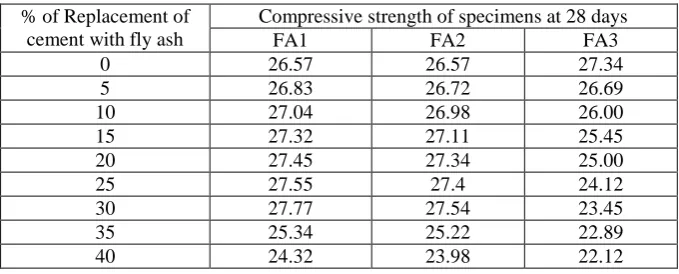
The concrete specimens were made with fly ash of different replacement of cement. The compressive strength of two different grades M25 and M30 were casted. The specimens of 150x150x150 mm cubes were used for the Compression test. Three specimens were tested for the required age and mean value were taken and reported. The compressive strength of concrete mixes at28 days were shown in tables 5 and 6.
Table: 5 Compressive strength of specimens at 28 days made with fly ash obtained from three different power plants of M25 grade of concrete
% of Replacement of cement with fly ash
Compressive strength of specimens at 28 days
FA1 FA2 FA3
0 26.57 26.57 27.34
5 26.83 26.72 26.69
10 27.04 26.98 26.00
15 27.32 27.11 25.45
20 27.45 27.34 25.00
25 27.55 27.4 24.12
30 27.77 27.54 23.45
35 25.34 25.22 22.89
40 24.32 23.98 22.12
Table: 6 Compressive strength of specimens at 28 days made with fly ash obtained from three different power plants of M30 grade of concrete
% of Replacement of cement with fly ash
Compressive strength of specimens at 28 days
FA1 FA2 FA3
0 32.61 32.61 32.61
5 32.98 32.78 32.68
10 33.18 32.96 32.84
15 33.48 33.22 33.04
20 33.74 33.34 33.22
25 33.98 33.58 33.36
30 34.16 34.08 33.98
35 32.24 32.02 31.98
ISSN: 2319-8753
International Journal of Innovative Research in Science,
Engineering and Technology
(An ISO 3297: 2007 Certified Organization)
Vol. 3, Issue 1, January 2014
Fig.1. Compressive Strength of specimens made with fly ash obtained from three different power plants of M25 grade of concrete
Fig.2. Compressive Strength of specimens made with fly ash obtained from three different power plants of M30 grade of concrete
0 5 10 15 20 25 30
0 10 20 30 40 50
C o m pr essiv e st re ngt h o f sp e ci m ens a t 2 8 da ys
% of Replacement of cement with fly ash
Compressive strength of specimens at 28 days made with fly ash
obtained from three different power plants of M25 grade of concrete
FA1 FA2 FA3 0 5 10 15 20 25 30 35 40
0 5 10 15 20 25 30 35 40 45
C o m pr e ssiv e st re ngt h o f sp e ci m e ns a t 2 8 da ys
% of Replacement of cement with fly ash
Compressive strength of specimens at 28 days made with fly ash
obtained from three different power plants of M30 grade of concrete
FA1
FA2
ISSN: 2319-8753
International Journal of Innovative Research in Science,
Engineering and Technology
(An ISO 3297: 2007 Certified Organization)
Vol. 3, Issue 1, January 2014
IV.CONCLUSIONS
1. The fly ash samples collected were satisfying the requirements of Bureau of Indian Standards in both physical and chemical characteristics.
2. From the above graphs and tables, it was observed that the there is not much difference in compressive strengths of concrete mixes made with fly ash obtained from three different sources.
REFERENCES
1) IS 3812-1 (2003): Specification for pulverized Fuel Ash, Part 1: For use as pozzolana in cement, cement mortar and concrete 2) IS 3812-2 (2003): Specification for pulverized Fuel Ash, Part 2: For use as Admixture in cement mortar and concrete 3) IS 10262: 2009 Concrete Mix Proportioning –Guide lines, First Revision, Bureau of Indian Standards, New Delhi, 2009
4) Malhotra V.M. and Ramezanianpour A.A. “FLY ASH IN CONCRETE”. Canada center for mineral and Energy Technology (CANMET), Sep
1994.
5) Malhotra V.M., “ CANMET Investigations dealing with hgh-volume fly ash concrete” Advances in Concrete Technology, CANMET Publication MSL 94-1(IR), pp.445-482, 1994.
6) Mehta P.K., and Monteiro P. J. M., “Concrete Microstructure, properties and materials”,4th Ed. Prentice Hall, NJ, 2013.
7) Shetty.M.S., Concrete Technology (Theory and Practice), S.Chand & Company Ltd., New Delhi, 2012.
8) Sivasundaram V., “ Evaluation of Indian Fly ashes for use in HVFA concrete, Part II: Behaviour of concrete”, The Indian Concrete Journal, November, pp. 41-50, 2011.
9) Sivasundaram V., Georges G.Carette, Malhotra V.M., “ Mechanical properties, Creep and Resistance to diffusion of Chloride Ions of Concretes Incorporating High Volumes of ASTM Class F fly ashes from seven different sources”, ACI Materials Journal, July-August, 407-416., 1991
BIOGRAPHY
Mr. Ch.G.Satyanarayana is a Research Scholar pursuing his masters degree in Structural Engineering Specialization at Pydah College of Engineering, Visakhapatnam. His areas of interest are durability studies on concrete.